Tag: Interview

  • Chanticleer 10 Question Interview Series with Science Fiction Author Jayson Adams – Grand Prize Award-winning Author of Ares

    CHANTICLEER 10 QUESTION AUTHOR INTERVIEW SERIES

    with Award-Winning Author, Jayson Adams

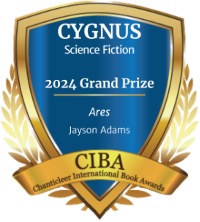
    Author of the 2024 Cygnus Grand Prize Winner Ares
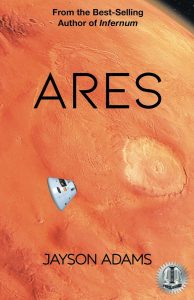
    Ares Cover

    Blue, Gold, Badge, CIBA

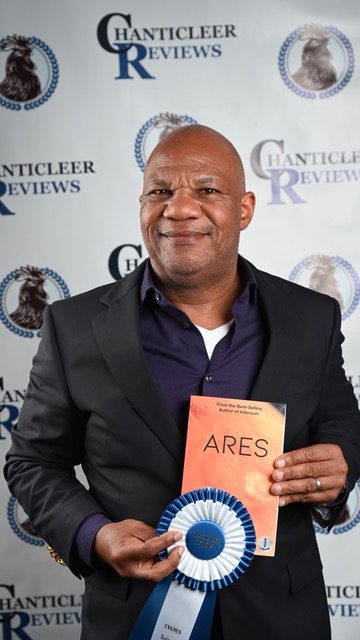
    Hello friends! We have another wonderful interview for you today, with author Jayson Adams! His book Ares took home the Chanticleer 2024 CIBA Grand Prize Award in the Cygnus Division, and we are excited to share with you the steps he took to becoming an award-winning author and what he’s planning next.

    Take a minute or two and get familiar with Jayson and his incredible journey to becoming award-winning author!
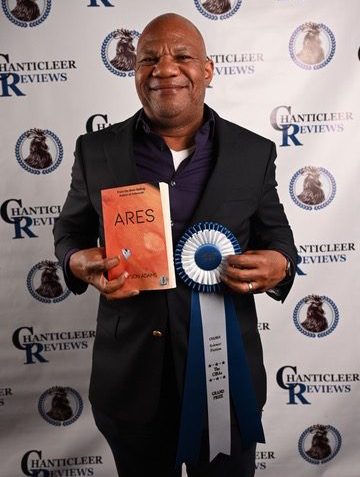
     

    man, ribbon, bald, blazer, book, ares, ciba, award

    Chanti: Jayson, let’s start with your background. Tell us a little about yourself—have you always dreamed of being a novelist, or did writing come into your life in a different way?

    Adams: I’ve been a science fiction fan since I was kid, but I had never really imagined myself writing novels. My passion leaned more toward computers. Even though they’re deeply technical, I saw the computer screen as a blank canvas—it was my creative outlet. I started several software companies and had the freedom to build whatever I could imagine.

    About ten years ago, I joined Google as an engineer on the Chrome browser. Over time, I grew frustrated with the division of labor in that space: product marketers decided what the product should do, designers decided how it would look and feel, and engineers were expected to bring it all to life—no questions asked. A few years in, I realized I needed a new creative outlet and turned to writing. I figured that with enough practice and a relentless drive to learn the craft, I could eventually become a decent writer.

    Chanti: We’ve definitely seen the shift from tech to writing frequently. That need for a creative outlet is undeniable. When it comes to the strengths you brought from your previous jobs to your new skills as a writer, can you talk about where you feel most confident and maybe offer some advice to anyone who struggles with that?

    Adams: Coming up with interesting plot twists. My advice to anyone who struggles in that area is the same lesson I find myself relearning from time to time: just write. When I get stuck wondering what should happen next, if I force myself to sit down and write what I do know, the ideas start to flow. And more often than not, they’re ideas I never would’ve discovered if I hadn’t put something on the page.

    Chanti: That’s such practical advice about pushing through the uncertainty! Your novel Ares has received incredible recognition. When did it really hit you that you’d become an author—not just someone who writes, but truly an author?

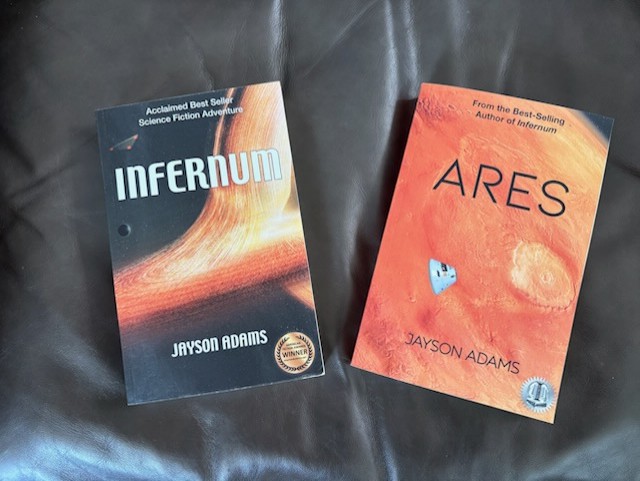
    Adams: It really sank in after I published my second novel, Ares. My first novel, Infernum, was well received, but who could say if that was just a fluke. With Ares earning similar acclaim, I can’t deny it anymore: I’m a writer.
    Man, blazer, bald, book

    Chanti: Two successful novels definitely prove it wasn’t beginner’s luck! You’ve established yourself firmly in science fiction. Is that where you plan to stay, or do you explore other genres as well?

    Adams: Broadly speaking, I write science fiction, but after publishing my second novel, I realized I’m straddling two sub-genres. Infernum is a space opera set a few hundred years in the future, while Ares is grounded sci-fi rooted in the near future. The tricky part is that fans of one don’t always enjoy the other. The novels I’m working on now lean toward grounded sci-fi, but I’ll likely return to space opera before long.

    Chanti: Managing reader expectations across subgenres is a challenge! When it comes to your writing approach, are you someone who follows established storytelling conventions, or do you prefer to break the rules and forge your own path?

    Adams: I follow the rules. They’re an unspoken set of agreements between author and reader that allow the reader to relax into a story. They signal what kind of world they’re entering, what matters, and what to expect. If I hand them something I’m calling a novel, they know it won’t fizzle out at 30,000 words. If I say it’s a mystery, they know there’ll be resolution. Following the rules doesn’t make you predicable, it makes you trustworthy.

    I once read The Hollow Man by Dan Simmons. The bulk of the book was the main character drifting from one random situation to the next. I kept waiting for a through line—some deeper meaning or connection to emerge. But all those events turned out to be filler, just killing time until the ending, which was probably the whole reason Simmons wrote the book. He broke the rule that says everything in the story should matter. When events don’t connect or build toward something, the reader feels tricked. I was so frustrated, I actually threw the book away.

    Chanti: That’s a compelling argument for honoring the reader contract! When you’re not crafting these intricate sci-fi worlds, how do you spend your time? What are your hobbies and interests outside of writing?

    Adams: Outside of reading, most of my time goes into writing software. I’m currently building out an app idea, though my long-term goal is to leave the tech world behind and focus entirely on writing. I’m also an artist and plan to return to life drawing, something I’ve missed.
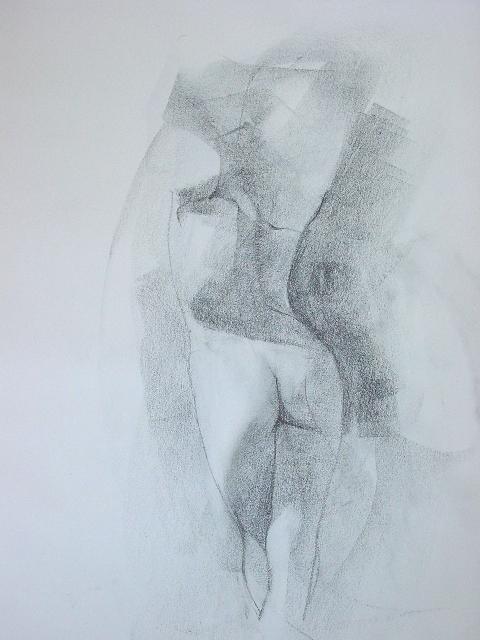
    Jayson Adams, figure drawing, pencil sketch
    Copyright © 2000 Jayson Adams. All rights reserved.

    Chanti: It sounds like creativity flows through everything you do! Writing is definitely a craft that requires constant learning. Which books on the craft of writing have been most helpful to you?

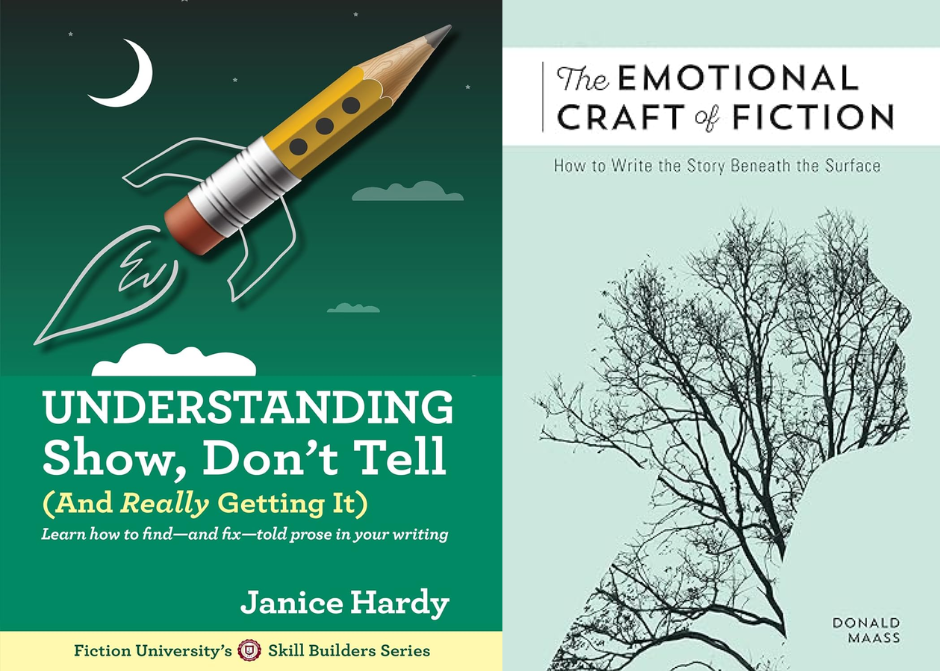
    Adams: Understanding Show, Don’t Tell, by Janice Hardy. Before I read this book, I had a general understanding of show vs. tell. This book was fantastic as far as explaining all the different ways telling can creep into a section of prose.

    I also love The Emotional Craft of Fiction by Donald Maass. Maass says that readers may not remember every plot point, but they’ll remember how a story made them feel. This is the power of emotionally resonant fiction. He does a great job of explaining how to tap into it on the page.
    Show don't tell, book, green, pencil

    Chanti: Both of those sound incredibly valuable! Marketing can be one of the trickiest aspects of being an author. What strategies have you found most effective for selling books and building your readership?

    Adams: A well-performing BookBub ad is incredibly valuable, but can be tricky to build. Ares has been out for awhile now, so Amazon lists about 100 other titles that readers also bought. I used ChatGPT to turn that list into a spreadsheet, with info like author, summary, and more, and then fed it back into ChatGPT to identify recurring themes and tropes that define an Ares reader.

    From there, I built ad copy around four tropes that resonated the most. I also had ChatGPT identify authors from that list whose work aligned with each trope. Then I created BookBub ads for each trope that targeted fans of the corresponding authors. That approach was far more effective than my earlier “try this headline” style of experimentation.

    Another thing I’ve explored is using negative reviews as a marketing tool—not to win over critics, but to help misaligned readers recognize the book may not be for them. I took screenshots of all my 1-, 2-, and 3-star reviews and fed them into ChatGPT, then asked it to gently distill the criticisms. (Screenshots let me avoid even glancing at what might be painful feedback, while still giving the AI everything it needed.) My goal was to add a line to the book description that would help readers who probably wouldn’t like the book self-select out.

    From that effort, I learned that many of Ares’s low-star reviews came from people who expected hard sci-fi and were disappointed to get something that leaned more toward mystery/thriller instead. ChatGPT crafted a short blurb that lets potential readers know that if they’re looking for hard sci-fi, Ares may not be the book for them.
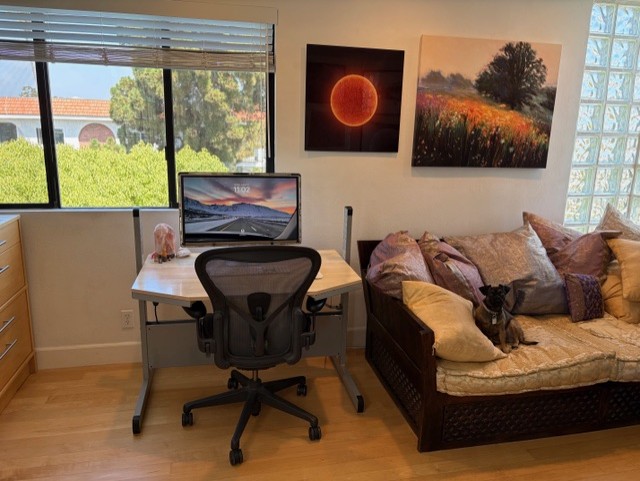
    Jayson Adams, office chair, office, desk, window, computer, couch

    Chanti: That’s a genius use of AI for market research! I’m going to have to try that out! Looking ahead, what projects are you working on now? What can your readers look forward to next?

    Adams: I started working on a sequel to Ares, called King of the Moon. It follows Commander Praviraj Anand and Lieutenant Jack Bremmer from the moonbase featured in that story. But along the way, I found myself pulled into a new, unrelated novel called The Quantum Mirror, which centers on a rescue mission to a decrepit Russian space station. I plan to finish both, though The Quantum Mirror will likely arrive first.
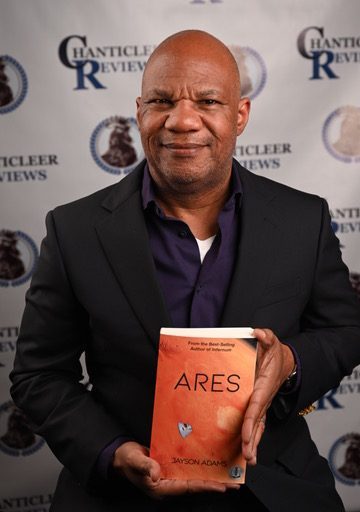
    jayson Adams, Ares, book, Chanticleer

    Chanti: We can’t wait for either of them! Ares was such a treat, and we can’t wait to read more! As we wrap this up, we’d love to end with some advice for readers: What’s the single most important thing a reader can do to support an author they enjoy?

    Adams: If they enjoy a book, please, please, PLEASE leave a rating for it wherever they bought it. As a reader, I always look at the average rating, the number of star ratings, and the release date (how long it took to earn those star ratings). That alone tells you so much about a book’s appeal. Ratings may seem like a small thing, but they make a huge difference.

    Thank you, Jayson, for sharing your writing journey with us and for creating thought-provoking, thrilling science fiction! 

    blazer, blue, shirt, bald, man


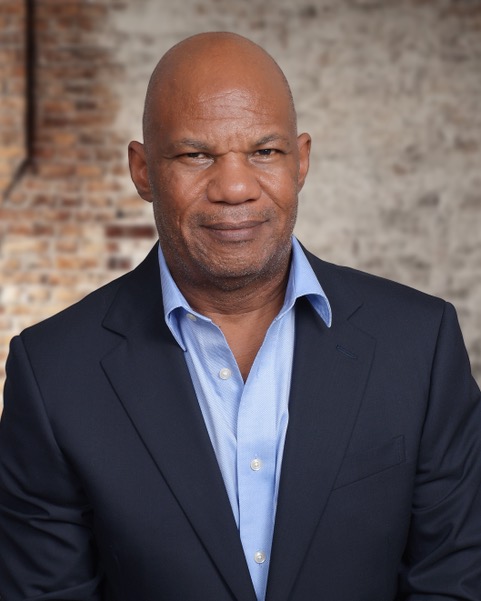
    Jayson Adams began his career as a tech entrepreneur, achieving his dream of starting a software company, which he did at the age of 24, and retiring by the age of 30. He has worked for notable figures like Steve Jobs and has founded several successful startups, including one sold to Netscape. After a successful career in technology, he transitioned to writing science fiction around 2018, finding a new creative outlet in storytelling.

    After traveling through Europe and taking up music, he returned to computers with another start-up. He is currently working on a sequel to his award-winning novel, Ares.
  • Chanticleer 10 Question Author Interview Series with Rae Knightly – Grand Prize Award-winning Author of Exostar

    CHANTICLEER 10 QUESTION AUTHOR INTERVIEW SERIES
    with Award-Winning Author, Rae Knightly

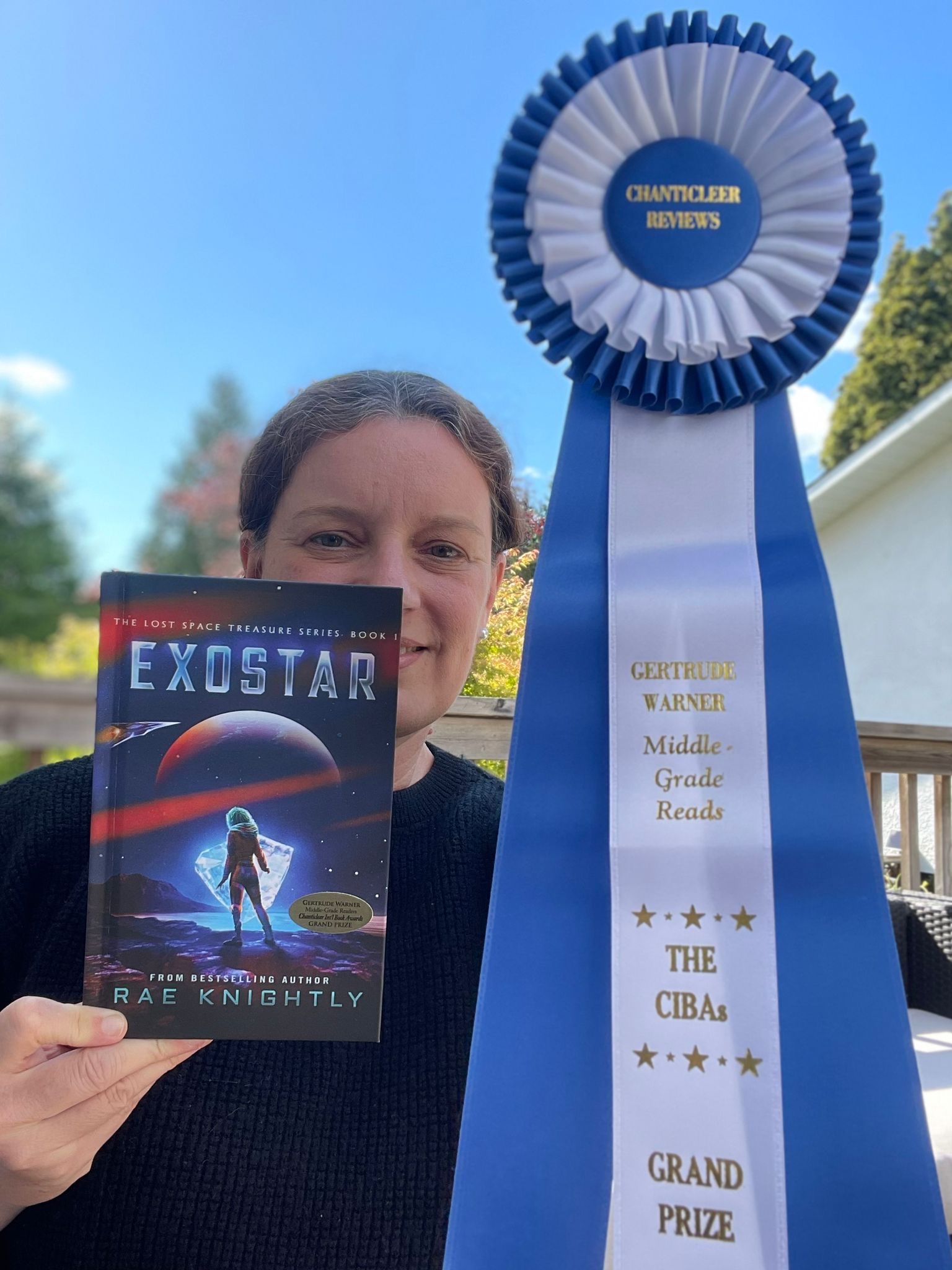
    Gertrude Warner 2023 GP Winner Exostar Rae Knightly

    Hello friends! We have another fabulous interview for you today, with author Rae Knightly! Her book Exostar took home the Chanticleer 2024 CIBA Grand Prize Award in the Gertrude Warner Division for Middle Grade Fiction, and we are excited to share with you the globe-trotting, star-gazing journey she took to becoming an author and what she’s planning next. Take a minute or two and get familiar with Rae and her incredible journey to becoming award-winning author!


    Chanti: Like all great heroes, we’d love to start with your origin story. Have you always considered yourself a writer, or was that an identity that developed over time?

    Rae Knightly, book, scarfKnightly: I was a reader before I became a writer. As a single child, I would devour books up until my teenage years. Fictional characters were my friends. I would go to my local library on Fridays after school, pick out three books (the maximum allowed) and read those until it was Friday again. The problem was that, after a while, I felt like I had gone through the middle-grade section. It was time for me to head downstairs to the adult section. Unfortunately, the switch proved too big of a step. I couldn’t find anything to my liking among the big boring-looking adult books. Where was the fantasy, science fiction and adventure section for my age? I guess “young adult” books weren’t a thing back then. So, instead, I turned to my imagination and carried on the stories I liked or created new ones in my mind.
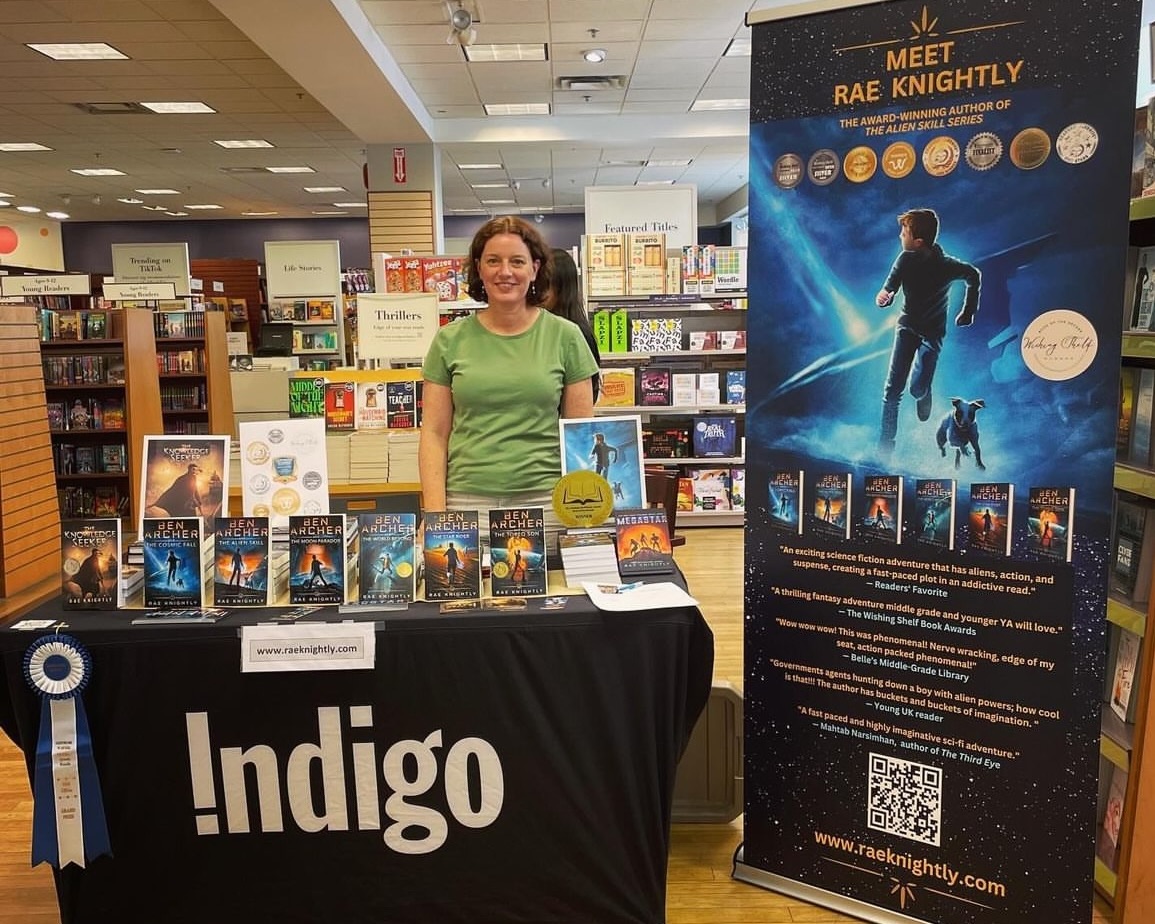
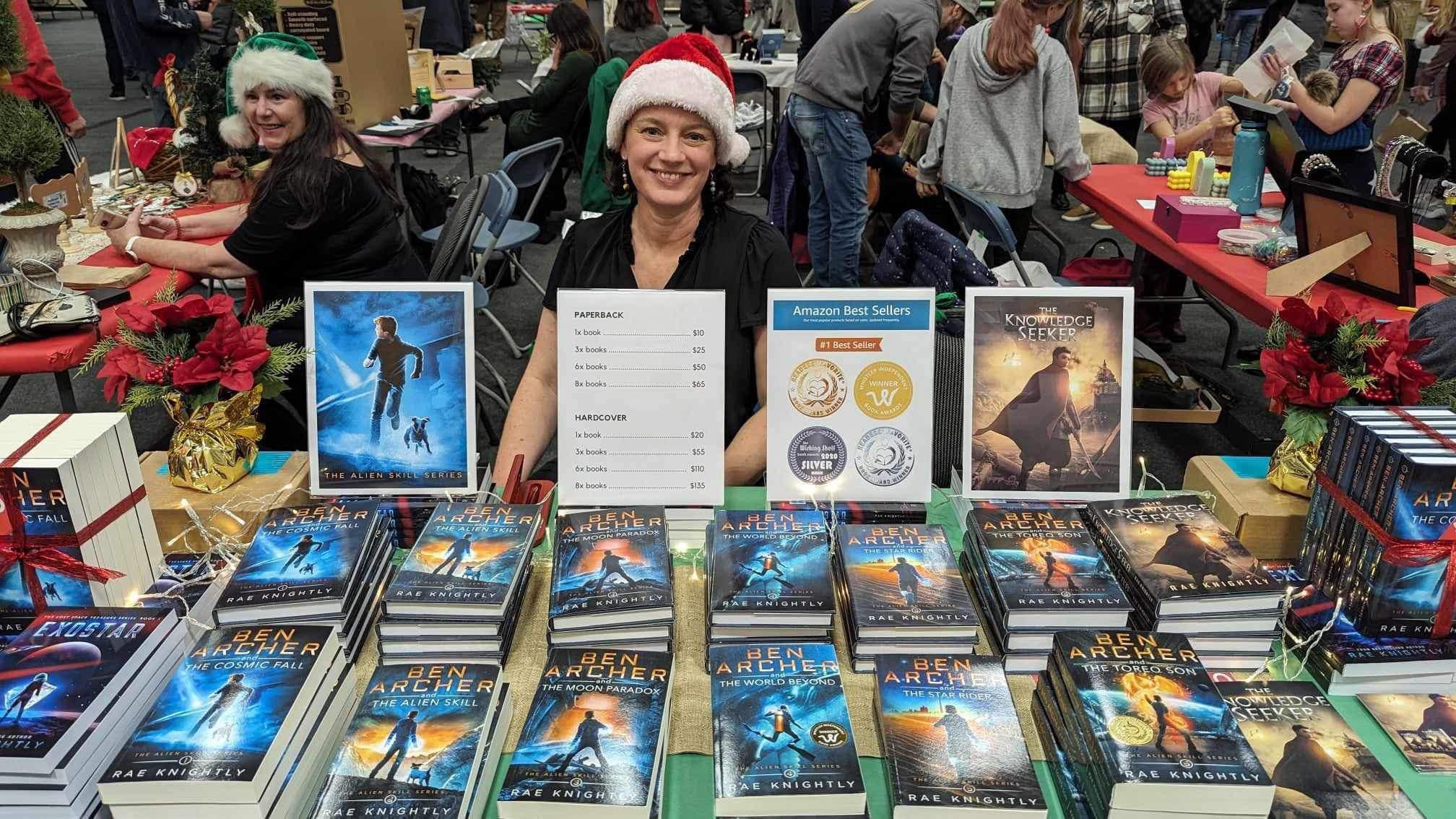
    It would be another thirty years before I got the chance to write these stories down. Once I had penned my first book, Ben Archer and the Cosmic Fall, I felt like a fish in water and knew that this was what I was born to do. You could say the books I am writing today strive to recreate the sense of wonder that I experienced as a middle-grade reader.

    Rae Knightly, bookstore, books, poster

    Chanti: What a beautiful way to describe it—recreating that sense of wonder! That really is the “write what you love” philosophy in action. What specifically inspires your science fiction storytelling?

    Knightly: I grew up in Africa where I became fascinated with the night sky. It made me ask profound questions: What is out there? Who are we? Why are we here? Are we alone in the Universe? Is there something beyond the Universe?

    Science fiction can be just as magical as fantasy and—in my mind—is even more so because this type of ‘magic’ might be real. Aliens might exist, we might settle on Mars one day, interstellar travel might be invented in the future, a young reader might invent clean energy when he/she grows up… I think it is vital in this day and age to inspire young people through science fiction because this could lead them to become compassionate scientists, inventors and politicians who will find answers to today’s challenges.

    I understand, though, that topics such as aliens, destructive inventions and climate change can be scary to young readers, so I strive to incorporate them in page-turning, thrilling adventures that are easier to absorb and understand. In this way, I hope to awaken a fascination for the marvels of our world and beyond—just as I was fascinated and inspired by the night skies as a child.

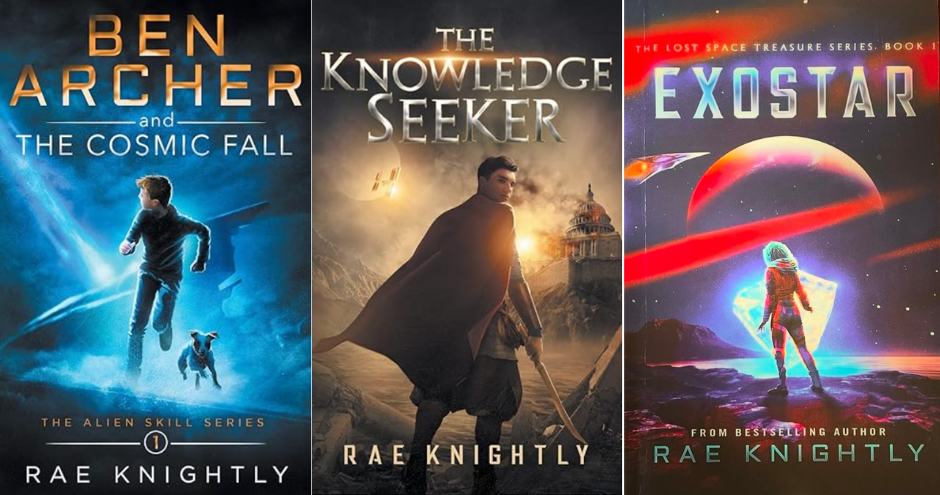
    I’m best known for the Ben Archer Series, which includes aliens, UFOs, superpowers and messages about how we treat our environment. My other series, The Lost Space Treasure, is a fun space opera in its purest form and appeals to fans of Star Wars. Exostar is book 1 in this series.

    Rae Knightly, books, awards, badges

    Chanti: That mission to inspire future scientists through storytelling is incredible! Do you find yourself following conventional writing rules, or do you prefer to chart your own course?

    Knightly: I highly doubt that I follow the rules. Middle-grade science fiction is not a common genre and I knew I was taking a big risk by writing it. But this was the genre I enjoyed above all as a child and I was disappointed when I couldn’t find more options to read. I also write from multiple points-of-view, which is not typical for middle-grade, and my main characters are loners. They don’t have a Hermione Granger or Ron Weasley tagging along.

    Adults play a huge role in my stories. This goes against the norm where middle-grade characters find themselves battling evil on their own, without adults around to help. Note that most middle-grade characters are orphans. Ben Archer is not one of them. In fact, the dad-figure in his adventures is a pretty big deal! As for Trin Moonrise in Exostar, she is a unique hero. Not only does she travel from one planet to another and encounter all kinds of alien civilizations, but she faces a hundred challenges while wearing a prosthetic leg.

    Rae KNightly, santa hat, books, people

    Chanti: Including adults and having more solo characters definitely pushes back against what we often seen in middle grade. When you’re not creating these amazing worlds and characters, how do you spend your time? What do you do to recharge and find inspiration?

    Knightly: I used to love exploring and got a lot of inspiration from visiting different places—especially ancient ones. I love reading about archeological and astronomical discoveries. The history of humankind fascinates me and I believe we still have a lot to discover when it comes to what our ancestors were capable of.

    I also love walking in nature and stopping every two minutes to take a picture of a leaf, a sunset, a landscape… I never make it very far because beautiful details are everywhere if you learn how to look. However, my walking and exploring days have been drastically reduced after I was diagnosed with a chronic illness called moderate ME/CFS. This mysterious illness has made it difficult for me to leave the house and I am currently spending most of my time learning how to manage symptoms.

    Fortunately, writing about superheroes has taught me what it means to be brave: it means that you have to stay true to yourself in the face of adversity. You can’t let the bad things that happen to you define you. I can still write and enjoy the company of my family. Also, my imagination allows me to travel way beyond the boundaries of Earth and I have explored many distant planets from the comforts of my sofa as I wait to get better.

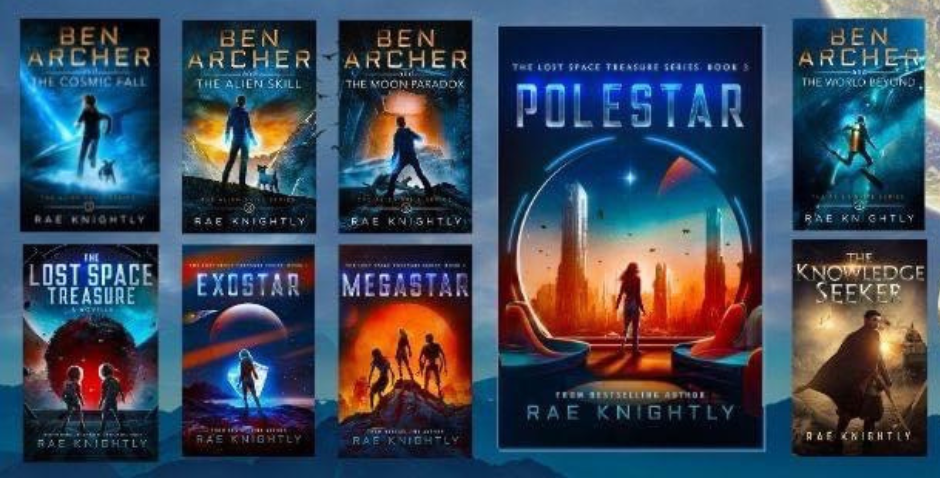
    book covers, science fiction, rae knightly, blue, gold, red, black

    Chanti: The kind of resilience definitely shows up in your book and storytelling. When it comes to creative process, where do you say your ideas for those stories come from?

    Knightly: I get most of my ideas from small newspaper articles. Ben Archer and the World Beyond pulled inspiration from different newspaper articles related to our oceans. Some years ago, Keith Davis—a marine biologist—mysteriously disappeared while out at sea. He was researching factory ships that empty the oceans of fish (tuna, in this case). Another article revealed that, in 2019, Russia released hundreds of beluga whales and orcas from an illegal whale jail located in Srednyaya Bay, where they were being trained or sold. Unfortunately, this type of news does not hit the headlines much.

    The Knowledge Seeker was inspired by a short newspaper article reporting that several countries had restricted access to the internet. It made me wonder how a small group of people could take away access to knowledge to millions of citizens. The plot of The Knowledge Seeker—which takes place in the distant future—took form based on these questions: should everyone have access to all information everywhere and all the time? And, if not, who should have the right to decide what should/shouldn’t be made available? The main character, Eodain, fights to return knowledge to the people, while his arch-nemesis wants to keep knowledge for himself because knowledge is power. But even Eodain struggles with the meaning of free knowledge when he is forced to provide instructions on how to build a deadly weapon.

    And, lastly, Exostar and its sequels dive into the wonders of science and the Universe. Could we travel between the stars using quantum mechanics? What color is the sky on other planets? What do aliens on other planets look like according to their environment, gravity, evolution, etc.? Do exploding stars (supernovas) provide the necessary elements to create life? When you have civilizations where robots, androids, ancient aliens, and mortal beings interact, what does it mean to be human?

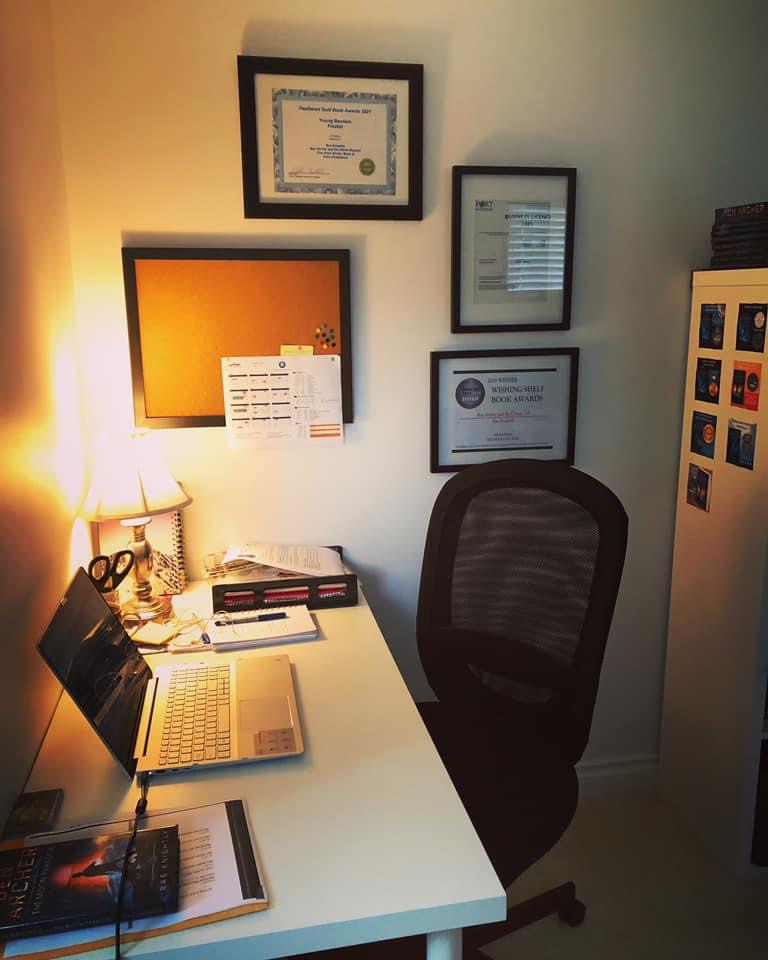
    office, chair, pictures, computer

    Chanti: Fascinating how you transform real-world issues into compelling science fiction! When it comes to your actual writing process, how organized are you? Do you plan everything out, or do you discover the story as you write?

    Knightly: By the time I sit down to write a new book, I have the full story well laid out in my head. It is very important to me to know the ending of a story and I will rarely start writing until I have figured that out. In fact, I often come up with the ending of a story first and then work my way backwards! This was crucial when I wrote The Knowledge Seeker, as the plot twist at the end had to blow the reader’s mind. The final sequel in the Exostar series will also have a mind-boggling ending.

    Since I have the plot all laid out, I am able to write a first draft in a short amount of time. I can write a 50,000 word book in five weeks. However, that’s when the hard work starts. This is when I go over the manuscript multiple times, one sentence at a time, one paragraph at a time, and back-and-forth and back-and-forth with the help of my editor, Cristy Watson. I also seek advice from beta readers who follow my work, know the characters and can point out errors in the manuscript. I will do seven or eight complete edits of the story before I’m satisfied, and this can take several months.

    book covers, science fiction

    Chanti: Working backwards from the ending makes a lot of sense! Can you talk a little bit about some of your literary influences, and how have they shaped your work?

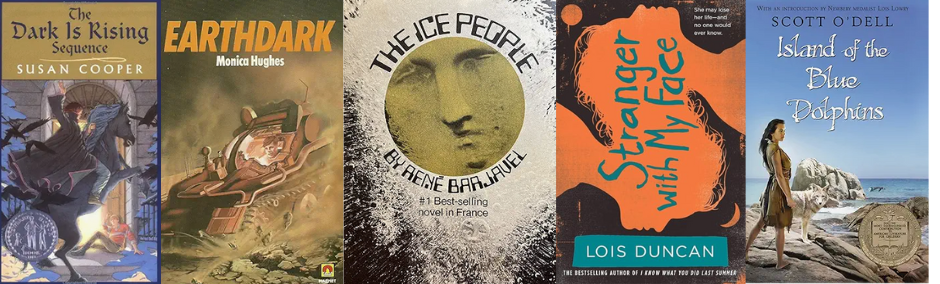
    Knightly: The Dark is Rising Trilogy by Susan Cooper opened my eyes to the power of imagination. Why? Because this Arthurian fantasy story took place in the real world and made me want to find ‘magic’ everywhere. It made me wonder if ‘magic’ was just around the corner, or hiding in the mist, or lost deep under the ocean. I love fantasy and science fiction stories that take place in the real world because they make the reader wonder, “What of this were true?” I sought to recreate this sense of ‘magic in the real world’ in my Ben Archer books.

    Monica Hughes was my go-to author while growing up. She wrote thrilling middle-grade science fiction like Earthdark, Space Trap or Ring-Rise, Ring-Set. The stories are exciting and ask interesting questions. They inspired me to write Exostar.

    The Ice People by French author Rene Barjavel is one of those books that stays with you long after you’ve finished it. It leaves you with the question: if humans have been around for tens of thousands of years, would it be possible that they developed advanced civilizations that are now lost and buried under the Arctic ice, under the dunes of the Sahara desert or in the deep trenches of the ocean? This fascinating question also lingers in the back of the Ben Archer and Lost Space Treasure Series.

    Lois Duncan’s Stranger with my Face is another of those stories that takes place in the real world but has elements of mystery in it. The characters in the author’s books face haunting topics such as telepathy, astral projection, spirit channeling, eternal life, etc. These themes make you wonder about the limits of the human mind and elements of this have seeped into Exostar and its sequels.

    Island of the Blue Dolphins by Scott O’Dell was a heart-shattering story that stayed with me for years. However hard the story, I believe that tough subjects in middle-grade books can teach young readers to better face real-life hardships as adults. For example, learning to deal with a fictional death might prepare readers to deal with it a little better in the real world. I channeled some of those raw, heart aching feelings in Ben Archer and the Alien Skill.

    Chanti: That is a rich tapestry of influences! With such a creative imagination constantly at work, do you ever hit those dreaded writer’s block moments?

    Knightly: Yes, I experience writer’s block. I guess it’s the bane of every author’s existence.

    However, I no longer shy from this debilitating fear of the blank page. I find that if I am unable to write, it usually means that my brain is saturated and I need to take a break. This break can last from a couple of days to several months, but I have learned to trust the process. Once an author, always an author, is my motto! Imagination never really leaves you. Creativity can come and go, like the ebb and flow of waves crashing on a beach, and if my characters are not talking to me, then perhaps it’s time to do something else for a while.

    Rae Knightly, CIBA winner, ribbon, exostar, book

    Chanti: That’s such a healthy perspective on the creative process! You’ve achieved remarkable success with your award-winning books. What marketing advice can you share with other authors?

    Knightly: The things that have helped sell over 120,000 books:

    • Paying for great, on-target book covers
    • Knowing who my readers are (10 to 14 year olds)
    • Always delivering as promised in a regular, timely manner
    • Learning to run Amazon ads
    • Creating clean, fun adventure stories that captivate readers
    • Joining joint book promotions and doing newsletter swaps
    • Creating excitement for the next book on social media
    • Putting up the next book for pre-order and adding links in the back-matter

    rae knightly, books, cover, science fiction

    Chanti: All fantastic, practical advice! As we wrap up, what exciting projects are you working on now? What can your devoted readers look forward to next?

    Knightly: The Lost Space Treasure Series continues. After writing book 1, Exostar, I published books 2 and 3: Megastar and Polestar. I am currently editing book 4: Grimstar.

    Trin Moonrise travels the stars in search of her identity which might be hidden on a legendary spaceship thought to hold the greatest treasure in the known galaxy. However, her arch-nemesis, the evil Remnant Supreme Leader, is always one step behind.

    Next, I plan on delving deeper into my young adult dystopian series, The Knowledge Seeker, and my readers have let me know that they would love to read more Ben Archer books.

    Even though middle-grade science fiction is less popular, I hope to continue exploring the genre for many years to come.

    Thank you, Rae Knightly, for sharing your writing journey with us and for bringing great young adult sci-fi to readers around the world! 


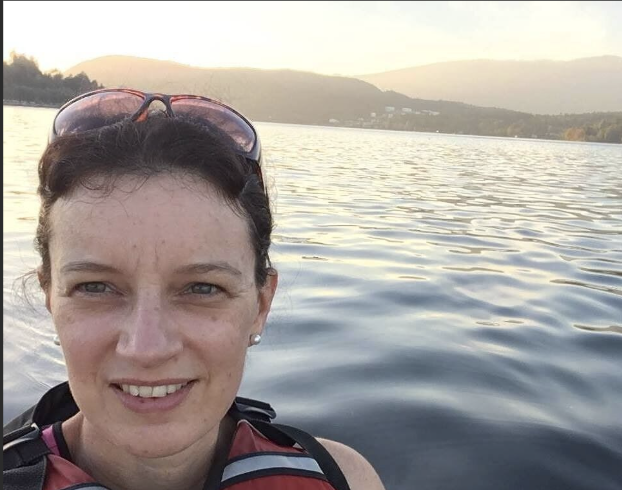
    Rae Knightly, water, woman, mountains

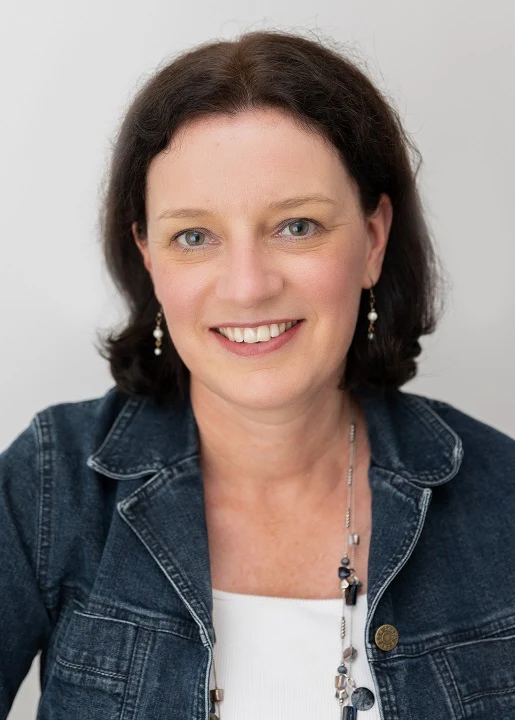
    Rae Knightly is an award-winning and Amazon bestselling author specializing in middle-grade and young adult fiction, with over 160,000 books distributed. She is the author of The Alien Skill SeriesThe Lost Space Treasure Series, and The Knowledge Seeker. Knightly was raised in various locations on Earth, during which time she picked up four languages and came to appreciate this blue pebble floating in the confines of space. Her current human mission is to keep the stars shining in her two children’s eyes, while hopefully igniting new ones within others across the globe. Rae spends her time spirit travelling to distant galaxies or exploring the breathtaking landscapes of British Columbia, Canada, before returning with more adventures for her Alien Skill Series.

  • A Chanticleer 10-Question Author Interview with Gail Avery Halverson – Historical Fiction, Colonial America, Slavery

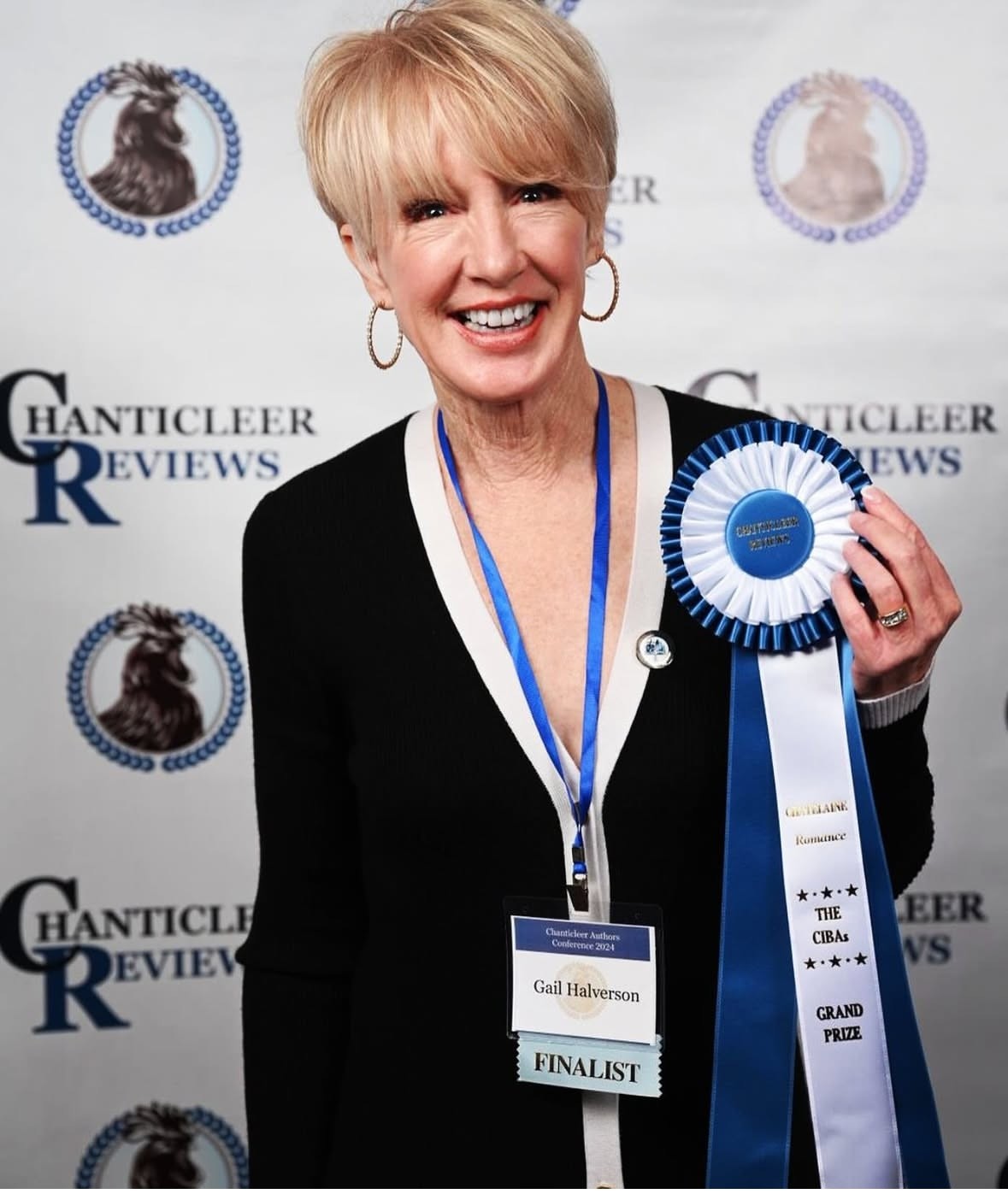
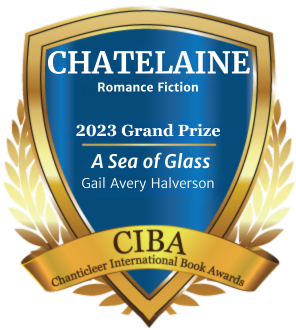
    blue and gold badge recognizing A Sea of Glass by Gail Avery Halverson for winning the 2023 Chatelaine Grand Prize For Historical Fiction RomanceHistorical Fiction Romance Author Gail Avery Halverson sat down for a 10-Question Interview with Chanticleer!

    We had the pleasure of speaking with Gail Avery Halverson recently. The author of the historical fiction romance novel Sea of Glass, Book Three in her Stockbridge Series. Avery Halverson took home the 2023 Chatelaine Grand Prize for Romance for Sea of Glass, and she’s sharing her journey to becoming an award-winning author with us today!

    Here’s what we talked about:


    Chanti: Your romance novel, Sea of Glass, also falls under the category of historical fiction. Can you talk about what drew you to both of these genres?

    Avery Halverson: I began writing in my twenties when I was a flight attendant and had a lot of days off during any given month. At first, I wrote mostly spec scripts for existing half-hour sitcoms to practice the craft of conveying a story through only what can be seen or heard. One of those spec scripts found its way to an agent in LA and after signing with her, I wrote two movie screenplays which were both optioned by Longbow Productions, but not made.

    I took some time away from writing to raise my son, and when he was a sophomore in high school, I began to toy with the idea of writing a novel. When I heard the story of ‘The Plague Village” in England, I knew I had my novel. From there, I had to learn a new style of writing that encompassed all the senses, in addition to creating accurate historical story arcs and believable, very real characters a reader would care about. After writing the first book, I was completely hooked!

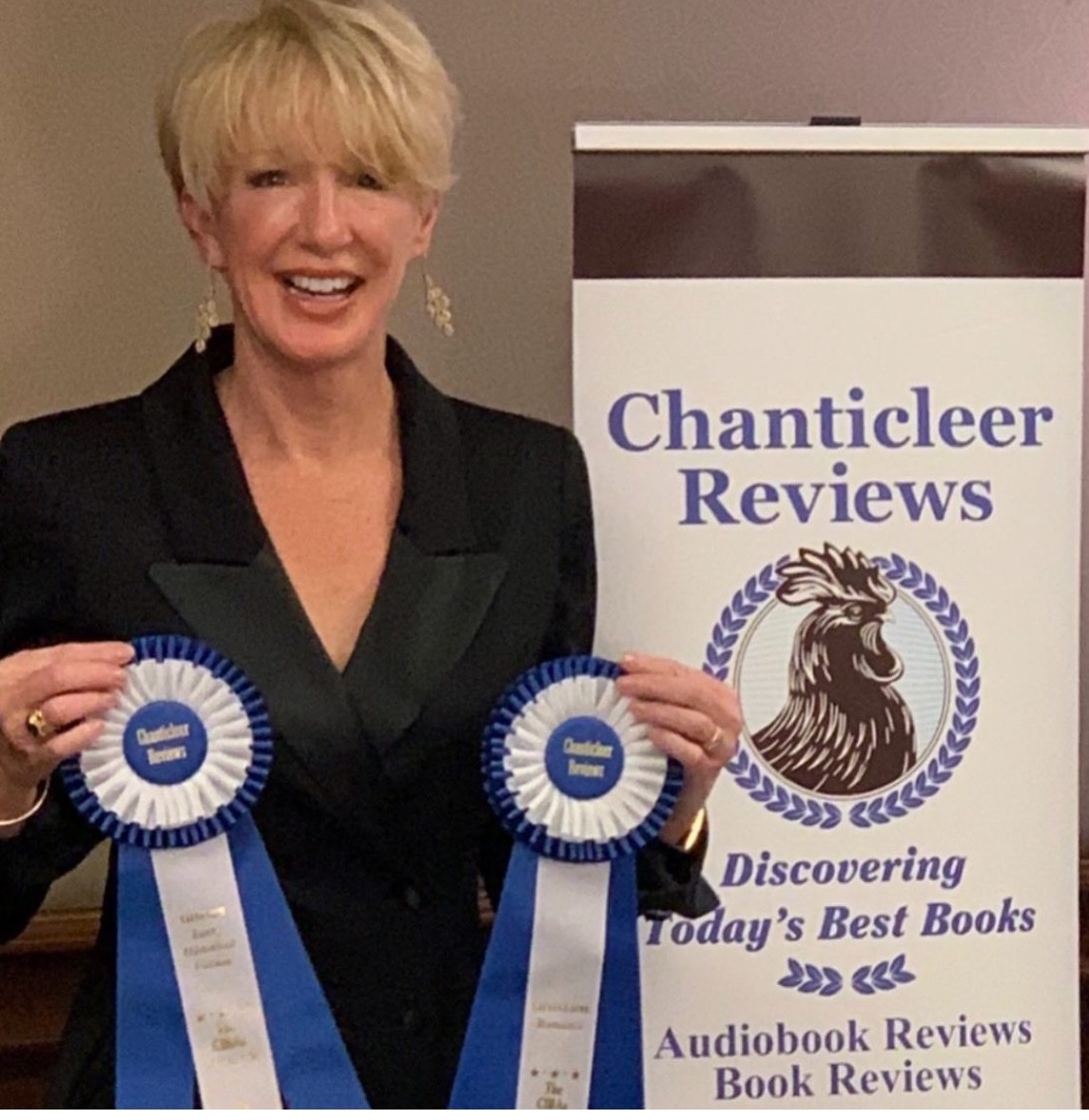
    Chanticleer Book Reviews, CIBAs, woman, blonde, ribbons

    Chanti: Have you always been a writer? When did you realize you could write?

    Avery Halverson: There were several points along the way, and while I can’t say that any one of them were really a defining moment, when I was in third grade, I wrote a story about a little girl that had gone through the 1906 San Francisco earthquake. I knew in my heart the minute I finished the assignment that it was an A+ story. It turned out that the grade was exactly that, and when the teacher handed my story back, she told me that I had a real talent.

    The other defining writing moments were those early screenplay options; when I read the reviews of the first book; when I won the Chanticleer awards for all three books; and when a London agent at the agency representing Julian Fellows said I was very talented (sadly, due to a personal emergency, she was not taking on new writers). Although as all writers know, the most exciting, validating, and I think, thrilling “writer” moment, was the moment when I opened that first box of books with my name on the cover.

    Chanti: I can tell you have a good eye for accurate period details in your books. What draws you to write historical fiction?

    Avery Halverson: As I mentioned, the first fictional story I ever wrote was about a little girl going through the 1906 San Francisco earthquake, and as I think of it, that may be where my love of writing historical fiction began. Funnily enough, I don’t particularly read historical fiction – my tastes run more toward action – Ken Follet, Clive Cussler and the like, but I find I absolutely love the research involved in writing historical fiction. If I were to refine if further, I love using fictional characters to bring to light actual women in history who did not get the recognition they deserved for accomplishing some amazing things.

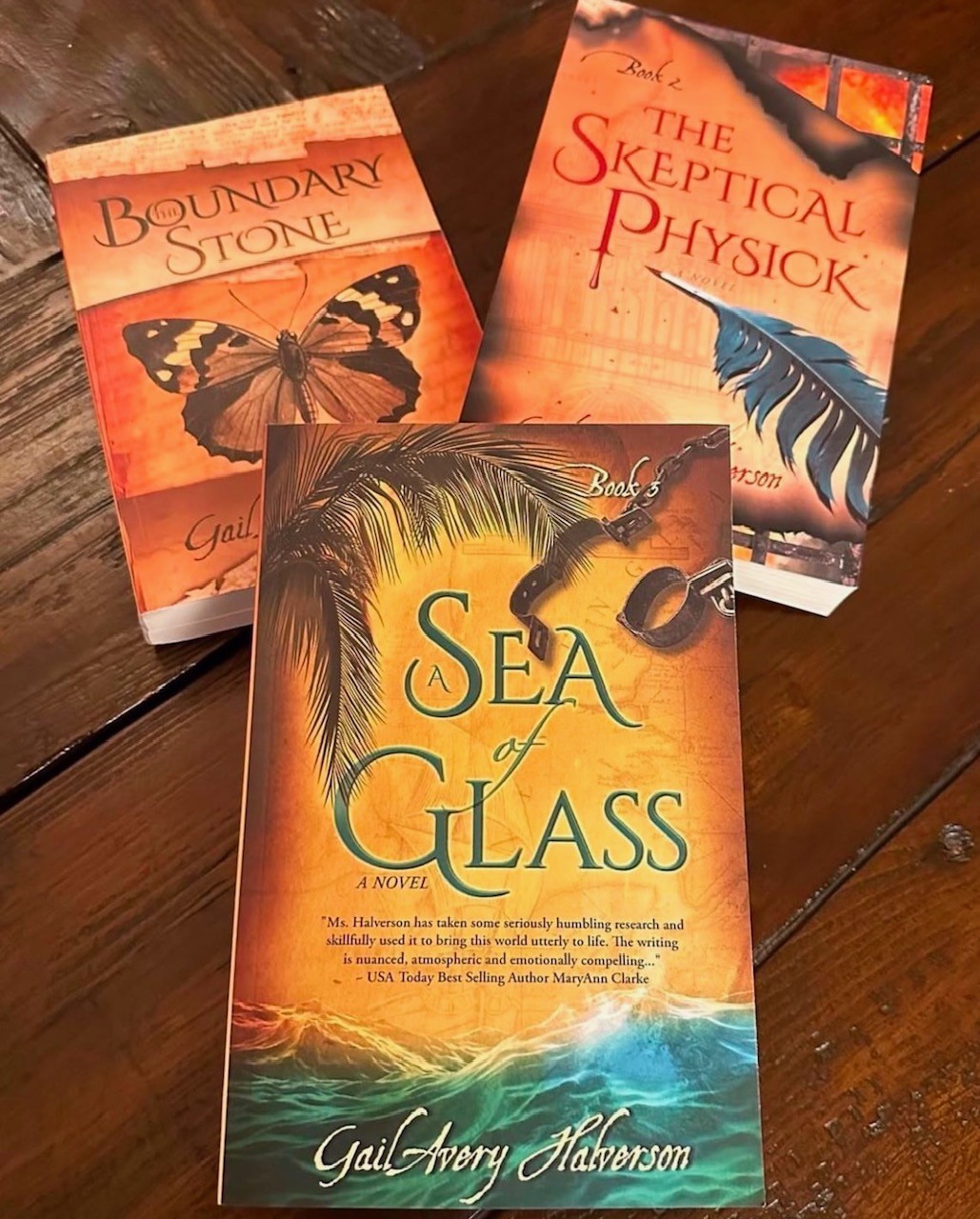
    books, covers, wood, planks

    Chanti: What areas in writing am I most confident about in writing?

    Avery Halverson: I feel very confident in two areas of the writing process. The first is story arc, and the second is dialogue. As to the former, I’ll insert another Chanticleer author question here – which is, which craft book(s) have helped the most. The answer to that question is the book How to Write a Screenplay in 30 Days by Viki King. She wrote the book many years ago, and while it was intended for screenplays, the information also applies beautifully to novels, as well. In the book, Ms. King describes a story arc as a clothesline, with clothespins evenly spaced. The clothespins are plot points, and the corresponding visual reference in her book made perfect sense to me, in that each book has a story arc, each chapter has a story arc, and each character has a story arc. In the case of my Stockbridge trilogy, I had to create an all-encompassing, three book story arc, as well, and I find the construction of all that fascinating. As to dialogue, I can only credit being a bit of a natural mimic – and many, many years of flying, listening carefully to not only a multitude of accents, but the vocabulary and word choices, the cadence, tone and even underlying sub-text of the conversations I heard from passengers.

    With respect to my books, I did a tremendous amount of research into the letters and formal writings of people in the 1600’s, not only in England but in early America as well and had to interpret that formality so that it captured the essence of what was being said, but did not sound as stilted as it did while reading the material. I also had to consider which social class a character belonged to and the way each group spoke, as well as in the case of Book Three, A Sea of Glass, the way a young, African American woman born in America, might have spoken. So, in terms of advice to a new writer, I would say eavesdrop all you can, then read your dialogue out loud after you’ve written it. Every single person on this planet has a different way of speaking – young vs. old, male vs. female, etc., and I’m always amazed when dialogue sounds stilted. People rarely, if ever, speak in grammatically correct sentences. Also, to a new writer, use the “find” button on your computer and try your very best to eliminate every single “ly’ adverb. Create a new way to say it – your writing will be clearer and far more concise.

    Chanti: Those are wonderful tips for writers getting started, and great advice for editing. Can you talk about what happens when you stall (if you do), with writer’s block?

    Avery Halverson: On occasion, I’ll run up against a brick wall where nothing comes to mind. When that happens, I usually dig deeper into history – nothing made up could ever top some of the things that actually happened. At one point in The Skeptical Physick, I needed a side character with a talent, which could then be something my heroine could learn. At that time, the Great Fire had just decimated nearly all of London, and my heroine had natural artistic talent, so I searched the history books and found Lady Elizabeth Wilbraham, a real-life 17th Century architect. Perfect. Lady Wilbraham and her story became that side character. I also try to read a few chapters leading up to wherever I am to get in the flow and that will usually get me started again. I also find that doing something else away from the computer – laundry, gardening, errands, or even soaking in the bath – allows my mind to wander and the creativity or solution to the current writing puzzle usually comes.

    Garden, flowers, house, blue door, terra cotta, pink, white, red

    Chanti: Taking time away from the screen can be one of the most valuable tools for moving forward. Would you talk a little bit about your writing “comfort zone?” Are you a structured writer, or do you write when the moment feels right?

    Avery Halverson: When I started writing my novels, I was very disciplined. At first, I tried every desk and office area in my house, but finally ended up sitting on the couch, feet up on the coffee table in front of the fire. I would start at 9am sharp and write until noon. If I hadn’t written 1500 words, I’d began again at 3:00pm, then continue until I hit that number. With that structure, I finished my first book, The Boundary Stone in six months.

    I confess that I relaxed a bit on the next two books in the trilogy. I still tried to meet that 1500 word a day goal, but if a natural break point came and I’d only written 750 words, I would not panic, but I would spend the other hours editing or researching. I had a lot more fun that way, rather than forcing myself to reach a hard goal. Interestingly, I found that on most days, I would still exceed that 1500-word goal.

    Chanti: 1500 words a day is impressive! What excites you most about writing to keep that drive?

    Avery Halverson: What excites me most about writing are those two magical words, “The End.” I absolutely love accomplishing a goal I’ve set for myself, and I don’t think there’s a more exciting moment than finishing a novel. I also love those writing days when the words just seem to flow out, and the days when I don’t even look at the word count until I close the computer for the night and find I’ve written far more than I thought I had. I love writing a great scene, or even a great sentence, and I especially love the research into and writing about the extraordinary accomplishments of ordinary people long forgotten by history – especially women.

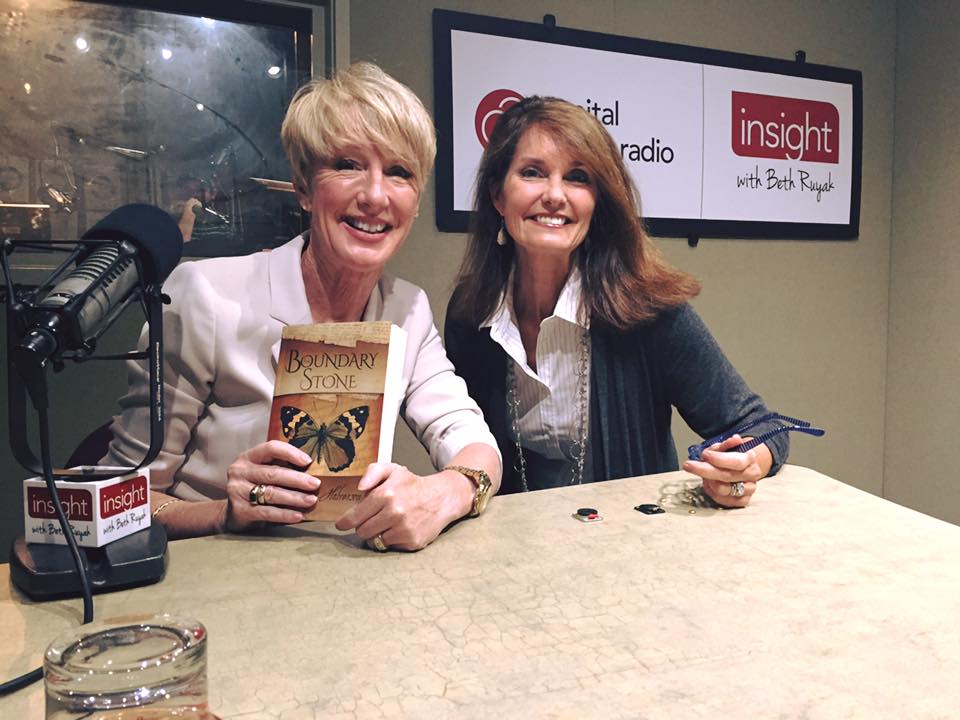
    two women, studio, book, cover design, blonde, brunette, blazer, white jacket

    Chanti: Your love of extraordinary people is clear in your intriguing cast of characters, absolutely! Who is the perfect reader for those forgotten stories of brilliant women?

    Avery Halverson: I think anyone who likes historical fiction with strong, intelligent characters and a touch of elegant romance. I’m not one for stories where someone deliberately makes a bad decision and ruins the lives of everyone else around them. I much prefer to write the stories of good people who are thrust into circumstances beyond their control and how they use their intelligence, their wits and their integrity to survive. It’s funny, I thought the trilogy would appeal to mostly women, but some of the best reviews I’ve had have been from men, so I hesitate to limit the category of readers.

    Chanti: I believe there are a lot of men who love romantic adventures! How do you come up with ideas?

    Avery Halverson: I read everything! I’ll read everything from the National Enquirer to Neuroscience News and anything in between, but my favorite thing to do is to go down Google rabbit holes. I’ll start with Wikipedia for a general introduction to historical figure or event, then start to dig from there, and in that digging I very often find the story.

    Gail AVery Halverson, bookstore, bench, coat, purse

    Chanti: Reading deeply is definitely crucial! What about for readers? What is the most important thing they can do to support an author who they want to read more of?

    Avery Halverson: I’ve found that the most important things a reader can do to help an author is to post reviews on Amazon, Goodreads and other reader sites, to create social media posts about the books, and to generate interest via word of mouth and any other promotional ideas they can think of, and an especially helpful thing is to invite an author to their book clubs. All authors are tremendously grateful to any reader offering to help promote their books!


    blonde, woman, teeth, window, headshot, block, make up

    Award-winning writer, Gail Avery Halverson, is the author of The Boundary Stone, and its sequel, The Skeptical Physick, a historical romance novel set in 1666 England at the time of the Great Fire and the Scientific Revolution. The Boundary Stone is a Chaucer Award First Place winner (historical fiction) and The Skeptical Physick won First Place in the Chaucer Awards and 2019 Grand Prize in the Chatelaine Award. Sea of Glass was awarded Grand Prize in the Chatelaine Award in 2023. 

    Ms. Halverson is also the writer/producer for “Take it From The Top,” (sitcom pilot, Twin One Productions, Inc.), as well as the playwright and composer of musical plays that have been performed for nearly 300,000 children since 2004. Writing for both theater and television, she holds a B.A. in English Literature/Communications from the University of California, Davis, and is currently at work on the third novel in the Stockbridge Series. She lives in Northern California with her husband and son.

  • 10 Question Author Interview with DESTINY ALLISON – 2016 Grand Prize Winner for JOURNEY AWARDS

    10 Question Author Interview with DESTINY ALLISON – 2016 Grand Prize Winner for JOURNEY AWARDS

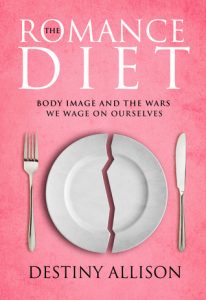
    Destiny Allison writes narrative non-fiction/memoir, and she writes it in a no-holds-barred fashion that captures audiences across the globe. The Romance Diet: Body Image and the Wars We Wage On Ourselves was our pick for Grand Prize in the 2016 Journey Awards.

    Join us in discovering what drives Destiny Allison.

    Chanticleer: Tell us a little about yourself: How did you start writing?

    Allison: I started writing at a very young age. My father was an aspiring writer and I wanted to be like him. I published my first poems when I was nine.

    Chanticleer: Nine-years old? Wow! That is so exciting – Congratulations! When did you realize you that you were an author?

    Allison: The day I released my first book, Shaping Destiny. There’s a big difference between being a writer and being an author. When you become an author, you can change people’s lives.
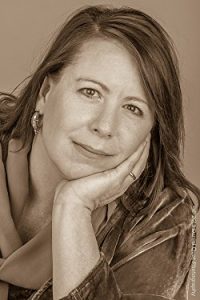
    Chanti: Well said, Destiny. Thank you for that. What do you do when you’re not writing? Tells us a little about your hobbies.

    Allison: I love to hike with my dog and I love to kayak, which is difficult because I live in the desert. Finding water is a constant adventure and a joy. I also own and operate several businesses. I think I was a social entrepreneur before the term was coined.

    Chanti: You’re ahead of your time! How do you come up with your ideas for a story?

    Allison: Most often, they come to me, as long as I’m writing regularly. When I try to force an idea, the writing typically isn’t good.

    Chanti: Speaking of writing regularly, how do you approach your writing day?

    Allison: With anticipation. I’m very disciplined when working on a project and I like to start early in the morning. I have to write at least 500 words every day, but usually, by the time I do, I have the inspiration for a couple of thousand.
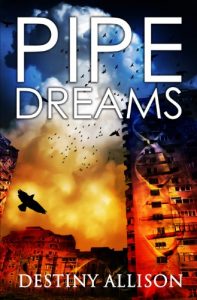
    Chanti: What areas of your writing are you most confident in? What advice would you give someone who is struggling in that area?

    Allison: Memoir is my greatest strength. My advice to other memoir authors is simple. Be brutally honest, but don’t feel like you have to provide every detail. Lay bare the bones of your story – know why you’re telling it and what message you hope your readers will take from it – then concentrate on the details that craft that message. Be lush with your imagery, authentic with your dialogue, and borrow from fiction. Your aunt may have been wearing a green hat that day but giving her a red one might flesh out her character and add pop to your story. It’s important to work on your craft. What do you do to grow your author chops? Read, write, repeat.

    Chanti: What do you do in your community to improve/promote literacy?

    Allison: I sponsor readings, support my local library, and help local authors sell their books.

    Chanti: That is so important – Thank you! Give us your best marketing tips, what’s worked to sell more books, gain notoriety, and expand your literary footprint.

    Allison: While we all love to see our work in bookstores, I’ve found that marketing outside the mainstream is more effective. I sell The Romance Diet in a local boutique and it does really well there because the subject matter is so close the hearts of that store’s customers. Knowing you market matters most when promoting your book.

    Chanti: Very smart! What is the most important thing a reader can do for an author?

    Allison: The most important thing a reader can do for an author is to leave a review. The next best thing is telling friends about the books they love and giving those books as gifts. Loaning a book is great, but gifting a book is better. Authors need to eat, too.

    Chanti: Destiny Allison is also a sculptor and works in steel. Here is a quote from her blog:

    Steel is exciting to me as a medium because it can have an exceptional softness in the final finish. I achieve a combination of organic forms and geometric shapes through the use of my MIG welder and plasma cutter. I create my colors by applying acid patina and heat to the raw metal, after the form has been completed. The combination of techniques allows me the freedom to explore relationships between emotional and intellectual responses to experience.

    Reminds me of the editing process…Chanticleer

    Thank you, Destiny Allison, for being a part of the Chanticleer Author Interview series! 

    Now, readers, you know what to do:

    • Like & follow Destiny’s Facebook Page
    • Check out her books on her Amazon.com author page
    • Read her book and, you guessed it, write those reviews!

    Here are Destiny’s other book links:

    Pipe Dreams  and Bitter Root