Five Reasons to Make Your Book Available in the Audiobook Format, Article # 1 in the 411 Series
1. Audiobooks are a great way to fit in more time for books in our busy lives!
Audiobooks = Hands-Free “Reading”
Listen to your favorite authors’ works while you:
Drive
Commute
Do laundry
Make dinner
Take a walk
Garden
Rake leaves
Sail
Knit
Pet your cat (although Bruno, the Cat-in-Chief, requires one’s full attention)
Walk the dog
Paint your walls or just about anything
Pretend to nap
Clean the house, fill the dishwasher
Your eyes can be open or closed. Your hands can be busy (not just holding a book or flipping pages) or not.
Hands-Free “Reading” with Audiobooks
2. The Oral Tradition of Listening to Stories and the Spoken Language
There is also the age-old appeal of listening to stories. We all have memories of listening to stories from our favorite auntie or uncle, or around the proverbial campfire, or our favorite radio shows (such as Lake Woebegone by Garrison Keilor or Car Talk by Click and Clack and the Tappet Brothers, the commentary from your favorite DJ, or rekindle your love of having stories read to you or (like me) experience it for the first time.
3. Increase and Develop Vocabulary and Spoken Syntax
Listening to correctly spoken, grammatically correct language is the best way to improve our language skills—whether it is learning a new language or accent or improving one’s first language skills.
4. Hone Listening Skills and Critical Thinking Skills
The brain has to process information at the pace that the audiobook is played which gives the listener the time create and process imagery, create versions of characters, and scenes in stories – fiction and non-fiction. Keep in mind that a listener may slow down or speed up the recording.
One has to listen carefully when there are no visual cues to rely on therefore increasing retention.
5. The Growth of Audiobooks is Correlated with the Increase of Use of Voice Assistants: “Hey Siri” (Apple), “Ok Google” (Google), “Alexa” (Amazon), “Cortana” (Microsoft), etc.
Voice assistants make the transition into audiobooks easy.
Audiobooks & Voice AssistantsVoice Assistants and Audiobooks
Having natural conversations with the AI and technology in our lives is becoming a normal expectation. This has opened up new areas for content. fiction and non-fiction. The “voice first” revolution reaches new audiences while leveraging a once-in-a-century opportunity to pioneer innovative forms of content delivery and a new opportunity to monetize your content.
Did you know that Google now sells audiobooks? Those with an Android device can ask “Ok Google” to play an audiobook from your GooglePlay Library. You can ask basic questions, give the assistant a time limit for playing the recording (great for scheduling), and play it over your home speaker system if you would like.
In Conclusion – The Publishing Industry’s Digital Audiobook Revenue Is Up 32.1 percent in 2018.
According to this Forbes article, “Audiobooks now earn publishers more than mass market paperbacks—even as ebook sales fell 3.2% in 2018’s first quarter.
In this article, “…Audiobooks increased their market share by 32.1% and accounted for $98.8 million in sales in the first quarter of 2018.”
Audiobooks are the fastest growing area of publishing and have opened up vast new opportunities for publishers (and authors) to monetize their content.
Chanticleer Reviews and Technology – a love affair
From the inception of Chanticleer Reviews, technology has been our “under-the-hood” superpower under the direction of Argus Brown, CEO of Chanticleer Reviews, and uber computer geek.
Chanticleer Reviews has always focused on increasing the positive digital footprint of authors and publishers in today’s (and tomorrow’s) age of unbounded publishing.
You can learn more about how we do this for our clients here.
Kiffer Brown has just returned from the Digital Book World annual conference held in Nashville, Tennessee where she was asked to moderate two technology panels:
Artificial Intelligence and Machine Learning in Content Production
Best Practices in Creation and Distribution of Audiobooks
We do! And our first audio reviews will be posted soon! The reviews will also be available in brief audio versions–for busy people. Links to the audiobook review and podcast will be listed with each Chanticleer Review and also on the Chanticleer Reviews podcast channel.
Our reviews of audiobooks will also be available with the Chanticleer Reviews Video-blogs channel that will be available on YouTube, Instagram TV, Amazon channels, and other apps.
Next in the Chanticleer Audiobooks series:
How to go about creating an audiobook – best practices.
EMAILS – How to improve your “Open Rate” of Your Email Campaigns and E-newsletters that use MailChimp, Constant Contact, or Customer Relations Management software systems (CRM).
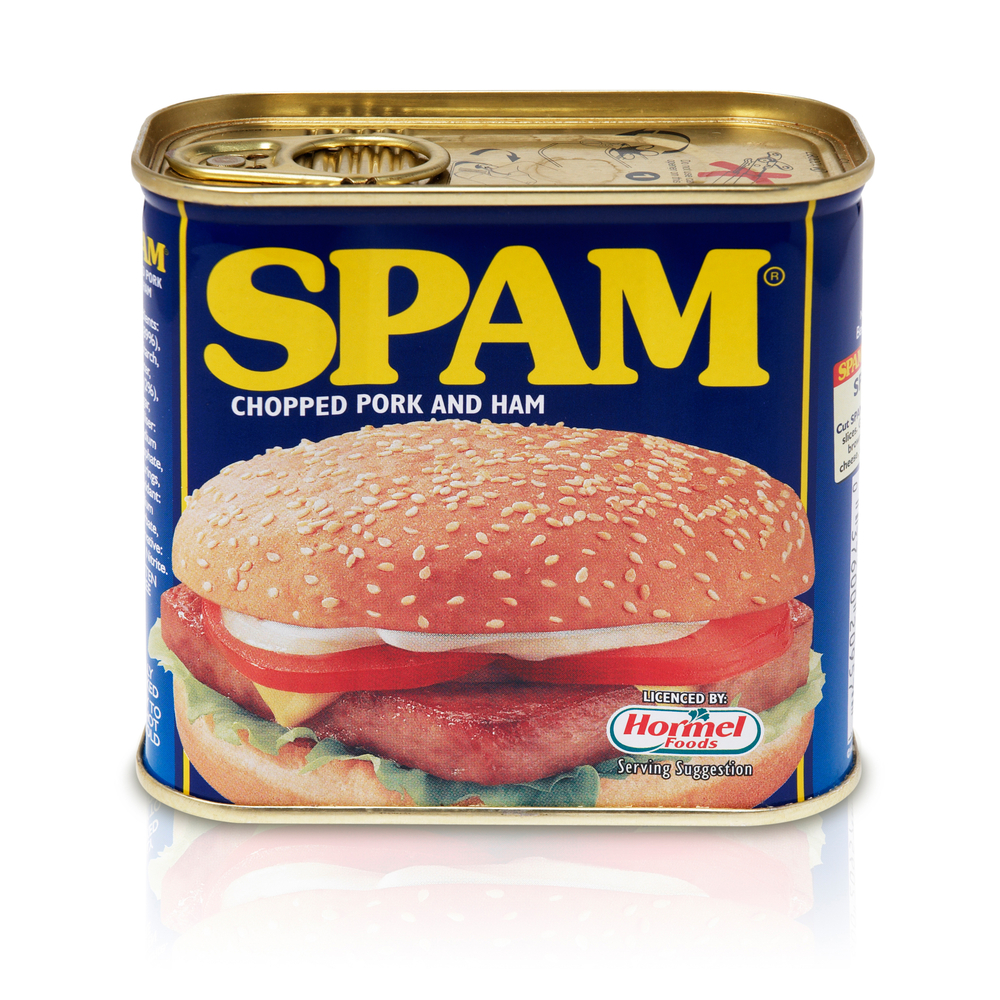
Don’t let your emails to your subscribers end up in the dreaded SPAM folder!
Make sure that you DO NOT use the following words in your emails’ subject lines or in the first line of your emails.
These WORDS have been shown to decrease your “open rates” when used in the Subject Line and may have the ability to direct your email campaign into the SPAM folder/Junk Mail folder of your recipients’ inbox. How does this happen — the web crawlers try to determine what is “Spam” and what isn’t.
Hurry
Look inside
Free (but Freebie works!)
SALE or Sale
DEAL or Deal
Incredible Deal
This won’t last
Offer expires
Limited Time
Last Chance
Don’t use a ? and ! in the subject line — this combo is known to redirect emails into the dreaded SPAM folder.
Don’t use ALL CAPS in the subject line because that is equivalent to YELLING at your recipient. However, do capitalize one or two words.
Basically, make sure that your emails subject lines do not read like a sales pitch.
The Dreaded SPAM Folder
How to organize emails campaigns?
TARGET. Make sure that your list is targeted to correct recipients. I know this sounds like it should be common sense, but it is often the first obstacle.
You can ensure that you have a targeted list by having a “subscribe” button on your website. Never buy email lists and we advise never selling your subscribers’ emails.
BLUE Subscribe buttons have been found to be clicked more than any other color.
All of your social media and marketing collateral should be targeted to drive potential readers and fans to your website (not your Amazon page or a book sales page). You want to engage your readers and potential readers to interact with you and your stories (your brand). To do this you must have a website that resonants with your targeted audience. (This will need to be a separate topic).
FREQUENCY and TIMING. I would caution you to send out three or fewer email campaigns per week. Make sure that your email campaign is not getting lost in “Holiday” traffic. I have found that emails campaigns that land in our subscribers’ email boxes on holidays have a reduced open rate.
UNLESS. If your campaign is 21 Days to a Better _____ campaign, then deliver what you promise!
VALUABLE CONTENT. Only send out an email campaign when you have something of value to present to your targeted audience.
SHORT and SWEET. Remember to keep your message concise and interesting. Make sure that your email stands out from the rest of the emails in the recipient’s inbox.
WORDSMITHING. Make your language entertaining (do this always because you are supposed to be a master word-crafter! )
CONVERSATION. Make it a two-way conversation by encouraging the recipients to ask questions, give feedback, or join the discussion about characters, events, or enter a contest specifically created to resonate with your readers. Here is a link to how (Ann Charles is a USA Today Bestselling author who writes award-winning sassy mysteries) Ann Charles offers contests on her website. Notice that she doesn’t scream CONTEST. But it is there for her beloved fans. http://anncharles.com/2018-traveling-with-ann-calendar-contest/
SUBJECT LINE. Spend some time crafting the subject line of your email. It will determine the “open rate” of your email campaign more than anything else that you could do. Subject lines are to email campaigns like covers are to books.
Pique your readers’ interest
Avoid ALL CAPS and exclamation points in the Subject line along with the dreaded sales words.
Capitalize at least one word.
Do keep it SHORT. Most people are reading emails on their mobile devices.
Really think about what will intrigue your recipient to continue reading and to OPEN your campaign email.
Make sure that the subject line matches the content of your email. Don’t “bait and switch’ because that leads to unsubscribes.
What do you want your recipient to do? Keep the email focused on that. Is it engagement? Attend an event? Know that you have a new book in the works?
What is the purpose of your email?
TEST and REPEAT. Keep track of what works and what doesn’t.
What is a GOOD OPEN RATE for email campaigns?
Open rates vary from industry to industry and purpose to purpose. This is what MailChimp has to say about open rates. Click here to learn more.
Words that do work in the SUBJECT LINE and increase your email campaigns’ open rate are along the following veins:
Announcements
Invitations
Thank you
Personalizing Subjects (are you emailing “Quick Tips” or “How to” or “Announcing” )
Direct and to the point messages — > The ONLY WITNESS to a tragic crime is Neema, (THEN this could go into the “preview text”> Neema is a gorilla who can communicate (Will this get your readers attention?) – Then the preview continues…the latest eco-mystery by award-winning author Pam Beason. (Notice how the power words are front-loaded in the Subject Line). Beason can then go on in the email body to say that her works on now on sale or where they are available or when she is doing an author event or that there is a new book in the series.
An exclusive offer only for my dear (insert name) subscribers
Did you know that Neema had a baby? (Subscribers, again, would know about Neema and her companion and that this email is just for them.)
Most email recipients do appreciate a good pun or a clever or quirky use of words.
IMAGES – studies have shown that having an image for every two-to-five hundred words of text makes for a more positive interaction with the email recipient.
In conclusion, study what works with your target market, continue to evolve your email templates and campaigns, keep testing and analyzing your open rates and click rates. Discover what resonates with your readers.
Freddie of MailChimp
Crafting email campaigns is quite the art. Generators of email campaigns must consistently try to improve “their game.” Fortunately, MailChimp has easy methods to test your email campaign effectiveness through A/B testing, analytics, and feedback.
A word about A/B testing> Only test one A/B variable at a time. As I always say, “Today’s digital marketing is all about the long game.”
I have read and researched many articles and posts on how to increase the effectiveness of Chanticleer Reviews email campaigns. To include all of the links would make this article cumbersome and longer than it already is. I hope that you don’t mind that I put the information in a more digestible format. For more information about how to make your email campaigns more effective, just “google it” and click on the links in this post. Meanwhile, I hope that you have found some of the tidbits that I’ve shared with you interesting and valuable in promoting your brand and books.
Remember to never forget that social media posts and comments, emails, and websites are you represented in the Internet of Things is akin to being in attendance of the Earth’s biggest cocktail party. Be the guest that always gets invited and not the one to be avoided at all costs.
And now for inserting those images! One thousand words equal two-to-five images. Let me know what you think! Kiffer Brown, Chanticleer Reviews Team
Author Susan Faw is the perfect example of what I mean by #SeriousAuthor. She not only writes amazing YA Fantasy, she also approaches her writing as an occupation.
She’s serious. She plans. She kills it. Every time.
Please read, respond, and share this 10 Questions Interview with author, Susan Faw.
Chanticleer: Tell us a little about yourself: How did you start writing?
Faw: Back in 2014, the company that I had been working for since 1994 announced that it was merging with another company from the U.S. I knew that it was the death knell for my position within the company and that it wouldn’t be a matter of ‘if’ but ‘when.’ I grabbed a bottle of wine, went out to my deck, cried for a couple of hours while I polished it off, then went inside and sat down at my computer and started to write Seer of Souls. My prediction came true on May 1st of 2017 when I was let go due to a “work slowdown.” It was a nice way of saying I was over 50 and no longer wanted within the organization.
Chanticleer: That’s fascinating. I often wonder about how stress has the power to alter our perception of the world around us – even how we define ourselves. And sometimes what it draws out of us in that altered state. When did you realize that you were an author?
Faw: I think it started to feel real when Seer of Souls was picked up by Booktrope (now defunct). They gave me my start and dragged this new author through the process of taking a raw manuscript to finished, published product. Unfortunately, they closed their doors three months after my first book went live, and so I had to start all over again, learning the Indie way of doing things.
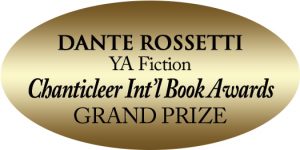
Chanitcleer: Seer of Souls did well in our 2016 Dante Rossetti Awards. Talk about genre. What genre best describes your work?
Faw: I am a fantasy author, first and foremost. I cut my teeth on the great fantasy authors of the century and have always loved to be transported to unique worlds. I think the subgenre of dystopian fiction, which I see to be a hybrid of science fiction and fantasy, was birthed due to this need to know the answers to what if the worst case scenario happens.
Chanticleer: What led you to write in this genre?
Faw: I adore it. Despite what most people think, fantasy is about people, more so than even the romance genre. Fantasy explores the human condition through a portal of strange new worlds and if well written, challenges our beliefs about structures or ‘norms’ that we must accept in modern society. It allows us to talk about taboo subjects in a safe environment, because of it is “just fantasy.” I read a lot of fantasy and science fiction. When you immerse yourself in a genre, you learn the tropes, the norms, what works within the genre and what has been already done. By reading you absorb a culture that you can then build on. I couldn’t write romance. I don’t understand the genre.
Chanticleer: Good insights. Are you a rule-follower or do you like to make up your own rules?
Faw: I follow the rules for the most part, but I find that when I try to be formulaic about the rules, it shuts down my creativity. I become bored with the project, so a certain level of spontaneity is important for me.
Chanticleer: Yeah, sometimes the best way to silence the muse is to unleash the editor in the middle of the creative process. Something, I’m sure, we all do from time to time. How do you come up with your ideas for a story?
Faw: I like to do a day or two of random reading online. I check out the weird and the wonderful posts that litter the Internet and start taking notes of strange occurrences or weird events. Ghost stories or reports are a great source of inspiration. Paranormal activity can lead to all kinds of magical concepts.
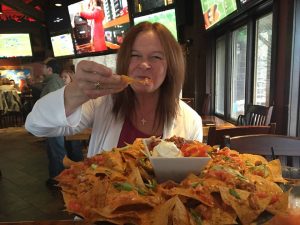
Chanticleer: Those nachos look good… How structured are you in your writing work? How do you approach your writing day?
Faw: Now that is a work in progress. I recently moved and am still settling into my writing routine here. In the past I would write whenever I could squeeze the time in, but now that I am writing full time I have found my discipline to have weakened. Ideally, I like to treat my writing day like a work day, work 8-5 at my computer. I find that keeping a routine is the most productive. Beyond that, I like to write in the mornings and do the business side of things in the afternoon, such as marketing or production activities.
Chanticleer: I believe you will settle into your routine in no time. Can you give us a few of your favorite authors and describe how they influence your work?
Faw: JK Rowling, Robert Jordan, Erika Johnannsen, Terry Goodkind, Brent Weeks – all are fantasy authors and I love rereading their works because of the depth of their writing. The world building is amazing and the character development is so real, you would swear their characters breathed.
Chanticleer: I love authors who can create worlds and characters like that. Do you use craft and/or business books? Which ones have helped you the most?
Faw: When it comes to editing, I put every book I write through this preliminary edit, to sift it for the chaff – The Word-Loss Diet by Rayne Hall. It is a small book stuffed with the most common, juvenile writing mistakes. I also reference The First Five Pages by Noah Lukeman and Writing The Breakout Novel by Donald Maass. I need to give a shout out to indie author Chris Fox and his advice in Six-Figure Author – Using Data to Sell Books and Write To Market – Deliver A Book That Sells. That last book is not what you think but involves understanding your audience and discovering subjects within your niche that will resonate with your audience, within your genre.
Chanticleer: That’s an awesome list. Thanks! Give us your best marketing tips, what’s worked to sell more books, gain notoriety, and expand your literary footprint.
Faw: Marketing is every author’s Achilles heel. Whether you publish the traditional route or are self -published author, like me, we all need to market. The reasons for this are varied, but in the end, it all boils down to the same two facts:
No one will take as much interest in your career as you will. You are your own best advocate.
Over the last three to four years, I have worked hard to learn the best practices when it comes to advancing and expanding your author footprint. No one answer works for everyone but there are some essentials that you must have in place.
Firstly, you MUST have a kick-ass(ets) cover. Everyone judges by appearance, if they have eyes to see. A poor cover is a stumbling block. When someone is browsing for a book to buy, your cover needs to stop them dead. It should compel them to read your blurb, to check out the ‘look inside’. If you cover cannot grab their eyes, then you book will not grab their wallet. Spend the money on this, if you are an indie. If you are a traditional author, make this a serious discussion with your publisher.
Secondly, take the time to LEARN about Facebook ads, and Amazon (AMS) ads and how they work. As a traditional author, you might not be able to run Amazon ads, but you certainly can with Facebook ads. A small, effective and can make a huge difference in daily sales.
Thirdly, work hard to build a mailing list dedicated to your author brand. There is no better way to market than to a dedicated list of fans waiting to snap up every book you write. There are ways to introduce your work to new people, usually in the form of some sort of giveaway. It can be a short story related to your series or some deleted chapters, or original sketches/artwork that you have drawn. Work on building that audience who is hungry for your next book. The other reason why this is important is that it is a marketing activity that is totally within your control. Regardless of what happens with other advertising platforms, your list is yours. That direct contact with your customer is essential. An excellent coach for in this area is Bryan Cohen of the “Sell More Books Show” podcast.
Lastly, take the time to get to know other authors in the book industry. The collective wisdom of these smart people can help you avoid some costly mistakes and alert you to new possibilities as they crop up. Whether traditional or indie, be humble enough to learn from others who may be farther along the path than you, or doing something smart.
Chanticleer: Susan, thank you for spending time with us today. You are a powerful and positive force in the universe and we absolutely adore you!
Susan’s second novel, Soul Sanctuary, took home the 1st Place in the 2017 Dante Rossetti Awards! Check out her website and her other books, social media accounts. As you can see, she’s got it going on!
Meet Paul Aertker, 2017 Grand Prize Winner in the
Chanticleer Gertrude Warner Awards
I first met Paul Aertker when we were in Portland Oregon last year. My first impression: Dynamic, Intelligent, Generous. In short, I am so glad we met! When I found out he was coming to our Chanticleer Authors Conference, CAC18, and that he was indeed in the running for an award – I was thrilled.
Paul is an amazing human being – but don’t take my word for it! Find out for yourself! Read on and be sure to comment at the end – and share if you like.
Chanticleer: Paul, tell us, how did you start writing?
Aertker: I started writing on September 12th—the day after 9/11. I guess I saw what the world had become or rather, what adults were capable of doing, and I thought maybe I should focus on kids and maybe kids could make things better. So that’s how I got started writing.
Chanticleer: That’s amazing, Paul. Thank you for taking action in this way. What led you to the middle-grade crowd?
Aertker: I write middle-grade books mostly because I act like an 11-year-old. No, but seriously, I do. I enjoy working with and writing for the middle grades for several reasons. Nine to twelve-year-olds are at a perfect stage in life—before the challenging ages of young adult, yet they are still old enough to understand what’s going on in the world, and most importantly, they get my jokes!
Chanticleer: You’re right! What inspired you to write this particular series, The Crime Travelers? I hear, by the way, that this series is doing quite well…
Aertker: I think most everything I write is about travel. The Crime Travelers series is about international action adventure—”like the Bourne Identity but for kids.” What’s more, this new book Posthumous is about an American family in Paris, and the mother dies, and the dad and daughter move back to the US. I think of travel as a catalyst for writing, a means of generating ideas mostly because I see reading and writing as a form of travel.
Chanticleer: Oh, good answer! Reading is the best form of escapism. Give us five authors whom you would love to meet on your travels – and tell us how they have influenced your work.
Aertker: What I’ve done is a little different from most children’s book writers. I love Roald Dahl and Margaret Peterson Haddix and Rick Riordan and Gordon Korman and the rest. However, most of my influence comes from the adult authors who write international and action adventure novels—specifically, James Patterson, Robert Ludlum, Lee Child, John Grisham, etc. I like these guys, and I like their work. In the Crime Travelers series, I bring the action and adventure of adult novels into the kid world.
Chanticleer: I think Middle-Grader readers are ready for these books. Look at their video games! Tell us a little about areas of writing you feel most confident in – and what advice you can give someone who is struggling in this area.
Aertker: I’ve gotten much better at getting the words on the page. I used to struggle to create a lot of volume of pages. But, I have a trick that has helped me. I think we all struggle with the internal critic telling us that we are not good enough or whatever we’ve done is terrible. We all have this. Sometimes I find that I cannot sleep so instead of tossing and turning, I will get up, put on my glasses, and sit at my desk. I’ll write in the middle of the night for hours. And what I’ve learned is that my internal critic doesn’t get up with me! He’s too tired to criticize. So I write for a while and then go back to sleep. In the morning I wake up and notice that someone has written in my document! Yes, sure it needs work, but editing seems to be easier than cranking out the first draft.
Chanticleer: Good advice – If your inner critic is too loud, wait until it passes out, and then write. So, I hear you sell a lot of books… Which business books have helped you the most?
Aertker: I think one of the best business books for writers is Tim Ferriss’s 4-Hour Work Week. We all know that we will not work just four hours a week. Writing has no end. We know this. What I took from this book was that it’s important to delegate tasks. You need to hire an excellent cover designer, and you need a good interior designer for your book… You also need a developmental editor, a copy editor, and a proofing editor. Then you need to assemble a team of beta readers. And, and, and. The point being: ask (or hire) others to help.
Chanticeer: What do you do in your community to improve/promote literacy?
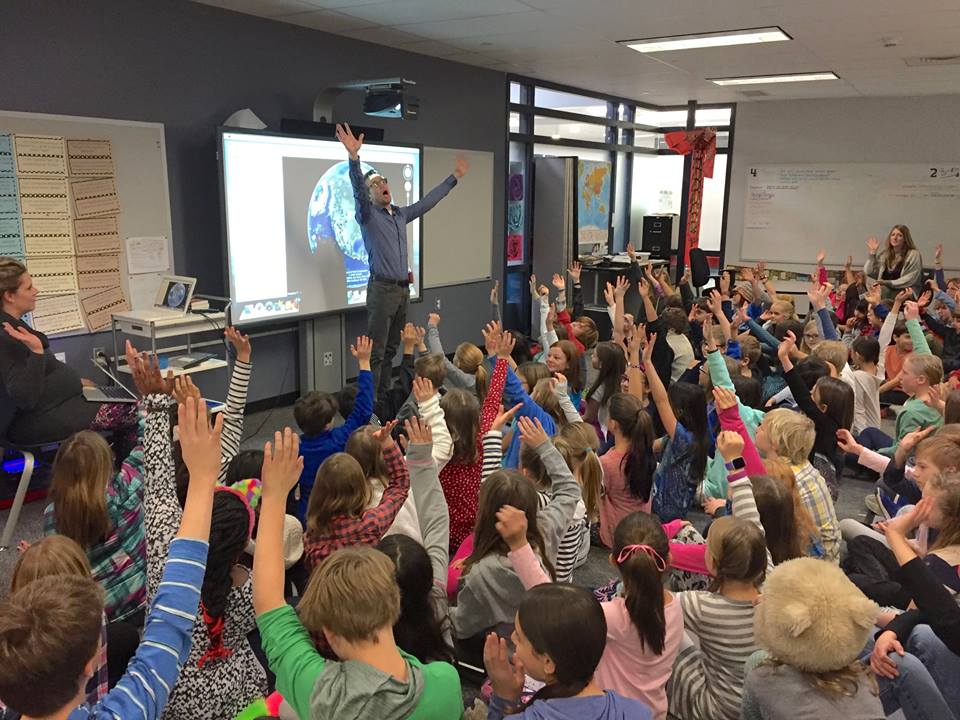
Aertker: I frequently speak at local schools whether I’m in my hometown or traveling to a new place. I love speaking to classrooms and bringing excitement to books and reading. I promote reading for the sake of reading. Period. I think it’s important for kids to enjoy the activity. If we want kids to read great literature and to be healthy adult readers, we have to get them to like reading, first.
Chanticleer: Love your passion for reading and helping kids discover the joy of reading. Give us your best marketing tips, what’s worked to sell more books, gain notoriety, and expand your literary footprint.
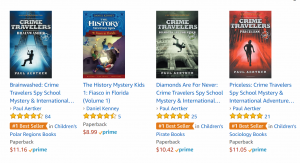
Aertker: The single best marketing tip for me has been to give my books away. I give mostly to teachers, fourth, fifth and sixth-grade teachers, and to librarians. If you’re a teacher, please write me, and I will send you a set of books for free. Yes for free! The reason being that a set of books in a teacher’s classroom is without question the best calling card I could ever have. I often have teachers write me back and say, “Oh thank you so much for sending the books. The kids are fighting over them!” That is awesome marketing. (Reach Paul at https://www.paulaertker.com/)
Chanticleer: Wow! Well done. So, what are you working on now? What can we look forward to seeing next from you?
Aertker: I am super excited about this next book coming out called, Posthumous. It’s a book about a 12-year-old girl who wants to publish her late mother’s stories. It’s one of those books that I wrote in the middle of the night, and I think it’s the best thing I’ve ever written. It’s sad and sweet, and it’s all about the kids making things right.
Chanticleer: I think we will all want to read this one. Please keep us updated. What is the most important thing a reader can do for an author?
Aertker: The most important thing a reader can do for an author? That’s easy. Write a review! I am amazed at how critical getting reviews are, and how difficult it can sometimes be to get people actually to go on Amazon and write the review.
Chanticleer: Paul, it’s been a pleasure. Thank you for spending some time with us. You are a bright star in the universe!
Okay, now it’s your turn… If you have a question for Paul Aertker, please feel free to comment on this post or reach him directly through his website https://www.paulaertker.com/. If you enjoyed this interview, please SHARE it! Sharing is Caring, baby.
Paul won the 2017 Grand Prize Gertrude Warner Award for Middle-Grade Books because he entered the contest! If you have a middle-grade book the world needs to see, enter the competition here. The deadline is fast approaching – May 31, 2018.
A few weeks ago, a wonderful and talented author named Debu Mujumdar contacted me about how to begin creating an effective book cover. Effective cover meaning one that will sell itself to readers, bookstores, agents, distributors, librarians…He knows that his current cover is not serving his novel well, but where to start. “What are the first steps to create an effective book cover? Where do I begin?” he asked.
You see, Debu’s novel, Sacred River: A Himalayan Journey, has won multiple prestigious awards. You can read the Chanticleer review by clicking this link. He published it in 2016. However, from what I could surmise from his email, he isn’t pleased with its sales or readership reach. The story is unique and exceptionally well written and has a suspenseful climax. It is filled with tense sub-plots that are engrossing and the stakes are high!
But the cover he now has reflects very little about the story within. We discussed his cover at last year’s Chanticleer Authors Conference session on book covers. I think I will call the session this year THE GREAT CHANTICLEER COVER “Bake-Off” (with a nod and a hat tip to The Great British Bake-Off TV show). At these sessions in the past, brave authors (self-published) have lain their books on the Cover Altar to be scrutinized—and not just by me, which would be tough enough, but by their peers.Debu was one of the brave authors who laid his book on the Cover Altar for judgment.
I then would hold up the targeted book for about 3 to 5 seconds to the group and ask the following question: “What is the genre of this book?”
Notice, that I did not ask, “Do you like this cover?” An effective book cover is not necessarily “pleasing.”
An effective book cover communicates information. And not just the basics—that is a given.
Most of the time (99% I’d say), not one person in the group could tell the genre of the (self-published) books laid on the Cover Altar —much to the chagrin of the books’ authors.
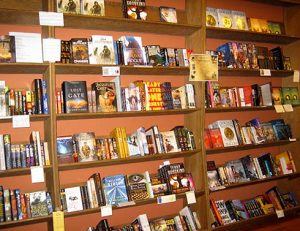
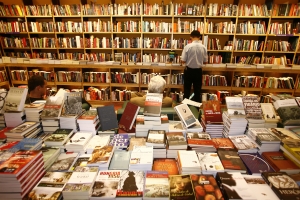
Village Books Bellingham, Wa
Why 3 – 5 seconds? That is the time that the cover has to attract a potential readers’ attention.
Potential Readers being booksellers at tradeshows, librarians at the ALA shows, shoppers on Amazon, shoppers at your local bookstore, shoppers at WalMart or Barnes & Nobles or at the airport … Well, you get the picture.
In this 3 to 5 seconds, your cover must communicate quickly and effectively the following 5 Elements:
The Genre (Historic? Thriller? SciFi? Romance? Cozy Mystery? Literary? etc.)
The Primary Targeted Age Group (Adult for the Trade? Guys? (think Tom Clancy) or Gals? (think Rebecca Wells), General Audience? Young Adult? Middle-Grade? Clean reads market? (think Jan Karon) etc.)
Place or Cultural Reference (India? New York? Africa? Outer Space? California? Paris? Russia? Japan? etc.)
An effective book cover will convey all of this information (or enough of it) to capture a potential reader’s attention in less than 5 seconds—three seconds really. It will garner enough interest to have the potential reader to pick it up or click on the link to find out more. If it does not, your book is invisible to potential readers. And yes, that is a publishing industry’s insider’s term.
Invisible books rarely sell.
Effective covers sell the first book. The content between the covers sells the second book. And you can quote me on that.
Here are some examples of before and after covers that have been lain upon the Book Cover Altar:
Example No. 1
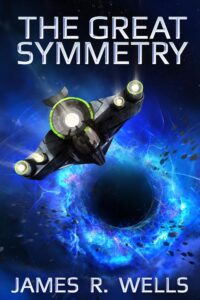
James R. Wells Awarded the Cygnus Grand Prize for THE GREAT SYMMETRY
Is it a biology book? Is it a math biology book? I dunno? Is it a non-fiction book?
Point made.
Bookbub picked up The Great Symmetry with its new cover. ‘Nuff said.
Does the new cover communicate quickly the 5 Elements above:
Genre – yes. Clearly Science Fiction
Primary Age Target Group – yes. General Audience for the Trade (i.e. commercially viable, a plus!)
Mood – yes. Suspenseful with Action — Is that a black hole? Looks scary!
Timeframe – yes. Futuristic with high technology
Place or Cultural Reference – yes. OuterSpace — possibly intergalactic.
Example Number 2
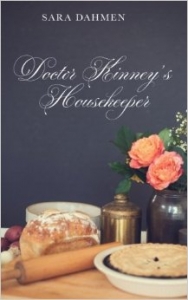
Sara Dahmen’s Doctor Kinney’s Housekeeper, Laramie Grand Prize Winner for Western Fiction
Sara Dahmen awarded Laramie Grand Prize for DR. KINNEY’S HOUSEKEEPER
BEFORE AFTER
The comments made during the Great Cover Bake-Off regarding the original cover were:
Is it a cookbook for baking? Is it a book about a baker? Again: I dunno? Is it a non-fiction book?
Point made.
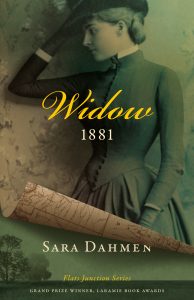
Dr. Kinney’s Housekeeper was picked up by a publisher because it had an interesting storyline and commercial potential (read, TV series). After some rewriting to pose the book as a series, a new cover was created that reflected the storyline along with a new title Widow 1881: Flats Junction Series
Does the new cover communicate quickly the 5 Elements above:
Genre – yes. Clearly Historical Fiction, the late 1800s
Primary Age Target Group – yes. General Audience for the Trade – female-focused
Mood – yes. Change is coming. The fancy wallpaper from city life Back East to the map of the territory clearly shows this. The cultured young woman standing in front of fancy wallpaper is wearing clothes that do not allow for much movement or made for working. Note the tiny waist from wearing a corset, her fine gloves, the fine wool flannel, and her hair arrangement, her hat. This young woman is heading out alone to a place where there will be little refinements that she has become accustomed to. Will she survive? What awaits her?
Timeframe – yes. 1881 (And what was it like being a young widow in 1881 going out to unknown territory alone)
Place or Cultural Reference – yes. North America West against Back East culture in the late 1800’s
Sara is happy to report that book sales are brisk and the novel (first in the Flat Junction series) is under consideration for film options.
Example No. 3
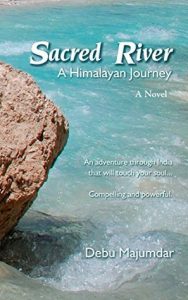
Now let’s go back to Debu‘s award-winning novel, Sacred River: A Himalayan Journey.
Click on the link above if you want to visit Debu’s website.
The tags for the book are Literary Fiction, Multiculturalism Issues, Mystery, Thriller/Suspense, India.
Here is the novel’s cover:
Now let’s apply the 5 Elements. What does the cover tell you in less than 5 seconds?
The Genre: Travel? Non-fiction?
The Primary Targeted Age Group: General Audience? Probably. Literary audience? Probably not. Suspense/Thriller audience? No way.
Mood: Don’t know.
Timeframe: No idea.
Place or Cultural Reference: No idea?
Does the cover convey any of the following (blurbs from the Chanticleer Review of it)?
“A tour de force of India’s history, religion, culture, philosophy, anthropology, sociology, and politics are neatly packaged as a mystery…”
“…As speculation of a golden hoard hidden in the sacred temples arises, Chetti and his associate scheme to locate and plunder treasure for a noble cause…”
“An engrossing and tense subplot unfurls, one that will ensnare a temple swami along with some of the pilgrims to the Ganges. This adventure, which culminates in an enormously suspenseful climax…”
“Readers will feel they are in a marketplace, on the side of the mountain, in a temple, and bathed in light and water. Especially lovely are the passages noting religious rituals and the spiritual significance of the Ganges. The author weaves in Indian legends and morality stories, artfully juxtaposing parallels between ancient tales and his characters’ modern lives.”
Nope.
Make your book stand out in a sea of books!
Debu’s award-winning novel deserves a cover worthy of the time and writing craft that he invested into it. His cover has to intrigue potential readers and booksellers to pick it up wherever it is displayed. The cover must convince the web surfer to click on the image.
But how?
My advice to Debu is to begin collecting visual elements of people, objects, paintings, locations, symbols, ideas, etc. that reflect the content of the work. Take several weeks to do this. Enlist friends, family, and readers to help with this. Gathering visual elements would make a great social media campaign. Ask readers to post photos or graphics of images that remind them of the novel.
Dig deep. Come up with at least 30 elements, if not more.
Lay the visual printouts where you can see the elements from far away, close up, upside down. Such as writing the novel, exploring the cover concepts will take time. Deciding on the cover concept will take more time and feedback.
In a few weeks of letting ideas percolate, particular visual elements will begin to resonate. Then you will have something to explore.
Update! Debu has re-released his book with this cover
Don’t let your book become invisible to its potential readers!
Effective covers sell the first book. The content between the covers sells the second book. And you can quote me on that. (And yes, I am repeating myself. )
I will continue with another blog post that discusses what comes next—How to Put the Elements Together for an Effective Book Cover.
Here is a link to Canva. It is a FREE graphic-design tool website that is easy to use. It is a great way to explore cover ideas and to play with visual elements to discover what will resonate cover-wise with your readers.
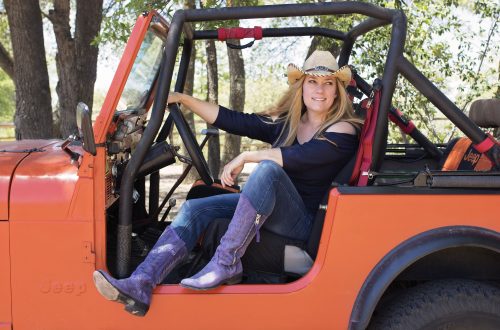
We are super excited to announce that Ann Charles, the award-winning author of the USA Today Best-Selling Deadwood Mystery Series, to keynote at CAC18 and to present sessions and workshops!
Ann writes multiple award-winning mystery series that are splashed with humor, spice, suspense, action-adventure, and whatever else sounds fun.
Her books garner thousands of Amazon reviews and are the Top-Rated #1 Kindle Bestseller Women Sleuth Mysteries.
Ann will share her proven and tried marketing secrets to creating, building, maintaining, and growing an enthusiastic fanbase. www.AnnCharles.com
CAC18 Workshops and Presentations by Ann Charles:
CREATING DIE-HARD FANS THROUGH RELATIONSHIP MARKETING – (2-hour workshop presented by Ann Charles)
There are many ways to find and entice readers, but keeping them as part of your long-term readership base is tricky. Years ago, Ann made the choice to focus much of her non-writing energy on Relationship Marketing, fostering reader loyalty rather than taking the one-time-sale mentality. In this workshop, she’ll explain 5 W’s of Relationship Marketing: WHAT it is, WHY it’s important, WHERE you can develop career-beneficial contacts, WHO benefits from this style of marketing, and WHY this marketing method can be effective.
GROWING YOUR AUDIENCE—For Published or Unpublished Authors – (2-hour workshop presented by Ann Charles and Jacquie Rogers)
The publishing industry is morphing every day, and the internet brings a new dimension to the concept of audience. Together, these changes merge into a vastly different and exciting concept of marketing. The shotgun approach to finding your audience worked for decades, but this technique becomes more expensive and less viable with each passing month. The bad news: no one will find your readers for you. The good news: you have more options than ever in history to build your own fan base. In this interactive class, we’ll explore these options and send you on your way to building your own tribe of diehard fans. This class will help you pinpoint your audience—find the readers who want to buy your book—so you can tailor your marketing and promotion techniques to them and stop wasting time and money.
BUILDING A WORLD ONE BOOK AT A TIME – (Session presented by Ann Charles & Diane Garland)
Many readers love crossover books and characters. Creating one world that encompasses multiple series offers a familiarity even though the setting, style, and series are different. For authors, it not only helps to sell backlist books but can also create die-hard fans for life. In this presentation, Ann will explain some of the ways she has used to create crossover elements within her three on-going series. Diane Garland will join Ann and discuss the various ways her role as a World Keeper plays with Ann’s series building.
WORKING WITH A WORLD BUILDING EDITOR or How to make your writing time more efficient and productive – (Session presented by Ann Charles & Diane Garland)
Building a world takes a lot of planning. Readers are smart, so you need all the help you can get making sure your world follows the rules you create along the way. For authors, previous threads and rules can become hazy by book 3 or 4 in a series. In this workshop, Ann and Diane will talk about ways they work as a team to make sure each book in an ongoing series stays true to the world the readers know and love.
LIVING VICARIOUSLY THROUGH FICTION – (Session presented by Ann Charles and Jacquie Rogers) The Writer’s Life tract
Have you ever wondered where authors find the information needed to write stories about historical setting, character careers, or true events from the past, and how they incorporate it all into a single story or series? In this presentation, Ann and Jacquie will discuss how difficult it can be to live vicariously through fiction, and how important it is to be as accurate as possible.
CAC18 STORY. PRODUCTION. BEYOND.
Stay tuned for the latest info about Chanticleer Authors Conference presenters & sessions!
But here’s what I think, time passes quickly when we’re happy and productive or involved in something meaningful. Joy makes us buoyant and time, therefore, becomes lighter and easier to move.
When we’re faced with something terrible or unpleasant, the opposite happens. We are weighed down by depressed thoughts or depressing situations. We feel every moment because the pain it causes is real and we cannot do anything else but live in it. Time slows because our focus is on the moment.
Today, (I started writing this on the first flight of the fall trade show season) Kiffer and I are heading to New Orleans for the Southern Independent Booksellers Tradeshow (SIBA). We’re leaving a couple of days before the exhibit portion of the show begins. We’re crossing time-zones. Neither of us has been to NOLA and I have a list of things and places to see and experience. Little did I know, that we would be spending most of our time in the convention center. NOLA sights and sounds will have to wait for another time.
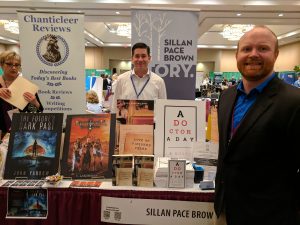
It is important that we arrive ahead of the exhibit time because TWO of Chanticleer’s authors’ works have been selected for the prestigious SIBA events and everything must be PERFECT:
Bernard Mansheim, M.D.’s Somerset award-winning novel, A Doctor A Day was selected for the prestigious Moveable Feast event at SIBA
Gregory Erich Phillips’ Chanticleer Overall Grand Prize novel titled Love of Finished Years was selected for the prestigious First 180 Days event for books that will be published in January 2018.
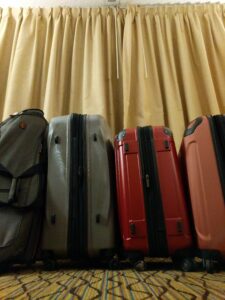
Those of you who do a lot of traveling know that your bag cannot weigh more than 50lbs or you pay a hefty price. We had 3 fifty-pound bags plus personal luggage to lug around between the two of us. Our bags easily weigh more than the allotted fifty pounds each. However, eventually, we discover that a $20 tip to the Skycap helps to “lighten” the load.
Bossy, Bertha, Betty, & Biff
And those of you who read books know that they tend to be heavy. We’re representing 25 Chanticleer Authors and because books look better with a partner, I’ve packed two of each title. You might think that’s fifty books, but you’d be wrong. Most of our authors have two or three titles coming with us. Do the math.
I drop Kiffer off at the departure deck at SeaTac with the bags and park my van in the garage. When I catch up to her, she’s at the Alaska counter unpacking the bags… One of the bags is overweight and shuffling of its contents is required. By the time we reconfigure, the agent has closed the counter and we have to move to the next aisle to check in.
This is how our tradeshow adventure begins.
We are learning things about ourselves and each other – things we didn’t know before. Kiffer has started calling the luggage by name: Betty, Bertha, Bossy, Birdie, and Biscuit. I cannot drink McDonald’s coffee. I tried. I can’t. Kiffer thinks I’m a bit of a coffee diva. I guess I am. Kiffer has graciously upgraded our seats to premier economy class – which means more leg room for both of us tall gals and free drinks. She knows how to travel and I’m grateful. After everyone is clicked in and flight safety drill is given, we’re in the air. It will be six hours before we land. Six hours.
This is the first tradeshow of the season. There will be three more plus auxiliary shows.
Sharon Anderson, Editor in Chief of Reviews; Gregory Phillips, a Chanticleer Grand Prize Winner; Josh Floyd of Ingram.
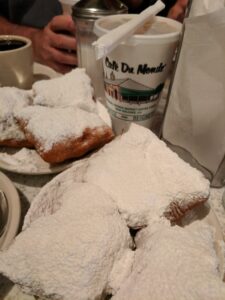
NOLA is sultry. It’s a city that beckons the visitor to ease on in and sit for awhile. It hits the high notes of the most compelling song and doesn’t judge anyone for anything. The police ride horses whose backs are as tall as my minivan back home. It’s a different world. I love the vibe and the beignets – the coffee and the company.
Beignets from Cafe du Monde, NOLA
In N’Orleans, all you have to do is pause for a second and someone will be around to chat you up on how your day is going and if you like the city they call home. It’s very Southern and for me, a Northwest native, it’s lovely. To Kiffer, well, being from the South, I can tell she’s feeling her roots as we venture from one restaurant to another looking for the perfect hush-puppy.
Hush-puppies
We’re off to Portland, OR next for the Pacific Northwest Independent Booksellers Tradeshow where two Chanticleer authors’ books were selected for the BUZZ BOOKs event. This time it was Kaylin McFarren of Portland for her Chatelaine award-winning romantic suspense Threads series and Seattle’s own Gregory Phillips, Love of Finished Years was selected – again!
From there, we hop a plane in Portland to head to Chicago for the Heartland Fall Forum. These are bigger shows than SIBA and I’ve increased my load of authors I’m representing. More luggage is required. We borrow Andy’s orange suitcase and name it Biff. Once again, Kiffer is the proud mother hen when the Laramie Grand Prize winner, Sara Dahmen’s Widow 1881 (renamed from Doctor Kinney’s Housekeeper) was selected for Heartland’s prestigious Moveable Feast Event!
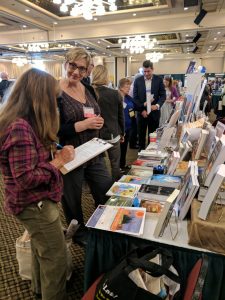
Sharon hand selling to a PNBA book buyer!
After the Heartland trade show, we will split up and Kiffer will take our authors’ books to San Francisco for the show there and I will travel up to Surrey for the SiWC for the weekend. For me, it feels odd not being a part of the last trade show, but Chanticleer has been at the Surrey conference for five years running – it’s no time to stop now.
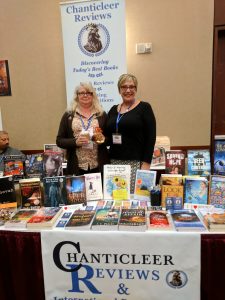
Kiffer refueling with coffee and Sharon proudly showing off Chanticleer’s Best Books Collection at the Heartland Fall Forum, Lombard, Illinois
Before leaving, my mother asked me why was I going away for such a long time. I had to smile, as long time means so many different things to so many people. It depends on what you’re doing, right? Spending a week in jail would be rough. Attending tradeshows? I know it will be over before I have had a chance to settle in.
My mother’s question is valid, though. What do I hope to gain from being away from my family for most of September and October? First of all, I expect this time away will work to sharpen my professionalism and further my career in the book industry world. I expect to meet new people, build stronger connections and learn with a little more certainty that I am capable and ready for this new and exciting adventure. It is exciting to meet the some of the top executives in the publishing industry and mingle with the “Big 5” publishers. There is always a lot to learn and many networking opportunities.
Equally as well, I hope to increase the visibility of my (Chanticleer’s) authors’ work, widen their footprint, as it were, in the retail world of book-selling. I hope, through our efforts, they gain even more notoriety and, more importantly, benefit from more bookstores placing more orders for their work. I hope their books fly off those bookstore shelves because I’m not taking just anyone to these shows. I’m taking Chanticleer Award winners and those very special people who have earned the very highest scores from our professional reviewers. I’m taking the top books and the booksellers are pleased that we have vetted the books that we are exhibiting. We even had a Disney exec who was interested in Chanticleer’s YA and children’s book selections stop by the Heartland booth—she was looking for new content for Disney. She took away sell sheets and information—we will definitely stay in contact!
Book buyers would be crazy not to snatch these books up! And we did connect many indie booksellers and book distributors with Chanticleer Reviews’ best books!
We Discover Today’s Best Books!
Endnote: I started this article on the plane to New Orleans and I was right, the Fall trade show season is over before it began! Time does have a knack for passing quickly when you’re having fun and are passionate about what you do!
Next up are the 2018 American Librarian Association trade shows and the Comic Cons—just around the corner…
In the previous blogisode, the YA Writer stumbled upon a gritty secret. A secret that revealed the often un-used marketing processor installed in every bonding animal who hawks bookish wares inside the All Powerful Cybersphere.
Socializing.
Now the YA Writer is forced to make a choice that may alter their impressions, clicks, and engagement foreverrrrrrr…
<<dramatically clears throat>>
We are gathered here today to witness the exchange between this author to this reader in meme-y internetrimony. Author, do you take this social media thing-a-ma-gig seriously? Do you solemnly swear to post interactive content and reply to comments until defective accounts do you part?
Before you shout, “I object!” … THIS is what I believe most authors hear when told to engage their readers online. I’ve talked to hundreds of authors face-to-face on this subject. The reaction is typical––dear-in-headlights look, nervous laughter, shifting on their sudden cold feet.
Yeah, I know … commitment is a scary idea for many. Perhaps even a monstrous call-to-action for us please-dear-cat-gods-of-the-interwebs-don’t-make-me-small-talk introverts. Some view social media as a black vortex that will suck away their humanity until their cyber-Gollum alter ego hisses, “My preciousssss…,” whenever a notification chimes.
Do not despair, fair YA Writer. Even if socializing with strangers is nothing but rainbows, unicorns, and kittens for you, I have encouraging news.
You don’t have to love it, therefore you don’t have to marry it.
You don’t even have to put a ring on it.
But you do have to care. Because sharing is caring.
Literally. What you share on your social media accounts reflects what you care about.
So, what do you care about? Beyond book sales, that is. Dig deeper. Think broader. Embrace this exercise as a way to tone and sculpt your creative marketing muscles.
Bring to mind a writer or celebrity you enjoy following on any social media platform. Then ask yourself, why? Why do you enjoy following them so much? Is it because they talk incessantly about buying the book you’ve already read and own? Doubt it. Maybe it’s their keeping-things-strictly-business posts that only announce events and new releases? <<yawns>> Yeah, didn’t think so.
Every once in a while? Sure. But if that’s all you share? #DontCare
Make me care. Make themcare. You know, your followers. The ones who clicked you into their newsfeed existence. Rise up and say, “My people!” and lead them into a conversation. Actual YA-aged readers long for this. It’s psychologically built into an adolescent and twenty-something to search for and declare “their tribe.” Give your audience, regardless of age or genre preference, a sense of belonging. You found me. You belong here. Welcome. Let’s discuss all the things! Let’s discuss YOU.
The YA reading crowd is passionate. Intelligent. Lively. Transparent. Witty. And always on the hunt for immersive communities. They also care deeply about the characters and worlds you’ve created. They also care about the word magician behind the curtain who cast a spell over their imagination.
True confession: I’m legit socially awkward. No, really. Small talk is my arch nemesis. I have a terrible habit of nervously laughing at just about everything. And if I’m not nervously laughing, I’m nervously rambling. Even when I recognize the social cue that I need to stop talking, I CAN’T STOP TALKING [-_-]
If you’re socially awkward like me, take heart! The best form of caring is sharing the spotlight with another. Just remember, talk with people and not at them. Here are ideas on how:
I just finished reading [title] by [author name] and [gush about book]. Not sure what I should read next. What are YOU reading right now? I’ll add your answers to my TBR list on Goodreads.
So full. Just enjoyed [food]. Aaahhh, happiness. What’s your favorite comfort food? Bonus points for posting a recipe link!
Let’s play a game! [You can use a meme-ready prompt like, “What’s your Hobbit Name?” Or, you can provide your own prompt like, “Using only a meme or GIF, share your favorite female superhero.” Search through Pinterest or various fandom sites on your fave social media for more examples.]
[Share an image related to characters or worldbuilding in your book with a quote from said story. You can leave it as is for people to like, comment, and re-post. Or, you can end with a question.] “Is this how you imagined them?” “What would you do in this situation?” “Do you think [character] made the right choice?”
Examples are endless! The point is to start conversations. People will begin interacting with each other’s comments, or tag their friends to participate, too. #SharingIsCaring
First, the cautionary tale: Please, for the love of emoji reaction buttons, REPLY. If a friend invited you into a face-to-face discussion but ignored you, how would you feel? Right. That’s how your followers would feel, too. This isn’t a contest to see who has amused you the most. Don’t––I repeat––don’t ignore your followers when they’re taking time out of their busy lives to participate with your conversation prompt. A simple acknowledgement is all that’s needed with a blue thumbs up or a heart-like. Go the extra mile and interact further if you like. Make the reward centers in your follower’s brains light up wildly.
OMG, she spoke with me!
He thinks my recipe for pickled shark chops in a beet reduction sauce sounds yummy!
The more you engage, the more your followers will engage, too.
Socializing. It’s a thing.
A thing you need to make time for, like in real life.
Caring fosters loyalty. And that, folks, is the end goal. All customers for you are short-term. They read your book. They move on. But with a community to keep them company, they’ll stick around until you release your next title. The best launches are built from established reader pre-orders who are in-the-know because they stuck around on your social media to find out. *wink, wink*
So how often should you post? Totally up to you and your followers. Honestly, I post 1-3 times a week on my author social media accounts, save Twitter. When not posting, I make time to participate in other accounts I follow. It’s a give and take, right?
Share.
Care.
If you don’t? You might discover an intervention at your social media doorstep from fellow YA Writers 😉 But only because we care…
Many thanks toJesikah Sundinfor sharing her effective and fun social media techniques with us!
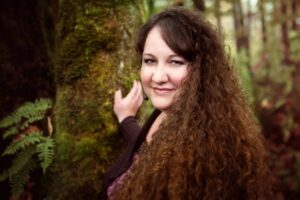
Two words could describe Jesikah:books and coffee. She pours a cup of dark roast writer’s ambrosia before approaching her keyboard. And the forest is her happy place.
Jesikah invites you to socialize with her on herwebsiteand social media pages (visit her website for direct links).
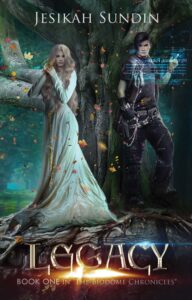
Siblings born and raised inside an earth-based experimental Mars biodome have only known a rustic medieval life rich in traditions and chivalry. Groomed by The Code, they have built a sustainable community devoid of Outsider interference––until the unthinkable happens.
Cultures clash when the high technology of the Anime Tech Movement collides with the Middle Ages in a quest for truth, unfolding a story rich in mystery, betrayal and love.
Anyone producing a digital book or setting up an ISBN may come across the acronym BISAC. If you’re a self-published author wondering what a BISAC code actually is, here are some answers.
Mysterious Coding – BISAC Codes
Metadata For Your Book
BISAC is an acronym for Book Industry Standards and Communications, a very helpful tool put out yearly by the BISG (Book Industry Study Group). TheBISAC code systemis an alpha-numeric system of book classification. The book industry (libraries, universities, Barnes & Noble, local bookstores, and online bookstores) use BISAC code numbers to categorize books.
For example, if you’ve just written a graphic novel murder mystery, they have a BISAC code for that:
In the BISAC code catalog, there are fifty-three (53) main categories with various sub categories – and in some instances, sub-sub categories.
How do you access the BISAC codes?
If you are buying an ISBN code for your book directly fromBowker, you will be prompted to select your BISAC code. When you set up your Bowker account when you purchase an ISBN, Bowker will ask you to identify or categorize your book. A list of 53 BISAC codes will appear (if Bowker is truly up-to-date) and you’re off to the races.
Even if you’re not working with Bowker and using a third party to acquire your ISBNs, you can alwaysaccess the BISAC code categoriesdirectly online.
How do you determine your book’s BISAC code?
YES, you can unlock the secrets to BISAC Codes!
The first category you choose should be what the book is about, which genre category it fits into. Think of it as a funnel: a wide opening at the top, narrowing down to a spout at the bottom. Start large, go narrow.
Don’t let the process intimidate you. Don’t be sidetracked. Get your BISAC codes down so you can start talking about your book in an intelligent manner. For example, when asked what your book is about you can say, “My book is a Sci-fi/Fantasy with elements of the paranormal and badass skateboarding.” Or, you could say that if you were author Jesse James Freeman talking about his book,Billy Purgatory: I am the Devil Bird.
BIASC Codes and Discoverability
BIASC codes are used by booksellers, librarians, teachers, and others who need to categorize and catalog your book. But as an author, you can use this coding system to understand your book in the context of all the other books out there.
Third Party Keywords
Please note that if you are letting a third-party such as Amazon’sCreateSpace, they have their own codes, some of which match to BISAC and others do not. For example, when you log in to CreateSpace and upload your book files you’ll be prompted to enter keywords. During this process – currently on CreateSpace,Step 3: Target Your Book to Customers >categories– a screen will pop up and ask you for KEY WORDS. These, like BISAC codes, will help readers find your work. So the principles described below for BISAC codes apply to keywords as well.
BISAC Identifiers = The Beginning of Interest
You can also think of BISAC Identifiers as the bones for DISCOVERABILITY.
Let’s take this wagon on another ride and construct a little scenario where you are attempting to purchase the perfect book for your grandma. You sit down with her and ask her what she likes to read. She tells you that she likes mysteries best – mysteries with a lot of vampire sex. Instead of screamingT.M.I. GRANNY!You smile and say,I will find you the perfect book!
How? You now know about BISAC codes and how to wield them. You either visit your favorite brick and mortar store – or go online and search:
Mystery, Erotic, Vampire
And you’ll findJ.D. WardandLaurell Hamilton– two of the tops authors writing in this category – both of whose books will be perfect for your grandmother.
Check your BISAC codes yearly
The BISG is not a static group. They are constantly changing things up with BISAC codes – rearranging codes, creating codes, destroying codes – all in an attempt to make our books more discoverable.
Once you’ve landed on the codes that best describe your book you will need to check back from time to time (yearly) to ascertain if your chosen codes are:
still accurate,
still active, and/or
if the BISG has come up with a better code for your book.
In their most recent update, the BISAC Subject Committee states that they never reuses inactivated codes and that they would never inactivate a code and then reuse that code for an unrelated literal. The committee continues that this has always been the case and inactivated codes have never been reused. So, that has never been a practice – apparent or otherwise. They do, however, “reactivate” codes as necessary. For example, GAR011000 was inactivated after the 2.3 edition (in 2001) and the reactivated for the 2016 Edition with the same exact literal.
A Concise Context For Your Book — Unlocking Publishing Secrets
Let’s be honest, the real reason you need to know your book’s BISAC Code: It gives you a fast way to describe your book.
Can you imagine doing that to anyone in the book industry? No one has the time or inclination to listen to you prattle on about it. Base your book description on its BISAC code and everyone will have a good solid context for its genre, content, and even the type of experience they’ll have when they read it.
So when your all-too-well-meaning writer friends set your book down and ask in unison,“Yes, but where is this book going to be on the shelf?”Or agents at conferences ask you, “Who’s your audience? How am I supposed to sell this book?”Now you have something smart to say in return. Now you know BISAC codes!
We will have more articles about BISAC codes and how to decide on which ones to use and how.
Sharon Anderson is an award-winning author and Chief Reviews Editor for Chanticleer Reviews and International Book Awards. Creating and editing content – as well as editing/writing reviews – and outreach are just a few skills she brings to the table. An SPU graduate in Clothing Design and Textiles – something she barely uses in her day-to-day life – Sharon brings her textile know-how into her stories as often as possible. In her spare time, she serves as President of the Skagit Valley Writers League where she promotes authors, engages speakers, leads workshops, and more. She writes dark comedy, horror, short stories, articles, and essays whenever she gets the chance from her home in the Skagit Valley where she lives with her husband, two children, two dogs, a couple of cats, and a sketchy Guinea pig. Working with Chanticleer is like playing every day! Contact: editor@chantireviews.com
Dear YA Writer, You know that moment right before you hit “Post”? The seconds seem to still, like a roller coaster summiting a steep incline. Click. Movement. A loading bar appears. Aaaaand, plunge. Self-promotion rockets into cyberspace on the wings of a WiFi prayer to the cat gods of the interwebs.
Then the wait.
Refresh! And still no notification. Doubt creeps in and whispers error messages from your social media past. But you’ve changed. You no longer join the horde of desperate town criers who scream into the void “buy my book!” with every tweet. Your contribution is now a diverse portfolio of hooks and calls to action with appropriate yet ironic hashtags. A notification pops up. Someone has engaged! Impressions increase.
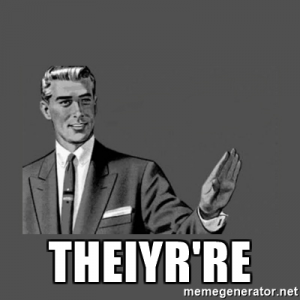
Inhale relief. You did it! Exhale negativity. Whew, you spelled there/their/they’re right.
Yeah, that moment.
Lather. Rinse. Repeat.
This is authordom. This is #amwriting about #writerslife and #writerproblems. Because, let’s face it. For all our word-slinging bravado, marketing via social media is not our best use of wordsmithery. OK, some of you are seriously boss when it comes to online engagement. Most of us, though, are introverted, please-dear-god-don’t-make-me-have-small-talk-with-strangers types who require naps to recharge our social anxiety batteries. Shooting proverbial fish in a cyberspace barrel cuts into our writing time. <<inserts angry eyebrows>> So what do we do? We sin against the Internet by cluttering newsfeeds with our amateur attempts at marketing. Why talk with strangers when we can talk at them? No, YA Writer. Just, no. Better to not Internet at all. I know, I know, I know… You’ve changed. A reformed self-promotion junkie. I believe you. But revision is the theme song of writing, amirite? And when it comes to engaging young adult readers, one thing is critical. Socializing.
Yeah, you read correctly. I said socializing. Some of you just cringed. Sorry-not-sorry. Strange as it may sound, social media is designed for community and relationship building, not marketing. The kind of place where you talk with people, not at them. YA readers (especially actual YA-aged YA readers) are sensitive to this online phenomenon, too. Get to know your readers and potential readers. Ask them questions about what they like. Be silly. Be serious. Be everything in-between. Share strange but true tidbits about you. While plunking away at this blog, shoulders hunched and face pinched with all the feels, my elbow bumped a book stack where an unsuspecting gummy cinnamon bear rolled off the edge and met an untimely end in a cup of tea. Not bad. I think I just found my new favorite sweetener. #RIP #GummyBear2017 #NeverForget What is the strangest thing you’ve drank in your coffee or tea?
What is the strangest thing you’ve drank in your coffee or tea?
See what I did there? Did I mention my books? Nope.
Did I direct someone to my website or Amazon page? Negatory.
Did I ask them to comment? You betcha.
But I chose a safe topic. Neutral ground. No sales pressure here. Instead, I’m building a community for my followers and establishing a thread of conversation. Interact with comments. Like, heart, wow, and laugh. Weep with your followers when they give you a piece of their troubled heart. Be outraged when they describe crimes against humanity. Be you. Socializing. You totally got this. True confession: I don’t always post like a saint. Sometimes I sin against the Internet with shameless plugs and yadda-yadda-yadda about my product rather than engaging my community. Sometimes this is necessary. Sometimes it’s too much, and my followers show me by ignoring my attempts for attention. The best combo is 75% community building and 25% self-promotion. Hey, don’t worry. I’m still learning this, too. We’ll do this social media thing together.
First, a cautionary tale: Please, for the love of cat GIFs, don’t bore your followers with business details. Your readers don’t care. Your younger readers care even less. Authordom is not the Dow Jones Industrial Average, and readers are not brokers waving money and shouting at machines with fluctuating values. OK, so they sorta are, and the giant AI that is Amazon oscillates prices like Oprah. Here’s a saving for you. And a saving for you. Savings for everyone! You get the gist. They don’t need the gritty details of your sales or the publishing industry. <yawns> Plus, people notice when other people stop looking at them as fellow humans and blink $$$ instead.
Don’t be that author.
Join the resistance! I’ll stand beside you fellow #YAlit writer as we lift our keyboards and Smart tech in solidarity to reclaim our followers and engagement!
Click.
Plunge.
#SocializingWithInternetStrangersForTheWin Sincerely, Me
P.S. Pssst. This isn’t goodbye. Oh, no. You’re stuck with me for a few more blog conversations. So stay tuned! P.P.S. Many of us have day jobs or other duties outside of writing. Since we’re getting to know each other here: Using only GIFs, comment on what you do for a living.
A note from Chanticleer:
Many thanks to Jesikah Sundin for sharing her effective and fun social media techniques with us!
Two words could describe Jesikah: books and coffee. She pours a cup of dark roast writer’s ambrosia before approaching her keyboard. And the forest is her happy place.
Jesikah invites you to socialize with her on her website and social media pages (visit her website for direct links).
Siblings born and raised inside an earth-based experimental Mars biodome have only known a rustic medieval life rich in traditions and chivalry. Groomed by The Code, they have built a sustainable community devoid of Outsider interference––until the unthinkable happens.
Cultures clash when the high technology of the Anime Tech Movement collides with the Middle Ages in a quest for truth, unfolding a story rich in mystery, betrayal and love.




 From the inception of Chanticleer Reviews, technology has been our “under-the-hood” superpower under the direction of Argus Brown, CEO of Chanticleer Reviews, and uber computer geek.






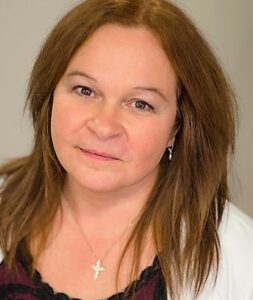 Author Susan Faw is the perfect example of what I mean by #SeriousAuthor. She not only writes amazing YA Fantasy, she also approaches her writing as an occupation.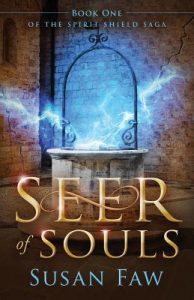
 Faw: I like to do a day or two of random reading online. I check out the weird and the wonderful posts that litter the Internet and start taking notes of strange occurrences or weird events. Ghost stories or reports are a great source of inspiration. Paranormal activity can lead to all kinds of magical concepts.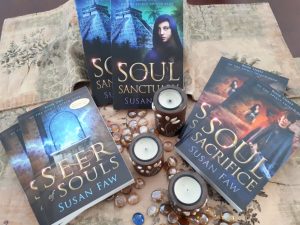






 Stay tuned for the latest info about Chanticleer Authors Conference presenters & sessions!










 BISAC Identifiers = The Beginning of Interest
 This article is by Sharon E. Anderson