Tag: how to use hashtags

  • HOW HASHTAGS can INCREASE ONLINE BOOK SALES – Part 4 by Kiffer Brown

    HOW HASHTAGS can INCREASE ONLINE BOOK SALES – Part 4 by Kiffer Brown

    Tips to Selling More Books Online – Part 4 by Kiffer Brown

    Hashtags
    And that is with just one hashtag…Make your social media posts work harder for you!

    The POWER of the HASHTAG

    Hashtags will make your social media posts work harder for you! They will amplify your posts. Hashtags will help new readers discover your books and help you discover new readers. – Kiffer Brown

    Definition of Hashtag:  A hashtag, introduced by the number sign, or hash symbol, #, is a type of metadata tag used on social networks such as Twitter and other micro-blogging services (i.e. Instagram, Facebook, Pinterest). It lets users apply dynamic, user-generated tagging that helps other users easily find messages with a specific theme or content. In other words: 

    Hashtags enhance your exposure to people who do not follow you. If you are just staring out building your social media platforms, #hashtags will help you increase your Followers — even if you only have one person following you. If you are already participating in social media, hashtags will enlarge your following!

    Hashtags are your hardworking  friends (you know the ones who will help you move or watch your kid in a pinch) in social media.

    • Hashtags help to gather different social media conversations about the same topic.
    • It makes the same topic easier to find and search throughout a social media platform.
    • Imagine being able to type in a word in your post that will allow other people on the platform to search the topic and, thereby, discover your post. Hashtags ( # )  will work for you in your posts on Facebook, Instagram, and Twitter.

    • Hashtags help to boost your social media posts beyond your own followers. It will help you find crossover markets for your books. Do some research to find out the hashtags that resonate with your targeted readers. For example if your work’s protagonist is an adult with autism, you may want to try #adultautism.
      • Or if your work centers around a protagonist who is a birdwatcher (example: Border Songs by Jim Lynch), you may want to have your social media posts use #birdwatchers  or #PNW  or #PNWBirds if the plot is centered in the Pacific Northwest Or if the work is science fiction but will appeal to computer geeks use #cyberpunk and #SciFiCyberpunk.
    • Hashtags need time to percolate. It will take some time to be able to drill down to discover the best niche hashtags to reach out to your audience. You must use the hashtags  over a long time to start percolating throughout the Internet and to allow potential new followers time to find you via #hashtag. Be patient. Be consistent.

    • Promoting on social media is a lot like brushing your teeth. You can’t just do it on Sundays or set aside a couple of days a month to do it. Your social media posts must be consistent and almost daily. You don’t have to spend a lot of time doing it— much like brushing your teeth, but consistency and long-term maintenance are the keys.   Some people I know set a tea timer or kitchen timer to keep themselves from going down the social media rabbit hole. Fifteen minutes twice a day is better than a whole Sunday spent posting.  Also, remember that social media levels the playing field against the big boys. It is mostly free (except for your time) and still a bargain as compared to the old Yellow Page ads or magazine ads.

    • A TWO-WAY STREET –– If you want others interact with you on social media, you must LIKE, COMMENT, and SHARE other peoples’ posts. Nuff said. Social Media is the world’s largest cocktail party—make the most of your networking time! Following a hashtag is just like following a friend. 
      • A friendly reminder:  The same goes with REVIEWS. If you want more consumer reviews, you will need to post more consumer reviews of others’ works. It is well-known by publishers that Editorial Reviews generate more Consumer Reviews (reader reviews).
    • Find Readers by Association with Top Authors in Your Genre by Discovering their hashtags and key words. Determine two or three best-selling authors’ works whose works you would like to have your books shelved next to in a bookstore. Then follow the author on social media (and interact), read and leave consumer reviews wherever you purchase books, and  subscribe to his/her blogs and emails. Again, a long time strategy, but when you are ready to for a “peer review” and/or ask for an author quote, you will have increased your chances. Discover their hashtags to discover new readers. 
    • #Hashtags can help you enlarge your reader base. Meanwhile, you can state that  “If you are a fan of MISS BIG AUTHOR’s works, perhaps take a look at my works while you wait for the next one in the series to come out… ”  A word of caution, make sure that your book is well edited and the best that it can be. Why? Because a few of Miss Big Author’s fans will take you up on your proposition. And if Miss Big Author likes your work, you may just get an endorsement blurb for your cover. Be ready for when Luck meets Opportunity and Preparation.

    Back to #Hashtags

    #Hashtags continue to work for you long after you have posted (percolation). The social media platforms’ crawlers continuously search for them and try to connect the people who use them.

    Here are some hashtags that READERS use:  #amreading

    #amreadingfantasy    or  #amreadingYA  or #amreadingthrillers   #summerreading    #tbr   (to be read)

    Here are some hashtags that writers and authors use:

    #amwriting  (1,045,508 viewers at the time of this article).  #novel (383,783 viewers at the time of this article)  #author  (1,448,021  viewers at the time of this article)

    Hashtags on Instagram

    If you only want to use #hashtags on INSTAGRAM, then use the following format:   #instawritingcommunity  #instawritersofinstagram  #instaamwriting

    On Instagram the hashtag   #books is banned. So, you must drill down instead of using the obvious. But #instafantasybooks is legal.

    One study shows that Instagram posts with a least one hashtag generate on average 12.65 percent more engagement.

    Other Hashtag Categories

    1. Brand Hashtags   #mysteryauthor   #cozycatmysteries   #spaceopera  #shewritespress   #ChantiReviewsBooks  #olreign
    2. Category Hashtags  #animals  #cats   #snickerdoodles  #PNW  #summerreads   #heartwarming #bebold  #sheplayshere    #WWIIhistory
    3. Event Hashtags  #authorsigning  #booksigning   #ComiconWest   #CAC20   #2019WFIFA  #internationalnursesday  #caterday
    4. Campaign Hashtags  #yourbookstitle  #yourseries   #titleofyourlaunchcampaign
    5. Feelings/Moods   #simplepleasures   #kitchenflowers  #rip   #petgrief  #ptsd  #swoon
    6. Activities   #bakingbread  #woodcarving   #daysailing   #yogaclass

    Hashtags NOT to USE

    • #Free
    • #giveaway
    • #deal
    • #offerexpires
    • #Sale

    Do not use ALL CAPS as it is seen as YELLING!

    The Jøssing Affair by Janet Oakley won the Goethe Book Awards Grand Prize. The award-winning novel is about the Nazi occupation of Norway and the Norwegian Resistance Fighters in WWII. There is also love, betrayal, espionage, and bravery.


    You can capitalize a couple of letters – for example:  #JossingAffairBookLaunch  #WWIINorway  #NorwayOccupation #NorwaySuspenseNovels


    Do not use ! or ? or ‘  or any punctuation in your hashtags besides the hashtag (#)

    Banned Hashtags

    Also, if you use a banned hashtag, your posts and account could be flagged and then “shadowbanned” which means that your posts will not percolate throughout Instagram.

    Some banned hashtags are innocent as #happythanksgiving  or #besties (banned because of overuse and spamming) to the egregious posts that you could imagine would go with these hashtags: #milf   #lingerie    #nasty    #xxx   #selfharm.

    Here is a link with the latest of banned hashtags of 2019. (2020’s list is not out yet).

    Hashtag Etiquette
    Where to Place Hashtags

    Hashtags may be used on any social media, and are typically found within a post in an #organic fashion, or at the end of the post like an index word. Twitter is a platform where the hashtag is so endemic that it often becomes like punctuation, performing its function while remaining nearly invisible to readers, as long as it’s not overdone.

    Using a hashtag as part of a sentence is understood and accepted on Twitter, probably due to the character limit. But on Google+ and Facebook the hashtags are used less and can be intrusive in the middle of sentences. When in doubt on Facebook and Google+, add your hashtags to the end of your post, even on a separate ending line.

    If your hashtags sticks out like a sore thumb, it may communicate “this is spam”, especially on some platforms, and that may create a negative reaction to the post.

    Hashtag Advice 

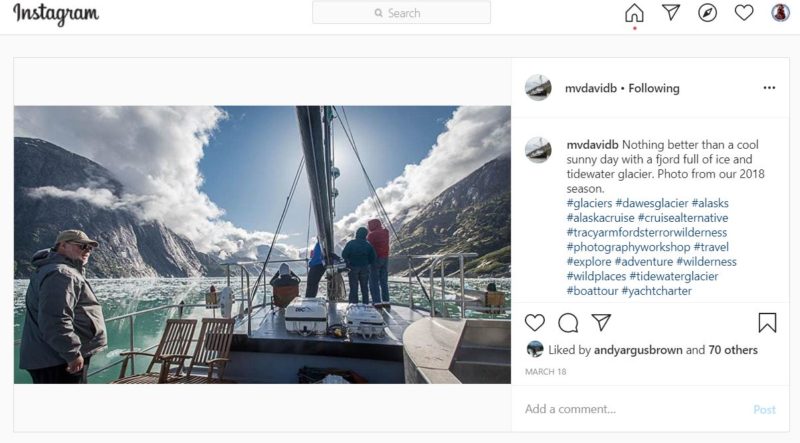
    Use 3 – 6 hashtags. Start with a popular standard then drill down. For example, @ChristineKatSmith used #catnap  #tabbycat   #happyhour  #landotter (a boater’s term for a cat) #friday #shelterinplace   Christine is the co-Captain of the David B, a small ship that offers adventure cruises to Alaska and the award-winning author of More Faster Backwards, Rebuilding David B. 

    In the above Instagram post, she used the following hashtags @ mvdavidb
    #glaciers #dawesglacier #alasks #alaskacruise #cruisealternative #tracyarmfordsterrorwilderness #photographyworkshop #travel #explore #adventure #wilderness #wildplaces #tidewaterglacier #boattour #yachtcharter #alaskayachtcharter #smallshipcruise #mvdavidb

    The post looked like this:
     

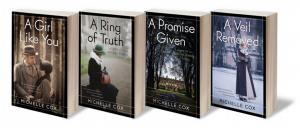
    Now to see how one of our favorite authors uses hashtags – Michelle Cox at @michellecoxwrites   Michelle’s A Promise Given won the Chanticleer Mystery and Mayhem Grand Prize along many other awards.

    Notice how she uses little known hashtags all the way to a broader net with #DowntonAbbey  #Chicago  #MissFisherMurderMysteries  and then associates her brand (#HenriettaAndInspectorHowardSeries) with the other hashtags such as #mustread  #booktofilm and so forth.
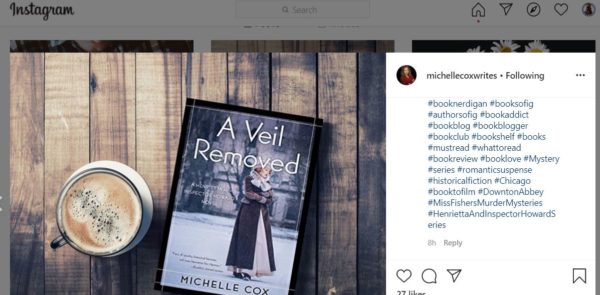
     

    This in an introductory blog post to hashtags. Remember that following a hashtag is like searching for someone or something. Just type your hashtag into the Search text field on the social media platform that you are posting on.

    Give it a try! Try it! You’ll like it! – Kiffer

    Chanticleer Reviews social media handle is @ChantiReviews   The hashtags we commonly use are:  #CIBAs  #ChanticleerFamily   #ChanticleerRReads  and the CIBA Divisions  such as #CYGNUSAwards  @MandMAwards  and so forth.


    HANDY LINKS – Chanticleer Reviews Tool Box Series 

    Click on these links to blog posts on the Chanticleer website for more information on how to increase online book sales: 

    How to Increase Book Sales Online – Part One

    How to Increase Book Sales Online – Part Two

    How to Increase Book Sales Online – Part Three

    BISAC CODES – Not Just Alphabet Soup

    Book Reviews – 4 Types and Why You Need All Four

    Social Media and Creating and Keeping Top of Mind Association with Readers

    Chanticleer Writer’s Toolbox

    Thank you for reading this Chanticleer Writer’s Toolbox post on Marketing and Book Promotion to Increase Online Book Sales.

    Stay tuned for our next post on the How to Increase Online Book Sales series.

    Also, we will continue to post the 2019 CIBA Finalists, so please stay tuned.

    And, we will have new writing craft posts from top editors coming your way to keep you writing and editing during these unprecedented times.


    We encourage you to stay in contact with each other and with us  during this stint of practicing physical distancing to prevent the spread of COVID-19.

    Let us know how you are doing, what is going on where you live, how are you progressing on your writing projects.

    I invite each of you to join us at The Roost – a private online Chanticleer Community for writers and authors and publishing professionals. You are welcome to email me for more info also.

    We are active on Facebook, Twitter, and Instagram. You can find us by using our social media handle @ChantiReviews

    Minimize physical contact! Maximize social connecting!

    Here are our contact emails:  

    General information:  Chanticleer@ChantiReviews.com

    Editorial:  BookEditor@ChantiReviews.com

    Reviews: Sanderson@ChantiReviews.com

    Me:  KBrown@ChantiReviews.com

    Take care, be safe.

    Keep writing and creating magic! 

    Kiffer and Sharon & Entire Team Chanticleer 

     

  • HOW to INCREASE ONLINE BOOK SALES – Part 2 by Kiffer Brown

    HOW to INCREASE ONLINE BOOK SALES – Part 2 by Kiffer Brown

    How to Increase Online Book Sales – Part 2 by Kiffer Brown

    I receive several emails a week from authors wanting to know if there is one thing that they can do to increase book sales. Many confess that they despise spending time that they could be writing on “marketing tasks” and abhor the idea of “wasting time” on social media.

    The Attack of Social Media – sometimes I feel this way…

    I get it. I truly do.

    However, as with any product, your books must have a marketing and promotional strategy if you are going to increase sales. Participating in social media is a must in just about any product marketing strategy.

    J.D. Barker, master of suspense and international best-selling thriller author and whose books are under contract for TV series and movies, reminded us at the Chanticleer Authors Conference,

    “Books are products—products to be sold.” – J.D. Barker

    If you want to make a living as an author,  never forget those simple words from J.D.

    At CAC 19, J.D. shared with us his very structured plan that he developed for launching his first novel. We hope to have him back soon.

    JD Barker presented at CAC19

    A successful marketing and promotion plan is part data driven, part art, and part luck. And you know the old saying that, “Luck is Opportunity meeting Preparation and Planning.” Your job is to write the best work possible, promote it like an expert guerrilla marketeer, and, of course, build your brand as an author. Easy Peasy. Well, no. But if you do, and one day the stars align, and those days do happen, you will be ready. And remember your plan doesn’t have to be perfect. Every little bit helps and builds.

    The main thing is to get started as another one of my favorite authors says.

    Whatever you can do or dream you can, begin it. Boldness has genius, power, and magic in it.  ~Goethe

    Your brand and book marketing strategy should be a multi-pronged approach that is consistent and plans for at least three years into the future. You can always pivot if needed.

    Remember that Budweiser, Pringle Potato Chips, Heinz ketchup, Reese’s Peanut Butter Cups,  and others pay the  $5.6 million dollars for a 30-second ad in the 2020 Superbowl just to keep their brands in your Top-of-Mind associations.

    Your marketing and promotion strategy is to keep your brand (author name) and products (books) promoted with  magazine articles, interviews, blog posts, social media posts, old-school marketing materials, graphics and visual images, etc. on a consistent basis with a few “major event promotions” throughout the year for content and P/R generation.

    Keep that $5.6 million dollars per 30-seconds in mind the next time you think that you are wasting time promoting your brand and your work on social media. And like the Superbowl ads, your social media posts must be compelling to stand out in a crowded field.

    Whether or not you are aiming to go the traditional publishing route or self-publish, building your brand and book promotion strategy is key to have a successful writing career.  Having a brand and marketing strategy will open many more possibilities and doors for you.

    Here is an all-too-familiar scenario that I have heard again and again from literary agents (mostly when we are having drinks together in the evening after book expos or trade shows):

    The conversation from the lit agent (no pun intended) generally goes something like this:

    I just read this compelling manuscript. I thought that it might have potential (as in commercial potential because that is what pays the bills). So, I got online to see what kind of digital footprint the author has. Crickets. The website’s last blog post was eighteen months ago. I clicked on the Facebook page–no fan-base or street team. Twitter was just re-posting of posts that have nothing to do with other authors in her genre or of interest to potential readers…and Instagram was the same. So, I guess I will have to give this manuscript a pass. It seems to me that the author just isn’t serious about having a writing career and I don’t have  the time to get her social media platform up to speed  while shopping the manuscript. 

    As opposed to this rare excited version of a lit agent discovering the magical gem of great writing and serious promotional efforts that I did have the opportunity to hear (and drink a celebratory glass of champagne with):

    Oh my god! I just read this compelling manuscript. I thought that it might have potential. So, I got online and JACKPOT! This author is doing everything right to reach her target market. Her marketing strategy will make it so much more easier for me to sell the book to _______ (insert publisher here). She has a lively website that is current and up-to-date. I saw a lot of consistent activity on her author Facebook page. Her Instagram posts are subtlety promotional. Perfect! And I see that she has a calendar full of scheduled events. It is so rare to find this combination of talent and business sense. 

    Now I understand that some of you will say, “Au contraire, mon ami!  If I self-publish, I will be the bane of literary agents. Lit agents will not touch self-published authors.”  I hear you mumble to yourself.

    As for the disbelievers who think that self-publishing makes you untouchable to literary agents, I will use J.D. Barker as one of the tried and true examples of disproving that is old advice from before 2010. What a difference a decade makes.

    J.D. Barker successfully published his debut novel as an indie and sold enough copies to land on the radar of the traditional publishers in a BIG way including seven-figure advances, two feature films, and a television series. 

    For now, please bear with me as I go off-topic for a bit… for those who are familiar with me, you probably have come to expect this wandering around bit on my part.

    SHORTS – (a prelude to Part Two — How to Increase Online Sales) 

    Even if you are planning on going  the traditional publishing route and not self-publishing, you will have to create a social media platform and a brand. Remember the book and the film Julie and Julia by Julie Powell. She is an inspiration to bloggers everywhere. Her book was basically a compilation of her blog posts.

    Julie Powell–inspiring bloggers everywhere!

    Hugh Howey self-published the science fiction blockbuster short story Wool – and Simon and Schuster picked up his omnibus of short stories. Howey is now sailing around in the South Pacific on his custom yacht as I write this. (I did have a chance to meet him several times before he embarked– he is a really nice guy.) Of course, everyone thinks that Howey  was an overnight success. It only took him ten years of writing consistently for one short story to take off and create a fandom for all of his works.

    Hugh Howey, author of WOOL

    Andy Weir self-published his debut novel, The Martian. He said I was writing all sorts of stories. I had three different serials going, and random short stories that I would post. I just kind of wrote whatever I wanted, and ‘The Martian’ was just one of the serials, but it was the one that the readers clearly liked the best, and so that helped encourage me to write it more than the others,” Weir told Recode.

    It took Weir a long time to get his writing career off the ground. He even took several years of as software programmer to work on his writing, but then had to go back to programming until The Martian took root and agents were contacting him about publishing deals and movie deals.

    As Jerry Macquire said, “Show me the money.”  In the publishing industry that equates to copies sold and your author brand.


    CIBA SHORTS

    We became so excited about Short Stories from writing this blog post that we decided to finally offer a CIBA Book Awards division. We have received many requests for an awards program for  just for short stories, novelettes, and novella. So without further ado… The CIBA Shorts!

    Anthologies and Collections are accepted along with solitary works. Click on this link to learn more https://www.chantireviews.com/contests/


    Back to the point of Part Two – as I circle back around to:  How to Sell More Books Online!

    Link to Part One of How to Increase Book Sales 

    Michelle Cox, a Mystery & Mayhem Grand Prize Winner, shares her strategy for promoting  her well-received Henrietta and Inspector Howard mystery novel series.

    Michelle says, “I spend five to seven hours a day doing marketing and PR—anything from writing the blog or the newsletter or articles or interviews, taping podcasts, setting up events, answering email, attending to social media, etc.  It’s really a full-time job, though, sadly, the actual writing, the part I love, is the part I get to spend the least on.”

    Award-winning mystery author, Michelle Cox

    Michelle continues:

    All marketing is pretty elusive, isn’t it?  It’s a constant process of throwing things at the wall and seeing what sticks.  It’s also important to remember that what works for one person, might not work for everyone.  It’s not an exact science.  If it were, we’d all be rich!

    But, in general, here are some good marketing tips that I have found to work:

    • Try to figure out where your readers are. Most of my readers, for example, are on Facebook, so that’s where I spend most of my social media time.
    • Think of yourself as a brand and try to match your posts accordingly. I post things about myself or the book or writing, but mostly old recipes, period drama news, or old stories from the past (which constitute my blog).
    • Also, I’m very careful never to post anything religious or political.  This is a business, and the more you see yourself that way and follow basic business protocols, the more successful you’ll be.
    • Try to build your newsletter list by offering a freebie (such as free story, writing tips, a webinar, a prequel). Personally, I do it by running contests with really big prize packages. I make sure to state that the contest winner will be picked only from my newsletter subscribers.  I pay a designer to create a beautiful graphic of the prizes, post it on Facebook, and then boost the post.  Not only does this get me a lot of new subscribers (sometimes up to 1,000!), but it exposes the series to new readers as well!
    • Build your network. Join online author groups (I am part of a fabulous private FB group organized by my publisher, She Writes Press. We all share ideas, marketing tips, and offer support and advice, especially to the newer authors just coming on board.  It’s a collective wealth of information.) or real-world groups in your area.  Don’t be jealous of the success of others, but help each other as much as possible. As my publisher, Brooke Warner has said, “There’s room for everyone at the table.”
    • Show up at other authors events, write reviews, help promote whenever possible.  Go to conferences to meet not just readers, but other authors who can potentially help you.  Remember that you are a business, and you need to do work within your community to begin standing out.

    Read more of Michelle Cox’s Marketing Tips that she shared with us by clicking this link. 

    You can discover more Book Marketing and Promotion Gems by reading Sharon E. Anderson’s 10 Question Interviews blog posts series  that can be found on the Chanticleer Reviews website.  

    The latest interview is with the CYGNUS Grand Prize winner, J.I. Rogers. Rogers discusses her marketing tips and her Patreon marketing strategy. Click here to read. 

    Please stay tuned for Part Three of How to Increase Online Book Sales by Kiffer Brown

    HANDY LINKS – Chanticleer Reviews Tool Box Series 

    Below are links to blog posts on the Chanticleer website that have more information on the above points: 

    How to Increase Book Sales Online – Part One

    BISAC CODES – Not Just Alphabet Soup

    Hashtag Primer 

    Book Reviews – 4 Types and Why You Need All Four

    Social Media and Creating and Keeping Top of Mind Association with Readers


    Chanticleer Writer’s Toolbox

    Thank you for reading this Chanticleer Writer’s Toolbox post on Marketing and Book Promotion to Increase Online Book Sales.

    We do a post (SOON) about book selling and distribution platforms – increasing your target market globally.

    Also, we will continue to post the 2019 CIBA Finalists, so please stay tuned.

    And, we will have new writing craft posts from top editors coming your way to keep you writing and editing during these unprecedented times.


    We encourage you to stay in contact with each other and with us  during this stint of practicing physical distancing to prevent the spread of COVID-19.

    Let us know how you are doing, what is going on where you live, how are you progressing on your writing projects.

    I invite each of you to join us at The Roost – a private online Chanticleer Community for writers and authors and publishing professionals. You are welcome to email me for more info also.

    We are active on Facebook, Twitter, and Instagram. You can find us by using our social media handle @ChantiReviews

    Minimize physical contact! Maximize social connecting!

    Here are our contact emails:  

    General information:  Chanticleer@ChantiReviews.com

    Editorial:  BookEditor@ChantiReviews.com

    Reviews: Sanderson@ChantiReviews.com

    Me:  KBrown@ChantiReviews.com

    Take care, be safe.

    Keep writing and creating magic! 

    Kiffer and Sharon & Entire Team Chanticleer 


  • Chanticleer Author Marketing Primer: Hashtag How-To

    Chanticleer Author Marketing Primer: Hashtag How-To

    Authors marketing their books on social media need know how to use hashtags. Hashtags are a fairly simple concept, an effort to index categories among posts, but for the newcomer to social media they can be intimidating. Even those who know about hashtags may not be aware of the intricate ways to maximize their benefits.

    Hashtag Types:

    • Organic/Topics
    • Promotion (brands, products, people, events, etc.)
    • Discussions/Issues
    • Activities (Day-of-the-Week/Themes)
    • Asides (humor, reflection of emotions, feelings, states of minds related to the post)

    Why do we use hashtags?

    There are many reasons to use hashtags, but keep in mind that our most important reason for using a hashtag is to enhance our exposure among people who don’t follow us. Even if you have one Twitter follower, using #amwriting has the effect of increasing your followers for that one post by showing it to anyone who is searching on that topic.

    If you are using a hashtag that is unique or has very little exposure–which you might do to create a branding effect, or spawn a new social activity (like #YouMightBeAWriterIf)–you would pair it with a hashtag with higher exposure to give your post better support.

    Basic Hashtag etiquette:

    • Don’t go overboard. Use two, maybe three. More than that will communicate “this is spam” to people.
    • Use clear and concise hashtags, generally. Long hashtags are not easy to read. So keep them to a minimum and know that if you do use one some eyes will slip past without comprehension.
    • Use hashtags that are relevant to your post and help people find the posts they want to find. Think of it like creating an index at the back of a cook book. If cream puffs were listed under #shrimp that would confuse and possibly upset a lot of people.

    Where to Place Hashtags

    Hashtags may be used on any social media, and are typically found within a post in an #organic fashion, or at the end of the post like an index word. Twitter is a platform where the hashtag is so endemic that it often becomes like punctuation, performing its function while remaining nearly invisible to readers, as long as it’s not overdone.

    Using a hashtag as part of a sentence is understood and accepted on Twitter, probably due to the character limit. But on Google+ and Facebook the hashtags are used less and can be intrusive in the middle of sentences. When in doubt on Facebook and Google+, add your hashtags to the end of your post, even on a separate ending line.

    If your hashtags sticks out like a sore thumb, it may communicate “this is spam”, especially on some platforms, and that may create a negative reaction to the post.

    How to vet a Hashtag

    Always run a search of the hashtag on Twitter or the platform you will be using, to make sure the other posts using it will be good company for your posts. You don’t want to accidentally use a hashtag that has a lot of inappropriate content under it–or worse, co-op a hashtag meant to promote an important social issue for your own self-promotion.

    Next use https://ritetag.com/hashtag-search to look up your hashtags to see how well they will serve as promotional tools. RiteTag will give ratings to guide you.

    These results will change over time, but here are a few examples of the different ratings that RiteTag uses to vet hashtags:

    #Free shows up as red with a “!” and a message “Don’t use this hashtag or you will get lost in the crowd”. The statistics show that people are tweeting over 5000 times an hour under that hashtag–lost in the crowd is right!

    #Writing shows up as green with a lightning bolt and the message “Use this hashtag to get seen now”. The statistics show it’s being used nearly 300 times an hour, but over 3.5 million people are seeing those posts. But keep in mind whats hot today could be gone tomorrow.

    #Pubtips shows up as blue with an hourglass and the message “use this to be seen over time”. The current stats don’t look very impressive, but the history shows that it has regular and consistent surges in activity.

    #Pubtip (I intentionally used this one to demonstrate how one little letter can make a difference) shows up grey with a crossed circle and the message “don’t use this, very few people are following it”. The stats are almost empty and the history shows very low usage.

    Enjoying these tips? Learn how to market and sell more books at our upcoming Chanticleer Authors Conference. #SeriousAuthors register for #CAC17