
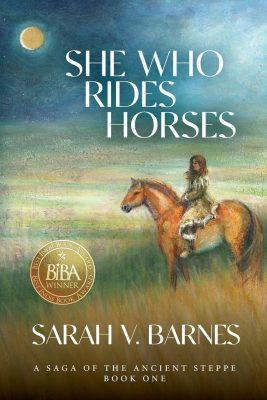
Wild horses race across the ancient Pontic-Caspian Steppe, hunted by predators and pastoral clans. But in Sarah V. Barnes’s She Who Rides Horses, Naya, daughter of a clan chief, ventures beyond the understanding of her people to form a bond of true partnership with a young filly.
Naya spends day and night watching a wild herd, drawn to a filly who shares her burning red hair and a dream of purpose to be found between them. But, nearing adulthood, Naya will soon be expected to marry and likely leave her clan for another. Her mother Sata and grandmother Ajiwa conspire to give Naya the chance to prove that she can forge a bond with the wild horses like those her people treasure with their livestock.
Though she has a vibrant will and the promise of a mystical vision behind her, Naya risks much more than social standing to ride the red filly.
An accident leaves Naya terribly injured, separated from most of her clan on their migration south, and caught on the steppe as winter winds howl. Sata has only two mistrusted strangers—travelers Oyuun and Aytal—and a few sleds of spare supplies to watch over her daughter throughout moons of cold and hunger. But in the midst of the snow, a familiar band of horses draws near their camp.
Through the wondrous vistas of the spirit world, the precarity of survival, and the choice whether to forgive the young man who wounded her, Naya reawakens to her dream of becoming She Who Rides Horses.
Barnes fleshes out the Pontic-Caspian Steppe of 4000 BCE with complex and well-researched societies.
Naya’s people live with a palpable connection to the natural world. Their relationships to plants, animals, and the landscape itself show how comprehensively their pastoral lifestyle shapes both daily life and culture. She Who Rides Horses explores the power structures in such a society, with Naya’s father Potis balancing his influence against that of the clan’s priests who claim sole access to the realm of the spiritual—something which Naya herself could threaten.
Barnes builds this story on an impressive foundation of historic research for such a long-gone time. Drawing from archaeological and genomic findings, she presents a fictional but realistic setting for such a monumental development as the early domestication of the horse. The words and names of her characters even reference the Proto-Indo-European language, among those of other nearby cultures. For lovers of ancient history, Barnes includes a list of references on her author website.
This historical detail comes through in colorful descriptions of every location and the tasks required to live within them. Wilderness and pockets of human settlement alike become palpable. As this world flows through the senses of each character, it reveals more about them both.
She Who Rides Horses stands out for its central cast caught between conflicting burdens and desires.
Naya and Sata share a painful distance from their own culture. Sata yearns for the far-away people of her childhood, and Naya bucks against patriarchal limitations while hoping that her elders can learn to appreciate the horses as she does. Oyuun, having lost his beloved many years ago, finds a connection growing between himself and Sata that could tear the bonds of both of their lives. Aytal gives up everything that he can in pursuit of forgiveness, even if it means turning away from his own purpose.
Each must find their true path forward, and decide which responsibilities to drop from their shoulders—or which to take on.
She Who Rides Horses switches between these characters’ perspectives, showing a more rounded view of their ancient world. No two have the same thoughts on their societies or relationships. The more readers learn of these disparate people along their shared journey, the more deeply they’ll care for each of them.
For anyone interested in ancient history, nuanced character-driven stories, or of course our world-changing equine companions, She Who Rides Horses by Sarah V. Barnes will satisfy and fascinate in equal measure.
Readers will gladly bound right into the second book of the Saga of the Ancient Steppe, A Clan Chief’s Daughter.

 Award-winning author Barbara Salvatore brings human foibles, horse traits, and herbal lore together through a young teenage girl’s eyes in her historical fiction novel,