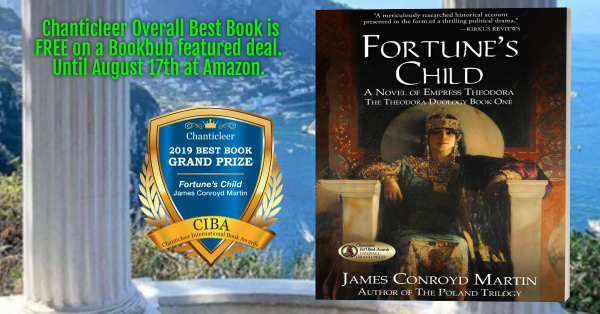
I am excited to share with you two great books – Chanticleer Overall Grand Prize Winners – that are on special at BookBub and Amazon for the next several days! Be sure to add these to your To – Read digital library!
FORTUNE’S CHILD, A Novel of Empress Theodora by James Conroyd Martin
James Conroyd Martin brings to life one woman we should all know better in his multi-award-winning, epic novel, Fortune’s Child: A Novel of Empress Theodora.
Like Cleopatra, Empress Theodora was a legend in her own time. And also, like Queen Cleopatra before her, Empress Theodora’s life and accomplishments were distorted and maligned by the male historians of her own time. Even after death, men who couldn’t bear or couldn’t believe that a woman, particularly a woman of the lower classes as Theodora was, could possibly have accomplished the things she did or wield the power she had. Chanticleer Reviews
If you didn’t get the BookBub link, here are links where you may download this exceptional historical fiction for free through August 17th, 2024.
Don’t delay! Download your copy today for your To Read Library!
ALSO, here is another fantastic offer showcasing on BookBub another Chanticleer Overall Grand Prize Winner – a Mystery!
The Only Witness by Pamela Beason
Can a gorilla identify a criminal? Neema is a “signing” gorilla that is part of an animal communication project (think KoKo). She is also the only witness to a crime.
A missing baby. A teenage mother suspected of murder. A jaded detective whose reputation is on the line. A signing gorilla destined for the auction block. A scientist who is about to lose everything. Will the revelation that a gorilla is the only witness to the crime save or doom everyone involved?
I, personally, am a big fan of the “Neema” series! It is a marvel of storytelling and a riveting mystery. Read Chanticleer’s review here.
If you did not receive the BookBub email for the 99 cent sale of The Only Witness, you can download it to your To – Be Read digital library with the link below for 99 cents until August 21, 2024!
We are passionate about helping readers discover great reads and new authors!
If your Chanticleer Award Winning Book is featured in a book promotion for free or 99 cents, we’d love to share it! Email us with the related links to Info@ChantiReviews.com with Book Special in the Subject line.
If you are interested in the Chanticleer International Book Awards program, please click here.
In his debut novel The Frog-Eyed Gospel: A Texas Exodus, Leslie DeBrock weaves together the inspiring yet complex stories of a diverse cast of characters, all making their way through a tense Texas summer in 1965.
Peter Loucas is the boy at the center of this story, a senior in high school bent on going to college and becoming the newest preacher in the Bible belt. His faith in God is passionate and strong — until his father is killed in an oilfield accident. In his grief, Pete finds himself suddenly questioning the teachings to which he had given himself blindly for years.
The setting of the story couldn’t be more poised for conflict: Sabine Gap, a small town with religious intimidation and racism everywhere you look. The Vietnam war rages and veterans flock home traumatized. Supporters and protestors clash nationwide. The residents of Tin Cup —Sabine Gap, a small town replete with religious and racial rigidity. While protests roil the nation, veterans return, some walking; some not.
As Pete begins to question his faith, he finds his world suddenly colliding with others.
He works the summer at a wax plant, falls in love, and sees new sides of Sabine Gap. Witnessing firsthand the atrocities that Black Americans face gives him insight into the racist foundation of his town. And as Pete continues his journey to redefine himself and his beliefs, he is pressured by the threat of being drafted if he doesn’t attend college.
This novel offers a look into the violence of the 1960’s. DeBrock does not shy away from hard truths of the times yet captures bittersweet moments in pockets of tragedy.
Any reader who has escaped a stifling hometown can relate to Pete’s development as he learns the life he was born into is not one he can live with.
The end of Pete’s journey not only captures the changes and traumas that he has gone through with emotional maturity and development, but also through a drastic change in setting.
Fans of historical fiction, literary fiction, and suspense will find their favorite genres swirled together as DeBrock walks them through a tale of questioning the society around you. Pete may still be uncertain of his place in an open-minded world, but he knows that his own transformation is inevitable.
The Frog-Eyed Gospel: A Texas Exodus captures the difficult journey of carving your own path in an intolerant town. DeBrock’s vivid and passionate characters seem like they’ve stepped right out of 1965 Texas, and each one brings perspectives that enlighten and inspire.
David Fitz-Gerald concludes the Ghosts Along the Oregon Trail series with a grand finale for an eclectic cast of characters, as the long wagon train is finally Rolling Home to their new lives in the wild west of Oregon.
With the end of the trail just out of reach, however, their hopes dwindle and their hunger rages. The rigor of the western environment continues to test their determination and threaten vows of heartfelt romance. These weary people ache and mourn losses, while seeking new ways to survive and pull each other forward in the face of impending winter.
This wagon train of travelers will also face venomous villains who have been lurking in the shadows, outlaws waiting for their best opportunity to pounce.
Now they feel the traveling train is at its weakest, and strike without mercy. Dorcas and her family are in a desperate situation, clinging to the hope of a better life ahead. But even if they can hang on to reach that final destination, they doubt whether the life they’d planned in Oregon is still the future they want.
Injured at the beginning of this final leg of their journey, Dorcas Moon struggles desperately to keep her family together.
Her young children have had to rapidly grow up and take on responsibilities well beyond their years in order to keep pace with this treacherous, unpredictable life. Surrounded by perils, their joys are fleeting and cannot be taken for granted.
Fellow travelers have become friends and family, tying their futures together, and Dorcas feels the weight of responsibility for all of their dreams.
Dorcas’s children are pulled deeper into the world of spirits and the paranormal. Even Dorcas begins a tentative connection with those forces. She must also open herself to feelings in the material world— she had been resistant to embracing the love she has for Agapito, but now she can no longer hold back. Does he feel the same?
The wagon train keep moving, but at times with a painful slowness. When they roll through snow on the trail, their fear becomes tangible. If they’re caught in the heights of the mountains when winter descends, warmth and safety will be impossible to reach.
Disagreement among the travelers on the best way forward fuels those fears. Decisions need to be made and mistakes can be deadly. The dangers of river crossings claim Dorcas’ own belongings and wagon. And when the outlaws strike, Rose and Dorcas herself are both kidnapped. Precious lives are lost and more surprises yet wait in store. Will they ever see the promised land of Oregon?
Our wagon master, author David Fitz-Gerald, has skillfully guided readers on an epic journey to a time and mode of travel that excites the imagination and pushes the limits of suspense.
His story is compelling from the first book all the way through to this incredible end of the trail. The growth of the characters through their adventures, sacrifices, and joys along the way shows human nature’s persistence and people’s dedication to each other. As long as there is the glimmer of hope, Dorcas and her band will set their sights on the future, and set their wagon wheels Rolling Home.
Everything We Had, book one of Tom Burkhalter’s No Merciful War series is an inexorable thrill that will grip readers tight. It starts with a poker game, through which a main character’s luck soon becomes evident. But will that luck hold out?
Jack—the poker player—and Charlie—Jack’s older brother—have been separated by war, even though that war has yet to be declared. Everything We Had focuses more on the machinations leading up to US involvement in World War II than on actual combat. The gears of war that have so many young men caught in them move with gradual but inevitable force, and so Everything We Had takes a more thoughtful approach to a historic moment in time.
Connecting with the characters is a gradual process as you get to know the intricacies that make up their individual personalities. This sets the reader up to feel the emotions of the characters as they face an uncertain fate, and throughout the book the author’s clear and methodical research shines with details such as specific views, locations, and—most notably—comprehensive descriptions of the airplanes Jack and Charlie pilot. This allows the reader to become deeply familiar with the motivations of the characters and the capabilities of the airplanes they fly.
The importance of their family gradually emerges, too, through their mother’s letters and their memories of their father who flew racing planes. The more readers learn, the more attachment they feel to these characters, giving weight to the growing danger they face.
Even side characters in Everything We Had have names, hometowns, and sweethearts they’ve left behind. This grants a sense of truth in the actual people who were lost to war.
Readers may not track every last piece of information—especially the technical details of planes and flight—but the story remains accessible, with its most important details emerging with time. Like flying a P-26, it takes a bit of patience and skill to follow everything in this book, but Burkhalter trusts his readers to keep up.
The perspective switches between Jack, Charlie, and occasionally Al, who becomes Charlie’s navigator. Al’s viewpoint lends interest at first, but Everything We Had focuses on Jack and Charlie’s narratives as they become more complex and dire.
Through dialogue, readers start to piece together the puzzle: why Jack and Charlie’s father is gone, who Jack’s mysterious love interest is, and the strength of Charlie’s desire to be a leader. Burkhalter makes good use of dialogue for exposition as readers see how the war gradually unfolds, and how little information the men prepping for combat are told. For much of the book, Jack and Charlie aren’t even sure of each other’s whereabouts.
Sensory descriptions help ground this intricate story.
A few wonderful flying scenes—including Jack flying in challenge to a rival pilot—give physicality to the technical descriptions of planes. Small details, like a black Bakelite telephone, and a manila envelope holding mysterious contents, make the narrative even more tangible—not to mention historically accurate. Character descriptions remain simple, but with so many named characters in the story, this helps avoid overwhelming the reader with information.
The book uses true-to-form period language and stereotypes of US enemies. While this can make for an uncomfortable read at times, it serves the book’s historically-accurate illustration of a growing conflict. However, the main characters show their good hearts. They speak respectfully of women and, for the most part, of each other. In fact, a sense of camaraderie grows steadily even among former rivals as the war creeps closer.
When the war arrives, late in the book, it shakes the reader like a stone thrown into the still pond of the characters’ lives, who wait for war with a growing sense of apprehension.
With war, of course, comes injury and more death than these characters have ever seen.
Yet Burkhalter steers away from lurid, bloody descriptions and instead focuses on how the violence affects Jack and Charlie internally as people. They come from a privileged background, with a healthy dose of luck, and have distinguished themselves each as leaders by the time war arrives. Yet it’s far from certain that these accolades will help protect them from the hopeless-sounding odds: the US is under-prepared and low on supplies, while the enemy has at least one ace in the hole.
After such a carefully paced book, the ending comes quickly, and leaves some loose ends untied, nudging readers to continue with this fascinating series.
Thanks to Burkhalter’s meticulous research, real events, places, and even people in the early Pacific war get a well-deserved remembrance in the form of fiction.
The 2024 JOURNEY Book Awards for Overcoming Adversity Narrative Non-Fiction Long List will be published soon!
The Ozma and Goethe Awards both close at the end of July! Don’t let your History become a Fantasy!
We’re delighted to continue promoting the First Place Winners in our brand new “Round Up Articles” here, and our Grand Prize Winners in the Chanticleer Int’l Book Awards Hall of Fame Articles!
These are the promotions that have come out so far!
We’re committed to maximizing our authors digital footprint through long tail digital marketing. Through our prized Editorial Reviews, we do this with our Chanticleer Under The Hood SEO Boost.
We use the same technology for our CIBA posts combined with reposting. A lot of reposting. Every time an author’s book advances on our list we promote it on our website, social media, and in a newsletter blast. Why?
Your book is worth being discovered!
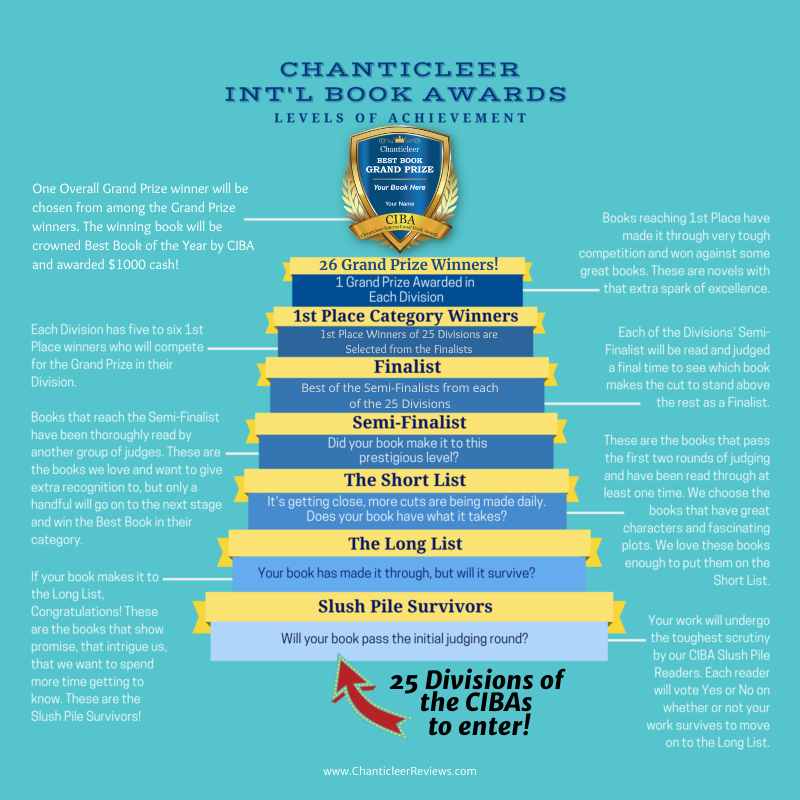
You put in so much work to create this book, we want to treat it with the respect and care it deserves! That’s why we take you through the Levels of Achievement.
Our normal posts tend to have double the response and interaction rate of comparable businesses. The CIBAs posts announcing when work advances in the Book Awards is five times greater than our regular posts and still double that of comparable businesses that run writing competitions. And that is for every Award post that goes out. The way we do this is simple.
First, we give each division breathing room on Social Media, on our high traffic website, and in our Newsletter. The consistent promotion and spaced promotion keeps every post prioritizedinstead of devalued by search engines for over-posting.
We also try to tag each winner on Facebook within their CIBA divisions. Again, the spacing prevents Facebook from devaluing our posts and lowering your exposure.
Under the Hood with SEO
Publishing is the Hub of Technology. There’s a lot great at Chanticleer, but our emphasis on being ahead of the technical curve is something we pride ourselves on. Our Robust SEO system that we use for both our CIBAs and our Editorial Reviews are the cornerstone of using technology paired with promotion.
You can see the article we put together specifically on the All In One Search Engine Optimization Tool (AIOSEO) we use here.
While most SEO tools recommend a score between 60-80, we always strive to exceed that, with many of our Book Award posts receiving a score over 90. We do this through our rigorous attention to detail surrounding the optimization of heading distribution, sentence length, alternative text, key phrases, meta data, tagging, and much more. There’s no replacement for basic elbow grease when it comes to the secret sauce that maximizes our posts so that web crawlers love them and promote our authors’ writings as much as possible. We know from client feedback that it really makes a difference!
Human Beings Make the Difference
A rare photo of the Chanticleer staff all in one place. And, yes, that is a bag pipe under the table.
We are a small business with huge reach that works hard to address every question, email, and comment we receive directly with care, empathy, and expertise. Putting together an internationally attended conference with authors from India, Australia, Portugal, the UK, and other countries takes hours of dedication and careful planning. We bring that same energy and enthusiasm to the CIBAs and promoting the books submitted to us year round
Most of all, the Chanticleer Int’l Book Awards is a labor of love!
Love of Books, love of words, love of storytelling, love of authors,
And love of the writing community!
Thank you to everyone who submitted to the 2023 CIBAs and to the outpouring of submissions that have come in to the 2024 CIBAs already! Every year the quality and intensity of the competition is better than the year before, and we are always blown away by the incredible work you send our way.
Thank you for making Chanticleer possible and trusting us with your work!
A Song That Never Ends, the first volume of a two part series by Mark A. Gibson, opens a dramatic fictional saga of the Hamilton family from the late 1930s Depression era, to 1967 and the Vietnam conflict. Here against the backdrop of a South Carolina tobacco farm, we come to witness a family in turmoil.
The calm and reserved Walter Hamilton and his rebellious, impulsive wife Maggie strive to build a life and raise a family. But the couple is tested by a series of misfortunes—miscarriages and stillbirths, and Walter’s enlistment during WWII leaving him with guilt-induced PTSD as he deals with the memory of fallen comrades.
At the center of this heartfelt story is James, the middle child, who at the tender age of eight is forced from his home due to a horrific accident and sent to live with a widower uncle.
James proves to be an extremely intelligent and talented youngster who longs for a connection to his family. In the meantime, he learns from his gracious uncle to deal with dire situations and unexpected circumstances in life, as well as the importance of having a charitable heart. Under the tutelage of this kind, caring, and nurturing man, the story begins to evolve into a coming-of-age tale.
Clearly a character driven work, author Gibson aptly weaves themes of love, loss, and resilience throughout.
Though James is unjustly relocated it ultimately proves a positive experience, spending time away from his own dysfunctional family including a depressed mother who drowns her sorrows in vitriol, a ne’er do well, self-centered brother, and a father wrapped up in his own laments. We see how the twists of life shape the character and emotions of these engaging individuals.
While the story prologue opens in 1967, the narrative quickly moves to the 1930s and subsequently keeps a steady pace as chapters move the action ahead in chronological order.
Gibson carefully places the story within its historical context by showcasing details of each passing era. Here readers will witness the struggles to provide and survive during an economic depression, and the feelings of family separation and a husband’s need to serve in WWII. Years later we see a son follow suit and get shipped off to fight an unfavorable conflict in the jungles of Vietnam. In another instance, when enthusiastic teens rebuild an old roadster, Gibson provides a solid history of stock car racing and its roots with the bragging rights of bootleggers.
Gibson keeps his audience invested up until the final moments when the closing page notes “To Be Continued…” It’s the perfect set-up for the second volume to continue with the Hamilton family saga. Whatever Gibson has in store for his readers is sure to be another well-crafted experience rich in both character and detail.
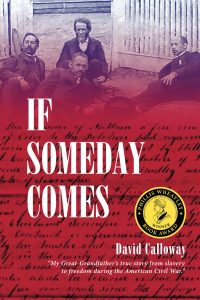
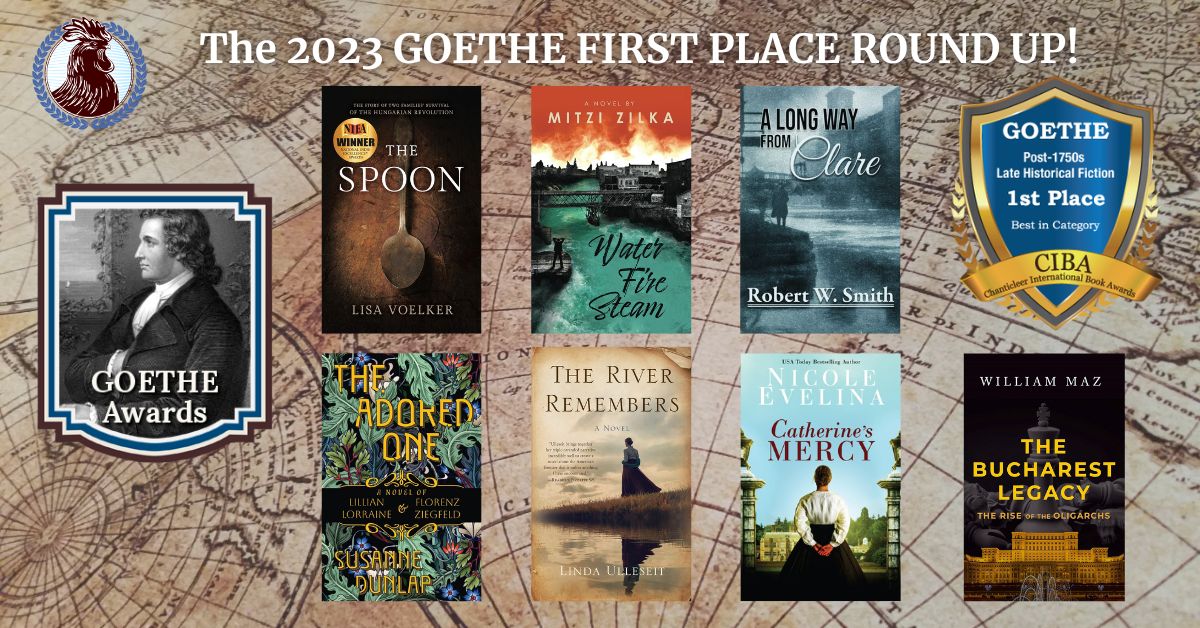
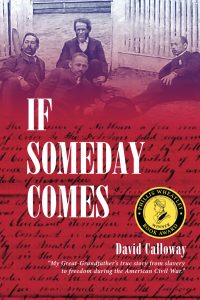
The Goethe Book Awards recognize emerging new talent and outstanding works in the genre of Late Historical (Post 1750s) Fiction. The Grand Prize Winner, David Calloway’s book, If Someday Comes will be promoted for years to come in our annual Hall of Fame article, as well as be featured on the Goethe contest page year ’round!
The best part about being a Chanticleer Int’l Book Award Winner is the love and attention you get all year ‘round!
The Spoon is historical fiction based on the personal anecdotes of survivors of what we now know as the 1956 Hungarian Revolution. At the heart of The Spoon is the true story of two people incongruously brought together during the maelstrom of this historic event; a story that is embodied in one small heirloom and remembered and shared through the generations when the family gathers each year for Christmas.
From Chanticleer:
Lisa Voelker’s historical fiction novel, The Spoon, takes us back to the 1950s in Hungary during the daring student uprising, and attempted revolution,. The author weaves historical facts with fiction in the form of family lore that has been handed down for generations.
We follow scores of people whose lives intersected during this uprising of 1956. The revolution was, at its inception, a time of joyous upheaval, but in less than two weeks became one of devastating dissolution. People fled Hungary by the thousands, but not before giving the Soviet Union a taste of their discontent.
Voelker introduces Rebeka, a member of the Varga family with old ties to the bourgeoisie, who lived a life of privilege on a farm. She is contrasted by Peter, a member of the Turea family who attends Budapest Technical University, where students began demonstrating against the Hungarian Government that was under Soviet control.
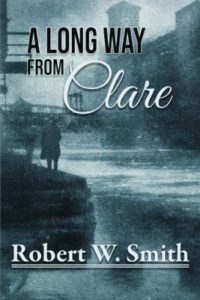
Conor Dolan, a young Irishman, travels to Chicago in 1903 to visit his older brother; instead, he finds a mystery. His journey sparks a quest to peel away secrets and rediscover a dead sibling he idolized but never really knew as he strives to learn the true meaning of brotherhood.
His search reveals an Irish Republican plot to assassinate a visiting British royal. In the process, he is drawn into an alliance with two women: a mesmerizing Jewish widow and a struggling young Irishwoman. Each teaches Conor existential truths of life and love in her own way.
But the brother he finds may not be the brother he remembers. A Long Way from Clare is a story of Chicago’s early twentieth century immigrants and one man’s struggle with both bigotry and justice in an unforgiving city where no good deed goes unpunished.
From Chanticleer:
Twenty-four-year-old Conor Dolan had intended to surprise his older brother and catch up after years apart. However, what he finds when he arrives in Chicago will spark a harrowing mystery, in A Long Way from Clare by Robert W. Smith.
Kevin, a beat cop in twentieth-century Chicago’s worst neighborhood, was found six weeks before Conor’s visit, in what the police have dubbed a suicide. However, Conor has his doubts. Each time he asks people about Kevin, he is met with resistance and denial. When Conor speaks with Detective Flynn, the man assigned to Kevin’s case, his suspicions become certainties. Flynn’s bizarre behavior, the minimal effort on the police’s part to investigate, and the men following Conor at every turn convince him to stay in Chicago rather than return to his home in Springfield.
Conor’s determination to find answers to Kevin’s death lead him in a dangerous dance with darkness amidst the shadows of Chicago’s underworld.
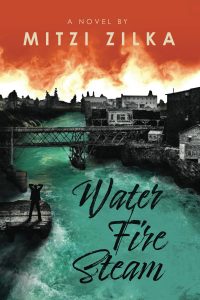
The year is 1884. Rolla Alan Jones, an ambitious dreamer fresh out of an East Coast engineering school, is commissioned to design and build the first water system in Spokane Falls, Washington, a booming town of twenty-thousand. He is everyone’s golden boy for five years until the city burns down on August 4, 1889. The once-celebrated engineer is scapegoated for the catastrophe alleging his system yielded inadequate water pressure. Asked to resign, betrayed by his friends, shunned by the community, and abandoned by his pregnant wife and three-year-old son, Rolla must find the strength to reinvent himself or return to New York as an abject failure. Based on a true story, Water Fire Steam is a story of forgiveness and redemption for anyone who has ever had to claw their way back from an unwarranted accusation.
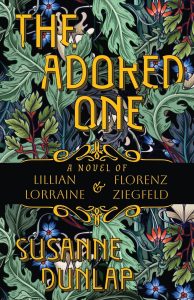
Lillian Lorraine was a naive 15-year-old chorine on Broadway when she attracted the notice of the notorious 41-year-old Florenz Ziegfeld. Accustomed to getting what he wanted, Ziegfeld took Lillian under his wing and into his arms, giving her coveted numbers in the Ziegfeld Follies and taking control of her career. But Lillian’s rebellious spirit chafed against him, refusing to play according to his rules, and nearly destroying her own career in the process. The Adored One follows her through rise and fall after rise and fall as she comes of age in a world where her youthful beauty was an asset-and a liability.
From Chanticleer:
Step into the glittering world of fame and betrayal in Susanne Dunlap’s The Adored One. At just four years old, Leleanne de Jacques, aka Lillian Lorraine, began her acting career. After fleeing an abusive husband in San Francisco, Mary Anne, Lillian’s mother, moves to Philadelphia, seeing her daughter’s talent as their potential meal ticket.
Soon after arriving in Philadelphia and changing her daughter’s name, Mary Anne relocates them both again to New York, where she puts Lillian in front of artists who see her potential for print ads. Lillian soon meets Fred McKay, her first talent agent, and she begins performing in Lee Shubert productions.
When Florenz Ziegfeld sees Lillian onstage, he knows he must have her, both in his productions and his bed. At only sixteen, Lillian signs with Broadway’s biggest producer. She begins to spiral soon after. Drinking and partying become a staple in Lillian’s life, and she is soon keeping more secrets than her young heart can handle. Florenz’s obsession, Mary Anne’s domineering, and Lillian’s own need for approval lead her down a dangerous and lonely path. Losing every friend she ever makes as well as a part of herself, Lillian wonders if the prize of fame is really worth the cost.
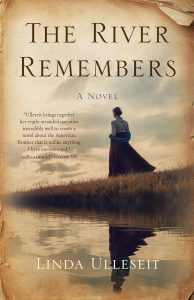
Samantha Lockwood, Day Sets, and Harriet Robinson come to Fort Snelling from very different backgrounds. It’s 1835 and the world is changing, fast, and they are all struggling to keep up. After she refuses another suitor he’s chosen for her, Samantha’s father banishes her to live in the territory with her brother. He, too, tries to take over her marriage plans—but she is determined to find her own husband, even when her choices go awry.
Day Sets demands that her white husband create a school to educate their daughter, supporting her father’s belief that his people must learn the ways of the white man in order to ensure the tribe’s future. Until events prove her father wrong. Harriet’s life in the territory is more like that of a free person than anywhere she’s lived. She even falls in love with Dred Scott and dreams of a life with him. But they are both enslaved, and she keeps being reminded of how little control she has over her own fate. As their cultures collide, each of these three women must find a way to direct her own future and leave a legacy for her children.
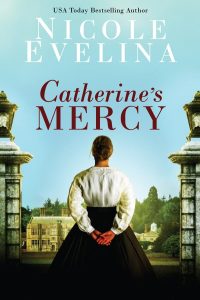
Based on a true story, Catherine’s Mercy brings to life Irish reformer and Sisters of Mercy founder Catherine McAuley.
In 1824, Catherine, a Catholic spinster of 44, unexpectantly inherits millions. However, she doesn’t use it to climb the social ladder or snare a husband; she uses it to fulfill a lifelong dream of building a refuge for the poor and sick of Dublin, Ireland. That an unmarried woman would dare propose such a thing is so scandalous, even her own brother calls it “Kitty’s Folly.” Society turns against her. The Church tries to take over. Catherine must defend her choices or lose not only her inheritance, but her reputation and life’s calling.
One of the first women who seeks Catherine’s help is Margaret, a maid in the house of Lord Montague, the loudest of Catherine’s detractors. Daring to protect herself from his advances and rebel against his maxim of total obedience, Margaret is forced to flee for her life. She desperately approaches Catherine for help, setting off a series of events that haunt Catherine all her days and prompt a rule that holds today, in the real-life Sisters of Mercy.
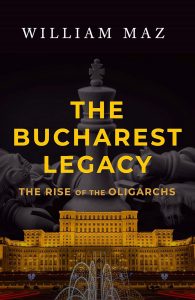
William Maz – The Bucharest Legacy: The Rise of the Oligarchs
The CIA is rocked to its core when a KGB defector divulges that there is a KGB mole inside the Agency. They learn that the mole’s handler is a KGB agent known as Boris. CIA analyst Bill Hefflin recognizes that name—Boris is the code name of Hefflin’s longtime KGB asset. If the defector is correct, Hefflin realizes Boris must be a triple agent, and his supposed mole has been passing false intel to Hefflin and the CIA. What’s more, this makes Hefflin the prime suspect as the KGB mole inside the Agency.
Hefflin is given a chance to prove his innocence by returning to his city of birth, Bucharest, Romania, to find Boris and track down the identity of the mole. It’s been three years since the bloody revolution, and what he finds is a cauldron of spies, crooked politicians, and a country controlled by the underground and the new oligarchs, all of whom want to find Boris. But Hefflin has a secret that no one else knows—Boris has been dead for over a year.
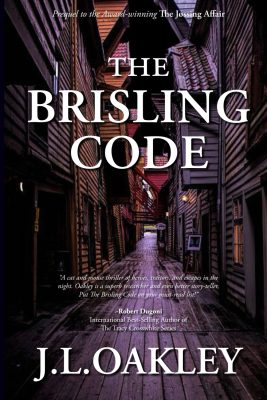
In The Brisling Code, a fast-paced first installment of her historical thriller series, Oakley weaves a brilliant portrayal of the perils met by the Norwegian Resistance during WWII.
Layered perspectives—from resistance workers, traitors, and even an SS Officer—create a rich world through which readers can understand the sacrifices that were made to free our world from the tyranny of Nazi Germany.
Immersed in volatile Nazi-occupied Bergen, Norway, fearless young intelligence agent Tore Haugland and his team of organizers work tirelessly to protect the essential work of the Norwegian resistance.
Haugland’s task is to uncover the plans for the expansion of the German Uboat base with inside help at a shipyard. Also charged in unveiling the meaning behind a mysterious message sent by his murdered predecessor, Haugland navigates the treacherous waters of Norway—a mere haunting of the beautiful city it once was before Nazi occupation. Readers can “almost taste the danger” as our hero moves from one treacherous predicament to the next. Haugland’s mission risks not only his own life, but the lives of every friend and connection he makes.
The Brisling Code is a multi-faceted novel, interspersing the harsh and secretive political climate of Nazi occupation with the deaf community’s resistance work in Norway and a 1919 Norwegian program called the Wienerbarnkomitten, in which Norwegian families took in and raised German children whose families were impacted by WWI.
These overlapping communities create a heart of tenderness and relational love at the center of the novel, despite the violence and treachery that constantly threatens to break through.
For example, seemingly cold-hearted SS officer Hans Becker—on the hunt to capture Haugland and responsible for torturing and murdering many resistance workers— experiences a deep tenderness for his Norwegian foster mother, admitting that “She is my mamma. Not of my blood, but my heart.” As a result, he is forced to reconsider the motives behind his actions and stand up for her well-being, risking both his position as an officer and his life.
The Brisling Code is filled with these small, deeply sensitivity moments that bring characters to life.
People show warmth in a freezing world with actions like a cup of hot coffee, an embrace, and a smile of welcome. Despite the constant threat of violent death, life goes on in Norway, creating a web of intricate characters whose lives are rich with hopes, fears, and longings. Similarly, characters often reveal their true selves under their heavily-curated exteriors through actions and allegiances. These complicated moments and relationships refuse cut-and-dry judgements, allowing readers to find humanity in unexpected places.
Undercurrents of political tension in The Brisling Code create a rich historical context that puts readers in the shoes of Norwegians in their occupied homeland.
With descriptions of everyday life, readers soon understand the paranoia and surveillance in Norway— the constant fear of separation and harm among families and friends.
An expertly researched and executed novel, The Brisling Code invites readers to see that unexpected tender moments can always be found, opening up the possibilities for resistance in the face of violence.
The Ozma and Goethe Awards both close at the end of July! Don’t let your History become a Fantasy!
The Ozma Award for Fantasy Fiction and The Goethe Award for Post-1750 Historical Fiction close submissions on JULY 31st.
You can’t win if you don’t submit!
Submit to the CIBAs Today!
Only 10 days left to submit your books to the prestigious CIBAs and embark on an extraordinary journey to success. With over $30,000 in prizes awarded annually, now is the time to make your mark!
The Ozma Awards for Fantasy and The Goethe Awards for Late Historical Fiction are still open until JULY 31st!
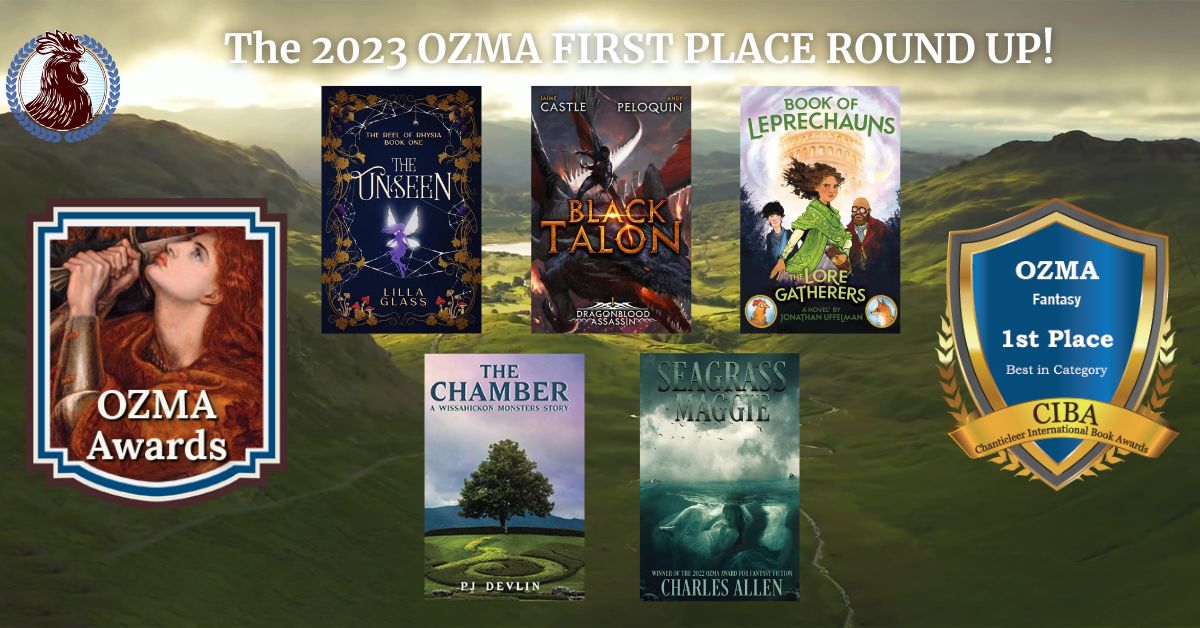
Congratulations to the Winners of the 2023 Ozma Awards!
Lilla Glass – The Unseen
Charles Allen – The Order of the Red God
Jaime Castle & Andy Peloquin – Black Talon
Jonathan Uffelman – Book of Leprechauns: The Lore Gatherers
PJ Devlin – The Chamber
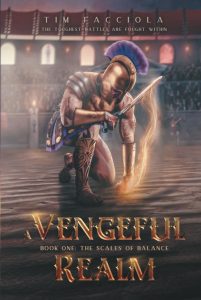
And a huge round of applause to this years Overall Grand Prize, and Division Grand Prize for OZMA
A Vengeful Realm by Tim Facciola!
Congratulations to the Winners of the 2023 Goethe Awards!
William Maz – Bucharest Legacy: The Rise of the Oligarchs
And a huge round of applause to this years 2023 Goethe Grand Prize Winner- If Someday Comes by David Calloway
The CIBAs offer more than just recognition — they provide a ladder to success with a range of achievement tiers and expert long tail marketing strategies. From the highly anticipated Long List to the prestigious Overall Grand Prize Winner, the CIBA lists energize both authors and readers, maximizing your digital footprint and expanding your fan base.
We are always eager to support the Best Books through the CIBAs. Join the ranks of celebrated authors who have already taken this critical step in their publishing.
Your book deserves to be discovered, celebrated, and shared with the world. Don’t miss the chance to showcase your talent and gain valuable exposure at the Chanticleer Authors Conference (April 3-6, 2025) where Winners from all 25 Book Award Divisions will be announced and honored.
In a world hungry for good books, your story deserves to be heard. Submit now and leave a lasting impression.
In Loving Beth, a Christian historical romance by Bonnie Rose Ward, a young woman finds herself in dire straits when her widowed mother dies unexpectedly.
Beth’s father had taken out loans to improve their property, but he was killed in the Civil War, leaving his wife and daughter to struggle to keep up with the payments. Now, Beth is alone without any means to keep her home—finding and taking in two young, abandoned children certainly doesn’t help. But even amidst her troubles, Beth’s thoughts keep going back to the mysterious and handsome stranger who found and brought home the body of her mother.
Life is not easy in her tiny settlement in West Virginia, and young, pretty Beth finds that it is not about to get any easier. The new banker holds a grudge toward her for having rejected his advances, and the man’s snobbish wife is determined to make Beth’s life even more miserable. The loans that Beth and her mother worked to pay each month are suddenly due in full— but the banker’s unwanted and ugly advances are foiled with the appearance of the mysterious stranger.
Ward effectively describes the harsh day-to-day work Beth must do to keep her farm afloat.
She reminds us in no uncertain terms that, yes, deciding which rooster to butcher and process is an integral part of the process to simply put dinner on the table.
Beth McCullough’s world is clear and well-characterized. The writing pays close attention to its setting, with different characters speaking in regional accents, providing the characters with a natural feeling to their speech.
Loving Beth is a heartwarming historical romance.
Author Bonnie Rose Ward describes a time and place long ago, portraying the struggle for women who are left behind in the aftermath of a devastating war, relying on their faith and friends to carry them forward, while finding love in an unexpected place.




 In his debut novel The Frog-Eyed Gospel: A Texas Exodus, Leslie DeBrock weaves together the inspiring yet complex stories of a diverse cast of characters, all making their way through a tense Texas summer in 1965.
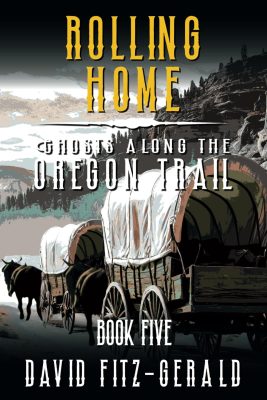
 David Fitz-Gerald concludes the Ghosts Along the Oregon Trail series with a grand finale for an eclectic cast of characters, as the long wagon train is finally Rolling Home to their new lives in the wild west of Oregon.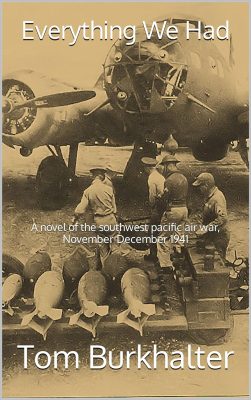










 A Song That Never Ends, the first volume of a two part series by Mark A. Gibson, opens a dramatic fictional saga of the Hamilton family from the late 1930s Depression era, to 1967 and the Vietnam conflict. Here against the backdrop of a South Carolina tobacco farm, we come to witness a family in turmoil.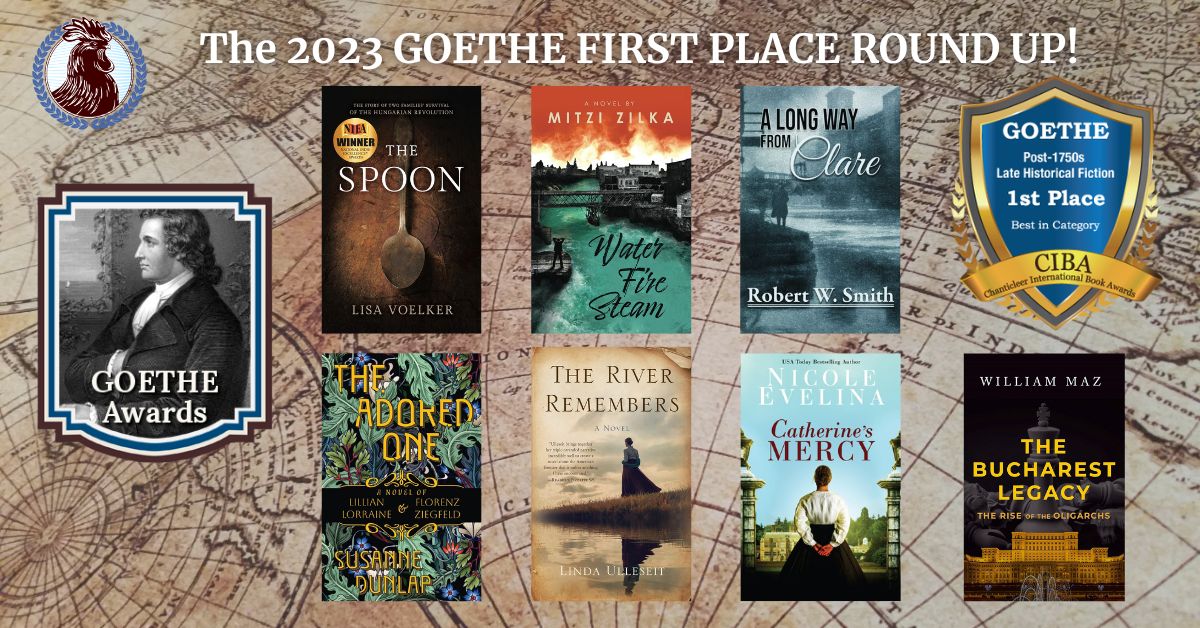
 The Goethe Book Awards recognize emerging new talent and outstanding works in the genre of Late Historical (Post 1750s) Fiction. The Grand Prize Winner, David Calloway’s book, If Someday Comes will be promoted for years to come in our annual Hall of Fame article, as well as be featured on the Goethe contest page year ’round!
 In The Brisling Code, a fast-paced first installment of her historical thriller series, Oakley weaves a brilliant portrayal of the perils met by the Norwegian Resistance during WWII.


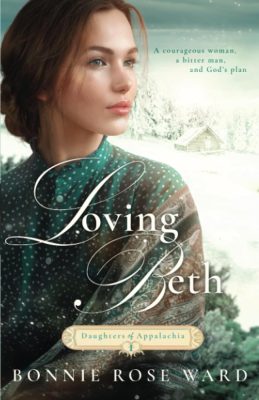
 In Loving Beth, a Christian historical romance by Bonnie Rose Ward, a young woman finds herself in dire straits when her widowed mother dies unexpectedly.