Tag: Historical Fiction

  • A River Divides by Michael J. Roueche – Historical Fiction/Civil War

    A River Divides by Michael J. Roueche – Historical Fiction/Civil War

    Like the first book in Beyond the Woods Series, the second, A River Divides, offers a complex view into life during the Civil War era. This multifaceted book has the same engaging characters found in the first and includes a few new ones, that when combined, will keep readers riveted to the pages.

    The story resumes in winter of 1864, where Betsy Henderson remains outside Staunton, Virginia with a freshly bruised face, worrying whether she’s revealed too much. Will the sheriff find out about her affair with Union soldier Hank? Does the sheriff have enough evidence to capture Walthorpe, the man who gave her the bruise and nearly made away with her fortune? Walthorpe, meanwhile, has another plan up his sleeve, one that will force Betsy to grapple with her southern loyalties, including the secret she’s keeping from Hank—one she won’t be able to hide for long.

    Author Michael J. Roueche does a great job introducing esoteric terms while giving them proper context, thereby helping present-day readers immerse themselves in the historical tapestry he’s created. All the characters in this story demonstrate authentic shades of good and bad, making their choices (and their consequences) even more intriguing. Especially William, the former slave from Betsy’s plantation, whose bond with a new family makes his objective of joining the Union Army a lot more complicated.

    Reading the first in the series isn’t required here but doing so will certainly enhance the experience. Roueche’s ability to sprinkle in enough detail to keep the interest of readers of Beyond the Wood while enticing those who are yet to pick through its pages makes this bittersweet story more than palatable. The sheriff’s point-of-view not only enlightens new readers to the necessary backstory found in the first book but also offers some surprises along the way. Readers will also get a glimpse into Walthorpe’s past and gain insight into his character that will suggest his villainy isn’t as cut-and-dried as it originally appears.

    Roueche writes each character’s voice so distinctly that the reader may not notice the point-of-view shifts within the scenes, a small, but present, distraction. On the whole, Roueche’s beautifully written imagery and ability to immerse readers in place and time will delight and hook readers from the very beginning to the very end.

    By the close of A River Divides, it’s clear that a river divides no more. And the cliffhanger in the final chapter will whet readers’ appetites for the next book in the series.

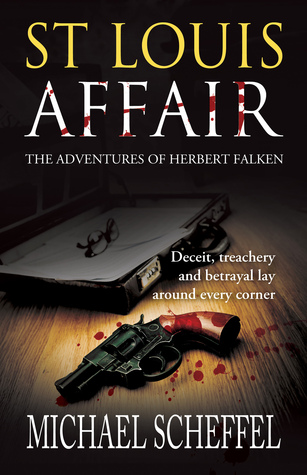
  • St Louis Affair: The Adventures of Herbert Falken by Michael Scheffel – Historical Thriller/Detective

    St Louis Affair: The Adventures of Herbert Falken by Michael Scheffel – Historical Thriller/Detective

    This tantalizing whodunit is set in 1899 St. Louis and revolves around the heinous murder of a prominent wealthy citizen, Charles Garrett, whose body is discovered on the banks of the Mississippi River. Because the crime scene is devoid of clues and political pressure for a fast resolution abounds, the city police turn to professional Inquiry Agent, Herbert Falken, for assistance.

    Falken, also known by the public as Major Falken from his heroic exploits fighting renegade raiders along the US – Mexican border, is well respected for his deductive abilities and previous success in solving a perplexing string of grisly crimes. What the public doesn’t know is that Falken is haunted by his own personal and professional demons.

    Not long after departing from this crime scene, however, Falken discovers a curious fact: Charles Garrett’s public and private personas are polar opposites. Faced with a growing list of suspects and demands from the Governor on down to the average citizen for an immediate arrest, Falken feels the pressure. If it weren’t for James Westfall (former army officer mustered out due to a permanent leg injury) Falken’s aide-de-camp, our hero would be in dire straights. Westfall not only records critical crime scene and subject interview information, but he also cares for and tries to protect Falken—sometimes from himself.

    A strong cast of well-drawn and individually distinctive characters who aid, circumvent, and forestall Falken’s pursuit of justice adds richness to the story.

    Scheffel’s use of architectural design, clothing and accouterments, individual and class attitudes, and various character traits and dialects to resurrect old St. Louis is a true highlight of the book. He deftly crafts different scenes in smooth, articulate detail without hindering the story’s pace. Whether it’s inside Falken’s dining room, traveling across uneven paving bricks in a horse-drawn buggy, trudging along the muddy banks along the river, descending into a seedy opium den, or watching Falken get his butt kicked in a bare-knuckle brawl, the reader is right there. Another treat is the seamless placement of real-world news events into dialogue, which adds both authenticity and consistency to the setting.

    Overall, St Louis Affair: The Adventures of Herbert Falken is an entertaining turn-of-the-century page-turner with plenty of twists to keep the reader guessing to the end.  Michael Scheffel grabs the reader’s attention from the first sentence and doesn’t let go until the very last in St. Louis Affair: The Adventures of Herbert Falken, a fast-paced, page-turner that will have the reader hoping that he is hard a work penning a new tale involving Herbert Falken, Inquiry Agent. 

  • HISTORICAL FICTION Post-1750s – 2016 GOETHE Awards SHORT LIST

    HISTORICAL FICTION Post-1750s – 2016 GOETHE Awards SHORT LIST

    Post 1750s Historical Fiction AwardThe Goethe Novel Writing Competition recognizes emerging new talent and outstanding works in the genre of post-1750s Historical Fiction. The Goethe Awards is a division of Chanticleer International Novel Writing Competitions.
    More than $30,000.00 dollars worth of cash and prizes are awarded to Chanticleer Book Reviews 2016 writing competition winners at the Chanticleer Authors Conference April 1, 2017!

    Because we received an unprecedented amount of entries for the 2015 Chaucer Awards we divided the writing competition into two separate awards for 2016: The Chaucer Awards for pre-1750’s historical fiction and the Goethe Awards for post-1750 historical fiction.  We have moved entries that are post 1750 to the 2016 Goethe Awards tracking and judging rounds.

    This is the Official Semi-Finalists List of the Authors and Titles of Works that have made it to the Short-List of the Goethe 2016 Novel Writing Contest.

    The Goethe Awards FIRST IN CATEGORY sub-genres are: Regency, Victorian, 1700s/1800s, Turn of the Century, 20th Century, World Wars and Other Wars, World/International History post-1750, and U.S. History.

    Chanticleer Short List

    The following Semi-Finalists titles will compete for the FIRST IN CATEGORY Positions and Book Awards Packages in the 2016 Goethe Book Awards:

    • Carrie Kwiatkowski – Running Before the Wind
    • Amy Wolf – The Misses Bronte’s Establishment
    • Linda Cardillo – The Boat House Cafe
    • Elizabeth Crowens – Silent Meridian
    • J.L. Oakley – The Jossing Affair
    • Duncan Stewart – In Their Finest Hour
    • Darryl Wimberley – A Seeping Wound
    • A.B. Michaels – The Depth of Beauty
    • Michael Sheahan – The Sean
    • Vanda – Juliana
    • S. Thomas Bailey – Blind Faith-The Gauntlet Runner
    • Connie Hertzberg Mayo – The Island of Worthy Boys
    • Carol M. Cram – A Woman of Note
    • Teresa Healy Janssen – The Ways of Water
    • Eleanor Webster – No Conventional Miss
    • C.T. Wells – The Kingdom of the Air
    • Ivan Light – Deadly Secret of the Lusitania
    • Darryl Wimberley – Paul Bunyan
    • Tom Glenn – The Last of the Annamese
    • M.C. Nelson – Chrysalis: A Novel
    • Brigitte Goldstein – Death of a Diva–From Berlin to Broadway
    • David Selcer – Lincoln’s Hat 
    • Lucinda Brant – Deadly Affair: A Georgian Historical Mystery

    The Goethe Semi-Finalists will compete for the Goethe Awards First In Category Positions, which consists of Four Judging Rounds.  First Place Category Book Award winners will automatically be entered into the Goethe GRAND PRIZE AWARD competition, which has a cash prize of $200. The CBR Grand Prize Genre Winners will compete for the CBR Overall Grand Prize for Best Book and its $1,000 purse.   

    • All Semi-Finalists Award Winners will receive high visibility along with special badges to wear during the Chanticleer Authors Conference and Awards Gala.
    • Digital book award stickers for on-line promotion
    • Adhesive book stickers
    • Shelf-talkers and other promotional items
    • Promotion in on-line media

    As always, please do not hesitate to contact us  at Info@ChantiReviews.com with any questions, concerns, or suggestions.

    Congratulations to the Goethe Finalists in this fiercely competitive contest! 

    Good Luck to all the Goethe Semi-Finalists as they compete for the coveted First Place Category  positions.

    The 2016 Goethe Grand Prize Winner and First Place Category Winners will be announced at the April 1st,  2017 Chanticleer Writing Contests Annual Awards Gala, which takes place on the last evening of the Chanticleer Authors Conference to be held in Bellingham, Wash. 

    We are now accepting submissions for the 2017 Chaucer Awards and the Goethe Awards writing competitions for Historical Fiction. Please click here for more information or to enter the contests.

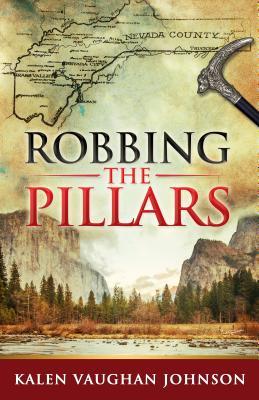
  • Robbing the Pillars by Kalen Vaughan Johnson – Historical Fiction

    Robbing the Pillars by Kalen Vaughan Johnson – Historical Fiction

    When James MacLaren flees his native Scotland, he leaves a body behind – but not his hatred of the upper class. In England, he meets and weds Emma, but will the skeletons in their shared past remain silent?

    Robbing the Pillars crosses the Atlantic and lands in Nevada City, California at the beginning of the Gold Rush, amidst the discovery of seemingly endless supplies of the precious mineral. James and Emma, now with their young daughter Charlotte, come out to California by wagon train accompanied by Emma’s best friend, Althea and her son Justin.

    Along the way and upon arrival in the region, they meet friends and ruffians including an entrepreneurial chancer with a conscience, an inveterate loser with a taste for alcohol and his eye fixed on Althea, and a Mexican who finds that MacLaren is the first white man he can trust.

    MacLaren involves himself in mining, engineering, and homesteading while Emma and Althea get a taste of town life and community activism. Their children meanwhile are growing up with a sense of true freedom that their European-born parents could never have known. In pursuit of his personal quest, Justin will come up against Althea’s past; and the beautiful, willful Charlotte and her father must learn to live with the pangs of lost love.

    Meanwhile, the territory is changing rapidly. Big men with big ideas are taking an interest in the fate of the new state and move to monopolize its resources. Into this mix, author Vaughan Johnson has expertly interwoven both fictional characters and real “empire barons” such as Leland Stanford, Collis Huntington, and Mark Hopkins into her epic tale.

    This first part of a planned series ends with the rumbling of war that splits the nation and brings about a sad parting that begs for a reunion in a later volume.

    Author Kalen Vaughan Johnson has created a large canvas; her knowledge of the region – its history, the mix of cultures, the lilt of varied accents, even the cuisine – highlights her obvious talent for creating richly detailed historical fiction. The title, for example, references an arcane aspect of mining in which, as the miners retreat from a played out vein, they risk dislodging the roof pillars as they go, endangering their lives by ferreting out every last flake of gold. Johnson depicts with equal verve and realism the lives of the rich, the wannabes, and those at the bottom struggling upward.

    A sweeping look at personal idealism and autonomy pitted against the forces of greed and manipulation, Robbing the Pillars is an emotive family saga solidly rooted in the American dream.

    5 Star Best Book Chanticleer Reviews round silver sticker


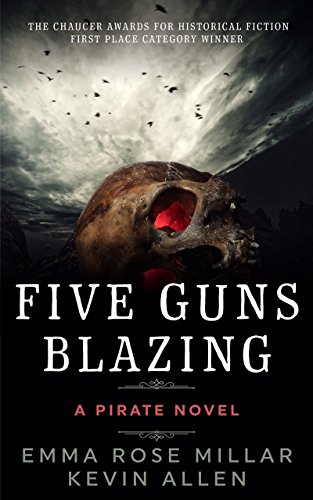
  • Five Guns Blazing: A Pirate Novel by Emma Rose Millar and Kevin Allen – Historical Romance

    Five Guns Blazing: A Pirate Novel by Emma Rose Millar and Kevin Allen – Historical Romance

    Containing exquisite historical imagery and diction in addition to brutal sensory detail of what life was like in 1700’s London and the Caribbean, particularly regarding the slave trade are portrayed in Emma Rose Millar’s and Kevin Allen’s Five Guns Blazing. The word choices, spelling, and dialogue are not only authentic to the time period, they contain a palpable amount of emotional heft.

    Laetitia Beedham, the daughter of a criminal, ends up on the ‘Revenge,’ piloted by known pirate John ‘Calico Jack’ Rackham. When Rackham and his two lady friends, Anne Bonny and Mary Read, are captured by pirate hunter Jonathan Barnet, Beedham must save her friends while a price hangs over her own head.

    Laetitia Beedham’s story begins at age 11 as she watches her chronically reprehensible mother sentenced to a workhouse. Since no provisions are made for the motherless at the time, Laetitia joins her mother in the workhouse disguised as a boy and referred to as “Nathaniel.” Her time in there is short and tragic, but she makes a few friends who introduce her to a life with a slightly better potential for a girl in her circumstances.

    After her mother offends the law again, both mother and daughter are tossed onto the brutal steer of a ship on its way to the Caribbean to work off the transportation sentence. As a temporary slave, Laetitia learns a few hard lessons about what existence is like for those poor people chained to a life of permanent servitude and unforgiving masters.

    Halfway through the book, the pirate ship arrives and Beedham’s mother, true to her nature, sells Laetitia for five guineas to the infamous pirate, ‘Calico Jack’ Rackham, in exchange for her daughter’s maidenhead. Known on the ship only as “Beedham,” Laetitia is constantly unsure of her place, looking for anyone to give her the nurturing that she didn’t get from her birth mother – especially from Pierre Bouspeut, who (like Jack, Mary, and Anne,) is a true-to-life character. In pirates, Laetitia finds unexpected allies, people who care for her and help her along the way. Much to the delight of the reader, these characters aren’t carbon-copy stereotypes of pirates we’ve come to know and expect.

    There are many elements of story that work to tie the character, Laetitia, firmly in place. We get to know her and grow to love her as the thread of her tale is woven into historical characters’ narrative. In Laetitia, we see a bit of Cinderella as well as many of the Caribbean folk tales, which only lends flavor and familiarity to her plight. Sometimes she has trouble reflecting and learning not to trust those who betray her, yet the authors’ purposeful use of significant poetic symbolism adds much-needed justice to Laetitia’s tragic tale.

    Though this book is advertised as a pirate novel, the pirates don’t show up until almost halfway through. When they do, though, the story picks up a significant pace. Knowing that Calico Jack, Pierre Bouspeut, Anne Bonny, and Mary Reed were real people adds to the overall historical appeal.

    Five Guns Blazing is a dark, rich, historical 18th-century tale that weaves real pirates into a fictional story with many unexpected twists and turns. A must read for those interested in immersing themselves in 18th-century life, textures, and shadows.

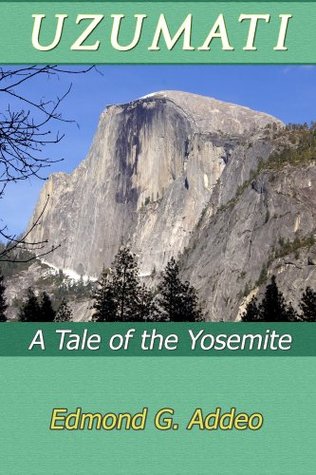
  • Uzumati: The Tale of the Yosemite by Edmond G. Addeo – Historical Fiction

    Uzumati: The Tale of the Yosemite by Edmond G. Addeo – Historical Fiction

    Three thousand years of epic historical reach, Edmond G. Addeo presents Uzumati: A Tale of the Yosemite, an exceptionally well-crafted novel. The author’s enthusiasm and deep love for his subject matter pay off in a big way.

    Edmund G. Addeo is a master storyteller, talented in weaving historical figures with fictional and displaying the vast stage of the Yosemite Valley for all to enjoy. Readers will be both captivated and entertained by this fascinating story brimming with memorable characters.

    Uzumati is the name given by the Indians 1,200 years ago to the area commonly known as the Yosemite Valley. The book details how the valley was discovered by the Native Americans and then re-discovered by white settlers in the 19th century. This valley, striking in its beauty, proved to be a safe and plentiful site for those fortunate enough to find it and settle there.

    Although Addeo’s story focuses on a time period spanning 3,000 years, his skill as a storyteller is evident. Uzumati is both engaging and easy to read, especially when one considers the amount of time and work invested into bringing this story to print. Addeo spent 50 years researching animals, plants, Native American oral history, and news reports from the later years of the era to ensure the story’s accuracy.

    The book focuses on Choluk, “the discoverer” and his family tree which includes Chief Tenaya who plays an important role. Another memorable player is Major Jim Savage, of the US Army. As the story reaches its climactic conclusion, both Tenaya and Savage are well aware that tensions between the Native American inhabitants and the settlers will likely end in conflict. Readers will find it a struggle to choose a side, and in the end, witness a breathtaking conclusion of betrayal and political treachery.

    Heartbreaking and beautiful, Uzumati: The Tale of the Yosemite is a novel any reader will find hard to put down.

  • WALLS for the WIND by Alethea Williams – The Orphan Trains of Hell on Wheels

    WALLS for the WIND by Alethea Williams – The Orphan Trains of Hell on Wheels

    A poignant tale set in the post-Civil War era of the United States in the rough-and-tumble boomtowns that follow the transcontinental railway as it was being built. The author focuses heavily on the often-forgotten plight of orphaned and immigrant children from the crowded cities of the East where they disembarked from the “coffin ships.” Many were packed on “orphan trains” heading west. The book leads off in New York City and eventually heads to Dakota Territory as readers learn about the plight of these orphans.

    Several children’s welfare movements began to deal with the thousands of homeless children of indentured servants and impoverished immigrants. One of these programs was a welfare program that transported orphaned and homeless children from the highly populated Eastern cities and placed them in foster homes located throughout the rural Midwest. These trains operated from 1854 to 1929 and relocated some 200,000 orphaned, abandoned or homeless children. Their plight is the core of Alethea Williams’ historical fiction titled Walls for the Wind.

    Kit Calhoun’s character, the protagonist, was created to portray one youngster among the estimated 34,000 children roaming the streets of New York City, enmeshed in despair and hopelessness in the 1850s. Kit eventually finds herself in the care of the influential Reverend Howe, founder, and director of the Immigrant Children’s Asylum. Kit is fortunate as she is given education and training as a young ward. As time passes and Kit grows older, she takes a job as assistant to the elderly director, Rev. Howe. Having felt the genuine love and care from a person to redirect the course of her own life, Kit passionately goes about the task of rescuing other homeless children.

    Kit finds the work empowering and important, but she also faces an inner struggle at times that the author, Alethea Williams, expertly develops. The author is adept at weaving historical fact, vivid descriptions of the times, and an engrossing plot-line through a young woman’s perspective in this male dominated time.

    The pace of the novel picks up when Kit heads west on an orphan train to help place children with farm families on the frontier. Obviously, Kit would like to see the children adopted by loving parents, but what she quickly discovers is the families the children are being placed with, treat the children as little more than indentured servants who are forced to pay for their room and board as farmhands and laborers with little nurturing or no time for education.

    Not being able to accept this fate for four particular children, Kit decides to adopt them herself when the Orphan Train reaches its destination in Colorado.

    Though her actions are noble, supporting her newly adopted children is a struggle. They live out of a tent and Kit must take in laundry to earn money. But it’s never enough. To make matters worse, she is assaulted by a gambler. At this point, Kit has total disdain for men as she has come to the belief that all men are users and want women for only one thing. When she finally encounters a man that breaks this mold she openly struggles with trust issues.

    A vivid and multi-layered take on the turbulent post-Civil War times that examines with wide open eyes the Wild West environs and the human cost of the “Manifest Destiny” that lead to Transcontinental railway and the U.S. expansion west.

    Author Alethea Williams’ characters portray the difficulties and challenges of these hard scrabble times with a refreshing perspective from a young woman who is trying to make her way. The closing chapters of this powerful tale play out this struggle in breathtaking fashion. An enlightening and informative read of the United States’ not so distant past.


  • The WARSAW CONSPIRACY by James Conroyd Martin – a political tale of gripping suspense

    The WARSAW CONSPIRACY by James Conroyd Martin – a political tale of gripping suspense

    This gem could be read as a stand-alone novel even though it is James Conroyd Martin’s conclusion to his gripping historical saga on Poland. The Warsaw Conspiracy  is preceded by Push Not the River and Against a Crimson Sky; you do not need to read the first two books in the trilogy to appreciate and enjoy it, but why would you cheat yourself out the total immersion?

    The book covers the Polish revolt of the 1830’s, known as the November Rising or the Cadet Revolt. Martin uses this tumultuous time in Polish history as the backdrop for his sweeping novel. It starts with an armed rebellion of young Polish officers in Warsaw and soon grows as the cadets are joined by other Polish sympathizers in a grandiose stand against the Russian Empire. The uprising is ultimately crushed by the Russian Army and Poland is placed firmly under Russian control. Martin expertly weaves historical figures and events with a cast of fictional characters that carry the story through to its emotional end.

    Martin centers his tale on one extended family giving the story the feel of a family saga set within the greater true-to-life struggle of a nation. This method lends well to the overall scope of the work and the overarching story contained within the pages of this lengthy 510-page novel. Yes, like the other novels in this saga, this book is huge, and will not disappoint readers who love to curl up with a thick juicy novel.

    The family dynamic is a key to the success of this novel. In particular, the relationships centered on Anna, one of the main characters, were fleshed out well, and in effect made her one of the book’s more endearing characters. To drive the story, Martin gives us an excellent Villain we love to hate: Viktor, the head of the Russian secret police, who is as complex and intriguing as he is dastardly. A family man who lovingly kisses his family goodbye in one scene, and in the next, we see him torturing Poles under the guise of extracting confessions. Add to the drama, brothers Mical and Jozef who find themselves caught up in a plot to capture the Grand Duke of Russia. Here you have a story filled with gripping tension that builds throughout the book.

    Author James Martin makes this well-known revolt in Polish history come alive, jump from the pages and captivate the reader. This book is nothing short of a true testimonial to the Polish people and their drive to remain an independent nation. Filled with unstoppable action, edge-of-your-seat suspense, and unforgettable characters, this breathtaking page-turner will remain with readers long after they close their books.

  • CROSSING into the MYSTIC by D.L. Koontz – a paranormal mystery that crosses genres

    CROSSING into the MYSTIC by D.L. Koontz – a paranormal mystery that crosses genres

    Grace MacKenna has a problem – actually, she has two. At sixteen, she loses her family and is sent to live in Boston with her greedy aunt. Then she discovers she has something called “subtle vision” that allows her to see spirits. But not the spirits of her family, who have crossed fully to the other side. Grace sees the spirits trapped in limbo on Earth, who must complete their business before they can escape.

    Her first spirit confrontation occurs when she inherits Crossings, her stepfather’s house in Maryland. It is haunted by William Kavanaugh, a young man murdered during the Civil War who needs her help in solving the mystery of his death so he can move on.

    It takes her a while to figure everything out, being distracted by the maneuvers needed to occupy her new home without her guardians and understand the “subtle vision.” When she trips over Clay Baxter, a recovering young veteran just home from Afghanistan, upon moving in, more conflict comes into play. He’s “a ruffian and a gentleman all in one package”; “night to my day, truck to my Volvo, grease to my silk, bedroll to my egg-roll.” He’s also twenty and can’t approach Grace as he desires because she’s a minor (and he happens to be engaged). To make matters even more complicated, Grace thinks she’s in love with William, who becomes progressively more solid as she masters her perceptive powers.Clay worries that Grace is being pulled, dangerously, more and more into the world of the dead.

    Grace’s physical and emotional reactions to the paranormal are convincingly portrayed by the author. Koontz grounds the story in the area’s history, teaching readers about the Civil War era while riveting us with suspense—all in a Gothic undertone of ghosts and graves, shadows and groaning doors. Grace is believably mature for her age while intermittently reverting to the normal insecurities of being at the crossroads of teenager and young adult. This makes her character even more to root for. The plot-line twists and turns adding suspense, the setting is, well,vividly haunting, and the author adds a dash of wit and humor to the mix while the characters are rich and complex.

    “Crossing Into the Mystic” is the launch volume of this paranormal mystery trilogy that crosses genres (YA+) told in a bright, new-adult voice. Also, while the central story is resolved nicely enough, there is plenty to entice the reader to look forward to the next two books.

  • GOETHE Book Awards for post-1750 Historical Fiction – the 2016 FINALISTS

    GOETHE Book Awards for post-1750 Historical Fiction – the 2016 FINALISTS

    Post 1750s Historical Fiction AwardThe Goethe Novel Writing Competition recognizes emerging new talent and outstanding works in the genre of post-1750s Historical Fiction. The Goethe Awards is a division of Chanticleer International Novel Writing Competitions.
    More than $30,000.00 dollars worth of cash and prizes are awarded to Chanticleer Book Reviews 2016 writing competition winners at the Chanticleer Authors Conference April 1, 2017!

    Because we received an unprecedented amount of entries for the 2015 Chaucer Awards we divided the writing competition into two separate awards for 2016: The Chaucer Awards for pre-1750’s historical fiction and the Goethe Awards for post-1750 historical fiction.  We have moved entries that are post 1750 to the 2016 Goethe Awards tracking and judging rounds.

    This is the Official Finalists List of the Authors and Titles of the Goethe 2016 Novel Writing Contest.

    The Goethe Awards FIRST IN CATEGORY sub-genres are: Regency, Victorian, 1700s/1800s, Turn of the Century, 20th Century, World Wars and Other Wars, World/International History post-1750, and U.S. History.

    The following titles will compete for the SHORT LIST (Semi-Finalists):

    • Rich DiSilvio – My Nazi Nemesis
    • Lars D. H. Hedbor – The Darkness: Tales From a Revolution – Maine
    • Anthony Cunningham – Skyesong
    • Sandra Perez Gluschankoff – Franzisca’s Box
    • S. Thomas Bailey – Blind Faith-The Gauntlet Runner
    • Emma Rose Millar & Miriam Drori – The Women Friends: Selina
    • Michael Sheahan – The Sean
    • J.P. Kenna – Lost Utopia
    • Brigitte Goldstein – Death of a Diva–From Berlin to Broadway
    • C.T. Wells – The Kingdom of the Air
    • Joe Vitovec – Full Circle – A Refugee’s Tale
    • Connie Hertzberg Mayo – The Island of Worthy Boys
    • Paula Butterfield – Forever Free: A Novel of Edmonia Lewis
    • Linda Cardillo – The Boat House Cafe
    • Amy Wolf – The Misses Bronte’s Establishment
    • Lucinda Brant – Deadly Affair: A Georgian Historical Mystery
    • Carrie Kwiatkowski – Running Before the Wind
    • Elizabeth Crowens – Silent Meridian
    • J.L. Oakley – The Jossing Affair
    • Duncan Stewart – In Their Finest Hour
    • Meredith Pechta – Dividing Prejudice
    • David Selcer – Lincoln’s Hat
    • Tom Glenn – The Last of the Annamese
    • Ivan Light – Deadly Secret of the Lusitania
    • Eleanor Webster – No Conventional Miss
    • Darryl Wimberley – Paul Bunyan
    • Carol M. Cram – A Woman of Note
    • Jude Berman – Angel
    • Joe Corso – Lafitte’s Treasure
    • Sherman Smith – Golden City on Fire
    • Nancy Foshee – Ephemeral Palaces
    • Jeremiah Clark – American Slave
    • M.C. Nelson – Chrysalis: A Novel
    • Alethea Williams – Naapiikoan Winter
    • Neal Katz – Outrageous, The Victoria Woodhull Saga, Volume 1: Rise to Riches
    • Teresa Healy Janssen – The Ways of Water
    • Suzette Hollingsworth – Sherlock Holmes and the Dance of the Tiger
    • Darryl Wimberley – A Seeping Wound
    • A.B. Michaels – The Depth of Beauty
    • Vanda – Juliana

    The Goethe Finalists will compete for the Goethe Awards First In Category Positions, which consists of Four Judging Rounds.  First Place Category Book Award winners will automatically be entered into the Goethe GRAND PRIZE AWARD competition, which has a cash prize of $200. The CBR Grand Prize Genre Winners will compete for the CBR Overall Grand Prize for Best Book and its $1,000 purse.   

    • All First In Category Book Award Winners will receive high visibility along with special badges to wear during the Chanticleer Authors Conference and Awards Gala.
    • First In Category winners will compete for the Chaucer Awards Grand Prize Award for the $200 purse and the Chaucer Grand Prize Ribbon and badges.
    • TEN genre Grand Prize winning titles will compete for the $1,000 purse for CBR Best Book and Overall Grand Prize.
    • A coveted Chanticleer Book Review valued at $345 dollars U.S. will be awarded to the winning title.
    • CBR reviews are published in the Chanticleer Reviews magazine.
    • A CBR Blue Ribbon to use in promotion at book signings and book festivals
    • Digital book award stickers for on-line promotion
    • Adhesive book stickers
    • Shelf-talkers and other promotional items
    • Promotion in print and on-line media
    • Review of book distributed to on-line sites and printed media publications
    • Review, cover art, and author synopsis listed in CBR’s newsletter
    • Contests are based on merit and writing craft in all the Chanticleer Writing Competitions.

    As always, please do not hesitate to contact us  at Info@ChantiReviews.com with any questions, concerns, or suggestions.

    Congratulations to the Finalists in this fiercely competitive contest! 

    Good Luck to all the Goethe Finalists as they compete for the coveted First Place Category  positions.

    First In Category announcements will be listed in our social media postings as the results come in.

    The 2016 Goethe Grand Prize Winner and First Place Category Winners will be announced at the April 1st,  2017 Chanticleer Writing Contests Annual Awards Gala, which takes place on the last evening of the Chanticleer Authors Conference to be held in Bellingham, Wash. 

    We are now accepting submissions for the 2017 Chaucer Awards and the Goethe Awards writing competitions for Historical Fiction. Please click here for more information or to enter the contests.