Tag: Helena P. Schrader

  • THE TALE Of The ENGLISH TEMPLAR by Helena P. Schrader – Historical Fiction, Knights Templar, 13th Century


    Far from the romantic legends of King Arthur and the Knights of the Round Table, Helena P. Schrader’s The Tale of the English Templar faithfully captures the harsh decimation of the Knights Templar. Schrader offers a sobering, immersive look at one of history’s darkest betrayals. This is historical fiction worthy of legend with its feet planted firmly in research—not myth.

    Set in the early 14th century, the novel captures the downfall of the Knights Templar at the hands of French King Philip IV. With the Pope’s reluctant cooperation, the Templars are accused of heresy and tortured until they confess to crimes they didn’t commit. The king’s true motive? Their immense wealth.

    Among those captured is Sir Percy de Lacy, an English Templar who is swept up in a raid by local French soldiers and caught in a mass arrest on Friday, October 13th, 1307. What follows is a harrowing account of imprisonment, torture, and unlikely survival.

    After being brutalized, Percy miraculously escapes the King’s dungeons, only to be found near-death and nursed back to health by Felice, the strong-willed granddaughter of a powerful and wealthy noblemanwith enigmatic Templar connections.

    Felice arranges for Percy to be brought to her grandfather Geoffrey. Together they risk their lives to shelter Percy and ultimately join his mission to save others from the Templar purge raging outside their walls. Though still marked by what he’s endured, Percy heals enough to join Geoffrey in rescuing fellow knights. Driven by loyalty and purpose, Percy risks everything to aid the knights still in peril.

    As the adventure unfolds, Felice’s arc rises as one of the novel’s most rewarding. From a teenage girl promised in marriage to a cruel Portuguese noble, she becomes a quiet revolutionary, challenging the roles available to women of her time. Her eventual alliance with Percy and Geoffrey becomes one of shared purpose and moral courage.

    The meticulous historical detail includes graphic descriptions of torture and public execution. Readers should be prepared for the historically accurate burning of 54 Templars in an auto de fe, a public execution orchestrated by the Inquisition. These scenes are unflinching but not gratuitous. Schrader’s intent is clear: to help readers grasp the full horror of what was done to these men—and why.

    There’s no clear-cut hero in this story. Instead, The Tale of the English Templar explores the ambiguity of morality and faith, and how loyalty, fear, and ambition intersect in dangerous times.

    At its core, this is a book about conviction—what we believe, and what we’ll risk to defend it.

    Fans of serious historical fiction will find much to admire here. Schrader’s characters are complex, her world brutal but vividly drawn. Readers looking for a fast-paced escape may find the philosophical reflection slows the narrative, but for those who enjoy layered, character-driven stories grounded in historical truth, this book delivers.

    The Tale of the English Templar by Helena P. Schrader rewards readers with insight, depth, and a cast of characters who refuse to be forgotten.

  • COLD PEACE: A Novel of the Berlin Airlift, Part 1 by Helena P. Schrader – Historical Fiction, Post-WWII, Military Aviation Fiction


    Amidst the ruins of Post-WWII, Berlin struggles to rebuild from the ashes, torn apart and facing down the promise of another bloody dictator. A myriad cast, all shaped by that same war, become entwined with the broken city as its hour of need approaches.

    Just as Germany is divided between the Americans, British, French, and Soviets, Berlin has been cut into pieces. But the balance of the occupation powers tips eastward as the Soviet Zone surrounds the city, giving them control of all ways into and out of Berlin – save for the air. The occupation currency is worthless thanks to Soviet over-printing, leaving Berlin on a barter system of cigarettes and black-market trading. In order for Germany to recover, the Western Allies plan to introduce a new currency, even if it angers the Soviet bear.

    To fight over the city with tanks and planes would mean a third world war and a battle for Berlin that the overwhelming Soviet military force would win without question. This fight must be one of resources and diplomacy. But the Soviets have little interest in rebuilding Germany, preferring to loot from, starve, and rape the defeated Berliners as their means of taking ‘reparations.’

    Amidst gridlock in the Allied Control Council and a populace that largely refuses to elect Soviet sympathizers, SMAD (Soviet Military Administration in Germany) tries to push the Western powers out through intimidation and ever-harsher strangling of transit along the streets and railways.

    Berliners and occupation forces alike try to build their own future, while bearing the weight of the city’s future.

    Robert “Robin” Priestman takes a position as Wing Commander in Gatow, a former Luftwaffe airfield now used by the RAF – located in the British Sector of Berlin – that is, deep inside the Soviet Zone of Occupation, which surrounds Berlin. Memories of his time as a POW haunt him, and he doesn’t understand what the purpose of RAF Gatow even is. However, when a Soviet pilot crashes into a British civilian plane, and as SMAD makes greater plays for unilateral power over Berlin, Robin prepares to use his planes and runway to keep Western opposition alive, for the sake of the Berliners.

    David Goldman’s disapproving father weighs him down with a massive inheritance, forcing him out of the RAF and into a business of his own. But heavier on his shoulders are the old properties owned by his aunt and uncle in Germany – before they were murdered by the Nazi regime. David faces a former Nazi officer in the home that holds so many of his childhood memories and resolves to bring the man to justice.

    Charles “Kiwi” Murray, David’s closest living friend, helps him to build an air ambulance business, AAI (Air Ambulance International). Berlin needs such a service desperately, its hospitals hopelessly overwhelmed, and Robin gladly offers them use of Gatow’s runway. Kiwi’s struggle with alcoholism nearly tears this dream – and his friendship with David – apart. But he won’t lay down and let that happen, pushing himself to get their ambulance off the ground, even as David’s own struggles wear him thin.

    Emily Priestman hopes to reconnect with Robin in Gatow as she helps him with his duties. But she’s even less versed in the diplomacy of the rich and powerful than he is, and knows that she needs to find another purpose, for her own sake as much as that of the ruined city around her. That opportunity presents itself through old friends and new, as she joins AAI to fly their ambulance, saving those who had no chance of survival in Berlin.

    Fear and despair hound the people left in WWII’s wake, kept at bay by the hope for a better life tomorrow.

    Charlotte Walmsdorf lost much of her family, and lives in Berlin’s desperation, refusing to even try crossing the Soviet Zone. But her cousin Christian arrives, and though his hope seems naïve to her, she feels a flicker of her own as she teaches Emily Priestman German, joins AAI, and finds herself drawn to David.

    WAAF Galyna Borisenko, whose father was taken from her by the Soviet Union, makes an unlikely connection with Hero of the Soviet Union, Mila Levchenkova. Both Ukrainian women take the considerable risk of meeting with each other, for the chance to speak honestly with someone who understands the pain of life beneath the USSR. Mila’s strength and courage inspire Galyna, as they form a deep and emotionally impactful friendship.

    The City Council of Berlin refuses to back down to the minority Soviet-controlled Socialist Unity Party (SED). Jakob Liebherr, an ardent councilman, holds firm against Soviet misinformation, arguments with his son, and his own terror. He suffered in a concentration camp for his resistance to Nazi power and knows of the tens of thousands kidnapped by the Soviet Union, doomed to a similar fate. His commitment to democracy contrasts the grim state of Berlin with a gripping sense of integrity and determination.

    As Soviet control tightens, each character will have to act with courage and clarity to withstand their grip.

    Helena P. Schrader blends her character’s internal struggles and desires with the traumas of Berlin, creating a powerful and cohesive read.

    WWII left its mark on each of these people, through the ghosts of dead loved ones, injuries that will never leave them, and responsibilities greater than they ever imagined. Some, like Robin and Emily, reckon with the destruction of Berlin as its former enemies. Blackened shells remain where once there were homes, entire stories are missing from those buildings that still stand.

    And yet, restaurants open with only one floor, people make dinner in their kitchens and keep warm beside the stove. Neighbors lend clothes to one another, and even black-market smugglers can be convinced to give away that which they can’t use. Just as Berlin must make life from its ruins, so must all the people within this story.

    Schrader’s attention to detail illuminates a fascinating place and time in history. Her engaging characters and the tense history offers a gripping blend of fiction and reality that makes the complex political/military situation in post-WWII Berlin approachable and clear for readers, regardless of familiarity with it.

    Helena P. Schrader weaves a tapestry of human resilience and courage against the backdrop of post-WWII Berlin. Cold Peace promises to be a captivating journey that will leave readers yearning for the next installment in this important historical-fiction series.


     

    5 Star Best Book Chanticleer Reviews round silver sticker

  • MORAL FIBRE: A Bomber Pilot’s Story by Helena P. Schrader – Historical Fiction, WWII, Historical Aviation


    In Moral Fibre: A Bomber Pilot’s Story, Helena P. Schrader takes readers to 1943 England, where deeply held values of honor and bravery mingle with the importance of one’s place in society. It was a time and place where failures of the former could shatter the latter and change a man’s life forever.

    Within this psychological landscape, the reader is led to wonder, in the case of RAF pilot Christopher “Kit” Moran, will the war break him?

    With thirty-six missions under his belt and as a decorated veteran, Kit suddenly refuses to fly another mission. Although a shock to everyone who knows him, Kit has his reasons. The new assignment comes less than one day on solid ground and two hours of sleep since returning from his most recent bombing sortie over Berlin. In itself a harrowing experience, the mission ended with his best friend, the plane’s skipper, being mortally injured and ultimately dying. The RAF hierarch deems Kit LMF (Lacking Moral Fibre) – a term introduced in 1940 to address those who refused to fly without having a verifiable medical reason. He is sent to a diagnostic center and examined by a psychiatrist.

    The psychiatrist understands. Kit is not insane nor lacking in moral fibre. He was simply “wiped out.”

    So Kit is declared capable and fit for duty and given the opportunity to train as a pilot. This outcome was a far cry from what he, an experienced flight engineer, expected after the incident that sent his career off track.

    The novel really takes off in 1944 when, after completing pilot training in South Africa, Kit returns to England for the final stages of training and ultimately a return to operations. Now he must put his experience and training into practice while sublimating his lingering self-doubt and anxiety about his own resilience. Should he fail, people will die, and his dreams will die with him.

    What ensues takes the reader into the English psyche of that time, tapping the depths of human emotions, holding them up to the light, and revealing their concomitant beauty and ugliness in times of fear and crises.

    Before the war is over for Kit, he finds his inner strength, finds love, and learns the true meaning of sacrifice.

    Meticulously researched and skillfully written, Schrader’s Moral Fibre steps off the pages and comes to life. Her nuanced characters and authentic dialogue also provide a glimpse of Britain’s stratified class-conscious culture during the WWII era.

    Schrader picks a critical period during WWII for the setting and, in so doing, educates today’s readers about the horrors of a war that was and what it takes to save a nation – and perhaps the free world.

    In Moral Fibre: A Bomber Pilot’s Story, Helena P. Schrader again reaffirms George Santanya’s position, “Those who cannot remember the past are condemned to repeat it.”


    5 Stars! Best Book Chanticleer Book Reviews for Moral Fibre

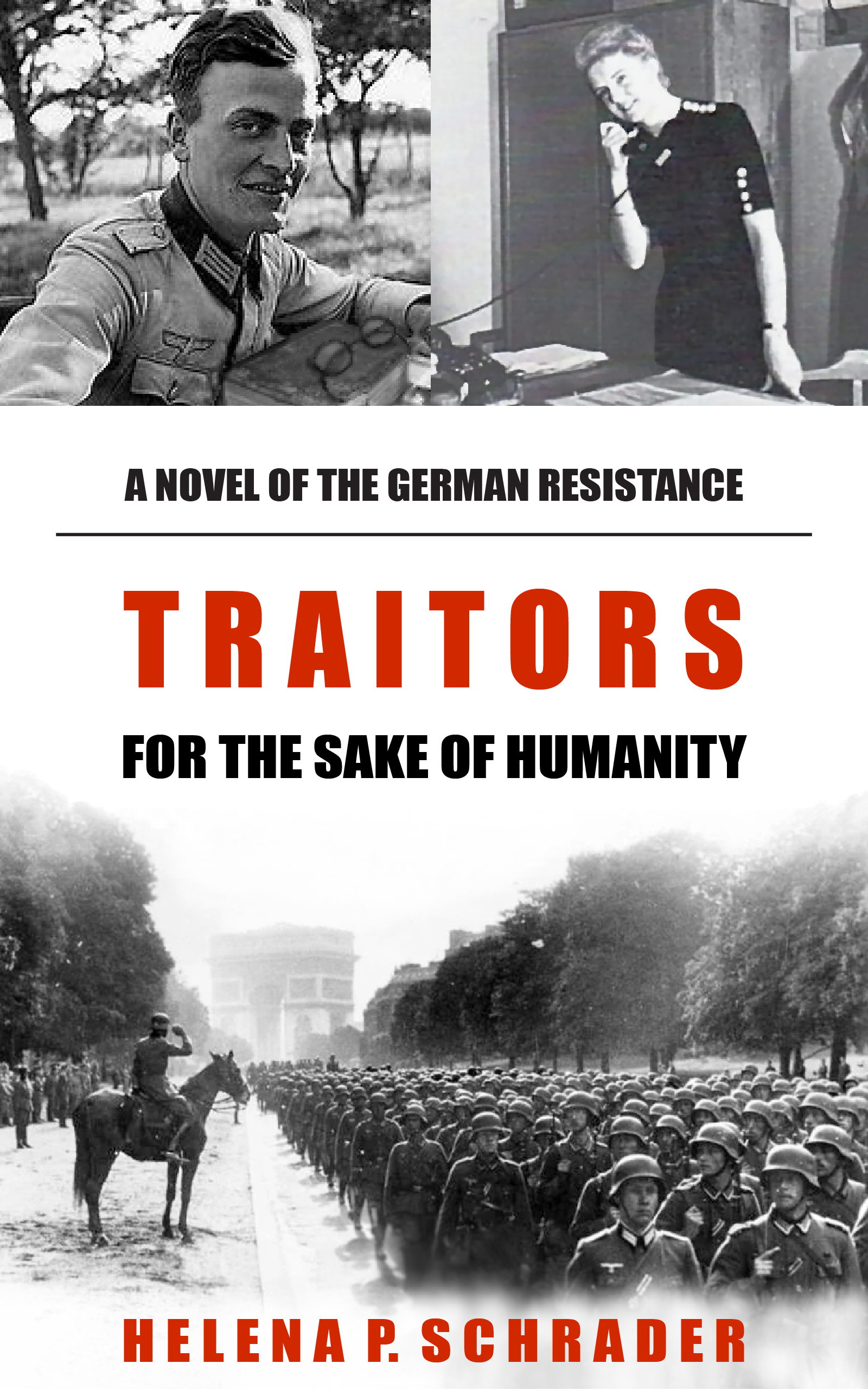
  • TRAITORS for the SAKE of HUMANITY: A Novel of the German Resistance to Hitler by Helena P. Schrader – Historical World War II Fiction, Political Fiction, World War II Fiction

    TRAITORS for the SAKE of HUMANITY: A Novel of the German Resistance to Hitler by Helena P. Schrader – Historical World War II Fiction, Political Fiction, World War II Fiction


    Traitors For the Sake of Humanity by Helena P. Schrader may be more terrifying today than when first released in 2008 as An Obsolete Honor and re-released in 2012 as Hitler’s Demons. 

    The chilling story reveals the means used under the leadership of Adolph Hitler to spread insidious Nazi socio-political ideology before and throughout WWII. Although a work of fiction, the grim, dehumanizing social transformation the tome reveals brings to mind the caution in George Santanya’s oft-quoted posit, “Those who cannot remember the past are condemned to repeat it.”

    Schrader masterfully utilizes the setting as an unseen, omnipresent character. Scenes imbued with equal parts of detached cruelty, greed, and hunger for power – acting as a control agent affecting everyone within its grasp.

    By Christmas, 1938, when the story begins, the Nazi Party dominates the German Parliament for nearly six years, and its influence alters the nation’s face. Within that period, during which Hitler becomes Chancellor, both welcome and unwelcome changes occur and spread beyond Germany’s large cities into and throughout the countryside.

    The German citizenry is conflicted.

    Many poor, disenfranchised citizens consider forfeiting their faith, culture, and free will for materially improved living standards and restoring their national pride as an acceptable trade-off. Others grow dismayed by the denigration and annihilation of traditional values, virtues, and mores. Residents find the mandated, unfettered obedience to the state’s authority and the flourishing of Machiavellian values an abomination.

    Within this setting, we meet the aristocratic, well-educated, and cultured Baron Phillip von Feldburg. Phillip, the eldest of three children, is an officer in the prestigious German General Staff and has been imbued from childhood with the importance of honor, integrity, and allegiance to his country.

    In the first chapter, Baron von Feldberg is juxtaposed with his immediate family, characters Schrader utilizes to reveal some of the varying socio-political views prevalent in Germany.

    Christian, his handsome, devil-may-care Luftwaffe fighter pilot brother, lives in the moment, exhilarated by his conquests and the thrill of adventure. Theresa, an envious, entitled, and defiant “youngest child,” marries an uneducated, self-made man with a knack for doing business in the Nazi regime and little use for breeding, manners, or culture. Their widowed mother, the Baroness, gracious, kind, and concerned – but not enough to make waves—completes the family circle.

    Phillip’s sense of honor and duty dominates his life, both personally and professionally.

    As he advances within the military and is given more and more leadership responsibility, he begins to have troublesome questions about the decisions coming “down,” along with the ongoing, less-than-honorable actions and events he witnessed while serving on the front lines against Russia. Not until he meets the astute and savvy secretary with connections, Alexandra Mollwitz, that he begins to act upon his inner conflict, and his life begins to change in ways he could never have imagined.

    Presented in multiple points of view of the von Feldburg family members, cohorts, and supporters, Schrader breathes life into some of the historically documented events occurring in Germany before and including WWII that forever changed the world. Each of their voices reflects their social status, belief systems, and loyalties—and their angst and fears as change turns evil and evil turns deadly.

    Traitors For the Sake of Humanity, based upon documented historical events and personal memoirs recounted to the author by individuals who lived through that time.

    In the end, the importance of this book cannot be underestimated. Traitors for the Sake of Humanity rises as a critical, provocative, and timely book that perhaps we would all benefit from reading. The Glossary and documentation alone impress.

    Helena P. Schrader puts a human face on some “monsters,” and exposes the monster faces of others. Kudos, Dr. Schrader.


    Chanticleer Book Reviews 5 Star Best Book silver foil sticker