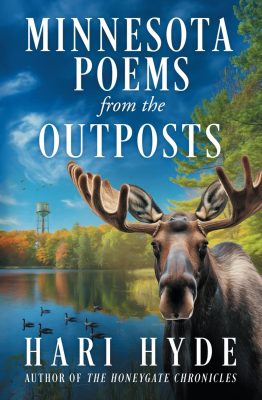
Hari Hyde reveals the mysticism of exploring chaotic nature and our human need to connect with it. He takes readers to sites of wonder, physical and conceptual, in his collection Minnesota Poems from the Outposts.
“Part 1: Middle Rivers” illustrates the shared liminal states of people and the natural world.
Aligning symbols of the turning seasons with people growing up in their communities, “Middle River, Minnesota” establishes our innate kinship with nature—as individuals and collectives. “School Bus” follows the transient days of childhood, while “Unruffled Railway” looks back from the end of an era, as the rails are now overgrown and unused. But, to be overgrown is to find life, and a new way of being after the end of that old cycle.
Meanwhile, “Moon Over Thief Lake” illustrates the need to commune with nature through beautiful but distant imagery.
Part 1 maintains a childlike playfulness in its use of language.
“Goose Capital” and “Young’s Store” give in to flights of fancy about the little details of rural life, while a trio of poems “Ye Olde Depot Theater, River Avenue”, and “Church Bell” fully immerse themselves in the charm of small communities.
But Part 1 also touches on the difficult challenge of maturity. “Milking Holsteins” and “Angus Cattle” find peace in a world where each creature has a role to play. But, matching the use of rivers as a thematic force of eternal change, “Minnesota Highway 59” reckons with the fact that there are some deep yearnings a person will never be able to satisfy.
These first poems open the book well, introducing both the setting of rural Minnesota and a focus on living in relation to its natural forces. Some of the themes in Part 1 could be expanded upon, but the warm poetic voice beckons readers to continue on.
“Part 2: Smalltown Outposts” broadens its scope to include a variety of notable locations, embracing the culture and history of Minnesota.
A mixture of compelling imagery and unique tones give each new location a sense of identity, especially in poems like “Split Rock Lighthouse (Lake Superior)”.
This combines with whimsical renditions of local mythology in “Paulette Bunyan” and “Mankato Man and Nature’s Plan” to instill in readers Minnesota’s vital, defiant soul.
Hyde also explores the human shadow of Minnesota’s history—the inner lives of those who made it—in “Minnesota’s Ten Millennial Girl” and “Blue Mounds State Park”. These poems describe the personality that history leaves to its locations but, at the same time, exposes the complexities that can’t be preserved over a long period of time.
Where Part 1 embraced communion with nature, Part 2 creates a thematic duality by highlighting our inherent conflict with it.
“Mankato Man and Nature’s Plan” puts this conflict in stark relief. The central figure defies his place as a tool in Nature’s hand. But “Red River Flood” shows how futile that fight can be, with the narrator choosing to become like the river itself rather than try to live in spite of it.
The rhyming can create awkward lines sometimes, but this section’s beauty is in its clear familiarity with its locations, which maintain their grandeur.
“Part 3: Inner Outposts” and “Part 4: Family and Faith” create another dichotomy—the inner self and its struggle to fit in with the outer world.
“Private Ponds”, “Secret Snow Bones”, and “The Outside” encourage trusting the inner self, finding meaning beyond societal expectations and dogma. But “The Believable Distance” and “Last Love” both recognize the pain in being distant from others.
These sections make playful use of metaphors, but in poems like “Guard Dog”, those become more complex and conflicted. The animal part of one’s mind tears and recoils at the chains that bind it.
As a whole, Parts 3 & 4 step into darker territory. Pain and suffering are reframed as the necessary teachers of survival—from the mundane to the divine—in “Ancient Apathy”. “Corporal Counselor” grapples with pride and envy as truly inescapable sins, innate to the inner self.
While there’s a return to some of the mysticism of childhood from Part 1, these later parts offer a more nuanced perspective on relationships.
This is particularly true among the poems most concerned with death, “Elegy for a Nobody”, “Get Well Cards (Calibrated)”, and “A Little Light”. While the themes of family and faith don’t interact much in general, these death poems find interesting connections between how death changes our relationships to each other and the deep desire to understand one’s meaning in the universe.
“Jonah and the Great Fish” stands out as a unique take on this section’s view of God. Here, animals are to humans as humans are to the divine. But the might of nature tests the boundaries of this metaphor. A great and terrible sturgeon reigns as a bloody demon, and it’s only through the help of nature’s small and wriggling things that the fish can be bested.
This poem serves well as a transition point to the fifth and final part of the collection, “The Wild.” Here, the core ideas and writing style of Minnesota Poems from the Outposts both shine at their brightest.
“Moose Head” grants intention and emotion to the forces of the natural world, while reinforcing its incompatibility with human society. This poem and “Arrowhead Northern Lights” create a compelling combination of descriptive language and poetic contrasts. All underscored by a palpable appreciation for the wilderness of Minnesota.
“Into the Woods” and “Lake of the Woods” experiment most with structure and poetic flow, to fascinating effect.
Both are much longer than any other poems in the collection, with lines and paragraphs shifting in size as they explore new parts of the wilds. They take this time to fully immerse a reader in their contrasting views of wilderness.
The narrator finds that, to truly go “Into the Woods” and become a part of them, one has to give themselves up to the beautiful ways of nature. It’s a welcoming of the raw, physical world.
“Lake of the Woods”, on the other hand, seeks divinity in the beasts of the water. Recurring symbolism aligns the lakes with the sky—a celestial realm, where humans can touch and even enter, but will find themselves reflected back in challenging ways.
And yet, for all of the woodlands’ chaos and strangeness, people come.
Here, in these final poems, Hyde returns to the incessant yearning. The distance between a person and the worlds of men and trees alike might be vast, but the quest to cross it is equally as meaningful.