Embark on an enchanting voyage through the realms of Middle Grade Fiction with the Gertrude Warner Book Awards. These awards transcend genres, uniting tales that ignite youthful imaginations with captivating exploits. Whether whisked away to far-off lands, unraveling mysteries, or forging friendships, these stories cocoon young readers in a world of adventure. Every story invites exploration and engagement, fostering a love for reading that lasts a lifetime. The Gertrude Warner Awards celebrate authors who craft stories that spark curiosity, empathy, and the joy of discovery.
Inspire your inner child with the Grand Prize Winners of the Gertrude Warner Awards!
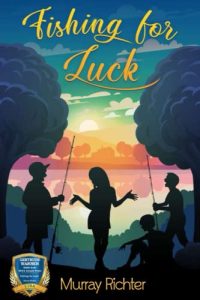
Fishing For Luck By Murray Richter
During the pre-internet era of 1980, Kevin and his friends just want to enjoy a good fishing adventure, but troubles from the past come back to complicate their carefree boyhood in Murray Richter’s novel, Fishing for Luck.
As the group prepares their fishing raft for its maiden voyage, Kevin tries to solve these problems himself before anyone else knows of them, but no matter what he tries, the situation only gets worse. His parents seem on the verge of a divorce, his mentor struggles to find his long-lost love, and his sister just wants her bike back already. As Kevin takes on more and more responsibility to avoid what seem to be inevitable consequences, will he be able to see that this is all too much for one kid to handle and ask those he trusts for help?
Fishing For Luck is a wild ride of pre-teen hijinks reminiscent of the golden age of coming-of-age comedies and sitcoms we all know and love. Our young main character gets into a situation where everything goes wrong, and scrambles to fix it before anyone notices. Kevin’s predicament becomes engrossing with an extra dose of danger.
In this first installment from the new Kassy O’Roarke Pet Detective Series, award-winning author Kelly Oliver delivers a fun and engaging kid-friendly literary experience. Here is a story intended for middle-graders, Cub Reporter proves a quality blend of adventure and mystery involving a smart, inquisitive 12-year old with aspirations of becoming a spy.
As a reporter for her school paper, Kassy’s hoping to nab a front-page scoop and win the honorable Thompson Award for Journalism. Unfortunately, help from her pesky, but the well-intentioned younger brother, sets in motion a roller coaster of calamities she never expected. From animal-nappings and a mixed-bag of clues to car chases and rescues from entrapment, ultimately the constant reinforcement from family, friends, and a menagerie of furry companions bring positive lessons to the forefront of this likable tale.
Amidst popular classics like Emil and the Detectives and the resurgence of the Nancy Drew mysteries, Oliver has hit the mark with this bright and entertaining series opener. Though geared toward a younger audience, readers of all ages can look forward to more investigative capers on the horizon featuring the creative escapades of Kassy and company. Highly recommended!
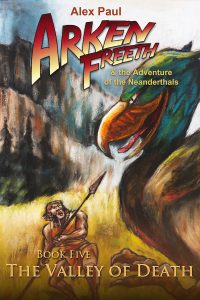
The Valley of Death – Arken Freeth series book 5 By Alex Paul
The Valley of Death, Book Five in the Arken Freeth Middle-Grade series, continues the story of a heroic young man in a land before time.
The book is the latest chapter in the swashbuckling saga of Arken Freeth, a hero who will eventually become the central figure of his era, 11,000 years before the Roman era, as powerful and wise as Alexander the Great would be to his time. The many readers of the award-winning series know his adventures as a teenager in the land of the Neanderthals, or Nanders as they are called, along with his royal friend Asher, heir to the throne of Tolaria, and the young woman Talya. They know his Nander blood brother Ord, the evil pirate Yolanta, king of the Tookans, and the vile Gart whose life he saves despite their difficulties.
These familiar figures return in the latest thrilling installment. A war between the leading factions of the time, the Amarrats, the Lanthians, and the Tolarians is on the brink. The central prize that all desire: ownership of the necklace of Tol, which possesses enormous powers such as foretelling the future to those who own it. The quest to own the necklace is such that war is being threatened by the Amarrats against the Lanthians in order to possess it. Arken, who placed the necklace in the hands of the Nanders, is now the one person who can successfully stop the bloodshed by retrieving the necklace.
Now that you’re set on your next reads, what are you waiting for? The only way to join this amazing list of Gertrude Warner Winners is to submit today!
Those who submit and advance will have the chance to win the Overall Grand Prize of the CIBAs and $1000!
Don’t miss your chance to light up the minds of young readers everywhere. Send us your Middle Grade Reader stories by the end of August for the chance to be recognized and celebrated for your amazing work!
And remember! Our 12th Anniversary Chanticleer Authors Conference (CAC24) will be April 18-21, 2024, where our 2023 CIBA winners will be announced. Space is limited and seats are already filling up. Sign up and see the latest updates here!
You have until August 31st to share your Love Story and enter the 2023 CIBAs!
Everyone deserves more love, and we’ve got lots of it for you to read! Steamy (Not Spicy), Historical and more! Other categories also include romantic themes, but if you’re looking for Romance- look no further!
Lets take a look at the Grand Prize Winners for the Chatelaine Award
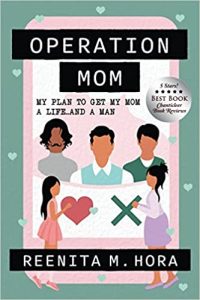
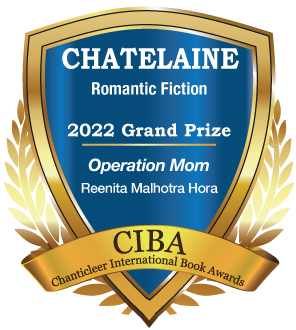
Operation Mom By Reenita Hora
Master storyteller Reenita Malhotra Hora’s YA romance Operation Mom: My Plan to Get My Mom a Life and a Man takes us on a charming journey through the life of one teen, Ila Isham.
Hora introduces Ila and her best friend Deepali, two boy-crazy teens on a summer quest. Readers will fall in love with the smart, sassy, angst-filled, rebellious Ila. A typical teenage girl, Ila lives in Mumbai with her mom and Sakkubai, their house manager. Ila’s mother calls her obsessed, but that seems unfair. Is she obsessed just because her every waking minute is spent thinking of Ali Zafar, famous pop icon, singer, and heartthrob? Or is she obsessed with fellow classmate Dev?
No, Ila couldn’t be taken with Dev because he’s one of three young men that her best friend Deepali is juggling in her summer experiment of exploring her “feminine mystique.” This turn of phrase becomes just one of many opportunities for Hora’s humor to shine as Ila remarks, “That’s a book by Gloria Steinem . . . no Betty Friedan.” Deepali’s response? “Yaar. Don’t be so literal.” The delightful balance between Ila’s book smarts versus Deepali’s street smarts carries us through Hora’s expertly crafted story.
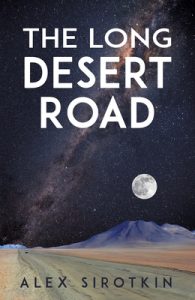
Alex Sirotkin’s debut novel, The Long Desert Road, navigates the emotional arcs of life in contrast with the greater expanse of the cosmos. Here a young woman must face her addictions while the people around her try to move beyond her backlash.
We meet Henry Spinoza, a 44-year-old quirky science writer. He ponders his life as half over, looks for the right woman, and wonders if there isn’t more to existence.
For twenty years, Henry, a science writer, has been researching a non-fiction book on the universe that he intends to write. Henry’s feeling “bored, boring, and budget-conscious…the trifecta of gloom,” as he puts it. But in the middle of this ennui, his sister-in-law invites him to dinner, along with her divorced friend, Isabel Dalton, an attorney, and “the setup is afoot.”
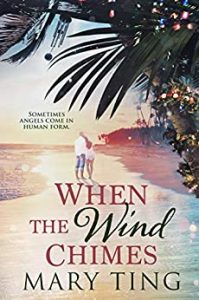
In When the Wind Chimes by international best-selling author Mary Ting, Kate Summers wants to make this Christmas extra-special for her older sister, Abby, and four-year-old nephew.
A year ago, she’d given up Christmas with her family to spend the holiday with her boyfriend, Jayden, whom she had caught cheating on her the next day. Not only is she hoping to erase that memory, but she also has another even more important reason to make this Christmas special. A few months after her disastrous break-up with Jayden, her brother-in-law, Steve, passed away from cancer, so Abby and Tyler will be spending their first Christmas alone.
After taking a leave from her job as a graphic designer in LA, Kate flies to Poipu, Kauai, determined to make this an amazing holiday, but on her way to her sister’s house, she meets a mysterious man, who gives up his cab for her. Kate can’t get the handsome stranger out of her head, and when she sees him again in her sister’s art gallery–and destroys his expensive shirt with paint–she is both mortified and excited.
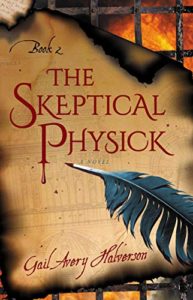
In the second in a series by author Halverson, an aristocratic, intellectually curious young woman has fallen in love with a young physician, a commoner whose radical experimentations have jeopardized his reputation. The couple is just recovering from the professional and personal rigors of dealing with London’s plague victims when the city is overwhelmed by fire. Their services are needed now more than ever.
Supported by mentor hospital administrator Father Hardwicke in his medical endeavors, Simon McKensie is finally on the verge of marrying the woman he adores, Catherine Abbott. Even the wealthy, protective Aunt Viola has come to terms with the fact that, though she might not approve the match on social grounds, she sees that Catherine will be happy with Simon.
If winning her aunt’s approval and administering aid to plague victims wasn’t enough, just days before their planned nuptials, a fire breaks out that threatens to delay them yet again. Worse, Catherine sustains a severe injury on her way to the hospital to help Simon treat burn victims. It seems that there may not be a wedding. But Simon acts quickly and effectively to save the life of his beloved, exchanging wedding vows with her even as she is barely recuperating from her accident.
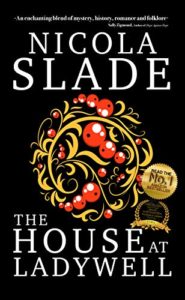
A surprise bequest, a cryptic benediction, and a box of long-lost letters thrust Freya Gibson in the middle of a life-changing mystery. As the personal assistant to successful novelist Patrick Underwood, Freya never takes a vacation. She believes herself content to be surrounded by the hustle and bustle of London, keeping Patrick on track and reigning in her newly discovered and completely uncertain feelings for her boss.
When Freya inherits a house from a heretofore unknown relative, she isn’t sure what to do. What’s more, the house comes with a clause preventing the immediate selling off of the relic. Freya has no choice but to visit the estate, still reasonably sure she will rid herself of the property; until, of course, she sets foot in the ancient home in Ramalley.
With Patrick gone on a business trip to the US, Freya decides to spend a week getting to know her new home and the village nearby. She quickly decides she wants to keep the enigmatic house with the enormous stone mantle, former church windows, and hand-carved hares. Still, as she falls in love with the house, she uncovers evidence that Violet, her cousin, and the former owner, knew a great deal more about Freya than Freya knows about herself. With each step closer to the truth, the house seems to draw her closer in a protective grip, perhaps giving her a chance at a new future.
Now that you’re set on your next reads, what are you waiting for? The only way to join this amazing list of Chatelaine Winners is to submit today!
Those who submit and advance will have the chance to win the Overall Grand Prize of the CIBAs and $1000!
Submit to the CIBAs Today!
Now is your chance to touch the hearts of readers everywhere. Your Romance story deserves to be discovered, and you can submit to the 2023 Chatelaine Awards by the end of the month. Don’t miss this chance to give your book the recognition it deserves.
And remember! Our 12th Anniversary Chanticleer Authors Conference (CAC24) will be April 18-21, 2024, where our 2023 CIBA winners will be announced. Space is limited and seats are already filling up. Sign up and see the latest updates here!
On August 18, 1920, the Nineteenth Amendment to the United States of America Constitution was ratified and signed into law on the 26th that same month.
Celebrating the 103rd Anniversary of the 19th Amendment: A Triumph of Perseverance and Equality
In the tapestry of history, some threads are woven with courage, resilience, and indomitable will. This year, as we commemorate the 103rd anniversary of the 19th Amendment to the United States Constitution, we honor the relentless dedication of those who paved the path to gender equality and universal suffrage.
Join us in celebrating this significant milestone, reflecting on the arduous journey that spanned over seven decades. The suffrage movement wasn’t a mere campaign; it was a movement that transformed society and opened doors to empowerment.
This commemoration takes us back to the historic victory that marked the amendment’s ratification on August 18, 1920, forever engraving the right for women to vote into the framework of American democracy. The amendment stood as a testament to unity, courage, and the conviction that change is attainable.
The Nineteenth Amendment was the capstone of that fight, but it took over seventy years to achieve it.
We are celebrating the 103rd anniversary of the Nineteenth Amendment’s adoption into the U.S. Constitution: the amendment that guarantees citizens the right to vote regardless of their gender, and the victory of the American Suffrage Movement. It took more than seventy years of protesting, picketing, and struggles for women to gain the civil right to vote in US elections. And many more decades passed before other disenfranchised groups were systematically denied the right to vote.
And still, the vote was not granted to Black women and men. That right came about much later than most people realize, June 6, 1965, whenPresident Lyndon Johnson signed the Voting Rights Act, which outlawed the discriminatory voting practices that some Southern states adopted after the Civil War.
Women’s suffrage was not just a long fight, but one taken on by many pivotal figures. But the story of the suffrage movement is best told by remembering many of its impactful suffragists, such as Alice Stone Blackwell, Elizabeth Cady Stanton, Matilda Joslyn Gage, Ida B. Wells, Mary Church Terrel, Josephine St. Pierre Ruffin, and Harriet Tubman whose unwavering dedication rallied people to challenge oppressive norms. Their legacy echoes through the ages, inspiring us to continue championing justice and equality.
Suffragists were physically attacked by mobs of angry men and boys while police looked the other way. They’d been roughly arrested; been held in fetid, cold, vermin-infested cells; been shackled to the wall; and endured abuse and even torture in jail. When they went on hunger strikes, they were force-fed, tubes rammed up their noses. The Christian Science Monitor.
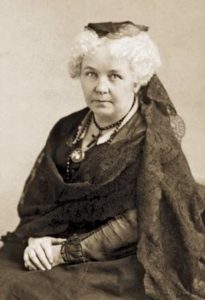
Elizabeth Cady Stanton, c. 1880
Elizabeth Cady Stanton was one of the women who first crystallized the Suffrage Movement, having helped organize the Seneca Falls Convention. Her unique background was pivotal in formulating the first demand for women’s suffrage in 1848.
As the movement grew and drew public attention, Stanton proved herself to be a skilled orator and writer, working closely with Susan B. Anthony throughout the years; Stanton actually wrote some of the speeches that Anthony delivered, and– along with Anthony– was one of the founders of the National Woman Suffrage Association. Stanton wrote for a more equitable future in more than voting; in addition to the question of suffrage, she championed a broader view of women’s freedoms, supporting labor rights, property rights, and the right to divorce. She saw that women should have the chance to lead their own lives, taking part in all aspects of society equally to men.
Movements don’t just happen, they come alive when a group of people decides to take action against injustice, and even small beginnings can lead to sweeping change.
Elizabeth Cady Stanton came from a privileged background and used her position and means to propel her views. Her father was a prominent attorney, Congressman, and a judge. He also was a slave owner. Elizabeth was exposed to the study of law and the government mechanisms that govern by her father. She was particularly against how religion was used to justify the oppression of women. She pennedThe Woman’s Bible to tackle misogynistic traditions rooted in religious dogma after being sent to a seminary at the age of sixteen.
She became an adamant abolitionist to end the practice of slavery in the United States in 1839 at the age of 24. Many historians believe that the Abolitionist Movement to End Slavery experiences and lessons were essential to pave the way for the Women’s Suffrage Movement.
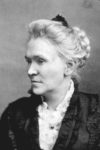
Stanton wasn’t the only suffragist who saw the reality of sexist injustice throughout her society, and one of her contemporaries joined her in drawing attention to these wrongs. Matilda Joslyn Gage was considered a radical in her time, having fought against traditionalist views as Stanton had. Matilda was on the revising and editing committee for Elizabeth’s highly controversialThe Woman’s Bible.
Matilda Electa Joslyn March 24, 1826
This right to vote was a battle, fought and won 103 years ago by women we will never know, but by what they have written, what others have written about them, and what they have done for all of us.
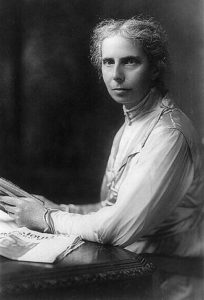
Alice Stone Blackwell
One of the women who played a significant role in uniting these two groups was Alice Stone Blackwell.
She was in a position to do so because of her connection to the AWSA: her mother was Lucy Stone. Along with Alice’s father, Henry Browne Blackwell, they were some of the primary organizers of the group. As Alice Stone Blackwell grew up, she worked with her parents on their paper, theWoman’s Journal, and eventually ran the paper. Once the AWSA and NWSA had merged, Blackwell served as the NAWSA’s recording secretary.
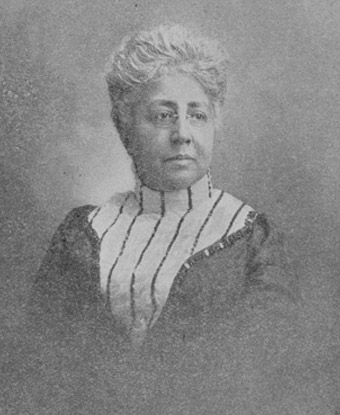
Publisher and founder of the Woman’s Era Club (which laid the foundation for NAACP), Josephine St. Pierre Ruffin, an activist at heart, a community leader, and a national organizer, grew up surrounded by the abolitionist ideals of justice, equality, and political representation. Her earliest public service dates to the Civil War, during which Ruffin recruited African American men for the 54th and 55th Massachusetts infantry regiments. After the war, Ruffin served on several charities that helped Southern Blacks. Ruffin dedicated her life to bettering the lives of women and Black Americans both locally and nationally. NPS.Gov/People/Josephine-St-Pierre-Ruffin.
Josephine St. Pierre Ruffin
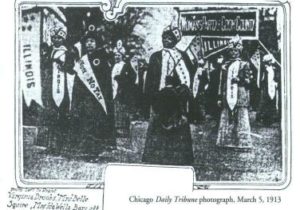
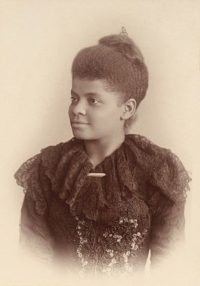
While the centennial celebrates the federal adoption of women’s suffrage, we shouldn’t forget the smaller victories and works that punctuated the movement’s length, those who spoke out against injustice in many forms, while seeking the vote. One such woman was Ida B. Wells, who played an active role in the suffrage movement of Chicago. The city had given partial suffrage to women. Wells, along with a fellow suffragist Belle Squire, started the Alpha Suffrage Club to advance women’s suffrage further and educate women on civic involvement.
Ida Wells & Belle Squire marching in 1913
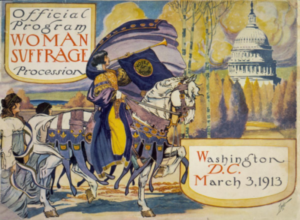
The club especially supported African American candidates for the city’s elections, working to break down multiple unjust barriers in politics. Wells participated in one of the NAWSA’s best-remembered marches, set in Washington D.C. the day before the inauguration of President Woodrow Wilson. At the beginning of the rally, she was told to walk at the back, but she refused. Ida B. Wells marched with her sister suffragists from Illinois at the front. The power of social change comes from unified work between many people, and Wells refused the idea that she, as a suffragist, could be divided from anyone else.
Along with women like Wells and Ruffin, Mary Church Terrel was an advocate for racial equality. She was entwined with gender equality, which shows throughout her work with the NAWSA, where she frequently met with Susan B. Anthony and Elizabeth Cady Stanton. She insisted that the movement fight for the rights of black women alongside those of white women, and spoke highly of the suffragists who fought for everyone oppressed by the political and social systems of the time. She spoke at NAWSA meetings, delivered speeches, and called for the suffragists to remember all of the women whose vote they worked so hard to gain.
Ida Wells
Let’s not allow their work to be forgotten – and let us never give up our full Rights as U.S. Citizens to carry out this all-too-important privilege.
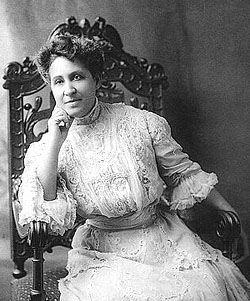
Despite the NAWSA’s issues with racism, some black women did act within that organization, such as Mary Church Terrel, who was an advocate for racial equality entwined with gender equality, which shows throughout her work with the NAWSA, where she frequently met with Susan B. Anthony and Elizabeth Cady Stanton. Mary insisted that the movement fight for the rights of black women alongside those of white women, and spoke highly of the suffragists who fought for everyone oppressed by the political and social systems of the time. She spoke at NAWSA meetings, delivered speeches, and called for the suffragists to remember all of the women whose vote they worked so hard to gain.
Mary Church Terrel Sept 23, 1863
Women’s suffrage had a complex relationship with black civil rights in large part thanks to the period of history in which the suffrage movement began: the Seneca Falls Convention took place in 1848, seventeen years prior to the abolition of slavery. This meant that the women’s rights movement was progressing and focusing at the same time that black people across were achieving freedom and directing themselves in a country that, while changing dramatically, still marginalized them.
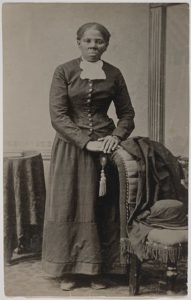
Harriet Tubman’s work is an example of how black women fought on both fronts; she’s a figure best remembered for her work as a liberator, freeing slaves prior to and during the civil war, but she took part in the suffrage movement as well. During the time of the NAWSA, she traveled to meetings and demonstrations to give speeches, telling of her experiences fighting for freedom and facing down oppressive and dangerous power structures during the time of slavery, and how important the struggle for freedom is. She bridged her advocacy for equality into the fight for the vote, and during this time, Ruffin’sThe Woman’s Erawrote a profile on Tubman, as the country’s attention was once again drawn to her fight.
Harriet Tubman after the Civil War
All of these histories show that the suffrage movement’s victory– the adoption of the nineteenth amendment– was the result of disparate people, dedicated and idealistic people coming together and fighting hard for their rights. They gave time, energy, and passion to a movement that would, eventually, provide them with the right to participate in the democracy of their country. The fact that the suffrage movement stayed strong for 70 years united its two significant organizations, tackled legislation at both the national and local levels, is a testament to the people who refused to give up, and whose worked– together– to win the fight.
It’s been a century since women won the right to vote, and more than 170 years since the American suffrage movement started in earnest. This movement has a lot it can teach us: the value of working together, across the country, to bring about change; the importance of remembering that there is always more than one fight for progress and rights, that we should listen to the voices of everybody who’s been pushed down and denied their rights and opportunities; and, of course, that even in the face of a power structure that calls rebellion and the fight for equal freedoms’ radical’, that fight is a good one, and worth taking on.
At the Seneca Falls Convention, the call for women’s suffrage rang out in America, whereas before it had been considered a fringe idea, or even impossible. The fight was long, but after seventy-two years, the suffragists made what was ‘radical’ a reality.
So, in the spirit that the right to vote is something that all people deserve, and should never have been restricted to any one group over another, let’s celebrate the centennial of a victory that brought America one step closer to the ideals of equality, freedom, and the rights of all. The power of the vote has shaped America’s history. We must all understand the importance of voting, and today we recognize those who fought for our rights. We are thankful for those brave suffragettes, for it is their struggle that has given us the right to participate in our democracy regardless of gender.
It required three generations of fearless activists over a span of more than seven decades working in more than 900 state, local, and national campaigns to finally win the vote for American women. And that active verb – win – is important: Women were not given the vote; they were not granted the vote. As one commentator so aptly describes it: “They took it.” Christian Science Monitor
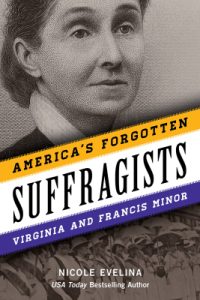
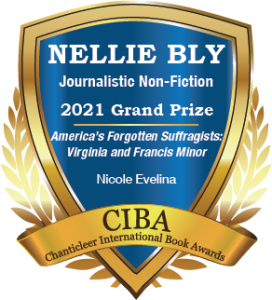
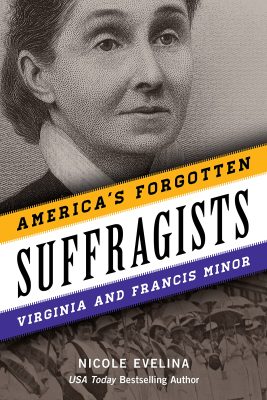
This year holds a special place in our hearts as we also celebrate the exceptional work of Nicole Evelina, whose groundbreaking book, ‘America’s Forgotten Suffragists: Virginia and Francis Minor,’ sheds light on the indelible contributions of lesser-known suffragists. Evelina’s meticulously researched biography illuminates the lives of Virginia and Francis Minor, who, alongside their better-known contemporaries, shaped the course of women’s rights and equality. Their story, like many others, exemplifies the unyielding spirit that fueled the suffrage movement.
As we honor the remarkable journey that brought us to this juncture, we are reminded that progress is a collective endeavor. The road to universal suffrage was marked by sacrifices, courage, and a shared vision of a more just world. The fight for equality continues to resonate, urging us to safeguard the rights that were hard-fought and won.
Join us in commemorating the 103rd anniversary of the 19th Amendment, a testament to the power of determination, unity, and the enduring spirit of change. Let us remember the past, honor those who blazed the trail, and carry forward their legacy as we champion equality and justice for all.
Comprehensive in its own right, America’s Forgotten Suffragists by Nicole Evelina is an essential addition to the canon of women’s suffrage and first-wave feminism.
Equal parts local history of women’s right to vote in the nineteenth century and biography of Virginia and Francis Minor, America’s Forgotten Suffragists illuminates the story of a wife-and-husband feminist duo who were the first to fight for women’s suffrage at the Supreme Court level.
We learn about the lives of Virginia and Francis Minor by way of historical records, intersecting timelines with other suffragists, and news articles and letters. Virginia Minor was raised on the new and intellectually stimulating University of Virginia campus, where her father worked. Born into a colonial settler and slave-owning family, Virginia came into her own as she grew older, forming abolitionist and feminist beliefs.
In 1869, Virginia realizes that, through implication, the Constitution could grant women the right to vote by way of the Fourteenth Amendment, which acknowledged the freedom, citizenship, and human rights of Black men freed from enslavement. She shares her thoughts with Francis — a practicing lawyer and constant ally for women’s financial independence. And when Virginia is denied from registering to vote in 1872, she sues and goes to court with Francis as her attorney, to introduce her interpretation of the law.
As history reveals, the Minors lost their case. However, they ignited conversations about women’s suffrage nationwide, pushing others to take up the charge.
Virginia became good friends with Susan B. Anthony, collaborating on suffrage campaigns in the Midwest, and giving speeches in territories that were becoming states. Francis Minor continued his advocacy for the feminist cause by publishing his writing on women’s rights. To preserve their words, biographer Evelina includes many of the Minor’s speeches and articles, as well as Virginia and Francis’s petition in full calling for the Supreme Court to acknowledge women’s right to vote based on the Fourteenth Amendment.
What truly shines about this book — along with its gentle prose and historical scene-setting — is what it teaches about the origins of first-wave feminism and why the American voting system continues to disenfranchise Black citizens.
Nicole Evelina takes great care to analyze Virginia’s 1875 Supreme Court case, Minor v. Happersett, from all angles.
Minor v. Happersett has been (mis)used over seven times since the trial to reinforce voter suppression tactics. Evelina demonstrates through this extensive biography of Virginia and Francis Minor that the issues we face today — election tampering, gerrymandering, expunged registration records, and restrictions on accessible voting methods for the working class — can, in part, be traced back to this case.
This biography documents one woman’s bold path to securing women’s rights, a beacon of hope for a world where no person is lesser than another.
Does your work focus on the key point of development between become a child and an adult? Do you find yourself drawn to work like the Redwall series or the Chronicles of Prydain, but you want to make a different mark for it? We’re ready for your ideas that will whisk young readers away on thrilling adventures, sparking their imaginations and ignite their love for storytelling. Join the CIBA 2023 Gertrude Warner Awards—an arena designed to honor and elevate outstanding middle-grade fiction.
The Gertrude Warner Awards:
Named in honor of the revered author of “The Boxcar Children” series, the Gertrude Warner Awards hold a unique place in our heart. Gertrude Chandler Warner’s timeless tales have enchanted generations of young readers, and now, we invite you to follow in her footsteps and leave your indelible mark on the world of middle-grade fiction.
Submitting to the CIBAs is a great way to help promote your book. We partner with other major supporters of indie and traditionally published authors like ALLi, IBPA, Reedsy, and Book Award Pro to bring the unique excellence of our Book Awards to you. Whether you sign up in the hopes of winning a Blue Ribbon, Author Interview, or Editorial Book Review Package, know that each time your book advances in our tiers you will receive regular promotion on our website, social media, and Newsletter!
Celebrating First Place and Grand Prize Gertrude Warner Winners!
The Gertrude Warner Awards have previously celebrated remarkable authors who’ve breathed life into middle-grade fiction. Here’s a glimpse of our esteemed winners from the last year:
Alex Paul – The King’s Armada, (Arken Freeth and the Adventure of the Neanderthals) Book 6 of 6
J.K. Pinsel – KAZI
Didem Saracel – Story of Universe
Ben Gartner – People of the Sun
U. W. Leo – ARKO: The Dark Union
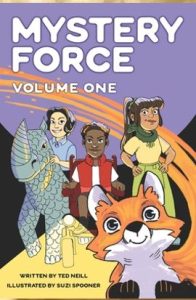
And the Grand Prize Winner for the CIBA 2022 GERTRUDE WARNER Awards is:
MYSTERY FORCE, Volume 1 by Ted Neill and Suzi Spooner
Submit to the CIBAs Today!
Now is your chance to weave narratives that linger in young hearts and minds. Prepare to make your mark as we open the doors for submissions to the 2023 Gertrude Warner Awards. Your masterpiece could be the next cherished tale inspiring future generations.
The Gertrude Warner Awards Winners will be announced at the CIBAs Ceremony on April 20, 2024 in Bellingham, WA and will be sp0nsored by the Chanticleer Authors Conference.
The Goethe Book Awards recognize emerging new talent and outstanding works in post-1750s Historical Fiction. The Goethe Book Awards is a division of the Chanticleer International Book Awards (The CIBAs).
The Goethe Book Awards competition is named for Johann Wolfgang von Goethe who was born at the dawn of the new era of enlightenment on August 28, 1749.
Chanticleer International Book Awards is looking for the best books featuring Late Period Historical Fiction. Regency, Victorian, 18th Century, 19th Century, 20th Century, World and other wars before the 20th century, history of non-western cultures, set after the 1750s, we will put them to the test and choose the best among them.
The other three Historical Fiction Genres are the Laramie Awards for Americana Fiction, the Chaucer Awards for Early Historical Fiction, and the Hemingway Awards for 20th c. Wartime Fiction.
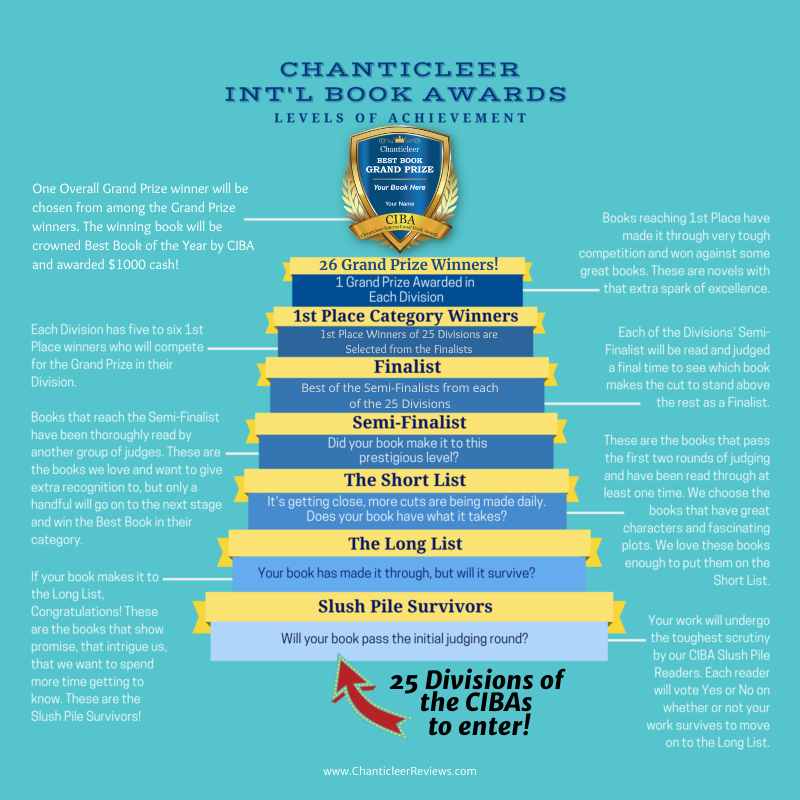
These titles have moved forward in the judging rounds from all 2023 Goethe Late Historical Fiction entries to the 2023 Goethe Book Awards LONG LIST. Entries below are now in competition for the 2023 Goethe Shortlist. The Short Listers will compete for the Semi-Finalist positions. Finalists will be selected from the Semi-Finalists. All FINALISTS will be announced and recognized at the Chanticleer Authors Conference (CAC24).
The First Place Category Winners, along with the CIBA Division Grand Prize winners, will be selected from the 25 CIBA divisions’ Finalists.
We will announce the 1st Place Category winners and Grand Prize Division Winners at the CIBAs Banquet and Ceremony on Saturday, April 20th, 2024 in Bellingham, Wash. sponsored by the 2024 Chanticleer Authors Conference.
These titles are in the running for the SHORT LIST of the 2023 Goethe Book Awards novel competition for Post-1750s Historical Fiction!
Join us in cheering on the following authors and their works in the Goethe 2023 CIBAs.
Pat Wahler – The Rose of Washington Square: A Novel of Rose O’Neill, Creator of the Kewpie Doll
J. Stanion – My Place Among Them: A Novel
Sandra Wagner-Wright – Ambition, Arrogance & Pride: Families & Rivals in 18th Century Salem
Janis Robinson Daly – The Unlocked Path, A Novel
Lindsey S. Fera – Muskets and Masquerades
Jerena Tobiasen – Tsarina’s Crown
Colleen Coyne – The Unintended Heiress
Mitzi Zilka – Water Fire Steam
Jeff Schnader – The Serpent Papers
Miriam Polli – Birds Of Passage
Eleanor Tatum – The Countess of Change
Patrick Greenwood – Sunrise in Saigon
Jodi Lea Stewart – The Gold Rose
Chris Black – Chameleon
Lisa Voelker – The Spoon
Nichole Louise – Raven Rock
Susanne Dunlap – The Courtesan’s Daughter
Robert Brighton – The Unsealing
Gary Born – The File
Robert W Smith – A Long Way from Clare
Carrie Hayes – Naked Truth or Equality, the Forbidden Fruit
David Calloway – If Someday Comes
Michael Miller – High Bridge – Matilda and Grover Battle Learned Ignorance
Susanne Dunlap – The Portraitist: A Novel of Adelaide Labille-Guiard
Nina Romano – Dark Eyes
Susanne Dunlap – The Adored One
Alexandru Czimbor – The Soul Machines
Wendy Long Stanley – The Treason of Betsy Ross
Linda Ulleseit – The River Remembers
Ed Davis – Last Professional
Loretta Miles Tollefson – There Will Be Consequences
Don Jacobson – The Sailor’s Rest
Dean Cycon – Finding Home (Hungary, 1945)
Leslie K Simmons – Red Clay, Running Waters
William Maz – Bucharest Legacy: The Rise of the Oligarchs
Linda Rosen – The Emerald Necklace
Jason Ollander-Krane – Circus Home: A Novel of Life, Love and New Jersey
S.P. Grogan – Crimson Scimitar–Attack on America
Venetia Hobson Lewis – Changing Woman: A Novel of the Camp Grant Massacre
T. M. Brown – The Last Laird of Sapelo
Nicole Evelina – Catherine’s Mercy
Jeanette Watts – My Dearest Miss Fairfax
J.L Oakley – The Brisling Code
Radu Guiasu – The Faraway Mountains
Johnny Teague – The Lost Diary of George Washington
Joan Koster – Censored Angel: Anthony Comstock’s Nemesis
PROMOTING OUR AUTHORS!
This post has been posted on the Chanticleer Facebook Page. We try to tag all authors listed here in the FB post. However, for FB to allow us to tag an author, that author must LIKE our page and Follow Chanticleer Reviews.
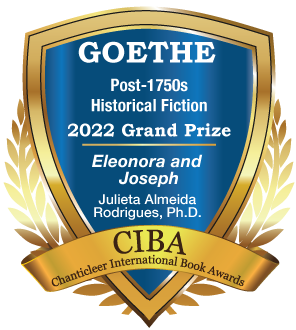
The Grand Prize Winner for the CIBA 2022 GOETHE Awards is:
Eleonora and Joseph:
Passion, Tragedy, and Revolution in the Age of Enlightenment
by Julieta Almeida Rodrigues
We are now accepting submissions into the 2024 Goethe Book Awards for Post-1750s Historical Fiction. The 2024 CIBA winners will be announced at CAC 2025.
Seating is Limited. The esteemed WRITER Magazine (founded in 1887) has repeatedly recognized the Chanticleer Authors Conference as one of the best conferences to participate in and attend in North America.
Unveiling the Allure of the Chatelaine Book Awards!
Indulge in the world of romantic tales, where hearts entwine and stories of love blossom. The Chanticleer Int’l Book Awards cordially invites you to embark on a journey through the pages of captivating romances – from the echoes of historical love affairs to the sparks of steamy passions – we are on a quest to find the best among them.
The image for the Chatelaine Awards is pulled from Dante Rossetti’s iconic painting, featuring Jane Morris, a muse whose allure is still felt today.
Are you an author with a romance novel or manuscript ready to sweep readers off their feet? Do you yearn to see how your creation fares among others of its kind? The Chatelaine Book Awards beckon, ready to embrace your literary gem.
Romantic storytellers, both budding and seasoned, take heed! We have moved the deadline for the Chatelaine Awards for Romance Literature to August, 31, 2023.
That’s right, submissions for the 2023 Chatelaine Book Awards are due August 31, 2023. So, whether your heart beats for contemporary romance, historical intrigue, pulse-pounding adventures, or soul-stirring inspiration – the Chatelaine Awards are your stage.
The Chatelaine Awards Categories are:
Contemporary Romance
Romantic Adventure & Suspense
Historical Romance
Inspirational/Restorative/Clean
Romantic Steamy/Sensual
Don’t let this opportunity slip through your fingers. Embark on a journey of literary romance and share your masterpiece with the world.
One of our favorite things about the Romance genre is the versatility it brings to the page! Historical, Suspense, YA – anything can be a sub-genre with romance and vice versa!
As we celebrate the Chatelaine Awards – a universe encompassing Romance, Chick-Lit, Women’s Fiction, Inspirational, Suspenseful, and the irresistibly Steamy and Sensual – let us not forget the enigmatic Jane Morris. Morris personifies the spirit of the Chatelaine division. An embodiment of intelligence and allure, she leaves an indelible mark on our perception of romance. To learn more about this intriguing muse, delve into her captivating story here.
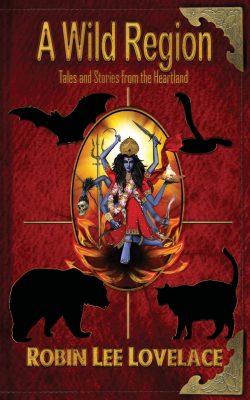
A Wild Region: Tales and Stories from the Heartland by Robin Lee Lovelace is a wonderful collection of Weird fiction (emphasis on Weird), showcasing the oddities and fantastic adventures which hide among the everyday people of the midwestern United States.
Lovelace opens with ‘Virgie’s Headless Chicken’, setting the tone for the full collection as Virgie attempts to reproduce a circus sideshow act. Lovelace shares her familial inspiration for this story in a fascinating preface.
From there she gifts readers with the award-winning novella, Savonne, Not Vonny, a coming-of-age story of a little girl involving brothels, voodoo, and displaced gods. Savonne faces trial after trial as she grows up in different environments, all while she tries to understand her place in the world. This setting is particularly well-developed, leaving readers wanting more from even the secondary characters. Readers who loved Neil Gaiman’s American Gods will enjoy every page of Savonne’s adventures.
Varying in emotion and impact, all of these tales will grab a reader’s attention. In every story of A Wild Region, fully-realized characters deal with important problems, approaching them with their own strange solutions.
A Wild Region, as a whole, deals with themes of belonging. Some stories explore belonging to a family, be it blood or found. Others in relation to society. No matter how strange and fantastic the setting and circumstances, the characters drive each story. Even the most bizarre elements are secondary to the characters, enhancing their journey. Readers will feel for each protagonist, rooting for them to the end.
This collection will help readers see their own surroundings with a new curiosity.
Every one of these stories takes place in the mundane, real world, tucked away somewhere at the edges of daily life with ties to the South and Midwest United states. From a southern Indiana farmhouse in the 1940s on to an abandoned mansion in a virus-ravaged Memphis in 2041, readers will look twice at roadside attractions and dusty drives which lead into the unmitigated wilds of this continent, questioning their hidden mysteries.
Lovelace is a strong voice in contemporary Weird and Southern Gothic fiction whom readers should continue to watch for. Hopefully, she has many more fantastic scenarios and characters yet to share with the world.
Prepare to be carried away to bustling, vivacious streets as you read Elizabeth Crowens’ New York: Give Me Your Best or Your Worst.
This captivating literary anthology is a love letter to the great city from a group of brilliant artists and authors, which delves into the multifaceted lives of New Yorkers.
Short fiction and a few poems describe the ins and outs of New York living. Murder mysteries, revenge, family struggles, family sagas, and, of course, the most important questions regarding real estate. Finding the perfect place to live in the city may be difficult, but this story brings into vivid relief the heart of what makes New York special: the people.
Each piece of the anthology maintains a steady focus on its characters’ journey, ensuring their needs and desires stay in the foreground. The city itself becomes a vibrant entity that weaves its way into the fabric of each story.
New York: Give Me Your Best or Your Worst is set apart by the inclusion of Crowens’ captivating photography.
The written word and visual imagery interplay elevate the anthology beyond expectations. From glow-in-the-dark skulls welcoming you to the gentrified street, to the twin boys who stand in as the fictional Angel and Israel in Richie Narvaez’s series of three stories, each photo adds depth that allows the reader to reimagine the story they accompany. With each page, these images remind readers of the heartbeat of New York City.
This anthology is a treasure trove for mystery lovers, with a range of stories that vary from curious to chilling.
The pieces come together like an intricately crafted puzzle, enticing readers to decipher their enigmatic clues and revel in the satisfying resolution. Perhaps the greatest joy here is that one can return after their first reading to linger gently on the interplay between image and story for a fuller experience. Each readthrough unravels new layers and meanings, expertly arranged by Crowens.
New York: Give Me Your Best or Your Worst is an outstanding anthology that captures the essence of New York and its myriad stories.
With its diverse range of voices, skillful storytelling, and the captivating addition of photography, this collection invites readers to embark on a literary journey through the soul of the city. Whether you’re a mystery enthusiast seeking a thrilling read or a lover of New York longing to rediscover its magic, this anthology is sure to leave an indelible mark.
Celebrating the 4th of July – Independence Day in the U.S.A.
In July 1776 the United States declared Independence from England.
John Dunlap printed copies of the Declaration of Independence in his Philadelphia shop on the night of July 4, 1776. (National Archives Identifier 301682)
The primary freedoms that everyone remembers from the Declaration of Independence is “Life, Liberty, and the pursuit of Happiness.” You can read the full Declaration here via the National Archives. It’s about two pages long and worth taking the time to review it.
Of course, the Declaration of Independence didn’t mean freedom for all…
Since US Independence was declared, the path to voting rights for all has been a long one getting from there to here, and there’s still more work to be done. You can read an abridged history of the journey of voting rights for women and people of color here, with special attention paid to the 19th Amendment.
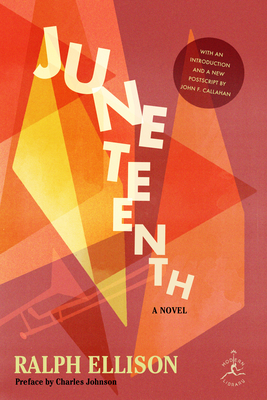
And we now have Juneteenth, a Texas holiday that is now celebrated nationwide. . The holiday celebrates a June 19, 1865 proclamation that freed enslaved peoples in Texas. Texas then, in 1979, became the first state to recognize Juneteenth as an official holiday. You can learn more about Juneteenth here.
Clearly, the US Independence Day has a deep, rich history that still lives on and evolves today. The traditions to celebrate the Fourth of July also continue to change and grow with the world.
Here in Bellingham, Wash., there will be a celebration at Zuanich Point Park and the Squalicum Boathouse. Events begin at 2pm, and, with sunset around 9:16pm, the big event begins at 10:30pm! You can learn more about this and other Whatcom County Events here.
Bellingham’s Old City Hall
It is also a time to remember those who serve and have served to preserve our nation’s independence and democracy.
Finally, we want to celebrate the US Independence Day in the most Chanticleer way possible — by recognizing wonderful titles . We hope you enjoy them as much as we did!
Great Reads from Chanticleer Reviews
US Fiction and Early History
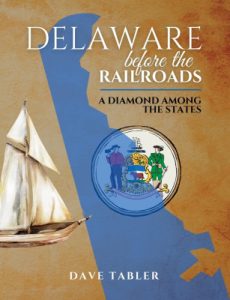
DELAWARE BEFORE The RAILROADS By Dave Tabler
Delaware Before the Railroads by Dave Tabler presents a captivating visual tale of this tiny state, from 1638 to 1832, ranging between early colonial settlements and the aftermath of America’s Independence.
Delaware’s place in this seminal time of United States history is carefully illustrated through pictures with wonderful captions. Delaware Before the Railroads highlights the significant role played by Delaware in America’s creation, uncovering surprising historical details such as the origin of log houses, a heroic figure who thwarted the British invasion of Canada, and the intriguing connection with Captain Kidd.
The pictures and captions are highlighted by sidebar paragraphs that deliver more knowledge about what life was like for the Swedes and Dutch who settled near Delaware Bay. They found, for instance, a “new world” of seafood they didn’t recognize, such as the crabs they called “sea spiders.”
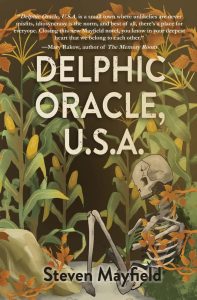
DELPHIC ORACLE, U.S.A. By Steven Mayfield
Mark Twain Grand Prize Winner
The Coen Brothers meet Garrison Keillor in Steven Mayfield’s quirky, offbeat, and often hilarious Delphic Oracle, U.S.A.
One June afternoon in 1925, seventeen-year-old Maggie Westinghouse, out walking alone as was her custom, comes upon a stranger in a railroad switch-house asleep on a pile of gunnysacks. Maggie, who has always stood a little apart from the town, has recently begun to experience visions that come upon her “in a leisurely way,” ending in a swoon and a restless sleep filled with exotic talk of which she later has no memory. No one knows what to make of it, but they soon will. After this afternoon’s chance encounter with July Pennybaker, a charming grifter on the lam, her world will never be the same. Neither will the town of Miagrammesto Station.
Eighty-nine years later, in the days leading up to and following the July 4th weekend, domestic dramas are playing out across Delphic Oracle, Nebraska (nee Miagrammesto Station).
EVERYTHING THAT WAS
By Conon Parks, Chris Sempek, Mike MacNeil, Larry Knight
Somerset Grand Prize Winner
Everything That Was echoes myriad broken emotions born of the world in turmoil after 9/11, intricate and politically bold, and as disturbing in its brutal humanity as it is satisfying with witty jests.
The 9/11 terrorist attack has shattered the psyche of the American people. A volcanic eruption of questions demands the whys and hows of the attack. From this anger, a massive war on terror begins. This historical fiction reflects the chaos of 9/11 and its ensuing global chaos – resulting in a series of violent endeavors and events. Throughout Everything That Was, one can find a swarm of fragmented ideologies, mini memoirs of war veterans, and witness accounts – all screeching reasons for the attack, the ensuing war, and its consequences: political, ideological, and theological.
The book’s very structure expresses the central ideas of its content, making for an affecting read.
DEAR BOB: Bob Hope’s Wartime Correspondence with the G.I.s of World War II
By Martha Bolton with Linda Hope
Military and Front Line Grand Prize Winner
During World War II, Bob Hope traveled almost ceaselessly to outposts large and small, entertaining US troops – and inspiring them; Martha Bolton brings the extent of this work to light in Dear Bob.
Writer Martha Bolton worked with and for comedian Bob Hope. Now, with Hope’s daughter Linda, she has gathered and organized the letters written to Bob by the soldiers he helped.
Hope, English born, and born to entertain, once said he could not retire and go fishing because “Fish don’t applaud.” Among his sizzling lines – and there are hundreds recorded here – he told one audience that he’d gotten a wonderful welcome when he arrived at their camp: “I received a 10-gun salute… They told me on the operating table.”
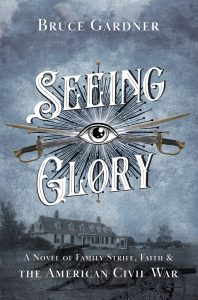
SEEING GLORY: A Novel of Family Strife, Faith & the American Civil War
By Bruce Gardner
Seeing Glory by Bruce Gardner is a sweeping, thought-provoking Christian historical novel of the American Civil War. The novel portrays the critical roles of family ties and religious faith in shaping personal attitudes and actions towards the horrors of slavery and the war itself.
Spanning the era from the famous abolitionist John Brown’s Pottawatomie Massacre in 1856 through the end of the war nine years later, Seeing Glory focuses on the gut-wrenching conflicts over slavery and the southern way of life faced by David, Emma, and Catherine Hodge, fictional siblings, raised on a wealthy plantation in Virginia.
David returns home from a prestigious northern college filled with radical new perspectives. He challenges his father’s and his southern church’s assurances that the Bible says slavery is approved by God. When David calls out the truth as he now sees it, he ignites a firestorm that tears him away from his family at the beginning of the Civil War, sparking huge changes in their individual destinies. Soon after meeting Abel Bowman—an ardent abolitionist and follower of John Brown—David moves north to Ohio and becomes an embedded war reporter with Abel’s Union army regiment. Mutual zeal for the abolitionist cause abounds, but will it help or hinder the two men’s endurance of horrific battlefield violence and scandalous personal accusation?
May your family and loved ones be close and happy. May we share in the benefits of a community that cares for and loves each other.
Happy Fourth of July from Sharon, Kiffer, David, Scott, Anya, Andy, and the whole Chanticleer Team!
And Remember! You can join the Chanticleer Family Anytime!
CAC 23 featured atty Maggie Marr, magazine editor Eric Lucas, author Mark Berridge, podcaster and broadcast journalist Reenita Malhotra Hora, and more!
To stay up to date with exciting news about our conference, your next great read, or contest deadlines, sign up for our Newsletter here!
Check out our Editorial Services here and our Manuscript Overviews here, OR, if your work is already polished to a fine shine, it’s time to submit to our Editorial Reviews here and our Chanticleer International Book Awards (CIBAs) here!






 The Goethe Book Awards recognize emerging new talent and outstanding works in post-1750s Historical Fiction. The Goethe Book Awards is a division of the Chanticleer International Book Awards (The CIBAs).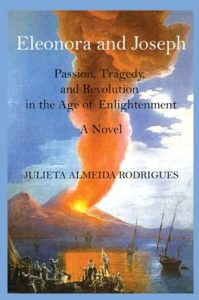
 Indulge in the world of romantic tales, where hearts entwine and stories of love blossom. The Chanticleer Int’l Book Awards cordially invites you to embark on a journey through the pages of captivating romances – from the echoes of historical love affairs to the sparks of steamy passions – we are on a quest to find the best among them.

 Prepare to be carried away to bustling, vivacious streets as you read Elizabeth Crowens’ New York: Give Me Your Best or Your Worst.