Tag: Goethe Awards

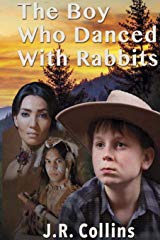
  • The BOY WHO DANCED WITH RABBITS by J. R. Collins – U.S. Historical Fiction, Romantic Action/Adventure, Family Saga

    The BOY WHO DANCED WITH RABBITS by J. R. Collins – U.S. Historical Fiction, Romantic Action/Adventure, Family Saga

    J.R. Collins has given a voice to an ancestor, Jeb Collins, who was almost killed at birth – twice. His survival is significant for that, but also for the fact that in another part of the Georgia mountains, a Cherokee boy, Wolf, is born on the same night. The families of the two boys will meet and mix in the early days of American settlement when everyone had to struggle for survival, and such friendships were still possible.

    Jeb learns smatterings of Cherokee language, and Wolf and his kin pick up English with a sharp mountain twang from their settler neighbors. Together Jeb and Wolf explore the mystical, mountainous part of Appalachia named Cho-E-Sto-E for the prevalence of rabbits there.

    Both of the boys’ fathers remember and despise the British who killed the American rebels and betrayed the Indians who agreed to help them; and both hate all evil-doers, like the ones who kidnapped Jeb’s sister or the sneak-thieves who stole from Jeb’s family. But most of all, they will stand united against a nearby tribe that wants Wolf’s sister as a bride for their leader.

    The author grew up in the region he describes so vividly in this, his first novel, and has a sequel, the award-winning, Living Where the Rabbits Dance. The story, focusing on the boy’s view of a sometimes-dangerous world, is told in a satisfyingly recognizable dialect, using many endearing folk expressions – one of our favorites being, My heart melted like butter on a hot biscuit.

    This multilayered saga presages the time that will come when the Cherokees will be marched away on the Trail of Tears, and family connections like those depicted here will be destroyed in the name of Manifest Destiny. It is heartening to read about the few years enjoyed by such friends as Jeb and Wolf when they could roam the land together with the approval of their elders. There is a finely-honed homage paid to two religions, the Christianity of the Collins clan and the animist visionary beliefs of the Cherokees, each playing a role in Jeb’s perceptions of the world around him.

    From learning to fish to making bead bracelets from local gemstones, to seeing visions invoked by Cherokee spirits, here is a tale of a boy coming of age in a significant time and place. Collins’ book records that history, that atmosphere, with equal measures of zeal and reverence.

    The Boy Who Danced with Rabbits by J. R. Collins won First Place in the 2017 CIBAs for the Goethe Awards, Western Fiction.


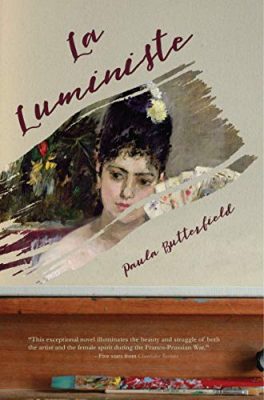
  • La LUMINISTE by Paula Butterfield – Women Impressionists, European Historical Fiction, Franco-Prussian War

    La LUMINISTE by Paula Butterfield – Women Impressionists, European Historical Fiction, Franco-Prussian War

    Berthe Morisot knows from a young age that she is destined to be an artist but living in nineteenth-century France severely limits her path. As a girl, she longs for the education any male artist would receive, and though her parents support her dream at first, Berthe isn’t even allowed to view some of the great works deemed unsuitable for females.

    Before long, she realizes she is uninterested in being any man’s student, wanting instead to explore her own style, painting the world of a modern woman–a real, intimate representation, not the perfection shown by most male artists. When her sister Edma, who originally paints with Berthe, marries and becomes the picture of femininity, Berthe feels the societal pressure to give up her painting and choose a husband. The one man she feels any connection to, fellow artist Edouard Manet, is a controversial rogue, and although she knows he feels for her, too, he marries another.

    However, the two cannot break free of their would-be love, and when Berthe decides to model for Edouard, she is more tantalized than ever. As her fascination turns to obsession, Berthe will be forced to choose between her desire to be a respected artist or the fallen lover of a scoundrel. It will take a revolution for Berthe to have either.

    This first-person fictionalized autobiography littered with famous Impressionists is the story of a woman’s love affair of both art and a man. In discovering her style, she finds a love she didn’t want and often questions the sanity (and more importantly) the healthiness of that love. As though her struggle to be an independent artist in a world of oppression isn’t already enough, Berthe knows she should dislike, maybe even despise, Edouard but is drawn to the proverbial flame. Unable to have him but unwilling to give him up creates clashing needs: becoming an independent woman but still tangled in what is proper and expected.

    On top of her obsession for him, she is torn between admiration and envy of this man who often feels as much repression as Berthe and wonders which she’ll lose first, her determination to paint or her societal constraints.

    A modern woman trapped in the nineteenth century, Berthe embodies the female struggle. Limited in infinite ways by societal views on women, she navigates a world of male domination in life as well as art, evolving much more quickly than her beloved Paris. If she marries, she wrestles with whether she is giving in or growing up, but as she matures in both art and life, she becomes angry with herself for her single-minded obsession of Manet and decides he is “not worthy of the woman [she would] become,” a woman (like so many modern women) who will find a way to have both a ground-breaking career and a family. As the list of prohibitions rises, so does her determination, and though her fight is for the individual woman (herself), it transcends that.

    Just like Berthe Morisot’s paintings, La Luministe shows a real woman, a woman with hopes and dreams that outreach her environment. Just as Paris was thrust into the turmoil and deprivations of war with Germany, Berthe set herself free in a bloody battle of change. This novel will show readers the beauty and struggle of both the artist and the female spirit.

    Paula Butterfield won 1st Place in the 2015 Chaucer Awards for La Luministe. (Because we have split the Historical Fiction Awards into two categories, La Luministe is considered a Goethe Award Winner!)