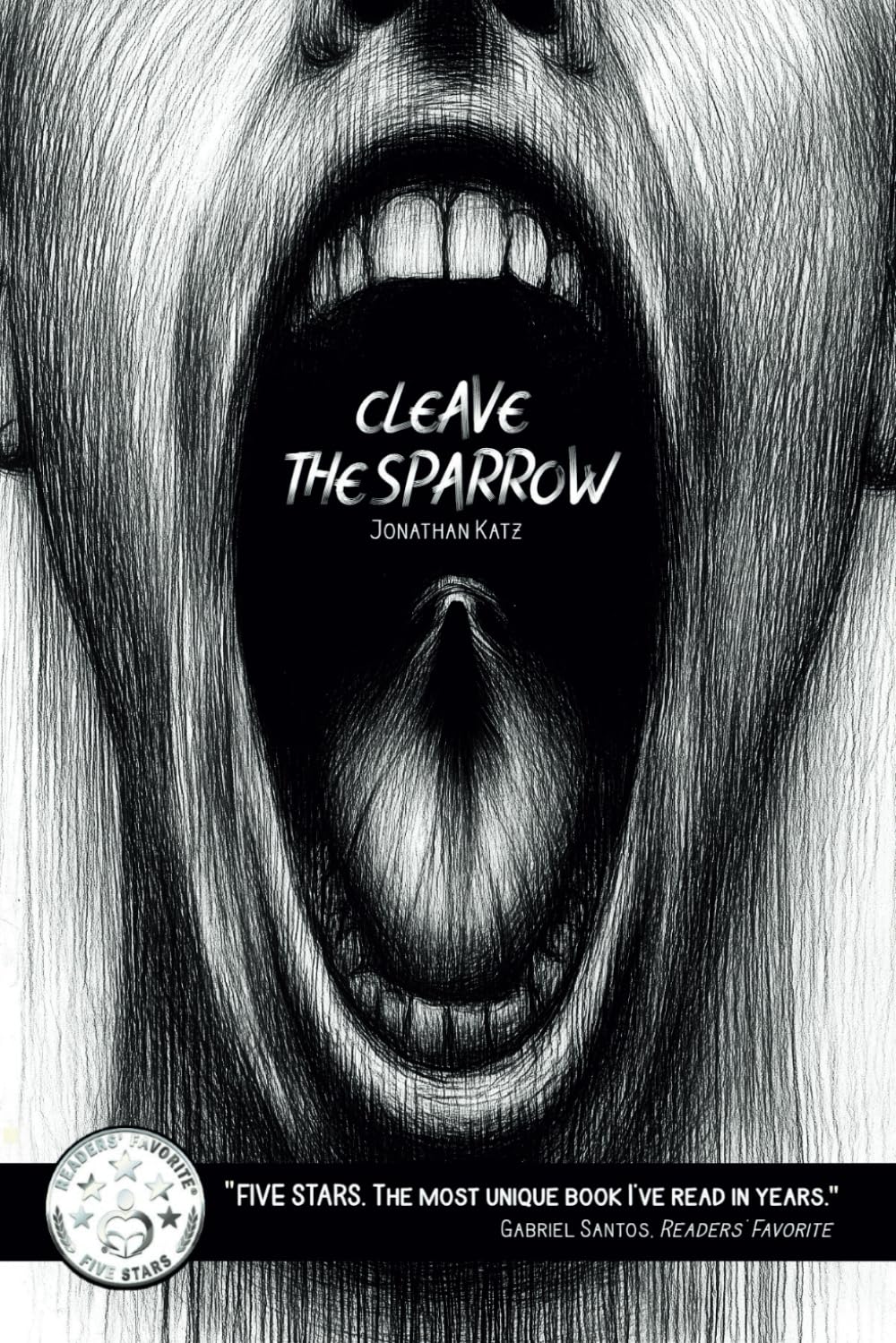
Cleave the Sparrow by Jonathan Katz blends political satire, existential philosophy, and absurd humor to immerse readers in a complex, surreal dystopian narrative.
Tom is a reluctant political candidate stuck on the blurred line between truth and power. His mentor, Crick—a controversial figure for his political views—has an ultimate goal in mind that pulls Tom into its wake. Believing in the limitation of human perception and the illusory nature of the world, Crick endeavors to destroy a ‘cosmic projector’ that he supposes fabricates this false reality.
Cleave the Sparrow charts a course where Tom, as Crick’s successor, follows his holotapes to carry out this dream, plunging into political and scientific conspiracy and moral dilemmas—opening an unexplored trail to time travel, quantum mechanics, and existential dread.
With Crick’s plan thrusting Tom onto a risky and unpredictable path, he scrambles to navigate fanatical beliefs and ideological purity, which ominously signal self-destruction.
Plato’s allegory of the cave is the foundation behind Crick’s philosophy. Crick embodies Plato’s escaped prisoner, emphasizing the fluidity of reality and challenging social constructs and enforced limitations. Crick’s beliefs invite one to reimagine reality, to step beyond and explore the unknown.
Cleave the Sparrow is a powerful and darkly comedic critique of modern politics and media.
Politicians prioritize public perception and media manipulation over forming policies. Characters such as First Lady Kardashian, along with several over-the-top scenarios—a candidate’s affair with a coffee machine and robot President Microchip—satirize the current absurdity of politics and society.
A constant tug-of-war between free will and fate stands out among this story’s themes, explored through concepts of time travel and quantum mechanics.
Tom is aware that his every action and decision is part of a predetermined cosmic design. But with the equally forceful presence of time travel, is he capable of altering his destiny.
Stream-of-consciousness prose provides an intimate window into Tom’s psyche, whose inner monologues—filled to the brim with nervous energy and wry observations—add to his persona as a relatable but unreliable narrator. The growing complexity of Tom’s journey, political machinations, and betrayals mirror the story’s surreal, fragmented intensity.
Existential horror, political satire, and absurd comedy in perfect harmony, Cleave the Sparrow pulls readers out of their comfort zone into a realm demanding constant introspection.
Along the lines of George Orwell’s 1984 and Philip K. Dick’s Do Androids Dream of Electric Sheep?, Jonathan Katz’s Cleave the Sparrow is an entry into a whirlwind of philosophy and science—a cosmic dystopia that oscillates between dread and contemplation, or both in tandem.