Tag: European Franco-Prussian War

  • The REFUSED by Ron Singerton – Historical Fiction, Action and Adventure Historical Fiction, Historical Thriller


    Fine artist and award-winning author Ron Singerton turns his astute attention to some little-known history, enmeshed in immortal names and enduring truth in his mystery romance novel, The Refused.

    The story boils from the first page, depicting families from the North and South in 1859 America. The brewing conflict will pull all of them into its orbit. In the South we meet Charlotte, her half-brother and slave, Jerome, who sail to France at war’s end.

    Life and love in Paris become the vibrant heartbeat in The Refused.

    Jack Volant, an aspiring painter and Union cavalry officer, wounded at Gettysburg, travels to Paris following the war to become a more accomplished artist. It is there that he begins a tumultuous relationship with Charlotte, a sculptor who sells her work to Empress Eugenie, wife of the Emperor, and a noted art patroness.

    Jack’s younger brother Steven, while still in America, becomes embroiled in an affair with a professor’s wife. When the professor, an expert shot, learns of it, he challenges the young man to a duel. Fearing for his life, Steven changes his name and flees to Paris where he engages in the eerie occupation of unwrapping mummies in the salons attended by the elite.

    All these dynamic characters, many involved in intrigue and murder, will interact in the decadent City of Light. They enjoy its ambience for only a short time, however, before war finds them once again. In 1870, the influence of the Empress, Prussian militarism and national rivalry will lead to disaster for France in the Franco Prussian war, the siege of Paris. In the chaos, Charlotte, deeply in love with Jack, waits anxiously as he attempts to save his brother and Jerome from the Prussian onslaught.

    The Refused is more than the title of a novel.

    Jack will find himself accepted by and creating new works alongside the Impressionist painters. Their adopted sobriquet, the Refused, stems from their rejection by the mainstream critics of the day. Their band includes Manet, Monet, Pissarro, Degas, Cezanne, and Renoir. They all resolve to paint what they want and hope for success, even if it be posthumous.

    This novel explores far more than artistic expression.

    Even after Prussian victories in the field, Paris holds out and becomes a hotbed of the Parisian underclass, the Communards. Jerome, with his sympathy for the desperately poor, joins the movement, putting his life in danger. As turmoil explodes around them, Jack, Charlotte, Steven, and Jerome attempt to survive as the reign of Emperor Louis Napoleon III and the Second Republic implode around them.

    Singerton writes with verve and intelligence. He fashions several interwoven plots in numerous historical settings, while making all his players come to life as credible people, some with high aspirations and others with low scruples.

    The author provides useful background in his “Author’s Notes.” He cites the real people and fact-based events that he selected for this engaging tale. The narrative encompasses formal dueling, womanly wiles, shadowy views of a typical morgue, costuming, cafés, conditions in Paris in wartime, and many other fine touches that powerfully immerse the reader in the times and places.

    Singerton served in Asia with the US military, was a Civil War cavalry reenactor, an art and history teacher, and enjoys saber fencing and horsemanship. He has penned notable works of historical fiction. And significantly, he is also, like several of the book’s protagonists, a professional artist. All these interests weld neatly together into this enthralling novel, sure to please his current audience and garner new readership.

    Read our reviews of Ron Singerton’s other books by clicking on their titles, A Cherry Blossom in WinterThe Silk and the Sword: Gaius Centurion, Book 2, and Villa of Deceit: A Novel of Ancient Rome.

    5 Stars! Best Book Chanticleer Book Reviews


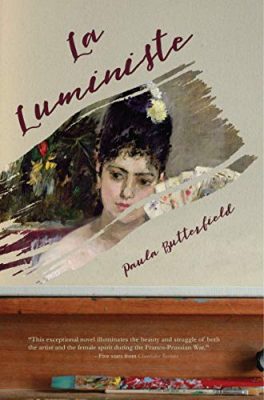
  • La LUMINISTE by Paula Butterfield – Women Impressionists, European Historical Fiction, Franco-Prussian War

    La LUMINISTE by Paula Butterfield – Women Impressionists, European Historical Fiction, Franco-Prussian War

    Berthe Morisot knows from a young age that she is destined to be an artist but living in nineteenth-century France severely limits her path. As a girl, she longs for the education any male artist would receive, and though her parents support her dream at first, Berthe isn’t even allowed to view some of the great works deemed unsuitable for females.

    Before long, she realizes she is uninterested in being any man’s student, wanting instead to explore her own style, painting the world of a modern woman–a real, intimate representation, not the perfection shown by most male artists. When her sister Edma, who originally paints with Berthe, marries and becomes the picture of femininity, Berthe feels the societal pressure to give up her painting and choose a husband. The one man she feels any connection to, fellow artist Edouard Manet, is a controversial rogue, and although she knows he feels for her, too, he marries another.

    However, the two cannot break free of their would-be love, and when Berthe decides to model for Edouard, she is more tantalized than ever. As her fascination turns to obsession, Berthe will be forced to choose between her desire to be a respected artist or the fallen lover of a scoundrel. It will take a revolution for Berthe to have either.

    This first-person fictionalized autobiography littered with famous Impressionists is the story of a woman’s love affair of both art and a man. In discovering her style, she finds a love she didn’t want and often questions the sanity (and more importantly) the healthiness of that love. As though her struggle to be an independent artist in a world of oppression isn’t already enough, Berthe knows she should dislike, maybe even despise, Edouard but is drawn to the proverbial flame. Unable to have him but unwilling to give him up creates clashing needs: becoming an independent woman but still tangled in what is proper and expected.

    On top of her obsession for him, she is torn between admiration and envy of this man who often feels as much repression as Berthe and wonders which she’ll lose first, her determination to paint or her societal constraints.

    A modern woman trapped in the nineteenth century, Berthe embodies the female struggle. Limited in infinite ways by societal views on women, she navigates a world of male domination in life as well as art, evolving much more quickly than her beloved Paris. If she marries, she wrestles with whether she is giving in or growing up, but as she matures in both art and life, she becomes angry with herself for her single-minded obsession of Manet and decides he is “not worthy of the woman [she would] become,” a woman (like so many modern women) who will find a way to have both a ground-breaking career and a family. As the list of prohibitions rises, so does her determination, and though her fight is for the individual woman (herself), it transcends that.

    Just like Berthe Morisot’s paintings, La Luministe shows a real woman, a woman with hopes and dreams that outreach her environment. Just as Paris was thrust into the turmoil and deprivations of war with Germany, Berthe set herself free in a bloody battle of change. This novel will show readers the beauty and struggle of both the artist and the female spirit.

    Paula Butterfield won 1st Place in the 2015 Chaucer Awards for La Luministe. (Because we have split the Historical Fiction Awards into two categories, La Luministe is considered a Goethe Award Winner!)