Tag: Editing

  • Search and Destroy, Cull and Extract, and Other Editorial Tactics for Your Work in Progress — A Chanticleer Toolbox Primer Article by David Beaumier & Kiffer Brown

    Search and Destroy, Cull and Extract, and Other Editorial Tactics for Your Work in Progress — A Chanticleer Toolbox Primer Article by David Beaumier & Kiffer Brown

    Now that you’ve completed your beautiful manuscript and have made several draft revisions, you are ready for the next move.

    You know, the one that comes before starting the editing process.

    A writer before having a manuscript overview terrified about what comes next for their work-in-progress. Don’t let this happen to you.

    Now for some Real-Life Ruthless Editorial Terms:

      • Reconciliation or Go Separate Ways
      • Search and Destroy (SAD)
      • Cull and Extract
      • Wrench Out Passive Voice – Mistakes Were Made
      • Clichés, Platitudes, and Banalities – Oh NO!
      • Kill Your Darlings – Stephen King
      • Are You Listening to How You Sound?

        Are You Listening to How Your Work-in-Progress Sounds? Really?

      Continue reading to the end of this post if you would like more information about these scary but necessary editing tactics.
      Some writers like to put their draft into a drawer for six weeks or so to allow themselves fresh eyes before endeavoring on one more draft revision as Stephen King recommends in his On Writing: A Memoir of Craft.

      Here at Chanticleer, we see basically two camps that writers fall into.

      • Writers who rework every sentence before moving on to the next sentence trying to reach perfection. If this is you, (And you know who you are.) then we advise you to click on this link to read an article by the multiple award-winning author, Michelle Rene.

      OR

      • Writers who bang out work and then think they are ready to publish with perhaps just a quick once over for typos. (And you know who you are.) Just upload to Amazon and you are done. Au contraire, mon ami!, as Q from Star Trek notoriety might say.
      Q from the Star Trek Next Generation Deja Q episode – Of course, the excerpt is on YouTube.

      Is this conundrum the same as the age-old question of writing style: Are you a plotter or pantzer?

      No, it isn’t. Writing styles are deeply personal. What we are discussing here is the editing process for novels.

      So, what’s a writer to do?

      Emulate what has worked successfully for traditional publishing houses.

      After your draft, but before you begin the editing process, have a manuscript overview (MOV) – an evaluation performed on your work by a professional editor. If you are with a literary agent, or if you work with a traditional publisher or acquisitions editor, this is the time to turn it over to them for their feedback.

      We hear you, “Well, if I had a literary agent or was working working with a traditional publishing house, I wouldn’t need to read this article.”

      If you don’t have any of these professionals on your team, then consider using a professional manuscript evaluation service such as Chanticleer’s. A manuscript evaluation will save you time and money and it will give you feedback about your work’s pacing, plotline, characters, atmosphere, P-O-V structure, dialog, and if you have a compelling story—one that will keep your targeted reader engaged.

      Here at Chanticleer Reviews, we come across many published works that skipped over this vital step. The work might have been copy-edited and proofed before clicking the publish button, but the story just isn’t compelling, or it has a saggy middle, or the characters are flat, or dialog stilted, or there is no “voice.” It is almost impossible for the author to “see” these issues because the story lives in the author’s head. The authors’ who receive this feedback generally exclaim to us, “But I’ve paid to have it edited. There are no typos.”

      No typos, does not a story make. However, authors and writers can create story magic. But it is difficult to get the story out of the writer’s mind and into words that communicate the “mind-film” that many authors see. This is where having an unbiased reading of your work with feedback will make your work shine. kb

      Others know there are choices they made at the end of the book that will require changes earlier in the book (maybe it started in 3rd person and the moved to 1st person). Whatever your process is, this article will help your work shine!

      The Editor – going over the ms with an MOV.

      1. Reconciliation or Go Separate Ways

      Getting Ready to Polish Now that Your Work-in-Progress has had a MOV

      There’s no universal way to use writing tools. As always, remember these are recommendations that have worked well for many of our authors, though it’s okay if they don’t work for you.

      Consider the Following for when you receive your manuscript’s MOV

      First off, give yourself time after reviewing notes from your MOV editor/agent/publisher. After receiving feedback try the following:

      • Consider recommended changes from your second pair of fresh eyes. It is good to keep in mind, that each one of the readers who decide to read your published book will be reading it with fresh eyes also.
      • Address issues. The editor will have made suggestions where needed. Deal with the biggest issues first.
      • Save a clean draft of your copy where the suggested changes don’t stand out. (Of course, you’ll want to save one where they do stand out as well, just in case.)
      • Wait two weeks.
      • Revisit the work. Ask yourself if anything stands out as odd or a change in voice.

      And, yes, sometimes, we do receive a ms that is ready to move on to either a line-edit or a copy-edit. It does happen. If this is the case, won’t you breathe easier knowing that it is ready to invest editing and shining.

      Rarely will suggestions from professional readers and editors let you down–just see the difference yourself!

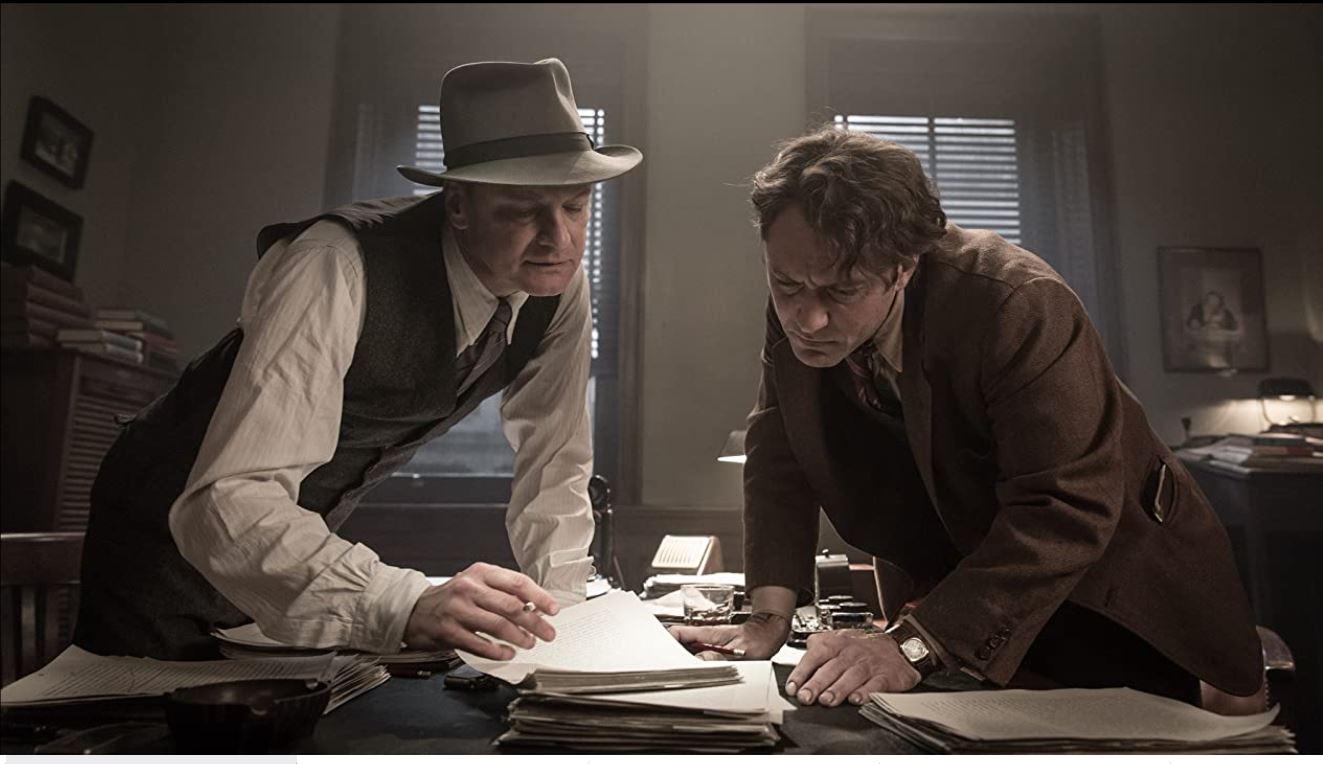
      The Editor film is based on award-winning book Max Perkins: Editor of Genius by A. Scott Berg. “Max Perkins discovered Ernest Hemingway and F. Scott Fitzgerald. But he never met anyone like Thomas Wolfe.” The film’s tagline.  Yes, even great authors such as these benefited from working with an editor.

      When you are satisfied that you have a compelling story—the work has had a manuscript overview and then you have reconciled the w-i-p with the advice given, it is  now the time to begin the Self- Editing Process! (Do the following before line editing or copy editing.)

      2. Search and Destroy (SAD)

      When we’re inspired by outside work, we love to tell you about it. The best line editing tools we know about come from Brenda Miller and Susan Paola’s book on creative nonfiction Tell It Slant, which features clear and direct steps to make your writing stronger.
      Tell it Slant, Third Edition — Brenda Miller
      First, identify all your “to be” verbs. If you can think of a comfortable, easy replacement, use it. Obviously, not all of them need to go (just glance through this article and you’ll see plenty), but a “to be” verb, while almost always the easiest choice, is not always the best choice.
      For example, here’s a piece of the short story Medusa by David Beaumier. First, with “to be” verbs shown in bold:

      She isn’t happy about it, but she had been encouraged to join Visitation to help people, not because it was personally comfortable for her. So she is sent into decontamination, followed by the sound of a seal behind her as the hermetic vacuum in front of her is opened. Her hair is only a little fluffed up by the experience, and is easily coiffed back into place after the blast of ionization that would be deadly to any foreign compounds in the air.

      Medusa
      Sometimes fluffier hair can be dangerous.

      And now revised without the repetitive verb choice:

      She doesn’t like it, but she joined the Visitation to help people, not for her own personal comfort. So into the decontamination room she goes, followed by the locking of one hermetic seal behind her and a second one in front. Her hair only needs to be patted down a little bit after the blast of ionization that should kill any foreign compounds in the air.

      3. CULL and EXTRACT

      Second, find your adverbs and adjectives. These can be the condiments and spice of your piece that really give it life, but too much mayonnaise is never a good thing, so look at each of them and see if there’s a weak verb or noun that’s being propped up by them.

      An arm holding food that it is impossible to identify due to the large amount of mayonnaise that is surely getting on the person's hand.
      Hopefully someone has a napkin

      Consider your proportion here, too. In one YA urban fantasy dredged up from the out of print pile was this unforgettable villainous dialogue spoken to the protagonist: “‘I’ll kill your whole family,’ he hissed maliciously.” While the intent is clearly to be evil, we can also see that the author didn’t trust the reader to understand that the villain wasn’t very nice.

      An adorable little girl dressed as a vampire devil
      Yes, evilly gnashing malignant teeth angrily with malintent

      4. Wrench Out Passive Voice

      The last suggestion from Miller and Paola is to look for passive voice, often indicated using “have” or “had.” A favorite trick for finding passive voice is to see if you can add “by zombies” to the end of the sentence. Like the previous rules, knowing why we use active and passive voice is important. Active voice tells us who does what to whom. Passive voice tells us what actions are done to whom, but not necessarily who did them.

      Looking to get more weasel words? Check out this article here by Jessica Morrell on decluttering your sentences.

      For a great example on passive voice, see this video below.  (It is non-partisan, we promise.) 


      5. CLICHES, PLATITUDES, and BANALITIES — Oh NO!

      Taking Advice from the Best: Jessica Morrell – Top-Tiered Developmental Editor

      Jessica Page Morrell
      Jessica Page Morrell

      Those who attended VCAC21 will know, Jessica Morrell is one of our favorite contributors. In her two workshops, Jessica goes deeper discussing the idea of “junk” words for writers. Maybe you’ve avoided all the pitfalls so far, but do you notice your characters do a lot of the following?

      Jessica’s advice on eliminating junk words can be found on the link below:

      https://www.chantireviews.com/2019/05/18/decluttering-sentences-by-eliminating-junk-words-from-jessica-morrells-editors-desk-writing-toolbox-series/

      • Shrug
      • Wrinkle their nose in disgust
      • Widen their eyes in surprise
      • Nod
      • Smile
      • Any other sort of repetitive description that doesn’t really subvert the reader’s expectations?

      What would you say your own junk words are?

      Jessica even provided a long list of words to give an idea of what hints that writing might not be as strong as we hope.

      Definitely, absolutely, particularly, actually, decidedly, quite, very, totally, mostly, dearly, ideally

      Notice how all of those are also adverbs? Keep an eye on your work!

      6. KILL YOUR DARLINGS and TOO MUCH EXPOSITION – TMIF

      Show vs Tell

      Showing and telling goes well with the debate about active and passive voice. In my mind, there is almost no writing rule more contentious or less understood than the rule that writers should always show rather than tell. Dialogue is often the heart of showing, but be careful! Occasionally dialogue can sneak in as a form of telling when it’s being used to explain something the characters probably already know for the sake of the reader. 

      Another video on the potential pitfalls of too much exposition and when dialogue tells too much. TMIF.

      We dare you to see just how long you last watching Too Much Exposition. (Kiffer lasted about 30 seconds)

      Go ahead, give it a try. We double dare you.


      So how should we define Show and Tell? Well, Showing is an example of narrative scene—something happens in real time! Meanwhile, Telling is an example of narrative description where there’s either a moment of summary or interiority, something that probably isn’t happening in real time. Like passive and active voice, there’s a time and a place for each.

      Consider the structure of your work. Has there been quite a bit of showing happening as characters flit from scene to scene? Even in a thriller, the reader will need a moment to rest, to have the narrator examine the main character’s interiority and explain a little bit of the backstory or the connection the hero makes just before solving the mystery.

      The moment where everything clicks into place often isn’t a show, but a tell, directly informing the reader that the most important discovery of the book has been made. That lets it happen fast rather than laboring to show each and every scene.

      We are quite proud of the articles on our website and to be a leading resource for writers, and you might also like some of what these websites say about writing craft:

      6. Are You Listening to How You Sound?

      Listening: The Most Powerful Tool

      The last secret here is one of the most useful things we’ve heard of for any writer or editor, and that is read your work aloud. You can ask a friend or loved one to do this for you, or you can find a screen reader that will take you through your story, but words always sound different when they’re vocal vibrations rather than fixed to a page. 

      A microphone that looks to be a blue yeti brand
      Recording yourself can also let you play back your story and, no you do not  need a fancy microphone like this.

      Reading aloud, especially for dialogue, can help you better understand your tone, and it helps you find where words may have been repeated more than necessary. Sometimes, especially if writing a play, it can help to highlight the piece with different colors based on whose speaking. If there’s an emotion that should be conveyed in the story, assign colors to each emotion and highlight lines with how they should land. Then, while reading it aloud, you can check to make sure that the assigned tones fit.

      Jessica Page Morrell has an excellent article on Glissando And Wordcraft you can read here.

      If you’re looking for voice recording software beyond Voice Memos on your phone, consider the following programs:

      In Conclusion, Remember that the Work is Always Yours 

      In the end, remember that you are the author of your work, which means you get final say. Peer review is excellent, and, as said above, it can be helpful to practice accepting all feedback and then reading your work after you’ve given it some space. 

      Remember, the earliest time we recommend submitting your work to one of our Twenty-Three divisions for the Chanticleer International Book Awards here or for a much sought after Editorial Review here is once you’ve reached the proofreading stage of your manuscript. Again, that’s the earliest we recommend sending your work in.

      For further reading on what we’ve said in the past at Chanticleer, check out parts one and two of articles written by Jessica Page Morrell here and here, plus a bulleted list of tips she put together here.

      Looking to demystify even more of the editing terminology? Learn about it here from Kiffer Brown herself.


      Chanticleer Editorial Services – when you are ready
      Did you know that Chanticleer offers editorial services? We do and have been doing so since 2011.

      Tools of the Editing Trade

      Our professional editors are top-notch and are experts in the Chicago Manual of Style. They have and are working for the top publishing houses (TOR, McMillian, Thomas Mercer, Penguin Random House, Simon Schuster, etc.).

      If you would like more information, we invite you to email Kiffer or Sharon at KBrown@ChantiReviews.com or SAnderson@ChantiReviews.com for more information, testimonials, and fees.

      We work with a small number of exclusive clients who want to collaborate with our team of top-editors on an on-going basis. Contact us today!

      Chanticleer Editorial Services also offers writing craft sessions and masterclasses. Sign up to find out where, when, and how sessions being held.

      A great way to get started is with our manuscript evaluation service. Here are some handy links about this tried and true service: https://www.chantireviews.com/manuscript-reviews/

      And we do editorial consultations. for $75.  https://www.chantireviews.com/services/Editorial-Services-p85337185

      Writer’s Toolbox

      Thank you for reading this Chanticleer Writer’s Toolbox article.

      Writers Toolbox Helpful Links: 

      First Draft in Thirty Days? No Tricks! Award-Winning Author Michelle Rene Shares How She Does It!

      Part One WRITING FICTION GUIDELINES — by Jessica Page Morrell

      An Editor’s Checklist for Manuscript Evaluations of Fiction by Jessica Page Morrell | Jump Start Your Novel – Brainstorming Tips for NaNoWriMo Season from the Editor’s Desk of Jessica Morrell

      15 Self-Editing Tips from the Editor’s Desk of Jessica Morrell

      GLISSANDO and WORDCRAFT from Jessica Morrell

      “The Strange World of Editing and the Beasts Who Inhabit It” by Kiffer Brown

      The traditional publishing tool that indie authors can use to propel their writing careers to new levels?  https://www.chantireviews.com/2016/05/15/the-seven-must-haves-for-authors-unlocking-the-secrets-of-successful-publishing-series-by-kiffer-brown/

    • Crafting Words and Lassoing Jottings – Writing Advice from Jessica Page Morrell – A Chanticleer Writer’s Toolbox Post

      Crafting Words and Lassoing Jottings – Writing Advice from Jessica Page Morrell – A Chanticleer Writer’s Toolbox Post

      “I try to pull the language into such a sharpness that it jumps off the page. It must look easy, but it takes me forever to get it to look so easy. Of course, there are those critics — New York critics as a rule — who say, Well, Maya Angelou has a new book out and of course it’s good but then she’s a natural writer. Those are the ones I want to grab by the throat and wrestle to the floor because it takes me forever to get it to sing. I work at the language.” ~ Maya Angelou

      ~ Maya  Angelou Source: Source: The Paris Review Interviews: Volume IV

      Maya Angelou’s website: https://www.mayaangelou.com/

      Maya Angelou, her gift for crafting words has forever left us with some of the most inspirational and memorable quotes of our time. “Biography” Jan 29, 2021

      Writing Advice from Jessica Page Morrell – Lassoing the Jottings and Crafting Words

      I’ve been purging my office and as I toss old receipts and rearrange books I’m finding scraps of paper with scrawls and tidbits on them. So I’m lassoing all these jottings. A single word on the back of an envelope says ‘waft’. Now, waft is in my vocabulary, and I’ve used it in writing, but these lists always inspire me. Another envelope back includes: pinprick, squatter, fusty, quisling, shacky, gawk, wheedle, moonwalk, shirk, bupkis, wraith, servile, scuttle, torpor, badger. Because if you’re not constantly gathering words you’re not growing as a writer.

      “…if you’re not constantly gathering words you’re not growing as a writer. – Jessica Morrell

      My next step is to figure out where to record these snippets. If you’re an analogue type like I am, you might have notebooks stashed all over the place. In fact, I’ve decided to stash one in my car’s glove box. Wondering why I haven’t done this years ago since I often hear information on NPR that I scribble on my hand as I’m driving. I’ve written here before about keeping a writer’s notebook, a lens to the world. Some jottings will land in my current writer’s notebook, while others will end up in specific ongoing projects.

      Jessica’s Notebooks

      Ruminate Productively. Question Thought Cycles

      Another note says: Ruminate productively. Question thought cycles. This one struck me hard. There was a tragic death in our family 3 weeks days ago and during the final weeks of my niece’s life, my thoughts returned again and again to her suffering. And her parents’ suffering. And, of course, I suffered too, sad, worried for them all, grieving the unfairness of her shortened life. I also tracked memories along years of family events and unearthed painful memories and tracked over old scars. In other words, unproductive ruminations.

      Poetry

      Sometimes it felt like I needed a lifeline to yank me free of this painful undertow. So I’ve turned to poetry before falling sleep and reading verses during the day. Such solace. And I’m falling into the poems and marveling at the poet’s imagery and turns of thought. Poetry can teach all writers. Poetry can help heal bruised and shattered hearts.[Editor’s Note: See Links above for Maya Angelou]

      Poetry can teach all writers. Poetry can help heal bruised and shattered hearts. – Jessica Morrell

      Track Complicated Emotions and Contradictory Thoughts

      Here’s another morsel: Track complicated emotions and contradictory thoughts. Since I’ve been quarantining for about a century now I’m getting worn down from too much time spent inside my head. Some days thoughts go skittering into strange places which then scare up unexpected emotions. Not always welcome emotions. So, as I ‘hear’ unhelpful inner talk, I try to stop myself. Then I backtrack into whatever I was thinking or feeling. Slow it all down and linger there. Figure out where the thought originated. Listening in to a hidden (or noisy) part of myself. Then, as I’ve been telling myself for years, thoughts aren’t like the weather. I can do something about them; question or entertain them, discard, or act on them. Instead of allowing a storm to brew.

      If you’re not prone to rumination be on the lookout for these complicated emotions on a screen or while reading a novel. For example, don’t you love it when you witness a cocktail of emotions flicker across an actor’s face? Maybe as a painful realization dawns or a joyful understanding blooms. How would you write that? Sir Anthony Hopkins starring in The Remains of the Day as the fusty head butler is an excellent example of how tiny face muscles can express a wide range of emotions.

      “The Remains of the Day” by Kazuo Ishiguro – Stevens the Butler of Darlington Hall, played brilliantly by Anthony Hopkins.

      Contradictions

      But let’s get back to contradictions. I taught online workshops last fall and in one workshop on subplots I explained the potency of contradictions while writing fiction. Contradictory needs and wants (or desires) within your main characters create delicious conflict. In The Remains of the Day, Hopkin’s character Stevens is at war with the truth. He’s blinded by his loyalty to his employer, a Nazi sympathizer, and clings to his duties instead of risking emotional intimacy–needs he dare not admit to. His elderly father dies alone while Stevens tends to an important dinner party and ignores the housekeeper’s–played impeccably by Emma Thompson– interest in him. The film is based on The Remains of the Day by Kazuo Ishiguro and is written as a first-person account by Stevens, a sometimes unreliable narrator.

      You often see this dynamic at work in romance plots and subplots. For example, a woman is attracted to bad boy types, but deep down she longs for marriage, stability, and kids. This scenario played out in Bridget Jones Diary by Helen Felding where readers and viewers recognized what was best for Bridget, but she did not. Bridget was beginning a new year and diary by vowing to cut down on cigarettes, alcohol and calories. Also on her list was to find a stable man, but of course, chaos ensued in the form of a fling with a bad boy. He was played with aplomb by Hugh Grant in the hit film version, while she overlooked stable lawyer Patrick Darcy (Colin Firth) until it was almost too late.

      Bridget Jones and one of her issues – smoking.

      Or a former addict or alcoholic has become clean and sober. All is well, until he is somehow triggered and then slips back into the bottle or ends up visiting his dealer. Meanwhile, as your reader is begging “do not go into that liquor store. Do not screw this up.” And this means your reader might be feeling contradictory feelings too–sympathy for the addiction, but enraged at the character for buckling under pressure.

      Contradictions create suspense and tension. Stay tuned because I’m going to cover this in more depth in the future.

      And as an aside:  Villains MUST Deliver

      This note was scrawled on a legal pad as I was reading a recent client’s manuscript: Villains MUST deliver. If you plop a villain or villainous group into your story they need to embody some form of evil and profound threat. He/she/they cannot remain offstage throughout. If your villains don’t threaten or scare your protagonist up close and personal, then fix the bad guy or your plot.

      Immersive Reading Experience = Resonating with Readers

      These days my notebooks are filled with mannerisms and reactions from the novels I read. In my  editing work I notice that writers use the same emotional responses in their stories. Characters repeatedly look down, shrug, or are wide eyed. I read a novel recently where the author used ‘deadpanned’ five or six times. By the third deadpan, I was wincing.

      Another reason to study other writer’s techniques is to create a more immersive reading experience. If you nail aftermaths or the viewpoint character’s experiences they will resonate with readers. Such as: startled chuff of laughter, a brittle silence settled between them, staring at him with dead, dark eyes, she flinches, settling uncomfortably, his heart started clattering around in his chest.

      Write Your First Draft with Everything You Got

      Don’t worry about finding the perfect words, the right words on your first draft. Just get your story out of your brain and into words.

      Then put the whole thing away for a few weeks or months. Come back to your draft with fresh eyes to see if the story concept is worth your editing time. Meanwhile, start a new story while this one simmers on the proverbial back burner. Have you fallen in love for one or the other?

      Here are two links that may prove helpful in unspooling the story in your brain onto the page:

      Unspooling Your Story

      How to Write Your Story in Four Weeks

      Keep writing, keep dreaming, have heart. Jessica 

      Jessica Morrell is a top-tier developmental editor and a contributor to Chanticleer Reviews Media and to the Writer’s Digest magazine. She teaches Master Writing Craft Classes at the Chanticleer Authors Conference that is held annually along with teaching at Chanticleer writing workshops that are held throughout the year. 


      Chanticleer Editorial Services – when you are ready

      Did you know that Chanticleer offers editorial services? We do and have been doing so since 2011.

      Tools of the Editing Trade

      Our professional editors are top-notch and are experts in the Chicago Manual of Style. They have and are working for the top publishing houses (TOR, McMillian, Thomas Mercer, Penguin Random House, Simon Schuster, etc.).

      If you would like more information, we invite you to email Kiffer or Sharon at KBrown@ChantiReviews.com or SAnderson@ChantiReviews.com for more information, testimonials, and fees.

      We work with a small number of exclusive clients who want to collaborate with our team of top-editors on an on-going basis. Contact us today!

      Chanticleer Editorial Services also offers writing craft sessions and masterclasses. Sign up to find out where, when, and how sessions being held.

      A great way to get started is with our manuscript evaluation service. Here are some handy links about this tried and true service: https://www.chantireviews.com/manuscript-reviews/

      And we do editorial consultations. for $75.  https://www.chantireviews.com/services/Editorial-Services-p85337185

      Writer’s Toolbox

      Thank you for reading this Chanticleer Writer’s Toolbox article.

      Writers Toolbox  a few more Helpful Links: 

      The INCITING INCIDENT: STORY, SETBACKS and SURPRISES for the PROTAGONIST – A Writer’s Toolbox Series from Jessica Morrell’s Editor’s Desk

      ESSENCE of CHARACTERS – Part One – From the Jessica Morrell’s Editor’s Desk – Writer’s Toolbox Series  


    • Understanding Story Structure — A Chanticleer Toolbox Primer Article by David Beaumier

      Understanding Story Structure — A Chanticleer Toolbox Primer Article by David Beaumier

      Start with the Heart 

      Henry Cavill responds to 'Enola Holmes' copyright lawsuit
      Henry Cavill stealing our hearts as Sherlock in the movie Enola Holmes. He definitely stole Kiffer’s.

      When we look at writing craft, it can help to start general and then move on to specifics. Start with questions to help orient yourself toward how you will edit the work:

      • What do you see as the genre?
      • What is the climax?
      • How do you imagine the story’s structure?
      • What is the heart of the story?

      The heart of the story can be more generally understood as theme, but it really boils down to where does the blood flow in the veins of the writing. I make sure that is always in my mind when editing for an author, and I recommend it for any writer who is working on a piece.

      Write down the heart of your story somewhere you can always look at it—on a sticky note near your writing area, at the bottom of the document you’re working in, anywhere you can see it. Having the heart of the piece as an easy reference point lets us keep an eye on the destination as we write or edit toward the end.

      The Evolving Nature of Structure 

      Get ready for book recommendations! In terms of structure, David recommends Jane Alison’s Meander, Spiral, Explode, which sets the bar for how we can reimagine the shape of our books. Most stories won’t tell their author what their structure is supposed to look like until they are nearly finished. 

      Meander, Spiral, Explode: Design and Pattern in Narrative by Jane Alis – Catapult

      Most of the time when we think of the structure of a story, we think of the Aristotelian spear. But story structure can look like anything! A spiral, a flower, a canoe, an inverted spear. Of course, there’s nothing wrong if your story structure does fall into this classic description, but keep in mind that doesn’t mean we close ourselves off to all other structures.  

      A Writer's Cheatsheet to Plot and Structure
      Aristotelian Spear story structure

       Alison takes the idea of seeing the structure literally, recommending that writers draw out the shape of the story. To do this, she recommends visualizing summary like this “__” a scene like this “–” and a still spot (interiority or a moment where the narrator pauses and explains events) as “·”. This is the example of the structure she sees when blocking out a section of Vikram Chandra’s “Shakti”

      __ __ __ __ — — — · —   

      You can see the pattern beginning to form, four moments of summary, followed by three scenes, a still spot, and then finishing with a scene. What do your own stories look like?

       Again, usually this structure becomes visible as the story reaches completion, allowing the author to see the images and metaphors that really shape it.  

       Narration in Four Parts 

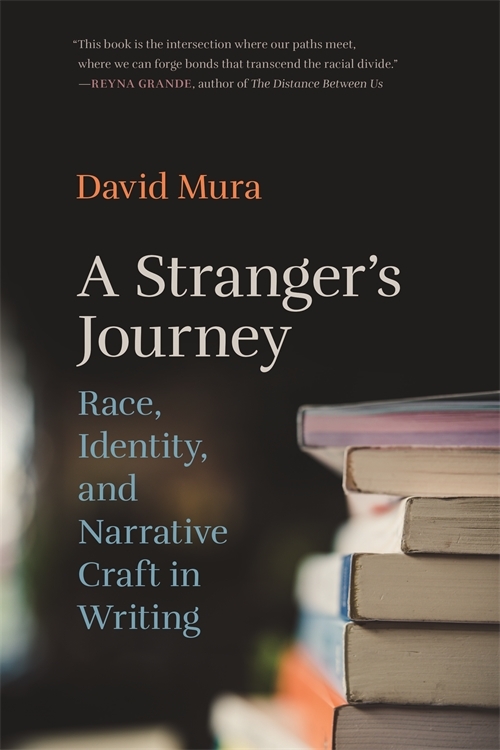
      A Stranger's Journey

      The next section here owes much to David Mura’s Book A Stranger’s Journey. At the start of his chapter “Four Questions Concerning the Narrator” Mura simply asks: 

      1. Who is the narrator?
      2. Whom is the narrator telling her story to?
      3. Where is the narrator telling the story?
      4. Why is the narrator telling the story?

      These simple questions open up most stories in wonderful ways that surprise and delight their authors. It changes the idea of the narrator just being the main character in their present (if so, is the narration in present first person, and does the reader only get information the main character knows?). Or perhaps the narrator is you, the author; remember you are a living, breathing, ever changing being, while your narrator becomes fixed in time the moment you put down your pen and stop the editing process. Understanding this allows the writer to slow down and understand the perspective of narration in their story.  

      Why did Drax say, “Why is Gamora”? - Quora
      From Avengers: Infinity War

      Let’s look at a short story attributed to Ernest Hemingway to better understand these questions of narrator. The story is as follows:

      For sale: baby shoes, never worn

      • Who is the narrator? We could say a newspaper or even the person who wrote the advertisement, possibly the parent of this child. We could also say that Hemingway is telling the story since he was asked to write a six word story.
      • Who is the narrator speaking to? Anyone who might want to buy baby shoes. If Hemingway is the narrator, then it’s also with the secondary desire to make the reader sad since the tragedy implied by baby shoes that have never been worn weighs heavily on us.
      • Where is the narrator telling the story? In the newspaper? A sign in a window?
      • Why is the narrator telling the story? Hard question. Maybe honestly just to sell the baby shoes. Maybe to find closure and remove the last reminders of their loss. Maybe in the hopes that someone will reach out.

      In examining the narrator and understanding the relationship the narrator has with the reader, we create work with richer tone, voice, and a better understanding of what information needs to be shared.  

      All in Good Measure 

      Amazon.com: Self-Editing for Fiction Writers, Second Edition: How to Edit Yourself Into Print (9780060545697): Browne, Renni, King, Dave: Books

      The next book recommendation is Renni Browne and Dave King’s Self-Editing for Fiction Writers. While many of their chapters are excellent, their fourth one, “Proportion” stands out among many craft books as a unique topic. The quickest way to say this is to simply ask the writer to say what they mean to say, and then move on without spending too much time repeating the point. Often, this repetition breaks the sense of proportion needed for the story, leaving the weakest repeat to carry the weight of the scene in which it appears.

      An example of this would be if the sunset was described as two Polaroids being jammed together to make the sky and land, and then describing again how the rocky cliffs were at odds with the soft clouds of sunset. Remember, choose which one seems stronger and cut the weaker one. 

      Most craft books touch on this as the idea of trusting the reader. Write the best story you can imagine writing, and then, after showing it to readers, you’ll understand if the way you wrote it made sense or not. Taking too much time to belabor your point will make it seem overwrought and overwritten to the point that the reader might lose interest (something I always fear when writing about proportion).  

       All Together

      So, the key parts of craft I’m looking at here are: Heart, Structure, Narration, and Proportion. Of course, there are the traditional ones that we hear about everywhere:

      • Dialogue
      • Character
      • Plot
      • Voice
      • Beat
      • The ever present struggle between show and tell.

      Of course it’s important to have a good grasp of the basics, you can’t have the four elements above without them! But understanding how you’ll put it all together in the end is what makes a work really sing.


      When we finish our first draft our work suddenly transforms into a behemoth that’s impossible to approach. We’ll give you some great advice here, though if you’re at the point where you’ve done all this the next step is to find some extra eyes for your work. For an unbiased evaluation  that will help you better understand what works and what needs to be improved in your book, check out our Manuscript Overviews editorial service here. Remember Kiffer’s advice to have a manuscript assessment prior to beginning line editing or copy editing. A manuscript overview/evaluation will save you time, money, and will improve your work-in-progress.

      The CIBAs – Discovering Today’s Best Books and Authors

      If you’ve read through this and think “I’ve done all this, and I’m ready for the next step!” Congratulations! We would recommend putting some positive attention on your book at this point. You can enter it in a Chanticleer International Book Award Contest here or submit it for a professional Editorial Review here. And remember, it never hurts to do both.

      Looking for more story structure? You can find many articles here from a search of our site. 


      Chanticleer Editorial Services – when you are ready

      Did you know that Chanticleer offers editorial services? We do and have been doing so since 2011.

      Tools of the Editing Trade

      Our professional editors are top-notch and are experts in the Chicago Manual of Style. They have and are working for the top publishing houses (TOR, McMillian, Thomas Mercer, Penguin Random House, Simon Schuster, etc.).

      If you would like more information, we invite you to email Kiffer or Sharon at KBrown@ChantiReviews.com or SAnderson@ChantiReviews.com for more information, testimonials, and fees.

      We work with a small number of exclusive clients who want to collaborate with our team of top-editors on an on-going basis. Contact us today!

      Chanticleer Editorial Services also offers writing craft sessions and masterclasses. Sign up to find out where, when, and how sessions being held.

      A great way to get started is with our manuscript evaluation service. Here are some handy links about this tried and true service: https://www.chantireviews.com/manuscript-reviews/

      And we do editorial consultations. for $75.  https://www.chantireviews.com/services/Editorial-Services-p85337185

      Writer’s Toolbox

      Thank you for reading this Chanticleer Writer’s Toolbox article.

      The traditional publishing tool that indie authors can use to propel their writing careers to new levels?  https://www.chantireviews.com/2016/05/15/the-seven-must-haves-for-authors-unlocking-the-secrets-of-successful-publishing-series-by-kiffer-brown/

    • WORDCRAFT – HOW to MAKE IT HAPPEN – from Jessica Morrell’s Editing Desk – a Chanticleer Writer’s Toolbox post

      WORDCRAFT – HOW to MAKE IT HAPPEN – from Jessica Morrell’s Editing Desk – a Chanticleer Writer’s Toolbox post

      How Does Wordcraft Happen? by Jessica Morrell

      Focus on Language

      There are so many mechanics of writing style I could write about columns on the topic for years. Come to think of it, I have.

      Let’s focus on layering language into a story with care so that it adds to overall meaning and effect.

      This means making careful choices so that you don’t distract the reader from your narrative. As a writer, search for precise words and comparisons to satisfy your reader. The problem of finding the perfect word or imagery, instead of the almost perfect word, is no small matter.

      Denotation or Connotation – Know the Difference

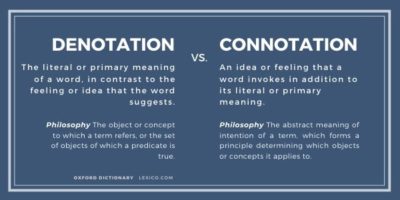
      While the literal or explicit meaning of a word or phrase is its denotation, the suggestive or associative implication of a word or phrase is its connotation. Thus you’re always making choices about meaning and language.

      Merriam -Webster says: “What’s the difference between connotation and denotation?

      While each of these two words has several possible meanings, they are notably distinct from each other in all senses. Denotation is concerned with explicit meaning, and connotation tends to be concerned with implicit meaning. The word home, for instance, has a denotation of “the place (such as a house or apartment) where a person lives,” but it may additionally have many connotations (such as “warmth,” “security,” or “childhood”) for some people.

      Examples of denotation in a Sentence
      The word has one literal denotation but several different connotations.
      The definition provides the word’s denotation.

      We all need a practical, sort of workday vocabulary that is consistent with our voice, and then we also need a vocabulary that’s the writer’s version of the Taj Mahal. Or, as another example, sometimes the style needs to be basic like bread pudding, sometime it needs to be more like a seven-layer wedding cake. Sometimes the best words are clear and simple, and sometimes they need to soar like a heron aloft on an air current. Sometimes stories work well in the style we’ve come to associate with Hemingway—terse, journalistic and economical. And sometimes a story needs all the embroidery and bombast of a stylist like John Updike.

      Obviously there are writing styles that are too gorgeous, too painterly. The same for a style that is too ‘out there,’ too odd to grasp—as if wooly mammoths populate the page.

      For example, boisterous and unexpected adjectives such as claxon or tessellated or the unforgivable boustrophedonic (all used by John Updike)—stop the flow of narrative. Instead of the reader remaining involved in the scene, he steps aside and engages his intellect. Choosing surprising yet apt modifiers is vital, but it’s not a task to be undertaken frivolously.  Playwright David Hare says, “Style is the art of getting yourself out of the way, not putting yourself in it.”  

      Choosing surprising yet apt modifiers is vital. – Jessica Morrell

      Anchoring the Story

      When it comes to figurative language, you want to demonstrate an imaginative range, while remembering figurative language adds layers of meaning while also concentrating the flow of ideas. We use figurative language because it mates images and likenesses, connects with the reader’s associative right brain, and helps anchor the story. With figurative language, you want to demonstrate with freshness and verve. However, don’t range too far with your images or the story becomes tangled and obscure. Wordcraft that makes us shiver is delicious. Wordcraft that exists merely to show off is pointless.

      Analogy and Metaphor

      Analogy and metaphor are always subservient to the viewpoint, yet always take us deeper into the subject or moment as when Truman Capote described Elizabeth Taylor’s “eyes so liquid with life” and “the face, with those lilac eyes, is a prisoner’s dream, a secretary’s self-fantasy; unreal, non-obtainable…” Don’t you wish you’d woven together “a prisoner’s dream” to describe an indescribable beauty? Notice how it makes you feel the allure of Taylor?

      Don’t Try to Do This in Your First Draft

      In your editing process, it’s okay if your first draft is unpretentious, just as it is okay if your first draft is blowsy and lumbering. But then, as you refine later drafts, ask yourself if the writing needs to lift off the page a bit. If it is clean, or simply stark. If lush prose is necessary, or stripped down prose is needed.

      Intensity of Language and the Potency of the Circumstance

      Pay attention to the intensity of language which can range from mild to inflammatory. Match intensity of language to the potency of the circumstance, the sentence, the scene. Note the places in the story where the reader needs to linger and feel emotions and tension. In these passages it’s important to make precise choices, to examine your sentences, and listen hard to what you must say.

      Clichés

      The next thing to ask yourself as you’re revising is ‘have I heard this before?’

      Clichés and trite expressions are often an editor’s first tip off that you’re a lazy or unimaginative writer. “Clichés are the old coins of language: phrases that once made a striking impression but have since been rubbed smooth by repeated handling.”

      In Conclusion

      If the writing seems thin, keep asking yourself a simple question: what does this remind me of?

      Perhaps you’ve written about time running out (always a juicy element) and in the story your character is desperate because a deadline is looming as his kidnapped girlfriend is buried alive in a tunnel under the New York subways. It is mid-February, a blizzard is raging, temperatures are dropping to the lowest in a century, and travel is almost impossible. Your reader needs to be practically digging his nails into his palms; as if the harsh cold is seeping into his joints while turning the pages.

      If the writing doesn’t illustrate those glacial temperatures, the reader won’t be feeling the danger. And will not harbor visions of frostbite or worse, of her frozen body  like a soldier left behind on the Russian Front during World War II. You don’t need to  conjure an analogy or metaphor for every passage, but you’ll need sensory details, until the reader is shivering and the cold has ripped through him.

      You may be interested in reading the Glissando and Wordcraft post. Click here for the link:  https://www.chantireviews.com/2020/02/21/glissando-and-wordcraft-from-jessica-morrells-editors-desk-a-chanticleer-writers-toolbox-blog-post/


      Jessica Page Morrell

      Jessica Page Morrell is a top-tier developmental editor for books and screenplays. Her articles have appeared in Writer’s Digest and The Writer magazines. She is known for explaining the hows and whys of what makes for excellent writing and for sharing very clear examples that examine the technical aspects of writing that emphases layering and subtext. Her books on writing craft are considered “a must have” for any serious writer’s toolkit.

      Jessica will teach the Master Craft Writing Classes at the Chanticleer Authors Conference on Thursday, Sept. 3, 2020  and will present sessions during the conference weekend.

      Did you know that Chanticleer offers editorial services? We do and have been doing so since 2011.

      And that our professional editors are top-notch and are experts in the Chicago Manual of Style. They have and are working for the top publishing houses (TOR, Macmillan, Thomas Mercer, Penguin Random House, etc.). If you would like more information, we invite you to email Kiffer or Sharon at KBrown@ChantiReviews.com or SAnderson@ChantiReviews.com.

      Click here to read more about our Editorial services: https://www.chantireviews.com/services/Editorial-Services-p85337185

      A great way to get started is with our manuscript evaluation service. Here are some handy links about this tried and true service:

      https://www.chantireviews.com/manuscript-reviews/

      We work with a small number of exclusive clients who want to collaborate with our team of top-editors on an on-going basis. Contact us today!

      Writer’s Toolbox

      Thank you for reading this Chanticleer Writer’s Toolbox article. 

    • How to Write a Potent Action Scene by Jessica Page Morrell – Writing Craft Series

      How to Write a Potent Action Scene by Jessica Page Morrell – Writing Craft Series

      [fusion_builder_container hundred_percent=”no” equal_height_columns=”no” menu_anchor=”” hide_on_mobile=”small-visibility,medium-visibility,large-visibility” class=”” id=”” background_color=”” background_image=”” background_position=”center center” background_repeat=”no-repeat” fade=”no” background_parallax=”none” parallax_speed=”0.3″ video_mp4=”” video_webm=”” video_ogv=”” video_url=”” video_aspect_ratio=”16:9″ video_loop=”yes” video_mute=”yes” overlay_color=”” video_preview_image=”” border_size=”” border_color=”” border_style=”solid” padding_top=”” padding_bottom=”” padding_left=”” padding_right=””][fusion_builder_row][fusion_builder_column type=”1_1″ layout=”1_1″ background_position=”left top” background_color=”” border_size=”” border_color=”” border_style=”solid” border_position=”all” spacing=”yes” background_image=”” background_repeat=”no-repeat” padding_top=”” padding_right=”” padding_bottom=”” padding_left=”” margin_top=”0px” margin_bottom=”0px” class=”” id=”” animation_type=”” animation_speed=”0.3″ animation_direction=”left” hide_on_mobile=”small-visibility,medium-visibility,large-visibility” center_content=”no” last=”no” min_height=”” hover_type=”none” link=””][fusion_text]

      Action is eloquence. William Shakespeare, Coriolanus

      There are a few techniques it seems like I’m always passing on to my clients: amp up your verbs; use language and details to create more tension, and force scenes to rise. By ‘rise’ I mean writers need to thrust the drama level to a crisis, a confrontation, an explosion. Because in most scenes you’re aiming for the worst outcome.

      Components of an Action Scene

      Characters The main players in the scene with their key traits visible & engaged. Secondary characters need a reason for being.
      Setting The time, place and context in which the scene takes place. The setting is not just a backdrop; stage action scenes for maximum wattage.
      Scene Driver:  The inciting event/change/stimulus/threat.

      The event/stimulus/threat that starts the action rolling in the scene (action can be precipitated before the scene begins)

      Internal response

      External response


      How the main characters react emotionally to actions, threat, choice. How the main characters react physically–dialogue, movement, escape confrontation, fisticuffs. Typically there is a second driver (event or response)that starts the action.
      Goal What the main character decides to do as a reaction to the inciting event or threat.
      Consequence How the main character struggles to accomplish the goal.
      Resolution How the scene goal turns out–win, lose, draw, escape, disaster.
      • Three words to write by—cause and effect.
      • Action scenes are high stakes.
      • The action needs to build to a full boil crisis.
      • Whenever possible structure action scenes with a midpoint which is also a reversal.
      • Use all your tools to create a character’s emotional responses including, subtext, posture, facial expressions, gestures, mannerisms, eye movements, and voice quality. Voice includes pitch, the rate of speech (does the character talk fast when nervous?), and intonation.
      • As you write, imagine you’re holding a camera catching the action blow-by-blow.
      • With intense action, use short sentences to pick up the pace. Action scenes usually have a minimal amount of description unless it contributes to the scene. The scent of blood. The sound of a gun cocking, or the creak of a floorboard. This is not the place for describing the scenery or the characters.
      • Action scenes feature choppy and incomplete sentences. Such as, “What was that noise?” “What the . . .”
      • If the setting is complex and the action intricate, sketch out a map. Place coins or placeholders to mark your players, define the sight lines, scene’s boundaries (how far can a character reach?), and how long it might take to walk, run (or sneak) from point A to point B.
      • If the action is complicated, ask friends or family members to act it out so you can verify the sequence and reactions.
      • Read your dialogue out loud.
      • Use simple past tense verbs such as “kicked” or “punched” rather than those pesky ‘ing’ participles such as “kicking” or “punching.”
      • Your protagonist has skills, strengths, and weaknesses you can exploit and showcase. Foreshadow those traits throughout the story so when the reader reaches the action scene, he is expecting complications and credibility.
      • Scenes are never random events—they all need a logical connection to the storyline and to create ramifications.
      • Pay special attention to endings—they need weight, potency, and to reveal consequences.
      • Pacing is key but should be controlled by the scenes that come before and after. These will typically be slower to set up and react to the fight/conflict.
      • When writing fight scenes or violence, pack these scenes with an emotional punch too.
      • Read screenplays to digest the moment-to-moment breakdowns.
      • When you watch films study the reaction shots.
      • Some emotions in an action scene will be brief or fleeting.
      • When a gunshot is fired nobody has time to think. However, the body’s chemistry shifts to handle lethal threats, allowing the brain to process far more information in a shorter period of time.
      • Keep in mind that action scenes happen at several levels and much of the fight needs to be about internal changes, the inner world of the protagonist.
      • During revisions fine tune character’s emotional reactions so they’re unique, fresh, and individual. This aspect of revision can be difficult, but it is crucial.
      • Make certain you can justify carnage and bloodshed.
      • Don’t bog down the sequence with too much technical description. Show who has the upper hand, rack up the tension to the nines and tap into the motivations of the character readers root for. And if someone gets punched or shot or knocked to the ground, readers should feel it too.
      • Utilize all the senses and never rely solely on the physical description.

      The next article from Jessica Page Morrell will include an example of screenplay action from Air Force One by Andrew Marlowe.

      Jessica Page Morrell is a top-tier developmental editor and a contributor to Writer’s Digest magazine,  and she teaches Master Writing Craft Classes at the Chanticleer Authors Conference that is held annually.

      Jessica Page Morrell
      Jessica Page Morrell

      Jessica understands both sides of the editorial desk–as a highly-sought after content development editor and an author. Her work also appears in multiple anthologies and The Writer and Writer’s Digest magazines.  She is known for explaining the hows and whys of what makes for excellent writing and for sharing very clear examples that examines the technical aspects of writing that emphases layering and subtext. Her books on writing craft are considered “a must have” for any serious writer’s toolkit. For links for her writing craft books, please click on her above. 

      Chanticleer Reviews and OnWord Talks will interview Jessica for more of her writing tips and advice. Stay tuned! ~ Chanticleer

      We are planning a writing craft workshop soon that will be taught by Jessica.[/fusion_text][/fusion_builder_column][/fusion_builder_row][/fusion_builder_container]

    • Deep Editing Power with Margie Lawson, CAC17 Master Class Presenter, Editor, and International Speaker

      Have you registered for our #CAC17 Master Class yet?
      Margie Lawson will present a full day Master Class on March 30th, the day before the conference. Make sure to plan to come early for this special session and REGISTER NOW.
      Enrollment is limited, and seats are starting to fill up.
      Margie has presented over a 150 full day master classes in the U.S., Canada, Australia, and New Zealand. Writers credit her innovative deep editing approaches with taking their writing to publication, awards, and bestseller lists.

      Margie took time out of her busy schedule (teaching around the world) to write a guest post on some of the topics she will cover in the #CAC17 full day Master Class.

      Do you have a question, a comment, or an editing experience to share? Post a comment and you have TWO CHANCES to WIN a lecture packet! 

      Scroll down below the related posts, and you’ll see the comments section.


      Rhythm and Cadence and Beats, Oh Yes!

      By Margie Lawson Editor, International Presenter

      Reading a book with flat-lined cadence is like watching a movie on mute.

      Most writers know about the power of rhythm and cadence and beats. But most don’t use that power in every sentence.

      A compelling cadence is more than varying sentence lengths. More than using ­­­­­standalone words.

      A compelling cadence carries power on the page. It propels readers through paragraphs and passages and pages.

      Read your work out loud, with feeling, and you’ll hear what beats work well, and what beats are missing.

      Many rhetorical devices are cadence-driven. Knowing which rhetorical devices boost cadence, pick up pace, make the read imperative, and 947 more cool things, loads your writing toolbox with super-powered tools.

      Check out these cadence-driven examples.

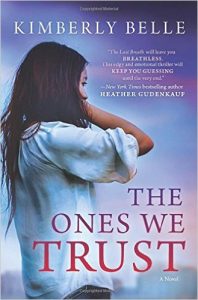
      The Ones We Trust, Kimberly Belle, Award-Winning MIRA Author, Multi-Margie-Grad

      1. Gabe’s good looks are real and rugged and raw, and now that I’ve seen both brothers up close, I’d choose Gabe over Zach any day.
      RD Combo: Polysyndeton (multiple conjunctions, no punctuation) and Alliteration

      2. The silence that spins out lasts forever. It’s the kind of silence that wraps around you like a shroud, the kind that turns the air thick and solid, the kind that makes you want to hear the answer as much as you dread it.

      Kimberly Belle could have written: The room went silent.

      I’m glad she decided to empower that emotionally-loaded scene dynamic.

      Rhetorical Devices: Amplification (silence) and anaphora (the kind, the kind, the kind)

      3. My heart races and my skin tingles and my blood pressure explodes like a grenade.

      Rhetorical Devices: Three visceral responses are powered with polysyndeton (multiple conjunctions, no punctuation) and a simile.

      The Blessing of No, Megan Menard, Multi-Margie-Grad

      1. Luke had a machine-gun laugh that fired about every third word.
      1. I picked up a French fry. It was a slender blonde, tall and weepy. I named the fry Tanya and chomped off its head.

      Those examples carry interest and power and are perfectly cadenced. The second example uses a metaphor and structural parallelism. It reveals a truth in a humor hit that could make us laugh or cry.

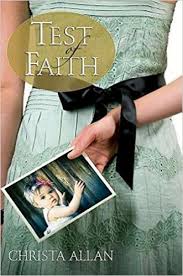
      Test of Faith, Christa Allan, Award-Winning Author, Multi-Margie-Grad 

      1. “If. Faith. Can. Come. Live. With Me?” I heaved every word out of my brain and into my mouth. I felt like someone regaining consciousness in an unfamiliar room or house or life.
      Christa Allan stylized that dialogue by using a Period. Infused. Sentence. That’s what I named it. Her dialogue cue is amplified, amplified, amplified stellar.
      She used an RD combo in the last sentence: polysyndeton and zeugma.

      What’s zeugma?

      I’ll SHOW not TELL. I know you’ll get it.

      My teaching-zeugma sentence:

      Margie grabbed her purse, her keys, and her steely resolve.

      You got it!

      This 2-point version is an example of zeugma too:

      Margie grabbed her purse and her steely resolve.

      Now you know the rhetorical device zeugma.

      1. This dinner was the Indy 500 version of returning to the track after a pit stop, except that the finish line was Logan, and there was only one first place.

      Ah… Metaphors and power words and hope all themed, propelled by a compelling cadence.

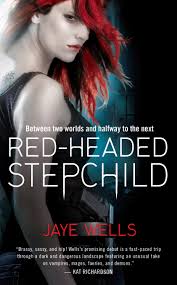
      Red-Headed Stepchild, Jaye Wells, USA Today Bestseller

      Jaye Wells wrote this paragraph when she was in a full day workshop I taught for Dallas Area Romance Authors in 2007. I asked all the participants to write an example of anaphora.


      Anaphora — Repeating a word or phrase at the beginning of three or more successive phrases or clauses or sentences. The first three must be in a row.

      The paragraph she wrote in class became the first paragraph in the first chapter of Red-Headed Stepchild, her debut Urban Fantasy.

      Digging graves is hell on a manicure, but I was taught good vampires clean up after every meal. So I ignored the chipped onyx polish. I ignored the dirt caked under my nails. I ignored my palms, rubbed raw and blistering. And when a snapping twig announced David’s arrival, I ignored him too.

      Deep Edit Analysis:

      Anaphora: I ignored, I ignored, I ignored, I ignored

      Three Humor Hits:

        • Digging graves is hell on a manicure
        • good vampires clean up after every meal
        • I ignored him too

      Power Words — Words that carry psychological power: graves, hell, vampires, clean up, ignored, ignored, dirt, ignored, raw, blistering, arrival, ignored him

      What does the reader learn in those 53 words?

      1. She’s digging a grave. We can infer she killed someone.
      2. She’s a vampire.
      3. She gets manicures.
      4. She’s Goth.
      5. She’s been digging that grave for a while.

      She’s not concerned about David catching her digging a grave.

      In that one short, opening paragraph, Jaye Wells deepened characterization, shared a strong and fun voice, and made the reader want to read more. That’s smart writing. The kind that impresses agents and editors and readers and reviewers.

      Every example in this blog carries a compelling cadence. That pleasing cadence speaks to the reader’s subconscious. Cadence has the same impact on the reader that a movie sound track has on a viewer.

      Read the first sentence of this blog OUT LOUD:

                  Reading a book with flat-lined cadence is like watching a movie on mute.

      Do you hear those perfect beats?

      I could have written:

                  It is critical to pay attention to cadence.

      No cadence-driven power.

      Deep Editing Caveat:  Most of the examples I shared in this blog were amplified. I’m not suggesting that every sentence should be powered up, or made special in some way. That would be gagifying. 

      Not a word. But it carries the punch I wanted to share.

      We need plain writing. Writing that does its job without any amplification.

      We need fun, quirky, deep, stylistic, and tug-your-heart writing too.

      I teach writers how to add psychological power to their writing in hundreds of ways. No hype. No hyperbole. I’m just sharing what I do.

      I’m a psychologist-turned-editor. I used my psychological expertise to analyze more passages and chapters than most people read in ten lifetimes. I developed deep editing techniques that help writers add power to each paragraph.

      I teach writers how to empower emotions.

      How to avoid clichés and clichéd phrasing.

      How to write fresh faces and voices and visceral responses.

      How to use advanced stimulus-response patterns.

      How to use my Four Levels of Powering Up Emotion. How to have the right emotional intensity in the right place.

      How to create emotional authenticity on the page. How a character can act in an out-of-character way, and get the reader to buy it.

      How to use six rhetorical devices to finesse backstory. Succinct, unskimmable, beautifully cadenced backstory.

      How to use my 20 Point Checklist for Openings, my 15 Point Checklist for Endings, my 12 Visceral Rules for Fiction Writers, my 10 Gems for Not Writing Your Mama’s Character Descriptions, and more.

      How to deep edit analyze your scenes. I developed The EDITS System so writers can see what’s working, what’s not working, and what’s missing.

      I created seven online courses for writers:

      1. Empowering Characters’ Emotions
      2. Deep Editing, Rhetorical Devices, and More
      3. Writing Body Language and Dialogue Cues Like a Psychologist
      4. Defeat Self-Defeating Behaviors
      5. A Deep Editing Guide to Make Your Openings Pop
      6. Visceral Rules: Beyond Hammering Hearts
      7. Fab 30: Advanced Deep Editing, A Master Class

      The first four classes each have 250+ pages of lectures. The next three classes have 180 – 230 pages of lectures.

      I used to teach college. Graduate level psychology courses. I back up every teaching point with plenty of examples from a variety of genres.

      I shared a few of the twenty rhetorical devices I teach fiction writers here. I’ll cover all twenty in about 75 minutes in my full day master class. Some, like polysyndeton (…photographed and bagged and carried away…, The Last Breath, Kimberly Belle) may be new to you, but they’re easy to learn, and use. Handouts help.

      I’m looking forward to having fun in my Master Class on March 30. Join me, and you’ll leave with deep editing tips and techniques that will add power to your WIP.


      About Margie

      Margie Lawson —editor, and international presenter – teaches writers how to use her psychologically-based editing systems and deep editing techniques to create page-turners.

      Margie has presented over a hundred fifty full day master classes in the U.S., Canada, Australia, and New Zealand. Writers credit her innovative deep editing approaches with taking their writing to publication, awards, and bestseller lists.

      Margie developed seven online courses she teaches through Lawson Writer’s Academy on her website. LWA has over 30 instructors and offers five courses most months.

      Margie also teaches fifteen 5-day Immersion Master Classes a year. Enrollment is limited to seven. In 2017 she’s teaching Immersions in Atlanta, Denver, Dallas, Amarillo, Calgary, Washington D.C., and in Melbourne, Sydney, Brisbane, Coffs Harbour, Canberra, and Hobart, Australia.

      What’s the Buzz? 

      Randy Ingermanson, Ph. D., award-winning author of Writing Fiction for Dummies:

      In the twenty years I’ve been writing fiction, two teachers have astounded me with their insights and taught me something radically new: Dwight Swain and Margie Lawson. Margie taught me new ways to empower my writing.

      Melanie Milburne, USA Today Bestseller

      I had 40 books published before I met Margie Lawson. It wasn’t until I started using her deep editing techniques that I won several writing awards. I have a library of how-to books, but none top Margie’s expertise.

      Laura Drake, RITA Winner, The Sweet Spot

      When I took my first Margie Lawson class, the paradigm shift I experienced was more like an earthquake — I saw everything differently. I took more of her classes and I got a three book deal with Grand Central. A few months later I got a contract for a fourth book. Several months after that, I got contracted for three more books! I sold seven books in fifteen months—before my first book was released. I have Margie to thank for teaching me how to deep edit to get power on every page.

      Allison Brennan, NYT Bestseller:

      Margie Lawson, a brilliant psychologist, teaches a class on editing that, ahem, truly tested me. She uses color-coding to dissect writing in order to empower your stories. I learned from Margie how to fix my prose. I think about her editing system and techniques, ways to add power, finding the emotional key of the scene. I use her lessons to add power to my writing.

      Romily Bernard, RITA Winner, Find Me

      Your classes (both online and at the Georgia writing conference) changed my life!! My YA debut sold in a three-book, pre-empt to Harper Collins. Phoebe was so very complimentary about the way I render emotion and tension on the page and I know I have you to thank!

      Alex Ratcliff, Daphne Finalist

      Margie’s online courses and Immersion Master Class have strapped me into a skill-building machine for writers. With her help, in one year I moved from a can’t-write-a-fresh-line beginner to a Daphne finalist. Wow!

      Karin Tabke, Bestselling author

      I had so many epiphany moments Saturday my head was twitching. It’s still twitching! I wish I had attended Margie’s Empowering Characters’ Emotions master class earlier. My writing is stronger, more vivid, more emotional. The effects of the workshop were immediate. I highly recommend if you have the opportunity to take Margie’s workshop in person, do it.

      Colleen Coble, CEO of ACFW and Bestselling author

      “The workshop I went to last month was the best I’ve ever been to, bar none. And I’ve been to plenty. Margie’s workshop was so awesome, I’m going over my notes from what she taught before I start my next book. She’s a genius, pure and simple.”

      Elizabeth Essex, RITA Finalist, The Danger of Desire

      I’ve attended one of Margie’s all-day seminars, taken all her online classes; attended her workshops at RWA conferences, flown to Colorado to attend her four-day Immersion class, and hosted an Immersion class in Dallas. Margie taught me to challenge and push myself to make the hard changes from the first page of a manuscript until the very last. Working with Margie, you’ll have the tools to make every single word count.

      Comment Contest Details

      Post a comment and you have TWO CHANCES to WIN a lecture packet!

      You’ll win the lectures (250+ pages) from one of Margie Lawson’s online courses listed here:

      1. Empowering Characters’ Emotions
      1. Deep Editing, Rhetorical Devices, and More
      1. Writing Body Language and Dialogue Cues Like a Psychologist

      The drawings will be Sunday, Feb. 5th, 8:00 PM Mountain Time.  

      Drawing reschedule due to SUPERBOWL! Time extended until Thursday, Feb. 9, 2017 at 6 p.m. PST.

      The winners names will be posted here.

      See you on the blog!

      KEEP SCROLLING DOWN UNTIL YOU GET TO THE COMMENTS SECTION ON THIS PAGE (the place to leave your comments for Margie’s  contest).  

      All smiles…………….Margie

    • The Seven Must-Haves for Authors – Unlocking the Secrets of Successful Publishing Series by Kiffer Brown

      The Seven Must-Haves for Authors – Unlocking the Secrets of Successful Publishing Series by Kiffer Brown

      I was asked by Orna Ross of Alliance of Independent Authors to share what I consider to be the “Seven Must-Haves for Independent Authors” at  UPublishU event that was held at the Book Expo of America 2016 held in Chicago. Of course, I agreed!

      However, the Seven Must-Haves are applicable for all authors whether they are self-published, small press published, traditionally published, or hybrid published. I formed the talk based on the following questions:

      What are the Seven Must-Haves?

      1. What is the traditional publishing tool that authors can implement to propel their writing careers to new levels and to earn an income from selling their books?
      2. What is the single most important publishing tool for first-time authors?
      3. What is the cornerstone of any author platform?
      4.  What should every author know about communicating and marketing in the Digital Age?
      5. How can an author set her books apart from the millions of titles that launch each year?
      6. How can an author expand readership?
      7. What should continue to grow and never disappear in today’s new era of publishing?

      Each of one these questions will be answered in the Seven Must-Haves blog-post series.

      1. What is the traditional publishing tool that authors can implement to propel their writing careers to new levels and to earn income from their books?

      Have you ever wondered how best-selling authors can churn out a book or two each year? 

      How they can continue to hit “home-runs” with each new title? 

      They use the tried and true tools that have built the publishing industry. Authors will benefit from taking the best tried and true methods of traditional publishing and combining them with today’s best publishing practices.

      One of the best tools that traditional publishing houses and literary agents make available to their authors is the power of a manuscript overview. Most best-selling authors have great editing and feedback from agents and senior editors from the very beginning of a work. This feedback comes in very early in a work’s process and allows for the author to publish more works and not as an afterthought.

      The Editing Process (when one is working with a literary agent and/or publishing house) goes like this:

      The author works on a rough draft – the early drafts of a novel. He creates the theme, the characters, the setting, the tone, the story, the plot lines, the dialog style, and selects the genre and has an audience in mind (YA or mystery fans, fantasy or Science Fiction readers, etc.). After the author creates the story with a beginning, middle, and end, he then sends this early unedited draft of the story to his editor or agent to read and to get feedback.

      Authors who work within this editing system then begin scratching out the next inklings of story ideas, or they will resume working on other drafts that are further down the editing schedule, while waiting for feedback about the manuscript overview from their agent/editor. Once the feedback (manuscript overview) is received, then the author decides what to incorporate and which suggestions to implement in the next drafts. He then reworks the draft while another work’s manuscript is being over-viewed or is in a separate stage of editing. Some authors who write within this system will have two or three works “in play.”  Also, some authors write in different genres while as the works are in different stages of the editing process.

      Have you ever wished that someone would give you objective feedback about your manuscript? Or that someone would give you the feedback that will take your work from good to great?  

      What is a Manuscript Overview: It is an objective evaluation of a story idea that is fully formed with a beginning, middle, and end, but still in an early draft stage. The MO comes before LINE EDITING and COPY EDITING.

      What is the process:  The entire manuscript is read and evaluated by a top editor for the following:

      • Does the work have a compelling story?
      • Is there more than one story in the manuscript? It is quite common for a manuscript to have two, three, or more storylines.
      • Are the characters engaging? Interesting?
      • Are there too many characters? See above.
      • Are the characters pathetic, sympathetic, or empathetic?
      • Is there inconsistent character development?
      • Are there plot holes? Smoking guns?
      • Does the story wander?
      • Is there “head hopping” or unplanned POV changes?
      • Does it take to long too engage the reader?
      • Does the story stay within its world construct?
      • Does it follow the “laws” of the setting?
      • Does the story sag in the middle?
      • Is the ending satisfying?
      • Does the beginning intrigue?
      • Is the dialog appropriate?
      • Is there too much backstory? Too many details?
      • Does the scenery and setting work with the story?
      • and so forth
      • Or is it spot on and ready for a Line Edit?

      The editor then writes a brief and honest evaluation of the work that addresses the above questions.

      If you do not have an agent or editor, you can still get this type of brutally honest feedback with a manuscript overview from Chanticleer Reviews.

      Remember, that a manuscript overview is NOT a Line Edit or a Copy Edit. It consists of broad sweeping strokes of feedback for the author to consider for the next round of drafts. Incorporating line-editing suggestions can typically shorten a manuscript by at least twenty percent, thereby paying for itself with the savings on copyediting.

      The editor then sends his comments, suggestions, and concerns about the work back to the author in a manuscript overview. It is up to the author to take these recommendations and decide whether or not to incorporate them in the next draft of the manuscript.

      Many of the authors who have used Chanticleer’s Manuscript Overview service have found that their writing was greatly improved and have discovered that the feedback has enabled them to be able to take their next works to a higher level.

      I’m incredibly appreciative of the many positive and helpful things the reviewer had to say in the manuscript overview. The feedback is terrific and more comprehensive than any other I’ve received… Many thanks, again! Brian L.

      All of her suggestions were right and I hope to make them to the best of my ability. It’s like taking a powerful and quick course in advanced writing. Please thank her for me….Working with someone of her caliber would take my writing to another level. – L.V.

       Please thank the editor  for her insightful and pinpoint comments as to how I can make the book better. They were very good and I’ve already incorporated many into the manuscript. –D.S.

      When the author decides that the story is ready (and the lit agent and/or publisher agrees), she may send it off for another manuscript overview with either the same editor or get a second opinion. Or the author may decide that the work is ready for a Line Edit.

      Line Editing is defined as a thorough and focused reading of the manuscript  on a line-by-line basis with suggestions, comments, and remarks noted for the author to consider. For more information about what line-editing encompasses, please visit our Editing Guide.  

      After the author incorporates the line edits, the work then moves to a Copy Edit.

      Copy Editing is a very technical read of a work for flaws in grammar, punctuation, syntax; consistency in spelling, numerals, hyphenation, etc.; flagging any inconsistencies that have made it past the Copy Edit such as eye color, name spelling, location, timing from point A to point B; and tracks any internal inconsistencies in the story (conflicting abilities or inabilities, location inconsistencies), etc.

      After Copy Editing, the work then goes to Final Proofing.

      The manuscript then goes back to the author for final approval to begin the publishing formatting for digital and print.

      To circle back around to the first question:

      What is the traditional publishing tool that authors can implement to propel their writing careers to new levels and to earn income from their books?

      This is how: Each time a work goes back to an editor for evaluation and editing takes time. During these interludes, the author continues to write new works or continues to work on other manuscripts that are further down the editing chain.

      Fundamentally, the manuscript overview allow authors to WRITE and CREATE rather than rework and reword a story idea again and again while trying to get it “right.” The honest feedback gives the author an advantage of the traditional publishing houses where authors continuously get feedback and are under contract to produce. Manuscript overviews allow the author to spend creative time developing stories, characters, unique language, and new plot twists rather than trying to dissect their own works. They also allow for the author to gain fresh perspective.

      The manuscript overview saves the author time and energy, and if the author is self-published, then money in editing fees.

      Each stage of editing brings an entirely new set of fresh eyes and fresh perspective to a work. Imagine the kind of polish that will bring to your work.

      Put the power of traditional publishing’s collaborative expertise behind your work. Begin with a manuscript overview. Our clients, who have taken advantage of the Chanticleer Reviews Manuscript Overview service, swear that they will never go back to writing another novel without first having a manuscript overview conducted on early on.

      How much is the fee for this powerful editing tool?

      $425 for 2,000+  word overview/evaluation from one of Chanticleer’s senior editors for a work under 110,000 words.

      Get objective, honest, and brutal feedback from one of Chanticleer’s top editors who edit for New York Times and Amazon best-selling authors.

      Order your manuscript’s overview today! 

      *If you publish with a hybrid or cooperative publishing house, we can work with their Style Sheets. We work with many authors who publish in a variety of ways, but want honest and objective feedback regarding their manuscripts before they submit them.