Tag: #editing advice

  • Continued – Top Ten Most Popular Writing Craft and Editing Posts for 2021 – Chanticleer’s Writer’s Toolbox Series

    Continued – Top Ten Most Popular Writing Craft and Editing Posts for 2021 – Chanticleer’s Writer’s Toolbox Series

    Top Ten Editing and Writing Craft Articles from Chanticleer’s Writer’s Toolbox Series to Point Your Works into the Right Direction

    Writer’s Toolbox

    Below are the second lot of our most popular writing craft articles in 2021! They are not in order or ranking. 

    5) Putting More Character into Your Characters

    “If you’re going to have a character appear in a story long enough to sell a newspaper, he’d better be real enough that you can smell his breath.” ~ Ford Madox Ford

    She might has well been talking to three empty chairs…

    4)  Component Layers of Successful Fiction

    Elements of successful fiction layer and fold back in on each other to create resonance, nuance, subtext, and undercurrents of great storytelling.

    Causality — the Physics of Writing

    3. Between the Lines: Mastering the Subtle Techniques of Fiction

    You see, it’s impossible to write fiction without understanding its underpinnings such as conflict, scene structure, and character development. Without this understanding , you might write two or three or four hundred pages, but you won’t end up with a story; instead you’ll produce a lot of words on a lot of pages or a haphazard pile of scenes loosely clustered around characters who never quite come to life.

    Causality — the Physics of Writing

    2. Language and Names in Writing Fiction

    The best methods of using language to authenticate your fiction often lies in blending the familiar and new, including fresh word combinations.

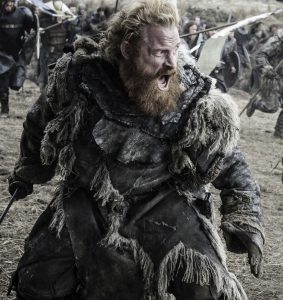
    Tormund Giantsbane of the Free Folk, A Song of Fire and Ice.

    1. Common Fiction Errors – a Checklist    

    The best fiction touches the deep layers in us. A writer achieves this effect by embedding dozens of techniques into his or her story.

    Do your characters sound like this?

    We hope that you have found these encore posts to be useful reminders and prompts for your work-in-progress!

    And in cased you missed it, here is the link to our New Year’s Eve post with the first five articles. Click here. 

    NOW for Kiffer’s Number One Tip for Writers in 2022!

    RULE # 1

    WRITE FAST!  EDIT SLOW! 

    Don’t edit your first draft as you write it!

    Writing your first draft should be a mad dash to get your story out of your brain. Don’t hinder it by worrying about each little detail. There will be time for that later. 

    Try to unspool the “mind-film” in your brain before reworking every sentence. Get your story out. Let the characters introduce themselves to you. Create the Atmosphere.

    There will be plenty of time to craft and hone sentences later. Meanwhile, fall in love with your story. Experience the rush and the thrill of creativity!

    We wish you joy and peace in the New Year from all of us at Chanticleer! 

    We hope to see you at the 2022 Chanticleer Authors Conference and the 2021 CIBA Banquet and Ceremony 

    Our 10th Anniversary Chanticleer Authors Conference (CAC22) will be April 7-10, 2022, where our 2021 CIBA winners will be announced. Space is limited and seats are already filling up, so sign up today!  CAC22 and the CIBA Ceremonies will be hosted at the Hotel Bellwether in Beautiful Bellingham, Wash. Sign up and see the latest updates here!

    Don’t Delay! Register Today! Seating is Limited.

  • Turning Points and Plot Points in Storytelling from Jessica Morrell’s Editor’s Desk – A Chanticleer Writers Toolbox post

    Turning Points and Plot Points in Storytelling from Jessica Morrell’s Editor’s Desk – A Chanticleer Writers Toolbox post

    Jessica Morrell, Top-tiered Developmental Editor Shares Her Thoughts on Turning Points and Plot Points in Storytelling

    Jessica Page Morrell
    Jessica Page Morrell, Top-Tiered Developmental Editor

    I want to talk about the thresholds and milestones that happen in storytelling, including films. These milestones are given different names by various experts. Most commonly they’re called turning points or plot points.

    Turning Point or Plot Point Development

    Crucial Scenes

    I was recently working on a client’s manuscript and an important scene was taking place in an early chapter creating the first major turning point. It features two main characters about to make love for the first time. It’s a crucial scene because everything in the story will change after this, the stakes will rise, serious repercussions will shape their futures. It’s an especially important scene because it’s the tale of forbidden love and once they’ve crossed this line they’ve admitted censure and danger into their lives. My job is to help the writer make the scene more momentous and intense, making sure the scenes contain enough emotional clout. Because these essential moments need to create major ramifications.

    Turning points are irrevocable changes staged as events or scenes, and are where the story shifts in a new direction. They’re also thresholds so characters pass through into a new situation. These moments, always shown via action, usually have an emotional change that comes with them. –Jessica Morrell

    Before this event, things might return back to normal; afterward, it’s a whole new game.

    One Way Gates

    As I’ve mentioned here before, effective fiction takes your main characters into new physical and emotional territory. Turning points are the thresholds to the other side. They signal the reader that danger and shifting tides lie ahead. I like to think of them as one way gates.

    The new territory can also be new spiritual territory, where principles, beliefs, and hearts are tested. Also, they are often tests and reveal what your protagonist is made of.

    And while turning points shift the direction of the story, keep in mind is that they’re also emotional turning points. I was thinking about them yesterday and how they snatch a protagonist from his or her comfort zone and thrust him or her into a threatening situation.

    Let’s look at The Hunger Games to help identify these crucial moments. It’s the first book in Suzanne Collins dystopian series that takes place in Panem, a country that’s formed after the collapse of North American governments.

    Inciting Incidents

    The inciting incident or catalyst happens on Reaping Day, an annual lottery where each of Panem’s 12 Districts must send two ‘tributes’ to participate in the state-sponsored, fight-to-the-death Hunger Games while the whole country watches the gruesome contest. Because the underlying brutality of the governing regime is an omnipresent threat. The winning district receives food. 

    Reaping Day in The Hunger Games – Gale and Prim (Katniss’ little sister).

    The story reprises the virgin sacrifices that existed in many cultures along with nods to mythical happenings. But then Collins has borrowed liberally from mythology and gory human history including a mashup of Dust Bowl imagery, a Nazi-like regime including the architecture, symbolism, and vicious stormtroopers, along with a hideous disparity between the classes.

    Complications

    At the Reaping, Katniss Everdeen volunteers to replace her 12-year-old sister Primrose in the deadly Games.

    Central Dramatic Question

    This creates the central dramatic question: Will Katniss survive? Then Peeta Mellark is chosen from District 12 too, and wouldn’t you know it, they have some history together because one of the rules of storytelling is Complicate, Complicate, Complicate.

    Katniss and Peeta leave home for the Capital (a threshold) and that’s when readers and movie-goers find out just how twisted and corrupt the Panem leadership is.

    Katniss and Peeta see just how wealthy the governing body is and how poor they are on the deluxe train ride.

    Plot Points Pushing Ahead the Plot’s Trajectory

    It turns out that Peeta is secretly in love with Katniss. Because Katniss needs to win to save her family, this is another complication in an already ghastly competition. Does she care about him too? Will she be forced to turn into a soulless killer to survive? The turning points that follow keep changing and pushing ahead the plot’s trajectory, but all affect her goal to survive.

    Katniss and Peeta decide to become allies and feign love in order to increase their chances of survival. Because the heartless denizens of the Capital love a love story in the midst of their killing field. Back in District 12 Katniss had learned to hunt to feed her family since her father had died in a mining accident. During the exhibition before the Games she gains notice for her archery skills.

    Atmosphere and Landscape

    Another turning point happens when the tributes enter the Arena – a nightmarish landscape where the rules keep changing, monsters and walls of flames appear out of nowhere. And can we just reiterate that these are children and teens operating in this whole blood-soaked nightmare?

    The children and teens from the 12 districts that must fight to the death until there is one survivor. Then, his or her district will receive food. The Hunger Games.

    Secondary Characters: Reflections of the Protagonist and Antagonist 

    The youngest tribute from District 11 is Rue and she represents innocence and all that’s wrong with the government and Games. Though agile and wily, she seems doomed or at least underestimated.

    Once the Games begin in the mad scramble to secure weapons and supplies Peeta and Katniss become separated.

    Katniss has been chased up a tree for safety and that’s when she hears a bird-like call. Rue is nearby in a tree. She warns Katniss of a nearby nest of deadly tracker-jackers (genetically-modified bee monsters). Katniss saws off the branch and the tracker jackers swarm on their adversaries. The girls become allies and readers, and viewers recognize that Rue is surrogate for her sister Prim.

    Rue warning Katniss about the deadly nest of robot yellowjackets.

    As allies they concoct a plan to destroy the Cornucopia, a huge stash of weapons and supplies.

    Reversals and Ramifications

    Returning to Rue after Katniss succeeds, she witnesses her being murdered by another tribute. It is a major turning point in the story.

    The fallout cannot be overstated:

    • Katniss changes from a hunter to a killer, first taking out Rue’s murderer.
    • The story slows down briefly so Katniss can process her grief and feelings.
    • The slave-like conditions the citizens of Pandem live under is emphasized by Rue’s senseless death.
    • It reinforces Katniss’ desire to survive – she will win for Rue.
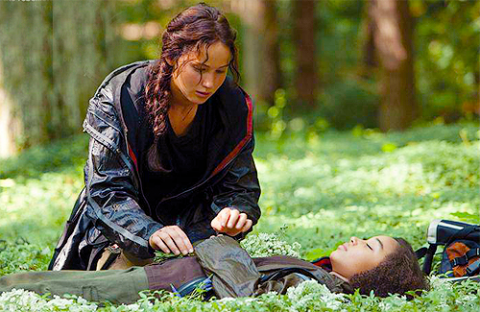
    • Katniss openly defies the Capital when she rings flowers around Rue’s corpse, showing her affection and respect.
    • Katniss uses her weapon for good when cutting flowers to honor Rue.

    The link to this emotional scene is here.

    Then with the Games’ cameras rolling, and honor and respect has been shown to Rue’s corpse, Katniss stands and salutes (as tribute) the other district’s people who are watching via he Games’ cameras, marking her defiance and the beginning of a rebellion. We’re talking major ramifications.

    Katniss’ symbol of defiance and respect is televised to all the districts in the Hunger Games. This simple gesture starts a movement.

    Later, Katniss’ compassion toward Rue saves her own life because Rue’s district sends her food – once again breaking the rules of the Games.

    Before: Rue and Katniss are allies and sisters in the struggle for survival.

    After:  Katniss would rather die than let the government regime win or steal her humanity.

    Question for Writers: What are the before and after statuses in your turning points for your work-in-progress?

    Another excellent example of plot points and turning points is The Toy Story series. It has terrific examples of thresholds that are easily identified because the characters often land in a new setting as they pass through each threshold.

    *Still photos copyright Lion’s Gate Entertainment

    Keep writing, keep dreaming, have heart. Jessica

    Jessica Morrell is a top-tier developmental editor and a contributor to Chanticleer Reviews Media and to the Writer’s Digest magazine. She teaches Master Writing Craft Classes at the Chanticleer Authors Conference that is held annually along with teaching at Chanticleer writing workshops that are held throughout the year. We suggest visiting her website for more articles on writing and the writing life. 


    When you’re ready, did you know that Chanticleer offers editorial services? We do and have been doing so since 2011.

    Our professional editors are top-notch and are experts in the Chicago Manual of Style. They have and are working for the top publishing houses (TOR, McMillian, Thomas Mercer, Penguin Random House, Simon Schuster, etc.).

    If you would like more information, we invite you to email Kiffer or Sharon at KBrown@ChantiReviews.com or SAnderson@ChantiReviews.com for more information, testimonials, and fees.

    We work with a small number of exclusive clients who want to collaborate with our team of top editors on an on-going basis. Contact us today!

    Chanticleer Editorial Services also offers writing craft sessions and masterclasses. Sign up to find out where, when, and how sessions being held.

    A great way to get started is with our manuscript evaluation service, with more information available here.

    And we do editorial consultations for $75. Learn more here.

    If you’re confident in your book, consider submitting it for a Editorial Book Review here or to one of our Chanticleer International Awards here.

    Our 10th Anniversary Chanticleer Authors Conference (CAC22) will be April 7-10, 2022, where our 2021 CIBA winners will be announced. Space is limited and seats are already filling up, so sign up today!  CAC22 and the CIBA Ceremonies will be hosted at the Hotel Bellwether in Beautiful Bellingham, Wash. Sign up and see the latest updates here!


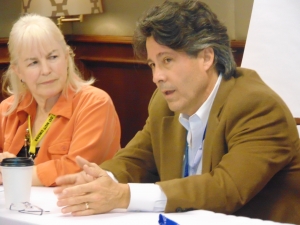
    Robert Dugoni
    Robert Dugoni is one of our most popular speakers at the Chanticleer Author Conference.

    Writer’s Toolbox

    Thank you for reading this Chanticleer Writer’s Toolbox article.

    Writers Toolbox Helpful Links: 

    At Its Core, the ‘Twilight’ Saga Is a Story About ________

    The INCITING INCIDENT: STORY, SETBACKS and SURPRISES for the PROTAGONIST

    BEATS & CONFLICT: The Engine for Your Book

  • You’ve Finished Your Work In Progress or NaNoWriMo or Perhaps Not – That is Okay by David Beaumier

    You’ve Finished Your Work In Progress or NaNoWriMo or Perhaps Not – That is Okay by David Beaumier

    You’ve finished NaNoWriMo!

    Or perhaps not — that is okay! 

    You have more words than you did at the beginning of November. Congratulations!

    Or perhaps you are one of the ones who will do February or June Writing Month. If so, bookmark this post for future use.

    Or, you are creating your work-in-progress? This post may be of particular interest to you.

    The first thing to do is to take a deep breath, maybe take an Epsom salt bath, massage your wrists, roll out those shoulders, and maybe let out a primordial scream into the darkness. You know, whatever helps you relax.

    Finish, Celebrate, Plan

    Now, let’s say you haven’t quite finished— Give yourself some time to relax, and brainstorm the ways you’re going to now fit writing into your life. For me, having a daily word goal of 1667 is great for short periods, but really what I need is time boxes to get the work down. I usually tell myself that I can shut myself away for at least twenty minutes a day writing until I finish, with the only rule being I write. Even if I need to struggle through something and get really meta in the writing process, I know that will come out later. Don’t forget to reward yourself, maybe with a day off, that fancy mocha you never spring for, or chocolate.

    So, whether you NaNoWriMo or not, if you are writing, be sure to reward yourself!

    Treat Yourself!

    Edit, Space, Edit

    Once you’ve finished your novel on your new schedule (or maybe you skipped that last paragraph because you’re so gosh darn prolific), the next stage will be editing. You know yourself better than I do, so if you need space from your writing, take that space.

    Before you hide it away though, consider taking the time to write what you know to be true about it now. Note down what parts mean a lot to you that you don’t want to change later, explain to yourself where you know you’ve decided you want to expand things, and then make a quick list of items that you know will need to be fixed (for me, I always need to fix the fact that my characters have very little interiority, so the reader doesn’t know why they do what they do.

    My other big struggle is setting, (everyone just exists in an empty void where their heads can talk). Leave yourself these notes and then get some space by taking Stephen King’s advice and hiding your work in a drawer or somewhere out of sight for at least six weeks.

    Meanwhile, start conjuring your next writing creation.

    Allowing your work to “rise” in a drawer while you start your next project.

    David’s Self-Editing “Trick” — He shares it with you, dear Chanticleerians.

    When the six-plus-weeks of letting your work “rise or proof” in a drawer somewhere is up, David offers this advice:

    For the next editing step, I treat myself like I would any other editorial client. I take the first ten pages of my work, and then skip ahead to the middle and grab ten pages from there. For many of us, the start and end of the book already appear clearly in our mind, and for something like NaNoWriMo, we start out fresh and excited to get the job done. So you can notice what you do well in your first ten pages, and if anything pops up that you know you need to fix, write those down as well. Then, in the section from the middle of your book, look at what parts that worked well in the beginning are still there, and what maybe fell out as the story weighed itself down in the middle of the month, heavy from the expectations and reaching that week three or week four point of exhaustion.

    We imagine this is David

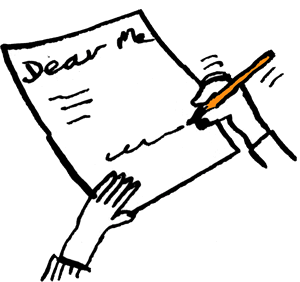
    Having taken notes one what worked and didn’t work at the beginning and middle, I write myself a letter explaining what I should watch out for as I move through my own work, and how I recommend shoring up the strengths and how I can correct any weak points. For me, again, this usually means taking time to give every setting and character a unique description, and then to make sure that I use my strengths, like dialogue, especially if I notice there’s a section where I skipped over dialogue in favor of narrative description.

    Then, I connect this letter with the note I left for myself when the story was still fresh in my mind, and I buckle down and do my first read through and selection of edits.

    Manuscript Overview or Peer Review, Rewrite, Repeat

    Now it’s time to get some other eyes on your work. This may be the time to have a manuscript overview if you are serious about publishing your work. Do this before you get into editing (line or copy editing). Click here if you would like to read more about this process:


    https://www.chantireviews.com/manuscript-reviews/

    If you are undecided about whether or not to publish your work-in-progress, this might be a good time to bring in a few Beta Readers for their general impressions—how do they see the structure of the story? What do they think of my character development? And what do they see as the heart of the story? That last question nets me some really interesting answers that help me better understand the themes of the story that maybe weren’t clear to me initially. Then I compile these notes into another letter of sorts to myself, and go through the entire book again. I would recommend doing this one more time, and this time asking for more specific feedback on theme, plot, characterization, dialogue, structure, world building (as applicable), and then just anything that just stands out as a hold up for the reader.

    Remember, when receiving peer review or manuscript overview, you are the author and no one else can force you to make changes. Even if a suggestion really bothers you and gets under your skin, reframing it as a question of why the reviewer gave you that feedback can always help. For example if someone hates your character, Beth, because “she just doesn’t seem real.” Ask yourself what you’ve done to develop Beth as a character. Read her dialogue aloud. Figure out why you love Beth (even if she’s actually awful—which is often a reason we back away from loving our bad characters), and put that love into her character. She can still be unsympathetic, but at least now she’ll draw your reader in.

    What should you do if you are not wanting to proceed with your w-i-p. Our suggestion here at Chanticleer is to print it and file it away. Also, save it digitally in at least two other places such as your computer or a USB stick plus some place off premise such as in the “cloud.” Never throw any writing away…just squirrel it away because you never know…

    Squirrel away your cuts and works that you are not moving forward on. Don’t toss them away.

    Let’s get Professional – You’ve Decided that You Want to Publish Your Work-In-Progress 

    At this point, if you still want to move forward with your story, which I’m imaging is quite good, it’s time to bring in a professional. Chanticleer can provide you with a Manuscript Overview, which is a great first step, and then you can work on finding an editor who understands your vision and whose style matches with the way you respond to feedback. Go through it with your editor, and then proceed with the editorial and cover design process. Remember, your cover has the greatest influence on whether or not a potential reader will choose your book to to consider.

    Line editing, copy editing (you can save $$ by creating and developing your own Style Guide and Story Bible).

    Here is a link about creating your Story Bible/ Story Guide by Continuity Editor Diane Garland.

    SERIES or Not to Series 

    In the process that you’ve been going through with your Work-In-Progress (w-i-p), are you considering turning it into a series? Indie Booksellers, Entertainment Producers, Literary Agents, etc. and especially READERS, enjoy book series.

    Do you need to reconsider your story structure in order to sustain a book series? 

    You may want to read this blogpost by mystery series award-winning author Wendy Delaney. https://www.chantireviews.com/2020/02/29/writing-a-series-primer-by-award-winning-author-wendy-delaney-a-chanticleer-writers-toolbox-article/

    To Series or Not to Series– What is Your Strategy?

    Publication? 

    This, for many people is seen as the big goal, and it deserves an article all on its own for the different facets of self-publishing versus traditional publishing, how to market, what to do about cover design, contests, book reviews, and so much more. At this point, the important thing to realize is that you are entering a period of extraordinary fine-tuning and a different kind of work with your book, from making it come to life to putting it in people’s hands. Good luck!

    On a final note, don’t forget about the COVER!

    THE COVER – The Number One Marketing Tool to Sell More Books – Don’t Sell Yourself Short. Start on your cover design as soon as you are serious that you want to publish your story then start working on the cover and the brand (Stories are products!)

    Here is link for you to take a look at on Five Essential Book Cover Elements by Kiffer Brown

  • DECLUTTERING SENTENCES by ELIMINATING JUNK WORDS – from Jessica Morrell’s Editor’s Desk – Writing Toolbox Series

    DECLUTTERING SENTENCES by ELIMINATING JUNK WORDS – from Jessica Morrell’s Editor’s Desk – Writing Toolbox Series

    Declutttering sentences give me the same thrill that Marie Kondo (author of The Life Changing Magic of Tidying Up) experiences when she organizes sock drawers or attacks a kitchen’s junk drawer. I believe she calls this feeling “sparking joy.” Not only do I want sentences to be grammatically correct, but I want to make sure that every word counts toward moving the story forward. And that definitely sparks joy in me.  

    The Ubiquitous Junk Drawer

    Most of us use go-to words that aren’t necessary to tell the story. We use them out of habit or laziness, or because no one has pointed out that you don’t need them. In the spirit of writing clean, crisp, and intelligently here’s a reminder about words you usually don’t need.

    Declutter Your Sentences by Eliminating These Junk Words

    Breathingdeep breathsbarely breathinginhalingexhaling, and other lung movements.  Many writers of all levels reveal their characters’ emotions and reactions using their breath, lack of breath, breathlessness, or as their main method of reacting and showing emotion. “I took a deep breath” is a phrase I’ve seen so often it’s a cliche.  Unless a character has the breath knocked out of him or is in the midst of childbirth, avoid focusing on breathing as your main means to create emotion. Instead collect a variety of mannerisms, reactions, gestures, and body language individual to each character.

    Down or up. As in Rachel sat down. Now Rachel can collapse into a chair, or sidle into an empty seat in a dark theater, or ease onto a sofa, or flump onto a bed. Sit and sat means a person is lowering himself or herself.  As in down. More accurately sit means supporting your weight on your buttocks.

    Question your use of up. It seems so innocent, doesn’t it? Blithe stood up. Stood means up because standing means a person is upright, supporting himself on his feet.  Denzel stood, joining the screaming fans. Also, do not write grabbed up; grabbed suffices. Avoid appending up to spoke, hurry, lift, climb, and rose.


    Really. I mean really? Do you need it? Is the weather really cold or is it frigid or dangerously cold?

    Really?

    Literally means exactly as described or in a literal or strict sense. It does not mean quite, actually or really. Wrong: I was so mad I was literally shaking like a leaf and red-faced. Or, I was so terrified I literally jumped out of my skin. Or, Her death literally brought me to my knees.  Better: The playoffs were watched by literally millions of fans.

    Basically, essentially, obviously, basically, totally. Hint: question every adverb you use with an -ly ending because many are so overused they’ve become meaningless. However, the larger issue is many people sow these words into their stories without understanding their correct meanings mostly to maximize or intensify. Over time many adverbs have become meaningless. Basically means at a basic level or fundamental sense, not almost or mostly. Essentially means the essence of something or in an essential manner, not almost or often.  Practically means in a practical manner not almost or mostly. Totally means completely, in every part, not really.

    Just. No, I’m not just kidding. Too many of us (guilt-hand raised) use this one out of habit.

    Moments. I’ve read manuscripts where characters pause or think or kiss for only a moment hundreds of times throughout the story. There are plenty of ways to describe brief actions or thoughts.

    That. If a sentence works without that, ditch it. Easy, right?

    Suddenly. Because if you’re reading fiction you assume that actions, twists, and surprises will happen abruptly. They are devices used to increase tension and suspense. No need to announce it.

    Hopefully doesn’t mean ‘I hope.’ But it might convince an editor you’re not the wordnik he or she wants to work with.

    Bleeding Manuscript

    Towards, backwards, forwards, upwards, downwards.  Replace with toward, backward, forward, upward, downward.

    A note from Kiffer: A handy tool to help you recognize if these egregious junk words have infiltrated your manuscript is the “Find and Replace” tool that  can be found in WORD or other word processors. This tool finds and highlights specific words so that you can replace if needed to insure that every word counts.

    Chanticleer’s Writer’s Toolbox Series


    Jessica Page Morrell
    Jessica Page Morrell

    Jessica Morrell is a top-tier developmental editor and a contributor to Writer’s Digest magazine, and she teaches Master Writing Craft Classes at the Chanticleer Authors Conference that is held annually along with teaching at Chanticleer writing workshops.

    Keep writing, keep dreaming, have heart. Jessica Morrell