
Tag: Deep Editing

  • An Editor’s Checklist for Manuscript Evaluations of Fiction by Jessica Page Morrell Part Two of the Writing Fiction Guidelines by Jessica Page Morrell

    Writer’s Toolbox

    Fiction Checklist for Deep Editing

    A Chanticleer Editorial Services Writing Toolbox Series

    While rules and techniques are not written in stone, most of the basic guidelines of fiction stem from logic and an understanding of dramatic structure. Don’t break the rules until you know them, or better yet, until your first novels have sold. – Jessica Morrell


    The Developemental Editing  Checklist by Jessica Morrell

    VOICE

    From the opening paragraphs, is there a clear, distinct and engaging voice? The writer’s voice should have authenticity, individuality, or originality. 

    Log-Line aka Elevator Pitch

    Is there a single, simple conflict that drives the action? Can your plot be summed up in a single sentence? (Log-line aka The Elevator Pitch). Keep your log-line visible and in plain sight whenever you are editing your work-in-progress to remind you of your story’s focus. 

    Opening – is it grabbing? 

    Does the story begin with a change or threat in the protagonist’s life? Or the loss of something important? Or an action happening that should be prevented. 

    The opening should contain a hook or inciting incident that creates stress, unease, questions, or opens a can of worms. The story needs to start in the first sentence. 

    Is the story driven? 

    Does each scene provide a sense of momentum, or narrative drive pushing the story forward? Does each description? Or are the words there for the writer? 

    Is the story immersive? 

    Is the story highly visual? Can your reader imagine “seeing it” while reading or listening to it? 

    Ticking Clock? 

    Is there a sense of time running out or another driving factor that creates tension? Even light-hearted or humorous stories should have tension. 

    Weather or Atmosphere

    Does the story contain weather? What is the environment or the atmosphere like? Make sure that your story doesn’t have the “empty room” syndrome. 

    Is Backstory on a need to know basis? 

    Have you worked at weaving data, description and backstory into the narrative so that it doesn’t interrupt the forward movement of the story?

    Did You SHOW and TELL? 

    Have you dramatized the action in scenes or have you summarized?

    “Show, don’t tell” is a useful guideline for writers, but fiction is actually ‘told’ and ‘shown.’ A combination of both techniques creates the most effective fiction.

    Scenes are most effective when you’re revealing complicated interactions between characters and emotions change via the scene.

    Exposition is most effective when you’re filling in background information or moving quickly between two scenes. Too much showing or too many scenes make the story too drawn out just as too much exposition makes it static.

    Setting

    Are the settings interesting, unique, memorable?

    Does the setting have the potential to teach readers about a place, a profession, a way of life?

    Or does it overshadow the story?

    Conflict

    Is the conflict weak or boring or not enough to sustain a manuscript of a particular length?

    Or does the conflict seems contrived?

    Or begins too far into the story? This happens far too often.

    Pacing

    Often writers apply the same level of speed or word count to everything in the story from a major heartbreak or ride across town. Sagging middle is another pacing problem so that the reader feels like it takes too long to reach the end.

    Other times, the story plods along only to barrel past the most interesting moments in the story.

    Do the chapter endings make your reader want to keep reading? 

    Have you ended scenes (chapters) with thrusters, surprises or cliffhangers?

    Readers need a reason to keep turning the page and all stories need growing intensity until the climax or resolution. 

    Flashbacks

    Have you relied on flashbacks to relate to the protagonist’s backstory? If so, is the information necessary and do the flashbacks disrupt the momentum of the story?

    Are your characters recognizable? 

    Have you repeated some physical characteristics, descriptions of the characters throughout the story so the reader is reminded of their physical attributes and personality?

    Is each character consistent? Are his or her dominant traits in evidence throughout the story?

    Transitions

    Are your transitions brisk and do they serve to keep the reader moving through time,  space and mood?

    Do you quickly slip in and out of scenes?

    Story Arc

    Are there a series of setbacks, mini-crisis, and complications along the way?

    Does the protagonist have a goal in each scene? Or something that will affect the protagonist is taking place?

    Have you added unexpected events midway in the story?

    Have you deftly handled your theme and premise, or are you on a soapbox preaching or shouting at the reader with an overreaching message pushing an agenda? This happens more often than one would think.

    Dialogue

    When you read the dialogue out loud, does it sound natural?

    Do you trip over words when you read the dialogue out loud?

    Does the dialogue contain tension?

    Does each character sound distinctive?

    Be aware of these problems: overly long exchanges; characters giving speeches, or the dialogue contains no tension or conflict. 

    Does each character sound distinct?

    The Ending

    Is the protagonist the person in the story most involved in the action, most likely to be changed by events in the story?

    Does the ending provide the most emotional and dramatic scenes?

    Does the ending tie up most of the subplots?

    Does the ending deliver? Does it satisfy?

     The best endings are not contrived or convenient. They are the logical and highly dramatic culmination of the proceeding events. The climax is the highest emotional pitch of your story, a decision, a collision of forces, and settling of scores.  Also in this category are too many loose ends and subplots dangling, and questions unanswered.

    The ending is what makes your work “go viral.” Take special care with the ending. –Kiffer

    RULE #1 from Jessica 

    While rules and techniques are not written in stone, most of the basic guidelines of fiction stem from logic and an understanding of dramatic structure. Don’t break the rules until you know them, or better yet, until your first novels have sold.


    Editor’s Note: Often it is hard for the author to objectively read her or his work for the above issues. Authors often “hear and see” their story in their minds’ eyes. The trick is to have someone else hear and see the story from words on the page from outside of the author’s mind. This is where the author’s agent or the publisher’s editor comes into play by doing a close read of the work for these top-level issues before editing begins.

    We, at Chanticleer Reviews Editorial Services, see that it is at the point where authors make the mistake to start copyediting their works when they should have their manuscript evaluated by an editor, agent, or publisher.

    The power of a manuscript overview makes it one of the best tools that traditional publishing houses and literary agents make available to their authors.

    Best-selling authors receive great editing and feedback from agents and senior editors on early drafts, which most self-publishing authors never receive. When feedback comes early in a work’s progress it allows the author to not only create a more polished final product, but also publish more works.

    It can be very difficult for the author  to discern the above issues because it takes fresh eyes and perspective to evaluate the manuscript aka work-in-progress. The entire manuscript should be read and then commented on and evaluated. To learn more about Chanticleer’s Manuscript Overview and Evaluation Service can save you time and money, please click here.

     

    Click here to download the handy WORD file that you can print out of the above points on Developmental Editing.


    Jessica Page Morrell
    Jessica Page Morrell

    Jessica Morrell is a top-tier developmental editor and a contributor to Writer’s Digest magazine, and she teaches Master Writing Craft Classes at the Chanticleer Authors Conference that is held annually along with teaching at Chanticleer writing workshops.

    Jessica will teach a Master Class and advanced writing craft sessions at CAC19.

    Jessica understands both sides of the editorial desk–as a highly-sought after content development editor and an author. Her work also appears in multiple anthologies and The Writer and Writer’s Digest magazines. She is known for explaining the hows and whys of what makes for excellent writing and for sharing very clear examples that examines the technical aspects of writing that emphases layering and subtext. Her books on writing craft are considered “a must have” for any serious writer’s toolkit. For links for her writing craft books, please click on here.

    Chanticleer Reviews and OnWord Talks will interview Jessica for more of her writing tips and advice. Stay tuned! ~ Chanticleer (who hails from Chaucer’s Canterbury Tales).

    Click here for more information about the 2019 Chanticleer Authors Conference!

  • Deep Editing Power with Margie Lawson, CAC17 Master Class Presenter, Editor, and International Speaker

    Have you registered for our #CAC17 Master Class yet?
    Margie Lawson will present a full day Master Class on March 30th, the day before the conference. Make sure to plan to come early for this special session and REGISTER NOW.
    Enrollment is limited, and seats are starting to fill up.
    Margie has presented over a 150 full day master classes in the U.S., Canada, Australia, and New Zealand. Writers credit her innovative deep editing approaches with taking their writing to publication, awards, and bestseller lists.

    Margie took time out of her busy schedule (teaching around the world) to write a guest post on some of the topics she will cover in the #CAC17 full day Master Class.

    Do you have a question, a comment, or an editing experience to share? Post a comment and you have TWO CHANCES to WIN a lecture packet! 

    Scroll down below the related posts, and you’ll see the comments section.


    Rhythm and Cadence and Beats, Oh Yes!

    By Margie Lawson Editor, International Presenter

    Reading a book with flat-lined cadence is like watching a movie on mute.

    Most writers know about the power of rhythm and cadence and beats. But most don’t use that power in every sentence.

    A compelling cadence is more than varying sentence lengths. More than using ­­­­­standalone words.

    A compelling cadence carries power on the page. It propels readers through paragraphs and passages and pages.

    Read your work out loud, with feeling, and you’ll hear what beats work well, and what beats are missing.

    Many rhetorical devices are cadence-driven. Knowing which rhetorical devices boost cadence, pick up pace, make the read imperative, and 947 more cool things, loads your writing toolbox with super-powered tools.

    Check out these cadence-driven examples.

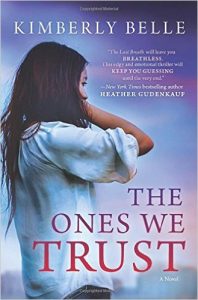
    The Ones We Trust, Kimberly Belle, Award-Winning MIRA Author, Multi-Margie-Grad

    1. Gabe’s good looks are real and rugged and raw, and now that I’ve seen both brothers up close, I’d choose Gabe over Zach any day.
    RD Combo: Polysyndeton (multiple conjunctions, no punctuation) and Alliteration

    2. The silence that spins out lasts forever. It’s the kind of silence that wraps around you like a shroud, the kind that turns the air thick and solid, the kind that makes you want to hear the answer as much as you dread it.

    Kimberly Belle could have written: The room went silent.

    I’m glad she decided to empower that emotionally-loaded scene dynamic.

    Rhetorical Devices: Amplification (silence) and anaphora (the kind, the kind, the kind)

    3. My heart races and my skin tingles and my blood pressure explodes like a grenade.

    Rhetorical Devices: Three visceral responses are powered with polysyndeton (multiple conjunctions, no punctuation) and a simile.

    The Blessing of No, Megan Menard, Multi-Margie-Grad

    1. Luke had a machine-gun laugh that fired about every third word.
    1. I picked up a French fry. It was a slender blonde, tall and weepy. I named the fry Tanya and chomped off its head.

    Those examples carry interest and power and are perfectly cadenced. The second example uses a metaphor and structural parallelism. It reveals a truth in a humor hit that could make us laugh or cry.

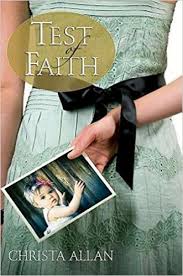
    Test of Faith, Christa Allan, Award-Winning Author, Multi-Margie-Grad 

    1. “If. Faith. Can. Come. Live. With Me?” I heaved every word out of my brain and into my mouth. I felt like someone regaining consciousness in an unfamiliar room or house or life.
    Christa Allan stylized that dialogue by using a Period. Infused. Sentence. That’s what I named it. Her dialogue cue is amplified, amplified, amplified stellar.
    She used an RD combo in the last sentence: polysyndeton and zeugma.

    What’s zeugma?

    I’ll SHOW not TELL. I know you’ll get it.

    My teaching-zeugma sentence:

    Margie grabbed her purse, her keys, and her steely resolve.

    You got it!

    This 2-point version is an example of zeugma too:

    Margie grabbed her purse and her steely resolve.

    Now you know the rhetorical device zeugma.

    1. This dinner was the Indy 500 version of returning to the track after a pit stop, except that the finish line was Logan, and there was only one first place.

    Ah… Metaphors and power words and hope all themed, propelled by a compelling cadence.

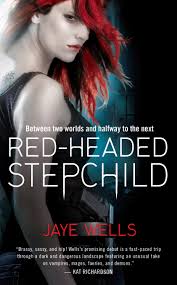
    Red-Headed Stepchild, Jaye Wells, USA Today Bestseller

    Jaye Wells wrote this paragraph when she was in a full day workshop I taught for Dallas Area Romance Authors in 2007. I asked all the participants to write an example of anaphora.

    Anaphora — Repeating a word or phrase at the beginning of three or more successive phrases or clauses or sentences. The first three must be in a row.

    The paragraph she wrote in class became the first paragraph in the first chapter of Red-Headed Stepchild, her debut Urban Fantasy.

    Digging graves is hell on a manicure, but I was taught good vampires clean up after every meal. So I ignored the chipped onyx polish. I ignored the dirt caked under my nails. I ignored my palms, rubbed raw and blistering. And when a snapping twig announced David’s arrival, I ignored him too.

    Deep Edit Analysis:

    Anaphora: I ignored, I ignored, I ignored, I ignored

    Three Humor Hits:

      • Digging graves is hell on a manicure
      • good vampires clean up after every meal
      • I ignored him too

    Power Words — Words that carry psychological power: graves, hell, vampires, clean up, ignored, ignored, dirt, ignored, raw, blistering, arrival, ignored him

    What does the reader learn in those 53 words?

    1. She’s digging a grave. We can infer she killed someone.
    2. She’s a vampire.
    3. She gets manicures.
    4. She’s Goth.
    5. She’s been digging that grave for a while.

    She’s not concerned about David catching her digging a grave.

    In that one short, opening paragraph, Jaye Wells deepened characterization, shared a strong and fun voice, and made the reader want to read more. That’s smart writing. The kind that impresses agents and editors and readers and reviewers.

    Every example in this blog carries a compelling cadence. That pleasing cadence speaks to the reader’s subconscious. Cadence has the same impact on the reader that a movie sound track has on a viewer.

    Read the first sentence of this blog OUT LOUD:

                Reading a book with flat-lined cadence is like watching a movie on mute.

    Do you hear those perfect beats?

    I could have written:

                It is critical to pay attention to cadence.

    No cadence-driven power.

    Deep Editing Caveat:  Most of the examples I shared in this blog were amplified. I’m not suggesting that every sentence should be powered up, or made special in some way. That would be gagifying. 

    Not a word. But it carries the punch I wanted to share.

    We need plain writing. Writing that does its job without any amplification.

    We need fun, quirky, deep, stylistic, and tug-your-heart writing too.

    I teach writers how to add psychological power to their writing in hundreds of ways. No hype. No hyperbole. I’m just sharing what I do.

    I’m a psychologist-turned-editor. I used my psychological expertise to analyze more passages and chapters than most people read in ten lifetimes. I developed deep editing techniques that help writers add power to each paragraph.

    I teach writers how to empower emotions.

    How to avoid clichés and clichéd phrasing.

    How to write fresh faces and voices and visceral responses.

    How to use advanced stimulus-response patterns.

    How to use my Four Levels of Powering Up Emotion. How to have the right emotional intensity in the right place.

    How to create emotional authenticity on the page. How a character can act in an out-of-character way, and get the reader to buy it.

    How to use six rhetorical devices to finesse backstory. Succinct, unskimmable, beautifully cadenced backstory.

    How to use my 20 Point Checklist for Openings, my 15 Point Checklist for Endings, my 12 Visceral Rules for Fiction Writers, my 10 Gems for Not Writing Your Mama’s Character Descriptions, and more.

    How to deep edit analyze your scenes. I developed The EDITS System so writers can see what’s working, what’s not working, and what’s missing.

    I created seven online courses for writers:

    1. Empowering Characters’ Emotions
    2. Deep Editing, Rhetorical Devices, and More
    3. Writing Body Language and Dialogue Cues Like a Psychologist
    4. Defeat Self-Defeating Behaviors
    5. A Deep Editing Guide to Make Your Openings Pop
    6. Visceral Rules: Beyond Hammering Hearts
    7. Fab 30: Advanced Deep Editing, A Master Class

    The first four classes each have 250+ pages of lectures. The next three classes have 180 – 230 pages of lectures.

    I used to teach college. Graduate level psychology courses. I back up every teaching point with plenty of examples from a variety of genres.

    I shared a few of the twenty rhetorical devices I teach fiction writers here. I’ll cover all twenty in about 75 minutes in my full day master class. Some, like polysyndeton (…photographed and bagged and carried away…, The Last Breath, Kimberly Belle) may be new to you, but they’re easy to learn, and use. Handouts help.

    I’m looking forward to having fun in my Master Class on March 30. Join me, and you’ll leave with deep editing tips and techniques that will add power to your WIP.


    About Margie

    Margie Lawson —editor, and international presenter – teaches writers how to use her psychologically-based editing systems and deep editing techniques to create page-turners.

    Margie has presented over a hundred fifty full day master classes in the U.S., Canada, Australia, and New Zealand. Writers credit her innovative deep editing approaches with taking their writing to publication, awards, and bestseller lists.

    Margie developed seven online courses she teaches through Lawson Writer’s Academy on her website. LWA has over 30 instructors and offers five courses most months.

    Margie also teaches fifteen 5-day Immersion Master Classes a year. Enrollment is limited to seven. In 2017 she’s teaching Immersions in Atlanta, Denver, Dallas, Amarillo, Calgary, Washington D.C., and in Melbourne, Sydney, Brisbane, Coffs Harbour, Canberra, and Hobart, Australia.

    What’s the Buzz? 

    Randy Ingermanson, Ph. D., award-winning author of Writing Fiction for Dummies:

    In the twenty years I’ve been writing fiction, two teachers have astounded me with their insights and taught me something radically new: Dwight Swain and Margie Lawson. Margie taught me new ways to empower my writing.

    Melanie Milburne, USA Today Bestseller

    I had 40 books published before I met Margie Lawson. It wasn’t until I started using her deep editing techniques that I won several writing awards. I have a library of how-to books, but none top Margie’s expertise.

    Laura Drake, RITA Winner, The Sweet Spot

    When I took my first Margie Lawson class, the paradigm shift I experienced was more like an earthquake — I saw everything differently. I took more of her classes and I got a three book deal with Grand Central. A few months later I got a contract for a fourth book. Several months after that, I got contracted for three more books! I sold seven books in fifteen months—before my first book was released. I have Margie to thank for teaching me how to deep edit to get power on every page.

    Allison Brennan, NYT Bestseller:

    Margie Lawson, a brilliant psychologist, teaches a class on editing that, ahem, truly tested me. She uses color-coding to dissect writing in order to empower your stories. I learned from Margie how to fix my prose. I think about her editing system and techniques, ways to add power, finding the emotional key of the scene. I use her lessons to add power to my writing.

    Romily Bernard, RITA Winner, Find Me

    Your classes (both online and at the Georgia writing conference) changed my life!! My YA debut sold in a three-book, pre-empt to Harper Collins. Phoebe was so very complimentary about the way I render emotion and tension on the page and I know I have you to thank!

    Alex Ratcliff, Daphne Finalist

    Margie’s online courses and Immersion Master Class have strapped me into a skill-building machine for writers. With her help, in one year I moved from a can’t-write-a-fresh-line beginner to a Daphne finalist. Wow!

    Karin Tabke, Bestselling author

    I had so many epiphany moments Saturday my head was twitching. It’s still twitching! I wish I had attended Margie’s Empowering Characters’ Emotions master class earlier. My writing is stronger, more vivid, more emotional. The effects of the workshop were immediate. I highly recommend if you have the opportunity to take Margie’s workshop in person, do it.

    Colleen Coble, CEO of ACFW and Bestselling author

    “The workshop I went to last month was the best I’ve ever been to, bar none. And I’ve been to plenty. Margie’s workshop was so awesome, I’m going over my notes from what she taught before I start my next book. She’s a genius, pure and simple.”

    Elizabeth Essex, RITA Finalist, The Danger of Desire

    I’ve attended one of Margie’s all-day seminars, taken all her online classes; attended her workshops at RWA conferences, flown to Colorado to attend her four-day Immersion class, and hosted an Immersion class in Dallas. Margie taught me to challenge and push myself to make the hard changes from the first page of a manuscript until the very last. Working with Margie, you’ll have the tools to make every single word count.

    Comment Contest Details

    Post a comment and you have TWO CHANCES to WIN a lecture packet!

    You’ll win the lectures (250+ pages) from one of Margie Lawson’s online courses listed here:

    1. Empowering Characters’ Emotions
    1. Deep Editing, Rhetorical Devices, and More
    1. Writing Body Language and Dialogue Cues Like a Psychologist

    The drawings will be Sunday, Feb. 5th, 8:00 PM Mountain Time.  

    Drawing reschedule due to SUPERBOWL! Time extended until Thursday, Feb. 9, 2017 at 6 p.m. PST.

    The winners names will be posted here.

    See you on the blog!

    KEEP SCROLLING DOWN UNTIL YOU GET TO THE COMMENTS SECTION ON THIS PAGE (the place to leave your comments for Margie’s  contest).  

    All smiles…………….Margie