CHANTICLEER 10 QUESTION AUTHOR INTERVIEW SERIES
with Award-Winning Author, Steven Mayfield
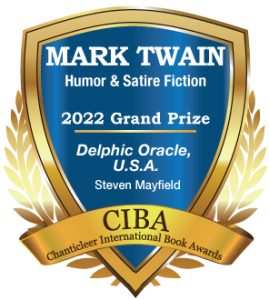 Happy Summer Chanticleerians! We’re thrilled to bring you another fantastic interview with Humor & Satire Grand Prize Winner Steven Mayfield!
From writing “bad poetry” at age nine to authoring award-winning novels, Steven Mayfield has taken quite the journey—including a two-decade detour through medical school and scientific writing. Here, he shares how that medical training actually made his fiction stronger, where he finds his story ideas (hint: be careful what you say around him!), and why he believes readers should give stories more than just one page to capture their attention.
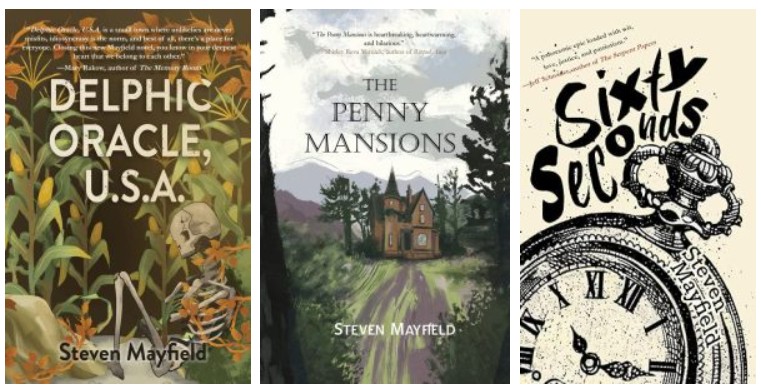
While Mayfield won the Humor & Satire Grand Prize for his book Delphic Oracle, he also received Chanticleer recognition for his book The Penny Mansions, and his new book Sixty Seconds is available now!

Chanti: Steven, let’s start at the very beginning. Can you tell us a little about yourself and how your writing journey first began?
Mayfield: I began writing bad poetry when I was nine years old and started a novel at twelve. I drew from that history to create the protagonist of my next book. He also starts a novel at a tender age, which he describes it as “plagiarism by paraphrase.” That pretty much nails my early efforts, as well. In college and for a couple of years afterward, I wrote more poetry and short stories, began another novel, and wrote sketch comedy. I then gave up creative writing and went to medical school. Over the next two decades I authored or co-authored a number of medical and scientific pieces, and as a result, when I resumed writing fiction in the early ’90s, my work was tighter and more disciplined. I’ve been solely a writer for the last twenty years.

Chanti: That’s such an interesting path from medicine back to creative writing! There’s often a moment when writers truly believe they can do this professionally. When did that realization hit for you—when did you truly believe you were an author?
Mayfield: For me, the question is “When did I believe I could write?” After completing a sophomore college assignment to write a book review, the professor asked me if I’d ever thought about writing as a profession. I had but didn’t think it realistic until that moment. A year later, one of my short stories won the Mari Sandoz competition. After that, I always thought of myself as a writer, regardless of what I did to make a living.
Chanti: The support from our educators can truly be all it takes to have that pivotal moment. Your background in medical writing is fascinating. Do you find that scientific training makes you more of a rule-follower, or do you like to break the conventional writing rules?
Mayfield: Writing for the scientific and medical literature forced me to strictly adhere to rules of grammar and syntax. As a result I think it’s important to know those rules so that when you break them, it’s for a reason; e.g. using sentence fragments for emphasis or rhythm.

Chanti: That’s such a smart approach—knowing the rules so you can break them intentionally. I’m curious about your creative process. Where do your story ideas come from? How do you find those sparks of inspiration?
Mayfield: I shamelessly exploit things people say or do. I’m being flippant but not entirely inaccurate. I wrote Treasure of the Blue Whale (Regal House 2020) after some friends told me an apochryphal story over dinner about the alleged discovery of whale ambergris on a beach in Northern California back in the 1920s; The Penny Mansions (Regal House 2023) was inspired by the Italian towns that are trying to stabilize their populations by offering one Euro houses for renovation; and Sixty Seconds (Regal House, July 2025) was prompted after I saw the movie, A Royal Night Out. My current work-in-progress, “The Bank House, was born from a conversation with a neighbor in my old Portland neighborhood who grew up in an Irish village where the bank was part of a residence provided to the bank manager. So…people should be careful about what they say when I’m within earshot. They might end up in a book.
Chanti: I love that you’re constantly mining conversations and experiences for material! When it comes to the actual writing process, how structured are you? Do you have a daily routine or specific approach?
Mayfield: I think I’m fairly structured. When I begin a book, I set up a log to track my daily word counts. I aim for a minimum of 250 words/day, a modest goal, but one that keeps me going on days when I don’t feel inspired. I then try to write every day, beginning by revising what I wrote the previous day and then adding new material. As the story builds, the daily word count builds with it, and once the first draft is done, I have typically averaged about 750 useable words/day.
Chanti: That’s a strong and sustainable approach. Every writer has their literary heroes. Can you share five authors who have really shaped your work and tell us how they’ve influenced your writing?
Mayfield: Muriel Spark: Does more with the simple declarative sentence than anyone I’ve read.
Sinclair Lewis: Unmasks puffery, hypocrisy, and injustice.
Kurt Vonnegut: Gives other writers permission to stray off-point as long as the reader is kept beside you and you don’t waste their time.
Jean Shepherd: Like me, a yarn-spinner.

A cumulative fifth choice comprised of several writers who share my publisher, Regal House: 1. Barbara Quick, whose elegant prose blends history and fiction, 2. Michael Strelow, whose command of language awes me, 3. Richard Martin, whose prose is inimitable, wise, and hilarious, 4. Michael Bourne, who has the ability to make unlikeable protagonists likeable, 5. Mimi Herman who is funny and understands how to mine small towns for literary gold.
Chanti: What a diverse and thoughtful group of influences! I love the shoutout to your follow authors! Writing is definitely a craft that requires constant development. Beyond reading great authors, what do you do to keep growing and sharpening your skills?
Mayfield: I listen when someone gives me feedback. If a reader is lost or bored, it’s my job to fix my work, not their job to guess what I was thinking when I wrote it. It’s also important to read work by other people and to workshop material in progress. I’ve been in the same workshop group for thirty-one years and their input is invaluable.
Chanti: Thirty-one years with the same workshop group is incredible dedication! What exciting projects are you working on now? What can your readers look forward to seeing from you next?
Mayfield: I’ve been engaged in final editing and pre-release marketing for Sixty Seconds (Regal House, July 2025) and I’ve just finished a sixth draft of a new novel, The Bank House. It follows a few months in the life of a thirteen-year-old boy who moves to a new town where his family will live in a former mansion that now has a bank in its living room. It’s a coming-of-age novel with my usual brand: heart, humor, and a dash of crime. I’m hoping for a spring/summer 2027 release.

Chanti: The Bank House sounds absolutely intriguing, and I’m looking forward to reading Sixty Seconds now that it’s come out. You mentioned earlier that it’s the writer’s job to make things clear to the reader, but what is the most important thing a reader can do to support a writer they enjoy?
Mayfield: Give us a chance. Agents would have us believe that a reader must be captured in the first page, but that’s marketing advice and doesn’t necessarily relate to good story-telling. It took me 100 pages to get into A Soldier in the Great War by Mark Helprin, one of my favorite books.
Chanti: That’s such wise advice about patience with storytelling! Finally, on a more personal note—what excites you most about the actual process of writing?
Mayfield: I can create a world where everyone does exactly what I want. Such power has always been restorative, but in our present climate of political chaos and heartlessness, it’s better and far cheaper than psychotherapy.
 Steven Mayfield is a past recipient of the Mari Sandoz Prize for Fiction and the author of over fifty scientific and literary publications. After a short stint as a sketch writer in Los Angeles, he attended medical school at the University of Nebraska followed by post-doctoral training and teaching/research appointments at the University of Iowa, Brown University Program in Medicine, and the University of Texas Southwestern in Dallas. After a hiatus away from creative writing that lasted almost twenty years—during which he published forty-two scientific articles, abstracts, chapters, and reviews—Steven began to again write fiction in 1993 with short stories appearing in literary journals and anthologies since 1994. He retired from medicine in 2004 and spent several years working as a free-lance editor before publishing Howling at the Moon in 2010 (Mount Parnassus Press). Regal House has been his publishing home since 2020 for three novels: Treasure of the Blue Whale (2020), Delphic Oracle, U.S.A. (2022), and The Penny Mansions (2023). A fourth novel, Sixty Seconds, is out now from Regal House!.
Steven’s books have been honored with numerous awards, including an IBPA Benjamin Franklin Silver Medal, a CIBA Mark Twain Book Awards Grand Prize ribbon, and an Independent Publishers Group Gold Medal. His last three novels were all Foreword Indies Finalists.
Steven currently resides in Oregon with his wife, Pam. He can order beer in four languages. His wife can say, “Pay no attention to this man” in five.