Celebrating the 12 Days of Christmas – One Day at a Time
On the Third Day of Christmas, Chanticleer brings to me…
Three Types of Edits!
Chanticleer is here for you! We offer three different types of editing services to help you get your book to the finish line.
Line Editing
If your story still has developmental issues (dialogue, plotting, character development, etc.), your work would benefit from a Line Edit. Line Editing is a line-by-line edit to make sure that each sentence pushes the story forward and creates just the right amount of pacing and tension. Each and every word should count! This is a collaborative edit that is done with the author in approximate chunks of seventy pages at a time.
Line Edit Review is a final check that all issues and concerns have been addressed by the author and that new problems have not been created in the reworking of the manuscript.
Copyediting includes Style Sheet Generation
Copyediting is a mechanical edit. It focuses on grammar, punctuation, spelling, typos, continuity errors, and timeline errors. A Style Sheet Guide is created that is the basis of your story-bible. The Style Sheet Guide will ensure that your characters’ names, place names, conventions (examples are: Happy Christmas instead of Merry Christmas or blond or blonde or using kilometers instead of miles), jargon, pet names, time frame, and more — the attention to detail that will set your work apart from the fray.
Proofreading
Proofreading with a third set of fresh eyes is the final reading to catch the inevitable typos and glitches. The Style Sheet generated by copyedit will used in the final proofing of the work. After proofreading, your manuscript is ready for formatting. Formatting is determined by the publishing platform.
And just for FUN, a humorous and clever YouTube video about Editing from Elle Cordova –
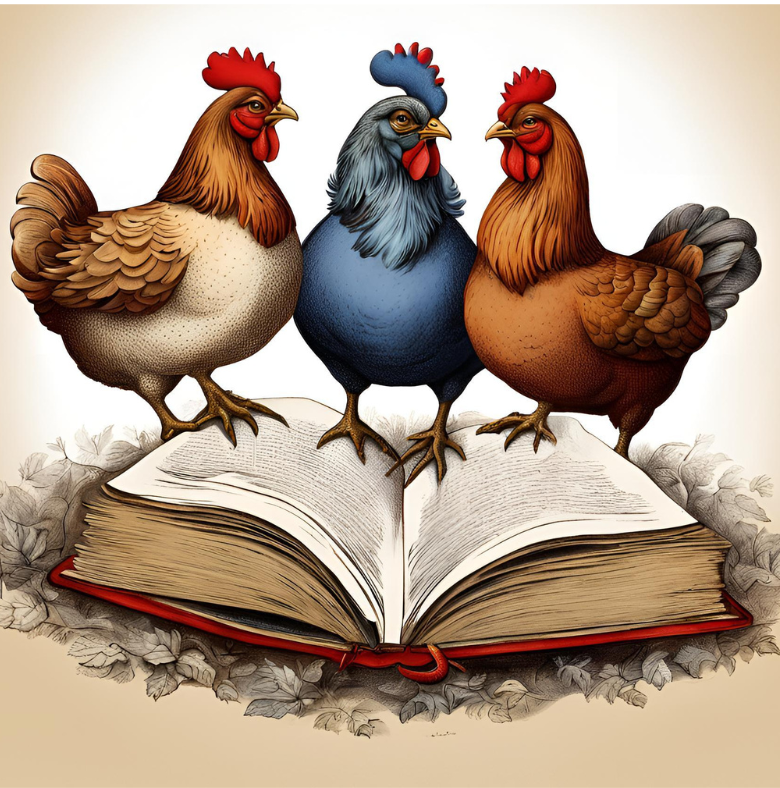
The Three French Hens gifted on this day represent Faith, Hope, and Love.
“But Jiminy Crickets, it’s after December 25th! Is it not too late for the 12 Days of Christmas?” you say.
Not to fear, Chanticleerians! The 12 Days of Christmas begins on December 26th! And it continues to the 6th of January – Three Kings Day. The 24 days leading up to Christmas are known as Advent.
Some say that December 25th is the first day of Christmas, but we are going with the medieval date of the 26th because revelry could not take place on the 25th as it was a holy day. And the Twelve Days of Christmas are all about revelry!
So if you haven’t finished wrapping presents, sending out those cards, and baking cookies—don’t worry. Just get it done—you’ve got nine days!
Happy Holidays to You from the Chanticleer Team!
On the 3rd day of Christmas, my true love sent to me
Three French Hens
Two Turtle Doves
And a Partridge in a Pear Tree
The Third Day of Christmas
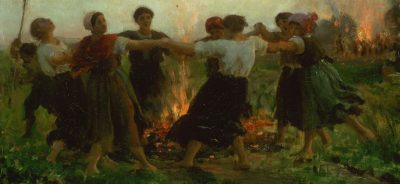
The Third Day of Christmas celebrates the Feast of St. John who drank a glass of poisoned wine and didn’t get sick! Many EU countries celebrate the Feast of St. John during the longest days of Summer (June 24th) by dancing around a fire. The best way to celebrate? Drink a lot of wine! Of course, if you have a different preferred beverage, that’s totally alright. We’ve been enjoying TÖST, a non-alcoholic wine recently.
The Feast of Saint John, by Jules Breton, c. 1875
Stay tuned for the 4th Day of Christmas!
Our favorite part about having the 12 Days of Christmas is that we can have the time we need to celebrate with our loved ones. We have time for wrapping presents, meeting with friends for hot cocoa, and continuing to prepare the Chanticleer Authors Conference and the 2023 CIBA Banquet and Ceremony.
Wishing you Happy Holidays from Chanticleer from Kiffer, David, Dena, Scott, Anya, and Argus!
Jennifer entered Mr. Hostler’s home, finding herself in an empty white room.
“Where’s your furniture?” she asked.
Mr. Hostler cocked a brow. “You don’t need chairs to talk, Ms. Trent.”
White Room Syndrome is an ominous name for a common problem in prose writing: the characters are acting, talking, and moving the story forward, but all in a scene that hasn’t been set through description. They’re in an empty white void. Despite the name, a literal white room is not required.
Chances are good you’ve seen White Room Syndrome at some point in your own writing, where an old friend’s attic, the car of a speeding train, or even the great outdoors aren’t described to the reader beyond those broad descriptions.
So, how do you paint a scene? Well, you can’t include every single detail about the locations your characters go to, not without sacrificing any hope of good pacing – or readers finishing your book. So, I’m going to go over five critical lenses you can use to figure out which aspects of a setting are most valuable to the story: The lenses of clarity, character, tone, imagination, and pacing.
First, the lens of clarity; you must construct the world to seem cohesive.
“Then where am I supposed to put this?” Jennifer demanded, shaking her sodden umbrella.
Mr. Hostler took it from her. “First, you ought to close it. You certainly don’t need any more bad luck. And, where else would it go?” He set it carefully in the umbrella stand.
“Hey! Where did that come from–”
“Why, it’s always been there. We live in a rainy city after all,” Mr. Hostler said.
Oh that’s where I left that!
Without a scene set in your reader’s mind, the actions of your characters will be harder to imagine, and immersion will suffer. Description bears much of the responsibility for maintaining continuity in your story, both at a small scale and a large one.
Focus on the specifics of your setting.
If your story is set in a desert town, then perhaps a room is filled with the hum of air conditioning, while sunlight bathes everything near the windows.
These small details will become part of your readers’ gestalt image of this town and its environment. So, rather than having a character comment on the heat of their city, you can simply let the dry stretch of sand, pitcher of ice water on the table, or faint smell of sweat comment on it instead. What an average person’s house looks, sounds, and smells like can tell you a lot about a town, from weather to economics to culture.
Building the world, piece by piece
On the smaller scale, try to describe important details for the actions of the coming scene.
If someone is going to lunge across their desk, then take a moment to describe that desk as the scene opens on the room around it. What’s going to fall and clatter to the floor? If one of your characters is worn down after a long day of work, about to have an argument with their inconsiderate partner, you might describe the car in the driveway that one of them will later angrily drive off in. Remember the principle of setup and payoff: willing suspension of disbelief thrives when important details are established before they come into action.
Not all details should be practical building blocks for the beats of a scene. As much as they can reveal the world itself, so can they reveal the people within it.
Consider next the lens of character
A description of a woman with butterflies in her stomach, of possibility in a beautiful world:
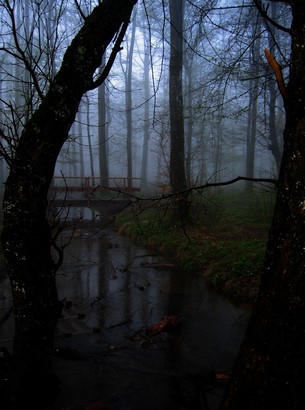
Pink crocuses beckon to the first rays of sunlight, eager on the riverbank. Marie’s fingers explored the spirals and stripes of the railing. To where did they all lead? On the far end of the bridge, a wooden board creaked faintly beneath Rona’s familiar blue boots as she stopped a few feet away. She seemed to belong on the bridge’s rising arch. Cool, piney air filled Marie’s chest.
You could fall in love here
A description of a woman who’s probably going to go missing in about two pages:
Dark green roots slithered out from the riverbank, disappearing beneath murk and silt. Marie’s every step was interrogated by the stark light of dawn. She traced the spirals of the wooden railing, but her fingers never quite escaped the splintery prodding of their coils. A sharp whine cut through the air, and Marie’s eyes darted up to find Rona, standing not but a few feet from her. Those heavy boots, sagging jacket, and long, flat hair all seemed to whisper that only a few old planks separated Marie from the sinking grip of the river.
Not a place to go walking alone
Because of the tone set by these descriptions, the conversation between these characters will have a strong foundation, with words that would otherwise mean very little now being heavy with implication (for better or for worse). Choose those details which tighten tension and keep your readers excited to see how this scene plays out.
This is a great time to employ sensory description beyond sight and sound. Yeasty baking bread, the calloused fingers of mountain wind on exposed skin, a disappointingly-unsweet taste of fresh cherry sap – details like these put your readers into the bodies of your characters, a powerful tool for establishing the emotional shade of a scene.
To spark imagination, use a lens of specificity
Find the balance of trusting your reader and showing them your world.
It’s not just a sunny day – the sun sears white even the empty sky around it. What can you describe in ten words that says a thousand about your setting? What could your character have on their desk that shows the fear seeded deep in their bones? How should the light fall in the old church, to make clear that something is very, very wrong in this town? These evocative details act as foundations, allowing readers to fill in the empty space without even realizing they’re doing it.
Give them enough of a groundwork to understand how a location feels, show them the striking details, but don’t spell out every mundane element of someone’s kitchen.
No hard and fast rules
These lenses aren’t requirements for every scene, especially as you’re drafting (consider this article by Michelle Rene on Write Fast, Edit Slow.) Lenses are useful tools for when you’re editing your work, thinking about what each line of description is supposed to do for your story.
Does it accomplish its goal?
Would something else be stronger in its place?
Could combine two lines into a single, more evocative one?
If you don’t know what color to paint your white room, try these lenses, and see what they can show you about the walls of your story.
Chanticleer Editorial Services – when you are ready
Did you know that Chanticleer offers editorial services?
We do and have been doing so since 2011.
Tools of the Editing Trade
Our professional editors are top-notch and are experts in the Chicago Manual of Style. They have and are working for the top publishing houses (TOR, McMillian, Thomas Mercer, Penguin Random House, Simon Schuster, etc.).
If you would like more information, we invite you to email Kiffer or Sharon at KBrown@ChantiReviews.com or SAnderson@ChantiReviews.com for more information, testimonials, and fees.
We work with a small number of exclusive clients who want to collaborate with our team of top-editors on an on-going basis.Contact us today!
Chanticleer Editorial Services also offers writing craft sessions and masterclasses. Sign up to find out where, when, and how sessions being held.
Thank you for reading this ENCORE Chanticleer Writer’s Toolbox article.
Scott Taylor – Editorial Assistant
Scott has worked as a book editor since 2020, with a BA in English & Writing from The Evergreen State College.
He facilitates a small writing critique group, and serves as an editor on the biennial anthology The Writer’s Corner. Scott’s book reviews feature on the Chanticleer Book Reviews website. His own writing centers on speculative and surreal fiction, from sci-fi & fantasy to magical realism, and has been published in the HamLit literary journal.
Beyond working on novels and short stories, Scott explores other media and modes of narrative, such as playwriting, tabletop game design, and music composition. He finds moving from one medium to another offers inspiration that feeds back into his prose work.
You’ve finished your first work in progress, and written those fateful words: THE END. Then, like a good writer, you revise it, one, two, seven, eight times! You’ve spent well over a year with the work, and you’re either ready to begin querying or you’ve decided that you don’t want to deal with the gatekeepers in the publishing industry. Whichever describes you, your book is ready to see the world!
The many hats worn by authors
Or is it?
Here are some questions (but certainly not all) to ask yourself before you publish your work:
Have you asked a professional to look your work over?
Have you considered how you’re going to format the interior?
What are you going to do for cover design?
What medium do you want to publish in? Physical, ebook, audio?
What company do you want to use to publish your work?
How will you market your book?
It’s too much!
If that feels overwhelming, there’s a reasonable explanation. Publishing is a business, and a different person is often paid to help answer each of these questions in a traditional publishing environment. Self-Published Authors frequently serve as their own project manager, meaning they are the head editor, publisher, marketer, and designer for their book. Don’t be afraid to set ambitious goals, and also remember to be gentle with yourself as this process takes serious time.
We’re going to make two basic assumptions going forward: 1. You want an ISBN, and 2. You’re doing this because you have the budget to do so.
Now, let’s start with the first bullet point on the list.
Having a Professional Review Your Book
The Overview
One of the biggest issues we come across with books is that there’s no story. The writing is crisp, clean, even gorgeous, but the most that can be said for the novel is it’s well-written. The plot does not compel and the characters do not drive. In the words of Anne Lamott:
“Any plot you impose on your characters will be onomatopoetic: PLOT.”
For those reasons, we recommend having a Manuscript Overview first, whether you receive that from us or from someone else. Professionals who understand the writing industry and work with publishers are uniquely situated to give you feedback on whether or not you have a story that people will want to read and buy.
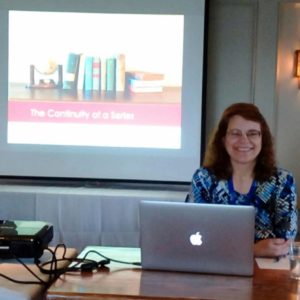
Kiffer Brown with an overview presentation
A good Manuscript Overview will examine the following:
Compelling nature of story
Dialogue
Character development
Does the scenery and setting work with the story
Backstory issues
Professionalism of editing & formatting
Continuity of storyline
Plotting and plot-hole issues
Writing craft
This stage comes before line and copyediting, as you still have plenty of work to do in bringing the work up to being the best it can be. You can read more about our suggestions surrounding Manuscript Overviews here.
Line Editing, Copy Editing, and Proof Reading
While we have all the general information about this on our Editorial Services page, those thoughts and definitions are worth repeating here. Our Editorial Coordinator can discuss with you about whether or not your work needs more development before moving onto the next stage in editing.
Line Edit
If your story still has developmental issues (dialogue, plotting, character development, etc.), your work would benefit from a Line Edit. Line Editing is a line-by-line edit to make sure that each sentence pushes the story forward and creates just the right amount of pacing and tension. Each and every word should count!
Line Edit Review is a final check that all issues and concerns have been addressed by the author and that new problems have not been created in the reworking of the manuscript.
Copy Edit
WorldKeeper Diane Garland always has excellent suggestions to track your story
We highly suggest that you have a Style Sheet Guide created that is the basis of your story-bible. A Style Sheet Guide will ensure that your characters’ names, place names, conventions (examples are: Happy Christmas instead of Merry Christmas or blond or blonde or using kilometers instead of miles), jargon, pet names, time frame, and more — the attention to detail that will set your work apart from the fray.
After reworking the manuscript and addressing the editor’s suggestions, then the work should be ready for a Copy Edit with an editor with fresh eyes.
Copyediting is a mechanical edit. It focuses on grammar, punctuation, spelling, typos, continuity errors, and timeline errors.
If a Style Sheet has been generated, then the manuscript will be edited using it to ensure consistency.
Proof Read
A proof read with a third set of fresh eyes is the final reading to catch the inevitable typos and glitches.
If a Style Sheet was generated prior to the copy edit, then it will be used in the final proofing of the work.
Proofing comes before formatting. Formatting is determined by the publishing platform.
As we get into the nitty gritty details of proof reading, that’s a good time to examine the often forgotten question of formatting.
Professional Touch
Call in the pros!
Many authors rightly find themselves wrapped up in the joys and beauty of their work. This devotion to writing is what makes them so good at what they do, and it is important to have an outside, less biased perspective to help you along. Often a key part of a story or character exists only in the author’s mind, and somehow it never found its way onto the page. Hiring extra eyes really can make the difference when it comes to your book being excellent as opposed to just another of the millions of published titles a year.
That’s all the time we have for this article. We’ve covered the importance of having professional eyes on your book. In a future article we’ll look at:
Interior Format
Cover Design
Mediums of Publishing
Self-Publishing Companies
Marketing
Stay tuned!
Thank you for joining us for this Writer’s Toolbox Article!
Our 12th Anniversary Chanticleer Authors Conference (CAC24) will be April 18-21, 2024, where our 2023 CIBA winners will be announced. Space is limited and seats are already filling up, so sign up today! CAC24 and the CIBA Ceremonies will be hosted in Beautiful Bellingham, Wash. Sign up and see the latest updates here!
When you’re ready,did you know that Chanticleer offers editorial services?We do and have been doing so since 2011.
Our professional editors are top-notch and are experts in the Chicago Manual of Style. They have and are working for the top publishing houses (TOR, McMillian, Thomas Mercer, Penguin Random House, Simon Schuster, etc.).
If you would like more information, we invite you to email Kiffer or David at KBrown@ChantiReviews.com or DBeaumier@ChantiReviews.com for more information, testimonials, and fees.
We work with a small number of exclusive clients who want to collaborate with our team of top-editors on an on-going basis.Contact us today!
Chanticleer Editorial Services also offers writing craft sessions and masterclasses. Sign up to find out where, when, and how sessions being held.
A great way to get started is with our manuscript evaluation service, with more information availablehere.
And we do editorial consultations for $75. Learn morehere.
If you’re confident in your book, consider submitting it for a Editorial Book Reviewhereor to one of our Chanticleer International Awardshere.
Writer’s Toolbox
Thank you for reading this Chanticleer Writer Resolutions article.