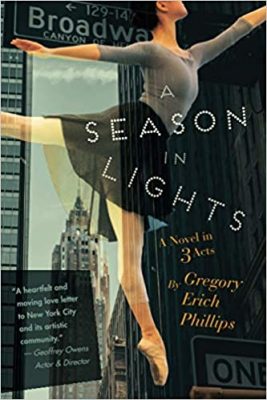
 Gregory Erich Phillips’ A Season in Lights is a well-crafted, engaging exploration of creatives, each following their heart and trying to reach their dream.
Against backdrops of the 1980s AIDS crisis and the more recent COVID-19 pandemic, the story entwines the lives of a 30-something dancer and an older musician as they strive to make their artistic mark in the cultural capital of New York City.
Here in a two-fold unveiling, the story comes to life from the first-person perspective of Cammie, a starry-eyed aspiring dancer from Lancaster, PA, and the third-person reveal of Tom, a more seasoned black pianist. He longs for a classical career but is too often labeled a jazz musician. Cammie first encounters Tom in a studio dance class where he’s taken a job as the musical accompanist. Befriended by the gay dance instructor, Tom heeds the worldly advice offered about surviving in the Big Apple. “All you’ve got to do is convince people that you belong. You’ve got to tell them who you are before they tell you.”
Phillips’ masterful narrative is layered with a backstory for each character, with details revealing multi-dimensional individuals.
Small town Cammie is close to her ailing father; she has a troubled yet artistically talented sister; and a mother who seems to carry everyone’s burdens. Cammie harbors guilt for leaving behind family obligations to follow her own path. Tom has tried to leave behind his own familial ties. Unfortunately, with an absent father who landed in prison for dealing drugs, and an older brother who seems headed in a similar direction, Tom is hesitant about the consequential outcome of such connections. Within their May/December style romance, these primary characters find solace and understanding with relatable family concerns and the need to venture beyond expectations and comfort zones.
As a dancer and musician himself, Phillips clearly draws on his own knowledge and experience to render authentic, believable characters in his writing. Here, personal experience from the NY stage easily translates to the page. Capturing the lighted spectrum of Broadway, the back alley theaters, and side-street clubs, the city becomes a character unto itself. The city seems alive as a place for second chances with its vibrant electric pulse.
In a nod to Broadway, Phillips presents his novel in three acts.
While the overall narrative effortlessly alternates between earlier times and the present day, the trio of segments maintains an appropriate momentum to propel events forward. Whether considering the classic themes of sibling rivalry, racism, and interracial romance, or the more contemporary struggles of theatrical LGBT community prejudice, drug addiction, or the new need for social distancing, the topics are well incorporated throughout the story line.
From the worry and fear showcased in HIV testing and AIDS-related complications ignited in the ’80s to the stress and anxiety of shutdowns, casualties, and the unknowns of the more recent COVID19 virus, Phillips highlights the extraordinary opportunities for friendship and healing. Even though the city and its inhabitants are scarred, the hope remains that New York will rebound. A surprise twist in the book’s final moments sheds a brighter light on the central characters, the NYC community, and the world at large in recognizing that we’re all in this together.
A Season in Lights is a modern-day tale featuring artists, dancers, and musicians and their efforts to honor the famous NY song adage, “If you can make it here, you can make it anywhere.” Through passion, grit, and determination against the odds, the final reveal is a lesson about making the most of the moment. Phillips has done an outstanding job with this creative, literary presentation that will indeed have readers looking for an encore.
A Season in Lights: A Novel in Three Acts by Gregory Erich Phillips won Grand Prize in the CIBA 2020 Somerset Book Awards for Contemporary Literature – and is a novel that comes with high recommendations.



 An intricate mystery set in a small fictional town in northern Michigan, End of the Race is contemporary fiction at its finest. Annika Wolfson is a young mother and accomplished swimmer that has faced adversity in many areas of her life. Growing up in the Berglund household was rarely quiet for Annika because her father struggled with mental health and his unwavering feud against the affluent Wolfson family. Despite the long feud between the two families, Brian Wolfson and Annika bond as kids over swimming and their dream of the Olympics. Fast-forward a handful of years, Brian and Annika are now married and have a daughter. Their dreams of Olympic gold have been close to reality but always just out of reach.




 In a rundown Minneapolis neighborhood, a woman and her three children are shot to death by someone using an automatic weapon. The city is shocked. The police department goes on full alert.

 It’s as if a large chunk of her heart was wrenched away in an instant. Celia’s twin sister died suddenly in a terrible accident. Now Celia is haunted by this dear sister who is gone forever. Moreover, the emotional distance between herself and her parents, the only family that’s left behind, is painful. From her hell on earth, she yearns for her own, Celia’s Heaven, where all could be right again. But the road to Heaven is paved with broken promises and a shattering revelation.

 Who commits a murder in a crowd of a hundred people relaxing in a park, and how did the Agatha Christie Book Club miss the entire thing from only a few feet away? In the trendy Sydney suburb of Balmain, Kat Mumford, social media interior design star, has been murdered during the inaugural Cinema Under the Stars. Her distraught husband, Eliot, is clearly the prime suspect, but at the time of Kat’s strangulation, he is nowhere near her. In fact, no one was sitting near Kat, and the crowd seems to have been so absorbed by the movie, Agatha Christie’s