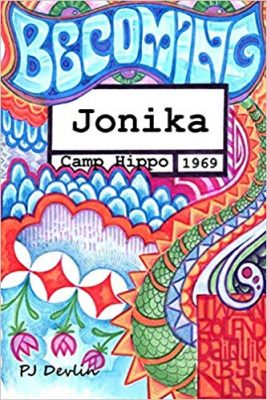
Immersed in the nostalgia of classic summer camp experiences, Becoming Jonika is the coming-of-age story of Joni Byrnes, who, after finding herself on the wrong side of the law, receives a second chance at St. Augustine of Hippo’s summer camp in the trouble-ridden summer of 1969.
Set against the backdrop of the Vietnam War and the aftermath of Martin Luther King Jr.’s assassination, Joni Byrnes is just trying to live a normal teenage life. At the cusp of high school, Joni’s parents send her to Redwood Academy, where they believe Joni will become their ideal daughter. In reality, Joni is quickly labeled by her elite classmates as a loser and an outcast, and the only place Joni feels like herself is in a swimming pool.
One day after practice, she meets Ishmael, who used to be on her neighborhood swim team and is now recently returned home after being discharged from the military. Ishmael treats Joni like she is special, and because of her insecurities and desire to be loved and accepted by others, she falls head-over-heels for him and follows him down a dangerous path that lands her in a courtroom at the mercy of a judge.
Instead of sending her to Juvie, the judge gives Joni the opportunity to make amends. She becomes the swimming instructor at a camp for young African-American children. Becoming an outcast yet again as the only white counselor, Joni learns about of her campers’ and co-counselors’ home lives. She sees their courage and perseverance and tries to move on from her own past; becoming her own person in the face of expanding generational and racial divides.
The hand-drawn look of the cover and the journal-like appearance of the interior create a physical representation of Joni’s report to the judge, pulling readers in and immersing them into the story. The descriptions of the inescapable humidity of summer, the coolness of pool water, and the sweetness of bug juice all feel within reach. In addition to the rich descriptions of Joni’s surroundings, PJ Devlin achieves authentic characterization in the development of Joni and those she encounters throughout the novel.
Joni’s feeling of being an outcast and a loser hits her upon arrival to Camp St. Augustine of Hippo, where she is different in every way from the people around her. In a heart-to-heart with Joni, one of the counselors’ is explicit about what being at camp means, “For us, that’s freedom. For you, camp’s a prison. That’s the difference.”
As the summer progresses, Joni is given the name Jonika and finds herself surrounded by people who like her despite their differences. Jonika describes these feelings in her report, “We were different on the outside but not on the inside.” By summer’s end, she’s uncertain about returning to her old life, but takes courage from the powerful lessons she learned at summer camp. She leaves Joni’s problems and insecurities in the past and instead becomes the person she chooses to be — Jonika.
Becoming Jonika by PJ Devlin won 1st Place in the 2017 Dante Rossetti Awards for Young Adult Fiction.
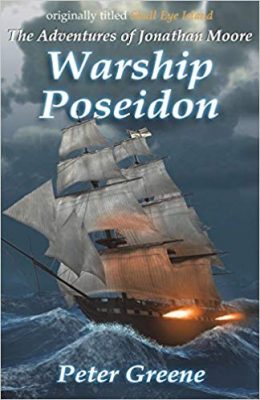
Author Peter Greene often read to his two children at bedtime. But one night, the bookshelf held nothing that enticed them. So, as he explains in the Acknowledgements to this book, he decided to tell them a story. The first words that came out of his mouth were: “Twelve-year-old Jonathan Moore lived in a three-sided wooden box at the end of a dark and filthy alley.” Thus was born the title character of The Adventures of Jonathan Moore, who Greene decided should be “as normal and as human as any real child,” whether in the nineteenth or the twenty-first century.
In England of the early 1800s, help for orphans was the duty of family or church. When twelve-year-old Jonathan Moore’s mother dies, and he hears nothing from his father, a Navy captain, he shuns appealing to either family or church. Thus, he finds himself homeless on the streets of London. Fortunately, he makes friends with a boy of similar age, Irish-born Sean Flagon. Together, the boys manage to sweep enough London chimneys to keep them from starving, until one rainy day when first Sean and then Jonathan are snatched by a group of men and soon find themselves in a cage strapped to a cart headed for the Chatham docks. They’ve been “pressed” into service on one of His Majesty’s warships, the Poseidon, which they soon discover isn’t such a bad lot at all.
The two boys look in awe at the rows of cannon (cannon being both singular and plural in England). And when shown to the closet of a room that is to be their new quarters, they realize that, though tiny, it’s dry, and there are rope hammocks to sleep in, wrapped in blankets. That certainly beats a leaky wooden box in an alley, with a piece of board for a cover. Better yet, they’re soon sitting at tables on the main deck, where hot fish stew is served for dinner (as it is most days, they soon learn), accompanied by hardtack or softtack (hard bread or rolls). The next morning Jonathan awakes to see huge white sails unfurled in the wind. The Poseidon is underway.
Much adventure and not a little danger await them, from one side of the North Atlantic to the other. After all, England is at war against France, and Napoleon Bonaparte has many fine French warships. One of them is the Danielle, which the Poseidon and her crew encounter more than as they make way from Lisbon to the Bahamas.
The aim of both these enemy warships is to search for an ancient Spanish treasure chest, which an equally ancient map indicates is buried on Skull Eye Island. On peaceful days at sea, there are lessons to be learned about being a seaman—taught aboard ship by experienced sailors, junior and senior officers, and even Captain Walker. The boys’ lessons also include fencing and swordsmanship, which stand in good stead when they must battle the French crew aboard the Danielle.
This thrilling tale of high adventure is not without an element of poignancy, however. Jonathan senses that several on board the Poseidon knew or know about his father, Captain Nathaniel Moore, who the boy had assumed was dead. They seemed to recognize him by name, and they treat him with more caring and respect than the other young boys, including his friend Sean. Yet, they consistently change the subject when he tries to question them.
Exciting and fast-moving as Warship Poseidon is, the tale is rendered even better by its author’s skill as a storyteller. Greene has thoroughly researched this era—including its shipbuilding, the administrative management of both English and French Navy vessels, the design of the warships themselves, and how their crews lived aboard them and battled from them. The story is presented in infinite detail, painted in vivid color, and written in a literary style. Much care has gone into the characters’ speech—emulating the language of the time while ensuring that it can be understood by its twenty-first-century readers, whether they be young or old—since this tale is one to be read with pleasure by all generations.
To Peter Greene we would say—in British parlance both then and now—”Huzzah! Huzzah! Huzzah!” So, have great fun reading Warship Poseidon and then proceed without delay to Books Two and Three: Castle of Fire and Paladin’s War. But don’t stop there! Mr. Greene declares there may be a prequel in the works as well as another type of series beginning!
Tom Edwards grew up rough and never lost his yen for travel and new adventures, as shown in this wide-ranging portrait that spans numerous years and continents.
The author depicts himself through the eyes of an omniscient observer, growing up as a sailor’s son in and around the city of Portsmouth, England during the Depression era. Many scenes of his childhood speak to the poverty in which the family, his mother, sister, and brother, lived in as they rarely saw the father/husband who was mostly away at sea.
But the boy never realized they were poor until one Christmas when the better-off folk visited his neighborhood with boxes of fruit, cakes, and toys for the children. Vivid historical touches including everything from famous buildings, castles, and ships in the harbor are wrapped around childhood memories of the flannel vests slaked in camphor that children were forced to wear all winter, to the sports cards sold with cigarettes that children prized, saved, and fought over. Yet despite an absent father and a mother who seemed happy to have the old man gone, Tom chose the seafaring life.
Born in 1929, Tom was accepted at Portsmouth Technical High School, and as the war was ending, he joined the Royal Navy, beginning his roving lifestyle. He was often punished in his training stint for being a daring young man, but he also managed to compete in various sports – swimming, boating, sailing, and once – but only once, boxing.
Stationed in Ireland, he was then transferred to Malta, his first experience of a truly foreign place. That was followed by years in various countries of southern Africa and finally Australia. In those years he was married, twice, had daughters whom he loved but rarely saw as his wife kept returning to England, while he couldn’t bear the boredom of home for long.
He mined for semi-precious gems, learned to fly gliders, played water polo, started a camera magazine, headed a rescue team, battled and won a fight against tuberculosis, worked in a dynamite factory, sailed around the world, and was shipwrecked three times, became a surveyor, a painter and ran art groups in three countries, and immigrated to Australia when independence movements in Africa began to make existence difficult for the former English colonizers.
Edwards is known for his writing, his first book compellingly titled If I Should Die, composed after he joined an anti-terrorist unit in Rhodesia. His prose is colorful and well organized, and his interjections of significant events in the world add a stirring background – the abdication of Edward VIII, the coronation of Elizabeth II, the war and all its terrors told both by the history book and from the observant memory of a growing boy in a critical seaport city. Small details overlap the larger scheme of things, including a great deal of humor surrounding young men’s constant longing for, and occasional securing of, female companionship. He is careful to admit his flaws, such as his weaknesses as a husband, his incurable need to seek new adventures in new climes, and his now waning physical powers after a youth and manhood of grit and occasional glory.
Edwards has made a comfortable name for himself in several spheres and here delivers a memoir that combines the larger historical picture and a plethora of nostalgia, revealing him as both gutsy and tenderhearted.
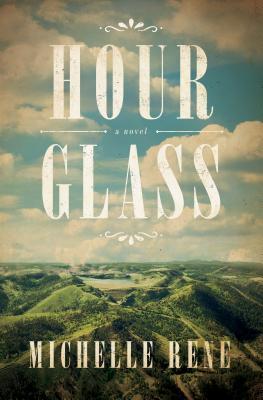
Hour Glass by Michelle Rene is the story of many lives, told through the lens of the young protagonist, Jimmy Glass. In non-linear fashion, Rene begins her story toward the end, when Jimmy and the infamous Calamity Jane once again cross paths. From there the story moves backward—to recount past events and the ways multiple lives are forever entangled. Hour Glass is a novel of strength, sadness, and perseverance.
Jimmy Glass’s father is dying of smallpox. With no options or way to help him at their homestead, Jimmy takes his dad and his younger sister Flower into the closest town—Dead Wood, South Dakota. A mining town is an unforgiving place, but Jimmy and his younger sister are quickly taken in by none other than Calamity Jane herself and a madam named Dora Duffran. The two siblings quickly find a home in the brothel and await news of their father’s health.
As their father’s life teeters on the edge, Jimmy’s dreams are full of visitations by his deceased Lakota stepmother Without Cage. She takes Jimmy to various times in their lives to show him things he needs to see and things he needs to remember.
Hour Glass is a novel driven by a complex cast of characters. There’s Calamity Jane, a belligerent drunkard with a kind heart. Jimmy Glass, a young boy with the burdens of manhood pushed on him far too early. Dora Duffran, the madam with a heart of gold and a spine of steel. Without Cage is seen only through memories, but her unbreakable spirit remains as strong as ever, and her character floats through the novel as any other earthly bound character with whom Rene gifts us.
Then there’s Flower Glass, Jimmy’s younger sister, a girl who many think of as peculiar for her anti-social behavior. She’s taciturn and reserved, dislikes loud noises and being touched, and appears not to pay any attention to what’s going on around her. Jane, however, seems to effortlessly bring Flower, or Hour as she comes to be known, out of her shell when others cannot.
This historical fiction manages to tell the story of many lives through only one character’s voice. Readers will find a sentimental novel that does an impressive job of recounting the meaningful ways in which lives can intersect, however briefly, and cause changes that will last forever.
Hour Glass by Michelle Rene won the 2017 Chanticleer Int’l Book Awards Overall Grand Prize!
Jessica Dainty’s, The Shape of the Atmosphere is remarkable for its startling realism, its gritty young heroine, and its hopeful conclusion.
When Gertie’s father and sister are killed in an accident on Gertie’s sixteenth birthday in 1957, she is left with one cherished memory: viewing the heavens with her father on the night of the world-changing Sputnik flight.
After the funerals, Gertie wounds herself as a way of coping with her inner anguish, after which her alcohol-addicted mother commits her to an insane asylum. Such institutions were considered modern and scientifically advanced for their time, but as author Jessica Dainty frankly depicts, Gertie’s new home is a combination prison and torture chamber. The naïve but intelligent girl soon becomes acquainted with such therapies as immersion in icy cold water and electroshock (both designed to calm the inmates), as she gradually gets to know her fellow patients, the women on Ward 2.
Gertie observes that some of her companions are not mentally ill at all: one has a speech defect that he is struggling on his own to correct, and another has Down Syndrome. Yet such people – anyone not wanted by family – are consigned to such asylums and often get lost in its labyrinthine system. Gertie slowly gains inner resolve, becomes an advocate for her rights and those of her companions, and starts an in-house newsletter that tells their stories. But when her compositions find their way outside the walls of the asylum, she is forced to take even bolder measures.
Dainty writes this traumatizing tale as though she’d lived it, so starkly painful and remarkably poignant are her portraits of Gertie and her fellow sufferers. She portrays the doctors as caring only up to a point, mainly interested in maintaining a full house of captive mental “cases” to keep the income rolling in. One staff member is sympathetic toward Gertie, but most are cold and indifferent, strictly allowing only 3-minute bathroom breaks, a single towel at communal shower times, and almost no time spent unmonitored.
Treatments such as electroshock (Electro Convulsive Therapy, ECT) are performed differently today for the treatment of severe depression, treatment resistant depression, severe mania, catatonia, and agitation and aggression in dementia patients (Mayo Clinic: https://www.mayoclinic.org/tests-procedures/electroconvulsive-therapy/about/pac-20393894), for example. But today, this treatment is done under general anesthesia and at reduced levels. This was not the case in the 1950s or in Dainty’s harrowing novel. ECT was conducted without any form of anesthesia and often without patient’s consent.
Reminiscent of the less enlightened times also is the blatantly denigrating attitude shown towards people of color and other minorities. The author’s descriptions of daily life in a mental institution of the 1950s are filled with scenes of mistreatment tantamount to torture. But many readers will find the story inspiring, especially as Gertie, sustained by images of space travel, finds her own stars to aspire to and reaches out to help others. Debut novelist Dainty is a high school teacher with many points of contact with the teens she hopes to engage with this evocative coming-of-age saga.
I first met Joe Collins at CAC18 this last April. He’s a tall, quiet man who carries himself with a certain nuance, a particular look in his eyes that lets a person know he’s looking for fun. He writes from the heart and although he won 1st Place in the Goethe Awards for 2017, his book could have done just as well in the Laramie Awards.
I am honored that Joe took the time to participate in our 10 Questions Interview Series. He has a lot to say and I hope you enjoy this piece as much as I do.
Let me introduce you to J.R. (Joe) Collins:
Chanticleer: Tell us a little about yourself: How did you start writing?
Collins: I was raised in the Southern Appalachian town of Blairsville, GA. Our whole county had a population of around eight thousand at the time of my birth, 1962. I spent my growing up years helping my father farm beef cattle and attending the local school for my education. I went to church as a kid. Learned a deep respect for a love that would sacrifice itself for me. I believe I was considered normal by the local folks. You knew everybody in my confined, little world, and their business, too, whether you wanted to know it or not. News traveled fast because of how the telephone worked. Most all the homes were on a “party line,” if you had a telephone at all. You knew folks’ business because you could listen in on your neighbor’s phone conversations over that “party line.” The older generation was judgmental to a point. That mattered to families. You didn’t want folks thinking bad of you or yours.
My trail after high school began by following the same path many of the kids from my area walked. College, job, then family. I couldn’t stay on that trail long, though. I discovered competitive golf after a couple years in college and turned pro after obtaining an Associate degree. Spent many years beatin’ that little ball trying to catch a break while working at different golf courses here, there, and yonder. I loved it. Did okay for a small-town, mountain-born boy. I got no regrets. Won a few good tournaments. Maybe I should’ve been a caddie?
Met my wife at the ripe old age of thirty-five. We have two kids, Alex and Emma, they’re twins. Fortunately, we all get along for the most part with little tension outside of normal weekly stress. We like the outdoors but have regrettably had little time over the years to enjoy vacationing there because of work and the crash of the economy. I do regret that.
I started writing because I wanted to tell a story. A story of my heritage to some degree. A story to enlighten those who read it about a frontier that came and went with little recognition outside a state of confusion about the grave mis-justice done to the native Cherokee. I won’t claim all that is in (or will be in) my books as actual, but I can guarantee you they are based on fact in my imagination. I love that about writing. I’ve always enjoyed a good “yarn” be it a ghost story that will haunt my nights, a mystery that challenges my intuition or an adventure that will take me to someplace I may never see. Introduce me to people I would never meet otherwise. It is a true blessing when I learn someone has enjoyed my work. Somebody give me a hug!
Chanticleer: We do love you, Joe! When did you realize you that you were an author?
Collins: That’s an easy one. It’s when I heard my name called out for First in Category at the Chanticleer Awards Gala. I for sure knew I belonged behind the scenes writing when I broke protocol and absent-mindedly went for the ribbon Kiffer was holding without shaking Gregory’s hand first. “What a stupid I am” — I feel terrible about that. I hope he understood. Accepting that ribbon was extra special to me. That’s the moment I knew I could actually think of myself as a writer. Thank you guys soooo much!
Chanticleer: Those of us who have won awards know what it’s like to be in that is-this-really-happening? moment. I’m sure Gregory Erich Phillips knows exactly what that’s like! What genre best describes your work?
Collins: Historical Fiction for sure. I love learning about history that is based in the lives of those who actually lived it. I respect heritage, so I enjoy creating stories combining the two. Those aspects wound together give me great pleasure when I write. My publisher told me early on in the publishing of my first book, “Write from your heart when you write, Joe. Don’t force it if it doesn’t fit.” I follow that. I want my reader to enjoy their trip back in time to a place they will never see outside of my book, and to be comfortable with the journey. I want them to experience the surroundings of each scene like they are actually standing there watching in person. To taste the smells, feel the air, hear the sounds and to comprehend the emotion I want them to feel. I love taking them back as they read. I’ve heard it said that history repeats itself. I believe history stays with us if we as authors write it, understand it, feel it; then our readers can believe and be transported. I want folks to escape to a world I completely understand. All they need do is be willing to go inside my mind for a while. It’s not such a bad place, really.
Chanticleer: That’s wonderful, Joe. Can you tell us a little more about it?
Collins: I grew up in a part of the Southern Appalachian that holds a rich history of ancestral heritage for those who were founded there. I basically grew up an only child as my siblings are much older than me. Being the only child on a big cattle farm surrounded by mountains and forest is heaven for a boy of my put together. My imagination had unlimited boundaries. I hunted constant when game was in season. I fished when hunting wasn’t allowed or whenever I got a hankerin’ for some fresh, juicy cold-water trout. One stream I would fish regular produced a lot of Brown Trout, another produced more Rainbow Trout. Just depended on which flavor I had a taste for as to where I’d go try and catch fish. Those days are gone. The fish have lost their flavor. The creeks and rivers now polluted with housing and folks. What a shame.
We got little in the way of television reception where I lived growing up, so entertainment had to be something other than watching TV. On some evenings after we’d worked hard on the farm all day, Dad would take Momma and me and we’d go visit the old-timers at their original family homes where they were born, then raised their own kids, and still lived in then. Some were family, others not so much. I loved goin’ with my dad and doing that. Sittin’ out on the porch rocking in a chair made right there in the work shed of whatever elder we were visiting. I’d rock and listen to their tales while they smoked or chewed tobacco. Spitting dark, brown burley tobacco juice out between their fingers while thinking on thoughts about the tale they were spinning. You had to watch where they spit that stuff because it would splatter in all directions when it landed. Get all over your feet and ankles if you were in too close. I heard stories from the days of old that sank into my soul. Are they in my book? Some, maybe. Remnants, mostly. The ideas? – for sure.
Of course, where I grew up was rich in Indian ancestral heritage as well. As a kid, I hunted the plowed bottoms up and down the river Notla whenever I got the chance hoping to find Indian made artifacts. After a good rain was the best time. We found some unbelievable things, too. Seriously, you wouldn’t believe a body could make such as we found on occasion from just the natural resources right where whatever it was you found was laying. I could live like settlers did back in those days. I can relate. I guess that’s why I like historical fiction so much. It takes me back to a time in my life where I had no worries. We all need a little of that from time-to-time. I miss it. #GroupHug.
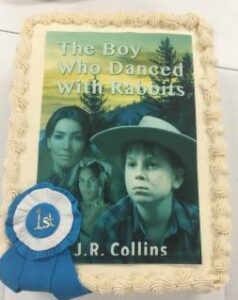
Joe received this beautiful cake from his work family. #GroupHugJoe showing off his beautiful cake! Sure looks good!
Chanticleer: Do you find yourself following the rules or do you like to make up your own rules?
Collins: I don’t like rules. I trust myself and my judgment more than I do most folks who make the rules. Politicians and government folk are prime examples of rule makers who care little for the common folk — ask the Native American. Being a person of faith, and knowing what lies ahead, I get confused as to why we have locks? Or why we hire our own to protect us from ourselves? I prefer a time when folks looked after them and theirs. In writing, I follow that same train of thought. Conversation can be lawless!
Chanticleer: You’re giving us a lot to think on, Joe. Thank you! How do you take all of these memories, all of these stories, and come up with a full-length novel?
Collins: If I can live it in my mind, I can make it into a story. I try to pull everyday occurrences and mix those with any corresponding relative history that I know about. That concoction has to settle in my center for me to know it’s something I can focus on. But, the difficulty comes when I try to pinpoint the objective of why I want to write about that particular subject. It has to satisfy my soul. If it ain’t there, it ain’t to write. But, God.
Chanticleer: How structured are you in your writing work?
Collins: Aghhhhhhhhhh! Hahahahahahaha! STRUCTURED? Don’t even know what that means. I write when I can feel the words going on to the paper (screen). I need to work on this area of my “authorshipness” profile. Hahahaha! I love you guys! I know y’all are structured. I saw it first hand in Bellingham back in April.
Chanticleer: [Don’t you just love this guy? #GroupHug]How do you approach your writing day?
Collins: That all depends on where I am in the writing process of the particular thing that I am writing. For a novel, I can spend a lot of time with story content and character development or I can work on the comfort of the read if I’m well enough along. The priority status of either of those two aspects will designate the attempts I will make for any particular day. Stories have to flow to achieve [the desired] effect. A story written poorly does not catch the imagination of the reader even though the topic is of interest. I prioritize where I believe a reader would want to be in the progression of what is taking place at a certain point in the story. Then, of course, you sit down to write and it all comes crashing down. No reason just crashes. Your mind shuts off. That’s when you reach for something other than your pencil (laptop) . . . like bourbon. No more writing that day. Sometimes intention to write and creative juices are way too far apart for my simple mind. I try to plan and prioritize, but it doesn’t always go the way I want. On those kinds of days, we all need a hug.
Chanticleer: [#Group Hug] What are you working on now? What can we look forward to seeing next from you?
Collins: Right now, I’m finishing the final book in the trilogy I call, “Home from Choestoe”, that I’ve been working on for the last few years. Originally, I’d planned on four books but I’m ready to move on. I want to start something else. Being raised in the Southern Appalachian Mountains offers many different opportunities to write about interesting topics. I haven’t fully decided on what my fourth book will be about as of yet, but it will come to me before long. I have some ideas, but nothing has settled with me that would spur me on to write a novel.
Chanticleer: What is the most important thing a reader can do for an author?
Collins: Enjoy what we write, then tell others so they can hopefully enjoy it as well. Give us reviews that we can share. Selling books is important, sure, but most all good stories have an underlying point of concern. If a reader finds that and is moved by it, then that is all we can hope for as authors. That, to me, is the most important consideration for what we do. Is the reader touched by what we write? Do they feel, then understand what we are saying? Let’s hope they get it because that’s why we do what we do. It sure ain’t for the money.
Love you guys! Take care, and God Bless . . . Joe
We certainly love you back, Joe! Thank you for spending some time with us today.
If you liked this interview with author J.R. Collins, please leave a comment below. We love being connected to our amazing author community, don’t you?
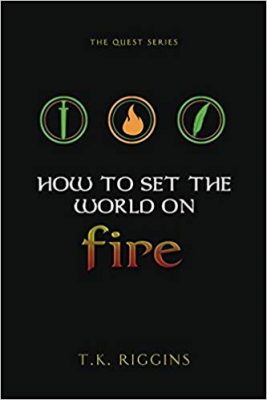
Are you looking for a magical fix this summer? Pick up the award-winning Young Adult book, How to Set the World on Fire by 2017 Chanticleer Award-Winning author for the OZMA – Fantasy Awards, T.K.Riggins and sink into a worthy example of the “school of magic” sub-genre sparked by the Harry Potter series.
In this fast-paced, good-humored story, Kase Garrick, grandson of legendary warrior Roman Garrick, takes up residence in the Warriors castle at The Academy, reuniting with his older sister Cali, a member of the school’s Scholars branch. From his first day, Kase gains an enemy in Cali’s boyfriend Niveous. Sent to the Disciplinary Room thanks to Niveous’s trickery, Kase makes fast friends with the two girls also in detention: Talen, a sweet but awkward savant, and rebellious Lenia, whose control over fire tends dangerously toward pyromania.
Kase hones his skills in weaponry while he and Lenia flirt themselves into love, while everything is building in anticipation to the Quest Series, the annual Academy competition. The teams are usually made up of four students from a single school, but Cali, Kase, Lenia, and Talen bend the rules to form their own team. They find support from the Grand Master and Professor Bright, the elements instructor, both of whom see the unusual potential in these four students.
When the Quest Series begins, the plot coalesces into an exciting journey, not only into the four corners of the realm, but also into the students’ psyches. Each of the five Events poses mental, physical, and emotional challenges for Cali’s team, The Liberati. Each student’s mental aptitude and fortitude are tested, as well, but not only by their ordeals—some teams join with Niveous’s crew to hamstring the favored four. Their malice, however, turns to alarm when it becomes apparent that The Liberati–Kase, and Lenia in particular—have powers far beyond those developed by The Academy.
Being a school of magic sub-genre, of course, one would be right in expecting the same feel and some of the same elements setting the stage as one would find in Harry Potter. For example, in this book, you’ll find former students turned evil, a headmaster, various schools within the larger school, an exciting and dangerous competition, Kase’s singular magic, and spiders. Another similarity fans will rejoice in, like Harry Potter, the author has just disclosed that this is indeed Book One of a series!
More impressively, the story holds up very well on its own, and author Riggins manages to create a world that has one foot in fantasy and the other in up-to-the-minute reality. Sage mirrors, for instance, are only slightly more magical than smartphones and the kids take selfies to prove their accomplishments. Very smart.
What Riggins also gets very right is the way he integrates words of wisdom into the competition. In one instance, the Grand Master exhorts them to: “Know who you are, but don’t be discouraged by who you are not.” And in another: “Sometimes the hardest part about finding something beyond your reach, is finding yourself first.” But avid readers will find The Liberati’s call to arms the best advice of all: “To the library!”
T.K. Riggins won the 2017 OZMA (Fantasy) Grand Prize in the Chanticleer Int’l Book Awards for How to Set the World on Fire!
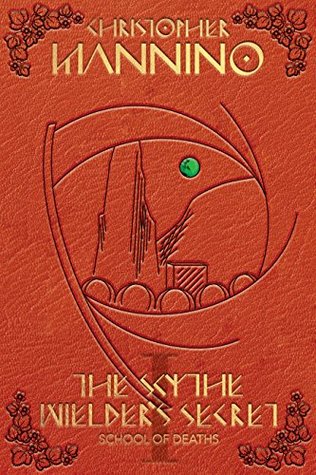
Christopher Mannino’s young adult fantasy novel, School of Deaths, opens with a portrayal of adolescent angst that goes waaaaay beyond “I have nothing to wear!” or “Oh, no! I have a zit!”
Readers will immediately sympathize with the main character, Suzie Sarnio, who’s having the worst first day of eighth grade ever. For starters, she looks like death. Seriously. For mysterious reasons, she’s lost so much weight over the last three months that her bones are about to burst through her skin. Her black hair is stringy, and she peers out at the world through lifeless, gray eyes. There’s no chance of her blending into the crowd.
Everyone wants to talk about her appearance. Her parents, her brother, her friends, her teachers, everyone comments on how terrible she looks. Just what every girl wants to hear, right? As if being thirteen wasn’t hard enough! No matter how much Suzie eats, she can’t gain weight. Of course, everyone assumes she’s anorexic.
To top it off, she’s having nightmares in which a grim-reaper-like dude tells her, “I’ve come to take you back. You are a Death.” And then it really happens. The doorbell rings and there he is, the Grim Reaper in all his glory, and he does indeed take Suzie away. Take a deep breath and join Suzie as she travels – not over the rainbow – but to The World of Deaths.
Once over her bafflement of how she got there, Suzie learns about her locale at the School of Deaths. It’s a bit like Hogwarts, but she’s not learning to be a wizard. No, she’s in training to be a “Death,” one of those who reaps and transports souls that have died from the World of the Living to the World of the Dead. She doesn’t study the use of a wand but instead takes classes on how to use the iconic scythe pictured with grim reapers. It’s very difficult but Suzie is determined to wield it like a pro, to reap and transport with the best of them.
If at the end of one year she passes the test given to all first-year Deaths, she can return home to her family, her memory of time spent in this ghostly school erased. The odds are heavily against her; most Deaths fail the test and must remain forever. To make matters super worse, Suzie is the only female in the school! The last one, Lovethar, attended more than a million years ago and the school hasn’t fully recovered from her scandalous dealings with dangerous dragons. So, Suzie has her work cut out for her.
Students and even some faculty are cruel and go out of their way to throw shade her way. She’s no cream puff, however, and refuses to be intimidated, at least in public. Hermione Granger herself would be impressed. After all, she had female classmates and professors while poor Suzie manages all girl-stuff entirely on her own. Fortunately, there are a few kind students who dare to befriend her and stick up for her when she’s bullied by the nastiest of the boys. Billy, Jason, and Frank help Suzie stand her ground in and out of the classroom. She and her squad become thick as thieves and join forces to discover what really happened to Lovethar.
Their investigation will also lead them to unlock the mysteries of the school’s servants, the “Elementals,” usually referred to with the slur, ‘Mentals. The author does a bang-up job describing these fascinating beings that come in various sizes and colors, with multiple attributes of plants and animals. Suzie and the boys are awed by a plant-like woman and winged boys, a seer with black eye sockets and a man whose skin has blue stripes.
They’re even more intrigued by the rivalrous history between the Deaths and the Elementals. It’s not surprising the Elementals revolt on the school’s campus, but it makes the foursome’s contact with them incredibly dangerous. Suzie feels tremendous compassion for them, but she can’t lose sight of her goal to get through the year, pass the test, and finally get home. That’s the plan, right? Hmmm, but if she succeeds, she’ll have to leave her friends and, well, one of them may be more than a friend. Yes, there’s a bit of romance tucked into all the suspense, and it adds a yummy complication.
From start to finish, this book rocks! It’s a story of female empowerment, the gifts of friendship, the curse of slavery, and the mystical mysteries of great beyond. It also makes the grade nailing the ubiquitous sexism and bullying students deal with as teenagers.
The YA audience will devour School of Deaths, as well as adults who love the genre. The prose and the plot sizzle with smarts and confidence. One finishes the book wanting more and thank goodness there is more. School of Deaths is the first volume in a series, The Scythe Wielder’s Secret. You’ll want to travel on with Suzie to volume 2, The Sword of Deaths, and to volume 3, Daughter of Deaths.
Christopher Mannino won 1st Place in the 2016 Chanticleer Int’l Writing Competition, in the Dante Rossetti Awards, for YA Fiction.
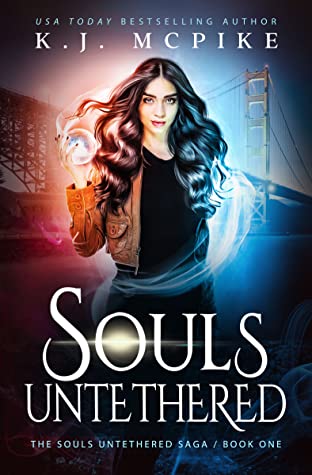
Lali Yavari has her hands full. She’s the oldest of five siblings, a bright, sensitive daughter of a scientist (her father) and a loving mother. Except, her mother up and abandoned the family leaving only a cryptic note behind. And now Lali’s having strange visions of things and people she does not know coupled with the disturbing ability to astral project her consciousness to another place—another dark and beautiful place.
Imagine her surprise when one of the people from her visions shows up as the new kid (#hottie_alert) at school! The surrounding cast includes her boy-crazy best friend, Paisley (and Paisley’s new annoying side-kick), and Nelson, a buddy Lali has grown up with since pre-school. Just to be clear: Nelson is not fond of NewBoy, Kai. In fact, Nelson is downright irritated over all the attention Lali is suddenly giving to the new boy. But Kai’s arrival at school is no accident. He knows more about Lali than she does—why she’s having visions and, perhaps more importantly, what the visions mean. He may even be able to help Lali decipher her mother’s note, thus solving the puzzle of her whereabouts.
But his assistance comes with a price. Kai’s baby sister also disappeared shortly after she was born, and Kai wants Lali to find her. Kai knows something no one else does: Lali is the only person who can astral project to the alternate reality of Alea.
Alea is filled with thick white trees and grass that’s red and yellow. Beautiful or not, Lali soon learns that Alea is a dangerous place whose citizens are watched by a controlling government with a police force known as the “Eyes and Ears.” Could this surveillance operation have something to do with Lali’s mother’s disappearance? If so, what has her mother done to earn their wrath—and how is her mother connected to Alea in the first place? Past and current events collide in a deeply suspenseful narrative that will have readers turning page after page to determine which characters are good and which are evil. Fittingly, Lali’s brothers and sisters get in on the action and the adventure ramps up in nail-biting intensity.
McPike gives us a strong family full of teasing, quarreling and sarcasm, yet indisputable evidence of a deep and abiding trust between brothers and sisters alike. The dialogue is fast-paced, witty, and wholly believable throughout the book. Here we have a splendid contemporary metaphysical young adult novel that deserves a place alongside our beloved Ursala Le Quin.
Souls Untethered is the story of an endearing, resourceful teenager who will stop at nothing to reunite her family.
*Note: Souls Untethered original title, Xodus, won first place in the 2016 Dante Rossetti Awards for Paranormal Y/A Fiction.
Writing: Excellent
Sex: None
Violence: Some physical combat, nothing graphic
Narration: Prologue is in 3rd person; the main novel is in 1st person; Epilogue is in 3rd
In Amaska, residents serve Anur, the God of Justice. Amaskans, men and women, train with a rigor akin to the Spartans to be in peak physical strength and to be ever alert for the presence of danger. Yes, the Amaskans kill, but only to right a wrong as directed by the “Order.” They take no delight in carnage, but they will not stand idly by when someone is suffering an injustice. Knives are their weapon of choice. When not in combat, they identify themselves proudly with tattoos of circles on their jaws.
The Tribor, on the other hand, are a people void of morals who worship Itova, the Death Goddess, and kill with abandon. Their triangular tattoos are covered by their clothing and there is nothing noble about their instinct to murder.
Then there are the previously warring kingdoms of Alexander and Shad, now existing in a tentative peace, one that rulers hope will be solidified through a royal marriage. A princess of Alexander is betrothed to a prince of Shad. If the union is successful, the two kingdoms hope the brutal conflict over the borderlands will cease once and for all. Unless, of course, the marriage a ruse on the part of one side, the first step in a strategy to conquer. There’s speculation and intrigue as readers speculate who are the allies and who is about to be betrayed.
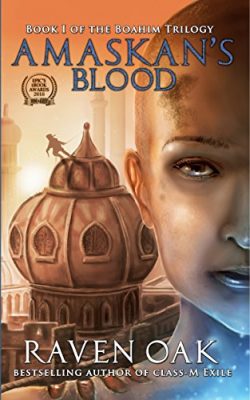
Locales, readers soon learn, are of great importance in this book and provide insights into the characters. The author includes a map of “Boahim” and we learn much about its “Little Dozen” kingdoms.
As accomplished as the situations and settings are, the real feat of this novel is the depth of characterization. At the heart of this tale are twins, young women who were born five minutes apart. Princess Margaret of Alexander is delicate, genteel, silly, spoiled, and absurdly naïve about political matters. At least her sister, Adelei thinks so.
In contrast, Adelei, raised in Amaska since she was five years of age, moves with the strength and stealth of one who has killed many times for a cause, who puts duty above any earthly pleasure. She has the advantage and the burden of having two fathers, King Leon of Alexander, her biological father, and Master Bredych of Amaska, the man who adopted her when she was five. How she came to leave her kingdom of origin and return a decade later is a riveting, suspenseful tale, part of which is told in flashback. Of course, present events are tied to the past, and Adelei will have to reconcile what has happened to her when she was a child, known then as Iliana, if she is to perform the assigned task of protecting her twin sister.
Princess Margaret is preparing to marry Prince Gamun of Shad, a young man with the worst of reputations (think Joffrey in Game of Thrones), although the dreamy young woman hopes it is only petty gossip maligning her betrothed. In protecting her sister, Adelei is also protecting their shared father, the elderly and ailing king, and the entire Kingdom of Alexander.
As events unfold, can two such markedly different sisters learn from each other? And, if so, what will the consequences be? Just when you think you know where the novel is headed, the author will surprise you, frighten you, charm you, and, ultimately, move you profoundly.
Raven Oak’s fantasy novel, Amaskan’s Blood, pays such careful attention to detail that readers will likely feel as if they’re reading historical fiction. While it does take occasional detours from realism, this epic novel reads like an extraordinary and engrossing depiction of actual events. This is a credit to Oak’s very precise and inviting prose and her enormous talent for elaborate plot twists imbued with emotional drama. Will fans of fantasy still like this book? Absolutely! In fact, if you’re longing for the next season of Game of Thrones to begin, this is the novel to read while you’re waiting.

 Immersed in the nostalgia of classic summer camp experiences, Becoming Jonika is the coming-of-age story of Joni Byrnes, who, after finding herself on the wrong side of the law, receives a second chance at St. Augustine of Hippo’s summer camp in the trouble-ridden summer of 1969.





 Jessica Dainty’s, The Shape of the Atmosphere is remarkable for its startling realism, its gritty young heroine, and its hopeful conclusion.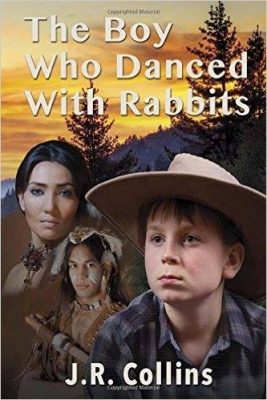
 I first met Joe Collins at CAC18 this last April. He’s a tall, quiet man who carries himself with a certain nuance, a particular look in his eyes that lets a person know he’s looking for fun. He writes from the heart and although he won 1st Place in the Goethe Awards for 2017, his book could have done just as well in the Laramie Awards.





 In Amaska, residents serve Anur, the God of Justice. Amaskans, men and women, train with a rigor akin to the Spartans to be in peak physical strength and to be ever alert for the presence of danger. Yes, the Amaskans kill, but only to right a wrong as directed by the “Order.” They take no delight in carnage, but they will not stand idly by when someone is suffering an injustice. Knives are their weapon of choice. When not in combat, they identify themselves proudly with tattoos of circles on their jaws.