Tag: Colonization Sci-fi

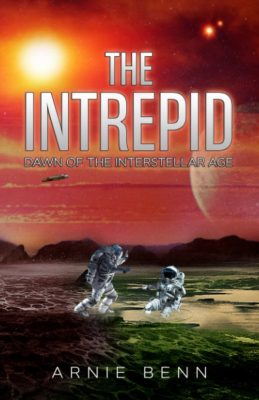
  • THE INTREPID: Dawn of the Interstellar Age by Arnie Benn – Hard Sci-fi, Mystery Suspense, Colonization Sci-fi


    Two interstellar missions encounter something beyond their understanding in Arnie Benn’s sci-fi novel, The Intrepid: Dawn of the Interstellar Age.

    The Intrepid begins a century after Apollo 11. Aksel Bolt, mission commander aboard the Centaurian, wakes too early – seven years into a projected twenty-eight-year sleep on the voyage from Earth – to find Mission Control ordering the crew to rendezvous with another incoming spacecraft. But details are scarce, due in part to being too far from home for two-way communication. What is this other ship, who crews it, and how is it even able to catch up? Will this change their peaceful mission of exploration? And what might be waiting for them at their destination?

    The crewmembers are forced to pivot in order to survive their continued mission.

    Bolt also finds that a member of his crew did not survive hibersleep. Was it simply a mechanical error, or was it sabotage? Was it murder? Did the crew member know something they shouldn’t have? Benn’s story twists and turns, tightening the suspense aboard this historic mission.

    The Intrepid boasts strong general pacing paired with the intensive exposition often necessary in hard sci-fi. The central dangers aboard the Centaurian will drive readers onward, the growing awareness that the crew is alone, far from familiarity, struggling with their growing apprehension. It doesn’t help that disturbing things seem to be going on back home, light years away.

    Full of refreshing surprises that will drive readers toward an unexpected and satisfying conclusion.

    There is so much packed into The Intrepid as it is that it delivers the questions and plots of multiple novels in one. A bonus to this is that the book includes an extensive glossary of scientific terms to complement the intended realism of the science in the story.

    “I’m on the surface now,” Kihumba says. “The human race… has officially reached the stars.” She tries to swallow but her mouth is dry; she is live to the entire solar system, or will be, when the signal finally reaches home 4 years from now. Her heart is pounding. Don’t forget the rest, Kioni. “Welcome, Earthlings, to the dawn of a new age.”

    Part suspense, part future history, a tiny bit romance, and all hard-driving science fiction, Arnie Benn’s near-future space exploration tale is a thoughtful and exciting journey into the wonders and mysteries that humanity has to look forward to…

    Or beware of.
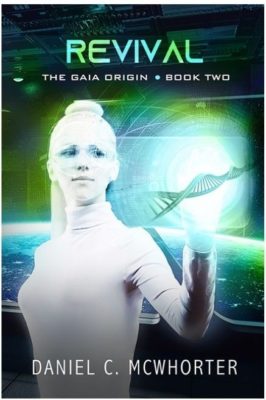


  • REVIVAL (Gaia Origin, Book 2) by Dan McWhorter – Colonization Sci-fi, Genetic Engineering Sci-fi, Artificial Intelligence Sci-fi

    REVIVAL (Gaia Origin, Book 2) by Dan McWhorter – Colonization Sci-fi, Genetic Engineering Sci-fi, Artificial Intelligence Sci-fi

    Artificial intelligence (AI) is an increasingly crucial technological development in human affairs, both for its enabling and disruptive powers. Revival, the second volume in the Gaia Origin series, gives us an astonishing glimpse of what role AI could play in the future of the human race. It’s both scary and exhilarating.

    A small group of people have escaped a near-dead Earth and traveled lightyears to reach a new Earth-like planet named Gaia by its human visitors. Chief among them is Evan Feldman, his wife, daughter, granddaughter, and a few Feldman extended family members. All of them were the masters of an Earth-bound corporation called Tel­­ogene, a multi-billion-dollar megacorporation dedicated to extending the possibilities of human life with revolutionary medical science and technology. Their transportation across the universe on board the Kutanga. The spaceship is large enough to contain some four thousand humans in suspended animation awaiting the day when the human race can establish a new home now that the home planet was all but destroyed by a disastrous and deadly plague.

    But here’s where the book takes an unexpected, radical turn. It seems that the passengers, as we would generally think of them, are all dead – that is, their biological, physical bodies are all gone. Instead, an AI super-intelligent computer named Aneni cares for and keeps the essence of these humans alive. Instead of natural bodies, they have become androids in humanoid form. Virtually all human functions have been duplicated except for the need to eat. The most remarkable is their brain functions, all of which have been “recorded” to function in their new bodies. Who they were as humans, their ability to think, feel, remember, love, hate all remain intact. Every function, including their thoughts, is monitored and potentially controlled by Aneni. Including the ability to modify their thoughts and feelings if the computer believes it would contribute to their well-being. If they become too troubled, they can be digitally “rolled back” and the troubled portion of their lives eliminated.

    So, are they still human? And what happens when they realize the computer Aneni is more akin to them than human beings? And who can tell when even their memories are not reliable, and, instead, a composite of other people’s memories kludged together to reconstruct a human being whose brain was too damaged when their earthly body died? What happens when they realize their essence is as editable as any other digital data: able – like any other data – of being backed up, or erased altogether?

    Before the story ends, readers will experience a fully imagined, detailed alternate world. Eyes will be opened up to an exploration of DNA and brain science, and even the theories of relatively obscure writers such as Zecharian Sitchin and Erich von Daniken, both of whom hypothesized that we, the homo sapiens of Earth were created or planted there by alien astronauts.

    Some sci-fans may see echoes of the book Altered Carbon by Richard K. Morgan, a novel that allowed a human’s essence to move from body to body. The recording and manipulation of that same essence in Gaia: Revival takes that manipulation a significant step further in its creation not only of digital humanity but in a benevolent AI responsible for protecting that humanity at a cost measured by the very concept of what is a human being.

    Don’t expect this book to deliver a collection of sci-fi shootouts. Only a few characters stand out, notably Evan, the founder of Telogene, who yearns for decades to see his long-dead wife brought to life, and their daughter Lily. She best expresses the anguish of trying to come to terms with this extreme version of being human. If you enjoy a thinking person’s science fiction, more in the tradition of Isaac Asimov than Robert Heinlein, this is a book for you.

    McWhorter has pulled off something original and rare. This is science fiction at its speculative best. The issues it raises will remain with you long after you’ve finished reading the book. Highly recommended.

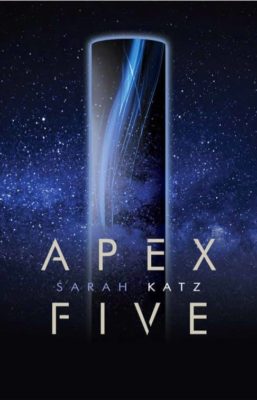
  • APEX FIVE by Sarah Katz – Colonization Science Fiction, Post-Apocalyptic Sci-Fi, Epic Sci-fi Series

    APEX FIVE by Sarah Katz – Colonization Science Fiction, Post-Apocalyptic Sci-Fi, Epic Sci-fi Series

    The first book in the Plane series, Apex Five, begins with a catastrophic storm hellbent on ending all life on the Plane. Many escape into the Void, leaving all who remain to perish. Now 12,000 years later, civilization is once again thriving on the Plane, but not without rivaling nations, political tensions, and religious persecution. The Tabiran government is the ruling body of the Plane, and they have been working for years to eradicate religious belief in the Zaam and the culture surrounding the megaliths found in each nation of Tabira, Lir, and Garo. The origins of these megaliths are forgotten and transformed into myth.  

    During a diplomatic mission from neighboring Lir, First Lasha Nasin meets with Tibira’s leader Mak Eta when the accomplice of the recent usurper is caught. That night Nasin finds the prisoner to be a young boy named Rohem, who never sleeps and only needs sunlight as sustenance. Around this time, Mak Eta’s sister Vata and her two children Inad and Ara, are journeying to the primitive colony Ayam intending to dissuade the Ayam people of their religious beliefs. Almost two decades pass, and the unrest between nations under the guise of partnership with Tabira has come to a breaking point. Efforts towards suppressing religion have seen technological and scientific advancement soar in Tabira. In Ayam, a deadly curse reigns that cause all inflicted to transform into monstrous creatures each night. To prevent war, Tabira sends a group from Lir and Garo that includes Rohem and Avithia, to find a solution to the curse. Rohem has felt an increasing pull towards the megaliths, and while in Ayam, he finds answers about himself and the Plane that will change the world forever.

    Apex Five manages to pack a lot of big ideas into a small package. At first, the worldbuilding is very dense, but the story flows a lot smoother once the groundwork is there. Fans of Ursula K. Le Guin’s Left Hand of Darkness will likely enjoy Apex Five because the story also takes place in a world of stark political and cultural differences where resulting tensions are reaching a high point. Another similarity with Le Guin’s Left Hand of Darkness is Avithia, who fluctuates between male and female on a bi-weekly basis. Katz manages to engage in the tradition of science fiction to explore divergences from what is considered normal. Avithia is a gender-fluid character judged by almost everyone on the Plane except a few close loved ones. Another character faces tragedy and persecution for having a sexual orientation that is illegal in their society. Oria balances a line trying to bridge the worlds of religion and science, hoping to better understand both. 

    Katz creates a lot of compelling and multilayered characters in a relatively short amount of time. With over a dozen different perspectives, Katz attempts the impossible task of fleshing out everyone equally. Fortunately, Apex Five is only the first book, and the story is far from over.

    Sara Katz builds a foundation for a complex science fiction world in Apex Five and invites readers to connect with many characters in what will likely be an epic journey. There is something else about this book, Katz manages to touch on all-too-human themes of science versus religion, sexual orientation, and a possible messiah figure that just might be able to save the evolution of humankind. All in all, it’s no wonder Apex Five won 1st in Category in the CIBA 2018 CYGNUS Awards for Science Fiction!