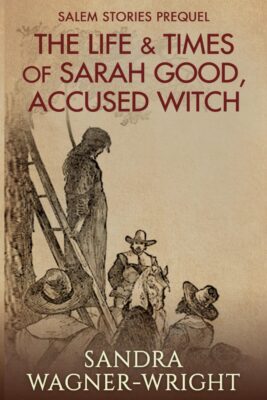
Even hundreds of years later, the Salem witch trials continue to capture the imagination. In The Life & Times of Sarah Good, Accused Witch, Sandra Wagner-Wright taps into this enduring fascination with historical details and emotional revelations. The suffering of women, the religious fervor, the inexplicable claims of supernatural experiences—it’s all here, in a compulsively-readable work of historical fiction.
Wagner-Wright makes good use of her background as an academic historian, never bogging down readers with unnecessary descriptions but selectively choosing details that immerse us in Sarah Good’s world.
Salem in 1692 has its own clothing, traditions, and terminology. Wagner-Wright writes convincing period dialogue with a healthy smattering of religious references. While words such as “fichu”—a woman’s kerchief worn to cover the neckline of a dress—aren’t explicitly defined in the text, there’s often enough context to figure out meanings. Plus, readers can find such definitions in a helpful glossary at the end of the book.
Although Sarah Good is the main character, Wagner-Wright weaves the narrative from many different perspectives. Two supporting characters, Ann Carr and her love interest Thomas Putnam, introduce readers to 17th Century Salem, shaping it into a realistic, tangible place. From Ann in particular, we get an understanding of the dominant role of religion in their society. The day of the church raising is a special one: most of Salem Town “and most importantly, Tom” will be there, Ann reflects. By showing the church as a cornerstone of society, Wagner-Wright sets up the later religious hysteria that will take over Salem.
Through Ann, we also get a close look at the hopes and heavy responsibilities of being a woman.
Ann is well aware of the importance of marriage. A woman without a husband has no status, and no safety net unless her family provides one. Yet Ann also learns of the burdens of marriage through her older sister. Many pregnancies are expected, and the physical stress of carrying and raising children can be draining. All too often, the babies don’t survive past infancy, so grief is intertwined in a woman’s burden.
With this setup, the stakes feel much higher when we return to Sarah’s perspective later in the book. Ann has successfully established herself with the things a woman needs: a husband, a home, and a family. Sarah has had no such luck. She’s unmarried, which means she’s unable to receive her inheritance, and at 28 is well past marrying age for the time. The unexpected appearance of a potential husband suggests her fortunes might change. Yet in short order, tragedy strikes, and Sarah’s once again on her own. Here, her downfall truly begins.
Wagner-Wright tells an exciting version of the events in Salem, with plenty of drama between characters. But the book’s compassion for its titular accused witch is what makes it truly stand out.
Wagner Wright paints a vivid picture of Sarah’s tragedy. To others, Sarah has gone mad and might well be a witch. Yet because we see things from Sarah’s perspective, readers can surmise that her increasingly odd behavior is more likely a natural reaction to stress and trauma. She’s lost both loved ones and physical security. Having been failed by her family, she has nothing to fall back on for support. Perhaps Sarah is indeed mad, but it’s not from any supernatural cause—she’s simply reeling from the worst outcomes for women of that period. Without a caring family or husband, she has no way of protecting herself.
This transition happens quickly, leaving some unanswered questions as Sarah progresses from ordinary woman to accused witch. Still, readers are bound to feel compassion as she falls further into her plight. Soon, it seems almost everyone in Salem is against her—certainly its religious leaders, who hold so much power in the community. The toll of poverty and inequality spirals into a haze of superstition alongside terrible coincidences. While other women are also accused of witchcraft, Sarah remains at the center of the maelstrom.
Anyone familiar with the Salem witch trials knows there are no happy endings. Yet in this work of historical fiction, Wagner-Wright gives Sarah a voice, which she uses to protest the unfairness to her last breath. With The Life & Times of Sarah Good, Accused Witch, Wagner-Wright has deftly set up her book series, Salem Stories, which promises to provide a further feminist take on one of history’s most interesting villages.