Tag: CIBAs

  • The CHATELAINE Book Awards for Romantic Fiction – The SHORTLIST for the 2018 CIBAs

    The CHATELAINE Book Awards for Romantic Fiction – The SHORTLIST for the 2018 CIBAs

    book award for Romance Novels The Chatelaine AwardsThe CHATELAINE Book Awards recognize emerging new talent and outstanding works in the genre of  Romantic Fiction and Women’s Fiction. The Chatelaine  Book Awards is a genre division of Chanticleer International Book Awards and Novel Competitions ( The #CIBAs).

    These titles have moved forward in the judging slush rounds to the 2018 Chatelaine Book Awards SHORT LIST. These entries are now in competition for the limited 2018 Chatelaine  Semi-Finalists from which the First Place Category Positions will be chosen. The Chatelaine Book Awards Semi-Finalists and First Place Positions along with  Chatelaine Grand Prize Award Winner will be announced at the Awards Gala on Saturday, April 27th, 2019. 

    We are looking for the best new books featuring romantic themes and adventures of the heart, historical love affairs, perhaps a little steamy romance, and stories that appeal especially to women. 

    These titles are in the running for the next round – the SEMI-Finalist positions for the 2018  Chatelaine  Book Awards novel competition for Romantic Fiction and Women’s Fiction. Good Luck to All!

    • L.E. Rico – Mischief and Mayhem
    • L.E. Rico – Blame It on the Bet
    • Trent Meunier – Flowers and Milkshakes
    • Pamela LePage – Virtuous Souls
    • Gail Noble-Sanderson – The Lavender House in Meuse
    • J.P. Kenna – Allurement Westward
    • Mona Sedrak – Six Months
    • Cerella Sechrist – The Way Back to Erin
    • Kate Vale – Friends Forever
    • Malinda Andrews – The Irish Baker
    • Rebekah N. Bryan – Brit with the Pink Hair
    • Lauren E. Rico – Solo
    • Karen Fitzpatrick – Sincerely, Amelia
    • Elizabeth Crowens – Dear Bernie, I’m Glad You’re Dead
    • Elizabeth Crowens – Dear Mr. Hitchcock
    • F. E. Greene – The Next Forever
    • Elena Mikalsen – Wrapped in the Stars
    • Diane Shute – Midnight Crossing
    • Lucinda Brant – Satyr’s Son: A Georgian Historical Romance
    • Alix Nichols – Playing with Fire
    • Alix Nichols – The Traitor’s Bride
    • Nicola Slade – The House at Ladywell
    • Michelle Cox – A Promise Given
    • Diana A. Hicks – Love Over Lattes
    • Tammy Mannersly – Persuading Lucy

    Congratulations to these authors for their works moving up to the Short List from the slush pile.  These novels will now compete for the (Semi-Finalists) Positions!

    Chatelaine Grand Prize Winner M. A. Clarke Scott

    The Chatelaine  Short Listers will compete for the SemiFinalists positions that will compete for the Chatelaine First-In-Category Positions.  First Place Category Award winners will automatically be entered into the Chatelaine GRAND PRIZE AWARD competition.  The CBR Grand Prize Genre Winners will compete for the CIBA Overall Grand Prize for Best Book and its $1,000 purse.
    We are now accepting submissions into the 2019 Chatelaine Book Awards writing competition. The deadline for submissions into the 2019 Chatelaine  Book Awards is August 30th, 2019. Please click here for more information. 

    As always, please do not hesitate to contact us with any questions, concerns, or suggestions at Info@ChantiReviews.com. 
  • CHAUCER Book Awards for Pre-1750s Historical Fiction – The SHORTLIST  for 2018  the CIBAs

    CHAUCER Book Awards for Pre-1750s Historical Fiction – The SHORTLIST for 2018 the CIBAs

    Pre 1750 Historical Fiction AwardThe CHAUCER   Book Awards recognize emerging new talent and outstanding works in the genre of  pre-1750s Historical Fiction. The CHAUCER Book Awards is a genre division of Chanticleer International Book Awards and Novel Competitions ( The #CIBAs).

    These titles have moved forward in the judging rounds to the 2018 CHAUCER Book Awards SHORT LIST. These entries are now in competition for the limited 2018 CHAUCER  Semi-Finalists from which the First Place Category Positions will be chosen. The CHAUCER Book Awards Semi-Finalists and First Place Positions along with the CHAUCER Grand Prize Award Winner will be announced at the Awards Gala on Saturday, April 27th, 2019. 

    Chanticleer Book Reviews is seeking for the best books featuring Pre-1750s Historical Fiction, including pre-history, ancient history, Classical, world history (non-western culture), Dark Ages and Medieval Europe, Renaissance, Elizabethan, Tudor, 1600s, we will put them to the test and choose the best among them. (Looking for Goethe Post 1750 contest or Laramie Western/Pioneer/Civil War contest?)

    These titles are in the running for the next round – the SEMI-Finalist positions for the 2018  CHAUCER  Book Awards novel competition for pre-1750s Historical Fiction. Good Luck to All!

    • Nicole Evelina – Mistress of Legend (Guinevere’s Tale Book 3)
    • Robert Wright – King David’s Lost Crown, Book 1 Before They Awaken Trilogy
    • Prue Batten – Michael – Book 3 of the Triptych Chronicle
    • Edward Rickford – The Serpent and the Eagle
    • Bernard Mann – David & Avshalom — Life and Death in the Forest of Angels
    • Brett Savill – Medici Apprentice
    • Gregory Hansen – Pelsaert’s Nightmare
    • P.K. Adams – The Greenest Branch, a Novel of Germany’s First Female Physician
    • Amy Wolf – A Woman of the Road
    • Eileen Stephenson – Imperial Passions – The Porta Aurea
    • Helena P. Schrader – Rebels against Tyranny: Civil War in the Crusader States
    • Charlene Newcomb – Swords of the King
    • Anna Belfrage – The Cold Light of Dawn
    • Anna Belfrage – Under the Approaching Dark
    • Kate Murdoch – Stone Circle
    • Jehan d’Elleby – Lanz & Gwenhevre: Love Against the Tide

    Congratulations to these authors for their works moving up to the Short List from the slush pile.  These novels will now compete for the (Semi-Finalists) Positions!

    The CHAUCER  Short Listers will compete for the SemiFinalists positions that will compete for the CHAUCER First-In-Category Positions.  First Place Category Award winners will automatically be entered into the CHAUCER GRAND PRIZE AWARD competition.  The CBR Grand Prize Genre Winners will compete for the CIBA Overall Grand Prize for Best Book and its $1,000 purse.

    Good Luck to each of you as your work competes in the 2018 CHAUCER International Book Awards. 

    The Chaucer  Grand Prize Winner and the Five First Place Category Position award winners will be announced at the April 27th, 2019 Chanticleer Book Awards Annual Awards Gala, which takes place at the Chanticleer Authors Conference that will be held in Bellingham, Wash. 

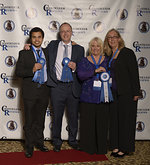
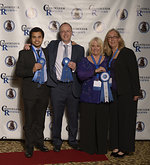
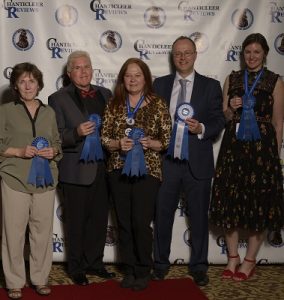
    CHAUCER Grand Prize Award Winners Catherine T. Wilson & Catherine A. Wilson with Edward Rickford and DJ Munro.

    We are now accepting submissions into the 2019 CHAUCER Book Awards writing competition. The deadline for submissions into the 2019 CHAUCER  Book Awards is June 30th, 2019. Please click here for more information. 

    As always, please do not hesitate to contact us with any questions, concerns, or suggestions at Info@ChantiReviews.com. 
  • The LOST YEARS of BILLY BATTLES, Book 3 in the Finding Billy Battles Trilogy by Ronald E. Yates – Historical Fiction, Literary, Action/Adventure

    The LOST YEARS of BILLY BATTLES, Book 3 in the Finding Billy Battles Trilogy by Ronald E. Yates – Historical Fiction, Literary, Action/Adventure


    Congratulations to Ronald E. Yates for winning the 2018 CIBAs

    OVERALL GRAND PRIZE – BEST BOOK of the YEAR

    for The Lost Years of Billy Battles!


    Reviewer’s Note: I’ve begun few books as eagerly as I did this one. Having read the first two volumes of Ronald E. Yates’ extraordinary trilogy, Finding Billy Battles, I couldn’t wait to continue his story in the final volume, The Lost Years of Billy Battles. The third installment lived up to the exceedingly high standard set in the first two volumes. Billy Battles is as dear and fascinating a literary friend as I have ever encountered. I learned much about American and international history, and you will too if you read any or all of the books. Each is an independent work, but if read in relation to the others, the reader experiences that all too rare sense of complete transport to another world, one fully realized in these pages because the storytelling is so skillful and thoroughly captivating. Trust me; you’ll want to read all three volumes.


    Overall Grand Prize Best Book Award for The Lost Years of Billy BattlesFor those not familiar with the series, Yates presents his books as works of “faction,” a story “based in part on fact” but also “augmented by narrative fiction.” The protagonist, William Fitzroy Raglan Battles, born in Kansas in 1860, lives a full 100 years and takes part in some of the most significant events of his time. He encounters key figures of the day (Bat Masterson Wyatt Earp, President Wilson, Francisco “Pancho” Villa, among others), gives us their backstories, and quietly appraises them.
    Yates, a journalist with a keen eye for nuance and subtlety, has created a protagonist with superb critical thinking skills. William, a journalist, and occasional soldier examines people and transactions from every angle. Just as at ease in a Kansas saloon as he is at the captain’s table on a grand ocean liner on the Pacific, Billy Battles is also ruthlessly honest about his shortcomings and feels tremendous guilt when he acts impulsively or inadvertently causes harm to others. Yates has crafted a fully human character who is easy to admire, perhaps because he is admirably cognizant of his own flaws.

    This installment of the trilogy opens with William enjoying middle age in Chicago with his second wife, his beloved Katharina, a former German baroness, and his daughter, Anna Marie, now a student at Northwestern University. It is 1914 and World War I is raging in Europe. Germany, late to the spoils of colonialism, is seeking to make up for lost time with its policy of Weltpolitik that advocates for imperialist expansion.

    When William is contacted by his friend and former military associate, General Freddy Funston, who informs him that a German merchant ship is bound to Mexico to deliver arms and munitions to its dictator, General Victoriano Huerta, William and Katharina travel to Mexico and pose as tourists while trying to find out as much as possible about the shipment. They learn that in addition to weapons, the ship is carrying a fortune in gold and silver bars. Further investigations reveal that Germany hopes to convince Mexico to engage in skirmishes along the U.S. border, creating enough havoc that America will sit out the war in Europe and thus allow Germany expansionist gains there.

    Although in Mexico at the behest of the U.S. military, William and Katharina readily understand why Mexicans feel hostile to Americans; a significant portion of the Southwest used to belong to Mexico. However, President Wilson does not recognize Huerta and is all too eager to engage in big stick diplomacy when he chooses. Also, many Mexicans are desperately poor, the Campesinos working as virtual slaves on haciendas for no pay. It’s not surprising that they cheer on Venustiano Carranza, leader of the Northern opposition Constitutionalists charismatic lieutenants, the intense, intelligent Zapata who yearns to bring about land reform for the poor, and the wild but charismatic Pancho Villa who sparks outrage when his men murder 17 Texas mining engineers.

    The U.S. military decides to intervene and, once again, William is impressed into service, this time with General Pershing and the General’s aide-de-camp, George S. Patton. While the U.S. Army has the latest in weaponry and travels with motorized vehicles and untrustworthy aircraft, the new technology causes a lot of noise, making it difficult to sneak up on Villa and his light-footed army, one that’s thoroughly familiar with the terrain and beloved by the people. William’s observations and reporting on all of this for his Chicago newspaper are riveting and wryly amusing.

    Following this Mexican adventure, William barely has time to catch his breath when his past once again catches up with him. Mason Bledsoe, the son of the man William killed due to complex circumstances when he was just nineteen, abducts Katharina. With the help of his cousin, William determines his wife’s whereabouts and attempts to free her, as well as seek vengeance on those who kidnapped her. The results of his actions necessitate his leaving the country for his safety and, more importantly in his mind, the safety of his family. Over the next decades, he will spend time in the Philippines and Indochina, where he will again grapple with the blatant injustices of colonialism, aggrieved by the plight of native men working 16-hour days on French rubber plantations in intense heat, their flesh bitten and eaten by mosquitoes, oxflies, and army ants.

    While abroad, William’s personal life takes some shocking turns that motivates him to return to the U.S. in 1936. His final years in Kansas, his birthplace, are the quietest of his life. Billy often muses on all he has seen and experienced. When he meets his great-grandson, Ted Sayles, he decides to bequeath him his guns, uniforms, journals, and correspondence. In the Epilogue, Ted addresses the reader and shares his thoughts about some shocking surprises he finds amongst William’s papers. It’s a most satisfying conclusion to an extraordinary trilogy.

    At his behest, William’s grave includes the simple statement, “He did his best.” The same is undoubtedly true of the author, Ronald E. Yates. The research involved in putting William’s story on the page had to have been immense. In addition to a careful plotting of history, the details he weaves into his prose regarding fashion, food, weather, social class, and technology make this the richest account of a life imaginable.

    Ronald E. Yates won 1st Place in the SOMERSET Awards for The Improbable Journeys of Billy Battles: Book 2, Finding Billy Battles Trilogy of this extraordinary series.

    5 Stars! Best Book Chanticleer Book Reviews