The GERTRUDE WARNER Book Awards recognize emerging new talent and outstanding works in the genre of middle-grade readers, fiction and non-fiction, that compel children to read and explore. The Gertrude Warner Book Awards is a division of the Chanticleer International Book Awards (CIBAs).
Named in honor of the author of the quintessential children’s series – The Boxcar Children, Gertrude Warner.
Chanticleer International Book Awards is looking for the best books featuring stories of all shapes and sizes written to an audience between the ages of about eight to twelve. Science Fiction, Fantasy, Mystery, Paranormal, Historical, Adventure we will put them to the test and choose the best Middle-Grade Books among them.
These titles have moved forward in the judging rounds from SLUSH pile to the 2019 Gertrude Warner Book Awards LONG LIST and now have progressed to the 2019 SHORTLIST. The Short Listers will compete for the Semi-Finalists positions. The Semi-Finalists will be announced and recognized at the CAC20 banquet and ceremony. The First Place Category Winners, along with the CIBA Division Grand Prize winners, will be selected from the 16 CIBA divisions Semi-Finalists. We will announce the 1st Place Category winners and Grand Prize Division Winners at the CIBAs Banquet and Ceremony on Saturday, April 18th, 2020 at the luxurious Hotel Bellwether in Bellingham, Wash.
These titles have been Shortlisted for the 2019 Gertrude Warner Book Awards for Middle-Grade Fiction
Carolyn Watkins – The Knock…a collection of childhood memories
Joyce Major – The Orangutan Rescue Gang
Nancy McDonald – Boy from Berlin
Veronica Myers – Flight of Maldar
B.L. Smith – Bert Mintenko and the Serious Business
B.L. Smith – Bert Mintenko and the Minor Misdemeanors
Mobi Warren – The Bee Maker
Amber L. Wyss – Phoenix Rising
Wendy Leighton-Porter – The Shadow of the Tudor Rose
Sue Bough – Norman Snodgrass Saves the Green Planet
Kit Bakke – Dancing on the Edge
M.J. Evans – PINTO!
M.J. Evans – The Stone of Wisdom – Book 4 of the Centaur Chronicles
Beth Stickley – Tarnation’s Gate
Lis Anna-Langston – Maya Loop
Lexi Rees – Eternal Seas
Catherine Mallette – Don’t Ask Me
Wendy Leighton-Porter – The Shadow of the Volcano
Diane Rios – Return of the Evening Star
C.R. Stewart – Britfield and the Lost Crown
Kay M. Bates’ – ‘B’ is for Baylee
Alexander Usher – Katie Hope: Blood Bonds
Susan Brown – Sammy and the Devil Dog
Wendy Leighton-Porter – The Shadow of the Pyramid
Rey Clark – Legends of the Vale
L.S. Barron – Harper T and the Timewave
Maria Ashworth – SUSHI KITTY
Gregory Saur – Diving Catch
Liana Gardner – 7th Grade Revolution
Liana Gardner – The Journal of Angela Ashby
L.M. Kemp – Skye’s Journey
Trayner Bane – Windhollow and the Axe Breaker (Windhollows, Book 3)
Leanne M. Pankuch – Dragon’s Truth
Alex Paul – The Valley of Death, Book 5, Arken Freeth and the Adventure of the Neanderthals
Which of these works will move forward in the judging rounds for the 2019 Gertrude Warner Book Awards for Middle-Grade Readers?
These titles are in the running for the Semi-Finalists positions of the 2019 Gertrude Warner Book Awards for Middle-Grade Readers.
Good luck to all as your works move on to the next rounds of judging.
The 16 divisions of the 2019 CIBAs’Grand Prize Winners and the Five First Place Category Position award winners along with recognizing the Semi-Finalists will be announced at theApril 18th, 2020 Chanticleer International Book Awards Annual Awards Gala,which takes place at the Chanticleer Authors Conference that will be held in Bellingham, Wash.
We are now accepting submissions into the 2020 Gertrude Warner Awards Book Awards. The deadline for submissions is May 30th, 2020. The winners will be announced in April 2021.
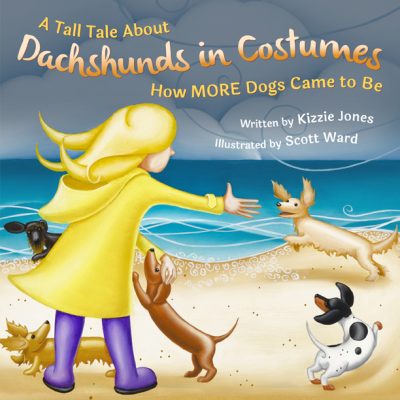
Author Kizzie Jones creates a beautiful origin story about how the lovable dog species – the Dachshund – came to be with the help of illustrator Scott Ward.
In an enchanted time and place, a little girl walks every day along a beautiful beach, delighting in the sea stars, anemones, mussels, and barnacles that are revealed when the tides sweep out. She combs the beach for treasured “friends” of shells and sand dollars. A pod of humpback whales visits the beach twice yearly, and the little girl thrills to see the whales and their newborn calves. But the little girl is lonely and more than anything, wishes for an animal friend to take home with her.
Kizzie Jones loves dachshunds (she has three) and lives near the Salish Sea, where Orcas and Humpback whales and other sea life frolic and play. This familiar setting provides a rich environment for her charming stories to take root. How Dachshunds Came to Be: A Tall Tale About a Short Long Dog, is Kizzie Jones’ first book, and like the other books in her series, A Tall Tale About a Dachshund and a Pelican: How a Friendship Came to Be, and her very latest book in the series, A Tall Tale About Dachshunds in Costumes: How MORE Dogs Came to Be, artist Scott Ward’s illustrations perfectly match the mood of Jones’ narrative – bright, fresh, almost etheric colors of sea, sand, and the whimsical renderings of the little girl and those who love and surround her. Each page number is highlighted on the back of a dachshund, and the three dogs that rush to befriend the little girl are simply adorable. This sweet collaboration makes a perfect “read-to” for parents and grandparents of toddlers and an engagingly accessible tale for older children to delve into on their own.
Shortly after the little girl leaves the beach for home, the whales decide to find a companion for her. This friend would need to be a warm-blooded mammal – able to breathe fresh air. Each creature has ideas about the ideal companion. A barnacle suggests giving it a long nose; seals advise a “long sleek body” just right for cuddling; anemones think it needs soft wavy whiskers and eyebrows. The octopus naturally suggests 8 limbs. Still, the group settles on four, with padding on the ends of their legs – suitable for walking on land.
By the time the little girl awakens and returns to the beach, she finds not one but three new friends – black, brown-red, and golden dachshunds. They run to her, ready for cuddles and loves.
A unique fairytale by author Kizzie Jones, A Tall Tale About Dachshunds in Costumes: How MORE Dogs Came to Be adds the third book her series that began with How Dachshunds Came to Be: A Tall Tale about a Short Long Dog, followed by the award-winning title, A Tall Tale about a Dachshund and a Pelican: How a Friendship Came to Be.
This tall tale begins on the beach one autumn day where a big storm is fast approaching a girl and her dogs, stopping their play and forcing them to retreat indoors. The next day the girl and the dogs decide to go clean up the debris left by the storm, and it is not long before they see what sort of costumes they can create with the various kinds of debris scattered along the beach.
The dressed-up dogs ask the girl if she would be upset if they stayed dressed up. The girl wonders if the dogs would change on the inside as well. they reply,
“We’d be changed and transformed—we’d be diff’rent outside. Yet, inside, our hearts are still caring and kind.”
That night the girl sends her wish to the ocean for the dogs to become the dogs they costumed themselves to be and goes to sleep hoping her wish will be granted.
It is easy to see that author Kizzie Jones has a deep love for her dachshunds and nature, but it is also clear that she loves to teach through her books. With assistance from USDA Forest Service, Jones fills her story with accurate plant life as well as lots of terms for different dog colorings and patterns, all of which she includes in a glossary at the end of the book.
Dachshunds in Costumes is a creative story that gives a lighthearted explanation for how the different breeds of dogs came to be, and as Jones’s previous books, we see the gift of self-acceptance. Also present is a meter that has a lilting and soothing quality. The meter pairs well with the wonderful illustration work from Scott Ward that has a unique and uniform shading style that readers of all ages will admire.
Kizzie Jones’ newest addition is perfect for the curious and inquisitive child who will surely spend hours curled up studying all that A Tall Tale About Dachshunds in Costumes: How MORE Dogs Came to Be has to offer.
This title will be released on November 3, 2019, in English and in Spanish! If you would like more information, please sign up on Kizzie’s blog here.
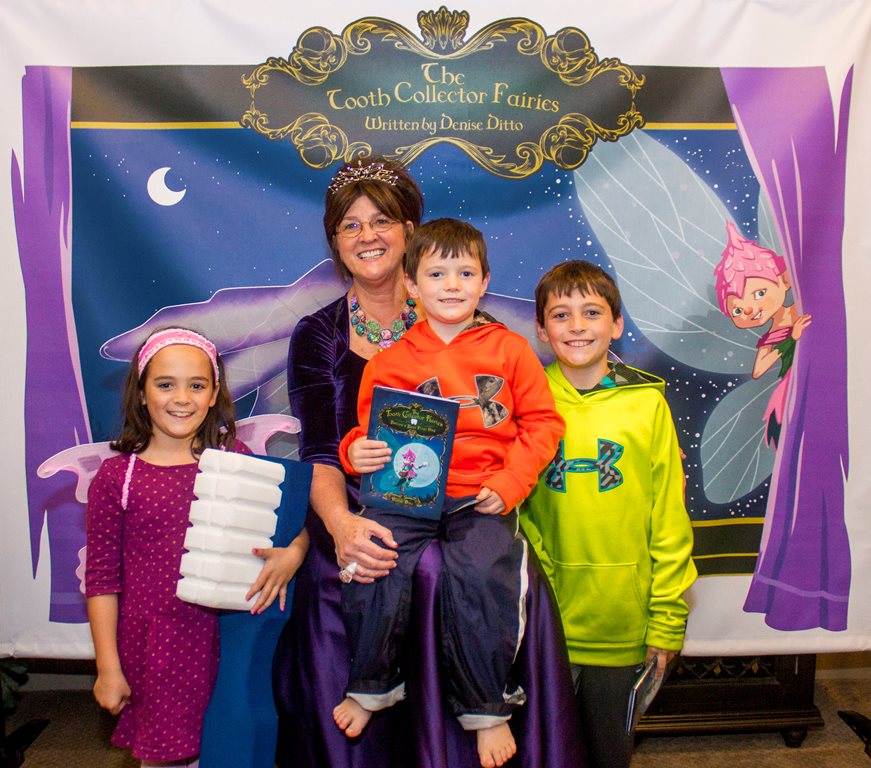
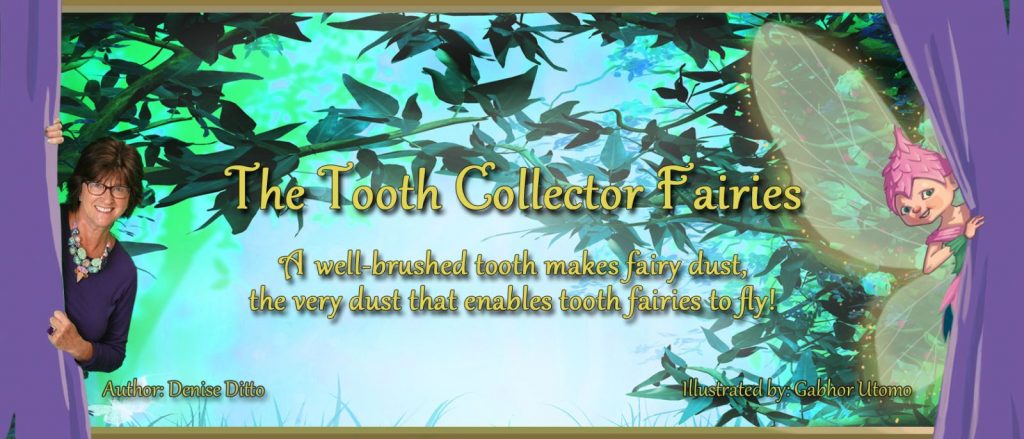
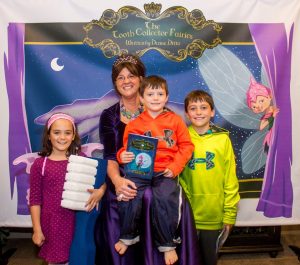
Inspiration and Going Back to the Drawing Board – the making of The Tooth Collector Series
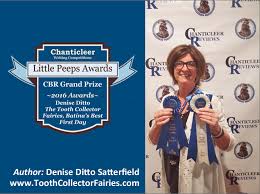
a Little Peeps Book Awards Spotlight blog post featuring Denise Ditto and The Tooth Collector Series
Do Early Reader Books and Picture Books Require Narrative Arcs?
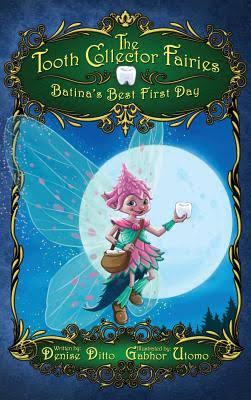
The original story about Batina was intended to be a picture book. It had 1078 words – words that I loved. It was tentatively titled,The Real Tooth Fairy Story – What Happens to all those Teeth? In this version, Batina did not have any unusual characteristics nor did she have any fairy friends. The whole story centered on what happens to well-brushed teeth. It introduced the concept that a well-brushed tooth makes fairy dust, the very dust that enables tooth fairies to fly. Each fairy delivered a tooth to Mr. Gizmo for inspection. All the teeth declared well-brushed were transferred to the manufacturing department. They were placed into the Super-Duper Magic Dust-Making Machine where they underwent a magical transformation that produced canisters of rainbow-colored fairy dust – one tooth, one canister, for each fairy. That was it.
When I presented this story for a professional review, I learned that if I intended the story to be a picture book it would need to be cut in half because 1078 words were too many. Ideally, a picture book should have around 500 words – give or take a few hundred. The idea of cutting the story in half was more than I could handle. Fortunately, there was a second option. I was encouraged to increase the word count, add a narrative arc and make it a chapter book. That was great advice – advice I decided to take.
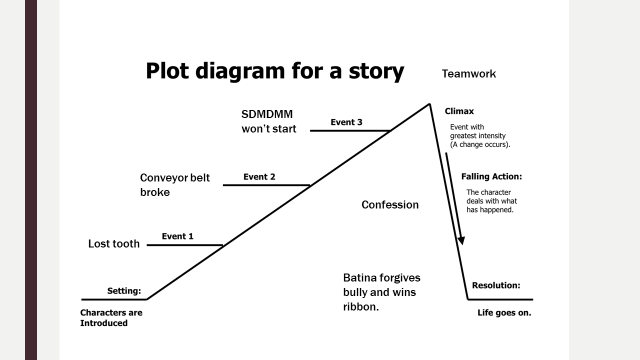
Batina’s Best First Daynow has nine chapters, over 4000 words, and includes a narrative arc. Below is the structure used to transform the original work into a chapter book.
Denise Ditto’s Story Plot Diagram The Tooth Collector Series
Timeless method for making the characters in your children’s book unique and interesting
In the original short version ofBatina’s Best First Day, discussed in an earlier blog post, Batina did not have any unusual characteristics. When redeveloping the picture book to a chapter book I felt the need to give Batina a distinctive appearance – a feature that made her stand out from others – a feature to make her more interesting. It was time to ponder ideas. Here is what I came up with.
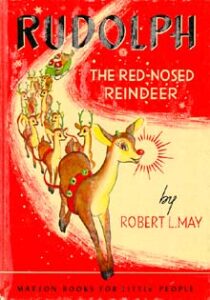
There are many children’s books and movies with characters that are unique in their own way. For example, look atRudolph the Red-Nosed Reindeer. You got a double dose of character uniqueness in this story. Rudolph and his red nose. Everyone knows that the other reindeer teased him and called him names. And what about Hermey, the Elf. He wanted to be a dentist, for goodness sake. I guess it would be easy to conclude that this is where I got my inspiration considering my book has a dental element to it, as well, but I didn’t.
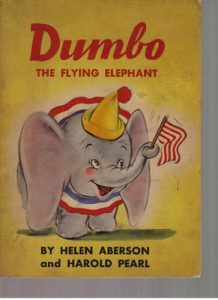
I was inspired by the storyDumbo. I’ll tell you why.
First and foremost, as a child I lovedDumbo. But there’s more to it than that. Dumbo had large ears and people made fun of him. With the help of his friend, Timothy the mouse, Dumbo learned how to use his ears as wings and he learned to fly. WHAT? Yes, an elephant learned to fly. What an accomplishment! Dumbo overcame his perceived defect and turned it into an asset.
What an inspiration it would be to read about a little tooth fairy with oversized wings whose primary job was to fly. Consider how difficult would it be for her to navigate in the air with oversized wings. Consider how scary it would be to learn that she had the fear of being caught in a rogue gust of wind that could stand in the way of her completing her mission. How awesome it would be to learn that she was not deterred. My little Batina became a motivated fairy determined to do a good job no matter the obstacles. Like Dumbo, Batina overcame a perceived defect and turned it into an asset.
Here’s the nugget – Embrace your differences because that’s what makes you, YOU! And no matter your differences, you can achieve your goals.
PS – Dumbo was released on October 23, 1941. Many years later, I was born on that day, too. Another reason Dumbo was my inspiration. That’s the truth.
Camelot and Tooth Fairies?
The name of the place where your children’s story will take place should spark the imagination!
Brushelot is the name given to the magical land where Tooth Collector Fairies live.
You might think a name for a tooth fairy’s magical land would come easy but it didn’t. Originally, the name was to be Panteen – a little play on Peter Pan and Preteens. It was a wonderful name and quite clever if you ask me. However, after a handful of people read a draft of the story and said, “I thought it was going to have something to do with hair,” I knew I had to make a change. It seemed the name Panteen was too similar to Pantene – the shampoo. Hmmm. Back to the drawing board.
After a long period of grieving the loss of this fabulous name, I found myself back to square one. How about Flossalot? Did you know there is a rapper named Flossalot? Really, there is. Can’t use that one. Brushalot came to mind. After a Google search, I learned that name was already taken, as well.
Camelot
How about simply changing the “a” to an “e” – to Brushelot? Brilliant idea. Now the question was, “Will that work?”
A Google search did not turn up any other usage of this word. Visually, the name reminded me of Camelot so I set out to research Camelot. Could there be a sensible reason to suggest a comparison between the word Camelot and Brushelot? My research revealed several interesting facts. First, Camelot, as defined by Merriam-Webster, is a time, place, or atmosphere of idyllic happiness. So far so good. Second, I found that an Arthurian scholar named Norris J. Lacy wrote, “Camelot, located nowhere in particular, can be anywhere.” BINGO! I thought. This sounds exactly like the place where the tooth fairy’s magical land is located. And it was declared that its name shall be Brushelot!
[Editor’s note: As authors and writers, sometimes we need to go back to the drawing board aka the writing desk to work out the little bits that will make our works stronger. -kb]
The 2019 Little Peeps Book Awards winners will be announced on Saturday, April 18, 2020, at the Chanticleer International Book Awards ceremony and banquet that takes place during the Chanticleer Authors Conference that is held annually in Bellingham, Wash.
Micha, Princess of Nor, can’t wait for her twenty-second birthday celebration. She wants to laugh with her sister, Olive, and their best friend and cousin, Dillip, and perhaps spend time with Percival, a prince from the nearby Mur. But her celebration is cut short when a messenger arrives at the manor with news that all of the inhabitants of the city of Valde, including her parents, have been enchanted by an evil witch Draka, who has escaped from her centuries-old mountain prison.
Though she has trained her entire life to pick up the mantel of a ruler, Micha isn’t ready to command armies and save her people; however, when Draka allies with the southern dragons and eastern goblins, she has no choice but to take up arms and defend her land. Micha soon enlists the help of Susa, a strange old woman of the forest who is more than she appears. With Susa’s wisdom and the bravery of their father’s captain, Demetrius, Micha and Olive pursue Draka’s horde.
There is one problem, they quickly learn that Draka can only be killed by a sword imbued with the blood of a great conqueror and wielded by his direct descendent. As the sacrifices pile up, Micha questions her ability to rule and wonders if anything will remain of the home she loves.
The world of Nor is an enchanted land where birds and bears offer much-needed help to the worthy, and giants roam the land. It is a place where goblins attack heroes, pirates plague coastal cities, and talking rats the size of horses walk upright. In all of this fantastical world-building, heroes still ride in on valiant steeds, and goodwill defeat evil no matter the cost.
Of these heroes, Micha is supreme. Her uncertainty in her abilities makes her a very human character. She doesn’t step into challenges knowing victory is certain. Micha questions her knowledge and sometimes feels the pull of Percival’s insistence that she shouldn’t have to shoulder all of the burdens that have been thrust upon her. She readily admits her fatigue and uncertainty but never shirks from her responsibilities.
Percival’s fun-loving ways are a direct foil to Micha’s dynamic character growth. With a father who ousted giants and a mother who quelled a pirate rebellion, Micha has big shoes to fill; yet, even in youth, her wisdom shines. She also has the good sense to know her limitations. Often, she turns to Demetrius for help, and in a sense, they become partners who find their strength in each other. Putting the kingdom above herself, Micha willingly sacrifices whatever is needed to defeat the greedy hubris of Draka.
Though Micha sacrifices much, many of the characters make similar sacrifices. Willing to die doing what’s right rather than live with the consequences of not fighting, these characters add to the righteousness of the novel’s message. Abbott, a half-breed giant, risks his life in warning Micha and then again by going to his giant family who ostracized him. Dillip suffers a significant loss when he fights the oldest dragon in Nor. Demetrius willingly faces off against Draka herself. All who see Micha’s bravery readily defend her and the kingdom, choosing action over complacency.
Middle-grade students and those who love fantasy will quickly fall in love with the land of Nor and its heroic queen.
The Queen and Knights of Nor won 1st Place in the CIBA 2017 Gertrude Warner Awards for Middle-Grade Fiction.
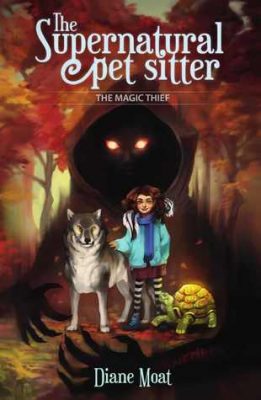
A talented and creative author, Diane Moat, presents a magical world hidden within a New England town where Witches, Warlocks, and Gnomes live together peacefully. That is until one day, something strange happens to the Familiars in the neighborhood. Someone or something had taken the magic from Frank the parrot a month previously, and now the same thing has happened to the tortoise King Arthur.
This is where Pepper Neely, pet sitter of the supernatural, comes in. Gnomes are magical people who can connect with supernatural creatures. Pepper has a unique aptness with her connection to animals, and she quickly became the neighborhood pet-sitter. With the help of her best friend and witch-in-training Luna, the two go against the well-meaning wishes of their parents to get to the bottom of what is happening to the Familiars. As usual, that is easier said than done when the Witches and Gnomes start to clash over the danger at hand. Pepper also discovers an ability that will change the meaning of what it is to be a Gnome.
Moat’s The Magic Thief is the first book in her The Supernatural Pet Sitter series. The story begins in the middle of things as Pepper is trying out a storm after checking on the ferret Familiar named Cranky. It doesn’t take long for it to discover that the story is very character-driven with a strong family dynamic at its heart.
Pepper Neely is a lovable character, and her pre-teen voice is decently portrayed in the novel. The way the story effortlessly welcomes readers into the Neely gnome family and their secret world of magic is captivating and delightful. Diane Moat leaves enough questions unanswered, setting up the next installment, and leaves enough loose ends open for the story to develop throughout the rest of the series.
Diane Moat’s The Supernatural Pet Sitter: The Magic Thief is a middle-grade novel perfect for the curious reader interested in the hidden magic that could be lurking in their own backyard.
The Supernatural Pet Sitter: The Magic Thief won 1st Place in the CIBA 2017 Gertrude Warner Awards for Middle-Grade Readers.
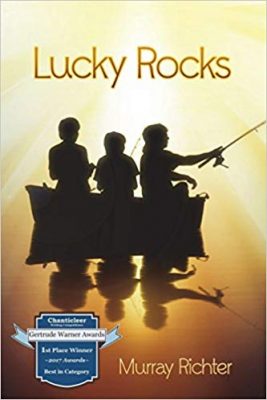
Lucky Rocks by Murray Richter is the stuff boys’ dreams are made of: escaping chores, ditching little sisters, playing pranks on each other, heading out to Uncle Oliver’s (the General), and sticking up for each other on the football field. Did I leave anything out? Oh, yes, there’s a hunt for sunken treasure, too.
This action-packed romp set in 1979 takes us on summer vacation we will never forget. We meet sixth-graders Kevin (Kev man), our hero; Preech, the brains of the group; and Rudy, the quarterback, and football star. They raise some dust as they race their bikes down the back roads of their small Texas town as they head out for adventure every day; whether it be to a fishing hole, a rough neighborhood where they lose Rudy, or to Uncle Oliver’s where they learn about life the fun way, though “The General’s” stories.
When Rudy shows up with a black eye, Kev man and Preech know there’s trouble at home, but Rudy won’t talk about it, not to anyone, not even Uncle Oliver. Rudy’s stepdad, a rough and gruff oil rigger, seems the likely culprit behind Rudy’s black eye, and Kevin and Preech are determined to help their friend. But first and foremost is an adventure, and Uncle Oliver has invited them on a treasure hunt.
With their parents’ permission, the boys go on the hunt, but on their dive to a sunken ship, they find more than they are looking for. Richter develops a plot filled with action and fun with spine-tingling elements of danger and tension that pulls us along as we witness Kevin, Preech, and Rudy conquer their fears and help each other out of danger, time and time again.
As summer ends, Richter takes us back to school and the football field where Rudy and Preech display their skills on the field. Kevin lags behind, but his friends aren’t about to let him down. They stick up for Kevin on the field and with the coach, but does that kind of friendship help win big games or make touchdowns?
Richter creates a world where Kev man, Preech, and Rudy conquer all the odds. They even find ways to help Uncle Oliver solve his “lady” problems. Here’s a solid middle-grade read, especially for boys, that shows how the power of friendship can become a super-power, a power we should all be so lucky to have.
Lucky Rocks by Murray Richter won 1st Prize in the CIBA 2017 Gertrude Warner Book Awards for Middle-Grade Fiction.
It is a “mixed up rainy, sunny day” and that means that the rainbow monsters have come to play. The Rainbow Monsters race each other on clouds leaving behind traces of their colors, creating the sequences of colors we’ve all learned of the rainbow.
Readers will get to meet each of the colored monsters and what makes them unique. Red loves sleeping and sweets, and orange loves bouncing around. Yellow plays music, while green has beauty. Blue is a funny trickster, while Indigo glitters. And lastly, violet just loves to play in the rain and splash around in muddy puddles. Once we get to know all of the colorful monsters, the sun goes behind the clouds! Here is where young readers must say goodbye to the rainbow monsters until the next “mixed up rainy, sunny day.”
Sylva Fae is a mother to three wonderful little monsters who inspire the stories she creates for them. Rainbow Monsters is a family endeavor since the illustrations were created by Sylva and her daughters, Scarlett, Sienna, and Sylva. Readers will see and feel the love and care that went into creating this story to share with other families and their little monsters.
Sylva Fae’s Rainbow Monsters is perfect for the young child who has yet to enter school. From this book, they will learn about the weather, colors, simple rhyming, and the different interests monster – or, people – can have. At the end of the story, Fae includes some fun games and activities to do that include word scrambles, line tracing, counting objects, maze, and a word search. This smart addition allows the fun of the story to continue even when it is over, and any child will enjoy doing these activities.
Sylva Fae’s Rainbow Monsters is a fun and simple story that little monsters will want to be read to them again and again, as well as its sequel Mindful Monsters.
Rainbow Monsters won 1st Place in the CIBA 2017 Little Peeps Awards for Children’s Literature.
The GERTRUDE WARNER Book Awards recognize emerging new talent and outstanding works in the genre of middle-grade readers, fiction and non-fiction, that compel children to read and explore. The Gertrude Warner Book Awards is a division of the Chanticleer International Book Awards (CIBAs).
Named in honor of the author of the quintessential children’s series – The Boxcar Children, Gertrude Warner.
Chanticleer International Book Awards is looking for the best books featuring stories of all shapes and sizes written to an audience between the ages of about eight to twelve. Science Fiction, Fantasy, Mystery, Paranormal, Historical, Adventure we will put them to the test and choose the best Middle-Grade Books among them.
These titles have moved forward in the judging rounds from SLUSH pile to the 2019 Gertrude Warner Book Awards LONG LIST. These entries are now in competition for 2019 Gertrude Warner Shortlist. The Short Listers will compete for the Semi-Finalists positions. The Semi-Finalists will be announced and recognized at the CAC20 banquet and ceremony. The First Place Category Winners, along with the CIBA Division Grand Prize winners, will be selected from the 16 CIBA divisions Semi-Finalists. We will announce the 1st Place Category winners and Grand Prize Division Winners at the CIBAs Banquet and Ceremony on Saturday, April 18th, 2020 at the luxurious Hotel Bellwether in Bellingham, Wash.
These titles are in the running for the SHORT LIST of the 2019 Gertrude Warner Book Awards for Middle-Grade Readers. Good luck to all as your works move on to the next rounds of judging.
Carolyn Watkins – The Knock…a collection of childhood memories
Joyce Major – The Orangutan Rescue Gang
Nancy McDonald – Boy from Berlin
Veronica Myers – Flight of Maldar
Jason Otis – Monkey and Moose & the Pirates of Pine Point
B.L. Smith – Bert Mintenko and the Serious Business
B.L. Smith – Bert Mintenko and the Minor Misdemeanors
Jason Colpitts – Corrine and the Underground Province
Mobi Warren – The Bee Maker
Amber L. Wyss – Phoenix Rising
Wendy Leighton-Porter – The Shadow of the Tudor Rose
Sue Bough – Norman Snodgrass Saves the Green Planet
Kit Bakke – Dancing on the Edge
M.J. Evans – PINTO!
M.J. Evans – The Stone of Wisdom – Book 4 of the Centaur Chronicles
Beth Stickley – Tarnation’s Gate
Lis Anna-Langston – Maya Loop
T.X. Troan – Sophia Freeman and the Mysterious Fountain
Lexi Rees – Eternal Seas
Rachel VanZandt – P.J. O’Breslin’s Pirate Journey
Catherine Mallette – Don’t Ask Me
Wendy Leighton-Porter – The Shadow of the Volcano
O’Dempsey Rynehart – The Seeds of Stone (A Sliver of Dark and Bright Series #1)
Diane Rios – Return of the Evening Star
C.R. Stewart – Britfield and the Lost Crown
Kay M. Bates’ – ‘B’ is for Baylee
Alexander Usher – Katie Hope: Blood Bonds
Susan Brown – Sammy and the Devil Dog
Wendy Leighton-Porter – The Shadow of the Pyramid
R. B. Maxwell – The Invisible Agent
Rey Clark – Legends of the Vale
Francis B. Glad – Ernie Germy Jenkins
L.S. Barron – Harper T and the Timewave
Maria Ashworth – SUSHI KITTY
Gregory Saur – Diving Catch
Liana Gardner – 7th Grade Revolution
Liana Gardner – The Journal of Angela Ashby
Jeff Orlowski – Avery Green And The Nightmare Busters
L.M. Kemp – Skye’s Journey
Trayner Bane – Windhollow and the Axe Breaker (Windhollows, Book 3)
Leanne M. Pankuch – Dragon’s Truth
Alex Paul – The Valley of Death, Book 5, Arken Freeth and the Adventure of the Neanderthals
Which of these works will move forward in the judging rounds for the 2019 Gertrude Warner Book Awards for Middle-Grade Readers?
The 16 divisions of the 2019 CIBAs’Grand Prize Winners and the Five First Place Category Position award winners along with recognizing the Semi-Finalists will be announced at theApril 18th, 2020 Chanticleer International Book Awards Annual Awards Gala,which takes place at the Chanticleer Authors Conference that will be held in Bellingham, Wash.
We are now accepting submissions into the 2020 Gertrude Warner Awards Book Awards. The deadline for submissions is May 30th, 2020. The winners will be announced in April 2021.
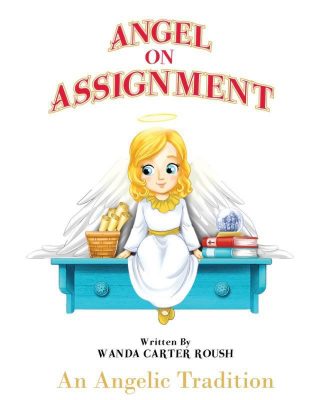
During the holiday season, it’s easy to become distracted from the true meaning of Christmas. In Angel on Assignment Wanda Carter Roush tells the story of this holiday and the important role that angels play.
Borrowing from the idea of Elf on the Shelf, this charming Children’s book teaches that angels are sent on assignment to help people. If you are ever scared, you need not be afraid because an angel is there to protect you. Children will love rolling up their sleeves and getting busy as they take the story to the next level and create their very own angel, and thus begin their own family tradition of having an angel on assignment.
Wanda Carter Roush is a former Sunday school teacher and children’s church director. She is the mother of five and was inspired by her youngest daughter to write this story to instill hope and peace of mind in children when they are scared. Angel on Assignment also challenges children to act as angels on assignment and always be on the lookout for those who need help because even the smallest deed can have a strong effect.
The book ends with instructions on how to make your very own angel. Imagination is an essential component to inspire children to be creative in creating their angel.
What makes Angel on Assignment truly special is that it encourages families to start a new tradition that serves to remind them of what they cannot see. What families can see are the wonderful illustrations by Mike Motz that bring the story to life.
Roush creates a wholesome tale with great lessons for children on how to deal with being afraid and encourages them to do selfless acts of kindness. Children, as well as parents, will love Angel on Assignment!
Angels on Assignment won 1st Place in the CIBA 2017 Little Peeps Awards for Children’s Literature.








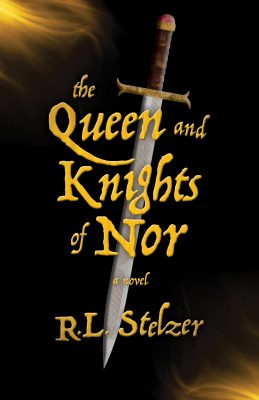
 Micha, Princess of Nor, can’t wait for her twenty-second birthday celebration. She wants to laugh with her sister, Olive, and their best friend and cousin, Dillip, and perhaps spend time with Percival, a prince from the nearby Mur. But her celebration is cut short when a messenger arrives at the manor with news that all of the inhabitants of the city of Valde, including her parents, have been enchanted by an evil witch Draka, who has escaped from her centuries-old mountain prison.