Tag: Child Abuse

  • LITTLE TEA by Claire Fullerton – Southern Fiction, Friendship Fiction, Cultural Heritage Fiction

    LITTLE TEA by Claire Fullerton – Southern Fiction, Friendship Fiction, Cultural Heritage Fiction

    Somerset Literary & Satire 1st Place Best in Category CIBA badgeAuthor Claire Fullerton’s skillfully crafted fourth novel, Little Tea, weaves bits and pieces of the human condition into a timely story.  

    Prepare to visit Fullerton’s Deep South, where, like the tropical storms from the Gulf, the southern mystique engulfs the land and its people. Beneath the genteel manners and tradition are whirlpools of passion, unrelenting memories, and behaviors that ebb and flow to and from the edges of conscious thought, leaving behind a sense of anxious anticipation.  

    From when Celia Wakefield agrees to meet her high-school friends, Renny Thornton and Ava Cameron, to spend a long weekend at Renny’s lake cabin in Arkansas, she’s been uneasy. She hasn’t gone “home” for more than ten years—it’s too painful. She first met Renny and Ava before her life inexorably changed. They were thirteen years old – newly-minted adolescents eager to spread their wings and take on the world. Besties ever since, Renny and Ava are a part of Celia’s present and unthinkable history. Celia needs their friendship, but the past floats just below the surface, like a ‘gator waiting for prey.

    But now she must go.  

    Ava, the fey sprite, the dream spinner, needs her help. She’s having a mid-life crisis and has reached out to her and Renny for support. 

    Celia agrees to fly to Memphis, meet Ava at the terminal, travel to Renny’s ranch in Olive Branch, Mississippi. From there, they will proceed to Renny’s lake house over the border in Arkansas for a long weekend of intervention and renewal. It’s all about Ava’s issues—not hers. It’s what good friends do. 

    That weekend, while Ava grapples with her discontent, alcoholism, and re-connects with her first love, Celia finds herself revisiting her own agonies. Her painful past, sublimated for so long, surfaces and demands resolution.   

    Little Tea resonates on many levels. 

    This modern-day drama juxtaposes the traumas of contemporary issues with unresolved traumas from history, where, for so many, the safe, secure, and predictable world of childhood innocence was ripped away, replaced by the unthinkable.

    For the reader who not only enjoys an engaging story but values skilled writing, Little Tea fits the bill. Fullerton’s use of lyrical language, imagery, and authentic dialogue capture the feel of the south. Her characters are believable—everyone knows an “Ava.” Fullerton uses setting as a nuanced character, always nearby, influencing without being intrusive and, her pacing and word choices are exemplary.        

    Like many modern, provocative novels, Little Tea ends not by tidying up anything. Fullerton leaves her readers with an open door, so to speak, that allows readers to venture out onto the porch, sit down on the old wicker rocker, and ponder what the characters might do next. In this trusting the reader, Fullerton gifts us with latitude for interpretation.      

    If you’ve never spent time in the south or wish to revisit, Little Tea will take you there. All in all, Fullerton has given readers a story that engages both the mind and the heart. Little Tea won First in Category in the 2019 Somerset Awards for literary fiction.

    5 Star Best Book Chanticleer Reviews round silver sticker


  • IMMUNITY: Entitlement of Wealthy Political Notables by Donna LeClair – Biography, White Collar Crime, Child Abuse

    IMMUNITY: Entitlement of Wealthy Political Notables by Donna LeClair – Biography, White Collar Crime, Child Abuse

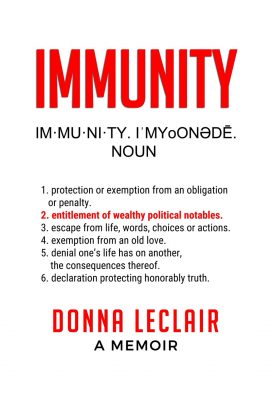
    Immunity, the latest offering by award-winning author Donna LeClair, recounts one woman’s struggles to maintain her sanity during a long nightmarish sojourn among the wealthy and powerful.

    Emma, a sixty-something Midwesterner, signs on as a personal assistant to the family of David and Pauline Gram and their four children, in a far off land that Emma comes to think of as “Hollow Wood.” She is told that anything the family does is okay and strictly confidential. On Day One Emma watches as Pauline consumes an illegal substance and tosses her a few hundred-dollar bills to purchase enough pasteurized goat’s milk for Pauline’s bathing pool. When she meets Luke, the only male heir to the Gram fortune (his twin having been forcibly aborted to guarantee he’d have no competition), she sees that he is cute, chipper and totally unaware of anyone’s needs but his own. Her first car ride with David is terrifying as he drives in the emergency lane at top speed and when stopped by the highway patrol, makes it clear that he can’t be given a ticket. In the Grams’ world, it’s not so much who you know but who you own.

    Trying to control her reactions to this selfish splendor, Emma discovers aspects of life with the Grams that are even worse than she could have possibly imagined. Pauline’s vast wardrobe never includes any outfit worn more than twice. David makes connubial visits to his wife, whom he keeps looking like a teenager by paying for the magic of the surgeon’s knife, on a strict schedule. Both parents snort, smoke and sip the best addictive substances, and when Emma hears the precise nature of their drug-related activities, she fears for her own safety. A romance keeps her temporarily soothed, but Emma will soon have to choose between her caring for the family and her culpability as a witness to their many nefarious dealings.

    LeClair is a prodigious wordsmith who uses the writing craft to good effect. Whether it is a drug-induced temper flare-up, the destruction of a motel room, or a brief erotic interlude, the author weaves a rich tapestry. She has made fiction, it seems, of a painfully recalled set of reminiscences, changing the names to protect the innocent and avoid the wrath of the guilty. She examines the word “immunity” in its many guises:  protection from penalty, entitlement of the very wealthy and well-connected, exemption from “an old love,” denial of responsibility, and “declaration protecting honorably truth.”

    Through Emma’s eyes, we see all of these definitions playing out. By stepping into daily life as the Gram family understands it, Emma must make sacrifices that she may later regret. Thankfully, LeClair has ensured an ending that will give Emma the new chance she deserves and take away some of the weapons of power wielded by the Grams and their ilk.

    Immunity won First Place in the 2017 CIBAs, in the JOURNEY AWARDS for narrative nonfiction.


  • BROKEN PLACES by Rachel Thompson, a Memoir of Abuse by Rachel Thompson – Child Abuse, Women’s Poetry, Sexual Abuse, Self-Help

    BROKEN PLACES by Rachel Thompson, a Memoir of Abuse by Rachel Thompson – Child Abuse, Women’s Poetry, Sexual Abuse, Self-Help

    While the incidence* of childhood sexual abuse continues to grow, thankfully there are survivors like Rachel Thompson who have conquered the horror.

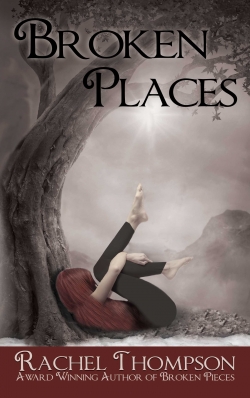
    In Broken Places: A Memoir of Abuse, Thompson conveys the facts and feelings of being an 11-year-old at the hands of a trusted neighbor who turns out to be a pedophile. The book dutifully begins with a “Trigger Warning,” notifying abuse survivors that the subject matter could be painfully harsh.

    Through poems, prose, and reflective pieces written with candor and literary charm, she shares how she coped: retreating to her room surrounding herself with books and music, and feeding her already introverted personality. She rarely went out except to earn good grades or do chores. “Because if I did, I faced the glaring, accusatory stares of his wife and children—as if I were the one who committed such ghastly crimes.” Later, she drank, got high, and considered suicide.

    Not until her thirties, depressed, anxious, and following the birth of a daughter, Thompson sought therapy for the first time after a doctor’s visit left her with a PTSD diagnosis and a prescription for an anti-depressant. Therapy was “life-changing,” leading her to the realization that she, not her abuser, was in the driver’s seat of her recovery. “I love, I breathe, I work, I write, I live. What happened does not stop me.”

    Today, in her fifties, she is an advocate for sexual abuse survivors and runs the Twitter chat #SexAbuseChat. She owns a social media and book marketing company and previously wrote the essay collection Broken Pieces, A Walk In The Snark and the more humorous The Mancode: Exposed.

    A talented writer with a journalism degree, Thompson adeptly plays with point of view employing both first person singular (“I”) to convey her experiences, and first person plural (“We”), perhaps to denote a kinship among survivors: “We are no longer whole—we are bits of cells made up of dread, and fear, and shame. We speak in terms that separate us from ourselves because even now, all these many years later, we don’t want to own what happened.”

    Also, she sneaks in literary gems, like alliteration: “The bad thing takes your brain hostage, fills it with the detritus of denial, becomes dead leaves waiting for the deep scratch of the rake.”

    The only weakness of Broken Places is its arrangement, as it seems like a random assortment rather than an intentioned story. Perhaps this organization, or lack thereof, speaks to the uncertainty Thompson faced during a time in her life that was more about second-guessing and doubting rather than chasing butterflies and riding bikes like little girls that age should be doing.

    Most importantly, the book is recommended reading for adults, college students, and youngsters alike as it serves as the impetus for a much-needed culture shift—telling children that it’s okay to report abuse and for grown-ups to hear them.

    Broken Places: A Memoir of Abuse by Rachel Thompson won 1st Place in the CIBAs 2017 JOURNEY Awards for Memoir. 

    *1 in 5 girls and 1 in 20 boys is a victim of child sexual abuse, according to the National Center for Victims of Crime.