Tag: Chanticleer Writers Toolbox Series

  • BETWEEN the LINES: Mastering the Subtle Techniques of Fiction – by Jessica Morrell, Top-Tiered Editor – a Chanticleer Writer’s Toolbox post

    BETWEEN the LINES: Mastering the Subtle Techniques of Fiction – by Jessica Morrell, Top-Tiered Editor – a Chanticleer Writer’s Toolbox post

    The best fiction touches the deep layers in us. A writer achieves this affect by embedding dozens of techniques into his story. The process is artful, and, I’m  to report, often sly. In fact, fiction writers employ the sort of sleight-of-hand used by a magician; he distracts with patter; whispers so that we lean in to hear his low, confiding tone; surprises us when we least expect to be surprised, produces flourishes that awe with their boldness. And somehow he makes it look easy, although we know that it has taken years for him to master.
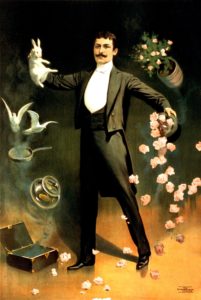
    But of course, writing fiction is not easy or merely a matter of employing tricks.

    Fiction writing means applying craft and artifice, and, like a conjurer’s lightening-speed maneuvers, it can be learned. You’ll look beyond the magician’s charming grin and focus on his ever-moving fingers, on the devices tucked up his sleeves, and then peer into his bag of gadgets. You start by mastering a few card tricks and then move on to a more difficult step: disassembling the magician’s contraptions, applying them to your understanding, and finally adding them to your stories.

    Explore

    Let’s begin with this understanding: Stories explore how interesting people act while dealing with significant problems at an important time in their lives.

    Stories explore human vulnerabilities and strengths and are usually focused on a character’s goals and dilemmas.

    Photo by @alessandroerbetta

    Stories inquire into why people act, react, struggle and change as they do.

    Stories are shaped from techniques that make the narrative lifelike and involved, complicated, and tense. And these fundamentals saturate the story with meaning which result in a deep, multi-layered world.

    It seems that there are as many types of fiction configured into novels, novellas, and short stories, as there are stars in a shimmering summer sky. There are comedies, tragedies, happily-ever-after stories, horror stories, historical re-creations, fantasies, young adult stories and novels that roller-coaster along with pathos, black humor, and grim portrayals of humanity. Some novels track the affairs of the heart; others track a murderer to his hideout or a monster to his lair. Fiction can be of a serious or literary bent or can be as fluffy as cotton candy. Short stories come in all sizes, and novels weigh in at a mere 60,000 words or ramble on to 200,000 words, while most lie in between.

    So the first choice of a would-be fiction writer is to choose the type and scope of the story (short, novella, novel, series, or epic?); then comes the reality of crafting it. That’s when a word-slinger-to-be discovers that creating a compelling narrative is complex and difficult. Or, that the idea for a story that seemed so dazzling and original when he first imagined it becomes flat and predictable when translated onto the page.

    Adding to this reality, beginning writers are often daunted by rules and advice about how fiction is constructed. I’ve noticed that writers tackle fiction in several ways. Some writers simply ignore advice, preferring to wing it or write guided by instinct and intuition, claiming that guideline are a straight jacket to plotting and creativity. Then there are writers who take the opposite path and slavishly read every book written on the topic, outline obsessively, and work with archetypes and mythic structure. The writers in the second group often spend five, six, ten years on a manuscript, revising it so many times that it bears little resemblance to their original concept. Perhaps the healthiest approach to writing fiction lies somewhere in between.
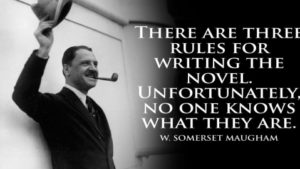
    He may be on to something…

    You see, it’s impossible to write fiction without understanding its underpinnings such as conflict, scene structure, and character development. Without this understanding , you might write two or three or four hundred pages, but you won’t end up with a story; instead you’ll produce a lot of words on a lot of pages or a haphazard pile of scenes loosely clustered around characters who never quite
    come to life.

    A story of any length can never be haphazard or based on predictable characters. Readers want to be haunted by characters and specific scenes that linger in their memory. They want to carry their story within and as they go about daily activities. They want to be transported to another time and place. Let’s begin adding to our understanding, so that you too can create a haunting story.

    Ingredients for Success

    Writing fiction means you’ll be entering another realm because fiction writing requires an intense immersion into your character’s lives and your story world. And because a novel is the sum of many parts, you learn how these parts work together, then once mastered, you can add the delicate layers of techniques that are covered in these chapters.

    It’s difficult to find the perfect analogy for writing fiction, but you can compare it to another kind of artistry—an elaborate meal prepared with precision by a master chef. Every element of the meal will entice, from the aromas to the presentation to the last savored morsel. There will be an array of flavors, textures, and colors all meant to beguile and satisfy, a constellation of delights. The same with works of music or art that resonant.

    While a magician’s tricks happen at lighting speed and thus are difficult to discern, you can witness a chef at work, a composer hammering out her next piece, or an artist trying to capture the light or test for the perfect brushstroke, and learn from their practiced approach. For purpose of illustration, we will use the chef! You can take note of the ingredients he works with—extra-virgin olive oil and aged balsamic vinegar, fresh oregano, the finely minced garlic or ginger. You can witness how he sears the flank steak to seal in flavors and deglazes the pan to create a sauce. If you suspect that his seemingly effortless approach took years to acquire, you’d be right. But luckily, his recipe can be followed and his techniques emulated.

    When it comes to fiction, think of these elements as your ingredients, not formulas. Remember, too, that cooking is a physical activity and requires forethought and analysis, as does fiction writing. When you cook a dish such as paella, you use a whole list of ingredients, but if you don’t add the correct ingredients at the correct time and fail to allow the ingredients to simmer until the flavors have melded, the dish will fail. Or, if you omit a crucial ingredient like saffron, it won’t taste authentic. Similarly, ingredients in fiction are the raw materials that combine to create a finished product, but they don’t necessarily create an involving story.

    Good stories come from the vibrancy of your characters, along with the subtler aspects found between the lines. – Jessica Page Morrell

    LEARN FROM THE BEST at VCAC 20!

    Jessica will teach Master Writing Classes for Intermediate to Advanced Writers at VCAC20! 

    Jessica Page Morrell
    Jessica Page Morrell

    Jessica Page Morrell is a top-tier developmental editor for books and screenplays. Her articles have appeared in Writer’s Digest and The Writer magazines. She is known for explaining the hows and whys of what makes for excellent writing and for sharing very clear examples that examine the technical aspects of writing that emphases layering and subtext. Her books on writing craft are considered “a must have” for any serious writer’s toolkit.

    Jessica will teach Master Craft Writing Classes at the Chanticleer Authors Conference VIRTUAL Conference that will be held from Tuesday, Sept 8 – Sunday, Sept. 13, 2020. She will present sessions and Master Classes on September 17, & 18,  2020 in conjunction with the virtual conference. She and Kiffer will also host a fun kaffeeklatch for Word Nerds at VCAC20.

    Master Classes are discounted for VCAC20 attendees. Or you may register for only the Master Writing Classes.

    Did you know that Chanticleer offers editorial services? We do and have been doing so since 2011.

    And that our professional editors are top-notch and are experts in the Chicago Manual of Style. They have and are working for the top publishing houses (TOR, Macmillan, Thomas Mercer, Penguin Random House, etc.) and award-winning independent presses. If you would like more information, we invite you to email Kiffer or Sharon at KBrown@ChantiReviews.com or SAnderson@ChantiReviews.com.

    Click here to read more about our Editorial services: https://www.chantireviews.com/services/Editorial-Services-p85337185

    A great way to get started is with our manuscript evaluation service. Here are some handy links about this tried and true service:

    https://www.chantireviews.com/manuscript-reviews/

    We work with a small number of exclusive clients who want to collaborate with our team of top-editors on an on-going basis. Contact us today!

    Writer’s Toolbox

    Thank you for reading this Chanticleer Writer’s Toolbox encore edition article. 

    We encourage you to stay in contact with each other and with us  during this stint of practicing physical distancing to prevent the spread of COVID-19 — especially at this time of re-opening.

    Let us know how you are doing, what is going on where you live, how are you progressing on your writing projects.

    I invite each of you to join us at The Roost – a private online Chanticleer Community for writers and authors and publishing professionals. You are welcome to email me for more info also.

    We are active on Facebook, Twitter, and Instagram. You can find us by using our social media handle @ChantiReviews

    Minimize physical contact! Maximize social connecting!

    Be well. Stay safe. Keep writing! Keep Creating! Kiffer 


  • Putting More Character into Your Characters – by Skip Ferderber – a Chanticleer Writer’s Toolbox Post

    Putting More Character into Your Characters – by Skip Ferderber – a Chanticleer Writer’s Toolbox Post

    Maybe it’s just me, but I often find myself lost when it comes to keeping track of multiple characters in a book I’m reading.

    Sometimes I’ll find myself about two-thirds through a novel when someone named Betty or Steve pops up in a conversation with my protagonist with an important piece of detail about the plot or a character development. Instead of taking in that information and using it to hurtle further into my novel, I find myself wondering who that character was, whether I’d seen him or her before and feeling a bit inadequate and frustrated that I can’t remember anything at all about the character.

    What I should consider instead is getting annoyed at the writer for not making the character memorable enough.

    Not every character in a book carries the same weight. You have your protagonists, your supporting cast, and possibly a boatload of tertiary characters. When it comes to the first two groups, you probably labor hard at making them distinguishable. But what about those pesky extras, the ones who are roughly the equivalent of chair-fillers in a night club in a ‘30s movie? You can’t waste your precious words on giving everyone a character workup . . . or can you?

    Consider this a good rule of thumb when you write about any character, large or small: If they’re in your book, you’ve got to know them well enough to tell your readers about them.

    “If you’re going to have a character appear in a story long enough to sell a newspaper, he’d better be real enough that you can smell his breath.” ~ Ford Madox Ford

    In an otherwise excellent novel I read recently, a career woman in her late 30s is talking at lunch to three girlfriends from her high school years. It was clearly meant as exposition about the woman, her struggles as a high-school non-entity to her present-day role as a prominent society all-star with three people from her past giving some much-needed context to that transition. But the author uses them as props. She might as well have been talking to three empty chairs.

    She might has well been talking to three empty chairs…

    If one of them had looked disbelieving at their friend, exchanged glances with each other, hastily taken a sip of wine, idly played with her silverware, etc., the scene would have had greater weight. If the central character had noted any physical differences from each or any of her friends, had an intense one-on-one exchange with any of them, turned that small discussion into a more personalized exchange, I would have known more about how the protagonist functioned.

    All I can recall in retrospect is that four women had lunch.

    So much can be done with characterization to make even the smallest “extra” memorable. One of my favorite examples comes from Daphne du Maurier’s “My Cousin Rachel.” As Philip travels to Tuscany to visit Ambrose, his troubled benefactor, he sees Italy not as a festive but as a sad, decaying land.

    He sees a young woman with a baby in her arms, apparently a beggar. Instead of using her clothes to show her situation, du Maurier writes,

    “She was young, not more than nineteen or so, but the expression on her face was ageless, haunting, as though she possessed in her lithe body an old soul that could not die; centuries in time looked out from those two eyes, she had contemplated life so long it had become indifferent to her.”

    Then she is gone. Poof!  But that brief moment on which she appears on du Maurier’s stage is a memorable detail in moving the story and its dark mood forward.

    One way to think about how you enhance your characters, large and small, is to consider the direct and indirect tools every writer has at hand.

    Direct tools are the most obvious: a person’s looks, clothes, their home, their family, their choice of music, books, the food they eat, etc. Indirect tools may include the way they look at someone (e.g., eyes narrow or open in pleasure or dismay), how they wipe their mouth after eating, a speech characteristic such as a small pause or a stutter. Their speech, how they approach their read, listen to music or watch movies, the way they sit, awkwardly gesture, lightly tighten their lips when they hear something they don’t like, a distracting memory . . .

    Your implementation of these tools will be important as you develop your story. It will help you elevate even the most mundane tale and make for a more enjoyable experience and hopefully increase your readership.

    It’s always worth your while to read the works of well known writers to see what characterization tricks they employ. But beware the trap of depending on them as a substitute for your own imagination. The maxim about writing itself being the only way to learn writing must be your truth. Try, fail and rise again. It’s the job, isn’t it.


    About Skip Ferderber 

    We are honored and proud that Skip is vital member of the Chanticleer Team of Professional Reviewers.  He has been a staff writer  for The Los Angeles Times, editor at Millimeter —a magazine that specialized in motion picture and television post-production, and has worked at several LA magazines during his career.  He is also a contributor to Geekwire, Puget Sound Business Journal, Sound Publications, and other Seattle-based media outlets.

    When not reviewing for Chanticleer Reviews & Media, Skip works on his second novel. He is an avid and intrepid traveler who has visited more than 20 countries including mainland China, Nepal, and Brazil with a journalistic eye for detail and subtext.


    HANDY LINKS to CHARACTER DEVELOPMENT Articles in the Chanticleer Writers Toolbox Series:

    ESSENCE of CHARACTERS – Part One – From the Jessica Morrell’s Editor’s Desk – Writer’s Toolbox Series

    CREATING UNFORGETTABLE SECONDARY CHARACTERS – Part Two of ESSENCE of CHARACTERS from Jessica Morrell’s Editor’s Desk – Writer’s Toolbox Series

    MINOR CHARACTERS – the SPICE of FICTION – Part One – From Jessica Morrell’s Editor’s Desk – Writers’ Toolbox Series

    MINOR CHARACTERS – the SPICE of FICTION – Part 2 From Jessica Morrell’s Editor’s Desk – Writers Toolbox Series

    CHARACTER NAMES are SIGNIFICANT in FICTION – Part Three: LANGUAGE and NAME-CRAFT in WRITING FICTION – a Chanticleer Writers Toolbox Blogpost by Jessica Morrell

    Did you know that Chanticleer offers editorial services? We do and have been doing so since 2011.

    And that our professional editors are top-notch and are experts in the Chicago Manual of Style. They have and are working for the top publishing houses (TOR, Macmillan, Thomas Mercer, Penguin Random House, etc.) and award-winning independent presses. If you would like more information, we invite you to email Kiffer or Sharon at KBrown@ChantiReviews.com or SAnderson@ChantiReviews.com.

    Click here to read more about our Editorial services: https://www.chantireviews.com/services/Editorial-Services-p85337185

    A great way to get started is with our manuscript evaluation service. Here are some handy links about this tried and true service:

    https://www.chantireviews.com/manuscript-reviews/

    We work with a small number of exclusive clients who want to collaborate with our team of top-editors on an on-going basis. Contact us today!

    Writer’s Toolbox

    Thank you for reading this Chanticleer Writer’s Toolbox article. 

    We encourage you to stay in contact with each other and with us  during this stint of practicing physical distancing to prevent the spread of COVID-19 — especially at this time of re-opening.

    Let us know how you are doing, what is going on where you live, how are you progressing on your writing projects.

    I invite each of you to join us at The Roost – a private online Chanticleer Community for writers and authors and publishing professionals. You are welcome to email me for more info also.

    We are active on Facebook, Twitter, and Instagram. You can find us by using our social media handle @ChantiReviews

    Minimize physical contact! Maximize social connecting!

    Be well. Stay safe. Keep writing! Keep Creating! 

  • COMPONENT LAYERS of SUCCESSFUL FICTION – A Chanticleer Writer’s Toolbox blog post by Jessica Morrell

    COMPONENT LAYERS of SUCCESSFUL FICTION – A Chanticleer Writer’s Toolbox blog post by Jessica Morrell

    Elements of successful fiction layer and fold back in on each other to create resonance, nuance, subtext, and undercurrents of great storytelling. – Kiffer Brown

    In this enlightening and instructional blog post by top-tiered editor and one of Chanticleer’s exceptional Master Writing Craft teachers, Jessica Morrell, will expand on the following components of exceptional fiction.

    Elements of Successful Fiction

    • The Dramatic Question
    • An Intimate Simmering World
    • Characters Built from Dominant Traits
    • Emotional Needs
    • Significance
    • Motivation Entwined with Backstory
    • Desire
    • Threat
    • Causality
    • Inner Conflict
    • Midpoint Reversal
    • Satisfying Ending

    Dramatic Question 

    Compelling fiction is based on a single, powerful question that must be answered by the story climax. This question will be dramatized chiefly via action in a series of events or scenes. If you are writing a romance, the question always involves whether the couple will resolve their differences and declare their love. In a mystery the dramatic question might be will Detective Smith find the serial killer in time to prevent another senseless death? In The Old Man and Seathe dramatic question is will Santiago catch the big fish and thus restore his pride and reputation?

    An Intimate, Simmering World 

    An intimate world isn’t created by merely piling on details. It means your story world has the resonance of childhood memories, the vividness of a dream, and the power of a movie. It’s filled in with shadows and corners and dogs and ice cubes and the sounds and smells of a dryer humming on wash day and a car blaring past, rock and roll music shaking the windows. Details lend your story authority, potency, and a palpable physical existence.

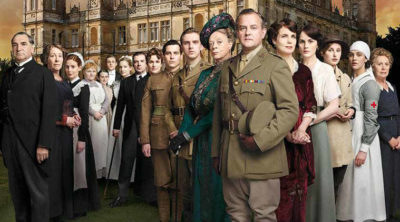
    Downton Abbey by Julian Fellowes — definitely an “intimate simmering world”

    An intimate story takes us to a specific place and coaxes us to remain there. An intimate story is lifelike and feels as real and complicated as the world the reader inhabits. When a reader finishes the final pages and leaves the story world, the reader should feel the satisfaction of the ending, but also a huge sense of loss. Much like a friend has moved to another town just when the friendship had reached a level of closeness and trust.

    Characters Built from Dominant Traits

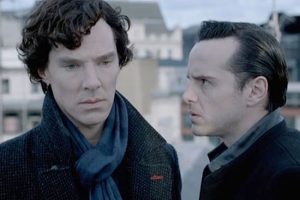
    Create main characters with dominant and unforgettable traits as a foundation of personality. These traits will be showcased in the story events, will help him achieve or fail at goals, and will make the story person consistent. For example, Sherlock Holmes’ dominant traits are that he is analytical, Bohemian, opinionated, and intelligent. These traits are showcased in every story he appears in along with secondary and contrasting traits. When the character first appears in the first scene, the character should arrive in the story with dominant traits intact.

    Sherlock Holmes and Jim Moriaty – enduring characters since 1892.

    Emotional Needs

    Protagonists and the main characters are people with baggage and emotional needs stemming from their pasts. These needs, coupled with motivation, cause characters to act as they do. For example, in Silence of the Lambs Clarisse  Starling is propelled by childhood traumas to both succeed and heal the wounds caused by the death of her father.

    The EXPANSE by James S.A. Corey went from a Sci-Fi book series to one of Amazon’s top video series. One reason is that the characters have some major emotional baggage.

    Significance 

    The storyline focuses on the most significant events in the protagonist’s life.

    Kiffer’s Note: As we were taught in journalism school, this is the “So what?” that our professors would continuously ask us. What were, are, and will be the significant events? Your story will show the “why and how.” Make your readers care. Make your readers interested and keep them caring.

    Crazy Rich Asians by Kevin Kwan  –  3 Perspectives Cubed makes for a complex story.

    Motivation Entwined with Backstory 

    Motivation, the why? of fiction, is at the heart of every scene, fueling your character’s desires and driving him to accomplish goals. It provides a solid foundation for the often complicated reasons for your character’s behaviors choices, actions,  and blunders.  Motivating factors provide trajectories for character development, as a character’s past inevitably intersects with his present. Your character’s motivations must be in sync with his core personality traits and realistically linked to goals so that readers can take on these goals as their own.

    See The Expanse SciFi series above. It said to be the current Game of Thrones of TV series streaming.

    Names convey emotional baggage and foreshadowing

    Desire 

    Desire is the lifeblood of fictional characters. Not only do your characters want something, but they also want something badly. Santiago, in The Old Man and the Sea desperately wants to restore his reputation and also wants his friendship and partnership with the boy to resume. And in the lonely hours when he is far out at sea, desperately struggling to hang on to the fish and fighting off sharks, we see his fierce desire acted out and the price he pays for it.

    The classic A League of Their Own – to be rebooted on Amazon 2021

    Here is a fun link to: 25 Things You Might Not Know About A League of Their Own 

    You can bestow on your character flaming red hair, an endearing, crooked grin, and a penchant for chocolate and noir movies, but if she doesn’t want something badly, she’s merely a prop in your story, not a driving force. But if she wants to win the Miss Florida contest, take over her boss’ job, or become the first female shortstop for the Atlanta Braves, then you’ve got a character who will make things happen and a story that will be propelled by desire.

    Threat

    Fiction is based on a series of threatening changes inflicted on the protagonist. In many stories, these threats force him or her to change or act in ways he or she needs to change or act. Often too, what the protagonist fears most is what is showcased in a novel or short story. It can be fear of losing his family, job, or health with this dreaded outcome providing interest, action, and conflict.

    The Martian by Andy Weir – one big ticking clock on so many different levels.

    Causality 

    Events in fiction are never random or unconnected. They are always linked by causality with one event causing more events later in the story, which in turn causes complications, which cause more events, which cause bad decisions, etc.

    Causality – the physics of writing

    Inner Conflict 

    A fictional character doesn’t arrive at easy decisions or choices. Instead, he is burdened by difficult or impossible choices, particularly moral choices, that often make him doubt himself and question his actions. Inner conflict works in tandem with outer conflict—a physical obstacle, villain, or antagonist–to make the story more involving, dramatic, and events more meaningful.

     Complications   A story builds and deepens by adding complications, twists, reversals, and surprises that add tension and forward motion. Plots don’t follow a straight path, instead, there are zigzags, dead ends, and sidetracks. Complications create obstacles and conflict, cause decisions to be made, paths to be chosen.

    12 Years A Slave – based on the memoir of Solomon Northrup, published in 1854

     Midpoint Reversal 

    The middle of a novel comprises more than half its length. At about the midpoint of most novels, a dramatic reversal occurs. The hunter becomes the hunted; a second murder occurs proving the detective has been wrong in his suspicions; a former lover arrives in town to complicate a budding romance. This reversal keeps the middle from bogging down and becoming predictable and also breathes new life and often a new direction into the story.

    Mid-point Reversal of Bride and Prejudice, an adaptation of Jane Austen’s Pride and Prejudice. Published in 1813, it is still relevant.

    Satisfying Ending 

    Every story needs an ending that satisfies the reader while concluding the plot. The final scenes, when the tensions are red hot and the character has reached a point of no return, must deliver drama, emotion, yet a logical conclusion. This is not to suggest that every plot ends with a shoot-out or physical confrontation because some endings are quieter, more thoughtful. Some endings are ambivalent, some a dramatic or a violent clash of wills. But there is always a sense that all the forces that have been operating in your story world have finally come to a head and the protagonist’s world is forever changed.

    Below is a scene from The Martian that heralds that maybe—just maybe—our protagonist may make it home—alive. It is a fun and creatively acted scene.  What a scene stealer! – Kiffer Brown

    A reversal of fortune in The Martian by Andy Weir

    The end is just the beginning…

    A Note from the Editor: A satisfying ending is one of the top, if not the top, reasons why books go viral and what will make your reader want to read your next work. Make sure that the you put as much effort in to a satisfying ending as you do into your opening hook. Kiffer Brown

    I hope that you found the visual examples enlightening. Determining and then searching for my favorite ones was fun! – Kiffer


    Jessica Page Morrell

    Jessica Page Morrell is a top-tier developmental editor for books and screenplays. Her articles have appeared in Writer’s Digest and The Writer magazines. She is known for explaining the hows and whys of what makes for excellent writing and for sharing very clear examples that examine the technical aspects of writing that emphasizes layering and subtext. Her books on writing craft are considered “a must have” for any serious writer’s toolkit.

    Jessica will teach Master Craft Writing Classes at the Chanticleer Authors Conference VIRTUAL Conference that will be held from Tuesday, Sept 8 – Sunday, Sept. 13, 2020. She will present sessions and Master Classes on September 17, & 18,  2020 in conjunction with the virtual conference. She and Kiffer will also host a fun kaffeeklatch for Word Nerds at VCAC20.

    Did you know that Chanticleer offers editorial services? We do and have been doing so since 2011.

    And that our professional editors are top-notch and are experts in the Chicago Manual of Style. They have and are working for the top publishing houses (TOR, Macmillan, Thomas Mercer, Penguin Random House, etc.) and award-winning independent presses. If you would like more information, we invite you to email Kiffer or Sharon at KBrown@ChantiReviews.com or SAnderson@ChantiReviews.com.

    Click here to read more about our Editorial services: https://www.chantireviews.com/services/Editorial-Services-p85337185

    A great way to get started is with our manuscript evaluation service. Here are some handy links about this tried and true service:

    https://www.chantireviews.com/manuscript-reviews/

    We work with a small number of exclusive clients who want to collaborate with our team of top-editors on an on-going basis. Contact us today!

    Writer’s Toolbox

    Thank you for reading this Chanticleer Writer’s Toolbox encore edition article. 

    We encourage you to stay in contact with each other and with us  during this stint of practicing physical distancing to prevent the spread of COVID-19 — especially at this time of re-opening.

    Let us know how you are doing, what is going on where you live, how are you progressing on your writing projects.

    I invite each of you to join us at The Roost – a private online Chanticleer Community for writers and authors and publishing professionals. You are welcome to email me for more info also.

    We are active on Facebook, Twitter, and Instagram. You can find us by using our social media handle @ChantiReviews

    Minimize physical contact! Maximize social connecting!

    Be well. Stay safe. Keep writing! Keep Creating! Kiffer 

  • CHARACTER NAMES are SIGNIFICANT in FICTION – Part Three: LANGUAGE and NAME-CRAFT in WRITING FICTION – a Chanticleer Writers Toolbox Blogpost by Jessica Morrell

    CHARACTER NAMES are SIGNIFICANT in FICTION – Part Three: LANGUAGE and NAME-CRAFT in WRITING FICTION – a Chanticleer Writers Toolbox Blogpost by Jessica Morrell

    I once taught a workshop when a writer proudly announced that he’d written an entire novel where none of the characters had names. It’s a story I never want to read. All plants, animals, objects, places and people have names that identify them.

    Naming people and things in fiction has a practical purpose because it appeals to the reader’s logic, imagination, and memory. We name characters to differentiate them, to suggest their age, social standing and personality, to make them solid and distinctive, and signal readers that the story person is worth noting.

    Jessica Page Morrell
    Jessica Page Morrell

    Since the reader will encounter your characters’ names again and again, bestow names  with care, and add subtle layers of meaning to a story via their names. Generally, the more complicated your character, the more distinct his or her name should be, (think Ebenezer Scrooge or Hannibal Lector) keeping in mind that names, like characters evoke a response in readers.

    Toolbox Tip:

    • All fiction writes need to collect names in a writer’s notebook or story bible, starting with the standard methods of gathering names by perusing phone books, obituaries, and baby name books.

    Be especially careful with a villain’s name, and don’t choose a name that works against type. You wouldn’t select a name for an arch villain that suggests a softie, nor would you give a good guy a name that has dark connotation.

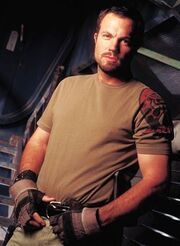
    Kiffer’s Note:  Although, one of my favorite Firefly characters is named Jayne. He is a bad-ass, no-neck, muscular guy who named his favorite weapon in his arsenal Vera. No one would dare make fun of his name to his face and live to tell about it. Also he wore (proudly) an absurd orange knit cap  with ear flaps, that his mother made for him. And speaking of names, the ship he served on was named Serenity. Life was anything but serene on Serenity.

    Jayne’s favorite hat
    Jayne was good to have on your side in a fight.

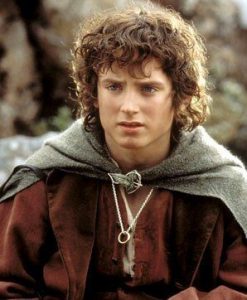
    If your story has a true villain, his name should reflect menace, coldness, and/or strength. You might consider using hard consonants and sounds to suggest menace or other characteristics. For example in Stephen King’s The Dark Half, a writer’s villainous alter ego is named George Stark.  Then there is Tolkien’s Gollum and Ian Fleming’s Auric Goldfinger.  Conversely, good guys will have names that suggest goodness, or perhaps strength, such as Tolkein’s characters Frodo, Sam, Merry, and Pippin.

    The best names reflect the genre and suggest the character’s traits such as Voldemort in the Harry Potter series.  On the other hand, the head master is Albus Dumbledore. Albus is from the Latin word alba, white, and his last name is Old English for bumblebee. So the headmaster’s name suggests honor and a hard-working nature. Sirius Black is Harry’s godfather. His first name is the dog star, appropriate for a wizard who can transform into a black dog.

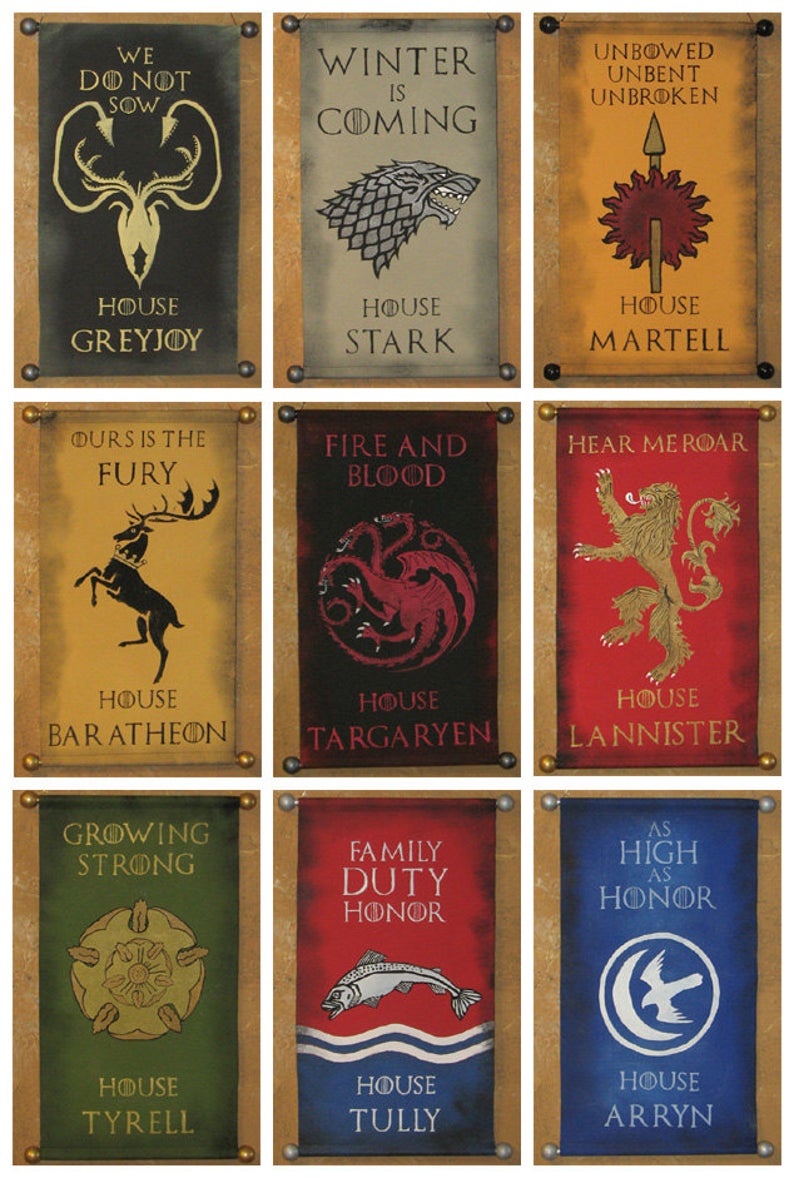
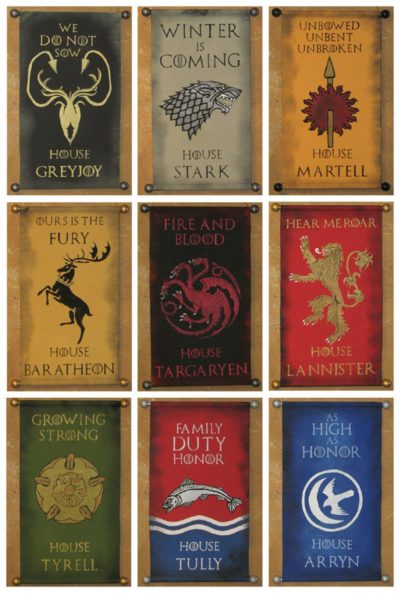
    George R.R. Martin’s fantasy series A Song of Ice and Fire is replete with terrific and memorable names: Mance Rayder, Tywin Lannister, Walder Frey and Jon  Snow. In fact, the series has such a crowded cast it comes with an appendix cataloging names. One royal family is also named Stark. The family is from a kingdom of the north, Winterfell and the Starks are tough and cunning and hardened, with a lower hall filled with the bones of their ancestors.

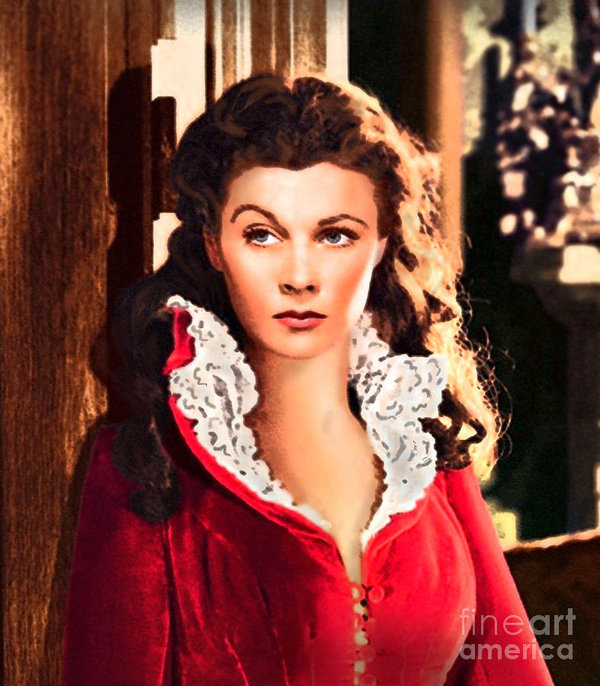
    It often works best to give tough, plain spoken, or unsentimental types, equally unsentimental names. Thus, your straight-shooting, beer-loving cop likely wouldn’t be named Julian or Florian, (no offense to the Julians and Florians of the world) but instead might be Jake or Jesse or Max. An alpha type needs an alpha-sounding name as does James (Jamie) Fraser in Diana Gabaldon’s Outlander series.  Of course this works for women too as shown in Ma Joad of The Grapes of Wrath. Many writers use names that are suggestive such as Romeo suggesting romance, Holly Golightly suggesting a light hearted nature, and Scarlett O’Hara a beautiful flirt.

    In Dean Koontz’s Forever Odd he gets the names just right and the villainess is called Datura which reflects her kinkiness, coldness, and cruelty. However, Koontz cleverly has chosen a name with layers of meaning, something fiction writers are always striving for. Datura is a flowering plant that is also called Devil’s Trumpets and Angel’s Trumpet. The Datura species, which has beautiful trumpet-like flowers exudes a narcotic-like scent, especially at night and is considered a sacred visionary plant. Datura plants have been used in many regions and by many cultures for medicinal and spiritual reasons, especially by shamans who use it for its clairvoyant powers. It is also interesting to note that all the Datura species contain potent alkoids which when taken in sufficient quantity have the power to kill.

    Of course, like all parts of fiction sometimes writers go awry when naming characters. One problem is that they take this technique too far. Examples are naming a macho private eye Rod Magnum or Sam Blaster or naming a seductress Jezebel Flower.

    Choose a character name that is age-appropriate and don’t make the mistake of choosing a name that is popular now for an adult character but wasn’t popular at the time of the character’s birth. To research the etymology and history of first names go to www.behindthename.com. If you’re writing historical fiction, it’s crucial that your names are historically accurate. Thus you wouldn’t name a 16th century character Tiffany or Shawna. But Geoffrey, Humphrey, and Giles have an authentic ring as do Eleanor, Phillipa, and Thomasina. And while Hester Prynne works for moniker of the scarlet woman of seventeenth century, her name wouldn’t work for a contemporary woman.

    Kiffer’s Note: In The Twilight series by Stephanie Meyer, naming characters had its own special conundrums. The characters exist in contemporary U.S.A. but may be from the 1918 such as Edward Cullen or Carlisle Cullen who was born in the 1640s. Meyer wanted the names to appropriate for the time period when they were born and that would not seem weird in contemporary America. Cullen is the name that Carlisle gave his Olympic coven.

    Edward Cullen, born 1901
    Carlisle Cullen, born 1640

    What to avoid in naming

    Another problem is featuring a story with too many names that sound alike—Jana, Jen, Jed, and Janine. Or names that rhyme like Ted and Ned. Or names that share the same vowels sounds like Sean and Dawn.  So you want your cast names to have contrast and variety. Other problems are naming a character after a real person as in William Washington Clinton, Prime Minister of the Federated Territories.

    Avoid also cutesy spellings or the alphabet soup syndrome most often found in science fiction or fantasy where the reader is left wondering how to pronounce oddball names like Aarghe or Zyyxr or T’muhra.   You might try combining two contemporary names or twisting a contemporary name to change it somewhat, or use mythological names or simply ones that are easy to pronounce like Bilbo Baggins from Lord of the Rings.

    Other TIPS:

    • Avoid androgynous names (unless that is part of your story)
    • Do pair unusual first names with simpler last names (Clark Bartholomew)
    • Or simple last names with complex first names (Reginald Clark)
    • Don’t use a name where the last letter of the first name is the first letter of the last name (Thomas Sinclair)
    • The more populated the story, the more the names should differ. (GOT examples – Jon Snow, Daeneys, Arya Stark, Cersei Lannister, Tormund Giantsbane…)
    • Avoid pairing characters with obvious names such as a bad guy named Damon or Rafe and a sweet heroine named Angela.

    Names are a terrific way to anchor a story with authenticity as Mario Puzo did in The Godfather with the Sicilian immigrant Don Vito Corleone and his sons, the tough quick-tempered one is Santino, Frederico is the weaker son, and Michael, the good son. Well, at least he starts out the story as the good son. Then there was Lucca Brazi who ended up sleeping with the fishes and Johnny Fontane, the singer whose name suggests the era.

    It’s also helpful to know how your character feels about his name. Many people don’t like their names, don’t believe their names suit them, or shorten or change their names—James is called Jim, Margaret shorten end to Meg, Jerome to Jerry. And that in itself can lend sub-context to your story.

    TITLES — that is an entirely different subject… Just imagine if the Twilight Saga kept its working title Forks. So stay tuned. If you haven’t subscribed, we invite you to do so! 

    Keep writing, keep dreaming, have heart. Jessica

    Keep creating magic! Kiffer 


    HANDY LINKS to Other Chanticleer Writers Toolbox blog-posts on Character Names and Language in Fiction. 

    Language and Names in Writing Fiction Part 1

    Language and Name Craft in Writing Fiction Part 2


    Jessica Page Morrell

    Jessica Page Morrell is a top-tier developmental editor for books and screenplays. Her articles have appeared in Writer’s Digest and The Writer magazines. She is known for explaining the hows and whys of what makes for excellent writing and for sharing very clear examples that examine the technical aspects of writing that emphases layering and subtext. Her books on writing craft are considered “a must have” for any serious writer’s toolkit.

    Jessica will teach the Master Craft Writing Classes at the Chanticleer Authors Conference VIRTUAL Conference that will be held from Tuesday, Sept 8 – Sunday, Sept. 13, 2020. She will present sessions and Master Classes during the conference. She and Kiffer will also host a fun kaffeeklatch for Word Nerds at CAC20.

    Did you know that Chanticleer offers editorial services? We do and have been doing so since 2011.

    And that our professional editors are top-notch and are experts in the Chicago Manual of Style. They have and are working for the top publishing houses (TOR, Macmillan, Thomas Mercer, Penguin Random House, etc.) and award-winning independent presses. If you would like more information, we invite you to email Kiffer or Sharon at KBrown@ChantiReviews.com or SAnderson@ChantiReviews.com.

    Click here to read more about our Editorial services: https://www.chantireviews.com/services/Editorial-Services-p85337185

    A great way to get started is with our manuscript evaluation service. Here are some handy links about this tried and true service:

    https://www.chantireviews.com/manuscript-reviews/

    We work with a small number of exclusive clients who want to collaborate with our team of top-editors on an on-going basis. Contact us today!

    Writer’s Toolbox

    Thank you for reading this Chanticleer Writer’s Toolbox article. 

    We encourage you to stay in contact with each other and with us  during this stint of practicing physical distancing to prevent the spread of COVID-19 — especially at this time of re-opening.

    Let us know how you are doing, what is going on where you live, how are you progressing on your writing projects.

    I invite each of you to join us at The Roost – a private online Chanticleer Community for writers and authors and publishing professionals. You are welcome to email me for more info also.

    We are active on Facebook, Twitter, and Instagram. You can find us by using our social media handle @ChantiReviews

    Minimize physical contact! Maximize social connecting!

    Be well. Stay safe. Keep writing! Keep Creating! 

  • TIPS for FICTION WRITERS – from Jessica Morrell’s Editor’s Desk and Kiffer Brown – Chanticleer Writers Toolbox Series

    TIPS for FICTION WRITERS – from Jessica Morrell’s Editor’s Desk and Kiffer Brown – Chanticleer Writers Toolbox Series

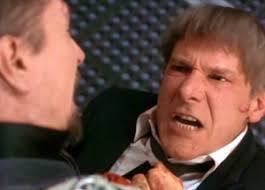
    Get off my plane! Air Force One (1997)

    Sometimes we all need reminders to keep us on track and focused while writing. We hope that you will find these tips handy.

    • Make certain that a major crisis, reversal or twist occurs at the midpoint to send the story skittering in a new direction and creating new motivation for the protagonist.
      • Kiffer:  It doesn’t matter if you are writing a lighthearted romance or a thriller or middle-grade fiction, keeping your readers guessing will keep them entertained and turning the pages.
    • Make certain that your protagonist is struggling with internal conflict as well as external conflict.
      • Kiffer: Jessica has contributed some excellent posts on creating complicated protagonists. See links below.
    • The reader’s first glimpse of the protagonist should evoke sympathy.
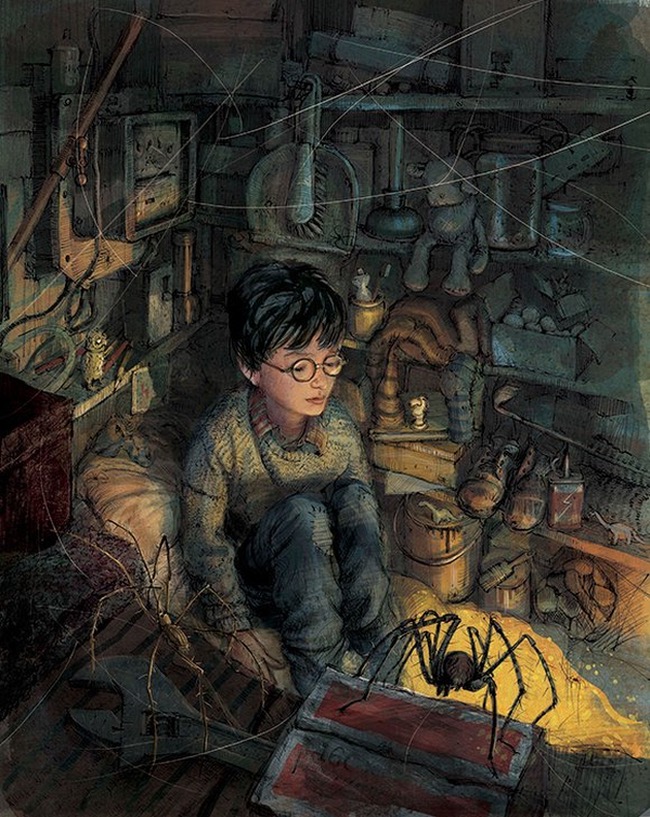
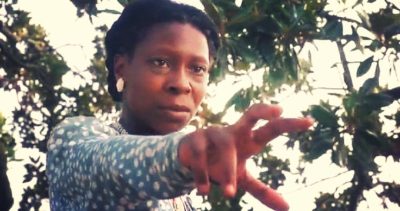
      • Kiffer: Think of Celie of The Color Purple, Harry Potter, Tom Ripley in the The Talented Mr. Ripley, James Bond in Casino Royale, Anne Shirley of Anne of Green Gables, Dana of Kindred, Katniss in the Hunger Games, Bella Swan in Twilight.

        The Cupboard Under the Stairs Artwork by Jim Kay, Illustrator for the Harry Potter series.
    • Base fiction around a single dramatic question.
      • Kiffer: This will become your log-line or pitch. See link below.
    • Remember always that you are a storyteller first. Stories are not merely about issues or themes. Fiction is about how threatening events affect fictional people.
    •  While a storyline requires a series of crises, surprises and reversals, do not use violence, sex, sin, gore, or murder to enliven a sagging plot.
      • Kiffer: This is known as lazy writing in the publishing biz. Don’t ever let yourself get labeled as a “lazy writer” by taking the easy way out.
    •  Don’t launch a story with too many characters for the readers to track in the opening.
      • Kiffer:  This is something that we see often when evaluating manuscripts–too many story lines cramped into one work when they should be divided out into a series or other story arcs.
    •  Keep dialect to a minimum and don’t write it without thorough research or intimate knowledge.
    • Dialogue immediately reveals a writer’s skills. Use it sparingly  and effectively by understanding that it is inherently dramatic. Avoid long sections of endless dialogue. Also avoid long sections where there is no dialogue. Eliminate mundane exchanges and repetitions. Limit using dialogue to reveal backstory.  Keep attributions short.
    •  Remember that the opening has much to accomplish including establishing the voice, viewpoint, tone, and pacing.
      • Kiffer: Most readers will determine if they want to invest time in reading a work by the opening.
    •  Characters are revealed while acting, talking, making choices and decisions. People are what they do.
    •  Make certain that there is a visual element on every page.
      • Kiffer: Scenes that are void of sensory input have a writing craft problem known as  “white room” syndrome. White room syndrome is where the characters float around the scene without visuals, noise, smells, atmosphere, or tactile experiences. There is nothing to anchor the reader into the scene.
    •  Create a vibrant and quirky cast of secondary and minor characters to enliven the story and reveal several sides of the protagonist.
    •  Don’t start major edits or rewrites until you finish your first draft.
      • Kiffer: As award-winning author Michelle Rene advises: “Pour your heart and soul into the rough draft with reckless abandon.” In other words, don’t start nitpicking and ripping into your work until you have a story idea that is fully formed. Let yourself be creative! Get the story down and then go back to fill in the blanks or to do research. Enjoy the creativity of following in love with your story and characters.

        Head Over Heels in Love with Your Story Idea!
    •  Each major character has an agenda and purpose.
    •  Avoid problems being solved by another character or force of nature.
      • Kiffer:  Avoid Deux Ex Machina (aka dragons, lottery winnings, Prince Charming, etc.). However, there are few times when it works (these tend to be in works that explore the human psyche) such as in the Wizard of Oz when it was all a dream for Dorothy or in Shakespearean works that tend incorporate human psyche archetypes.
    •  Beware of digressions that follow your interests or research, not the story. Rein yourself in.
      • Kiffer: This means that you should not use all that research that you gathered. However, all that research could become subtext and subtle undercurrents of your story. Use research as you would spice—as needed. Just because you have it (research/spice) doesn’t mean that you should use it all. #justsaying
    •  Nothing should happen at random, all fiction is causal. Fiction is storytelling.
    •  Structure scenes around scene goals and opposition to these goals.
      • Kiffer: This is the story current—imagine that your story is a river. Does it flow straight at a constant speed? Or does it bend and twist so that the readers do not know what is just around the corner? Does it have eddies? Does it have turbulence caused by huge obstacles to overcome? Does it run deep? Or shallow? Or both? Shallows can be very dangerous…

    Keep writing, keep dreaming, have heart. Jessica

    Keep creating magic! Kiffer 


    Chanticleer’s Writer’s Toolbox

    Handy Links to More Chanticleer Writers Toolbox Series blog posts

    Will Your Story Idea Work? by Jessica Morrell

    Writing Protagonists by Jessica Morrell

    How to Write Your First Draft in Four Weeks by Michelle Rene, award-winning author

    Prepping to Write: Plotting, Inciting Incidents, Atmosphere, Characters by Jessica Morrell and Kiffer Brown with advice from Chelsea Cain, Robert Dugoni, Stephen King…

    Inciting Incident: Story, Setbacks, and Surprises for the Protagonist – Jessica Morrell

    Minor Characters – the SPICE of FICTION by Jessica Morrell  (Part 1 & 2) 

    Part Two

    Essence of Characters Part One by Jessica Morrell

    Essence of Characters Part Two by Jessica Morrell


    Jessica Page Morrell
    Jessica Page Morrell

    Jessica Page Morrell is a top-tier developmental editor for books and screenplays. Her articles have appeared in Writer’s Digest and The Writer magazines. She is known for explaining the hows and whys of what makes for excellent writing and for sharing very clear examples that examine the technical aspects of writing that emphases layering and subtext. Her books on writing craft are considered “a must have” for any serious writer’s toolkit.

    Jessica will teach the Master Craft Writing Classes at the Chanticleer Authors Conference VIRTUAL Conference that will be held from Tuesday, Sept 8 – Sunday, Sept. 13, 2020. She will present sessions and Master Classes during the conference. She and Kiffer will also host a fun kaffeeklatch for Word Nerds at CAC20.

    Did you know that Chanticleer offers editorial services? We do and have been doing so since 2011.

    And that our professional editors are top-notch and are experts in the Chicago Manual of Style. They have and are working for the top publishing houses (TOR, Macmillan, Thomas Mercer, Penguin Random House, etc.) and award-winning independent presses. If you would like more information, we invite you to email Kiffer or Sharon at KBrown@ChantiReviews.com or SAnderson@ChantiReviews.com.

    Click here to read more about our Editorial services: https://www.chantireviews.com/services/Editorial-Services-p85337185

    A great way to get started is with our manuscript evaluation service. Here are some handy links about this tried and true service:

    https://www.chantireviews.com/manuscript-reviews/

    We work with a small number of exclusive clients who want to collaborate with our team of top-editors on an on-going basis. Contact us today!

    Writer’s Toolbox

    Thank you for reading this Chanticleer Writer’s Toolbox article. 

  • LANGUAGE and NAMES in WRITING FICTION – a Chanticleer Writer’s Toolbox Series – Jessica Morrell & Kiffer Brown

    LANGUAGE and NAMES in WRITING FICTION – a Chanticleer Writer’s Toolbox Series – Jessica Morrell & Kiffer Brown

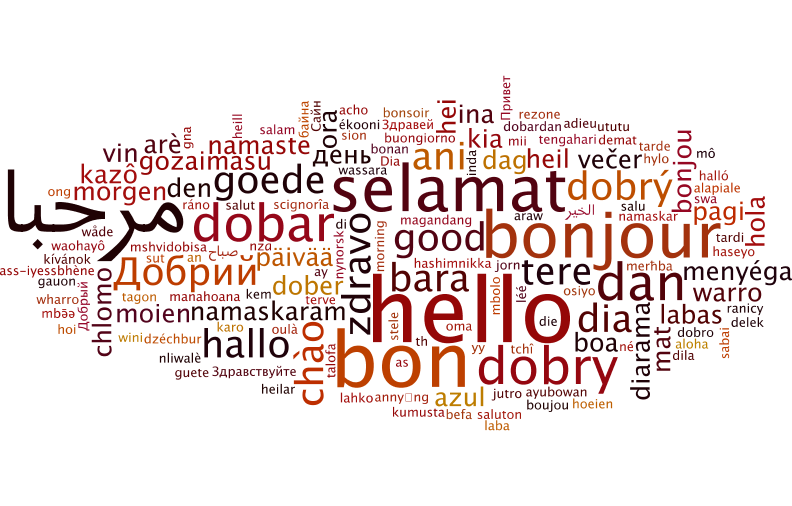
    Language sets the tone and creates the author’s voice.

    Names make characters memorable.

    Historical words allows for the cadence of past times to emerge.

    New words transport you to a different place and time.

    Nouns create time and place.

    Vocabulary and World Building is not just for science fiction and fantasy writers. Legal thrillers must accurately portray the reality of the judicial systems used. Historical fiction must be seasoned with the parlance of the time and place to bring the characters to life. Westerns have bounty hunters and train robbers.

    The Star Wars series set in the far future in a faraway place borrowed words from the past such as: knights, sabers, bounty hunters,  princess, master, and so on. Here is a link to a blog on Merriam-Webster ‘ website if you would like to read more in detail.

    And here is another fun link on Merriam-Webster:  Star Wars and Plain Words

    The best methods of using language to authenticate your fiction often lies in blending the familiar and new, including fresh word combinations. Jessica Morrell

    I confess, one of my secret pleasures is escaping with a cozy mystery and becoming immersed in it.

    One of my favorite series that I enjoy reading is the Henrietta and Inspector Howard mystery/historical fiction series by Michelle Cox. Cox is known for recreating Chicago in the 1930’s  during the Great Depression with cinematic detail that make her characters and settings come alive in the reader’s mind. Some old terms that she made new again are: twenty-six girl, taxi dancer, gallivant, paddy wagon, copper, weaseled, promenade, and other delightful words to transport her readers.

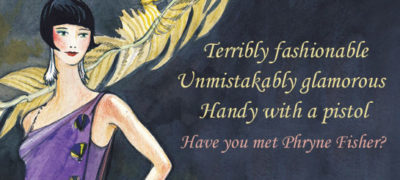
    If you are a fan of Kerry Greenwood’s Phryne Fisher’s Murder Mysteriesyou may want to add the Henrietta and Inspector Howard’s series to your must-read list.

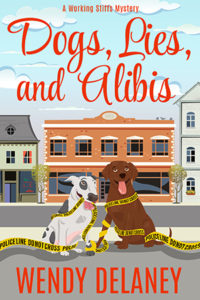
    Another one of my favorite series is the The Working Stiffs cozy mystery series by Wendy Delaney. Delaney adds color and subtext to her mysteries with her selected words. My favorite character (besides the protagonist, Char, a truth wizard and the amateur sleuth) is named “the crippler.”  This heinous character (a nemesis of Char’s) is one that many of us who visited relatives have been subjected to and can related to —the infernal sofa sleeper!  If you are looking for a cozy mystery that is engagingly humorous and cleverly crafted with a peculiar cast of regulars with small town charm, look no further than Delaney’s Working Stiffs Mysteries. Start with the first one—Trudy, Madly, Deeply.


    William Shakespeare is said to have coined more than 1700 words that we now use in the English language. He was particularly known for turning nouns into verbs such as “elbow.”  A few example of other words that we use today that he coined are: zany, grovel, luggage, madcap…

    Click here for a sample of other words that he coined and also links to the works where Shakespeare used them. This handy link also has other links and resources for you to go down the rabbit hole (as I did). Citation: Mabillard, Amanda. Words Shakespeare InventedShakespeare Online

    From Jessica Morrell’s Editor’s Desk

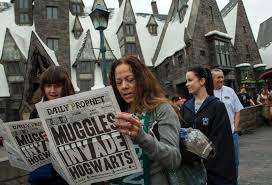
    J.K. Rowling author of the Harry Potter series is known for creating spells from Latin terms (Avada Kadavera) and coining fresh word combinations like parseltongue for the language of snakes and serpentine creatures.  Humans who can speak this language are called parselmouths. She also brought us dementors, muggles, and death eaters. Here’s an updated Harry Potter vocabulary guide that proves the richness of Rowling’s language that anchors the Potter world.

    It’s not like you need to create eleven new languages like George R.R. Martin did for his Songs of Fire and Ice. Or do you? Most of us have heard the Dothraki and Valyrian. (By the way, the Star Wars series has 68 languages.) These important languages in the GOT HBO series were expanded by hired consultants who matched words with the culture and history. And wouldn’t you know it, people around the world are learning these invented languages. There’s also the Common Tongue spoken by most citizens of the kingdom, the Old Tongue mostly spoken north of the Wall, and the True Tongue spoken by the mysterious children of the forest.

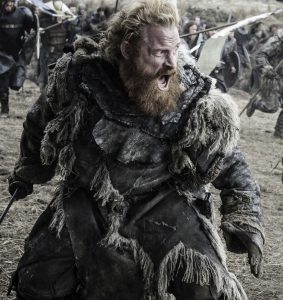
    Tormund Giantsbane of the Free Folk, A Song of Fire and Ice.

    Kiffer chimes in…

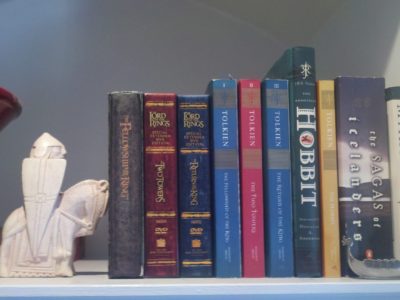
    And let us not forget J. R.R. Tolkien’s Lord of the Rings fantasy and adventure series and its many languages that Tolkien created for this world. The internet  has many websites listed that are dedicated to guides pronunciation, official definitions, etymologies,  and the histories of the languages that he created.

    The invention of languages is the foundation. The ‘stories’ were made rather to provide a world for the languages than the reverse. To me a name comes first and the story follows. J.R.R. Tolkien

    As most Tolkien fans, I have read the entire collection more than once or twice. And true to a classic, each and every time that I reread it, more of the collection’s subtext is revealed to me.

    My Lord of the Rings Collection. The Silmarillion  is on the far right out of the camera range… It is displayed prominently in my home library.

    We’d love to hear from you! What are some words that you have coined, created, used in new and different ways for your works. Leave a comment or email us!

    Some more reference links:

    A website that focuses on language diversity with a Language Planisphere:  Soroscoro: So the languages of the world may live on!  

    And just for fun, here’s a link to a glossary list of sci-fi terms from  Writers Write website.

    A Game of Tongues: Why George R.R. Martin is a Linquist After All by WordJazz  (very insightful and interesting article with 20 points).

    How many languages are there in the world? Linguistic Society of America


    Our Next Posts

    Chanticleer’s next Marketing blog post will address a more deep dive into Hashtags and Social Media (How to Expand Your Social Media Reach to Increase Online Book Sales.

    Our next Editorial blog post will address The Importance of Naming Characters.

    So please stay tuned…


    Jessica Page Morrell

    Jessica Page Morrell is a top-tier developmental editor for books and screenplays. Her articles have appeared in Writer’s Digest and The Writer magazines. She is known for explaining the hows and whys of what makes for excellent writing and for sharing very clear examples that examine the technical aspects of writing that emphases layering and subtext. Her books on writing craft are considered “a must have” for any serious writer’s toolkit.

    Jessica will teach the Master Craft Writing Classes at the Chanticleer Authors Conference on Thursday, Sept. 3, 2020  and will present sessions during the conference. She and Kiffer will also host a fun kaffeeklatch for Word Nerds at CAC20.


    Did you know that Chanticleer offers editorial services? We do and have been doing so since 2011.

    Our professional editors are top-notch and are experts in the Chicago Manual of Style. They have and are working for the top publishing houses (TOR, Macmillan, Thomas Mercer, Penguin Random House, etc.) and award-winning independent presses. If you would like more information, we invite you to email Kiffer or Sharon at KBrown@ChantiReviews.com or SAnderson@ChantiReviews.com.

    Click here to read more about our Editorial services: https://www.chantireviews.com/services/Editorial-Services-p85337185

    A great way to get started is with our manuscript evaluation service. Here are some handy links about this tried and true service:

    https://www.chantireviews.com/manuscript-reviews/

    We work with a small number of exclusive clients who want to collaborate with our team of top-editors on an on-going basis. Contact us today!

    Writer’s Toolbox


    Thank you for reading this Chanticleer Writer’s Toolbox article. 

    We encourage you to stay in contact with each other and with us  during this stint of practicing physical distancing to prevent the spread of COVID-19 — especially at this time of re-opening.

    Let us know how you are doing, what is going on where you live, how are you progressing on your writing projects.

    I invite each of you to join us at The Roost – a private online Chanticleer Community for writers and authors and publishing professionals. You are welcome to email me for more info also.

    We are active on Facebook, Twitter, and Instagram. You can find us by using our social media handle @ChantiReviews

    Minimize physical contact! Maximize social connecting!

    Be well. Stay safe. Keep writing! Keep Creating! 

  • HOW to DEEPEN PLOTS from the Editor’s Desk of Jessica Morrell – A Chanticleer Writers Toolbox article

    HOW to DEEPEN PLOTS from the Editor’s Desk of Jessica Morrell – A Chanticleer Writers Toolbox article

    Fiction is about the cost of things.

    The plot should always somehow scar or wound the protagonist and put something valuable at risk.

    Protagonists suffer. Period. Paying heavy costs make characters relatable. I swear by these statements. Jessica Morrell

    Making protagonists suffer in storytelling creates stakes, motivation, and tension.

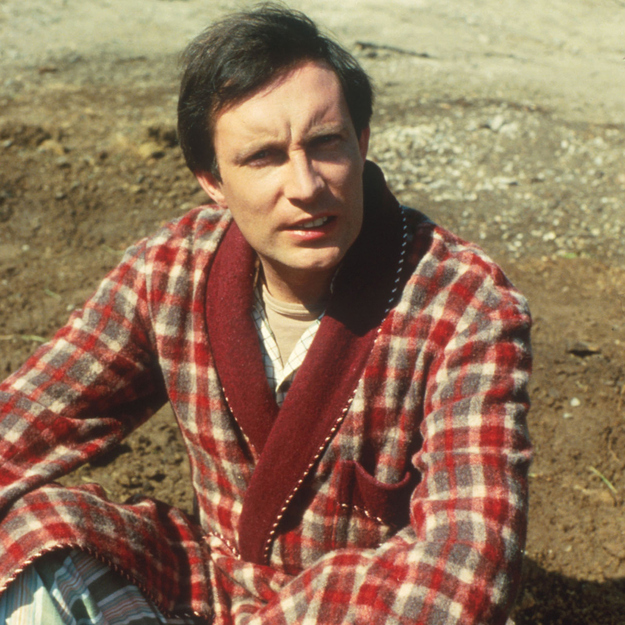
    Jon Snow – Game of Thrones

    Remember that fictional characters must take more risks than ordinary humans. But as in real life, not all risks pay off, but the cost should always be much higher in fiction.  Along the way friendships, allies, freedom or safety might be lost. Such is the cost of fiction.

    Even in comedies and cozy mysteries…

    How much will the protagonist suffer?  Sacrifice? Regret?

    Before I go further, it’s important to point out this doesn’t mean your protagonist will always be a martyr or your story ends in tragedy. But everything can be on the line in the fictional universe: friendships and allies, family, love, prestige, honor, trust, hope, money. Betrayals might happen. Long-held secrets revealed.  Obviously these possibilities create emotional distress.

    The Harry Potter novel series is a prime example of making your protagonist suffer from getting used mixed match socks for his birthday to betrayals to long-held secrets revealed.

    Just How Much Trouble Can this Kid Get Into?

    Not to mention to physical costs like  pain, injuries, and body parts. Think Katness fighting for her life in The Hunger Games and going deaf in one ear. Then she’s forced to fight for Peeta’s life because he’s been badly injured. (In the book, not the film series, he loses a leg)

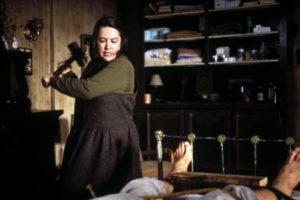
    Speaking of body parts: remember the suffering doled out by psychotic fan Annie Wilkes in Misery by Stephen King?

    Gulp.

    Misery by Stephen KingBecause bad things happen to our favorite characters. Really bad things. Your character’s suffering will always reveal his or her depths and strengths. Suffering always advances the plot. If it doesn’t, leave it out of your story.  Allow me to say it slightly different: any suffering, sacrifice, regret, betrayal, pain, or loss must advance the plot. 

    Let’s look at some examples:

    Jem Finch loses his innocence when he realizes the depth of racism in his small town in To Kill a Mockingbird.  

    Rocky Balboa is brutally beaten and loses to Apollo Creed. But he goes the distance and wins love.

    Juno MacGuff not only gives up her baby, but learns that the adoptive father-to-be is a man-child. She’s forced to risk giving her baby to a single mom instead of the stable couple she’d hoped for.

    Woody of the Toy Story series loses friends, risks his pride, leadership role,and life, battles greed and heartlessness. All these costs bring him maturity and wisdom.

    Woody of Toy Story

    In The Godfather the Corleone family loses their oldest son in the mob war that breaks out. Unfortunately it was Sonny’s impetuousness that started the war. The inciting incident, or catalyst in the story is a meeting between the Corleone family and are representative for the Tattaglia family. This issue on the table is investing a million dollars to get into heroin-trafficking business. Sonny, going against protocol, reveals his interest in the money-making scheme.

    After an attempt on the godfather’s life, and with the body count rising,  Michael, the youngest son, commits murder and is forced into hiding. The story follows his profound character arc from war hero and college graduate to cold-hearted mob boss. He loses his humanity with each power move and act of revenge.

    Michael Corleone and the Godfather

    Bad decisions often make things worse. Because fictional characters screw up a lot. Which brings on more misery, self-doubt, and need for more risks.

    Questions to consider when plotting:

    • Is the cost justified?
    • Will readers realize the cost or sacrifice is too great before the protagonist will?
    • Does the protagonist understand the cost involved or is he or she naive? Untested?
    • Can you make the toll affect several aspects of the protagonist’s life? Can the plot exact physical, emotional, financial tolls?
    • Will the cost involve another character? A vulnerable character?
    • Will the protagonist be exposed, peeled bare while paying the cost?
    • Will other characters try to dissuade the protagonist from paying the price?
    • Can you make the cost or sacrifice or pain visceral and believable?

    Moral Dilemmas to consider when plotting:

    • Principled choices and decisions will always create actions and consequences. They always drive the story forward.
    • Unprincipled choices and decisions typically cause chaos, pain, and also propel the story ahead. An example from Jurassic Park happens when the park employee-computer whiz leaves the grounds to sell off dinosaur DNA. His actions, taken during a horrendous storm, opens a Pandora’s box of disasters and life-and-death consequences.
    • The ramifications from all important decisions should be long lasting.
    • The higher the stakes, the higher the drama.
    • The choices often underline the genre type. A suspense story is often based on finding justice so decisions will hold a lot of weight and consequences.
    • Don’t provide characters easy answers. Corner them, stress them out, push them past their limits.
    • Know your fictional casts’ moral codes.

    Search out the important dilemmas in stories, noticing the enormous variety and possibilities. Are there shades in right from wrong? Is the crime story about sorting real justice from mob justice; truth from lies? Are actions based on loyalties,  faith, science, passion? 

    Homework

    Your homework this week:  Can you identify the cost in stories you read and films you watch?

    Keep writing, keep dreaming, have heart. Jessica


    Our  next marketing posts will be on SOCIAL MEDIA and PROMOTION TIPS for Selling Books ONLINE and New Selling Platforms.

    Our next editorial posts will be on Character Development.  So, please stay tuned…


    Jessica Page Morrell

    Jessica Page Morrell is a top-tier developmental editor for books and screenplays. Her articles have appeared in Writer’s Digest and The Writer magazines. She is known for explaining the hows and whys of what makes for excellent writing and for sharing very clear examples that examine the technical aspects of writing that emphases layering and subtext. Her books on writing craft are considered “a must have” for any serious writer’s toolkit.

    Jessica will teach the Master Craft Writing Classes at the Chanticleer Authors Conference on Thursday, Sept. 3, 2020  and will present sessions during the conference. She and Kiffer will also host a fun kaffeeklatch for Word Nerds at CAC20.

    Did you know that Chanticleer offers editorial services? We do and have been doing so since 2011.

    And that our professional editors are top-notch and are experts in the Chicago Manual of Style. They have and are working for the top publishing houses (TOR, Macmillan, Thomas Mercer, Penguin Random House, etc.) and award-winning independent presses. If you would like more information, we invite you to email Kiffer or Sharon at KBrown@ChantiReviews.com or SAnderson@ChantiReviews.com.

    Click here to read more about our Editorial services: https://www.chantireviews.com/services/Editorial-Services-p85337185

    A great way to get started is with our manuscript evaluation service. Here are some handy links about this tried and true service:

    https://www.chantireviews.com/manuscript-reviews/

    We work with a small number of exclusive clients who want to collaborate with our team of top-editors on an on-going basis. Contact us today!

    Writer’s Toolbox


    Thank you for reading this Chanticleer Writer’s Toolbox article. 

    We encourage you to stay in contact with each other and with us  during this stint of practicing physical distancing to prevent the spread of COVID-19.

    Let us know how you are doing, what is going on where you live, how are you progressing on your writing projects.

    I invite each of you to join us at The Roost – a private online Chanticleer Community for writers and authors and publishing professionals. You are welcome to email me for more info also.

    We are active on Facebook, Twitter, and Instagram. You can find us by using our social media handle @ChantiReviews

    Minimize physical contact! Maximize social connecting!

  • WORDCRAFT – HOW to MAKE IT HAPPEN – from Jessica Morrell’s Editing Desk – a Chanticleer Writer’s Toolbox post

    WORDCRAFT – HOW to MAKE IT HAPPEN – from Jessica Morrell’s Editing Desk – a Chanticleer Writer’s Toolbox post

    How Does Wordcraft Happen? by Jessica Morrell

    Focus on Language

    There are so many mechanics of writing style I could write about columns on the topic for years. Come to think of it, I have.

    Let’s focus on layering language into a story with care so that it adds to overall meaning and effect.

    This means making careful choices so that you don’t distract the reader from your narrative. As a writer, search for precise words and comparisons to satisfy your reader. The problem of finding the perfect word or imagery, instead of the almost perfect word, is no small matter.

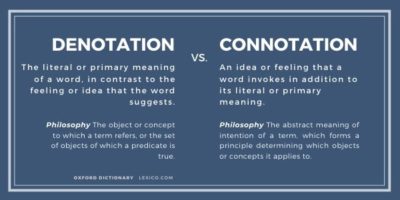
    Denotation or Connotation – Know the Difference

    While the literal or explicit meaning of a word or phrase is its denotation, the suggestive or associative implication of a word or phrase is its connotation. Thus you’re always making choices about meaning and language.

    Merriam -Webster says: “What’s the difference between connotation and denotation?

    While each of these two words has several possible meanings, they are notably distinct from each other in all senses. Denotation is concerned with explicit meaning, and connotation tends to be concerned with implicit meaning. The word home, for instance, has a denotation of “the place (such as a house or apartment) where a person lives,” but it may additionally have many connotations (such as “warmth,” “security,” or “childhood”) for some people.

    Examples of denotation in a Sentence
    The word has one literal denotation but several different connotations.
    The definition provides the word’s denotation.

    We all need a practical, sort of workday vocabulary that is consistent with our voice, and then we also need a vocabulary that’s the writer’s version of the Taj Mahal. Or, as another example, sometimes the style needs to be basic like bread pudding, sometime it needs to be more like a seven-layer wedding cake. Sometimes the best words are clear and simple, and sometimes they need to soar like a heron aloft on an air current. Sometimes stories work well in the style we’ve come to associate with Hemingway—terse, journalistic and economical. And sometimes a story needs all the embroidery and bombast of a stylist like John Updike.

    Obviously there are writing styles that are too gorgeous, too painterly. The same for a style that is too ‘out there,’ too odd to grasp—as if wooly mammoths populate the page.

    For example, boisterous and unexpected adjectives such as claxon or tessellated or the unforgivable boustrophedonic (all used by John Updike)—stop the flow of narrative. Instead of the reader remaining involved in the scene, he steps aside and engages his intellect. Choosing surprising yet apt modifiers is vital, but it’s not a task to be undertaken frivolously.  Playwright David Hare says, “Style is the art of getting yourself out of the way, not putting yourself in it.”  

    Choosing surprising yet apt modifiers is vital. – Jessica Morrell

    Anchoring the Story

    When it comes to figurative language, you want to demonstrate an imaginative range, while remembering figurative language adds layers of meaning while also concentrating the flow of ideas. We use figurative language because it mates images and likenesses, connects with the reader’s associative right brain, and helps anchor the story. With figurative language, you want to demonstrate with freshness and verve. However, don’t range too far with your images or the story becomes tangled and obscure. Wordcraft that makes us shiver is delicious. Wordcraft that exists merely to show off is pointless.

    Analogy and Metaphor

    Analogy and metaphor are always subservient to the viewpoint, yet always take us deeper into the subject or moment as when Truman Capote described Elizabeth Taylor’s “eyes so liquid with life” and “the face, with those lilac eyes, is a prisoner’s dream, a secretary’s self-fantasy; unreal, non-obtainable…” Don’t you wish you’d woven together “a prisoner’s dream” to describe an indescribable beauty? Notice how it makes you feel the allure of Taylor?

    Don’t Try to Do This in Your First Draft

    In your editing process, it’s okay if your first draft is unpretentious, just as it is okay if your first draft is blowsy and lumbering. But then, as you refine later drafts, ask yourself if the writing needs to lift off the page a bit. If it is clean, or simply stark. If lush prose is necessary, or stripped down prose is needed.

    Intensity of Language and the Potency of the Circumstance

    Pay attention to the intensity of language which can range from mild to inflammatory. Match intensity of language to the potency of the circumstance, the sentence, the scene. Note the places in the story where the reader needs to linger and feel emotions and tension. In these passages it’s important to make precise choices, to examine your sentences, and listen hard to what you must say.

    Clichés

    The next thing to ask yourself as you’re revising is ‘have I heard this before?’

    Clichés and trite expressions are often an editor’s first tip off that you’re a lazy or unimaginative writer. “Clichés are the old coins of language: phrases that once made a striking impression but have since been rubbed smooth by repeated handling.”

    In Conclusion

    If the writing seems thin, keep asking yourself a simple question: what does this remind me of?

    Perhaps you’ve written about time running out (always a juicy element) and in the story your character is desperate because a deadline is looming as his kidnapped girlfriend is buried alive in a tunnel under the New York subways. It is mid-February, a blizzard is raging, temperatures are dropping to the lowest in a century, and travel is almost impossible. Your reader needs to be practically digging his nails into his palms; as if the harsh cold is seeping into his joints while turning the pages.

    If the writing doesn’t illustrate those glacial temperatures, the reader won’t be feeling the danger. And will not harbor visions of frostbite or worse, of her frozen body  like a soldier left behind on the Russian Front during World War II. You don’t need to  conjure an analogy or metaphor for every passage, but you’ll need sensory details, until the reader is shivering and the cold has ripped through him.

    You may be interested in reading the Glissando and Wordcraft post. Click here for the link:  https://www.chantireviews.com/2020/02/21/glissando-and-wordcraft-from-jessica-morrells-editors-desk-a-chanticleer-writers-toolbox-blog-post/


    Jessica Page Morrell

    Jessica Page Morrell is a top-tier developmental editor for books and screenplays. Her articles have appeared in Writer’s Digest and The Writer magazines. She is known for explaining the hows and whys of what makes for excellent writing and for sharing very clear examples that examine the technical aspects of writing that emphases layering and subtext. Her books on writing craft are considered “a must have” for any serious writer’s toolkit.

    Jessica will teach the Master Craft Writing Classes at the Chanticleer Authors Conference on Thursday, Sept. 3, 2020  and will present sessions during the conference weekend.

    Did you know that Chanticleer offers editorial services? We do and have been doing so since 2011.

    And that our professional editors are top-notch and are experts in the Chicago Manual of Style. They have and are working for the top publishing houses (TOR, Macmillan, Thomas Mercer, Penguin Random House, etc.). If you would like more information, we invite you to email Kiffer or Sharon at KBrown@ChantiReviews.com or SAnderson@ChantiReviews.com.

    Click here to read more about our Editorial services: https://www.chantireviews.com/services/Editorial-Services-p85337185

    A great way to get started is with our manuscript evaluation service. Here are some handy links about this tried and true service:

    https://www.chantireviews.com/manuscript-reviews/

    We work with a small number of exclusive clients who want to collaborate with our team of top-editors on an on-going basis. Contact us today!

    Writer’s Toolbox

    Thank you for reading this Chanticleer Writer’s Toolbox article. 

  • GLISSANDO and WORDCRAFT from Jessica Morrell’s Editors Desk – A Chanticleer Writer’s Toolbox blog post

    GLISSANDO and WORDCRAFT from Jessica Morrell’s Editors Desk – A Chanticleer Writer’s Toolbox blog post

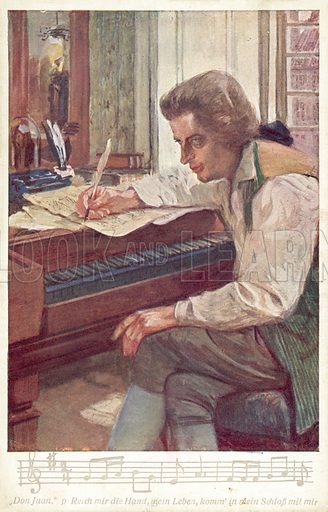
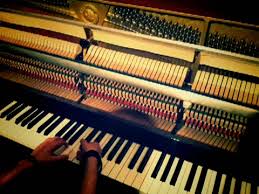
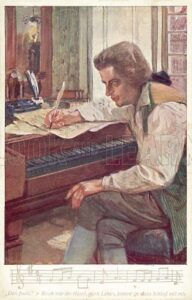
    Glissando is a term from music meaning sliding or gliding over keys.

    When glissando is applied to wordcraft, it means paying attention to the sound and flow of language.  Sounds arrest the reader’s attention. Even if your words are not read out loud, the reader hears them with her/his inner ear.

    All language has sound and sound communicates meaning, emotion, mood and tone. Language is also embedded with deeply appealing rhythms that, like drum beats or heart beats, that slip into the reader’s consciousness and enhance the experience of reading.

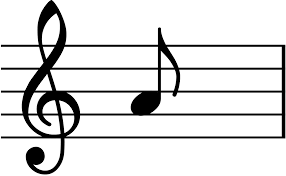
    In all writing, every word exists for a reason, every sentence builds the scene or idea. Each word is a note. Sometimes you want sound to lull a reader before you slap him with a heated argument or stage a bombshell scene. Sometimes you want him to pause at the end of a string of words. Sometimes you want to march along briskly as you dispense information.

    When sound is emphasized a narrative becomes poetic. When sound is deliberately employed, sentences, paragraphs and scenes have clout. Writing without themes, purpose and music is only typing and writing without paying attention to sound is flat and empty.

    Sound can add or subtract to the flow of writing.  Like other writing devices, flow is a nearly invisible factor, but when it’s employed, your writing will be seamless and will reflect the mood and ambiance of a particular point in a story.

    A note from Kiffer:  Think of a symphony.

    Think of symphonies and the myriad of moods that they evoke.

    A few examples:

    • Stravinsky’s riotous Rite of Spring
    • Gershwin’s sultry jazzy and brash exuberant Rhapsody in Blue
    • Bernstein’s fresh and challenging West Side Story
    • Mozart’s complex and exhilarating Jupiter 
    • Aaron Copland’s stirring and nostalgic Symphony for the Common Man
    • Bear McCreary’s Symphony for Battlestar Galactica  (a side note: Bear is from Bellingham)

    Each symphony is written with the same twelve notes, one note at a time. Each novel, each written work, is written one word at a time.

    Flow

    Flow happens when ideas and stories have fluidity, connectivity, and cohesion.  Flow is consciously applied as a courtesy to the reader because readers deeply resent being lost of confused when amidst a page or story. Readers also hate to be jolted or to dangle, or feel a sense of disorientation.  Flow provides the map, flow connects the dots, flow grants readers firm footing. Flow aids the internal logic needed to make your ideas comprehensible.  Flow will move the reader from sentence to sentence, paragraph to paragraph, idea to idea, scene to scene, and chapter to chapter with grace and ease.

    Transitions

    An essential technique that creates flow is transitions and it’s shocking how often writers neglect to use them.  Transitions are the words, phrases, sentences or paragraphs used to bridge what has been said with what is going to be said. Simple transitions are generally, but not always, a subordinate clause placed in the beginning of a sentence or paragraph and used as a road sign indicating a change. Probably the most famous transition in writing is “meanwhile, back at the ranch.” It provides an easy shorthand and the reader knows, Ah, we’ve changed locales; we’re at the ranch again. Wonder how Jane is getting along since Luke has been on the cattle drive for three months now.

    Transitions are handy devices because they can accomplish so much in only a few words. Their jobs are to signal: a change in time, a change in place, a shift in mood or tone, or a shift in point of view. Transitions also clarify relationships, emphasize, contrast or compare things, conclude actions or thoughts, and create associations.

    Here are a few tips for writing with wordcraft.

    • When in doubt, understate. Often the most painful, emotional, or violent moments in writing works best by using a minimalist approach.
    • Write about subjects that mean something to you, emotionally and intellectually; that force you to question your beliefs and values.
    • Save lush passages for choice moments in the story, especially decisions, revelations, and reversals. If you use heightened prose every time your character feels an emotion the whole will become contrived.
    • Omit redundancies like grotesquely ugly, grim reminders, complete surprise, and happy coincidence.
    • Make certain every sentence adds something new.
    • Generally avoid heightened prose for endings—often the best endings are concrete or understated.
    • Respect word territory. If you feature an unusual word in a sentence (effervescent, rococo, unremunerated, infelicity) then don’t repeat it again in a nearby paragraph or better yet, use it only once.

    Don’t forget to keep asking yourself, what does this remind me of?  As you lay out sentences and scenes, but also as go through your days, look around you with an artist’s curiosity.  It’s a simple question, and leads to wizardry.

    Keep writing, keep dreaming, have heart. Jessica


    Jessica Page Morrell

    Jessica Page Morrell is a top-tier developmental editor for books and screenplays. Her articles have appeared in Writer’s Digest and The Writer magazines. She is known for explaining the hows and whys of what makes for excellent writing and for sharing very clear examples that examine the technical aspects of writing that emphases layering and subtext. Her books on writing craft are considered “a must have” for any serious writer’s toolkit.

    Jessica will teach the Master Craft Writing Classes at the Chanticleer Authors Conference on Thursday, Sept. 3, 2020  and will present sessions during the conference.


    Did you know that Chanticleer offers editorial services? We do and have been doing so since 2011.

    And that our professional editors are top-notch and are experts in the Chicago Manual of Style. They have and are working for the top publishing houses (TOR, McMillian, Thomas Mercer, Penguin Random House, etc.). If you would like more information, we invite you to email Kiffer or Sharon at KBrown@ChantiReviews.com or SAnderson@ChantiReviews.com.

    A great way to get started is with our manuscript evaluation service. Here are some handy links about this tried and true service:

    https://www.chantireviews.com/manuscript-reviews/

    We work with a small number of exclusive clients who want to collaborate with our team of top-editors on an on-going basis. Contact us today!

    Writer’s Toolbox

    Thank you for reading this Chanticleer Writer’s Toolbox article. 

  • Writing Protagonists – by Jessica Page Morrell – A Chanticleer Writer’s Toolbox post

    Writing Protagonists – by Jessica Page Morrell – A Chanticleer Writer’s Toolbox post

    You need to care deeply about your protagonist – Jessica Page Morrell

    It’s impossible to write about a main character you don’t care about. And care deeply. When I say care, you can actually pity the poor sod (Quoyle in The Shipping News), or disagree with his morality as when you write an anti-hero like Scarlett O’Hara or Tyrion Lannister of the Game of Thrones series. Many readers find anti-heroes likable or relatable, but so must the writer/creator. Because fiction writing requires a serious emotional and intimate involvement.

    Harry Potter of the Harry Potter Book Series by J.K. Rowling

    Ideally you’ll find your protagonist fascinating, indelible, someone you can co-habitate with for at least a year if not longer. Because between first drafts and final revisions, it will take at least a year to finish your novel. This means your main player needs to be interesting to hang out with and interesting to write.

    Miss Celie of The Color Purple by Alice Walker

    I’ve known writers who have fallen out of love with their characters and it ain’t pretty. Especially if they created a series character. Typically they discover their creation feels stale or predictable. Similar to a failing relationship in the real world. Like those glum couples you spot in restaurants not speaking to each other; sitting in slumped misery or apathy. Of course I’m nosy and apt to spy on my fellow diners and I’ve been noticing these miserable pairings for years.

    Douglas Adam’s Hitchhiker’s Guide to the Galaxy’s protagonist – Arthur Dent

    Back to you and your main characters. Think long haul. Lasting commitment, curiosity or admiration. Think not being judgy, but observant and nosy, and perhaps a bit curious.

    Unforgettable or haunting protagonists are the keys to great fiction!

    A few suggestions for you to keep in mind:

    • Character first. Plot is people.
    • Create an intricate backstory that will cause motivations. This does not mean to add all of that backstory to your work.
    • Don’t confuse protagonist with hero. Sometimes the hero saves the day for the protagonist.
    • Sometimes the protagonist is not a “good guy.” Examples are:  Holden Caulfield from The Catcher in the Rye, Michael Corleone from Mario Puzo’s The Godfather, or Arthur Dent in The Hitchhiker’s Guide to the Galaxy by Douglas Adams.
    • Holden Caulfied – The Catcher in the Rye by J.D. Salinger
    • Give it time. It doesn’t need to be an instant attraction or intimacy, but your character should pique your curiosity.
    • Discover what in your character’s nature validates his/her humanity. Makes him or her worthy of your reader’s time.  Some of the best protagonists are not immediately sympathetic or understandable. It can take readers time to understand them. But that’s okay. Because there will be tests along the way that reveal his/her true nature.
    • Your protagonist needs traits you admire, even begrudgingly.
    • Figure in your protagonist’s chief vulnerabilities, then exploit them.
    • Understand how your character’s triggers, reactions or overreactions under duress.
    • Consider working out your demons through your protagonist. Is he or she insecure? Will he feel misunderstood? What about rewriting your awkward adolescent years through your character?
    Frodo of the The Lord of the Rings series by J.R.R. Tolkien

    Oh, and the protagonist should fail, fall on his face at least a few times along the way to the climax. Because your job as the master manipulator (aka author) is to blindside, torment, and thwart your characters. Again and again, so the outcome is in question and your readers are compelled to keep turning the pages.

    Handy Links to other articles featuring Protagonists

    The INCITING INCIDENT: STORY, SETBACKS and SURPRISES for the PROTAGONIST

    Essence of Characters

    Jessica Page Morrell
    Jessica Page Morrell

    Keep writing, keep dreaming, have heart.  – Jessica 

    Jessica Morrell is a top-tier developmental editor and a contributor to Chanticleer Reviews Media and to the Writer’s Digest magazine. She teaches Master Writing Craft Classes at the Chanticleer Authors Conference that is held annually along with teaching at Chanticleer writing workshops that are held throughout the year. 

    Jessica is teaching a Master Class at the Chanticleer Authors Conference along with other sessions. Click here to find out more information or to register. 

    Chanticleer Editorial Services

    Did you know that Chanticleer offers editorial services? We do and have been doing so since 2011.

    Our professional editors are top-notch and are experts in the Chicago Manual of Style. They have and are working for the top publishing houses (TOR, Macmillan, Thomas Mercer, Penguin Random House, Simon Schuster, etc.).

    If you would like more information, we invite you to email Kiffer or Sharon at KBrown@ChantiReviews.com or SAnderson@ChantiReviews.com for more information, testimonials, and fees.

    We work with a small number of exclusive clients who want to collaborate with our team of top-editors on an on-going basis. Contact us today!

    Chanticleer Editorial Services also offers writing craft sessions and masterclasses. Sign up to find out where, when, and how sessions being held.

    A great way to get started is with our manuscript evaluation service. Here are some handy links about this tried and true service:

    https://www.chantireviews.com/manuscript-reviews/

    Writer’s Toolbox

    Thank you for reading this Chanticleer Writer’s Toolbox article.