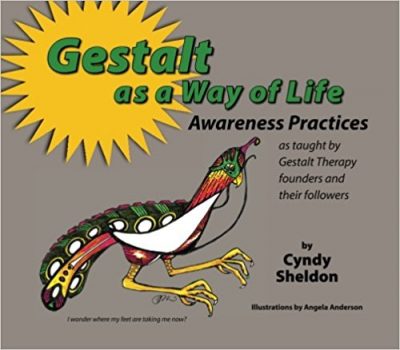
 Word of warning: I’m a bit of a self-help junkie, so Cyndy Sheldon’s Gestalt as a Way of Life is right up my alley. As one of the movement’s founders, Ms. Sheldon provides a valuable and instantly useable advice in this approachable introduction to Gestalt Therapy.
The word Gestalt derives from the German word for “form.” The group’s antecedents intended to create a holistic way of attending to human potential by, in Sheldon’s words, “… attending to the whole human being, including the physical, emotional, mental and intuitive or spiritual aspects.”
The book came out of a series of seminars that the writer had been offering beginning in 2007 in the Pacific Northwest. It became clear to her that recording the information and making it available to a wider audience would allow not increase exposure to the ideas, but would allow people to refer back to sections of value as needed.
Ms. Sheldon’s time spent among the Navajo Tribe, over ten years, clearly impacted the work. The overlap between Buddhist teachings, Navajo spiritualism, and Gestalt practices make an intriguing mix. The varying influences appear to really ground the suggested exercises or “experiments” as the author refers to them. Those experiments are intended to help the reader fully realize the benefits of the program as if one had attended the seminars as a participant. It’s in the experiments where the book shines, offering real-world practices the reader can revisit.
The book is broken up into six sections with letter identifiers A through F: Awareness, Growing Up, Get Out of Your Head, Authenticity, The Magic and Sacred in Gestalt, and Final Thoughts. I found the section on Authenticity (D) particularly apropos. As the reigning Queen of Conflict Avoidance (Ask my friends! Okay you can ask absolutely anyone who has ever met me!), the exercises intended to assist with becoming more direct in interactions with other people target my style of using nearly any tactic to prevent trouble from brewing – even if it leaves me furious, frustrated, angry and resentful. The sample experiment below helped me recognize some of my favorite dodging language, used when trying to avoid hurt feelings at the cost of being clear:
EXPERIMENTS (p. 83)
- Watch people in restaurants, in parks, wherever you can hear them, and listen for their qualifiers.
- Listen for your own. Exaggerate using qualifiers with good friends—see if they notice. Then experiment with not using them.
- What other ways do you use to be indirect? Exaggerate these, which will help you become more aware of doing this…
- Now be direct and clear without judging.
That last instruction alone proved so valuable. Being clear without indulging in a knee-jerk urge to start a self-shame-athon (at my deplorable display of selfishness) helped increase my awareness of the automatic pilot way my mind works when trying to avoid hurting others’ feelings.
Like most books of the genre, you benefit to the extent you are willing to engage in the suggested experiments. Gestalt as a Way of Life delivers on two levels: it provides a fine introduction to the Gestalt movement and a gentle method for applying it in your life.


 When it comes to high-adventure Science Fiction, why should adults have all the fun? Alexander Edlund’s novel, Keelic and the Pathfinders of Midgarth proves that younger readers want in on the action.
 Mae Keaney is looking for a way back to her childhood, back to safety, and finds it in a property on Chappaquiddick Island. A wind-tattered cottage and an old boathouse she envisions as a café will be her haven, as long as she can keep her regrets and sorrows hidden.
 Madison Cruz wants a breakthrough acting job, money in her purse, and fun with the sexy guys vying for her attention. Instead, she delivers singing telegrams for a living. Then her grandfather gives her mysterious evidence that must be kept sealed and hidden, he disappears, and now, spies are watching her every move. In other words, Madison’s life is a hot scheming mess!

 What’s more fun than Neanderthals? How about Neanderthals on the high seas? Now that we have your attention…
 Catherine Abbott has everything a young lady of quality could wish for in England, 1660’s. She lives on her father’s comfortable estate in the village of Wells, Buckinghamshire and she’s soon to be wed to Miles Houghton, a childhood friend recently returned from several years in France. For Miles, the wedding is just the ticket to free him from his rather large gambling debt. His heart isn’t in it, though, as he still yearns for the Parisian nightlife.
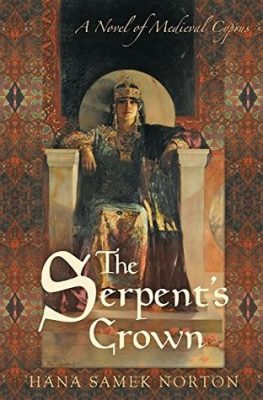
 Hana Samek Norton begins her epic and engrossing novel of historical fiction, The Serpent’s Crown; A Novel of Medieval Cyprus, with this quotation: “It sometimes happens that exploits, however, known and splendidly achieved, come, by length of time, to be less known to fame, or even forgotten among posterity.” (Itinerarum Peregrinorum et Gesta Regis Ricardi) How fortunate for readers, then, that the author brings to life a captivating chapter of history that occurred in Cyprus and Jerusalem in the early thirteenth century.
 Alisdair “Dair” Fitzstuart, spy and war hero, wants to enjoy a carefree life now that his service to his country is over. After spending years creating the daredevil reputation that has earned him fame beyond his heroic war efforts, he’s eager to return to the London town life, sample the season’s beauties, and carouse with his lifelong friends, but when his latest escapade literally throws him into the arms of Rory Talbot, his plans are turned upside down.
 An intractable and pampered debutante with plenty of pluck turns detective in Jennifer Kincheloe’s award-winning debut The Secret Life of Anna Blanc.