
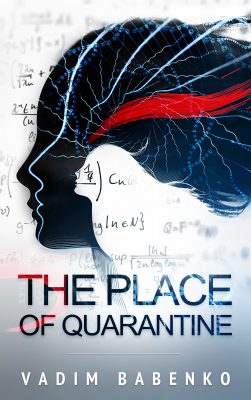
Theo awakens to a sound, which he likens to that of a trembling copper string. He finds himself midway up a stairway and realizes that the sound emanates from an ordinary fluorescent tube, about to burn out. He climbs to the next floor, where a door is open. A woman introduces herself as Elsa and welcomes him in.
Not remembering anything, or knowing where he is, Theo asks Elsa. Her answer confounds him. He is in their apartment, in a place called Quarantine. In support of her response, she hands him a laminated paper that reads, “WELCOME. YOU HAVE EXPERIENCED CORPOREAL DEATH FOR THE FIRST TIME. THE DEATH OF THE BODY IS NOT AS SIGNIFICANT AS YOU MIGHT THINK. THERE IS NOTHING TO FEAR.” Really? Theo goes cold. Memories begin to emerge—a gunshot and terrifying pain, a woman in tears, the old streets of Bern. Then it all fades.
Vadim Babenko, Russian-born physicist and businessman, left his former careers behind to become a writer of fiction—in The Place of Quarantine, thought-provoking fiction that begs us to consider what the reality of life truly is. In this effort, he draws on principles from the work of renowned researchers, such as Italian physicist Giuseppe Vitiello, to support the protagonist, Theo’s work, in particular, his concept of “the application of quantum field theory to the modeling of human memory and intelligence.”
Yes, science plays a significant role in this book, but it’s a supportive role, a means to an end: our consideration of the possibilities of life beyond that which we experience on Earth, and of the regeneration of our knowledge and memories, and their further development to benefit the inhabitants of the place of a subsequent life. Theo is assigned an advisor/mentor/friend, called Nestor, to help him with the task of reviving the memories of his renowned, but uncompleted research on Earth. His knowledge and intelligence are needed in Quarantine and perhaps beyond. Since the particular vocabulary of physics and metaphysics is not familiar to many of us, a glossary of the terminology is at the reader’s fingertips.
The science, however, is interwoven with the stories of characters from Theo’s very international first life—in particular, a beautiful young Asian woman, Tina, whom he met and loved in Bangkok and yearns for even in Quarantine; and a Russian businessman named Ivan Brevich, who is consumed with revenging the murder of his beloved wife, Nok. In Quarantine, his roommate Elsa adds a human element to his life, making his breakfast of coffee, fried eggs, and toast, and generally being his companion, although as phantom beings in a world of images. Nestor, who is but a face, with a voice, on the wall screen, is a friend as well as an advisor and research colleague.
As Theo comes to believe in what his research is telling him, he becomes increasingly obsessed with finding Tina, if not in Quarantine, then in whatever life awaits him next, if indeed one does. Can he be satisfied with continuing his work for the benefit of Quarantine, or must he try to prove his belief by taking the chance to move on?



 The suspense in Larry Temple’s excellent, haunting, global thriller, 100 Days of Terror, begins as a seed planted in the minds of the main characters and the reader. A torched car is found in a field in New Jersey. Residents in a town in Idaho wake to find green water gushing from their faucets. A small college town in West Texas is vandalized. And, then, three trucks explode on a highway in Los Angeles, and the clues linking the explosion to the other incidents are undeniable. The FBI knows that these aren’t random acts of isolated violence but an escalating series of terrorist incidents designed to disrupt life in America. During the next few months, multiple bridges will be bombed, airports will close, many highways will be unnavigable, communities will suffer power outages, and groups of children will stop attending school. The Dow Jones Industrial Average will steadily drop and the entire nation will be wondering what and where the next attack will be. Who is wreaking this havoc on America? To determine that answer, however, another question must be asked: Why?
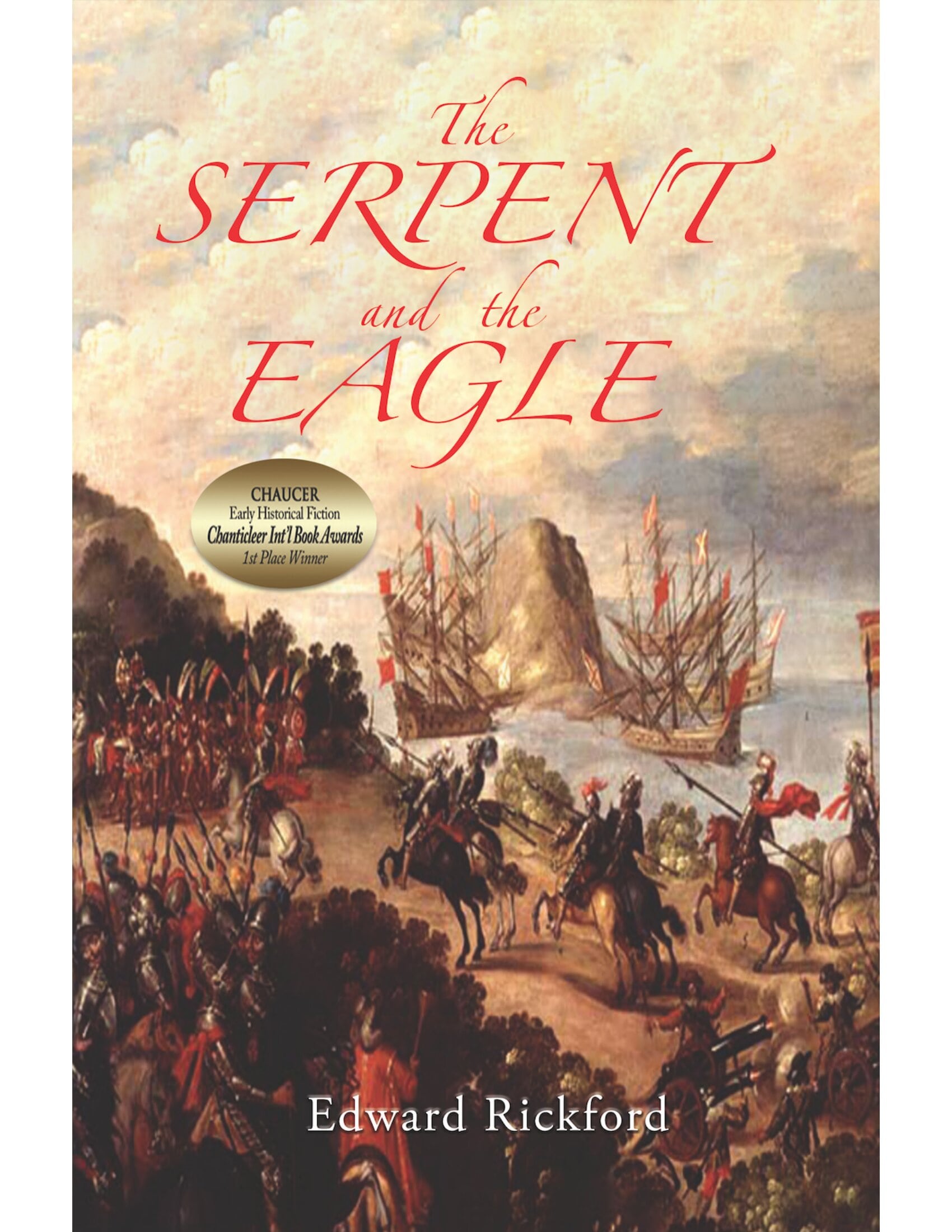
 In The Serpent and the Eagle, Edward Rickford details Hernan Cortes’ 1519 expedition to explore and secure the interior of Mexico for colonization, fleshing out known facts with the human factor—it is, to the typical depiction of Cortes’ exploration of the Yucatán peninsula, what a chorus is to a solo or a tulip to a bulb. Primarily narrated by individuals who were actual members, or may have been members, of this expedition, Rickford has crafted a fascinating tale of intrigue, love, lust, greed—essentially all seven of the deadly sins—within two diametrically opposed political and cultural systems.






 At the tender age fourteen, Thomas Cheke is kidnapped in the dead of night by Barbary pirates from his home on the Isle of Wight. His widowed mother and sister are left behind, but Tom doesn’t know if they survive the surprise attack. During the next six years, his life will take more twists and turns than he could ever have imagined, and the resulting story is one of the most fascinating ever put to page.