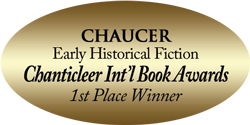
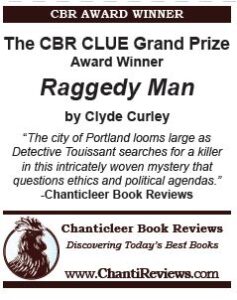
The gleaming silver seal stops them in their tracks.
Standing out on a crowded bookshelf is what every author wants for their book covers. Great cover art and clear fonts help, but what makes a reader walk across a busy store to pick up your book? Professional recognition they can see at a glance.
Why Stickers Work
Promotional book stickers are your book’s instant credibility. In a bookstore filled with hundreds of novels, all with covers designed to get noticed, stickers deliver that important third-party endorsement clearly and immediately. “Grand Prize Winner,” “Bestseller,” “Editorial Choice” – these messages tell browsing readers that your book has been professionally recognized as outstanding storytelling worth their time.
Chanticleer’s Foil Advantage
Of course, it’s not all about flash. It’s also about a message that tells the bookstore customer why they should stop and consider your book. This is your turn to crow! Get stickers that will tell the reader why they should buy your book. Awards and recognition, such as “Grand Prize Winner” or “Bestseller!” lets people know that your book has been put to the test and come out with a good review or even won a contest! It’s one more push to get them to pick your book over the others.
Of course, not all stickers are the same. At Chanticleer, we believe our foil adhesive stickers give authors an extra boost of promotional power with their built-in ability to catch the light and clear message. With the seal of approval from a respected industry partner, you’ll be making a clear statement about the quality of your storytelling. A shiny foil sticker on your book cover can make all the difference in hand sales, whether at bookstores, conferences, or local events. We’ve seen it work time and time again for our authors!
Final Hours: 10% Off Through Saturday!
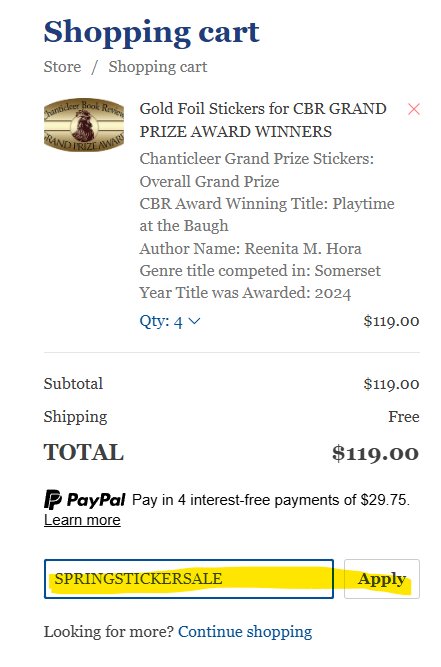
Sticker Sale ends May 31st at midnight!
Whether you’re preparing for summer book events, conference season, or just want professional promotional materials on hand, this is your last chance to stock up and save.
On the Second Day of Christmas, Chanticleer brings to me…
Two ways to link to your selling sites!
Getting people to your online selling sites is a challenge every author faces. Readers want convenient, one-step actions that will take them straight to the place where they can purchase your book, and they want to be able to trust their purchase will be handled professionally. But how do we get them there?
Web Links—A tried and true path
Web links have been used to move people around the internet for as long as the internet has been available to the masses. By linking a URL to a clickable button, word, or phrase you will be opening the doors to your online store and welcoming in more readers with only a click! This process is seamless to the user, as they simply see the new page load.
To get the most out of your web links, always have easily accessible links that open in a NEW WINDOW. Once someone is visiting your site, you want to make sure that your site remains open in his/her browser. Visitors should never have to leave your site to check out your book’s page on Amazon or sign up for your newsletter.
Links should be easily recognizable as a way to access more information. Try to use highly visible and friendly “buttons” whenever possible.
And always make triple sure that your links work!
QR Codes—A new path for speedier and more convenient purchasing power
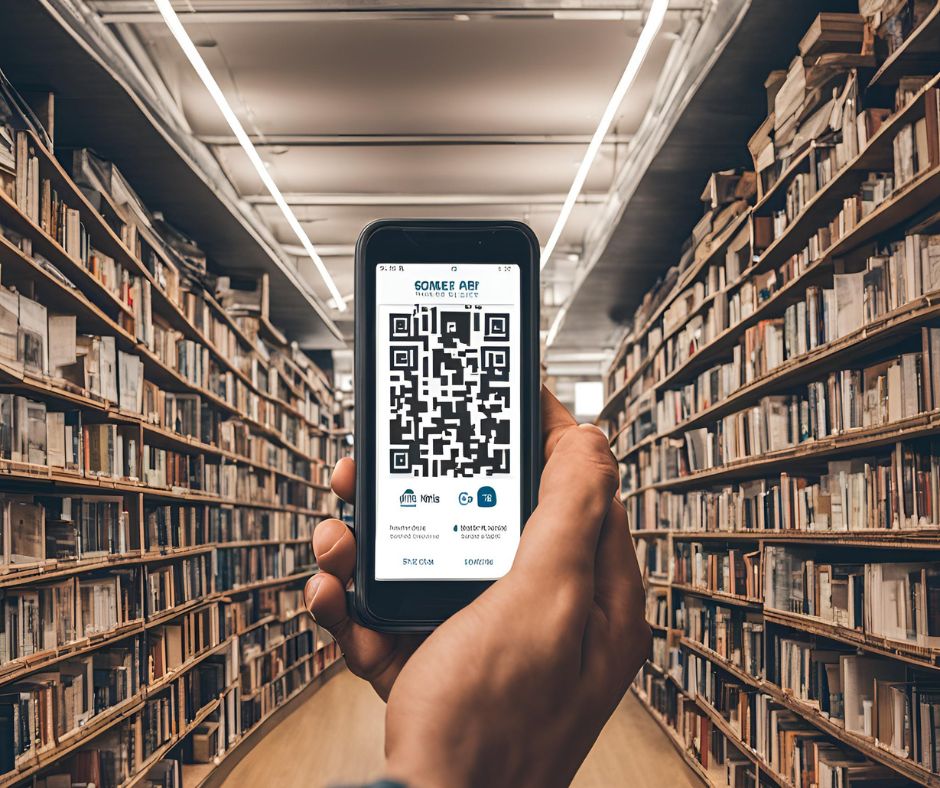
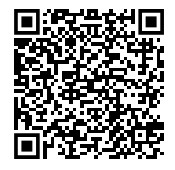
Because of their ability to be read by mobile phones, QR codes have emerged as a versatile and powerful tool for authors to promote and sell their books. Thesemachine-readable codes consist of an array of black and white squares, typically used for storing URLs or other information for reading by the camera on a smartphone.
With the help of a simple (and free) QR code generator, you can create as many QR codes as you need to get readers directly to your books’ purchasing sites, but there’s much more you can do with them, too!
Place a QR code on a tabletop sign to send potential readers at a book fair to your website or blog. You can link to a specific page, meaning you can give them trivia related to your story, images you’ve created, a sign up for your newsletter or blog, or just get them to your homepage and let them explore!
QR codes can also be attached to documents that live in the cloud, and therefore are not accessible to people without the code. This can be a useful tool for building a community, as readers will be excited to know they are receiving exclusive information.
Using a QR code will give you, and your readers, more power to easily connect and share and purchase! Check out this recent blog post about QR codes for a more in-depth look at how authors can benefit by adding them to their marketing. 🧰
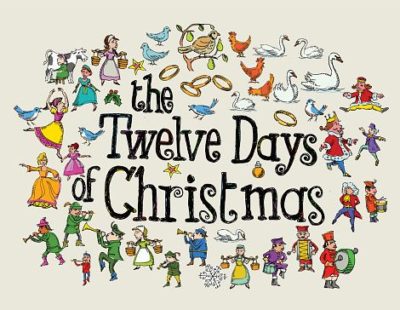
Celebrating the Twelve Days of Christmas!
“But Jiminy Crickets, it is the 27th of December! Is it not too late for the 12 Days of Christmas?” you say.
Not to fear, Chanticleerians! The 12 Days of Christmas begins on December 26th! And it continues to the 6th of January – Three Kings Day. The four weeks leading up to Christmas is known as the Advent. So if you haven’t finished wrapping presents, sending out those cards, and baking cookies—don’t worry—you’ve got an extra 11 days!
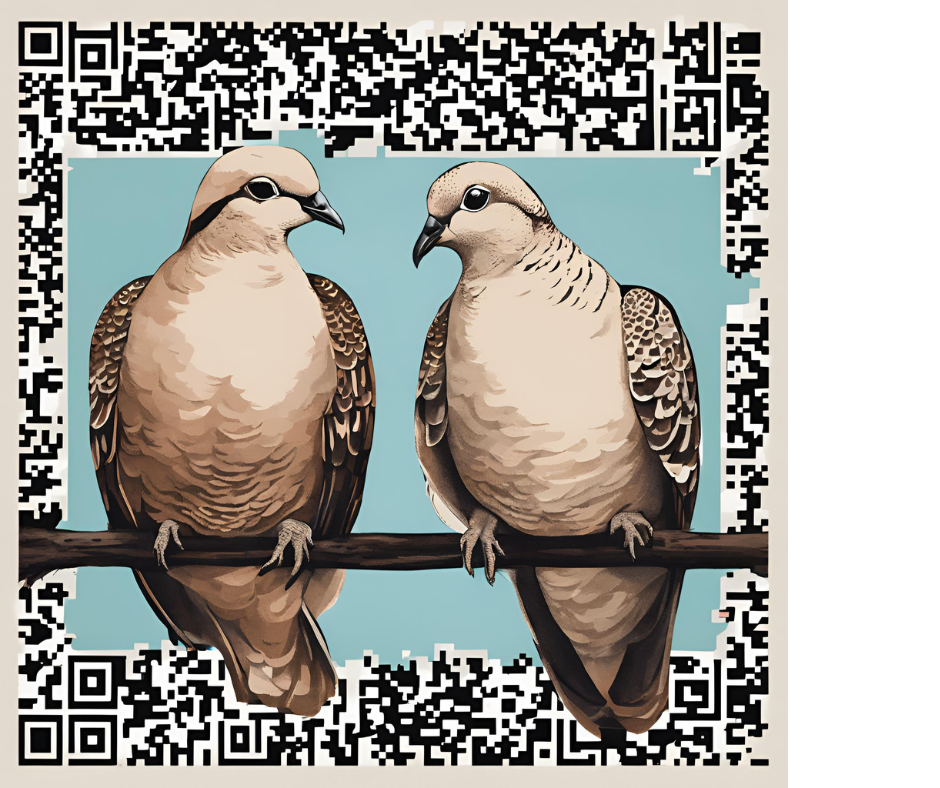
On the Second Day of Christmas, my True Love (or Chanticleer) brings to me… Two Turtle Doves
Two Turtle Doves represent love, loyalty, and friendship.
The Two Turtle Doves are symbols of Love and Fidelity. The turtle dove is monogamous and pairs for life. Males are actively involved in nesting (he will actually sit on the eggs during the day) and taking care of the young after they hatch so his mate can leave the nest to eat, exercise, and take care of herself. In Ancient Grecian stories, they are believed to be a favorite bird of Aphrodite, the goddess of love.
Good King Wenceslas
Day 2 is also the day that the Christmas Carol ‘Good King Wenceslas” takes place (c. 907 – 935). He was known as the Good Prince of Bohemia. The story tells the tale of his journey through harsh weather to bring a gift of food and firewood to a poor man he noticed while looking out of his castle’s tower during the Feast of Stephen. The song reminds us each and everyone: “Ye, who now bless the poor, Shall yourselves find blessing.”
“King Wenceslas” Art made by Hudson, Scott & Sons for Huntley & Palmers, 1913. Victoria and Albert Museum no. M.367-1983. Image: Gryffindor
Happy Holidays to You from the Chanticleer Team!
Stay tuned for the 3rd Day of Christmas!
Our favorite part about having the 12 Days of Christmas is that we can have the time we need to celebrate with our loved ones. We have time for wrapping our presents, meeting with friends for hot cocoa, and setting ourselves up in the New Year for publishing success (with Chanticleer Professional Services and the Chanticleer Authors Conference).
Wishing you Happy Holidays from Chanticleer from Kiffer, David, Dena, Scott, Anya, and Argus!
QR codes have emerged as
a versatile and powerful tool
for authors to promote and sell their books
In the ever-evolving landscape of book marketing and reader engagement, QR codes, these seemingly simple squares of black and white pixels can open doors to a multitude of opportunities. This makes them an invaluable asset for writers looking to connect with their audience in innovative ways. Here we’ll delve into how QR codes work and how authors can harness their potential to sell more books!
What is a QR Code?
QR codes, or Quick Response codes, are two-dimensional barcodes that can store a variety of information. When scanned using a smartphone or QR code reader, they can direct users to websites, videos, social media profiles, and more. Unlike traditional barcodes, QR codes can hold much more data and can be read from any angle, making them exceptionally user-friendly.
How Do QR Codes Work?
Encoding Information:
QR codes are created by encoding information into a pattern of black and white squares. This information can range from URLs, to contact details, or even multimedia content.
Scanning the Code:
When a QR code is scanned using a smartphone or tablet, the embedded data is quickly decoded and the user is redirected to the stored content, whether it’s a webpage, a promotional video, or a digital book. It’s a seamless and mostly effortless way for your readers to find you on the internet.
Decoding and Action:
The scanning app or device, such as a cell phone, reads the QR code and performs the action associated with it. If the QR code contains a URL, the device will open the linked webpage automatically.
Why Should Authors Use QR Codes?
QR codes present a unique opportunity to engage with readers in a more interactive and dynamic way. These are just some of that ways you can incorporate QR codes into your marketing strategy:
Streamlined Book Sales:
Place QR codes in promotional materials, at book signings, or on your book covers to lead readers straight to your selling sites, like Amazon or your personal website.
Direct Access to Content:
QR codes can link directly to book trailers, sample chapters, exclusive content, or your Newsletter! This immediate access helps generate interest and provides readers with a direct path to learn more about your work. For more information on different types of content marketing and how to build your Newsletter, check out this interview with Chanticleer Overall Grand Prize Winner Michelle Cox!
Enhanced Author Websites:
Use QR codes to direct readers to your author website where they can find more information about your books, upcoming events, or subscribe to your newsletter.
Interactive Marketing:
QR codes can be used to participate in interactive campaigns. For example, you can create codes that lead to online contests, reader polls, or exclusive behind-the-scenes content.
Social Media Integration:
Encourage readers to follow you on social media by including QR codes on you promotional materials. Scanning the code can take them directly to your social media profiles, making it easier for them to connect with you.
Simplify Reader Reviews:
Having a QR code at the end of your book can better link the reader directly with your Amazon or Goodreads page where they can leave a review of your book. Remember! Editorial Reviews help drive Reader Reviews by giving them language to work with. You can learn more about updating your Editorial Reviews on your Author Central here.
For more tips on marketing your book, check out this article here, which includes suggestions for using Book Awards and Editorial Reviews to market your work!
How to Create and Use QR Codes Effectively
Generate the QR Code:
Use a QR code generator tool (Many of which are free) to create your code. Enter the URL or information you want to encode, and download or screenshot the generated code.
Design with Purpose:
Incorporate your QR code into your book cover design, marketing materials, or business cards. Ensure it is large enough to be easily scanned and placed in a prominent location.
Test Thoroughly:
Before printing or distributing, try scanning your QR code yourself. Nothing is worse than discovering the code you set up for people to use just doesn’t work!
Provide Instructions:
Not all readers may be familiar with QR codes. Including a brief explanation on how to scan the code and what to do afterward can be the call to action you need to make things as easy as possible for your readers.
Give Readers More with QR Codes
QR codes are a powerful, cost-effective tool for authors aiming to enhance their marketing efforts and engage with readers in new ways. By providing direct access to content, facilitating book sales, and integrating with your online presence, QR codes can significantly boost your visibility and reader interaction. Embrace this technology to unlock new opportunities and keep your promotional strategies ahead of the curve!
Thank you for joining us for this Writer Toolbox Article
There is so much to learn and do with Chanticleer!
From ourBook Award Programthat has Discovered the Best Books since the early 2010s to our Editorial Book Reviews recognizing and promoting indie and traditional authors, Chanticleer knows your books are worth the effort to market professionally!
When you’re ready,did you know that Chanticleer offers editorial services?We do and have been doing so since 2011.
Our professional editors are top-notch and are experts in the Chicago Manual of Style. They have and are working for the top publishing houses (TOR, McMillian, Thomas Mercer, Penguin Random House, Simon Schuster, etc.).
If you would like more information, we invite you to email us at info@ChantiReviews.com for more information, testimonials, and fees.
We work with a small number of exclusive clients who want to collaborate with our team of top-editors on an on-going basis. Contact us today!
Chanticleer Editorial Services also offers writing craft sessions and masterclasses. Sign up to find out where, when, and how sessions being held.
A great way to get started is with our manuscript evaluation service, with more information available here.
And we do editorial consultations for $75. Learn more here.
NICOLE J. PERSUN – Award Winning and Bestselling Author and Creative Writing Instructor
Nicole J. Persun is an award-winning and internationally bestselling author with a master’s degree in Creative Writing & Instruction. Nicole has written and published in multiple genres, most recently book club fiction under the pen name Jennifer Gold. Her most recent novel, Halfway to You, was an Amazon First Reads selection in March 2023. Learn more at nicolejpersun.com. Discover her recent novels at jennifergoldauthor.com.
Still thinking about Registering for the Chanticleer Authors Conference?
Find out why The Writer Magazine (founded in 1887) has repeatedly recognized the Chanticleer Authors Conference as one of the best conferences to attend and participate in for North America.
TONY JETON SELIMI – Globally celebrated author, speaker, and coach, specializes in transforming human behavior and cognition.
Tony is committed to guiding individuals, entrepreneurs, leaders, business owners, and organizations from frustration to the pinnacles of breakthroughs, purpose, prosperity, and philanthropy. With a rich technology, business, wealth creation, and personal and professional growth and development background, he has honed distinctive methodologies that marry scientific rigor with spiritual intelligence, captivating audiences and clients worldwide.
From a humble beginning to a towering figure of influence, Tony’s narrative is a testament to perseverance and vision. His literary contributions, including the acclaimed titles “A Path to Wisdom,” “#Loneliness,” “The Unfakeable Code®,” and “A Path to Excellence,” have left an indelible mark on countless lives. His forthcoming work, “Climb Greater Heights,” is set to ignite the entrepreneurial spirit, urging business leaders to forge a legacy of impact and benevolence.
Tony’s acumen transcends the bounds of authorship. As a distinguished orator, he has illuminated platforms such as the UN, TEDx, and the London Business Exhibition with his profound insights into wealth generation, media mastery, and the art of strategic alliances. Celebrated with over a hundred literary accolades and featured in a myriad of media appearances, Tony stands as a beacon for authors worldwide.
In his presentation, “Soaring on the Wings of Words: Monetizing Authorship with Tony J. Selimi’s ‘Climb Greater Heights’ Method,” Tony charts a course for authors of all echelons. He offers the blueprint that propelled his ascent from anonymity to global renown, empowering authors to harness their craft for unparalleled success. Embark on this journey with Tony and witness the alchemy of words into wealth. For more information: https://tonyselimi.com
Tony will be presenting a two part session: Soaring on the Wings of Words: Monetizing Authorship with his “Climb Greater Heights’ Method
You’ll hear firsthand how leveraging technology, business acumen, and strategic partnerships can catapult your work from the shadows into the spotlight.
Join us and let Tony J. Selimi show you how to navigate the ever-evolving landscape of authorship with grace and confidence. This isn’t just a talk; it’s a call to action for all who believe in the magic of their stories and the potential of their dreams. Secure your spot and prepare to soar to greater heights on the wings of words.
Still thinking about Registering for the Chanticleer Authors Conference?
Find out why The Writer Magazine (founded in 1887) has repeatedly recognized the Chanticleer Authors Conference as one of the best conferences to attend and participate in for North America.
I learned a very long time ago in business school that “nothing happens until someone sells something.” [Henry Ford]
Selling is meant to create a chain reaction.
Pitching is the act of trying to sell something.
Selling (pitching) your book(s) is part of being a professional writer.
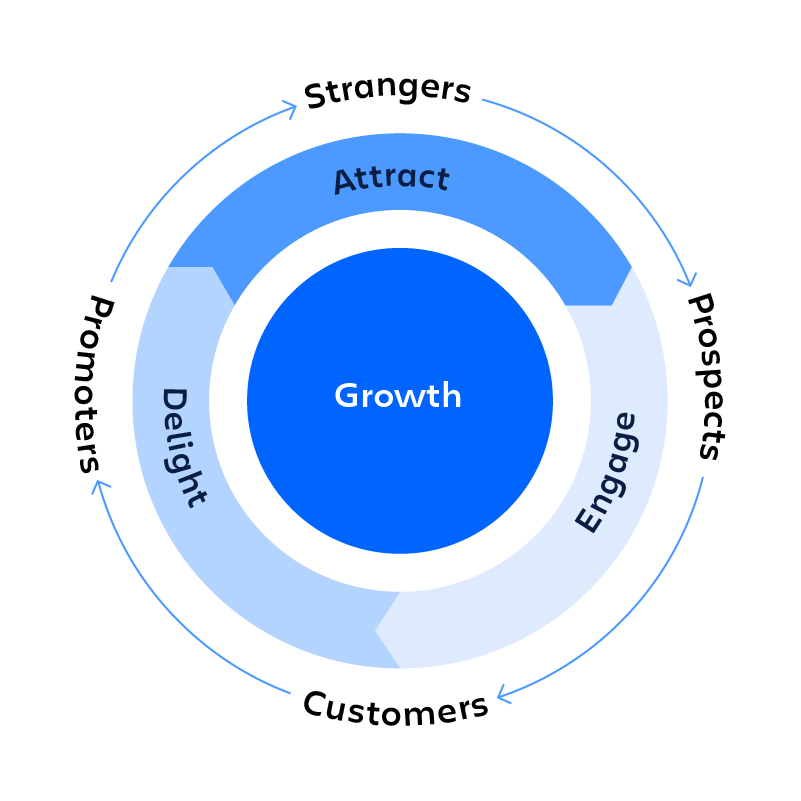
Pitching your book should put another spin on your book’s marketing flywheel to gain momentum for your book sales. The flywheel strategy creates a cyclical business pattern of success.
The idea is that a flywheel takes a lot of effort at the start, but once it gets spinning, it continues to quickly gain momentum and spin faster. This is similar to the snowball effect, where a snowball gets pushed down a hill as it progressively gets bigger and bigger until it is nearly impossible to stop before it reaches the bottom of the hill. The difference is that a flywheel never has to stop.
Amazon has a very intentional flywheel strategy. And, yes, it was written by Jeff Bezos on a paper napkin in 2001.
ATTRACT. ENGAGE. DELIGHT/ENTERTAIN
Elegantly simple.
The FLYWHEEL SUMMARY
The flywheel effect occurs when small wins (acquiring readers one at a time) accumulate over time, creating momentum that keeps your business growing (increasing your readership).
The concept is based on mechanical flywheels that power rowing machines and other devices.
Achieving the flywheel effect requires removing friction and applying force. In business terms, that means creating a self-serve purchase flow and applying “forces” to make the wheel spin faster, e.g., SEO, Meta-Data, and nurture campaigns.
A flywheel go-to-market model is well suited for selling books — easily replicated products such as books, e-pubs, audio-books, games, etc.
Flywheels attract and engage customers 24 hours a day – they’re literally working while you sleep. See SEO above.
Stay tuned for future posts on FLYWHEELS and how to create yours.
A Tiny Bit of Publishing History
We will circle back around to pitching. Please bear with me.
Amazon shifted the book-selling business by selling print books on July 16, 1995 and is now considered having the world’s largest collection of books. The first books were sold out of Jeff Bezos rented home’s garage. Remember that Bezos drew Amazon’s flywheel on a napkin in 2001. The rest is history.
E-books have been around since late 1990s, but it wasn’t until Amazon released the Kindle book reader in 2007 that e-books (digital books) caught the general public’s attention and dollars.
Selling books online – digital books requires a very different approach – one that sells directly to the reader and works to make the work discoverable by potential readers/purchasers.
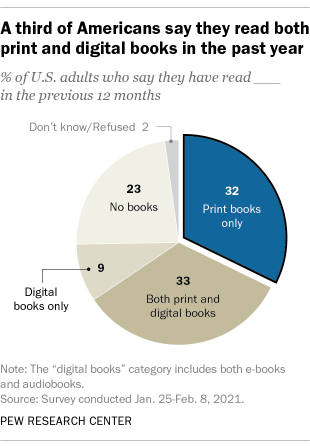
The Pew Research Center states that as of April 4, 2012 that only one-fifth (21%) of Americans have read an e-book.
As of now, 30% of Americans have read an e-book. This number has remained consistent since 2019 according to PEW Research.
The typical American reads five books a year (median – symmetric distribution) while the average (mean – includes outliers) is about 14 books per year per person.
Most Americans only have eight hours of free time per week. This is the window when reading a book (e-book or print book) for pleasure/leisure would take place. People could watch TV, play video games, play pickleball, golf, swim, etc. instead of reading during these rare free hours. Hence, this is why audio-books sales are increasing! Busy people can listen to books while they commute, knit, wash laundry, load the dishwasher, or rake the autumn leaves.
The point is “what is in your bag to sell?” If you are self-published, are your works available on a wide variety of platforms to reach your readers?
Audiobooks Hands-Free Reading
Now to circle back to PITCHING!
Whether or not you are pitching your work to a literary agent, a publishing acquisitions editor, bookstore staff, or, most importantly, a potential reader, you will need to know how to pitch your works.
Your literary agent will need to know how to pitch your book to publishers. They do not get paid until your book is under contract (and purchased).
The publishing house (you or a traditional publishing house) will pitch your books to “the trade” – booksellers, libraries, online selling platforms, and other brick & mortar outlets.
Most writers first exposure to pitching to agents is at writing conferences that offer “Pitch Blocks” or “Pitch Slams” where the conference host is paid (again, not the literary agent) a fee for hosting a session with a roster of agents who will listen to pitches. PNWA and Writer’s Digest offer these for a fee per block (WD $179 PNWA $100 per block). Pitch time is anywhere from five minutes to eight minutes per attendee and are on a strict time schedule with one pitch being delivered after another. There are different schools of thought of whether pitch sessions are helpful or not in obtaining a literary agent, but that is another topic.
How to Pitch at Conference Pitch Sessions
While it is normal to feel nervous when you are pitching your works, it behooves you to remember that:
You paid for this pitch session.
The clock is ticking.
There are many others pitching to the same agent.
Agents only want pitches on completed manuscripts or polished non-fiction book proposals.
Do your homework ahead of –make sure that you are pitching to an agent who is representing your genre. Visit their websites to see other books that they are representing.
First, most agents are forgiving of nervousness. It happens a lot and all that anxiousness will not help your pitch to stand out. Don’t spend your time apologizing for being nervous or explaining why you are not prepared. Doing so is wasting precious time. Rambling does not make a good impression. You want them to have your pitch echoing in their brains.
Come prepared. Over prepare. Have a prepared, polished pitch. Write it on a note card. Carry the card with you. Memorize your pitch. Read off from it if you need to. Believe me, the agent will appreciate this more than you hearing you hemming and hawing and umming.
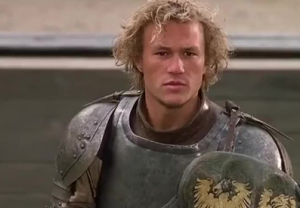
“Or is your name Sir ‘Um’?” Knight’s Tale
They also do NOT want to hear about your ‘dreams and passions’ about writing. Everyone that is pitching to them is passionate about their writing. Agents are about salability. They have mortgages to pay, food to by, and their own dreams of vacations and income from discovering that next break-out Hunger Games. See “nothing happens until someone sells something” above.
Keep your pitch short. Have questions to ask the agent-your conduit to the world of publishing-about if there was something that appealed to them. What did not appeal to them or what was missing. Try to let the agent guide the feedback. This is your chance to get professional feedback, to listen and learn.
Also, keep in mind that agents are also seeking to represent writers who are open to feedback and pleasant to work with along with understanding the process of the publishing industry (that it takes time and effort).
Remember to bring your business card with your website and contact information. Say hello. Introduce yourself. Give your pitch early on so that the agent will have time to give you feedback on it. Ask questions instead of “explaining” your manuscript to the agent so that she will give you feedback.
When your session is over (Some are as short as three minutes. Eight minutes is considered to be a long session.). Thank them for their time and leave. The next person to pitch is waiting to take your spot.
If the agent does have interest, be sure to have your synopsis ready (printed) with your contact information in case she asks for it.
Less than 1 percent of writers at a pitch session will gain representation. It is about the same as cold querying (another post is coming on that — stay tuned). So, keep on writing, editing, refining. The main objective is for the agent at the pitch sessions to think that you are open and understand the business and marketing side of being a writer.
Most agents also understand that it’s a busy world and will allow simultaneous submissions. If they don’t, they might not be a good general fit for most writers.
Chanticleer Authors Conferences do not offer “pitch sessions.” However, we do offer sessions on developing pitches. We do have opportunities to make excellent connections with film agents, directors, publishing house acquisitions, literary agencies, and other professional connections in the content industry such as Maggie Marr, Legal (Film and Book Representation) and Scott Steindorff, President of Stone Village Film Productions
Mariners pitching prospect Bryce Miller gets his first start of spring — against team he grew up watching | The Seattle Times
What is a PITCH and/or LOGLINE?
Your story reduced to less than 33 descriptive words. EACH. WORD. COUNTS.
Brand your story with a compact package of words that will astonish and entertain. It’s a craft of its own! Continue to refine and refine your pitch to a concise sound bite.
A PITCH is NOT
A meandering description about the story
The opening scene
Side stories
Character names
Flash forwards
Psychological thinking
Don’t confuse platitudes for story – avoid them!
Get your ‘self’ (looking at you Writer) out of the way of your story
Never give away the ending
A PITCH consists of the following:
Identifying the main character (protagonist) using descriptive words — tonality – leverage your language/voice
Describe the world that character lives in (Fantasy? Dystopian? Barbie Land? Future? Stone Age? Future in a galaxy far away?
What sets the story in motion — the inciting event
The goal of the protagonist — central conflict — choice — action
What stands in the protagonist way – what is the conflict or who is antagonist?
The best loglines have a sense of irony. (There’s the conflict again!)
Answer all of the above in 33 words or less. Perfect words. Use active and visual language. This is where you should show off your word craft abilities.
How are loglines/pitches different than taglines? Pitches are descriptive. Taglines are provocative and are used for marketing. Don’t confuse the two.
Here is a classic example of a logline/pitch and tagline:
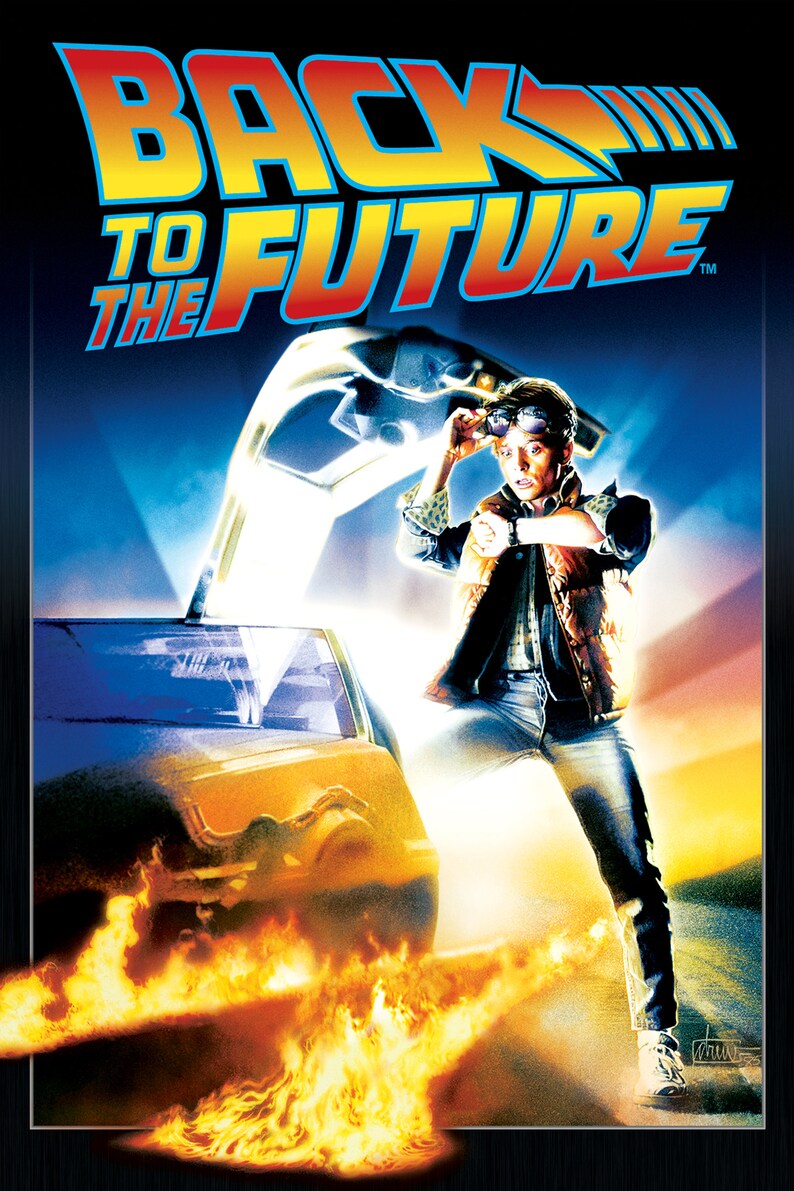
Back to the Future:
Logline: “A young man is transported to the past, where he must reunite his parents before he and his future cease to exist.”
Tagline: 17-year-old Marty McFly got home early last night—30 years early. (Notice that this tagline gives the tonality and targets the market for the work/film.)
In closing: The whole idea of pitching is to entice an extremely busy person to making time to read your work!
Next step: write a 50 word summary of your story. Bring it on your stationary along with your pitch on a notecard to your pitch session. Just in case! I’d even work on a tagline to give a visual!
An effective, evocative, compelling logline/pitch can propel your writing career forward and open doors and lead to conversations with industry professionals.
Celebrating the Twelve Days of Christmas – One Day at a Time
“But Jiminy Crickets, it’s after December 25th! Is it not too late for the 12 Days of Christmas?” you say.
Not to fear, Chanticleerians! The 12 Days of Christmas begins on December 26th! And it continues to the 6th of January – Three Kings Day. The four weeks leading up to Christmas are known as Advent.
Some say that December 25th is the first day of Christmas, but we are going with the medieval date of the 26th because revelry could not take place on the 25th as it was a holy day. And the Twelve Days of Christmas is about revelry!
So if you haven’t finished wrapping presents, sending out those cards, and baking cookies—don’t worry—you’ve got an extra 12 days!
Happy Holidays to You from the Chanticleer Team!
On the ninth day of Christmas, my true love sent to me
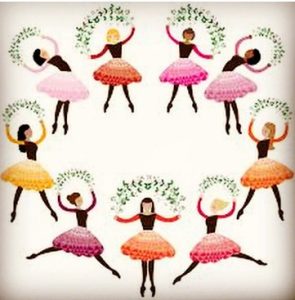
Nine Ladies Dancing
Eight Maids A-Milking
Seven Swans A-Swimming
Six Geese A-Laying
Five Golden Rings
Four Calling Birds
Three French hens (Chanticleer’s favorite #justsaying)
Two turtle doves
And a partridge in a pear tree
On the Ninth Day of Christmas, Chanticleer brings to me…
Nine SEO Boosts!
SEO stands for Search Engine Optimization. When you purchase an Editorial Review from Chanticleer, we do our best to keep up with all the latest trends that ensure your book is picked up by search engines like Google.
Key Word Optimization: We choose a word or phrase that is most likely to lead to your book, usually your title.
Excerpt Optimization that utilizes your keyword.
Title Optimization for the length of our review title as it appears in search engines.
Promoted in our Newsletter and Social Media.
Sentence Optimization: We make sure all reviews use the appropriate number of words to best improve their Flesch reading score.
Use of transitions between thoughts.
Heading Optimization: We use our blurbs to stand out in describing your book while also showing search engines what’s most important to pick up.
Tagging.
Links to the Author’s website, an Amazon Sales Page, and to our Local Village Books’ sale page for your book if it’s available through Ingram.
Editorial Reviews are powerful tools that are only limited by imagination! Don’t let your book go undiscovered! You can learn more about SEO here.
The days of publishers handling all an author’s marketing are looking like a thing of the past, even for traditionally published authors. This means you need to take control of your own marketing strategy for your books’ promotions.
To begin, list off the places where you imagine people will see information about your book(s). We have some ideas, but you know your community best so trust your expertise there. It’s safe to say you will need to at least look in these places:
Your Website!
Your Social Media Platforms (that point back to your website — not a selling platform)
A Cross-Promotion platform that you share with other authors
Bookchain.ca, Amazon, Barnes & Noble, Apple, Kobo, PublishDrive, and as many selling platforms as possible to create streams of revenue/royalties.
Independent Bookstores and Retail Outlets (many Chanticleerians join with garden shops, wineries, gift shops, toy stores, etc.) to sell their books.
Local Bookstores
Your local bookstores deserves special attention. There are always loyal readers with a strong preference to shop local, so take some time to show those stores extra love.
Shelf-talkers for point of sale displays
Small posters (free standing and flat for windows and bulletin boards
Shiny book stickers work! – They make your books stand out on the shelf.
Bookmarks with your WEBSITE and Social Media Handles and your Covers — ask if you may insert them in your books.
Make plans to participate in virtual author events – most indie booksellers are hosting these with great success
THEN you promote your events every where! (Social Media, email blasts, website, posters, etc.)
Now let’s put those together for some general recommendations (remember, your situation is unique, so if this advice clearly needs an adjustment for you, go for it).
[Editor’s Note: David Beaumier has worked with Village Books (Bellingham’s local Independent Bookstore) for several years before rejoining the Chanticleer Team after completing his Master Degree in English, so he knows what he is talking about with how to increase sales at local bookstores.]
How to Make Your Website More Effective in Promoting Your Books
We recommend that your website has a tab for Reviews and Awards, in addition to a tab for your books. It can also be good to include your shelf talker blurb after that to showcase a strong hook to bring your reader in. Then, from your Book tab, lead them to your review from there so they can see you have a strong digital base already built up with accolades from an independent and respected reviewer. These nods to your success tell the reader that your book is worthwhile and make it stand out from the thousands of other books they’ll come across.
Website Checklist
Tab for Reviews and Awards
Books Tab for more information with links to wear to purchase
Feature Your Digital Badges
Sign up Page for Announcements, Freebies, Bonuses, Short Stories, News, and Beta Readership Opportunities
If your books are available at indie bookstores, or other retail outlets — list where they are and give links!
Questions For and How To Connect with Book Clubs (remember — virtual gives you a wider audience span and the benefit of no travel expenses)
You can feature your digital sticker in proximity to an image of your cover in both places. It can also be good to include your shelf talker blurb after that to showcase a strong hook to bring your reader in. Then, from your Book tab, lead them to your review from there so they can see you have a strong digital base already built up with accolades from an independent and respected reviewer. These nods to your success tell the reader that your book is worthwhile and make it stand out from the thousands of other books they’ll come across.
Marketing packages can include an ARC, any swag you have (bookmarks, buttons, wrist bands, quarter sheet advertisements), a one page Sell Sheet (aka a write up of your book) which should mention your awards and positive reviews (including excerpts). On websites where your book is sold, you can populate their editorial review section of the site with your Chanticleer Editorial Book Review.
Village Books, Bellingham, Wash. all aglow!
Village Books at night. A brick cornerstone of the community with light pouring out the windows when it gets to be dark at 4 p.m. Our very own local, Bellingham bookstore. Local bookstores are key for selling your book!
That’s David up in the upper left hand corner sans grad school mustache.
Check to see if they have a regular advertising publication or newsletter and ask about including your review or your shelf talker in it (depending on space). Ask if you can post shelf talkers at their store and what the specifications for talkers are through their store.
Chanticleer Shelf talkerShelf Talkers sell Wine and Books! They work!
If a bookstore team member says they love the genre you write in, you can even offer them a free copy of your book and ask if they can do a write up for you. They have an abundance of riches when it comes to free books, but they don’t have a personal connection with every author. Only offer if they seem interested. Generally, do remember to always be kind to bookstore employees. They are the people who hand sell your book the most after you.
If the bookstore does do raffles on sale event days, or if you are having a socially distanced author event perhaps the staff can offer your swag such lavender sachets to each attendee or purchaser (as Gail Noble Sanderson does with The Lavender Meuse Trilogy or Kizzie Jones offers with coloring sheets for her Tall Tale of Dachsunds children’s book series).
Here is what Kizzie Jones is doing for her foreign book editions:
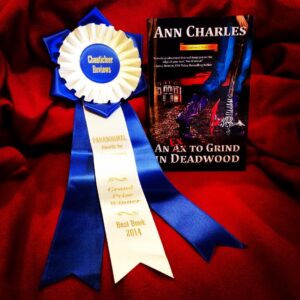
Plan events with your ribbon front and center — even if it is virtual — have your well-earned Chanticleer Blue Ribbon placed where it can be seen — another subtle way of stating that you are an award-winning author without having to say so yourself in your virtual presentation.
People know what a blue ribbon means, and it’s a great way to start a conversation about your book. Events are for more than just your local bookstore, but any stores near where you live or other places you think your story might resonate. Ask yourself if you might know special interest groups that would want to read your work that deals with zookeeping, financial advising, or a classic thriller. Reach out and add these places to your tour stops–yes even virtual tours—all small businesses are looking for ways to create virtual events to keep existing customers and find new ones.. Bookstore websites often run reading and writing groups that might connect to the genre you work in, and they love to have published authors stop by to chat with them.
But what about “virtual events” at your local bookstore?
If this means bookmarks, buttons, stickers, quarter sheets, and remember to put in your winning status and/or a blurb from your review as applicable and as makes sense for fitting the information onto the material. These swag items are a great way to keep the book in people’s mind. Bookstores can drop all of these into customer’s bags, which can really pay off in sales! Especially if the purchase was instigated by a virtual event. These items let your readers know that they are special to YOU! Be sure to invite them to visit your website because you offer readers special prizes and raffles and other fun stuff to readers who subscribed.
Always be gracious with anyone who might sell or buy your work at an event. There’s no crowd too small, even if it’s just a bookstore employee—remember, that person will hand sell your book and be your representative to customers in the store.
The short version of this, as with all the best advice, is to have a plan, reach out to your local community that provides built-in support, and always be kind and gracious to those around you.
Tweet us @ChantiReviews on Twitter to let us know how you used your marketing materials and award from Chanticleer to help generate interest in your book. We will share and LIKE and Comment.
Promote your wins by showing off your digital badges (Semi-Finalist, Finalist, First Place, or Grand Prize), book stickers, and reviews!
Now to start preparing for the HOLIDAY SEASON – Stay tuned for Tips and Tools for Increasing Holiday Book Sales.
Sailing along – making great time! Fair waves and following seas! All is good!
Your book baby is still alive and has weathered its first month on the rough seas of self-publishing. The holds of your ship are taking on coin. The sky is blue, the waves choppy, and for the most part you have beat back the sharks.
You got this, right?
Month two arrives, and the crest of the wave you have been sailing vanishes. Your sales drop. You attempt to prop up those sales by spending some of that hard-earned gold in the hold, on flags to fly atop your central mast. Surely everyone will see your flag and flock to it, to buy your book baby.
Month two expires and with it, your sales. Your ship takes on water and sinks, as it sails over the sixty-day new release cliff, leaving you with one oar on a shrinking raft.
Sharks are everywhere!
This close-up view of the seas shows you the truth. The sharks were swimming below the surface and already made off with the coin that should have been tumbling into your sea chests. Your book has been pirated, and no one is paying attention to the wildly flapping flag, tied to the peak of your tattered sales. (See what I did there? 😊)
Before you sink into obscurity you try one last time, to stopper the holes sliced into the deck by the shark’s fins. You throw money at every advertising platform you have ever heard, spending the last of your once-shiny piles of gold to prop up your sales. Not to be outdone, you send cease and desist emails to every site that has your book baby illegally uploaded for sale. Of course, they ignore you. The pirate’s code trumps all.
Nothing you do can save you. You decide to ignore the pirates because there is nothing you can do about it.
Depressing, eh?
There must be a better way, right?
What can a lonely self-published author do to prevent the theft of their hard work, and sink the pirate ships before they can even toss a grappling hook into your manuscript?
Are you ready to hear about one possible future for publishing?
Then read on.
Cryptocurrency. Let’s break down that term.
According to Dictionary.com, “Crypto” comes from the Greek word Kryptos, which means “secret, or hidden.” The English language derives the word ‘crypt’ from this root word.
The word “currency” has a wider range of definitions, which all help to illustrate its meaning. “something that is used as a medium of exchange; money,” and “the fact or quality of being widely accepted and circulated from person to person,” and the British dictionary also defines it as “the act of being passed from person to person.”
Cryptocurrency is a hidden form of exchange, defined as “a digital currency or decentralized system of exchange that uses advanced cryptography for security.” Simply put, cryptocurrency is a hidden form of currency that is able to be passed from person to person in complete security.
“But wait,” you say, “cryptocurrency isn’t coin. It isn’t even touchable. It exists only in cyberspace. How does that work?”
I am so glad you asked.
The beauty of a cryptocurrency universe is that the pirates can’t get to it.
It’s not floating around in some bank (ship’s hold), waiting to be stolen by a card skimmer or password bot, nor is it in grandma’s safe bolted to the basement floor, or held in an investment firm’s dubious clutches, where sticky fingers skim coin all too often.
Cryptocurrency is held virtually and is not in any one place. The currency itself is decentralized and encrypted. There is no Fort Knox to break into. There is no place to send a trojan horse, to sneak behind the secure walls.
Instead, the currency is distributed in code bits across servers located around the world. At last count, the number of cryptocurrency servers numbered over twenty thousand.
Cryptocurrency is riding the wild seas of any startup, but there is no doubt that it is here to stay.
As the currency gains in popularity and is adopted by more and more companies, it will become one more way to pay for goods and services in this digital age. I dare say that in time, it will become the currency to which all “paper” forms of currency are tied. It will become the central pillar to which all regional currencies are pegged like the USD is used for now. But no nation wants to be tied to another nation’s rise and fall, for their own currency values. Anyone outside of the United States understands this point of pain.
And payments made with cryptocurrency are more secure than any form of payment we presently use. No one can steal the currency as it is not laying around to be stolen. Transactions are secure because they are undertaken by large mathematical calculations that only computers can solve.
What does this mean for you, as an author, you ask?
It means, that in the near future, cryptocurrency will be a way of digitally selling and receiving payment for our books, that cannot be corrupted or stolen by an outside party.
But wait, what about the books themselves? They can still be stolen, right?
…. And that is the perfect segue to the last article in this series by Susan Faw:
“Chaining Piracy: How To Save Your Damsel / Damoiseau In Distress”
I have heard of the Amazon Books stores, but living in Bellingham, a little city north of Seattle in the Pacific Northwest, I haven’t had the opportunity to visit one. And Bellingham probably does not have the demographics to support one and probably never will. We don’t even have that many chain stores—no Banana Republics here, nor P.F. Chang restaurants.
Village Books is an Independent Bookseller that Publisher’s Weekly rated as #5 Indie book store in the U.S.A. and they have opened a second location in Lynden, Wash.
Nevertheless, I was still very curious about Amazon’s new brick and mortar bookstore concept—the antithesis of what I thought Amazon was all about.
What does it look like? Does it have author readings? Does it have author signings? Does it promote Indie authors or bestsellers? Will it have that cozy bookstore feel that I love to lose myself in for hours?
Or would it just feature its own 15 imprints: Thomas & Mercer, Lake Union, Montlake Romance, 47North, Topple, and so forth?
So many questions!
I promised myself that the next time I go Seattle I would seek out an Amazon Books store to quell my curiosity.
For those not in the know or have been without news, the Amazon empire is the most valuable company in the world and like Microsoft, is based out Seattle. Amazon is currently valued at over one trillion dollars (USD)—that is a lot of zeros. $1,000,000,000,000,000—I think that is enough zeros…
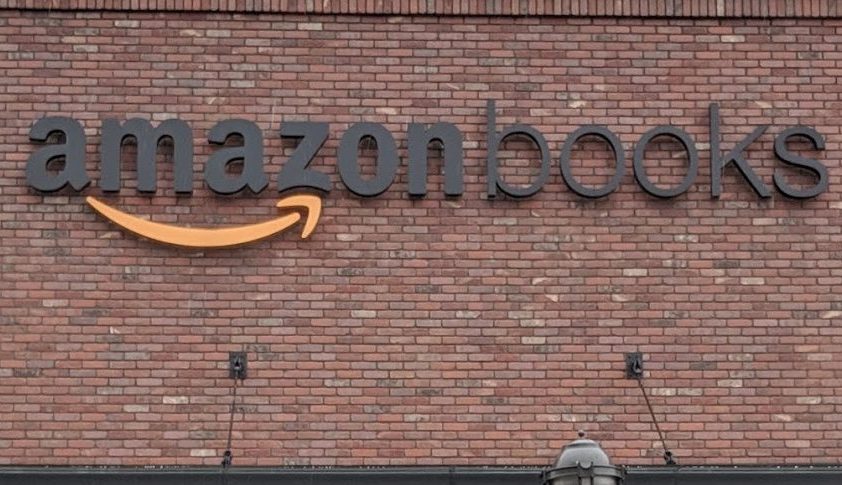
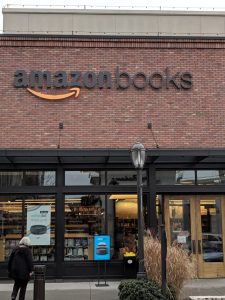
The Amazon Books store I decided to visit is also the very first physical storefront of Amazon and is located in a shopping center in Seattle that is known as the University Village located in the neighborhood of Ravenna. It opened on November 3, 2015.
Also, in the shopping center are other “temples to tech” (as my husband, Argus, calls them) such as a Microsoft store, an Apple Store, three Starbucks (yes, three), a TESLA showroom, a b8ta retail store (get it? Beta) that specializes in the latest in tech products, along with other high-end retail stores such as a top-tiered make-up and skincare lines—oddly named (imho)— BlueMercury. (imho– “tech speak for “in my humble opinion”).
From my online reading, I discovered that Amazon has opened 17 bookstores with another three in the planning stages.
Since Amazon is the largest seller of books in the world, I thought their journey into brick-and-mortar bookstores would be of interest to authors.
What did I learn from my Amazon Book Store visit?
The book store was very organized and neat. And very quiet. Aisles were big enough for strollers, and there was a children’s area at the rear of the store that was more brightly lit.
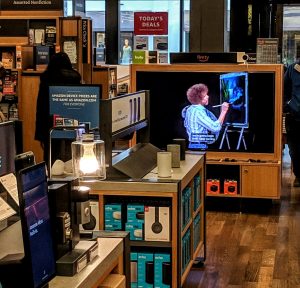
The center of the store was filled with the latest Alexa gadgets, Kindle readers, and etc.
And there were huge video screens playing video-clips. I found the large screens playing videos to be very distracting and not very bookstore-ish (imho).
I walked the aisles of books labeled “Fiction” or “Non-fiction” alphabetized by authors.
What I saw were tall rows and rows of the best-sellers. I then started to look for a few of my favorite Indie authors—no luck there. Next, I then looked for some of my favorite traditionally published authors only to find just a title or two.
I thought that the reason Amazon started the Amazon Books stores was to showcase authors and small publishers who published with them along with their own imprints. I even remember some Facebook posts where Indie authors were excited to see their books in print and face out on the shelves of the Amazon Books stores.
But that was not the case that day in early January 2019 when I checked out this particular store.
I thought then that perhaps there was a section just for Indie authors, so I decided to find a staff member to ask this question. Maybe I just haven’t found the section yet. But, I was told that there wasn’t a special section for Indies and that the store generally tried to stock the best-sellers on the shelves.
I was becoming increasingly frustrated.
I then asked the staff member if there was a section for Pacific Northwest authors. You know, since the PNW is known for being home to a lot of famous authors such as Robert Dugoni, Jim Lynch, Jamie Ford, Garth Stein, Cat Rambo, J.A. Jance, Chelsea Cain, etc.
I was shown this small section (see photo below).
Amazon Books display table of Seattle authors.
Yep, that little round display tower was it—about 12 titles from “Bong (yes, Bong) Appetit” next to Jamie Ford’s most excellent “Love and Other Consolation Prizes” at the Amazon Books store.
Certainly, they must have J.D. Barker’s books. I have seen them for sale in Paris, Lisbon, Frankfurt, Los Angeles, etc. But I didn’t see any. So I asked, the staff member didn’t know who J.D. Barker was, but he did check the computer records for Barker’s books. He told me that they did have The Fourth Monkey in stock last week.
I didn’t see any comfy areas for reading or hanging out. Or perhaps, I just didn’t see them…because of the orderliness of the store.
One of the many reading areas at Village Books.
The photo above was taken by leaning over the staircase at Village Books.
I didn’t see any “shelf-talkers” or posters promoting the next author event like the ones that I see at Village Books. See photos below.
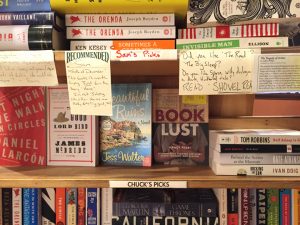
Village Books shelves — cozy and personal with shelf talkers.
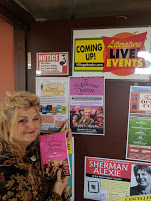
One of the many Author Events poster areas at Village Books.
What are the bottom line take-aways of my research trip to Amazon Books store?
Amazon Books exist for Amazon Prime Members. As do the Amazon Go stores & kiosks where no money or credit cards are taken and there are not any cashiers. Amazon Go can tell if you want to purchase something and automatically charges your credit card. Here is a link if you want to check out the Amazon Go stores.
Amazon Prime members spend approximately thirty percent more than non-prime members in shopping at Amazon. That is significant! No wonder Amazon wants to keep them as prime members and will make it as easy as possible for them to shop.
Indie authors do benefit from having their books available on Amazon to reach the North American market — especially digital and audiobooks. There is no question about that.
But Indie authors should realize that Kobo/Rakuten is where the rest of the world shops for digital and audiobooks.
Scribd (the Netflix of publishing) is acquiring subscribers at an accelerated rate. Scribd focuses on digital books and magazines along with audiobooks that can be downloaded. Indie Authors and Small and Medium presses should check out Scribd as a distribution platform to reach new readers.
And the #1 Take-Away is:
Authors should support your local Independent Booksellers wherever you live and wherever you visit—whether or not if you traditionally published, Indie published, or small press published because it will the Independent Booksellers that will introduce you to their clientele, book reading groups, and will host your author signings and author events.
Independent booksellers are where you will build your grassroots readership.
Independent booksellers will give your books a place to be displayed.
Independent booksellers will give your books a chance — if a title sells 4 books a year, there is an excellent chance they will continue to stock and allow retail shelf space to your book.
Independent booksellers will host your author signings and events.
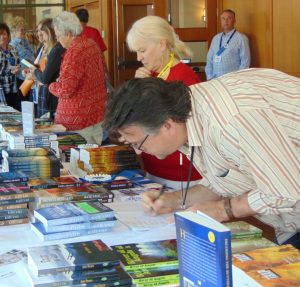
Below is a photo of a Village Book’s author event.
Long live Independent Booksellers! They are community support for authors at all stages of their writing careers.
Also, Village Books manages the BookRoom for the annual Chanticleer Authors Conference and promotes the award winners from the Chanticleer International Book Awards.
Would Amazon do that?
Thanks to Village Books and Paul Hanson (owner and steward for Village Books) for staffing the CAC book room!
Yes, Amazon is necessary and is beneficial for authors and publishers. There is no denial of that. However, we cannot forget to support our local Independent Bookstores that build community for authors and readers.
So the next time you are about to purchase a book, remember to take and make the extra effort to shop at your local Independent Bookseller store. If you are out of town on vacation or business, make an effort to stop by the area’s local bookstore.
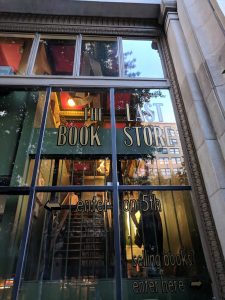
Don’t let this be the LAST BOOK STORE (Los Angeles, Calif).