Time is Running Out — Don’t Miss Out on these Once-A-Year Deals!
ONLY CYBER SALE of the YEAR
CHANTICLEER says
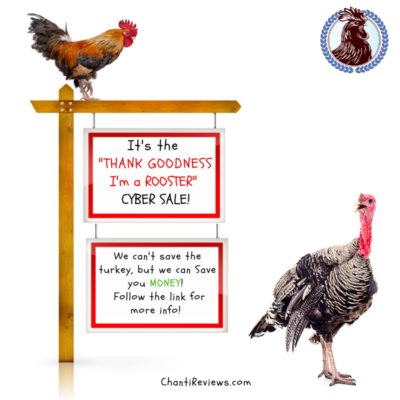
“THANK GOODNESS, I am a ROOSTER!”
CYBER SALE
We can’t save the turkey,
but we can save you $$$
Check out these T.G.I.A.N.A.T. SPECIALS
(Thank Goodness I am Not a Turkey)
SALE PRICES ARE VALID Wednesday, November 23rd until midnight PST Wednesday, Nov 30th, 2022
CYBER SALE – LIMITED TIME
Check out these awesome sales!
Chanticleer Editorial Book Review Package for $370
Purchase the book review package now and you can redeem it anytime in the future.
Use this code upon checkout to receive the discount the unprecedented discount of $100: BKRVWTGZANAT
Audio Book Reviews are also eligible for Chanticleer’s only CYBER SALE of the YEAR!
Our Book Review Package (Regularly $470) includes SEO, Meta-Data, Tagging, Social Media Promotion, and Publication in the Chanticleer Reviews Magazine. Don’t delay! Be one of the lucky few to get in on this incredible rate.
Receive a $100 discount off CAC23 registration, The Chanticleer Authors Conference package that will take place LIVE and IN-PERSON from the Hotel Bellwether (April 27-30, 2023). USE THIS CODE CACTGZANAT23
Note: This is our 11th Anniversary Conference and you do not want to miss out! Seating is limited, so Register Today!
Learn from the Best at CAC23
Past Presenters include: Cathy Ace, Robert Dugoni, Chris Humphreys, Scott Steindorff, and other insightful and exciting presenters.
Sessions on Fundraising for Authors, Audio Book Creation, Multi-Selling Platforms, Digital Marketing, Expanding Readership, Advanced Writing Craft and Content Creation, Social Media Efficacy, Increasing Sales on Amazon, SEO and Why Authors need Alphabet SOUP, BISAC Codes, and much more.
Multichannel Marketing
and the Business of Being a Writer
The New Era of Content Creation in All Its Forms
Take Your Writing Craft to the Next Level
Use this code upon checkout to receive this $100 discount – our deepest discount for the conference. CACTGZANAT23
Fear often tells us where to use caution, to play it safe, and how to know what’s best. Our favorite way to get a scare is from the books we love to read.
What are the Spookiest Genres?
Knock knock…it’s the villain from the last book you read
Well, there can be plenty of honest debate on the subject. For us, we often find the Paranormal, Suspense, and High Stakes Thrillers are the creepiest stories.
And we can’t forget Southern Gothic—shudders and chills even in a hothouse environment! More on that tomorrow on All Hallows Eve!
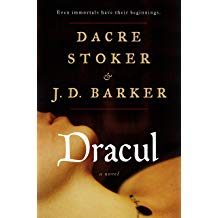
Leading the pack is the modern masterpiece Dracul by J.D. Barker and Dacre Stoker featuring vampires including Dracul himself. Dracul is everything horror can and should be. It doesn’t rely on gore, but rather captivating storytelling; and yet, the terror and intrigue are unrelenting.
Of course, we’ve said before that the reasons we like to be scared range anywhere from wanting that rush of dopamine that fright can offer, to better understanding the terrors of modern-day society. What better way to do that than reading some hair-raising literature?
Recommended Reads to Scare you and Make you Think from Chanticleer!
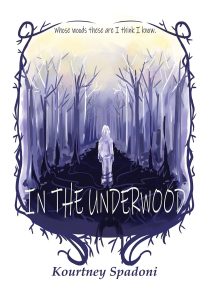
First Place Winner of the Shorts Awards, the art in this is reminiscent of Alice inWonderland, but the focus is much more on depression and anxiety, two of the most difficult things for us to confront in the world.
In the Underwood by Kourtney Spadoni is a memoir in graphic novel form, a thoughtful and gentle story about a young girl struggling with mental health issues, and learning how to keep them at bay as she grows up.
What if Alice’s adventures in the strange and fabulous Wonderland were the result of a mental health crisis instead of a story?In the Underwood draws metaphors inspired by Alice’s Adventures in Wonderland by Lewis Carroll and evokes the mood of Robert Frost’s classic poem “Stopping by Woods on a Snowy Evening.”
Author Spadoni relates with a simple narrative and delicate art style how as a child she was prone to severe bouts of anxiety, leading to her crying uncontrollably in her classes and avoiding other children in social situations. Now that can be scary!
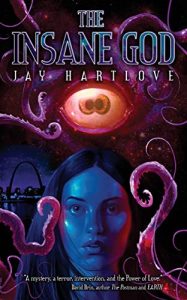
A current Short Lister for the 2022 Cygnus Awards, Hartlove’s tale follows a trans woman’s experience fighting the eldritch beings of H.P. Lovecraft. The cover makes it clear! This book will give you the tingles! A great book for social commentary.
Sarah, a transgender schizophrenic teenager, has spent the past seven years in a psychiatric ward. When all her symptoms of schizophrenia disappear after receiving a special necklace from a nurse, she must learn to live in a world that moved on without her, in The Insane God by Jay Hartlove.
She receives strange visions of two opposing gods in battle with each other, which Sarah and her brother Nate work together to understand. The reality of these visions threatens to endanger the lives of everyone on Earth unless they change the course of an eternal battle.
The Insane God touches on topics such as mental illness, mental health, gender identity, and racism.
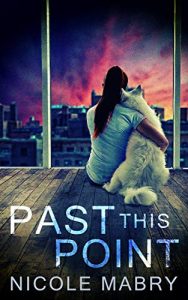
This Global Thriller First Place Winner was actually written before the COVID-19 pandemic, with eerie echoes into the future of a pandemic apocalypse that focuses on one woman’s mission to reunite with her family.
Nicole Mabry draws from her own life, the impact of a deadly snowstorm, and the subsequent shutting down of the subways to create Past This Point, an action-packed dystopian novel featuring a strong woman who seeks a way out of a world gone mad.
Karis Hylen is working in New York City a massive snowstorm shuts down the city. A total quarantine of the city becomes quarantine for half of the nation.
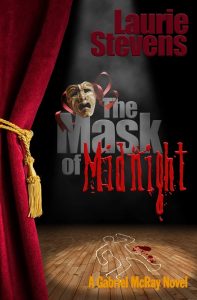
This suspenseful novel took home a Clue First Place Win for its intricate story where the killer and detective are already acquainted.
The Mask of Midnight by Laurie Stevens centers on a game of cat and mouse, made sinister and horrifying by the intricate plots of a murderer.
When L.A. Police Detective Gabriel McRay arrests serial killer Victor Archwood, known as the Malibu Canyon Murderer, he has no idea that the killer has some serious vengeful plans directly involving him. Archwood is a most clever, resourceful “mouse” who confounds McRay, the Los Angeles Police department, the L.A. district attorney, and an entire jury through skillful lawyering and a commanding interpretation of the evidence. Despite what appears to be an airtight case against a mass murderer, a jury finds him not guilty.
2022 CIBA DEADLINES FOR OCT 31
OZMA – Fantasy Fiction
Global Thrillers – High Stakes & Lab Lit
Paranormal – Supernatural Fiction
The only thing scarier is not entering!
Chanticleer Editorial Services – when you are ready
Did you know that Chanticleer offers editorial services?We do and have been doing so since 2011.
Tools of the Editing Trade
Our professional editors are top-notch and are experts in the Chicago Manual of Style. They have and are working for the top publishing houses (TOR, McMillian, Thomas Mercer, Penguin Random House, Simon Schuster, etc.).
If you would like more information, we invite you to email Kiffer or Sharon at KBrown@ChantiReviews.com or SAnderson@ChantiReviews.com for more information, testimonials, and fees.
We work with a small number of exclusive clients who want to collaborate with our team of top-editors on an on-going basis.Contact us today!
Chanticleer Editorial Services also offers writing craft sessions and masterclasses. Sign up to find out where, when, and how sessions being held.
Yom Kippur is coming up soon for our Jewish friends around the world.
As a gentile, I learned a lot in putting this article together, and I understand how much more there is to learn! Links will be included for further reading from all of our sources below!
One particularly useful site was Chabad.org, which says:
Yom Kippur is the holiest day of the year, when we are closest to G-d and to the essence of our souls. Yom Kippur means “Day of Atonement,” as the verse states, “For on this day He will forgive you, to purify you, that you be cleansed from all your sins before G-d.”
Many readers may know the events of the first Yom Kippur, but not realize the connection. Tradition states that the first Yom Kippur happened after the Israelites’ exodus from Egypt when God gave Moses the Ten Commandments at Mt. Sinai. When Moses came down from the mountain, he found his people worshipping a golden calf, and he broke the tablets in a rage. When the people saw the error of their ways, Moses returned to the mountain and returned with two more tablets and God’s forgiveness.
Jews Praying in the Synagogue on Yom Kippur, by Maurycy Gottlieb (1878)
Yom Kippur translates as “the Day of Atonement”
[I]t marks the culmination of the 10 Days of Awe, a period of introspection and repentance that follows Rosh Hashanah, the Jewish New Year. Read more here.
Many people will fast for 26 hours, and, being a holiday of asking for forgiveness, it’s not very common to hear “Happy Yom Kippur!” This article from USA Today explains that the traditional greeting is “G’mar chatima tova,” which means “may you be sealed in the Book of Life.”
The “ch” sound in “chatima” is not pronounced like the English word “chat.” Instead, it should sound more like guttural utterance from the throat, like a backwards snore, because it comes from the Hebrew letter Chet. “G’mar hatima tov” is also acceptable to say.
You can always also just say “Have an easy fast” or “have a good year” since the Jewish New Year has just started.
Breaking the Fast after Yom Kipper
Yom Kippur is the tenth day of the seventh month according to the Hebrew Calendar. It is also known as the “Sabbath of Sabbaths.” Yom Kippur has five prayer services that include the public and private confessions of sins and guilt with atonement and repentance. Along with the prayers is asking others for forgiveness, and give to charity and those in need.
This year, Yom Kippur is sunset of September 15th, until nightfall on September 16th, 2021. Food and drink are refrained from during this time for fasting. Fasting for 26 hours begins at sunset for all males over the age of thirteen and females over the age of twelve. It may be waived for certain medical conditions. It is tradition to eat one large meal on the afternoon of Yom Kippur and then to break the fast with a large feast to celebrate in the evening of the day after. After the last Yom Kippur service, most will return home for a joyous meal, which focuses largely on comfort foods often associated with breakfast like blintzes, noodle pudding, and other baked goods.
White is the traditional color worn on Yom Kippur. The Shofar, held above, is sounded at the beginning of Rash Hashanah and the end of Yom Kippur
Now we want to take the time to celebrate some of the books that highlight some aspect of the Jewish experience that we’ve reviewed.
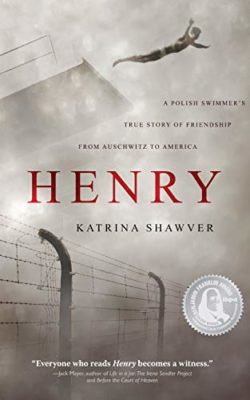
HENRY: A Polish Swimmer’s True Story of Friendship from Auschwitz to America
By Katrina Shawver
First Place Winner in Journey Awards
Katrina Shawver, a journalist for a Phoenix newspaper, was seeking a story for her weekly column. She had heard from a friend that a Holocaust survivor named Henry Zguda and his American wife, Nancy, lived in Phoenix. She called Zguda and was invited to come to his home, only a few blocks from her own. Shawver quickly bonded with both Henry and Nancy. Then she and Henry decided to have a series of weekly interviews, which she would draw on for her column and, later, for a book—this biography.
The horror story of Henry Zguda, a Catholic Pole born and raised in Krakow, Poland, begins with Henry walking down the street toward the YMCA for swim practice in 1942. A Gestapo car screeches to a stop beside him. Two men leap out, arrest Henry on the spot, throw him into the car, and take him to prison. After several days of torture, a practice used by the Gestapo to obtain information (of which Henry had little), he is taken to the train station and shoved into a cattle car so filled with people that it is impossible to do anything but stand, shoulder to shoulder. The door is slammed shut, and the train pulls out of the station. Henry has no idea what fate awaits him.
DAVID and AVSHALOM: Life and Death in the Forest of Angels
By Bernard Mann
First Place Winner in Chaucer Awards
Debut novelist Bernard Mann has diligently researched a wide-ranging saga centered on the life, loves, songs, and struggles of King David, a central figure in the Old Testament and author of the Book of Psalms.
The tale begins at a crucial stage of David’s life as he is escaping the wrath of King Saul. Once a father-figure to the former shepherd boy, Saul’s view of David sours when the majority of his subjects begin to revere David over him. David flees with a small band of loyal stalwarts. He is still a fast friend to Saul’s son and likely successor, Jonathan, and is married to Saul’s daughter Maacah. Moreover, he still holds fast to his faith in God and continues to compose poems and songs in praise of Him. When both Saul and Jonathan perish in battle, David takes up the struggle, amasses an army, receives the crown, and seizes the city of Jerusalem, making it the seat of Israelite power.
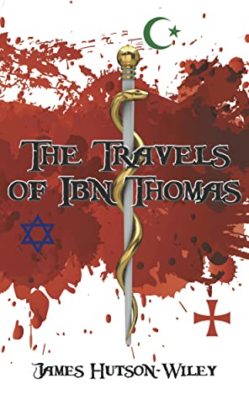
In an ancient world split in three by religion, a conflicted young man seeks the truth about his past and builds his future in this colorful panorama created by author James Hutson-Wiley.
Ibn Thomas, the book’s narrator, taken from his boyhood home In Aegyptus after his father and mother disappeared, lives in a monastery where he is mocked for his name and his knowledge of Arabic. At age 12, the monks send him from England to Salerno, Italy, where he will study medicine, supported, he learns, by considerable wealth to which he is heir from the commercial activities of his father, a trader in Al-Sukkar, or sugar, considered a precious commodity at the time.
A FEMALE DOCTOR in the CIVIL WAR
By Richard Alan
First Place Winner in Laramie Awards
Imagine a fearless, hard-as-nails contract surgeon hired by the Union Army who often works 48-hour shifts in battlefield medical tents amputating limbs, healing previously inoperable gut wounds, sewing up children’s hare lips, and diagnosing what we now call PTSD as critical in military patient care as patching physically wounded bodies.
A native of the Pacific Northwest, Dr. AbbyKaplan stands six feet tall and exchanges her dresses for breeches, totes a gun on her hip, engages in military defensive maneuvers, and is wounded multiple times for her efforts. Dr. Kaplan takes no guff from anyone and uses the language of soldiers appropriate to the situation. In a time when men are in charge and women are not, she wins the respect of her male colleagues in the most gruesome medical cases, winning over even those who could not fathom a woman examining a man’s most private parts.
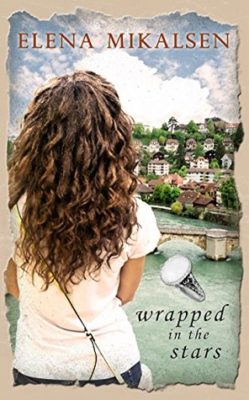
WRAPPED in the STARS
By Elena Mikalsen
First Place Winner in Chatelaine Awards
Maya Radelis has spent the last seven months running from herself. After the death of a patient, she abandons her pediatric residency in New York City for the jungles of Guatemala and the Family Health Volunteers Mission. However, after exhausting her six-month leave, she still cannot bring herself to return to New York. Instead, Maya ends up in Edinburgh, Scotland, where fate intervenes.
In a small antique shop, an inscribed ring somehow “calls” to her. Unwilling to part with it, Maya purchases the ring and traces its history. She has seven days before she must return to the university and face the consequences of her absence, as well as the investigation of her patient’s death. Fearing she will no longer be allowed to pursue a medical career and dreading the meeting where her fate will be revealed. Maya wants to make the most of her search for the ring’s previous owner, especially after she begins to have strange dreams and memory-like episodes of the woman she thinks owned the ring. Enlisting the help of Pauline, her French friend, she traces an odd, twisting path through Paris then Bern, Switzerland. The more she discovers, the more she begins to question her destiny.
YISHAR KOACH: FORWARD with STRENGTH
By Susan Lynn Sloan
YisharKoach:ForwardwithStrengthshares the account of a man who was entrusted with inspiring some of these precious few orphans to find strength and hope after experiencing tremendous loss. At Aglasterhausen, a United Nations school for WWII orphans, Fred Fragner took on the mantle of principal and teacher at the school—a daunting responsibility for most, but not for Fragner—a fighter of the Nazi regime who was shot, captured, and interrogated by the Gestapo and then imprisoned for five years in Buchenwald Concentration Camp.
The life of this most remarkable man of integrity and altruism was inspiration for Susan Sloan to write Fragner’s biography—a five year project that she undertook with great passion after being introduced to him at a café in Bellingham, Washington. Sloan researched transcripts of lectures and speeches made by Fragner, she refers to newspaper clippings and documents about him, listened to audio and video tapes, and interviewed many who knew him as mentor, coach, friend, family member, and teacher. Most importantly, Sloan had access to Fragner’s own scrapbook about Aglasterhausen that vividly tells how “the children gave him his life back” as he tried to help restore theirs.
When you’re ready,did you know that Chanticleer offers editorial services?We do and have been doing so since 2011.
Our professional editors are top-notch and are experts in the Chicago Manual of Style. They have and are working for the top publishing houses (TOR, McMillian, Thomas Mercer, Penguin Random House, Simon Schuster, etc.).
If you would like more information, we invite you to email Kiffer or Sharon at KBrown@ChantiReviews.com or SAnderson@ChantiReviews.com for more information, testimonials, and fees.
We work with a small number of exclusive clients who want to collaborate with our team of top-editors on an on-going basis.Contact us today!
Chanticleer Editorial Services also offers writing craft sessions and masterclasses. Sign up to find out where, when, and how sessions being held.
A great way to get started is with our manuscript evaluation service, with more information availablehere.
And we do editorial consultations for $75. Learn morehere.
If you’re confident in your book, consider submitting it for a Editorial Book Reviewhereor to one of our Chanticleer International Awardshere.
Also remember! Our 10th Anniversary Chanticleer Authors Conference (CAC22) will be April 7-10, 2022, where our 2021 CIBA winners will be announced. CAC22 and the CIBA Ceremonies will be hosted at the Hotel Bellwether in Beautiful Bellingham, Wash. See the latest updates here!
Hello Chanticleerians and we hope you are enjoying your Three Day Weekend for Labor Day!
For many of us who write, it’s a full time job on top of the day job we already have. And, as writing is a full time business, we deserve a little recognition for all the work we put in on top of any other labor we already do. Let’s look at the history of Labor Day and some stories that remind us how far we’ve come, and others that show us possibly how far we may be able to go!
First off, while Grover Cleveland officially signed Labor Day into law in 1894, people aren’t sure if it was Peter McGuire or Matthew Maguire, the cofounder of the American Federation of Labor and a secretary of the Central Labor Union respectively, who actually began the holiday. While there are more Maguires there than in the new Spiderman movie, there is no confusion on why Labor Day started. You can learn more from the Department of Labor here.
While Tobey Maguire was a great Spiderman, that’s not who were talking about here.
Labor Day is a celebration of the achievements, both social and economic, of workers in the United States. The holiday recognizes the contributions these workers make to the nation’s prosperity and well-being. Now, more than ever, it’s clear that our essential workers deserve recognition, celebration, and a thriving wage.
In describing the need for Labor Day, History.com says:
People of all ages, particularly the very poor and recent immigrants, often faced extremely unsafe working conditions, with insufficient access to fresh air, sanitary facilities and breaks.
Remembering Labor Day is a great way to remind ourselves that conditions can always be better for workers across the board.
The Ferengi Rom facing down his brother Quark and forming a union in Star Trek: Deep Space Nine’s episode “Bar Association”
When we think of the history of labor in this country, ways people can make a difference right now, and where we might be going, there’s a whole world of books that opens up to us! Here are just a few that we recommend!
Working Fiction
Infants of the Brush By A.M. Watson
A little boy is sold into an apprenticeship as a chimney sweep in eighteenth-century London, and soon learns the horrors of that profession.
Six-year-old Egan lost his father from an accident at sea, and now, may lose his little sister from illness. The only way his penniless mother can save her daughter is to sell Egan into an apprenticeship in order to purchase medicine. As a small boy, he will make an ideal “broomer;” a businessman named Armory gladly takes Egan into the fold. Under Armory’s absolute dictatorship he will sleep with other wretched boys on soot sacks, eat gruel, get bloody beatings for the slightest infraction, and risk his life almost daily.
The Selah Branch By Ted Neill
First Place Winner in Cygnus Awards
The Selah Branchcombines two surprising stories into one enthralling whole.
It begins with a ripped from the headlines feel, diving deeply into issues of race, class, poverty, and hopelessness in Selah Branch, WV. A town whose brighter future of uplift, integration, opportunity, and prosperity was wiped out one summer night in 1953 when a chemical explosion destroyed the promising university town and replaced it with a hazardous waste site. Like Chernobyl, only with a smaller footprint and chemical residue substituting for nuclear waste. But just as deadly.
The story views Selah Branch through the eyes of Kenia Dezy, an African-American public health student on a summer practicum. She’s to determine if a simple app can steer people towards healthier food choices and better health outcomes in a town empty of jobs, filled with poverty and hopelessness, marooned in the middle of a food desert.
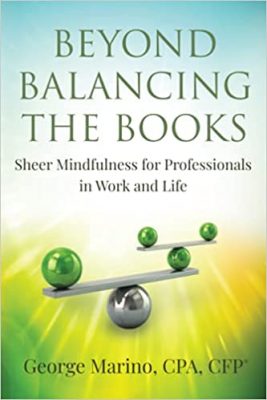
Beyond Balancing the Books By George Marino, CPA, CFP
George Marino, a practicing CPA and Mindfulness Coach, explores the possibilities for sustainable positivity in one’s work-life through mindfulness principles and practices in his new book,Beyond Balancing the Books: Sheer Mindfulness for Professionals in Work and Life.
It would be difficult to find a profession more fraught with detail, deadlines, and distress than a typical CPA. Applying to that particular realm the idea of mindful meditation is a challenge that author Marino has taken on because it is a process he has lived. He opens his book by comparing two CPAs and their approaches to life and work-life.
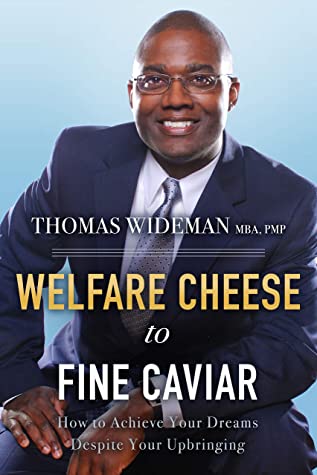
Thomas Wideman, the author of this dynamic self-help manual,Welfare Cheese to Fine Caviar: How to Achieve Your Dreams Despite Your Upbringing, rose from poverty and dismay to a life of security and personal achievement through techniques he shares with readers who can incorporate them into their own life plans.
Wideman came from an impoverished African American family wracked by confusion, chaos, and, at times, criminality. His mother had three sons by three fathers, and he would come to know his own father only peripherally, eventually learning that the man murdered people and subsequently died in prison. The boy grew up in tough neighborhoods and ate “welfare cheese” (a block of pre-sliced heavy American cheese that supposedly melted well). Every month, making ends meet became more and more difficult. In an early chapter of this finely woven chronology, we see him taking food from trains parked along the railroad tracks and running from the authorities. In this, as in each new chapter, he speaks of confronting severe issues and finding ways to resolve them. In the case of the theft and other childhood incidents of fighting, experiencing bullies, and battling racism, he speaks of making up his mind that “my circumstances need not be my limitation.”
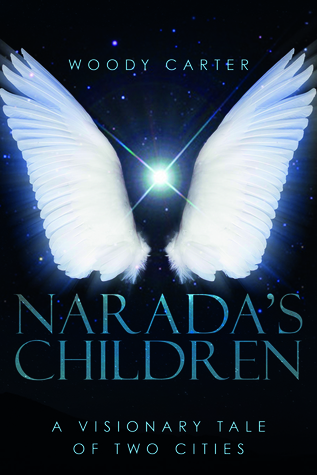
A colorful fable resonates with contrasting modalities of mysticism and social action, exploring how culture and religion can separate us or bind us together.
Narada is a traveler and a stranger when he first meets the lovely Hohete and her people in the ancient city of Ja’Usu. Given water, food, and shelter by Hohete’s family, Narada is sharply questioned by village elders who are stymied by his forthright statement that he is a representative of a deity named The Great Mystery. So they conspire to remake him as a storyteller, to reduce his power and profit from his talent for spinning yarns by selling refreshments to his audience.
Have a great story about workers and overcoming adversity?
When you’re ready,did you know that Chanticleer offers editorial services?We do and have been doing so since 2011.
Our professional editors are top-notch and are experts in the Chicago Manual of Style. They have and are working for the top publishing houses (TOR, McMillian, Thomas Mercer, Penguin Random House, Simon Schuster, etc.).
If you would like more information, we invite you to email Kiffer or Sharon at KBrown@ChantiReviews.com or SAnderson@ChantiReviews.com for more information, testimonials, and fees.
We work with a small number of exclusive clients who want to collaborate with our team of top-editors on an on-going basis.Contact us today!
Chanticleer Editorial Services also offers writing craft sessions and masterclasses. Sign up to find out where, when, and how sessions being held.
A great way to get started is with our manuscript evaluation service, with more information availablehere.
And we do editorial consultations for $75. Learn morehere.
If you’re confident in your book, consider submitting it for a Editorial Book Reviewhereor to one of our Chanticleer International Awardshere.
Also remember! Our 10th Anniversary Chanticleer Authors Conference (CAC22) will be April 7-10, 2022, where our 2021 CIBA winners will be announced. CAC22 and the CIBA Ceremonies will be hosted at the Hotel Bellwether in Beautiful Bellingham, Wash. See the latest updates here!
Chanticleer Editorial Book Reviews for #SeriousAuthors
Why do you want to post reviews on your book’s Amazon page in the Editorial Reviews section?
Kiffer Brown chimes in here:
It is well-known and believed that part of Amazon’s secret sauce search algorithm crawls the Editorial section of each book’s Amazon page. It is believed that the more individual blurbs attributed from different sources, the better. Be sure to leave a blank line between review blurbs along with giving attribution to the reviewer will attract the notice of the “crawler” program.
And having review blurbs in the Editorial Reviews section gives your title a certain cachet and panache that will separate it from the other books (read millions) that do not have them.
Editorial reviews help to garner more “consumer reviews” (reader reviews). They do this because they give readers the language to discuss your book and reaffirms the readers’ opinion. This is why traditional publishers spend a lot of time, effort, and money on getting reviews for pre-released books.
It’s a numbers game.
To get on Amazon’s radar, even more, your title will need at least 100 consumer reviews. Notice I didn’t say one hundred 5-starred reviews. It is the quantity that counts here. And the more mixed the better.
Why do you want your title to get on Amazon’s “good books radar?”
When a reader does a search on Amazon for a particular genre to read, Amazon “ranks” which books will be shown to the searcher (reader) as a potential selection that he or she might want to purchase. And Amazon is in the business of selling things (consumer goods). Books for “the Trade” (genre fiction) are consumer goods.
Now back to Sharon Anderson…
Most authors sell their books on Amazon.com because that’s where a fair share of the reading public goes to purchase their books. If an author has worked hard at conditioning their audience – or if enough people have read an author’s work, soon reviews will be added. Good or bad.
Sidenote:We all like good reviews, right? I mean, who doesn’t? But bad reviews can be just as helpful. Believe it or not, bad reviews (1-2 stars) are instructive. They will tell you about formatting issues, grammar issues, plot failures and more. Pay attention to them! Besides, if all you have are 5-star reviews – well, that’s a little unbelievable.
Back to our topic…
That’s all well and good, however, what do you do with your Chanticleer Editorial Review?
Update 3/20/2020: We just noted that we have not updated this paragraph. Our apologies. Kiffer: We are no longer allowed to post our reviews on Amazon since summer 2018 or so. It is Amazon’s policy not ours –even though Amazon ranked us highly and gave us special recognition. <<We will post the entire review on your book’s Amazon page Consumer Reviews>>
But there IS something that only you can do and that is to post a blurb of it in the Editorial Reviews section.
Posting Your Chanticleer Book Review to the Editorial Review Section
You cannot do this from Amazon.com. You first have to log in to your Author Central account.
You do have a fully functional Amazon Author Central account—don’t you.
Back to posting a review blurb in the Editorial section on your title’s Amazon page…
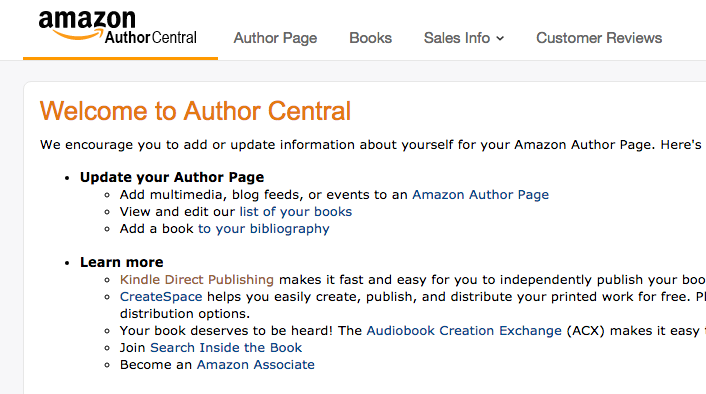
The welcoming page should look like this:
Click on Books:
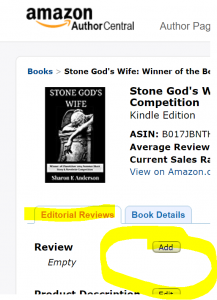
Your books will pop up and the screen should look something like this:
Click on the book you wish to add a Chanticleer Review to:
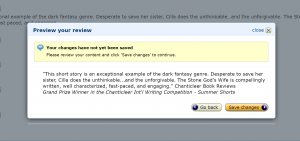
Hit the “add” button and place the Chanticleer quote you wish to use. Preview it, and if it looks good, click on “save changes.”
In a few days, you will see the Chanticleer quote appear under the Editorial Reviews section on your book’s Amazon.com page.
Another chime in from Kiffer:
For a professional look, do not post the entire review. A well-selected blurb will do nicely. Be sure to use ellipses if you are taking a section out. And always give attribution!
Example:
…Readers who are new to Larew’s series are in for a fabulously thrilling, nail-biting, page-turning, edge-of-their seats ride. Marilynn Larew’s writing style is smooth, engaging, and well-paced. Her ability to craft vibrant settings against the backdrop of exotic and gritty Hong Kong is exceptionally well-delivered. To sum it all up, Hong Kong Central is an absolute win. —Chanticleer Book Reviews
Thousands of wild mustangs now have a sanctuary to call home thanks to one man: H. Alan Day. This is his story.
Perhaps you’ve heard of a horse whisperer: a person who gently and patiently communicates with an animal. Multiply that by 1,500 and you have H. Alan Day, a cattle rancher from the southwest turned horse herder who takes on what would seem to be an unimaginably huge project.
The Horse Lover: A Cowboy’s Quest to Save the Wild Mustangs, is Day’s story of Mustang Meadows Ranch in the Sand Hills of South Dakota, the first government-sponsored wild horse sanctuary established in the United States.
In beautifully vivid prose, Day transports us to the prairie, as in this passage: “The sun highlighted the horses, now twelve hundred strong, creating a canvas of golds, bronzes, beiges, blacks, and deep browns that stretched out before me.”
Day’s youth played a critical role in his success and interest with horses as he grew up on a 200,000-acre cattle ranch straddling the high deserts of southern Arizona and New Mexico. After college, he returned to manage Lazy B, the family ranch, for the next 40 years. Later, he (hesitantly) purchased 35,000 acres in South Dakota and dedicated it as a horse preserve for 1,500 wild mustangs. Relying on a herd medication program he used at Lazy B, he trained the group of mustangs, those considered unadoptable, to follow a lead horse from the wild through the gates and into the horse meadow.
However, it wasn’t always easy. Initially, Day scoffed at the idea. “Come on, wild horses? I was a cattle rancher…”
Thanks to a heartfelt and informative introduction by his sister, Sandra Day O’Connor (the first female US Supreme Court Justice who retired in 2008 after 25 years on the bench), we learn that wild mustangs, formerly running free, breeding and multiplying, were being captured, sold, or destroyed. The Bureau of Land Management (BLM) took care of many of them; however, the remainder was considered unadoptable.
Day remained stalwart facing dangers, frustrations, and heartbreak and had to deal with government red tape. Through his eloquent and moving story, he shows us the resolve and passion required for undertaking South Dakota ranching.
It’s no surprise Horse Lover is well written and poignant; in 2002, Day partnered with his sister to co-author the family memoir, “Lazy B: Growing Up on a Cattle Ranch in the American Southwest,” which went on to become a New York Times bestseller.
Horse lovers will not want to miss this book – and witness the magic of thousands of horses running wild. The rest of us will marvel at what Day was able to accomplish in this story of loyalty and hope.
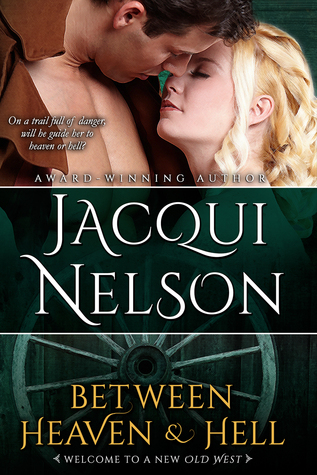
The year is 1841 when nine-year old Hannah watches the murder of her family by drunk white renegade men. She was found by native Americans and taken in. Thrust into a new and unfamiliar life that will challenge and change her forever. But over a decade later, a tragic event has left her on the run from the tribe she grew accustomed to and now she must find a way to make a living on her own.
She and her trusted horse travel to Fort Leavenworth, Kansas – in other words, Hell – where she hopes to find a job. With the skills she learned from living with the tribe and her dead eye skills with a gun, she’s hoping to land a scouting job. There, she meets Paden Callahan, a seasoned traveler and military man who is looking for a replacement for his current scout, Dawson.
After being taken at such a young age, Hannah finds it better to be strong and live independently than take up a typical woman’s profession. Hannah has honed her shooting skills and has an aim better than most men, which astonishes everyone and angers those she bests. But, despite her skill and strength, Callahan still isn’t too sure a woman can handle the tough trail life and also isn’t too sure he can control himself around a woman this beautiful.
With little options to choose from, Callahan reluctantly allows her to come, but they both discover there are more dangers following Hannah than anyone realized.
Between Heaven and Hell is an alluring romance that captivates readers in a time period where Pioneers fought for land and Native Americans retaliated in order to keep what was their home. Jacqui Nelson’s characters are multi-dimensional and drift between bridging the gap between the two groups.
Hannah is an inspiring strong woman whose path represents the bridge between Natives and Settlers, and who spends most of the novel struggling to reconcile her two very different identities. Her life with the tribe has helped make her the woman she is, yet many of the settlers she must find a life with are those who do not understand, nor wish to understand, where she came from. Despite her personal battle and the difficulties she faces as a woman on her own, Hannah proves herself to be tough and resilient.
Callahan is also haunted by his past, though it differs greatly from Hannah’s and he fights to understand her and how to help her. The connection that develops between them despite their differences makes their relationship worth rooting for.
Nelson delivers a perfect, steady-paced book with poetic descriptions of romance and easy-to-follow fluidity of Callahan and Hannah’s journeys. Those who love romance and hot sensual scenes, along with the Western historical fiction, will find themselves enamored with this novel.
Yay! You received your Chanticleer book review and it filled you with pride to see all the glowing things the reviewer had to say…now what? A few things are obvious. Quote it on your book cover, your website, social media, marketing materials, etc.
One of the most important things to do with your review is adding it to the “Editorial Reviews” section of your book on Amazon Author central.
It’s also one of the most often missed opportunities among authors.
Some authors are intimidated by Author Central, but it’s a very easy system to use, and we are going to show you exactly what to do. (If you are already comfortable with Amazon Central, skip the next section and scroll down to the Quick List of Steps for Adding Your Editorial Review to Amazon)
Meet Author Central
This is a screenshot of the welcome page when you visit authorcentral.amazon.com and log in with your Amazon username and password. In this one little square of webpage real estate you have, at your fingertips, everything you will need to manage your books: keep your author profile up to date, add and edit book information, check on your sales–even access Kindle Direct Publishing (KDP), CreateSpace, and the Audio Creation Exchange (ACX) to manage your books if you are self published.
The important thing to note is this extra place to add and edit your book. Most people know about KDP and how to upload and edit books. But after you have added your book to KDP, you also have to “add it” on Amazon Central.
To do that click on “Books” in the menu options (as seen in the image above). On the next page you will see this:
And if you have already added books you will also see a list of your own books. If you have a publisher actively involved in updating the Amazon information for your book, you may want to discuss your using Amazon Central with them first, because changes to sections here may prevent them from making future changes to those particular sections in their own access panel for your book.
To add a book, click the button and search for it by author or title, if it’s available on Amazon, you will find it quickly (if it’s not available on Amazon then you still need to add it to KDP and/or CreateSpace–and that is another article entirely).
When your book is listed on the “Books” page of your Author Central you can click the title and access its details. In “Editorial Reviews” you will find all kinds of goodies to play with!
You will see something like this:
This Review slot is what we are after. You can also add things in the other slots if they are needed, but keep in mind these are the bits that your publisher won’t be able to edit anymore if you change them. (Also you won’t be able to change them over on the KDP side either, so you will always have to come back here to make your changes).
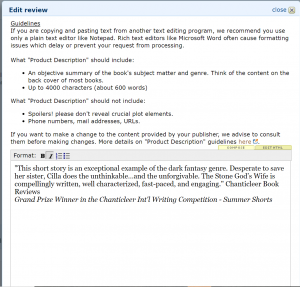
When you click the “add” button next to Review, a window will pop up to enter the text as well as a detailed set of instructions from Amazon on how format your reviews and their guidelines.
Choose a good quote from your Chanticleer review, a couple sentences, without too many “…” between snippets (you don’t want it to look pasted together like a ransom letter). Remember less is more. Use words that convey excitement and opinion about your book. Don’t waste your quote on plot description, that’s what your synopsis is for.
For example: “A riveting adventure…” — Chanticleer Reviews
Once you’re happy with it, hit preview and save. That’s it. It couldn’t be simpler.
Quick List of Steps for Adding Your Editorial Review to Amazon
Log in to author central
Go to your Books Page
Click on the title of the book you want to edit
Under Editorial Reviews, click “add” review
Enter an exciting snippet from your review that clearly shows the reviewers opinion about your book and attribute it the Chanticleer Reviews (e.g. – “A riveting adventure…” — Chanticleer Reviews)
By adding your review you are taking advantage of the authority and reputation that a Chanticleer Review brings with it. You’re showing people that your book was vetted by a respected source within the publishing community. Remember your editorial review is one of the single most valuable tools available to you in persuading readers to take a chance and buy your book. If you don’t use it, you are missing book sales.
Our team is going to be too busy enjoying a bit of time off on Black Friday to post a promotion on that day. But, we didn’t want to miss an opportunity to give back to our wonderful supporters.
Now through midnight on November 30, 2016, we are offering you $75 off the cost of our Chanticleer Book Review for a limited time.
Book isn’t quite ready? You can take advantage of this Thanksgiving special and we will issue you a voucher that is valid until December 2017. That’s a whole extra year to get your final polish done!
consumer reviews by individual consumers (readers)
An author requires all four to make a professional impression on potential readers because each type of review has its own targeted audience and its own aim. And since there are many shades of gray (no pun intended), authors will benefit from having reviews from all four categories.
Editorial Reviews
Editorial reviews tend to focus on the technical aspects (grammar, formatting, spelling, consistency, punctuation, POV, etc.) of a work along with the writing craft of the author by an editing professional. Other publishing or media professionals use these assessments when evaluating for works purchasing decisions or for distribution purposes.
Chanticleer Editorial Reviews:
Here at Chanticleer Book Reviews, our reviews combine an editorial assessment of a work: plot, structure, dialogue, characters, story development, along with grammar and punctuation with the readability of a work. The assessment is written by a professional editor after reading and evaluating the particular work.
Our review team is comprised of experienced editors selected for their expertise in specific genres and blended genres. It is extremely important that the person reviewing the work understands the genre of the work and what the readers of that particular genre are looking for in a “good read.” Thriller fans will be bored with cozy mysteries. Cozy mystery fans will be annoyed with the rapid fire of situations found in thrillers. Romance readers typically don’t enjoy the angst of many literary works that are known for not having “satisfactory or happy” endings. Some works overlap and blend genres which would go against the grain of some genre purists. Even though a professional editor can see merit or if there are problems in a work out of their expertise, we try to select the very best fit between a work and the reviewer.
Chanticleer Book Reviewers uphold the time-honored publishing traditions that readers have come to appreciate and expect from published works while maintaining an open-mindedness for emergent ideas, talent and creativity in the field of literature, media and publishing.
Manuscript Overviews
Editorial Reviews may also be manuscript overviews. Manuscript overviews are to help the author evaluate his work on a broad spectrum on the following issues before getting a line by line edit.
Manuscript Overviews editors look for:
consistency in story
POV
grammatical errors
style sheet issues
character development
dialogue issues
plotting, plot holes
pace of story
theme consistency
does the work need tightening or is it too staccato
I always like to ask the manuscript reviewers, “Does the work have a ‘beat to it?’ Does the story move along? Are the characters memorable?”
A manuscript overview can answer these questions in an objective and unbiased manner. The goal is to help the author work out issues before she has it line edited and proofed for publication.
On another note, a work can be technically correct, but a horridly boring read. We know, we’ve read them! Then there are works that are compelling to read even if they are bungled with grammatical and writing craft errors. The decisive point is that while an editor can correct errors in grammar, punctuation, POV, etc., they cannot “correct” a boring story. Creativity and Content are King and Queen. However, lack of editing or just bad editing can cause the reader to “stumble” over the text and put it down in favor of trying another read, another author. An intriguing storyline can benefit from a developmental editor – the most difficult level of editing. Most works can benefit enormously from a correct dose of developmental editing.
Remember:The editor sees what the author cannot. The story lives in the author’s mind. The editor sees the gaps between the author’s mind and the words on the page. It is almost impossible to “see” your own gaps because your mind automatically fills them in.
Peer Reviews by Peer Reviewers
For most fiction authors, this would be a review by another author who writes in the same genre. The most beneficial type of Peer Review would be an “endorsement” from an author in the next tier of sales above you—an author who can validate that your work is worthy of his/her endorsement. This type of review generally bespeaks, “If you like my novels, you will like this author’s work. Give this book a try.” The author making the “endorsement” is putting her reputation on the line for you. Request author endorsements judiciously and respect the author’s right to pass on the opportunity.
The reviews posted on Amazon, or on Goodreads, or on websites are precious! These reviews are from individual readers who (hopefully) enjoy reading your works. Readers, on the whole, write very few reviews for many reasons: too busy, not really knowing the specifics of why they like the work, not having the background (read vocabulary) to discuss the work, or it is just too much trouble.
Authors need to make it easy as possible for readers to recommend their books by:
creating links
making use of editorial (read: professional) reviews that will give recreational readers the vocabulary from which to discuss and share their thoughts about their works
thanking the busy reader for any feedback, LIKEs, +1’s etc.
Post, comment, LIKE, and +1 on the reviewer’s social media posts and blog-posts.
Consumer Reviews are instrumental in creating BUZZ! You, the author, should endeavor to do anything that will make it easier for your readers to spread the word about your work.
Visit examples of how to use the different types of reviews on your author platform’s website.
You will notice that they list peer reviewers (other authors), professional editorial reviews (Kirkus, Chanticleer, Foreword), and readers’ reviews together making it easy to scan for the preferred reviewer(s).
Please look for the next article from Chanticleer Book Reviews on Mastering Book Discovery Tools and Methods.