CHANTICLEER 10 AUTHOR INTERVIEW SERIES
with award-winning author, Jennifer Kincheloe
Jennifer Kincheloe won First Place in our Mystery & Mayhem Awards a few years back, but we still remember her contagious smile and her fabulous book, The Secret Life of Anna Blanc. Let’s get into it!
Chanti: Tell us a little about yourself: How did you start writing?
Kincheloe: I used to be a research scientist/mother of two. (Actually, I still am) About ten years ago, bemused by the boastful Christmas letters I would get every year in the mail (this was before Facebook), I decided to write a humorous, sort of spoofy Christmas letter. I spent hours on it. And when people read it, they laughed. That’s when I discovered I loved writing.
Chanti: When did you realize you that you were an author?
Kincheloe: After I wrote my Christmas letter, I decided to write a screenplay because, in my naïve mind, they were shorter than novels and therefore easier. I had just recovered from an illness and wasn’t working, so I had time to spend on it. When I started writing, I couldn’t stop. It made me high. I wrote all the time. I barely stopped to eat. I would wake up in the middle of the night and write. I took my laptop everywhere. (I still do). When I stopped to consider this, I decided I must be a writer.
And, by the way, my screenplay was terrible.
Chanti: I love that feeling when you’re in it deep and words just flow. What a high! What do you do when you’re not writing? Tells us a little about your hobbies.
Kincheloe: I like kickboxing and hiking. I love theater. I go to the Metropolitan Opera’s film series. I spend time with my family and pets.
Chanti: It sounds like you have a well-balanced life. Good for you! How do you come up with your ideas for a story?
Kincheloe: Newspaper articles. I usually base my mysteries on real crimes. The little details in the book, the world-building, typically come from historical sources. For example, I read in a wealthy woman’s diary about how her family had employed a man from China at the turn of the 20th century. He would fill his mouth with water and spit it out in a fine spray onto the clothes he was ironing. That went right into The Woman in the Camphor Trunk.
Chanti: How do you approach your writing day?
Kincheloe: I write on my lunch break, nights and weekend. I usually write every day, even if it’s just a paragraph.
Chanti: Smart. Put something on paper – it doesn’t matter how much. It’s about the habit. I like that. What craft books have helped you the most?
Chanti: What business books about writing have helped you the most?
Kincheloe: If I were to look at writing as a business, I would despair. Even the traditional publishing market is flooded and very few authors make a living. What helps me is having an engaging and profitable life apart from writing. This allows me to write for the joy of it. Most authors I know who make a living are a dozen or more books into their career. Some of our finest, most decorated authors do not make a living.
Chanti: What are you working on now? What can we look forward to seeing next from you?
Kincheloe: I’m working on the fourth book in the Anna Blanc Mystery series. It deals with mysterious fraternal orders and horrible death.
Chanti: How exciting! What is the most important thing a reader can do for an author?
Kincheloe: Email the author and tell them you loved the book and why. Recommend a book to a friend. Give books as presents. Leave reviews on Goodreads, Amazon, library webpages, wherever. Go to their book signing and say hi.
Chanti: Do you ever experience writers block? What do you do to overcome it?
Kincheloe: Yes. I overcome it by putting on my big girl panties. In the words of Gail Carriger, “Sandwich makers don’t get to have sandwich block.” I’m a writer. Thus, I write when I don’t feel like it. If I’m burned out, I spend time in nature. A fine book on creative blocks is The Artist’s Way by Julia Cameron.
CHANTICLEER 10 QUESTION AUTHOR INTERVIEW SERIES
with Award Winning author, E.E. Burke
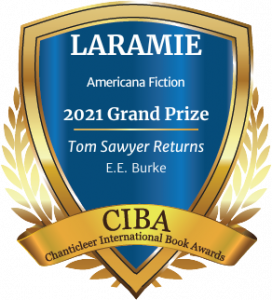
Two of my greatest honors came in succession last year when I won the Laramie Award for Tom Sawyer Returns and was featured by the Mark Twain House & Museum. Both honors were beyond my hopes and they fulfilled a dream. Leigh S. Stites w/a E.E. Burke
I’m excited for you to get to know award-winning author and historical maven, Leigh S. Stites aka (E.E. Burke) read on.
Chanti: Tell us a little about yourself: How did you start writing?
Stites: I’ve been an avid reader from an early age. My mother likes to tell the story of how I went to bed with books instead of my teddy bears. As a journalism major, I wrote for newspapers, and later, in public relations and advertising. Storytelling is my passion, but I didn’t start producing fiction professionally until I was nearly 50. I prefer to call it a midlife metamorphosis rather than a crisis.
Two of my greatest honors came in succession last year when I won the Laramie Award for Tom Sawyer Returns and was featured by the Mark Twain House & Museum. Both honors were beyond my hopes and they fulfilled a dream.
Chanti: Those are mighty fine honors, indeed! Congratulations! Let’s chat a bit about genre. What genre best describes your work? And, what led you to write in this genre?
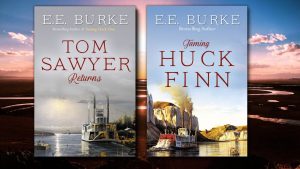
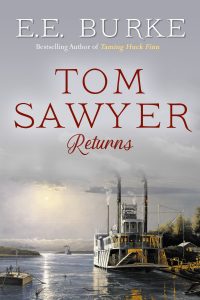
Stites: All of my novels have historical settings, primarily the American frontier. I’ve been fascinated with that period since I was in grade school. In fact, my novel Tom Sawyer Returns was born out of a burning need to know what happened to the two boys I read about when I was in seventh grade.
Huck and Tom had grown up, what professions would they have pursued? What great historical events would they get caught up in? What kind of women would they fall in love with? I envisioned a future for them as adults. It took me ten years to finish the two novels (Taming Huck Finn and Tom Sawyer Returns), but I think they represent the type the writing I do best—historical fiction with adventure, romance, and mystery. I recently released the 5th in my Steam! series, which is inspired by stories of the Katy Railroad, as it expanded across the Southwest. If you loved historical classics like James Michner’s Centennial or John Jakes’ North and South, you’ll enjoy this expansive, romantic saga.
Chanti: How do you come up with your ideas for a story?
Stites: From history mostly, and characters I read about, both fictional and real. After I came up with the idea of writing Tom and Huck as adults, I went beyond the facts in Twain’s classics for backstory. I delved into autobiographical elements from his life that inspired much of his fiction. For instance, Samuel Clemens’ adventures as a pilot shaped his love of the river and inspired Huckleberry Finn. Riverboat pilot seemed a perfect choice for Huck’s profession.
I approached Tom’s book in a slightly different way. Tom is the eternal adventurer. In a sense, he will never completely grow up. If he married, the woman he chose would have to stand toe-to-toe with him in courage and have an independent nature, or risk being left behind. Would the original Becky be right for Tom, I wondered. Could calamitous events bring forth her strengths and transform the spoiled girl into an independent woman? Do you see? This is how I come up with story ideas. I find characters, place them in historical situations, and then I ask myself, “What if…?”
Chanti: I swear, asking the “What if…” is a powerful tool in any author’s tool chest! How structured are you in your writing work?
Stites: Probably not as structured as I should be, but this is true of my entire life. As a writer, I worked for years to find a structure that works with my creative process. If there is one thing I’d advise writers, it is this: do not assume you can template someone else’s process and it will work for you in the same way. You can borrow tools, but how you apply them should serve your own unique gifts and proclivities.
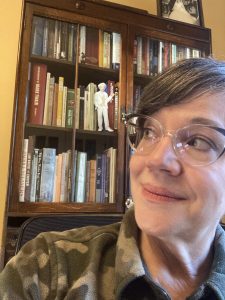
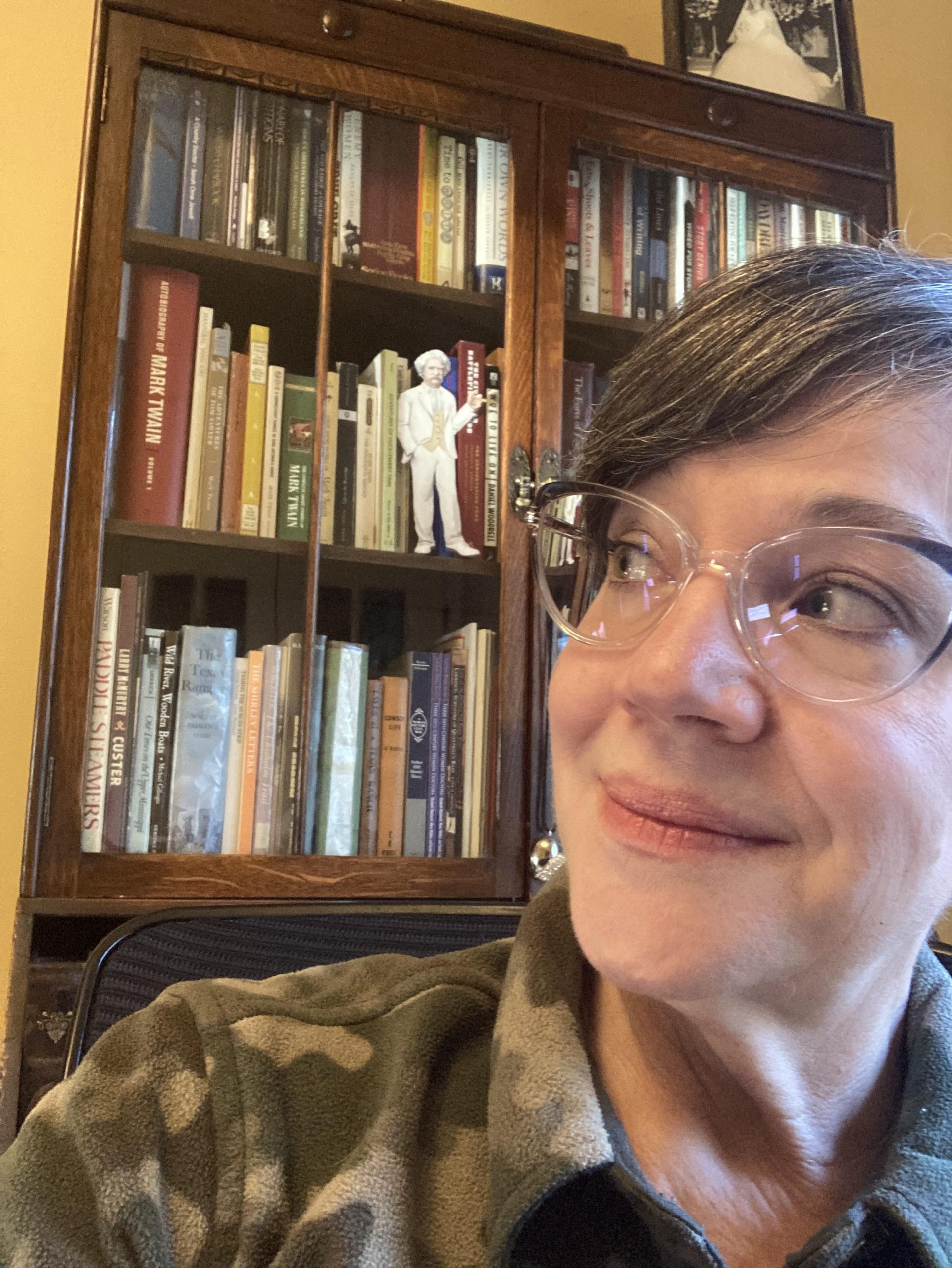
E.E. Burke & Mark Twain!
For example, all those craft books on plotting. There are too many to list, but I’ve probably read them all. For a long time, I felt stupid because I couldn’t follow their structure precisely and come out with a good book. I would veer drunkenly off the path and then experience weeks of despair, as I flayed myself for not being a bright enough pupil to get the lesson right. I finally gave up on being the best student in someone else’s structure and began to insert the most helpful parts into my own messy process. I do the same thing with recipes and drinks. I taste, test, borrow and experiment. Some efforts fail. Others are amazing.
Chanti: I think we are kindred spirits. I could never follow a pattern or a recipe to save my life. Do things turn out? Better than expected! Well, tell us, how do you approach your writing day?
Stites: With at least two cups of coffee under my belt. If I’ve had a good writing day, I end it with a cocktail 😉
Chanti: Now, that’s what I’m talking about!
Readers, did you know? Tom Sawyer Returns is a double finalist in the 2022 M&M AND the Chatelaine Awards? Congratulations – and best of luck moving forward!
CIBA Multi-Awarded Book!
Give us five of your favorite authors and describe how they influence your work.
Stites: Mark Twain—his brilliance at characterization, his portraits of American culture in the 19th century, and of course, his biting humor. Charlotte and Emily Bronte—their tortured, romantic heroes. Michael Shaara—how to weave historical facts into spellbinding fiction. Charles Fraser—creating a world that does more than serve as a setting. Jill Marie Landis—the importance of emotion and how to convey it. Mary Oliver—observing and writing about nature, poetic language. Ok, I’ll stop at seven if I must. My favorites list is much longer.
Chanti: It’s important to work on your craft. What do you do to grow your author chops?
Stites: Read books by authors whose skills far exceed my own.
Chanti: Excellent! What craft books have helped you the most?
Stites: So many I can’t list them all without exceeding your word count. Scene & Structure by Jack M. Bickham taught me how to write the critical building block for a novel—the scene. GMC: Goal, Motivation & Conflict by Debra Dixon taught me how to keep readers turning the page. The Artist’s Way by Julia Cameron inspired me to pursue my dream of becoming an author. Bird by Bird by Anne LaMott is simply a must-read. My copy of The Art of Fiction by John Gardner was passed on by one of my favorite authors. It is an absolute classic on writing fiction. Pay particular attention to the chapter: Common Errors.
Chanti: Good ones. What are you working on now? What can we look forward to seeing next from you?
Stites: At the moment, I am stretching my Mystery Muscles and working on a Noir novel set in the 1930s in Kansas City, the town that gave birth to Scarface, the Pendergast machine, and modern jazz. I’m in the research process now so it will be a while before the book is written.
Chanti: That sounds exciting! I hope we get to see it in our upcoming CIBAs. Who’s the perfect reader for your book?
Stites: Someone who is historically engaged, with a literary interest, who doesn’t mind the mushy stuff. Put another way, a multi-genre reader with a romantic soul.
Chanti: I love that… What is the most important thing a reader can do for an author?
Stites: Write an honest review. At the very least, recommend a book you like to someone else.
Chanti: That’s so important! Word travels fast these days. What excites you most about writing?
Stites: I get to play God for a few hours a day.
Chanti: There you have it, dear readers! A day in the life of a highly talented, on-fire author. If you would like to reach out and read some of these delightful books, go to her website here and follow the directions.
Join us for the Chanticleer Authors Conference held at the Hotel Bellwether, April 27 – 30, 2023. CAC23 is the proud sponsor and host of the 2022 Chanticleer Int’l Book Awards Banquet and Ceremony that will be held on Saturday evening of the conference.
The excitement builds as the 2022 CIBAs Best Book and Grand Prize Winners are determined and announced at this annual gala event!


 Congratulations! Let’s chat a bit about genre. What genre best describes your work? And, what led you to write in this genre?