
Tag: Barbara Salvatore

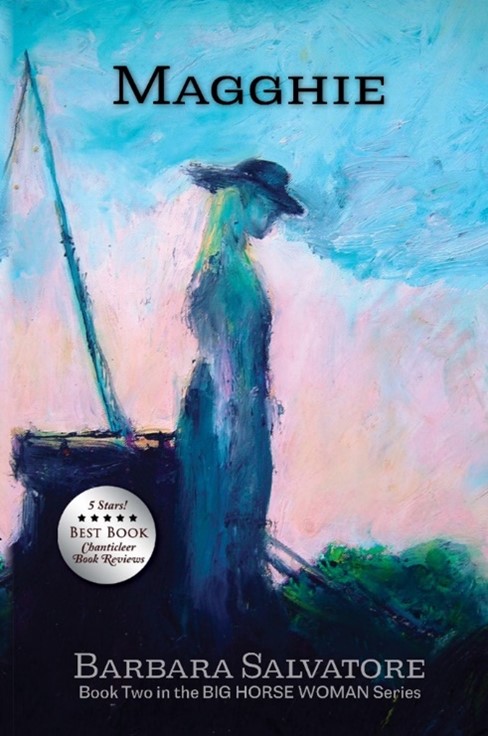
  • MAGGHIE: Big Horse Series by Barbara Salvatore – U.S. Historical Fiction, Women’s Historical Fiction, Horse Fiction


    Laramie Book AwardsAward-winning author Barbara Salvatore brings human foibles, horse traits, and herbal lore together through a young teenage girl’s eyes in her historical fiction novel, Magghie.

    Magghie Wilder has much to cope with, much to learn. She grows up as the only child of Hans and Maye, immigrants from Germany. They make a home in Pennsylvania, in the expanding United States. Hans talks too much, expounding on the simplest issues in grandiose German. He seems to have little time for listening to his curious but often distracted daughter.

    But Hans does teach Magghie how to train and handle the big draft horses needed for heavy hauling and farm work. He encourages her to drive her own team and learn the habits of each one. Maye, by contrast, dreams in quiet and calm, and from her, Magghie learns by watching. Maye understands plant lore deeply and elicits in Magghie the revelation that every green growing thing can be helpful and significant.

    The three live on a successful large farm in relative isolation. Neither religion nor socializing play a role in their routine.

    Things change when Braun, a blacksmith, and his lanky adolescent son, Karl, appear and are kept on as help with horses and farm. Magghie learns a smattering of English from the more worldly-wise visitors. Then, the somewhat chaotic but friendly incursion of a Mormon family follows. Magghie meets the husband, children, and two wives, one of which is pregnant. Maye, recalling the sorrows of losing more than one infant, helps Dora in childbirth. Magghie will watch and come to comprehend why Maye has always seemed so self-enclosed. From the Mormons, Magghie learns something else her parents had resolved never to tell her – the existence of God and the place of religion in human lives.

    Salvatore sets her scene, and the plotlines seem poised for positive outcomes. Until someone brings a life-threatening disease to the valley, creating havoc and despair.

    Salvatore’s current work includes teaching and consulting in Plant Medicine and Horse Care. Since she was thirteen, she has kept a “Dream Journal” and envisions her Big Horse series as a set of four novels, with Magghie being the second book. Her own interests shine clearly through every page of her story, which she tells in a cozy mix of prose and poetry.

    She has appended a lengthy section for her readers, offering further elucidation of the subject matter. This includes the history of Pennsylvania’s settlement, German language usages, extensive notations regarding the Percheron horses used on Wilder’s farm, and further facts about the Mormons’ epic cross-country pilgrimage.

    Salvatore’s Magghie has definite cinematic potential. The story ends with an open invitation to the sequel, promised by the author. That’s good news! 

    Magghie by Barbara Salvatore placed as a Finalist in the CIBAs Laramie Book Awards honoring Americana Fiction, and comes highly recommended!

    5 Stars! Best Book Chanticleer Book Reviews


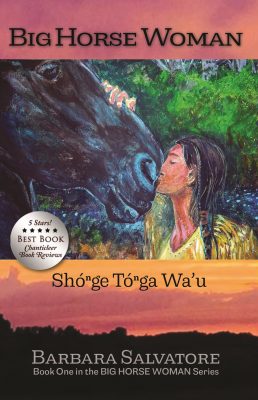
  • Big Horse Woman: Shónge Tongà Wa’u by Barbara Salvatore – First Nations Historical Fiction, Coming of Age Historical Fiction, Magic Realism


    Laramie Western Fiction 1st Place Best in Category CIBA Blue and Gold Badge

    A vivid, mystical tale of a young girl coming of age amidst her people, the Ponca, on the Great Plains, in the early 1800s. This prize-winning novel, Big Horse Woman by Barbara Salvatore, offers poetic imagery and a glimpse of the world seen through the eyes of a gentle healer and powerful seer.

    Water Willow is born under a black willow tree, daughter of an enchanting songstress mother, a fearless hunter father, a “seed carrying” grandmother known for her understanding of curative plants, and a grandfather who carries the secret lore of bears. She will inherit properties of all of them. The child bears a visionary gift that will be articulated when she reaches four years of age, so clear then that the whole tribe gathers to listen: enemies are on the way, and all must flee to the yet undiscovered site of a big white sycamore tree. Once there, they find protection and nature’s abundance and can settle in their new home, Planting Creek.

    As Water Willow grows, she continues to have visions, some of them too horrible to share.

    She sees the inevitable slaughter of a young man who wishes to take her as his wife. Water Willow acquires the secrets of communication with animals, hones her hunting skills, and develops her knowledge for using particular plants for healing. Her name becomes Big Horse Woman when she rescues a colt drowning in a flash flood and tames him even as he grows to great size.

    Maturity brings expanded inner sight, making her realize that wisdom can cause pain as well as prosperity.

    Big Horse Woman’s people, now under the subtle sway of white men invading their homeland, bringing disease and discord, are less prepared to follow her wise message: “We will not grow tall corn or live long if war is what we seek.”

    So Big Horse Woman will take to the wilderness with her Big Horse and her wolfish companion, Ears Up, becoming a loner and absorbing needed knowledge at each turn of her new-made path. Discovering a hidden bag of corn seed on the trail, she begins to realize they are close to their old home, and she must follow the clues as she moves on.

    One remarkable feature of Salvatore’s authorship is the diligence, the undeniable effort she has made to create this story.

    A lengthy segment following the tale gives a factual underpinning for the Ponca people’s history, language, and the many glowing images that infuse the narrative, a combination of prose and poetry appropriate to the magical universe inhabited in the heart of its heroine. When Water Willow brings home a scrap of beautifully decorated cloth found on the horns of a buffalo, she is unwittingly bringing smallpox to plague herself and her extended family, one of the eerie “legacies” of early white settlement of the West.

    A gripping reference to a historically recorded shower of shooting stars on November 13, 1833, heralds the girl’s incarnation. Descriptions of the women’s cures drawn from their natural surroundings will be comfortably recognizable to anyone familiar with herbal remedies in the modern era. With these and other salient references, Salvatore shows her admirable devotion to her setting and her subject. Salvatore’s book is the first in what she has titled the Big Horse Series and will doubtless garner a wide readership for this work and its sequels.

    Big Horse Woman won 1st Place in the CIBAs Laramie Book Awards for First Nations Historical Fiction and is one book we highly recommend!

    Laramie Americana Fiction gold foil book sticker image

    5 Star Best Book Chanticleer Reviews round silver sticker