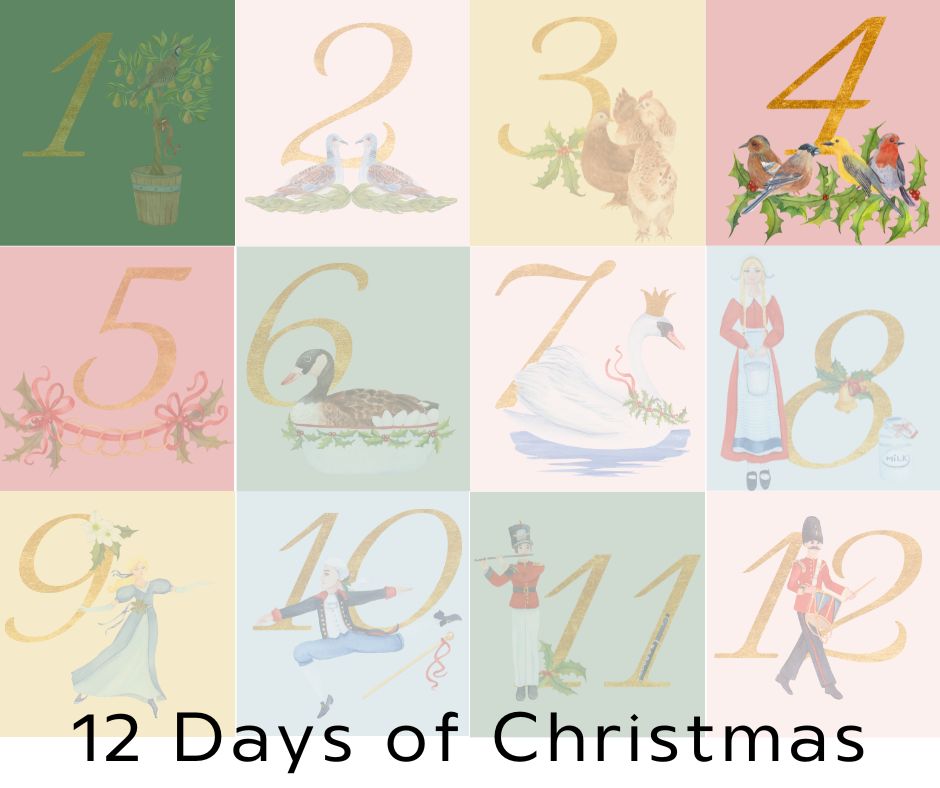
Tag: AuthorCommunity

  • The Art of Critique from the Desk of David Beaumier

    Understanding Peer Review and Feedback

    A Crucial Critique Skill for Authors

    Oftentimes when someone joins a critique group, it’s not because they’re in dire need of a free proofreader. They are looking to learn if their writing is any good, as Kiffer Brown says “Does it have a beat? Can you dance to it?”

    If you’d like to start your self-editing journey first, you can start here! Plus we have a secret solution to really get the feedback you need as an author! Read on to the end to learn what it is!

    While a work can be written in such a way that the errors make it unclear what the author wants to communicate. So, let’s get started.

    Ikebana is the Japanese art of arranging flowers. It can have more to do with writing than you would expect!

    What are the Guidelines for Critique?

    While every writing group will have extraordinarily varied suggestions for offering feedback, they often have a few golden rules:

    • Stay positive. We are critiquing, not criticizing.
    • Remember that suggestions should enhance the story through the author’s voice, rather than stating a variant of “this is how I would write it.”
    • We critique the work rather than the author. Look at what in the writing doesn’t work for you and address that.

    Let’s talk about each of those suggestions in greater detail.

    Staying Positive

    Not quite what we mean…

    No one wants to be in the group where people simply say “it was good, I liked it.” That’s not what we mean by positivity.

    The reason this rule is so common is that almost everyone who has ever submitted to a writing group has had at least one person thoroughly eviscerate a piece, calling it offensive, a waste of time, and of completely zero worth. This kind of feedback is about as helpful as “it was good I liked it,” because it doesn’t actually tell the author anything about the work.

    A sad looking Indian man in a blue shirt
    This guy isn’t getting actionable feedback!

    The best critiques often focus on direct observations or questions regarding the work. Pointing out contradictions and plot holes, or saying when a line rings true and why it rings true. For example, if your character is a member of the Canadian Royal Mounted Police, but doesn’t know how to ride a horse, there might be some questions as to why that is. Basics in Non-Violent Communication can really help get started in giving observational feedback (and hearing critique generally). You can read more about that here. For a less intensive and more focused look at just critique (as opposed to overall lifestyle), you can see this article by author and professor Brenda Miller here.

    In the end, the best critiques follow through and explain why the reader had the reaction to the text that they did.

    “Well, this is how I’d write it”

    Hopefully your critiques aren’t overwhelming the author

    Hopefully your critiques aren’t overwhelming the author

    Unless the reader is a co-author on the work in question, this statement is probably not geared toward helping the author’s voice come through.

    When writing my first book at around age ten, I tentatively showed it to my father. He added quite a bit to the first chapter, which focused on a tornado coming and whisking the main character away to a magical world where animals talked. Every place where he made a change stood out like someone had attempted to jam two different polaroids together with the hope no one would notice. –David

    Again, a focus on questions and observations can often help the author come up with the solution on their own.

    Friends, women, books, computer, smiling

    For example: “I noticed that there wasn’t a lot of setting description in this scene. Would there be a way to describe where the characters are having their conversation, both to add to the atmosphere of the story and to offer some beats that break up the dialogue?”

    This will let the author make the change instead of adding a new POV of the main character’s mother doing dishes and listening to smooth jazz in the background.

    We critique the Work, not the Author

    At this point, it seems clear that the focus is on the text. A character does things, and the author simply records them. However, while it’s always good to give the people critiquing work feedback, this is a crucial place to offer suggestions to the author.

    Remember that, as the author, people are not giving feedback as an attempt to sabotage the story or to make it worse. While all feedback isn’t useful, it is given with the intention of helping, and hearing it as something intended to help often makes listening to a critique easier.

    As such, here are a couple tips when receiving critique on your work.

    • Listen. Interrupting or arguing with the person giving you feedback means you have less time to receive a critique.
    • Remember that the work is yours. No one can force you to change your work, so there’s no need to quibble about what a reader sees as a must-have change that you won’t implement.
    • Ask questions. As you hear your critique, track places where you don’t understand where the reader is coming from or if you’re not sure you understand the motivation behind what they’re saying.
    • Say thank you. The best critiques are to improve your work, not review or judge it, and the reader’s work should be appreciated.

    Not sure how to get started on a group? Check out this article here to learn the ins and outs of forming a critique group!

    The Secret to get the Most out of your Critiques!

    The Secret to Successful Publishing

    Are you ready for this? The best thing you can do to guide the critique you receive is…

    Include specific questions and instructions for what you would like for your readers.

    The Number 1 request I get as an editor is to “Tear my work apart.” This guidance is about as helpful for an editor as “It was good” is helpful to a writer. – David

    By the time work is being submitted for critique, writers will hopefully have a good understanding of their own weaknesses. Setting, plot, and dialogue are common areas of focus. If you’re just getting started and not sure what to ask for, that’s alright! As you receive feedback, be sure to write down common feedback suggestions, like too many movie references that distract from the flow of the story, or not enough Star Trek references in your blogpost.
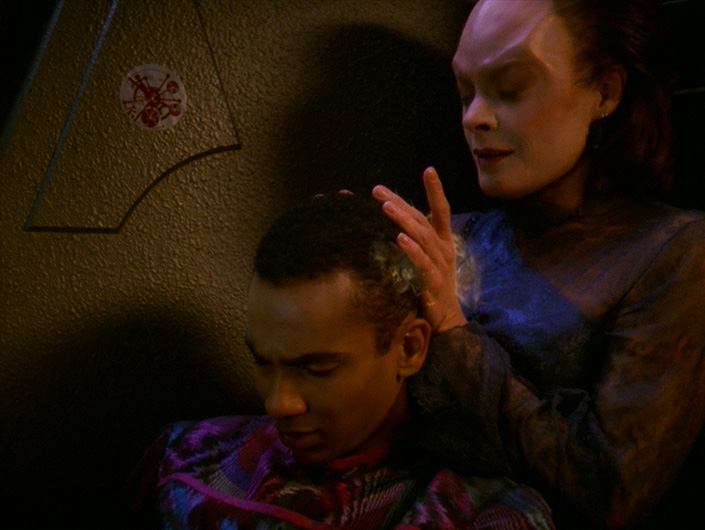
    We don’t recommend sacrificing all your creative energy at once to finish your work. Cirroc Lofton and Meg Foster as Jake Sisko and Onaya in the Deep Space 9 episode Muse

    Regardless of what your weaknesses might be, no editor is a mind reader. Many will be able to help, but the only way to guarantee you receive feedback on the craft elements you are most concerned for is to ask for it directly. Using a service like an MOV can be a great start to begin orienting your work to get the nitty gritty feedback of a Line Edit from a group before you commit to a professional Line Edit.

    Read Responsibly

    With that, you’re ready to go off and take a more active role in your writing community. We believe in you and know that you’ll do great!


    Thank you for joining us for this Writer Toolbox Article

    A red toolbox with the words "What's in your toolbox

    There is so much to learn and do with Chanticleer!

    From our Book Award Program that has Discovered the Best Books since the early 2010s to our Editorial Book Reviews recognizing and promoting indie and traditional authors, Chanticleer knows your books are worth the effort to market professionally!

    Helpful Toolbox Articles:

    When you’re ready,did you know that Chanticleer offers editorial services?We do and have been doing so since 2011.

    Our professional editors are top-notch and are experts in the Chicago Manual of Style. They have and are working for the top publishing houses (TOR, McMillian, Thomas Mercer, Penguin Random House, Simon Schuster, etc.).

    If you would like more information, we invite you to email us at info@ChantiReviews.com for more information, testimonials, and fees.

    We work with a small number of exclusive clients who want to collaborate with our team of top-editors on an on-going basis. Contact us today!

    Chanticleer Editorial Services also offers writing craft sessions and masterclasses. Sign up to find out where, when, and how sessions being held.

    A great way to get started is with our manuscript evaluation service, with more information available here.

    And we do editorial consultations for $75. Learn more here.
  • Top Revision Tips Before a Manuscript Overview from the desk of David Beaumier

    You’ve arrived at the last page of your story and written those crucial, beautiful words: “The End.”

    A young Asian woman leans back from her computer, done with her work in a generic room.
    Finished at last!

    Well done! You deserve some time to rest before you dive into the next step of editing your story.

    Now, one key piece of advice here is there isn’t a wrong time to put your work in front of a professional for feedback. While this article will take you through steps that will bring your book to be as strong as you can possibly make it on your own, we all are of different skillsets, so if something isn’t for you, that’s when you bring in a professional editor.

    To start out with, what is a Manuscript Overview?

    Someone hard at work on a Manuscript Overview

    Perhaps the easiest definition can be pulled from our page on providing Manuscript Overviews (MOVs).

    It is an objective evaluation of a story idea that is fully formed with a beginning, middle, and end, but still in an early draft stage. The MOV comes before Line Editing and Copy Editing.

    No matter who you pick to perform a Manuscript Overview for your book, you should get one. The amount of time and money it saves on editing by being more general and help you go further with your own writing is on thing, but the most important part is it helps keep your book focused and your narrative strong. Traditional Publishing Houses use them, and it makes sense to follow suit.

    Typically, an MOV will cover

    • compelling nature of story
    • dialogue
    • character development
    • does the scenery and setting work with the story
    • backstory issues
    • professionalism of editing & formatting
    • continuity of storyline
    • plotting and plot-hole issues
    • writing craft

    So, the question remains, how do you get your book to that point: fully formed with a beginning, middle, and end. How do you get it to the best point you can do on your own?

    The Reverse Outline

    A Red Uno Reverse Card

    Once you’ve finished your manuscript, even if you already have an outline, you can create one that reflects the actual book you’ve written. From this point, you can edit that outline of your book as is. Working within the outline to create a roadmap to revision often feels much more approachable.

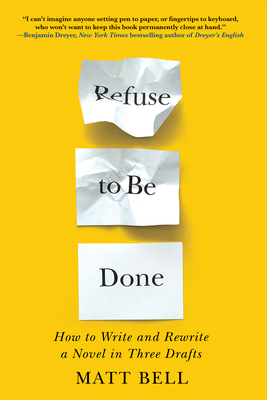
    Next off, we have a recommendation from Matt Bell, author of Refuse to Be Done.

    Rewrite your book.

    You can have the draft you wrote printed out, off to the side, on a separate monitor, whatever feels comfortable, but rewrite it using your new outline as a guide.

    Refuse to Be Done has a yellow cover with the title written out across 3 pieces of paper

    Bell’s theory behind this is that you will copy and paste a bad line (or duplicate scene). But you won’t rewrite a bad line.

    Not sure where to start in creating your outline? Jessica Brody’s beat sheet from Save the Cat! Writes a Novel can help. Brody breaks down the story into actionable beats you can aim for to keep your book flowing along. Check out her breakdown of story beats here!

    Once you’re done rewriting the book, it helps to go through and check to see if you’ve met the goals of a new outline. Ask yourself if your story has a beat and if you can dance to it.

    After all that work, you’re probably ready for a Manuscript Overview.

    What to do while you wait

    A standard Chanticleer MOV takes 6-9 weeks to finish. While that’s going on, we recommend following D.D. Black’s critical advice whenever you’re in writing limbo: Write the next thing.

    D.D. Black presented at CAC24! Check out his incredible series here!

    Not only will that get you out of your head and allow you to be more objective with your manuscript when it comes back, but it will put you ahead of the game for the next book.

    What do our authors say about our MOVs? Read recent testimonials here!

    Wow, huge thank you for this second review! It’s so detailed and very much what I was hoping for. The specifics about moving content and clarity are spot on. I knew it needed structural improvements but I was too close to do it. Please pass on my sincere thanks for this work! I’ve only started some of it & already feel a better flow. I’m hoping to possibly even cut about 10k words to make it tighter. – Sheridan Genrich author of REWIRED: Optimise Your Genetic Potential


    I’m writing to gratefully acknowledge receipt of the Manuscript Overview of my book. I am so pleased to have this close reading and incredibly helpful insights. These comments are far more beneficial than anything I had expected. It will be a pleasure addressing the editor’s critiques and trying out his concrete suggestions. Please extend to him my genuine gratitude. Chanticleer crows again! – John Feist, author of Edged in Purple and many more


    I finally got this copied and read. It’s just what I wanted it to be—a skillful job. I knew there were the kind of holes the editor mentioned, but he’s given me a plan for the revisions. Please pass on my thanks. – Linda Brugger, columnist and accidental author


    Please thank the reviewer for a very relevant and detailed review of my manuscript, ANKANAM. I plan to incorporate all his notes! – Vee Kumari, author of Ankanam.


    This was just what I needed. I am looking at the book with a new focus and have already started working up the suggested changes. The first thing I did was remove those items the editor mentioned should be deleted. It was a bit painful but necessary. There was plenty of meat in his review, which took me a while to digest, but changes are on the way. These will take some time, but I will likely be interested in the Manuscript Reconciliation process. I can tell the editor spent quite some time researching some of the issues raised in the book, which I greatly appreciated. It helped me see the book more from the reader’s perspective than mine. Please pass along my sincere thanks. – Jim Leonard


    Thank you for joining us for this Writer Toolbox Article

    A red toolbox with the words "What's in your toolbox

    There is so much to learn and do with Chanticleer!

    From our Book Award Program that has Discovered the Best Books since the early 2010s to our Editorial Book Reviews recognizing and promoting indie and traditional authors, Chanticleer knows your books are worth the effort to market professionally!


    When you’re ready, did you know that Chanticleer offers editorial services? We do and have been doing so since 2011.

    Our professional editors are top-notch and are experts in the Chicago Manual of Style. They have and are working for the top publishing houses (TOR, McMillian, Thomas Mercer, Penguin Random House, Simon Schuster, etc.).

    If you would like more information, we invite you to email us at info@ChantiReviews.com for more information, testimonials, and fees.

    We work with a small number of exclusive clients who want to collaborate with our team of top-editors on an on-going basis. Contact us today!

    Chanticleer Editorial Services also offers writing craft sessions and masterclasses. Sign up to find out where, when, and how sessions being held.

    A great way to get started is with our manuscript evaluation service, with more information available here.

    And we do editorial consultations for $75. Learn more here.  

    Writer Toolbox Helpful Links: 

    The traditional publishing tool that indie authors can use to propel their writing careers to new levels?  Check it out here!

  • On the 8th Day of Christmas, Chanticleer Brings to me… | 12 Days of Christmas 2023

    Celebrating the Twelve Days of Christmas – One Day at a Time

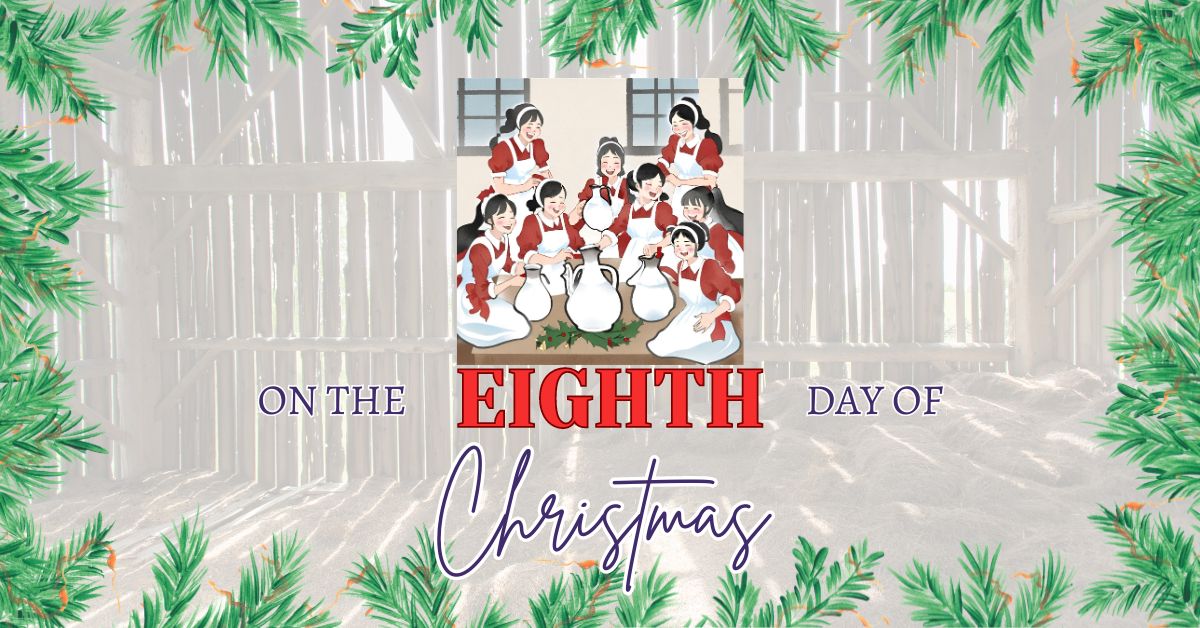
    On the 8th Day of Christmas…

    The Eighth day of Christmas is the celebration of Mary as the Mother of Jesus, which can be traced back to as early as 431 AD.

    “But Jiminy Crickets, it is the 2nd of January! Is it not too late for the 12 Days of Christmas?” you say.

    Not to fear, Chanticleerians! The 12 Days of Christmas begins on December 26th! And it continues to the 6th of January – Three Kings Day. The four weeks leading up to Christmas is known as the Advent.

    So if you haven’t finished wrapping presents, sending out those cards, and baking cookies—don’t worry—you still have time! You have FIVE Days! 

    Happy Holidays to You from the Chanticleer Team! 

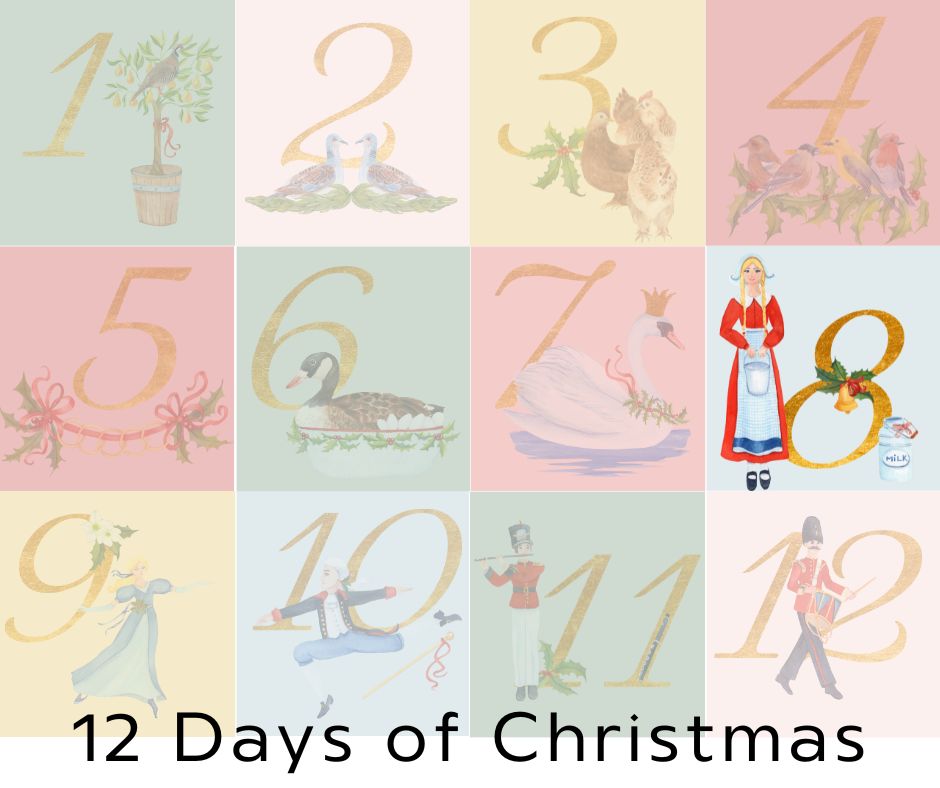
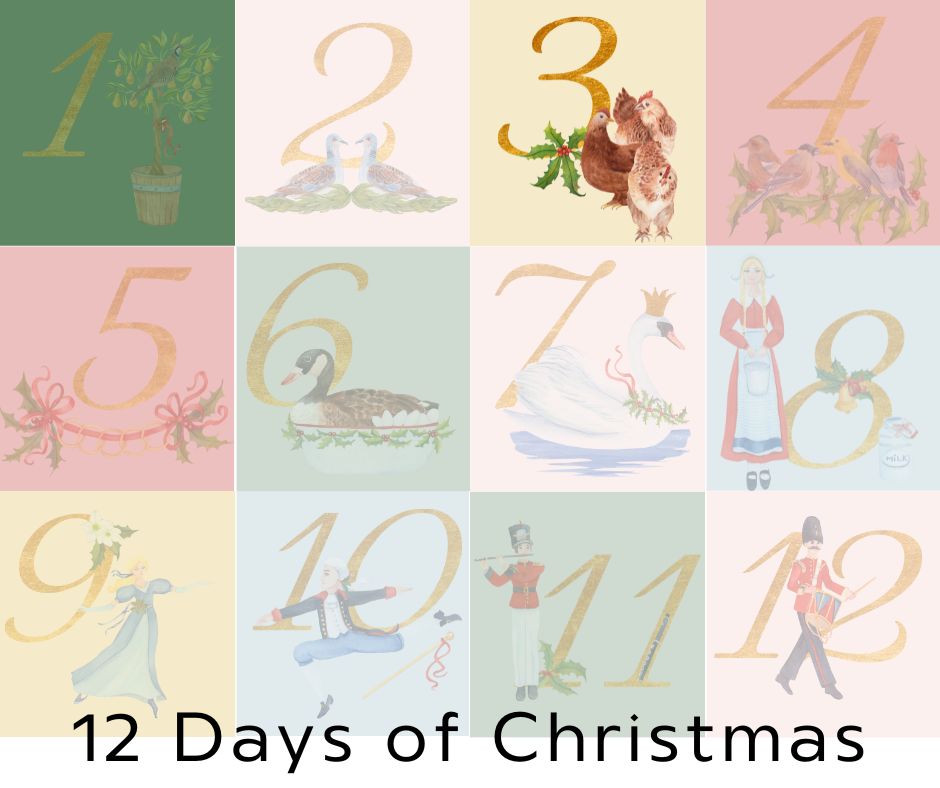
                 On the Eighth day of Christmas, my true love sent to me

                 Eight Maids A-Milking

                 Seven Swans A-Swimming

                 Six Geese A-Laying

                Five Golden Rings

                Four Calling Birds

                Three French Hens (Chanticleer’s favorite #justsaying)

                Two Turtle Doves

                And a Partridge in a Pear Tree 

    This lyric represents the common worker. We are so grateful to all those who make the wheels of the world turn who can be so easy to forget! An extra special Happy New Year to all workers!

    Happy Holidays to You from the Chanticleer Team! 

    On the Eighth Day of Christmas, Chanticleer brings to me…

    Image by Tumisu from Pixabay

    Eight SEO Boosts  (at least!) with each Chanticleer Book Review Package

    SEO stands for Search Engine Optimization. When you purchase an Editorial Review from Chanticleer, we do our best to keep up with all the latest trends and under-the-hood data technologies that ensure your book is picked up by search engines like Google, Bing, Yahoo, and others.

    1. Key Phrase Optimization: We choose a word or phrase that is most likely to lead to your book, usually your title.
    2. Title Optimization for the length of our review title as it appears in search engines.
    3. Heading Optimization: We use our blurbs to stand out in describing your book while also showing search engines what’s most important to pick up.
    4. Sentence Optimization: We make sure all reviews use the appropriate number of words to best improve their Flesch reading score.
    5. Optimization that utilizes your keywords.
    6. Tagging and Categorizing for web crawlers.
    7. Links! Links to the Author’s website, links to the Publisher’s website, links to the book’s Amazon Sales Page, links to other Chanticleer Reviews in the series (if applicable), and Links to our Local Village Books’ sale page for your book if it’s available through Ingram. We are currently working on linking to Barnes & Noble. The more links the better in the Internet of Things!
    8. AISEO PRO SEO Booster app with Meta Descriptions, Cornerstone Content, Focused Key Phrases

    In addition, all Chanticleer Reviews are promoted in our e-newsletter, website, Social Media platforms, and the Chanticleer magazine.

     Chanticleer’s AISEO Boosts continuously work for your books long-tail marketing strategy and to make your works more discoverable.

    Editorial Reviews are powerful tools that are only limited by imagination! Don’t let your book go undiscovered!

    For more detailed  information about how a Chanticleer Review with its exclusive AISEO PRO booster app, click here>>   You can learn more about SEO here.

    Image by Gerd Altmann from Pixabay


    We would like to invite you to join our curated online community The Roost!

    We are so proud the community we have on The Roost!  It is great perch to hang out on for writers and publishers to hang out in and connect.

    We host weekly write-ins, discussions of writing craft books, and advice on the author’s journey. With authors in all stages of the writing process joining us, there is always something to learn on this independent PRIVATE social media site.

    Writing may seem like a solitary activity, but stories are told in community. Whether you find that on The Roost or elsewhere, we’re happy that you are a part of our community here at Chanticleer.

    Limited Time Only! Join The Roost during the 12 Days at a discounted holiday price.

    Sign up now for $9.99 a month or $99.99 a year.

    Valid until January 6th.

    Follow this link to find out more information. 

    And just for fun: 

    We now have: 

    • Eight Partridges and Eight Pear Trees
    • Fourteen Turtle Doves
    • Eighteen French Hens
    • Twenty-four Calling Birds
    • Twenty Golden Rings 
    • Eighteen Geese-a-Laying 
    • Fourteen Swans-a-Swimming 
    • Eight Maids a-Milking

    The Chaicleer Rooster logo wearing a santa hat

    Our favorite part about having the 12 Days of Christmas is that we can have the time we need to celebrate with our loved ones. We have time for wrapping presents, meeting with friends for hot cocoa, and continuing to prepare the Chanticleer Authors Conference and the 2023 CIBA Banquet and Ceremony.

    Wishing you Happy New Year from Chanticleer! from Kiffer, Sharon, David, Dena, Vilina, Scott, Anya, and Argus!

    Stay tuned for the 9th Day of Christmas!


  • On the 4th Day of Christmas Chanticleer gave to me four ISBNs! | The 12 Days of Christmas 2023

    Celebrating the 12 Days of Christmas – One Day at a Time

    The 4th Day of Christmas

    The Four Calling Birds are meant to represent the canonical gospels of Matthew, Mark, Luke, and John.

    Also, the Fourth Day of Christmas is the Feast of the Holy Innocents, and it is considered a day for children. The feast honors the male children who were killed by King Herod in his quest to find the potential usurper (Baby Jesus) to his throne. Today, the youngest member of the family is in charge for what to do, where to go, what to eat for the entire day. The day is also known as Childermas.

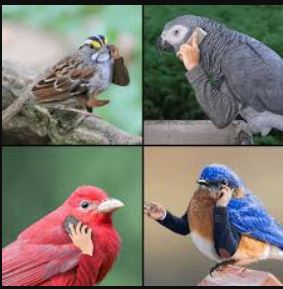
    Some say Four Calling Birds (song birds). Some say Four Colly Birds (black birds). And then, there is this person’s interpretation of Four Calling Birds on Reddit:

    Is this a conference call?

    “But Jiminy Crickets, it’s after December 25th! Is it not too late for the 12 Days of Christmas?” you say.

    Not to fear, Chanticleerians! The 12 Days of Christmas begins on December 26th! And it continues to the 6th of January – Three Kings Day. The four weeks leading up to Christmas are known as Advent.

    So if you haven’t finished wrapping presents, sending out those cards, and baking cookies—don’t worry. Just get it done. Eight Days left until Three Kings Day! 

    Happy Holidays to You from the Chanticleer Team! 

    On the 4th day of Christmas, my true love sent to me

    Four Calling Birds

    Three French Hens

    Two Turtle Doves

    And a Partridge in a Pear Tree 

    On the Twelfth Day of Christmas, Chanticleer brings to me…

    Four ISBNs! (not ASINs)

    An ISBN is the identification number that is unique to your book.

    ISBN is the International Standard Book Number

    Authors in the US need to pay for their ISBNs from Bowker, but in Canada they are provided to authors directly.

    Why Self-Published Authors Need to Own Their Own ISBNs

    1. Owning your own ISBNs gives you complete control over what is entered into your book’s metadata.
      1. Metadata is the descriptions and categories that help libraries, bookstores, wholesalers, distributors, global supply chains, and, most importantly, readers worldwide discover your book.
    2. ISBNs are non-transferable from the owner. ISBNs establish your book’s identity and authorship.
    3. ISBNs never expire and there are no renewal fees. However, you cannot reuse an ISBN once it has been assigned.
    4. ISBNs come with unique barcodes.
    5. In the U.S., Bowker is the only official source of ISBNs.
    6. Bibliographic immortality

    As you may surmise, there are many details to learn about ISBNs about when and why they are necessary along with the few cases where they are not.

    Here are a few handy links:

    Your Book’s Many Forms

    One thing to keep in mind is that each version of your book’s publication should its own ISBN. This means that each of the following needs a separate ISBN to be easily distributed:

    • Hardcover Edition
    • Paperback Edition
    • eBook Edition
    • Audiobook Edition

    You can see on Bowker, where ISBNs are sold, that there are huge savings to be had by buying ISBNs in bulk. Of course, this ISBN information is most applicable to the United States. Other countries have different rules and costs associated with an ISBN, so if you live outside of the US, you should do your research on ISBN rules and expectations. The discounts can be pretty sudden!

    • 1 ISBN is $125
    • 10 ISBNs are $295
    • 100 ISBNs are $575
    • 1,000 ISBNs are $1,500

    ISBNs are non-transferable, and if they’re bought in someone else’s name, they can’t be transferred to another name. That’s why it’s always good to be cautious when buying an ISBN from a third party from anything under the standard price.

    There is one type that doesn’t require an ISBN is your book on Block Chain / Bit Coin because each block chain book has its own unique code. If you decide to have your book available on Block Chain, our advice is to check out BookChain, out of Montreal, Canada.

    There are three basic ways to sell your book, print, ebook, and audiobook. For print, we’ve already discussed several ways you can go through that formatting, which also applies to ebooks. 

    We’d also like to pause and take a moment to mention Bookchain. Bookchain is one of our close affiliates who uses a unique blockchain (the NFT technology associated with Bitcoin) to track books and book sales. You can learn more and sign up for Bookchain here.

    bookchain logo

    For Audiobooks, you’ll also want to consider professional help. This isn’t just for voice actors, but also for audio software. Many people may be familiar with Audacity, a free audio recording software that was designed with music and mixing in mind. It takes a little bit to learn how to use it, but once you have a few basics dialed in, it becomes much easier to use. In a pinch, like Microsoft Word, Audacity can work to create an audiobook recording for your story, but it’s not what the program was specifically designed for. 

    What we recommend is Hindenburg

    Hindenburg is audio recording software designed to create excellent, professionally mastered audio for your stories. There’s plenty of support to learn how to use it, and longtime Chanticleerians like CC Humphries are experts with it, creating Audi-worthy creations regularly. And Hindenburg will format your audio book for the myriad of audio book platforms that are out there. Hindenburg is known for their incredible customer service and support team. 


    Stay tuned for the 5th Day of Christmas!

    And just for fun: 

    We now have: 

    • Four Partridges and Four Pear Trees
    • Six  Turtle Doves
    • Nine French Hens
    • Four Calling Birds  

    The Chaicleer Rooster logo wearing a santa hat

    Our favorite part about having the 12 Days of Christmas is that we can have the time we need to celebrate with our loved ones. We have time for wrapping presents, meeting with friends for hot cocoa, and continuing to prepare the Chanticleer Authors Conference and the 2023 CIBA Banquet and Ceremony.

    Wishing you Happy Holidays from Chanticleer from Kiffer, Sharon, David, Dena, Vilina, Scott, Anya, and Argus!

  • On the 3rd Day of Christmas Chanticleer gave to me 3 Pillars of Community! The 12 Days of Christmas 2023

    Celebrating the 12 Days of Christmas – One Day at a Time

    The Third Day of Christmas

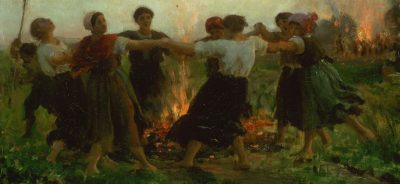
    The Third Day of Christmas celebrates the Feast of St. John who drank a glass of poisoned wine and didn’t get sick! Also, many EU countries celebrate the Feast of St. John during the longest days of Summer (June 24th) with dancing around a fire. The best way to celebrate? Drink a lot of wine! Of course, if you have a different preferred beverage, that’s totally alright. We’ve been enjoying TÖST, a non-alcoholic wine recently.

    The Feast of Saint John c. 1875 by Jules Breton


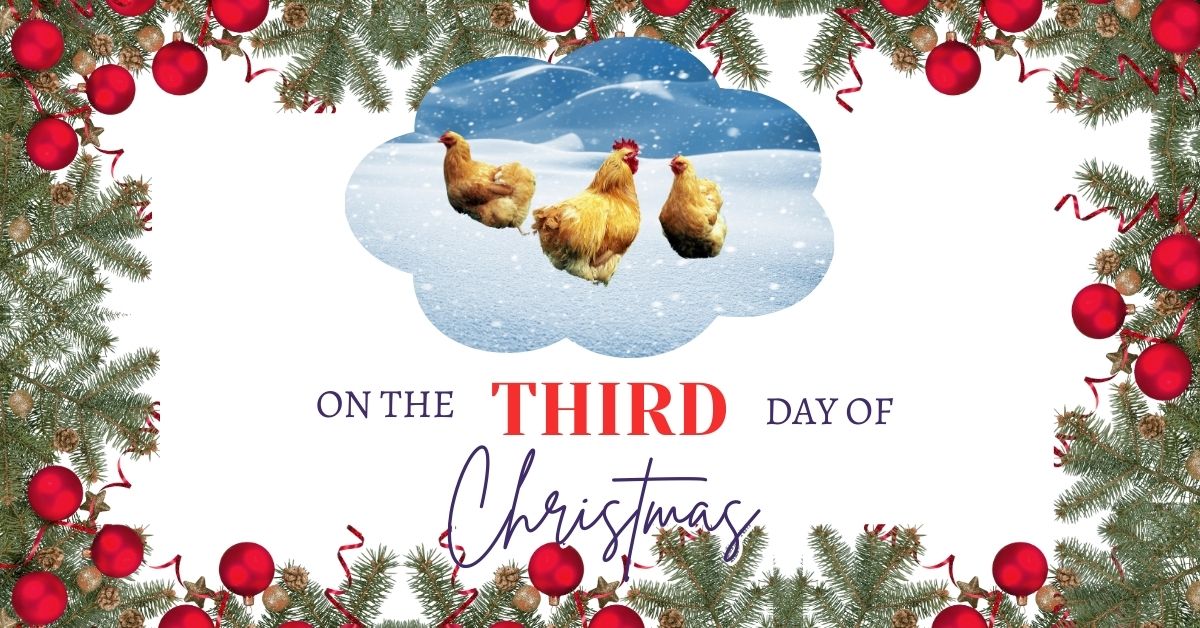
    The Three French Hens gifted on this day represent Faith, Hope, and Love.

    “But Jiminy Crickets, it’s after December 25th! Is it not too late for the 12 Days of Christmas?” you say.

    Not to fear, Chanticleerians! The 12 Days of Christmas begins on December 26th! And it continues to the 6th of January – Three Kings Day. The 24 days leading up to Christmas are known as Advent.

    Some say that December 25th is the first day of Christmas, but we are going with the medieval date of the 26th because revelry could not take place on the 25th as it was a holy day. And the Twelve Days of Christmas are all about revelry!

    So if you haven’t finished wrapping presents, sending out those cards, and baking cookies—don’t worry. Just get it done—you’ve got nine days!

    Happy Holidays to You from the Chanticleer Team! 

    On the 3rd day of Christmas, my true love sent to me

    Three French Hens

    Two Turtle Doves

    And a Partridge in a Pear Tree 

    On the Twelfth Day of Christmas, Chanticleer brings to me…

    Three Pillars of the Writing Community

    The Village Books Literary Citizenship Award with pictures of Rena Priest, Laurel Leigh, and Joan Airoldi

    On October 18, 2023, our wonderful local bookstore, Village Books, offered their first ever Literary Citizenship Award to Rena Priest, Laurel Leigh, and Joan Airoldi, pictured above from left to right. Here’s a little about them:

    Joan Airoldi, recipient of the Literary Citizenship Award
    Joan Airoldi (1946 – 2022)

     Joan served as Executive Director of the Whatcom County Library System (WCLS) from 2002-2013.

    In 2004, she took on the FBI by refusing to provide information to an agent regarding a Deming Library patron’s use of a book on Osama bin Laden. A grand jury subpoena was issued to get the records, but when it became clear Airoldi and the WCLS board were prepared to challenge the subpoena in court, it was withdrawn. She will be remembered as a Library Champion on a multitude of counts: establishing the Whatcom READS program in collaboration with partners at Whatcom Community College, advocating for new libraries in Ferndale, North Fork, South Whatcom, Island and Point Roberts and encouraging all of us to “Be Curious” and to “Listen, Learn & Lead.” Joan’s courage in defending patrons’ rights to privacy earned her national recognition with a PEN/Newman Award. She generously donated the prize money to start the Whatcom County Library Foundation.

    “Be Curious”  “Listen, Learn & Lead”

    “Libraries are a haven where people should be able to seek whatever information they want to pursue without any threat of government intervention.”  ~ Joan Airoldi

    Laurel Leigh, recipient of the Literary Citizenship Award
    Laurel Leigh Erdoiza (1963-2023)

    Professionally, Laurel was known as a writer, teacher, and editor whose 20 years of freelancing extends internationally. She was a script doctor, structural editor, and managed many publishing projects for Chronicle Books.

    She taught creative writing and memoir classes through the Chuckanut Writers Program, helped found the Chuckanut Writers Conference in 2004, and received the Bellingham Mayors Arts Award, and was published widely including the Pushcart-nominated essay “Nursey” (published in Clover, A Literary Rag in 2015). Those who knew Laurel personally have experienced firsthand both her talent and generosity of spirit. She walked hand-in-hand with collaboration and mentorship, helping countless writers hone their skills, find their voice, and bring their works out into the world. This included her hosting Village Books’ Open Mic for more than a decade, establishing and fostering the spirit of welcoming support that continues to this day. “It’s a good day to write.” ~ Laurel Leigh Erdoiza

    “It’s a good day to write.” ~ Laurel Leigh Erdoiza

    Rena Priest, recipient of the Literary Citizenship Award
    Rena Priest  – Washington State Poet Laureate

    Rena is an enrolled member of the Lhaq’temish (Lummi) Nation. She served as the 6th Washington State Poet Laureate (2021-2023) and was named the 2022 Maxine Cushing Gray Distinguished Writing Fellow.

    Priest is also the recipient of an Allied Arts Foundation Professional Poets Award and fellowships from the Academy of American Poets, Indigenous Nations Poets, Nia Tero, and the Vadon Foundation, and has taught at the Chuckanut Writers Conference. The thread that runs through all of Rena’s accomplishments and accolades is how she builds and connects community. “I think that there’s a way that poetry connects people. It’s very special– it’s like a soul connection, but it’s not invasive in any way,” she says. “The way that it works is subtle. It’s gentle, but it’s deep and profound.” For the book, I Sing the Salmon Home, Rena gathered poems from over 150 Washington poets ranging from first graders to tribal elders, all inspired by the Northwest’s beloved, iconic salmon. A diverse chorus of voices, they join together in poems that praise salmon’s heroic journey, beauty, courage, and generosity and witness the threats salmon face from pollution, dams and warming oceans.

    We are ever grateful to the irreplaceable contributions these women have made to our community.

    In particular, Laurel and Rena were writing mentors to Chanticleer’s David Beaumier, and both have helped keep him on a writing path.

    Thank you is never enough, but we will keep saying it to all the writers who lift us up in our community!

    Stay tuned for the 4th Day of Christmas!

    And just for fun: 

    We now have: 

    • Three Partridges and Three Pear Trees
    • Four Turtle Doves
    • Three French Hens 

    The Chaicleer Rooster logo wearing a santa hat

    Our favorite part about having the 12 Days of Christmas is that we can have the time we need to celebrate with our loved ones. We have time for wrapping presents, meeting with friends for hot cocoa, and setting ourselves up for success with the Chanticleer Authors Conference.

    Wishing you Happy Holidays from Chanticleer from Kiffer, Sharon, David, Dena, Vilina, Scott, Anya, and Argus!

  • The Twelve Days of Christmas! On the Twelfth Day, Chanticleer Brings to me…

    Celebrating the Twelve Days of Christmas – One Day at a Time

    Did you know that the Twelfth Day of Christmas is also known as Women’s Christmas in Ireland? Nollaig na mBan in the Gaelic).

    On this day in Ireland, men were to take over the household duties or take down the tree and other Christmas decorations, while mothers, sisters, daughters and friends would meet up and share a drink over the last of the Christmas cake.

    “But Jiminy Crickets, it’s after December 25th! Is it not too late for the 12 Days of Christmas?” you say.

    Not to fear, Chanticleerians! The 12 Days of Christmas begins on December 26th! And it continues to the 6th of January – Three Kings Day. The four weeks leading up to Christmas are known as Advent.

    Some say that December 25th is the first day of Christmas, but we are going with the medieval date of the 26th because revelry could not take place on the 25th as it was a holy day. And the Twelve Days of Christmas are all about revelry!

    So if you haven’t finished wrapping presents, sending out those cards, and baking cookies—don’t worry. Just get it done.

    (Note from Kiffer: I still have presents to wrap and cookies to bake, so I will extend the Christmas holidays like the Swedes do until St. Knut’s Day on January 13th. This is the day when the children can eat all the gingerbread decorations on the Christmas tree. Then, they take the tree down and outside and dance around it. We burn our Christmas tree on Summer Solstice.)

    Happy Holidays to You from the Chanticleer Team! 

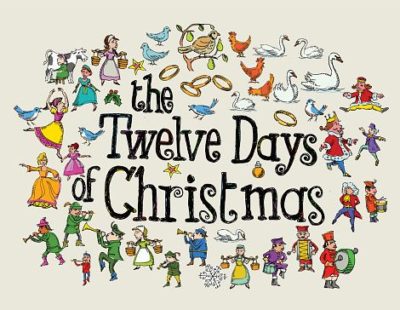
    On the Twelfth day of Christmas, my true love sent to me

    Twelve Drummers Drumming

    Eleven Pipers Piping

    Ten Lords A-Leaping

    Nine Ladies Dancing

    Eight Maids A-Milking

    Seven Swans A-Swimming

    Six Geese A-Laying

    Five Golden Rings

    Four Calling Birds

    Three French hens (Chanticleer’s favorite #justsaying)

    Two turtle doves

    And a partridge in a pear tree 

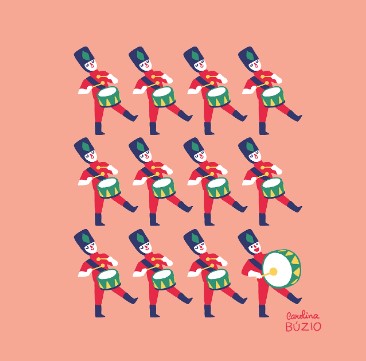
    Twelve Drummers Drumming by Caroline Búzio

    Interesting Notes about the Twelve Days of Christmas

    • King Richard II of England (1367-1400) organized a tournament that drew knights from across Europe to compete in during the twelve days of Christmas. Each evening after the jousting and sword matches, there would be dancing and feasting. The peasants could watch the matches because they didn’t have to work the fields during the Twelve Days of Christmas.
    • It was also custom that the lord provides a feast for all who are working his lands. Of course, the workers were expected to bring gifts of farm produce to the lord’s manor.
    • In colonial America, many parties took place during this time where finding romance (or a potential spouse) could happen. Also, many weddings took place during the Twelve Days.

    Interesting Notes about the Twelfth Day 

    • It is considered not the best for good luck in the new year, taking your tree down before January 7th, Epiphany.
    • Twelfth Day of Christmas is also the beginning of Mardi Gras. The Mardi Gras season is celebrated between Epiphany and Fat Tuesday (the Tuesday before Lent begins).
    • Shakespeare wrote the Twelfth Night (first performance Feb. 2, 1602), a comedy mistaken identities that tegins  on the twelfth night’s celebration – “If music be the food of love, play on.” Twelfth Night, Act 1 Scene 1

    Religious Significance of the Twelfth Day – Epiphany

    • The Three Wise Men visit the baby Jesus by following a guiding star aka as Three Kings Day: Melchior, Caspar, and Balthazar according to the Gospel of Matthew. Adoration of the Magi
    • In many cultures, it is on Three Kings Day that presents are exchanged and opened and feasts are held.
    • The Twelfth Day of Christmas is also when Jesus turned water into wine at a wedding at Cana (the first miracle of Christ).
    • Jesus was baptized by John on the Twelfth Day of Christmas

    Dom Prosper Gueranger in his Liturgical Year states that it was the Church’s tradition for many centuries that these three events occurred on the same day, January 6.

    On the Twelfth Day of Christmas, Chanticleer brings to me…

    Twelve Months of Community

    That’s a wrap for us on the Twelve Days of Christmas, but we’re still committed to bringing you excellence in as many forms as we can. Whether that’s our regular blog, with writing tips, our marketing tools like Editorial Book Reviews and the CIBAs, or our competitively priced Editorial Services that keep satisfied writers coming back, we’re here to help you on your Author’s Journey. Whatever it is you need, you can reach out to us at info@ChantiReviews.com and we’ll be there to help!

    Our goal is to discover today’s best book, and your book deserves to be discovered! Thanks for sticking with us on this 12 Days of Christmas, and we look forward to keeping up regular writing tips and content in the New Year.

    Warmly,

    Kiffer, Sharon, David, Scott, Argus, Rochelle, and the whole Chanticleer Team!


  • MailChimp 101: Level Up Your Mailing List from the Desk of Rochelle Parry

    An Introduction to MailChimp

    MailChimp may be no Rooster, but it’s a great way to start email marketing. With a very low barrier to entry (free!), you can build your audience before your book is published!

    Why Use MailChimp?

    Your personal email is great for sending messages to a small group of people, but once you get a higher volume of recipients, limits will apply. For instance, Gmail will only allow 100 contacts per outgoing email, with a limit of 2000 emails per day (source). Your email account can be suspended if you go over their limits.

    Signing Up

    To sign up, just go to MailChimp.com. Of course, there are paid plans, but assuming you’re starting out with fewer than 500 contacts, free will work! They also offer free email support for the first 30 days, so make sure to get your questions in early. Paid accounts can provide 24/7 technical support, add additional users to your account, and would allow more than 500 subscribers (source).

    To sign up, create an account with your email, and be prepared to verify. A surprise for most users is that to sign up you have to provide a physical address. This address will appear at the bottom of every email! Make sure it’s not going to give away your location if you’re working from home and are concerned about safety and privacy. Read up on MailChimp’s ideas to provide a less personal address here.

    I’ve signed up, now what?

    Once you’re in the Mailchimp site, you’ll see a dizzying array of choices. If you have a website, you’ll want to create a signup form. Click the “create” icon, and select “embedded form.” The form includes name and email by default, but other fields are available too.

    Newsletter Button Sign up
    You can see our Newsletter sign-up as an example here

    Once you’re happy with your form fields, hit ‘continue’ and you can copy the code and place it directly into your website. If this is all Greek to you, consider working with a webmaster to get the form to appear correctly. They also have a pop-up form option. If you create a pop-up form, you’ll need to provide your website address to connect it, then add some provided code to your site’s header, which MailChimp explains here.

    Your Audience

    A group of people applauding at a rock concert
    Get your audience excited!

    Once people sign up, they’ll be added to your Audience. “Audience” is where you manage your contacts. If you already have a list of emails you want to market to through Mailchimp, you can add them manually or by uploading a spreadsheet. Make sure you have the email owner’s permission first! The anti-spam laws can work against you if you get a lot of people marking your email as spam (learn about the importance of permission here). If they sign up via your form, they’ve given their consent!

    Campaigns

    Four People Playing a Board Game
    Marketing Campaigns rather than D&D Campaigns

    Your outgoing emails are called “Campaigns” in MailChimp. You create your campaign to go out to your audience or to a section of your audience. MailChimp’s design tools are a bit rudimentary, but they do provide templates to help you get started. You can use uploaded images, different fonts, texts and links, and style it to be consistent with your brand. While designing your email to send, you can send test emails to yourself and others to see how it appears in your inbox. Just remember that once it’s finalized, you can no longer make edits. Once sent to your designated audience, you’ll be able to see how many people opened your email in your dashboard via Campaign Reports. You can learn more about Campaigns in Mailchimp directly here.


    Thank you for joining us for this Writer’s Toolbox Article, and good luck out there on the web!

    Writer’s Toolbox

    Writer Toolbox Helpful Links: 

    Gmail sending limits in Google Workspace

    MailChimp Website

    Pricing Options for MailChimp

    Alternative Physical Address Ideas

    How to Add a Pop-Up Signup Form to Your Website

    Email Consent and The Importance of Permission

    Getting Started with MailChimp Campaigns

    Rochelle Parry – Creative Director

    Rochelle Parry helps authors and small business owners with their digital marketing efforts by creating custom websites, setting up social media, and publishing print and online materials including magazines and art books. You can learn more at her website: www.megabite.com

    Web Design | Megabite | WordPress Websites | Bellingham, WA Logo


    I hope you enjoyed this quick introduction to using MailChimp and found some useful tips! There is much more to this service, and hopefully this is enough to get you past the blank white page and into creating some fantastic emails! — Rochelle

    Looking for more quality time with Chanticleer?

    a Wreath surrounds CAC 2023 for the Chanticleer Authors Conference


    Take Your Publishing Career to the Next Level –  April 27 – 30, 2023! Register Today!

    Seating is Limited. The  esteemed WRITER Magazine (founded in 1887)  has repeatedly recognized the Chanticleer Authors Conference as one of the best conferences to attend and participate in for North America.

    Join us for our 11th annual conference and discover why!


  • Word Nerd – Using the Best Word – the PERFECT Word by Kiffer Brown

    Learning another language has always been my portal to understanding the nuances of my own language, American English. Currently, I am trying to learn European Portuguese to add to my faltering French and German. It is a very slow process but still appeals to my word nerdiness that I attribute to my Latin classes in high school.

    In reviewing books and many other types of media, my most frequent complaint is when the writers are lazy with their word usage. Not punctuation. Not verb agreement. Not even when the writers are being pedantic. What makes me twitch the most is Lazy Word CHOICE!

    An image of Scrabble Tiles spelling out the word "Word"

    Not that the words must be sesquipedalian. (Definition at the end of the post.)

    For example, the word PERFECT.

    Would any of these words below be a better fit than “perfect” for conveying your thoughts with a more exact meaning? 

    • impeccable
    • without fault
    • flawless
    • faultless (slightly different than flawless)
    • incomparable
    • sublime
    • ideal
    • the best
    • shiny new
    • perfection
    • absolutely

    None of the words above are sesquipedalian (ahem), but they do have slightly different connotations to convey your thoughts more exactly, don’t they?

    And now, as promised, the definition of sesquipedalia: very long words.

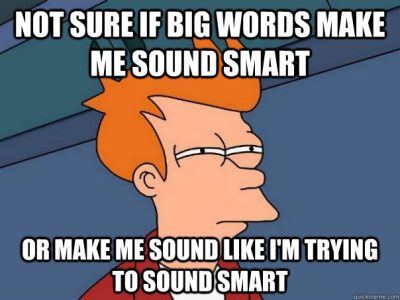
    Sesquipedalian: a person who uses big words to sound smart.

    Even though Diane Garland and I are lexicomanes, I hope that we do not come across as sesquipedalian. However, no one would accuse me of being pauciloquent.

    Lexicomane: lover of dictionaries

    Pauciloquent: using few words in speech or conversation

    The main point is that as a writer, you do not want to bumfuzzle your readers or listeners.

    Bumfuzzle: confuse, perplex, fluster

    To bring this diverting (aka fun, I hope) post to a close, I would like to share some words that I read in a business journal that are supposed to make you sound smarter. However, their synonyms might work better in your works. It depends. Right? Right! Or as my friend with whom English is a second language admonishes me to say, “Correct? Correct!” instead of right—especially when giving directions.

    • articulate (well-spoken)
    • accolades (kudos)
    • brevity (concise)
    • adulation  (excessive flattery)
    • anomaly (odd)
    • pithy (brief, clever remark)
    • lucid (clear and intelligible)
    • bespoke (custom-made)
    • diatribe (rant)
    • vitriolic (nasty, scathing comment or action)
    • aplomb (confidence)
    • resplendent (shining brilliantly)

    Do you have some words that you would love to share or ones that you think should be abolished (scrapped) from the English language? Let me know!

    REMINDER to WRITE FAST and EDIT SLOW

    And remember to not worry about word choice when you are creating your first or second draft.

    WRITE FAST!

    Edit Slow!

    Handy link to our Write Fast, Edit Slow post with a practice exercise. 

    Word choice editing comes after you get your story’s first or second draft draft down in words from the “mindfilm” that you experience when you are creating a work.

    I do hope that you have enjoyed reading this post at least half as much as I enjoyed writing it. Until next time,

    Keep on Writing! Kiffer


    Chanticleer Editorial Services – when you are ready

    Did you know that Chanticleer offers editorial services? We do and have been doing so since 2011.

    Tools of the Editing Trade

    Our professional editors are top-notch and are experts in the Chicago Manual of Style. They have and are working for the top publishing houses (TOR, McMillian, Thomas Mercer, Penguin Random House, Simon Schuster, etc.).

    If you would like more information, we invite you to email Kiffer at KBrown@ChantiReviews.com  for more information, testimonials, and fees.

    We work with a small number of exclusive clients who want to collaborate with our team of top editors on an ongoing basis. Contact us today!

    Chanticleer Editorial Services also offers writing craft sessions and masterclasses. Sign up to find out where, when, and how sessions are being held.

    A great way to get started is with our manuscript evaluation service. Here are some handy links about this tried and true service: https://test.chantireviews.com/manuscript-reviews/