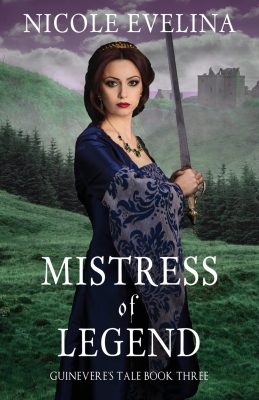
 In Mistress of Legend, the enticing finale of Nicole Evelina’s Guinevere’s Tale trilogy, matters are life-and-death by the second sentence, pulling readers deep into Guinevere’s fate in this retelling of Arthurian legend.
We come upon heroine Guinevere in the midst of an ill-fated romance with Lancelot. It’s far from her first troubled entanglement, but the stakes rise as she’s severely injured and faces even more threats, pursued by possible enemies. The novel’s beginning is woven with backstory, which adds suspense to the drama unfolding in Guinevere’s present. This summarizing might be slow for readers familiar with the series, but makes the story accessible for those who haven’t picked up the first two books.
Many more characters appear, waving the web of intrigue Guinevere finds herself caught in.
Evelina builds this setting through well-researched cultural details, like the holidays and rites of Guinevere’s pagan world, and the symbolism and ideology of the Christianity that threatens to blot her world out.
Though it’s a work of fantasy, Mistress of Legend has the feel of magical realism. Paranormal abilities like Guinevere’s “sight” fit subtly within Evelina’s carefully constructed foundation. Details down to ritualistic makeup and intoxicants are based on fascinating historical truths, many of which are explained in the author’s notes at the end.
Evelina avoids foreshadowing to ensure her characters’ futures long remain inscrutable. Unpredictable shifts in individuals and relationships seem to arrive at every turn, making for a thrilling, if at times mystifying, read. Guinevere’s relationship with Morgan, Arthur’s second wife, feels uncertain until the end, as the two vacillate from enemies to friends and back again. Meanwhile, Mordred, son of Morgan and Arthur, undergoes surprising development that makes perfect sense only in retrospect.
The use of “the sight” by characters like Guinevere and Morgan provides windows into other places, even the future, as the women experience highly realistic visions.
This allows Evelina to show two places at once without using multiple points of view (though some characters are so fascinating that readers may wish they could see things through their eyes). Instead, only Guinevere’s perspective is given, and readers feel her claustrophobic sense of being trapped in the mechanisms of fate.
Along with the characters involved in it, this tale of political intrigue only grows more complex with time.
The story begins to feel like a tapestry whose threads disappear and reappear in the weave. Some characters – even main ones – vanish and are nearly forgotten, only to return when they’re least expected. Guinevere’s life-threatening injuries, so crucial to the first pages, are soon eclipsed by even more pressing problems. Yet they return to the narrative from time to time, the marks left behind to remind the aging Guinevere of how much she’s lived – and how much is still in store.
Mistress of Legend fits well within the literary tradition of retelling classics from a strong woman’s point of view.
It’s a great pick for readers of magical realism, historical fiction, and new twists on old classics. It takes things a refreshing step further, too, with a strong female character who remains formidable, agile, and the subject of much male attention as she ages past 40. Youth is no threat to Guinevere. The foolish grabs for power that surround her are.
The pace of the novel shifts wildly: speeding through seasons, only to suddenly slow and zoom in on the intense details of a moment. At times, it feels a bit like whiplash – but surely that’s how Guinevere felt, as the life she built crumbled time and time again. Readers remain close within her viewpoint, feeling everything she feels, in a world whose only constant is change. Ambitious though she is, her true quest is simply for peace.