
Tag: Antarctica

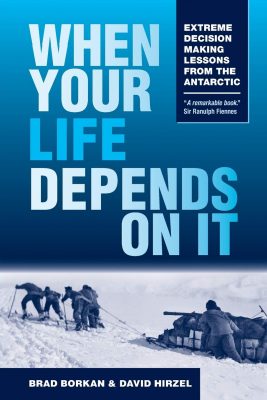
  • WHEN YOUR LIFE DEPENDS On IT: Extreme Decision Making Lessons from the Antarctic by Brad Borkan & David Hirzel – Travel & Exploration History, Personal Transformation, Antarctic Expeditions

    Instruction & Instight Blue and Gold 1st Place BadgeWhen Your Life Depends on It by Brad Borkan and David Hirzel is a mosaic of incredible factual stories from the “heroic age” of South Polar expeditions, reviving timeless lessons of tactical decision-making for the present world.

    Six vital polar expeditions between 1901 and 1917 catalyzed some of the most difficult and tough judgments in history – choices teetering on the border between life and death. The alluring fascination of Antarctica’s mysteries drew the heroes of this era, even while the continent’s frontier remained dangerous and unyielding. These journeys are treasured records of ambition, teamwork, sheer determination, and sacrifice. With a storytelling-driven approach to learning, When Your Life Depends on It contains a striking collection of true heroic tales from these six expeditions, imparting lessons about goal-setting, overcoming challenges, and approaching adversity with grit.

    The thrilling and momentous stories, coming from over a century ago, nimbly flow through each of the book’s twelve chapters. Each story serves as an object lesson for dealing with modern-day personal and business dilemmas. The reader is placed in the role of judge, evaluator, and student as they reflect on various sensible, selfless, and steadfast choices made along the polar journeys.

    “Tell me and I forget, teach me and I may remember, involve me and I learn” (Benjamin Franklin) – this quote holds the core purpose of this book.

    The expedition stories immerse readers, drawing parallels between historical expedition conditions and contemporary challenges. The question “What would you have done?” at the end of each chapter and story engages and interests the reader.

    The objective third-person narration pairs with a second-person point of view in these stories. The accounts of the dangerous and uncertain winter journeys –be it for national pride, scientific discovery, or personal goals– are not limited to the narratives of the authors. A recommended reading section at the end of the book contains diaries and accounts written by the expedition leaders, as well as pictures for curious readers. The authors offer links to several books and DVDs that they recommend for a continued Antarctic journey.

    Bringing together motivation and history, When Your Life Depends on It pays homage to the pioneers who spearheaded great scientific and geographic endeavors and inspired later explorers with their camaraderie and passion.

    This book offers stirring adventure with historical significance and valuable lessons on self-development. Its lessons are true to the quote – “It is the way you deal with and react to adversity that defines your life story” (Dieter F. Uchtdorf) – no matter what the terrain is, whether it’s chilly polar regions or your personal and business spaces.

    When Your Life Depends on It by Brad Borkan & David Hirzel won First Place in the 2019 CIBA I&I Book Awards for Non-Fiction Guides and How-To Books.


    5 Stars! Best Book Chanticleer Book Reviews

  • An Editorial Review of “Lost Antarctica” by James McClintock.

    An Editorial Review of “Lost Antarctica” by James McClintock.

    Lost Antarctica: Adventures in a Disappearing Land opens up an amazing world for readers, especially beneath the sea surface. You’ll meet bright orange “sea butterflies,” which can change sex from male to female, and read how scientists filmed soft corals actually walking from one place to another.

    Many readers will know that scientists from around the world come to Antarctica to study its unique environment, but we don’t often get to read about how they do that science and what the results mean. This engaging book delivers all that.

    The unique creatures that live in Antarctic waters have already been found to produce compounds that could fight cancer, AIDS, and influenza. Their body chemistry shows promise for new antibiotics. But if change continues at the current rate, all these species may be gone before we have a chance to understand them.

    How can a continent of more than 5.4 million square miles be “lost?” How could it disappear? Global warming is the answer. Antarctica is more than ice, so the land itself will never completely vanish, but the southernmost environment as we know it is already changing fast, and in ways that have drastic implications for the future of all life on earth. McClintock uses interesting descriptions and down-to-earth language to explain the situation for non-scientists.

    Take krill, for example—tiny crustaceans that form the majority of zooplankton near the bottom of the food chain. Juvenile krill feed on algae that grow on the underside of pack ice. With less and less pack ice each year, there are fewer and fewer krill. So what, you might be thinking—why should I care about krill? What eats krill? Bigger crustaceans, jellyfish, anemones, penguins, fish, seals, you name it. Even the largest animal on earth—the blue whale—depend on this food source.

    You’ll find out how more carbon dioxide in the atmosphere means more acidic ocean water, and how more acidic water means all shelled creatures are in danger of extinction.

    But this book includes more than just the results of experiments and their associated dire predictions. McClintock gives us a peek into the lives of the researchers. You’ll learn about living on board research ships and the fear and frustration of being tossed about in ferocious katabatic winds. McClintock describes how researchers camp out on ice shelves and challenge 1000-pound leopard seals for diving rights. The book details an invasion of king crabs and provides an explanation of “seal finger,” an injury that can be fatal. There’s even a warning of how the Norwegian delicacy, lutefisk, can permanently damage sterling silver (and possibly your insides).

    Professional scientists may want to know more about the various tests and methodology McClintock describes, so the author has thoughtfully included a Notes section, as well as a good Index. Unless you’re already familiar with the layout of Antarctica, you’ll be frustrated by the lack of a map in this book. Find or print out your own so you can follow along as McClintock describes the fascinating geography and the challenges of working in this rapidly vanishing environment.