Tag: Ancient Rome

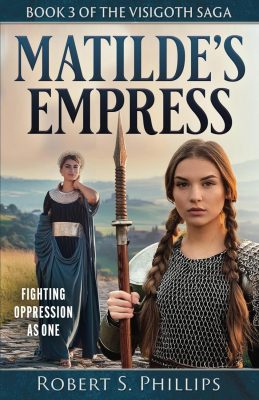
  • MATILDE’S EMPRESS: The Visigoth Saga Book 3 by Robert S. Phillips – Historical Fiction, Ancient Rome, Historical Women Leaders

    In Matilde’s Empress, book three of The Visigoth Saga by Robert S. Phillips we follow Matilde’s exploits during the decline of the Roman Empire, with unrelenting battles, meticulous period detail, and insight into how Romans and non-Romans alike dealt with shifting alliances and the frequent loss of loved ones.

    Now eighteen, feisty and wise Matilde has lost a child, her lover, and her safety. After she escapes to Thessalonica where her stepbrother Alaric presides, a courier brings word of Emperor Arcadius’s desire to rid his Eastern kingdom of the Visigoths. All Roman subsidies for the Goth’s armed forces are canceled.

    Ever the advisor, Matilde pushes for Alaric’s people to shift loyalties and align with Stilicho, the sympathetic Roman general who leads the Western kingdom’s military. Under the guise of delivering wedding gifts to the Western Emperor Honorius, a delegation departs to meet with Stilicho. However, not before Matilde enters a three-way marriage with Alaric and his wife, Pentadia.

    During her travels, Matilde discovers she’s pregnant.

    The web of politics becomes more complicated as Stilicho remains on friendly terms but will not go against the East. Soon after the delegation returns, Matilde gives birth to Theodoric. It quickly becomes apparent that without enough money to go around clans will soon fall on each other and dissolve into pure conflict. The chieftains appoint Alaric as King of the Goths, which bestows on him the responsibility to find his people a fertile land far from their enemies.

    As their migration begins, they wade through a land of violence – battles within the barbarian tribes, between barbarian and Roman armies, and between Romans and Huns. Men are slaughtered, and their wives and children are sold to slave traders.

    Amidst the bloodshed, Matilde – Queen of the Goths by virtue of her marriage to Alaric – is taken captive. She becomes enamored with a Roman general, Constantius, and they begin an affair.

    Political machinations – treachery, poor planning by excessively proud men, frequent shifts of power – create an intriguing plot. But while Matilde’s love affairs provide some respite, the near-constant fighting and casual indifference to death wears at the heart. Even Matilde is not immune to the weight of it: “Constantius allowed the captured legionaries to swear allegiance to Emperor Honorius. Only a few refused. He had them executed, along with all the barbarian prisoners. I thought that brutal, but, indeed, how were we to manage prisoners?”

    Even when there’s hope, sorrow lurks nearby: Matilde is finally released to go home to her family, only to find that a sickness has taken many. Alaric insists that their son Theodoric, his only heir, remain with him. He grants Matilde a divorce so that she can return to Italia with Constantius.

    The Roman Empire continues its fall, as usurpers such as Constantine arise, and allegiance to the Western and Eastern emperors is easily turned by gold.

    All sides continue to loot, plunder, and pillage any unfortified community. Incestuous marriages are made as power plays. When a longtime Roman ally of Alaric’s is murdered, the empire’s last grasp of power loosens. In 410 CE, Alaric leads the Goths to sack Rome.

    Lands and migrations are granted, only to see more battle over those lands. Within a year, Britain is no longer Roman. Within eight years, the Romans finally conceded to allowing barbarian tribes to live peacefully within their territory.

    Despite her years of foresight and reasoned counsel, men continued to discount Matilde for being a mere woman. Even Constantius loses interest when she fails to provide him with an heir. Her closest friend, Placidia—ready to marry Constantius once the two divorce – tells her, “A wife either produces sons or she is not a good wife. Your brilliance and other qualities were interesting but not essential.”

    In a few years, however, Placidia seeks her help in fending off Honorius. Matilde muses, “Of course, I will go. My next adventure is just beginning.”

    This final chapter in The Visigoth Saga will satisfy readers with Matilde’s tale of a girl who grows into a woman on her own terms. Phillips dives into the ancient world and brings readers with him to stand side-by-side with a legendary warrior heroine.


     

  • MATILDE’S GENERAL: The Visigoth Saga Book 2 by Robert S. Phillips – Historical Fiction, Ancient Rome, Visigoths

    Matilde’s General, the second book in The Visigoth Saga by Robert S. Phillips, follows young Matilde, daughter to the Visigoth Elodia and the Roman Caius, as she takes part in the looming fall of the Roman Empire.

    Showing the same will and cunning exhibited by her mother in Elodia’s Knife, Matilde spends her youth training to fight. She transforms from an 11-year-old bravado into someone stronger, wiser, and ultimately respected by men in power.

    Matilde’s General thrusts readers right into battle – and the action keeps blazing throughout this ancient history.

    Her stepbrother Alaric, and his fightersprized by the Roman Emperor Theodisiusare hired to fight in a civil war. Matilde follows behind in secret. When she is discovered, Matilde is grudgingly allowed to help her mother with the medical cart. But nothing has prepared her for the bloody conflict ahead.

    Used as arrow fodder, half the Goth fighters are slaughtered, with most of those still alive badly wounded. Compartmentalizing her grief and horror, Matilde helps treat the injured, whose numbers are multiplied when a ferocious storm follows the battle.

    As the ragged remainder, including a wounded Alaric, return home, Matilde asks, “Our songs and stories are full of heroic deeds. Why don’t they tell the truth? That war is horrible, and young men die?” Elodia tells her that men are born to fight and protect uswomen to be mothersbut Matilde thinks otherwise.

    She listens carefully and begins to debate military philosophy with first Alaric, and eventually, all men in her sphere.

    Although Rome viewed all non-Romans as barbaric, the Goths held themselves as civilized. All peoples plundered and burned other villages, but the Goths only took what they needed. Matilde’s family experiences this firsthand on their return home to Storgosia. The Huns have destroyed all but the old Roman fortress.

    Matilde and Alaric agree that their people can’t remain there. Together, they hatch a plan.

    Emperor Theodosius has died, leaving his kingdom split between his two mentally weak sons. The pact between the Goths and the emperor is now nullified. Alaric determines to forge a new one, not only codifying him as magister militum, but also giving his people lands within the Roman empire.

    Matilde refines Alaric’s speech to the Goths and is credited by one of the leaders as “wise beyond her years.” It won’t be the only time. In fact, many of the women far outweigh the men in perceptiveness and prudence. This echoes the point that Elodia made to her daughter.

    The Goths under chieftain Alaric journey to Constantinople to propose their new pact. Now recognized as a thoughtful advisor by her people, Matilde attends in the guise of a server but whispers counsel in Alaric’s ear. The negotiations last a month, and ultimately, Emperor Arcadius grants Alaric the region of Thessalia, but no military title.

    When Arcadius reneges on part of the pact, a battle breaks out, but the top Roman generals Stilicho and Gainas choose not to escalate.

    General Gainas takes note of Matilde. Before the Romans return to Constantinople, they demand two hostages as “guarantors of Alaric’s good behavior.” With Gainas’s growing respect for and attraction to Matilde, it’s no surprise that she is chosen.

    Robert Phillips imbues Rome with life and color, exciting readers with the ancient city just as it fascinates Matilde herself.

    The market stalls are filled with silks, jewelry, and other riches. Matilde joins on weapons drills, astonishing the young men. She watches gladiatorial games and chariot races, realizing that above all, Rome is defined by the constant presence of bloodsport, violence, and death.

    But for all its jubilant chaos, Rome is controlled by careful intrigue and political machinations. Matilde has to quickly grasp the tenuous flow of power.

    She is taken prisoner as a spy, but soon released back to an ever-more adoring Gainas, who acts on her suggestion to remove the chief minister and take his place. However, Arcadius feels threats closing in on him and starts having generals killed, so Gainas departs with an envoy to recruit more fighters.

    Befriended by a general’s wife, Matilde confesses: “Gainas is destined to be the Stilicho of the East […] though he doesn’t know it. He needs a woman to help him fulfill his purpose. I am that woman […] Gainas and I would become the rulersthe effective rulersof half the world.”

    For once, Matilde’s instincts fail her.

    On their return to Rome, unrest escalates, and the empire’s slow demise is reflected in Matilde’s personal life. Now very pregnant, she loses the empress’s friendship. Gainas is obsessed with military action, and he no longer takes her counsel. She realizes that, faced with turmoil, “Gainas was too proud to take suggestions from a little girl.”

    With few people she can rely on, Matilde will have to survive this collapsing city.

    Historical fiction rarely looks into the so-called barbarian tribes who helped bring about the fall of the Roman Empire. The Visigoth Saga illuminates this fascinating and important part of the ancient world.

    Phillips bolsters this story with intriguing, authentic details about battle maneuvers, political plotting, and life in general circa 400 CE. Each chapter is introduced with the words of an actual ancient historian. Within this historical veracity, Matilde’s General is made intimate by its intelligent women who love, and understand, their flawed men.

    Readers can look forward to Matilde’s story reaching its epic conclusion in book 3 of The Visigoth Saga: Matilde’s Empress.

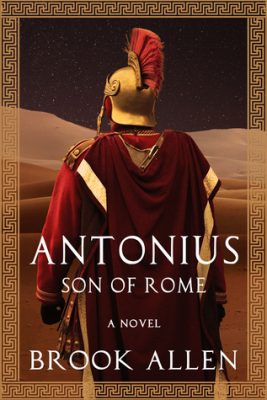
  • ANTONIUS: Son of Rome (The Antonius Trilogy Book 1) by Brook Allen – Ancient Roman Historical Fiction, Historical Fiction, Biographical Historical Fiction

    ANTONIUS: Son of Rome (The Antonius Trilogy Book 1) by Brook Allen – Ancient Roman Historical Fiction, Historical Fiction, Biographical Historical Fiction


    Blue and Gold Chaucer 1st Place BadgeAntonius: Son of Rome by Brook Allen focuses on one of history’s most vexing and perplexing figures, Marc Antony. It is also inevitably a prism on modern American politics, with its characters behaving duplicitously, greedily, and ignobly while spinning up service to the greater good.


    Historians often cite Antony as a controversial figure whose accomplishments and flaws have been noted by his enemies. Yet, he is as compelling as Richard III or Richard Nixon, with gaps in the accounts of his life that create grounds for curiosity and speculation as to how he became the pivotal figure in western history that he is. Allen weaves a wonderfully realistic and organic story of how a boy grows up desperate and bitter in a disgraced patrician family yet desperately transmutes mistake and tragedy into military achievement.

    Marcus Antonius was the eldest of three male children of his namesake father, Marcus Antonius, and Julia Antonia. Of noble birth in Republican Rome, the novel begins as eleven-year-old Marcus learns of his father’s fatal illness, a man who had failed in his duty to govern overseas provinces. His actions as provincial governor – extorting gold from those he should protect, then failing to commit suicide as a Roman general should when such disgrace is discovered – angered the Senate and left his widow and orphans to bear his dishonor.

    Young Antonius vows to restore honor to the family name.

    He commits to instruction in military practices and interacts with a cast of relatives and characters who aid him and provide additional problems with their political intrigues. His distant cousin, Gaius Julius Caesar, gifts him with a slave who becomes trainer and friend. But young Antonius also acquiesces to baser pursuits, becoming involved, with two other young Roman men of noble birth, in a brothel and gaming club where he indulges copiously. He begins to accrue gambling debts, which lead him to desperation as his moneylender demands repayment that the family’s modest wealth cannot meet. Roman proprieties and political savagery come together as his mother remarries. A plot to rebel against the Republican order includes his new stepfather, whom Antonius has come to esteem, and one of his brothel compatriots. The plot’s failure leads to his stepfather’s death and additional contempt for his family. Even his own joy sows horror; he frees and marries a family slave, only for her to be murdered by his usurious moneylender. Despondent and concerned for the others in his family, he is convinced by his cousin, Caesar, to study abroad in Greece, where his fortunes change.

    Allen makes historical Rome real.

    She brings to life areas readers might be familiar with, but she also takes us into the homes and less-pleasant places in mid-first-century BC Rome. From murder dungeons to strolls along the Palatine, receiving guests at a family Domus, and the daily interactions of Roman nobles and plebians and slaves, the perspective of young Antonius provides insight to a time two millennia distant and yet of human behavior not much different. As familiar names like Cicero and Caesar and Ptolemy plot and scheme and inveigle for personal glory with the lives of people they disregard in the balance, it’s difficult not to transfer young Antonius’s learning experience into our own era where the covetousness remains pervasive. The backstabbing is only slightly less literal.

    Indeed, the novel’s strength lies not in the admirable accuracy of its descriptions and accounts but in Allen’s ability to place the reader directly in the head of her hero. Perhaps it’s difficult to think of a man who drinks, fornicates, and wagers excessively as a hero but Marcus Antonius relies on honor in most instances, including when it may be to his detriment. As readers share his journey from the Domus Antonii to Alexandria, many will come to understand his philosophy and may be swayed.

    Steeped in history, but more than fiction, Antonius: Son of Rome ultimately invites readers to visit another place and time.

    Allen presents a flawed but sympathetic character to an enigmatic two-dimensional historical figure that will appeal equally to those already inclined to Roman history and those who might be just as inclined to the modern singer. Antonius: Son of Rome took home 1st Place in the CIBA 2020 Chaucer Awards for Early Historical Fiction.

    Chanticleer Book Reviews 5 Star Best Book silver foil sticker

  • CALL to JUNO (A Tale of Ancient Rome, Book 3) by Elisabeth Storrs – Historical Fiction/Ancient World, Historical Fiction Romance, Mythology

    CALL to JUNO (A Tale of Ancient Rome, Book 3) by Elisabeth Storrs – Historical Fiction/Ancient World, Historical Fiction Romance, Mythology

    Elisabeth Storr delivers an extraordinary tale of “Peasant and patrician; concubine and master” where man seeking woman, man seeking man (mostly unrequited) and man seeking boy, erupts into a generous narrative of the quest for power between a reluctant Etruscan king, Vel Mastarna (situated in Veii—mere miles from his oppressor) and Marcus Furius Camillus—he who would be Rome’s dictator in her stunning Historical Fiction novel, Call to Juno: A Tale of Ancient Rome.

    Veii has been under a 10-year siege; Rome biding its time at the unsurmountable gates, waiting to starve its conquest into submission (and thereby looting the bounty and putting Rome’s finances back into the black).

    But there is danger afoot: almost entirely fueled by relationships strong or soured. Along with the “human” battlements, the gods must also be looked after—not a few of them “serving” both sides of the battle.

    At the center of it all is Artile Mastarna an Etruscan soothsayer who would rather corrupt boys than provide life-advancing advice. His brother, Vel (albeit reluctantly) is readily betrayed by his all-knowing sibling who prefers to work with the Romans and topple his own countrymen. A further link to Rome comes in the beguiling and astute shape of Caecilia. Years ago, her Roman relatives used her as the glue for peace in a forced marriage between the warring countries. Their eldest, adopted son, Tarchon, also prefers the company of men and makes no bones about showing his inclination. Four other children have blessed this political union which, nonetheless, has become a truly loving relationship.

    In Rome, the action centers around the highly ambitious Marcus Furius Camillus, unashamed patrician and consular general. His love interest is a former prostitute (kept a secret from her lover, but others within the circle are aware), who faithfully serves her master in the role of concubine. The gay blade on this side of the divide is Marcus Aemilius Mamercus, whose unrequited love for Appius Claudius Drusus is further complicated Drusus’ infatuation with Caecilia—all the better to kill the Etruscan king!

    Watching, of course, are the gods. How curious that both sides worship the same deities, albeit with different names (e.g., Uni/Juno, Tina/Jupiter, Aplu/Apollo, Fufluns/Dionysus). When simultaneously beseeched for assistance from the disparate factions, what’s a god to do? Beware the thunderbolt!

    As with all good historical fiction, Storrs takes us on a long-ago journey that has much relevance for the present day, proving once again the old adage that there is nothing new under the sun (and in this case, son). Savor the past, then fill in your own cast of 21st-century characters and see them through the lens of time.

    Call to Juno won 1st Place in the 2017 Chaucer Awards for Early Historical Fiction.