Tag: American History

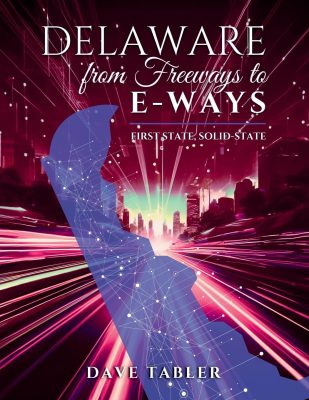
  • DELAWARE From FREEWAYS To E-WAYS by Dave Tabler – American History, Delaware, Vignettes

    DELAWARE From FREEWAYS To E-WAYS by Dave Tabler – American History, Delaware, Vignettes

    Dave Tabler’s Delaware from Freeways to E-Ways presents a nonlinear kaleidoscope view of Delaware’s twentieth-century history, braiding together snapshots of the state through a variety of lenses.

    By dissecting the history of the state’s education system, economy, politics, war, technology, social dynamics, religion, agriculture, and conservation of the natural world, this book becomes a patchwork quilt of Delaware’s contributions to recent American history.

    Tabler strategically places historical images throughout the first half of the book to help paint a vivid picture of what Delaware life has been like across the years. The second half of the book then expounds on every snapshot, allowing the reader to pursue the parts that most interest them. Tabler concludes each of these deeper dives by describing the impacts on present-day Delaware and America. These threads of connection to current events help the reader find meaning within the overall arc of history.

    The reader can feel Tabler’s passion for Delaware’s heritage in his storytelling lilt.

    Sometimes his tone is delighted, such as when he explains the origin of the Punkin Chunkin competition. Other times, he’s awed, using lyrical language to describe the snow geese migrating over Delaware Bay, “Their soft honks echo across the refuge as they glide over the brackish tidal marsh.” He frequently highlights clashing perspectives between historical figures and organizations with the tone of a racetrack commentator. This energizes his depictions of the growth of the du Pont family or the conflict between suffragettes, politicians, and the community. Even heartbreak shapes Tabler’s words as he tells the story of John T. Hopkins, who lost his farm to eminent domain.

    Tabler’s writing style offers an à la carte tour of Delawarean history, clearly supported by thorough research.

    Each story can stand on its own as a vignette, and together they reveal myriad perspectives on the state’s character. The engaging storytelling may encourage readers to dig deeper into the subjects on their own, and Tabler’s mix of historical images with several AI renderings give context to the information.

    Tabler excavates nuanced twentieth-century stories of Delaware with contagious fascination. Readers curious about the ways in which seemingly small events of the past are connected to lasting traditions in the present will find great interest in Tabler’s well-researched view of the state of Delaware.

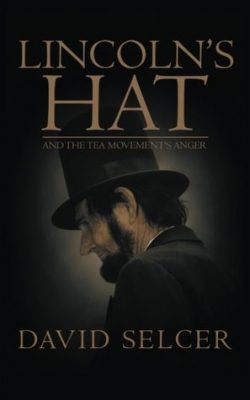
  • LINCOLN’S HAT and the TEA Movement’s Anger by David Selcer – Historical Fiction, Political, Literary

    LINCOLN’S HAT and the TEA Movement’s Anger by David Selcer – Historical Fiction, Political, Literary

    Laramie Book AwardsSet in the chaotic era of the American Civil War, Lincoln’s Hat provides an intelligent look at the many streams of thought that make up our political framework today, and how they may clash in times of upheaval.

    Harlan Pomeroy is a young Kentuckian setting off for college in 1855 when he encounters Sally Hairston, a free black girl who will later bear him a child. Pomeroy never forgets her. He will use his education to become a journalist, joining a political movement known as the “Know- Nothings,” a group that despises President Lincoln in part because of his loose immigration policies that draw Germans, Irish, Jews and atheists into the country. When the Know-Nothings attempt to assassinate Lincoln, they end up with his hat, which they give to Pomeroy for examination. Tucked in it he finds a letter of support to Lincoln from the author of the Communist Manifesto, Karl Marx. This adds further fodder to Pomeroy’s hatred of the President whom he now sees as a supporter of socialism, an ideology he believes will “rot the country from within.”

    Pomeroy has allies who share his views and plot yet another assassination attempt that also fails. Leading a new movement called The Enlightened Americans, or TEA party, Pomeroy joins forces with actor John Wilkes Booth in a scheme to kidnap Lincoln. But after Booth’s bold assassination of Lincoln, Pomeroy will become a target for the Pinkerton agency and flees west to escape their investigations.

    Lincoln’s Hat captures the imagination while presenting a character, fully believing in the rightness of his actions, yet unable – or unwilling – to fully contemplate the consequences of them; a problem that always makes for good story-telling. The Know-Nothings anti-immigration stance demonstrates their sense of nationalism, even though some understand their propaganda as racially motivated. Pomeroy and his friends little realize that their “exaltation of the rights of individuals,” as Selcer puts it, will result in endangering the general good.

    In driving home these points, Selcer makes use of long, complicated conversations among his central characters and a blend of real and imagined events relevant to the story. His behind-the-scenes depiction of Lincoln as both high-minded and no-nonsense are an engaging addition to his story. Selcer has done extensive research on the historical period during and following Lincoln’s presidency which is admirable.

    With a fast-moving plot and political intrigue, Lincoln’s Hat gives us history with a human face.

  • An Editorial Review of “Ephemeral Palaces” by Nancy Foshee

    An Editorial Review of “Ephemeral Palaces” by Nancy Foshee

    A winsome romantic mystery that takes place in the Gay Nineties or, also known as the Gilded Age of the Robber Barons.

    Ephemeral Palaces, by Nancy Foshee, transports us to Chicago, 1893, when the city was hosting the World’s Columbian Exposition (aka the World’s Fair). The magnificence of the exposition was unparalleled in the event’s history with more than 27 million people attending its six month run.

    The author unfolds her fast-paced story that deals with the submerged conflicts of the time that are just beginning to erupt to the surface: the emerging labor movement in counterpoint with the Robber Barons, the first Skyscraper emerging from the ashes of the Great Chicago Fire, and the swirling together of cultures from different nations and religions from the European mass migration. People from all walks of life were converging at first to build the exposition, then to work at it, and then to attend it. Different levels of the social strata converged at the exposition, along with the new public parks, sprawling roads and railways, and industrial works that were creating the now great city of Chicago. The women’s suffrage movement was beginning and starting to gain momentum, and the country was starting to finally heal from the American Civil War.

    Readers will be swiftly caught up in this story of love at first sight, treachery, family secrets, sabotage, and technological innovations of the time, meshed with the conflicts between the classes, religions, and national origins. Foshee intertwines her cast of characters against the subtext of this backstory to make for a lively novel that historical, cozy mystery and romance fans will enjoy reading.

    Shakespearean charades and surprises ensue when one of Chicago’s most prominent and most eligible young heiresses, Alexandra Schaffer, beguiles an up-and-coming young architect, Logan McConnell. They meet when she helps Logan pick up items from a display that he accidentally knocked over in the grandiose Marshal Fields department store. Meanwhile, Alexandra’s brother, Joey, has fallen head over heels in love with the Schaeffer family’s Swedish maid’s daughter Ingrid, but he is forbidden to pursue the relationship by the family patriarch.

    Foshee adds elements of mystery and suspense, with a dash of ominous threats to this romantic story that takes place in this volatile time of American history. She deftly explores the dynamics of the Gilded Age and some of the era’s significant events that will impact the future of America and its capabilities to take on the challenges that the future will bring. Ephemeral Palaces is an engaging historical novel of the Gilded Age that was well-researched and well-written and a pleasure for this reviewer to have read.