Tag: Amazon

  • A Review Primer: What to Know, Where to Post, How to Use a Chanticleer Editorial Review

    Editorial Book Reviews

    The Secret to Being Discovered

    When it comes to selling books, getting noticed can be just as challenging as writing the manuscript itself. Readers can look at the blurb on the back of the cover or check the customer reviews online, but how can they know the quality of the writing and whether or not they’ll be carried away with story?  

    That’s the job of a professional Editorial Review!

    books, woman, library, white shirt

    Editorial reviews are professional critiques, often written by industry experts, literary critics, or reputable publications. They offer an authoritative voice that authors can use to help shape a book’s reputation before it ever reaches the bookshelves.

    Chanticleer Book Reviews loves helping authors get their books noticed by providing professionally written Editorial Reviews they can use across all their marketing channels, both traditional and digital! In this blog post, we’ll explore what editorial reviews are, why they matter, and how authors can strategically use them to boost credibility, attract readers, and enhance their book’s visibility in a crowded market.

    girls, book, grass, pink, braid

    What is an Editorial Review?

    Customer reviews are great at relaying the emotional response casual readers experience when reading your book, but there’s little professional control and almost zero authorial control in what the content of those reviews are. Reader Reviews tend to quite brief, and often only touch lightly on themes and events in a book. Plus, there’s no guarantee that this reader is a good fit for the book as a whole.

    Editorial Reviews, on the other hand, are written by professional literary experts and provide insights into the quality of writing as well as the emotional impact these expert reviewers experienced when reading. Unlike customer reviews, Editorial Reviews are unbiased, polished assessments that focus on story elements, such as the quality of writing, originality, structure, and the overall impact provided by the narrative. From the craft of storytelling to the story itself, Editorial Reviews give readers a peek inside the reading experience to let readers know what to expect.

    Why an Editorial Review Matters

    Professional editorial reviews act as endorsements of your work. They take a deeper dive into the book, evaluating its bones and providing a sense of credibility and authority. That expert vetting can have a great influence on book sales and visibility for a new novel among booksellers and librarians (who often rely on reviews for purchasing decisions), literary prize committees, and readers who seek trusted recommendations when looking for their next book. Editorial Reviews help readers sift through the overwhelming number of books published every year, highlighting books with strong literary merit, originality, or cultural relevance and guiding readers toward quality content.

    In short, Editorial Book Reviews function as a bridge between authors, publishers, and discerning readers, which plays a crucial role in shaping the success, reputation, and cultural impact of a book.

    What to Expect from an Editorial Review

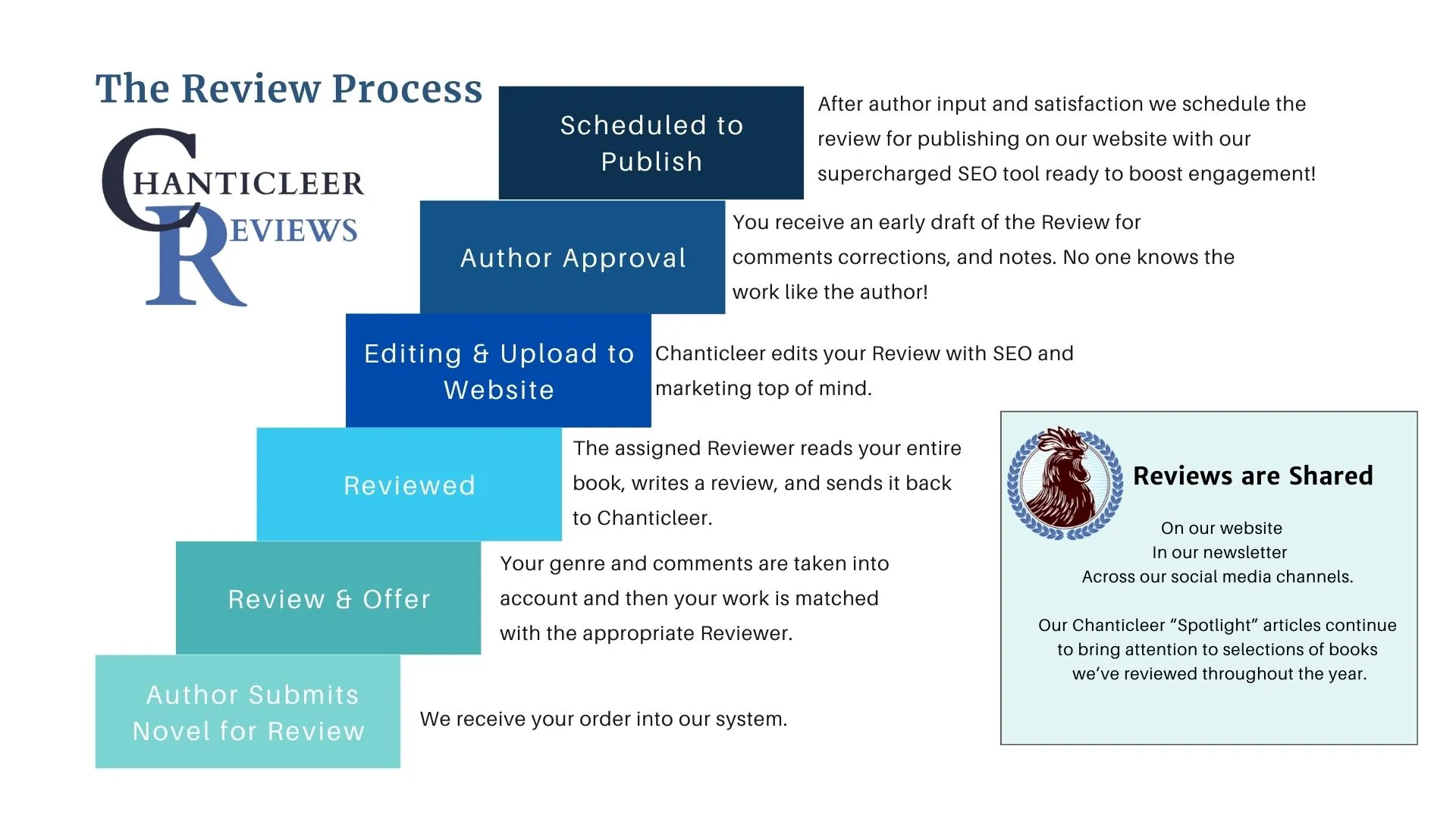
    Being reviewed by a reputable book review company, such as Chanticleer Book Reviews, is key to capturing the interest of readers through effective book marketing. Each company’s review process is different. This is ours—
    Blue, white, rooster, words

    • Clear Timeline: 6-9 weeks for standard reviews, 3-5 weeks for expedited service
    • Human Expertise: All reviews are read and written by professional reviewers whose other work you can view on our website
    • Marketing Focus: We edit each review to ensure at least 3 blurbable lines and optimize for SEO impact
    • Author Control: All paid reviews require your approval; we respect that no one knows your work better than you do

    Throughout the process, we stay in touch with the author, letting you know when your review has begun and working with you to refine it when it’s finished. We know Editorial Reviews are meant to work as a marketing tool to introduce your story to readers, and that’s why it is important to us that we offer authors and publishers the first look at their reviews to check for any comments, edits, or corrections that are needed to get it ready for their marketing. 

    How You can Use an Editorial Review

    To use your Editorial Review as a marketing tool look for all the ways, online and in-person, where you are presenting your book. Add a quote from the review to your book’s cover or an inside page, place it in a press release, ads, and promotional materials.

    I’ve used quotes from my review in tabletop signs at book fairs and readings at libraries alongside the blurb. I’ve also used blurbs on my website, in newsletters, and on social media in memes and messages. I’ve even seen them in video trailers! – Dena

    Reviews can also be part of an introductory email to bookstores and libraries, or if you are looking for an agent or publisher, an Editorial Review can provide them with a solid recommendation they can believe in. Some of our authors have purchased a review prior to their book being published for this very reason!

    When it comes to your selling sites, like Amazon, quotes from your Editorial Review can be pasted right on your book’s selling page where the customer can read an expert’s opinion alongside the customer reviews. Amazon (and Goodreads, which is owned by Amazon) are great places to post quotes from the review. In fact, don’t miss out on posting your review on these pages, as Amazon is the world’s busiest purchasing website for books, and Goodreads is specifically dedicated to readers.

    NOTE: A few years ago, Amazon changed its policy to limit access to selling pages to only the author. This move was prompted by the need to prevent fraud and keep control in the hands of the authors. It is Amazon’s policy not ours –even though Amazon ranked us highly and gave us special recognition.

    But there IS something that only you can do—

    Post a blurb from the review in the Editorial Reviews section on your book’s Amazon page!
    Amazon, computer, green, blue, laptop

    How to post an Editorial Review to Amazon

    To add an Editorial Review to your book’s Amazon selling page you must first create an Amazon Author Central account. This is the portal to your selling page to add, edit, or delete the content, all in the hopes of creating a more engaging experience for shoppers who visit your page.

    If you don’t have an Amazon Author Central account, here’s the link to get you started

    https://authorcentral.amazon.com/gp/help?topicID=200620850

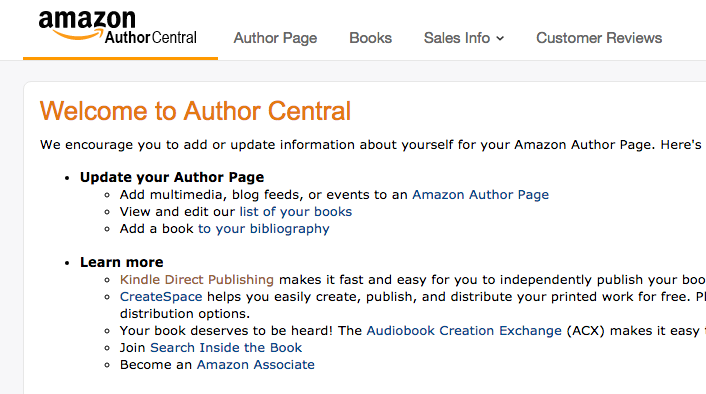
    1. The welcome page should look like this. Click on “Books” to get started (circled in red):

    Amazon Author Central Screenshot


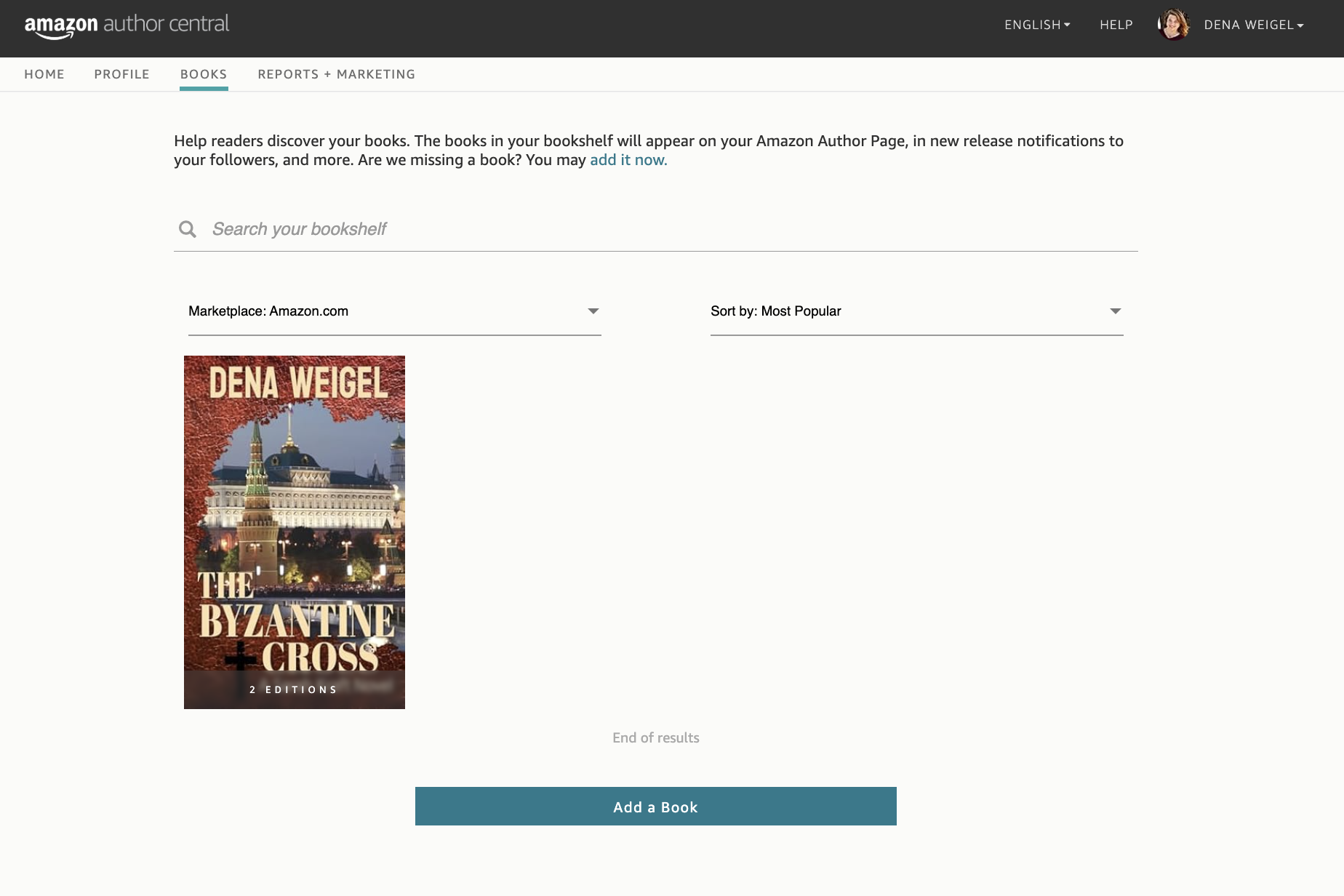
    2. Your books will pop up and you can add as many books as you like.
    Amazon Author Central Screenshot

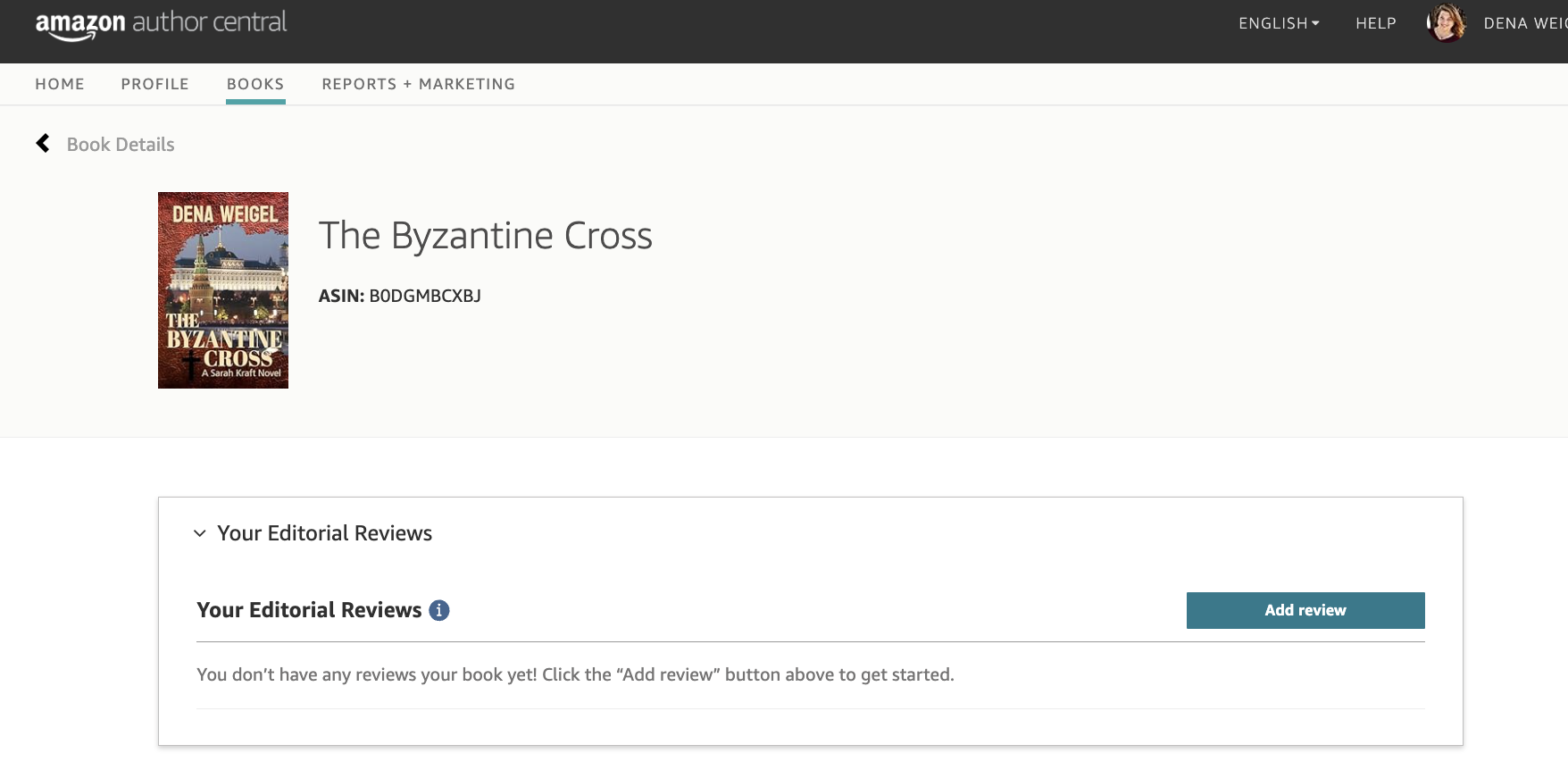
    3. Click on the book you want to add the Editorial Review for and you’ll next see a page that looks like this:
    Amazon Author Central screenshot

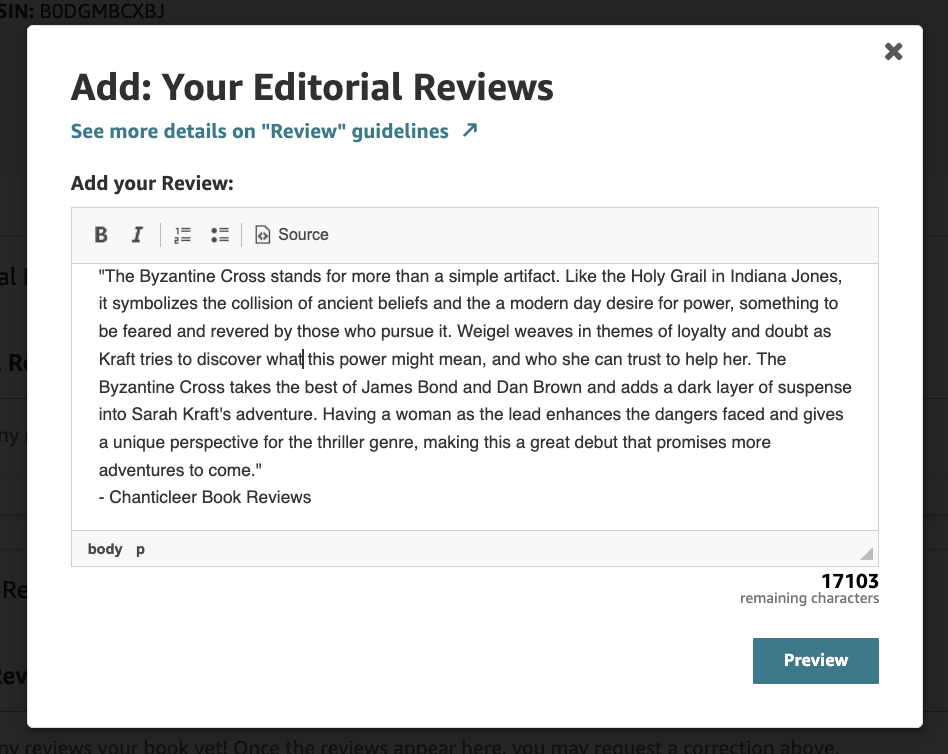
    4. Press the “Add review” button and you’ll be able to place your editorial review, or a quote from your editorial review, into the data box, just like this:
    Amazon Author Central screenshot


    5. Press “Preview” to make sure it looks professional, then press “Submit” to make the review go live on Amazon! You can add one review or more, we suggest adding 4 or five reviews that when combined will provide a well-rounded comment on your book. After you press “Submit” you’ll see a “Success!” message pop up on your screen that will tell you it can take 3-5 days for the review to publish, but I’ve seen the turnaround be much faster than that.
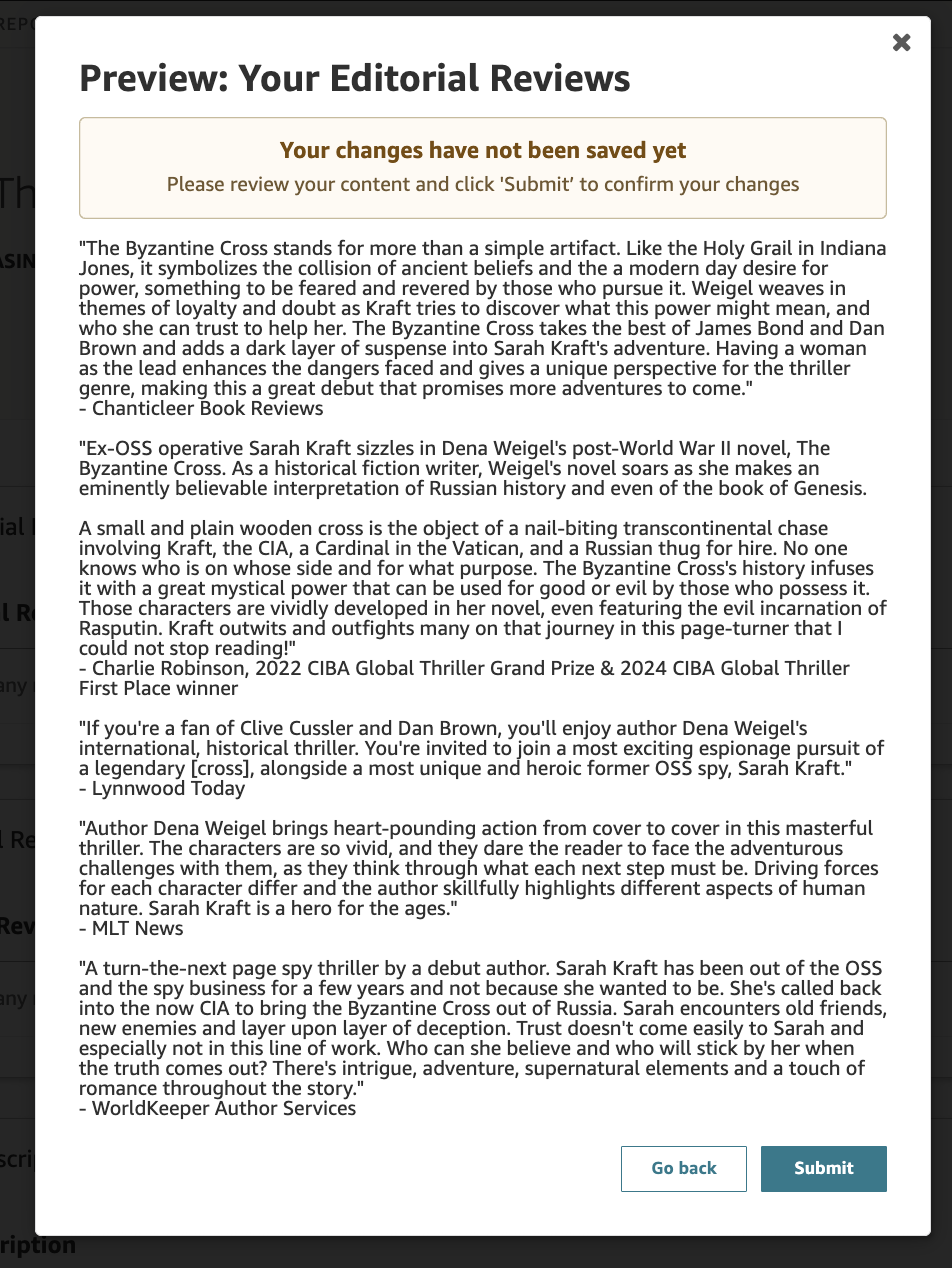
    Amazon Author Central screenshot

    A Few Insiders Tips

    • For a professional look, do not post the entire review. A well-selected blurb will do nicely. Using different blurbs on different marketing pieces, your selling pages, your website, in posters, etc., will give readers considering your book a broader view of the quality and experience they’ll have when reading your book, and it will also make the blurbs fresh and enticing!
    • Be sure to use ellipses when using a quote from the review.
    • Always give attribution! We prefer “Chanticleer Book Reviews” for our Editorial Reviews.

    Editorial Reviews are powerful tools that help authors show their work has been vetted by professionals. They help build trust with readers, retailers, and the industry, and can be the final decision maker when readers are at the check stand online or at their favorite corner bookstore!

    We hope this quick tutorial helps you get the most out of your
    Chanticleer Book Review, on Amazon and across all your marketing channels! 


    Ready for Your Marketing Breakthrough?

    Limited Time: Final Summer Push for Autumn Marketing Success!
    A typewriter with Chanticleer Reviews advertising Editorial Book Reviews

    Get your book professionally reviewed and ready for fall marketing season with our Labor Day Review Sale:

    Don’t miss this opportunity to get the professional credibility your book deserves before the busy autumn reading season. Our reviews provide the marketing ammunition you need to succeed on Amazon and beyond! Complete with SEO optimization, multiple quotable lines, and the expert validation that turns browsers into buyers.
    Get your professional Editorial Review today and transform your book marketing with the credibility only industry professionals can provide.

    Sale ends soon—position your book for autumn success while this limited-time offer lasts!
  • A New Tool to Improve Performance on  Amazon’s Sponsored Product Ads by Kiffer Brown

    A New Tool to Improve Performance on Amazon’s Sponsored Product Ads by Kiffer Brown

    Finally, a tool that will amplify your marketing efforts on Amazon!

    Amazon’s Sponsored Products ads are among the most powerful marketing strategies for authors who sell ebooks on Amazon.

    However,  the learning curve of how to use Amazon Sponsored Ads prevents many authors from ever taking advantage of this robust and proven advertising strategy.

    What are Amazon Sponsored Product Ads and Why are They Important to Authors?

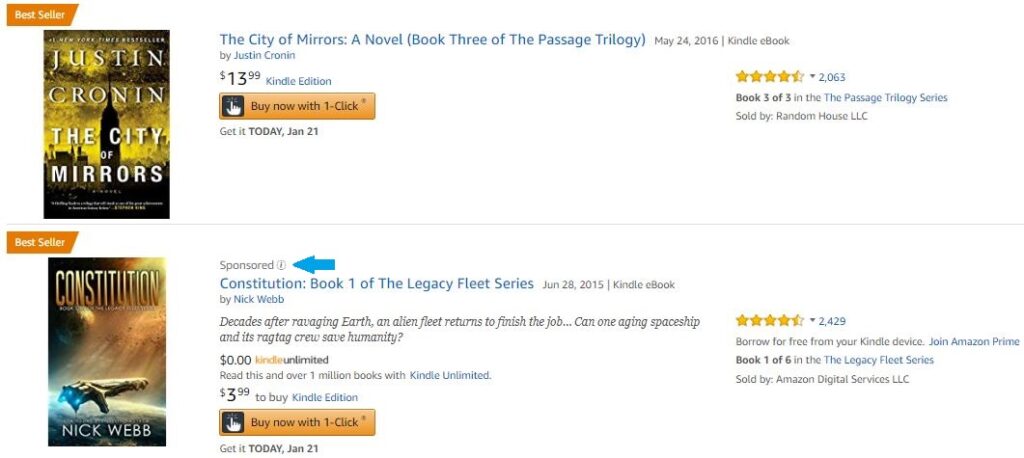
    Amazon’s Sponsored Products are cost-per-click ads for individual product listings that appear on product pages and search results throughout Amazon’s website. If you’ve ever been browsing for a new book on Amazon, then you’ve seen Sponsored Products. They look like regular book product listings, but they have a little tag that says “Sponsored.”

    Can you see “Sponsored” in the copy and paste below? It is to the left of the blue arrow on the second book listing. In reality on Amazon, there is no blue arrow—just an unassuming Sponsored tag.

    The great thing about Amazon Sponsored Products is that they directly target readers:

    1. who are already fans of the genre that you are promoting
    2. and who are actively looking for their next reads

    OR Let’s Say…

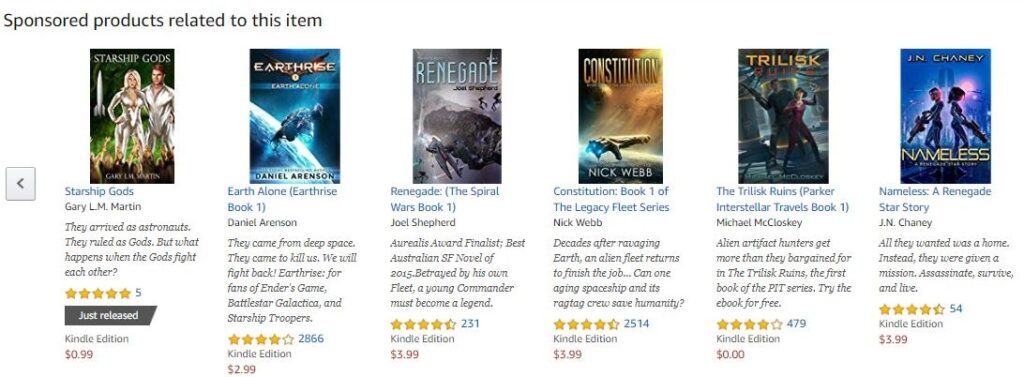
    Someone is browsing for a new sci-fi book, so they type, “scifi space opera” into Amazon’s search bar. Along with the search results, sponsored ebook listings (ads) will appear based on those search terms and related products.

    Product Targeting

    Instead of targeting keywords, you can also target specific products, such as best-selling and/or competing books in your genre. For example, if there’s a great book out there that’s similar to yours in terms of style and content, you can target your competitor’s book in hopes of attracting their readers. Additional functions with this option include targeting specific categories and excluding certain products with negative product targeting.

    With PublishDrive’s Advance Targeting Tool,  authors now have more options and greater control over their campaigns. So do keep on reading and stay with me…

    Another nifty point about Amazon Sponsored Products Ads is that the tool can be easy on your marketing budget. You only pay for clicks. You can budget how much you want to pay per click—so no surprises, and you can measure the results of your campaign along with insights on how to optimize performance by adjusting the AdWords that you select.

    The bottom line:

    You are only charged when your ad receives a click. This amount is deducted from your Amazon seller account.

    How much are Amazon AdWords? 

    Now that is the question, isn’t it?

    Amazon Sponsored Products operate on a cost-per-click, auction-based pricing model. You bid the maximum amount that you are willing to pay when a shopper clicks an ad for your product. The more competitive your bid is, the higher the chances that your ad will be displayed when it matches an Amazon shopper’s search.

    Adwords are determined by selecting keywords for the book that you want to promote on Amazon. Keywords are similar to Metadata. The more popular the keywords are the more expensive your AdWords will be and the more that you must bid to have them associated with your Sponsored Product ad.

    And this is where PublishDrive’s new tool will come in to play.

    The PublishDrive team invested months of research into finding the best ways to simplify this tool for authors, and we are beyond excited to tell you that PublishDrive is the first self-publishing platform to integrate Amazon advertising for ebooks. Now authors can manage global ebook distribution and powerful advertising in a single platform.

    SPECIAL OFFER: 

    LIMITED TIME ONLY – Try it out during the BETA TESTING of the TOOL – Visit PublishDrive

    Until the end of March 2019, beta-testing of this feature is available to all PublishDrive users who sell ebooks on Amazon. This means you can use the tool even if you distribute directly to Amazon rather than going through PublishDrive.

    Publish Drive’s revolutionary tool will help you to:

    • Refine your Amazon ad campaigns
    • Reduce costs associated with irrelevant ad clicks
    • Improve overall ad campaign performance

    PublishDrive offers one of the most robust and flexible distribution networks in the publishing industry that includes Amazon, DangDang (China’s Amazon), GooglePlay, Scribd, Tolino (Germany), Odilo (Spain), Bibliotheca (U.S. Libraries), Apple Books, and dozens more. PublishDrive’s list continues to expand.

    If you haven’t heard of the award-winning international PublishDrive, you will. 

    PublishDrive works with the New York Times and Amazon bestselling authors, niche indie publishers, and #seriousauthors. Read more about PublishDrive at  www.chantireviews.com/2019/02/28/publishdrive-an-international-and-technologically-innovative-publishing-platform/

    PublishDrive will present sessions on their innovative and easy to use digital platform that distributes ebooks on a global reach by using the latest in technology at the 2019 Chanticleer Authors Conference.

    Next Chanticleer articles:  Read about SAVANT, PublishDrive’s proprietary artificial intelligence program that helps identify the most relevant keywords and target their associated bestselling books for optimal Amazon Sponsored Products Ads to help authors boost their book sales and optimize their AdWords campaigns.

    Also, there will be a third article about the nitty-gritty of AdWords — like how much should you bid, what are the time projections for Amazon AdWords campaigns, and how does an author/publisher bring it all together to optimize book sales.

    At the Chanticleer Authors Conference, we will delve more into detail about promoting on Amazon and other digital book platforms. Have you registered? Hurry!  Seats are limited!

  • Are You CURIOUS about the AMAZON BOOKS Brick and Mortar Stores? – Kiffer Brown

    Are You CURIOUS about the AMAZON BOOKS Brick and Mortar Stores? – Kiffer Brown

    Aren’t you curious? About the AmazonBooks stores?

    I certainly was!

    I have heard of the Amazon Books stores, but living in Bellingham, a little city north of Seattle in the Pacific Northwest, I haven’t had the opportunity to visit one. And Bellingham probably does not have the demographics to support one and probably never will. We don’t even have that many chain stores—no Banana Republics here,  nor P.F. Chang restaurants.

    However, and more importantly, we do have two Village Books stores in the county.

    Village Books is an Independent Bookseller that Publisher’s Weekly rated as #5 Indie book store in the U.S.A. and they have opened a second location in Lynden, Wash.

    Nevertheless, I was still very curious about Amazon’s new brick and mortar bookstore concept—the antithesis of what I thought Amazon was all about.

    What does it look like? Does it have author readings? Does it have author signings? Does it promote Indie authors or bestsellers? Will it have that cozy bookstore feel that I love to lose myself in for hours?

    Or would it just feature its own 15 imprints: Thomas & Mercer, Lake Union, Montlake Romance, 47North, Topple, and so forth?

    So many questions! 

    I promised myself that the next time I go Seattle I would seek out an Amazon Books store to quell my curiosity.

    For those not in the know or have been without news, the Amazon empire is the most valuable company in the world and like Microsoft, is based out Seattle. Amazon is currently valued at over one trillion dollars (USD)—that is a lot of zeros. $1,000,000,000,000,000—I  think that is enough zeros…

    The Amazon Books store I decided to visit is also the very first physical storefront of Amazon and is located in a shopping center in Seattle that is known as the University Village located in the neighborhood of Ravenna. It opened on  November 3, 2015.

    Also, in the shopping center are other “temples to tech”  (as my husband, Argus, calls them) such as a Microsoft store, an Apple Store, three Starbucks (yes, three), a TESLA showroom, a b8ta retail store (get it? Beta) that specializes in the latest in tech products, along with other high-end retail stores such as a top-tiered make-up and skincare lines—oddly named (imho)— BlueMercury.  (imho– “tech speak for “in my humble opinion”).

    From my online reading, I discovered that Amazon has opened 17 bookstores with another three in the planning stages.

    Since Amazon is the largest seller of books in the world, I thought their journey into brick-and-mortar bookstores would be of interest to authors.

    What did I learn from my Amazon Book Store visit?

    The book store was very organized and neat. And very quiet. Aisles were big enough for strollers, and there was a children’s area at the rear of the store that was more brightly lit.

    The center of the store was filled with the latest Alexa gadgets, Kindle readers, and etc.

    And there were huge video screens playing video-clips. I found the large screens playing videos to be very distracting and not very bookstore-ish (imho).

    I walked the aisles of books labeled “Fiction” or “Non-fiction” alphabetized by authors.

    What I saw were tall rows and rows of the best-sellers. I then started to look for a few of my favorite Indie authors—no luck there. Next, I then looked for some of my favorite traditionally published authors only to find just a title or two.

    I thought that the reason Amazon started the Amazon Books stores was to showcase authors and small publishers who published with them along with their own imprints. I even remember some Facebook posts where Indie authors were excited to see their books in print and face out on the shelves of the Amazon Books stores.

    But that was not the case that day in early January 2019 when I checked out this particular store.

    I thought then that perhaps there was a section just for Indie authors, so I decided to find a staff member to ask this question. Maybe I just haven’t found the section yet. But, I was told that there wasn’t a special section for Indies and that the store generally tried to stock the best-sellers on the shelves.

    I was becoming increasingly frustrated.

    I then asked the staff member if there was a section for Pacific Northwest authors. You know, since the PNW is known for being home to a lot of famous authors such as Robert Dugoni, Jim Lynch, Jamie Ford, Garth Stein, Cat Rambo, J.A. Jance, Chelsea Cain, etc.

    I was shown this small section (see photo below).

    Amazon Books display table of Seattle authors.

    Yep, that little round display tower was it—about 12 titles from “Bong (yes, Bong) Appetit” next to Jamie Ford’s most excellent “Love and Other Consolation Prizes” at the Amazon Books store.

    Certainly, they must have J.D. Barker’s books. I have seen them for sale in Paris, Lisbon, Frankfurt, Los Angeles, etc.  But I didn’t see any.  So I asked, the staff member didn’t know who J.D. Barker was, but he did check the computer records for Barker’s books. He told me that they did have The Fourth Monkey in stock last week.

    I didn’t see any comfy areas for reading or hanging out. Or perhaps, I just didn’t see them…because of the orderliness of the store.

    One of the many reading areas at Village Books.

    The photo above was taken by leaning over the staircase at Village Books. 

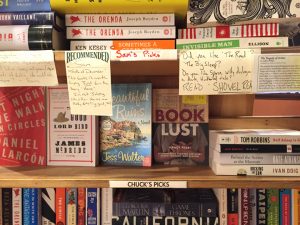
    I didn’t see any “shelf-talkers” or posters promoting the next author event like the ones that I see at Village Books. See photos below.

    Village Books shelves — cozy and personal with shelf talkers.


    One of the many Author Events poster areas at Village Books.

    What are the bottom line take-aways of my research trip to Amazon Books store?

    • Amazon Books exist for Amazon Prime Members. As do the Amazon Go stores & kiosks where no money or credit cards are taken and there are not any cashiers. Amazon Go can tell if you want to purchase something and automatically charges your credit card. Here is a link if you want to check out the Amazon Go stores.
    • Amazon Prime members spend approximately thirty percent more than non-prime members in shopping at Amazon. That is significant! No wonder Amazon wants to keep them as prime members and will make it as easy as possible for them to shop.
    • Indie authors do benefit from having their books available on Amazon to reach the North American market — especially digital and audiobooks. There is no question about that.
    • But Indie authors should realize that Kobo/Rakuten is where the rest of the world shops for digital and audiobooks.
    • Scribd (the Netflix of publishing) is acquiring subscribers at an accelerated rate. Scribd focuses on digital books and magazines along with audiobooks that can be downloaded. Indie Authors and Small and Medium presses should check out Scribd as a distribution platform to reach new readers.

    And the #1 Take-Away is: 

    Authors should support your local Independent Booksellers wherever you live and wherever you visit—whether or not if you traditionally published, Indie published, or small press published because it will the Independent Booksellers that will introduce you to their clientele, book reading groups, and will host your author signings and author events.

    • Independent booksellers are where you will build your grassroots readership.
    • Independent booksellers will give your books a place to be displayed.
    • Independent booksellers will give your books a chance — if a title sells 4 books a year, there is an excellent chance they will continue to stock and allow retail shelf space to your book.
    • Independent booksellers will host your author signings and events.

    Below is a photo of a Village Book’s author event.

    Long live Independent Booksellers! They are community support for authors at all stages of their writing careers.

    Also, Village Books manages the BookRoom for the annual Chanticleer Authors Conference and promotes the award winners from the Chanticleer International Book Awards.

    Would Amazon do that? 

    Thanks to Village Books and Paul Hanson (owner and steward for Village Books) for staffing the CAC book room!

    Yes, Amazon is necessary and is beneficial for authors and publishers. There is no denial of that. However, we cannot forget to support our local Independent Bookstores that build community for authors and readers.

    So the next time you are about to purchase a book, remember to take and make the extra effort to shop at your local Independent Bookseller store. If you are out of town on vacation or business, make an effort to stop by the area’s local bookstore.

    Don’t let this be the LAST BOOK STORE (Los Angeles, Calif).

    Support your local Independent Bookseller!


  • HOW to POST an EDITORIAL REVIEW on AMAZON.COM by Sharon Anderson – Book Marketing, Reviews, Instructional

    HOW to POST an EDITORIAL REVIEW on AMAZON.COM by Sharon Anderson – Book Marketing, Reviews, Instructional

    It’s not as hard as you think…

    Chanticleer Editorial Book Reviews for #SeriousAuthors

    Why do you want to post reviews on your book’s Amazon page in the Editorial Reviews section?

    Kiffer Brown chimes in here:

    1. It is well-known and believed that part of Amazon’s secret sauce search algorithm crawls the Editorial section of each book’s Amazon page. It is believed that the more individual blurbs attributed from different sources, the better.  Be sure to leave a blank line between review blurbs along with giving attribution to the reviewer will attract the notice of the “crawler” program.
    2.  And having review blurbs in the Editorial Reviews section gives your title a certain cachet and panache that will separate it from the other books (read millions) that do not have them.
    3. Editorial reviews help to garner more “consumer reviews” (reader reviews). They do this because they give readers the language to discuss your book and reaffirms the readers’ opinion. This is why traditional publishers spend a lot of time, effort, and money on getting reviews for pre-released books.

    It’s a numbers game.

    To get on Amazon’s radar, even more, your title will need at least 100 consumer reviews. Notice I didn’t say one hundred 5-starred reviews. It is the quantity that counts here. And the more mixed the better.

    Why do you want your title to get on Amazon’s “good books radar?” 

    When a reader does a search on Amazon for a particular genre to read, Amazon “ranks” which books will be shown to the searcher (reader) as a potential selection that he or she might want to purchase. And Amazon is in the business of selling things (consumer goods). Books for “the Trade” (genre fiction) are consumer goods.

    Now back to Sharon Anderson…

    Most authors sell their books on Amazon.com because that’s where a fair share of the reading public goes to purchase their books. If an author has worked hard at conditioning their audience – or if enough people have read an author’s work, soon reviews will be added. Good or bad.

    Sidenote: We all like good reviews, right? I mean, who doesn’t? But bad reviews can be just as helpful. Believe it or not, bad reviews (1-2 stars) are instructive. They will tell you about formatting issues, grammar issues, plot failures and more. Pay attention to them! Besides, if all you have are 5-star reviews – well, that’s a little unbelievable.  

    Back to our topic…

    That’s all well and good, however, what do you do with your Chanticleer Editorial Review?

    Update 3/20/2020: We just noted that we have not updated this paragraph. Our apologies. Kiffer:  We are no longer allowed to post our reviews on Amazon since summer 2018 or so. It is Amazon’s policy not ours –even though Amazon ranked us highly and gave us special recognition. <<We will post the entire review on your book’s Amazon page Consumer Reviews>>

    But there IS something that only you can do and that is to post a blurb of it in the Editorial Reviews section.

    Posting Your Chanticleer Book Review to the Editorial Review Section

    You cannot do this from Amazon.com. You first have to log in to your Author Central account.

    You do have a fully functional Amazon Author Central account—don’t you. 

    If not, start here: 

    https://authorcentral.amazon.com/gp/help?topicID=200620850

    Back to posting a review blurb in the Editorial section on your title’s Amazon page…

    The welcoming page should look like this:


    Click on Books:

    Your books will pop up and the screen should look something like this:

    Click on the book you wish to add a Chanticleer Review to:

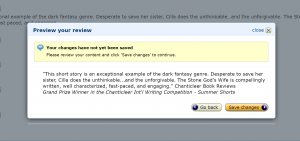
    Hit the “add” button and place the Chanticleer quote you wish to use. Preview it, and if it looks good, click on “save changes.”


    In a few days, you will see the Chanticleer quote appear under the Editorial Reviews section on your book’s Amazon.com page.


    Another chime in from Kiffer:

    For a professional look, do not post the entire review. A well-selected blurb will do nicely. Be sure to use ellipses if you are taking a section out. And always give attribution!

    Example:

    …Readers who are new to Larew’s series are in for a fabulously thrilling, nail-biting, page-turning, edge-of-their seats ride. Marilynn Larew’s writing style is smooth, engaging, and well-paced. Her ability to craft vibrant settings against the backdrop of exotic and gritty Hong Kong is exceptionally well-delivered. To sum it all up, Hong Kong Central is an absolute win. —Chanticleer Book Reviews

  • High Touch Marketing: The Secret Sauce of Book Promotion by Susan Colleen Browne, CAC17 Presenter

    High Touch Marketing: The Secret Sauce of Book Promotion by Susan Colleen Browne, CAC17 Presenter

    Susan Colleen Brown, Writing instructor and author will be teaching at CAC17 and took a little time out of her busy schedule to tell us more about the session she will be teaching:

    High Touch Marketing in a Digital World – As technology migrates into more aspects of our lives, forging personal connections with readers is crucial to an author’s success. In this session, we’ll discuss high-touch approaches and incorporating them into your marketing efforts. We’ll explore authors’ communities and how you can enhance your book events. We’ll also brainstorm ways to bring more of a personal touch to online interactions and look at authors who have mastered high-touch outreach. 

    Register for CAC17 NOW!


    Have you been riding the social media book promotion train without getting much traction? Maybe it’s time to try “high-touch” marketing strategies—making real-world connections to share your book.

    I first heard about high-touch marketing from Chanticleer’s fearless leader, Kiffer Brown, at one of her talks to a local writers’ group. Coined by Tesla CEO and game-changing thinker Elon Musk, the phrase “high touch” has taken on a new resonance as the publishing industry continues to shift and evolve more rapidly than ever. So how can we leverage high-touch to our advantage?

    When I published my first book, a backyard farming/follow your dreams memoir, face-to-face, hands-on reaching out was standard: visiting and/or phoning bookstores and libraries, lining up lots of author talks and events, getting into print media and distributing hard copy marketing materials. These venues took lots of time, energy, and money, but they were effective!

    Two years later, publishing my second book, I was dealing with a different genre (women’s commercial fiction) and an entirely new publishing landscape. With the exploding popularity of ebooks, who needed all that promotional heavy lifting? Even unknown authors could release a good story with a halfway decent cover online, and voila! Ebook sales happened organically! Several glorious years passed in which ebook sales overall rose steadily. All you had to do was sit back and let the good times roll while you worked on your next book.
    As they say, all good things must come to an end. The last two years or so, the publishing world has taken another ground-shifting turn. Authors are now releasing their books into a market flooded with titles, and reaching out to consumers inundated with entertainment choices. Social media content continues to explode. Tried and true marketing strategies are losing effectiveness as authors scramble to find the next magic book-promotion pill.

    So, how do we authors distinguish ourselves, our brands and our books in this crowded marketplace? Refocusing on high-touch tools, whether online or off—might be the “special sauce” you’re looking for! In the CAC17 session I’m leading, “High Touch Marketing in a Digital World,” we’ll share and discuss both face-to-face and digital marketing venues, how to cross-pollinate the two, and how high touch can help you negotiate the publishing industry’s ever-changing new normal.

    I look forward to meeting you at the Chanticleer Author’s Conference 2017!


    About Susan

    Susan Colleen Browne weaves her love of Ireland and her passion for country living into her Village of Ballydara series, novels and stories of love, friendship and family set in the Irish countryside. She’s also the author of an award-winning memoir, Little Farm in the Foothills, as well as the Morgan Carey fantasy-adventure series for tweens. A community college creative writing instructor, Susan runs a mini-farm in the foothills of the Pacific Northwest. Coming up: Book 4 of the Ballydara series, and a sequel to Little Farm in the Foothills!

    Register for CAC17 NOW!

  • How to Add Your Chanticleer Editorial Review to Amazon

    How to Add Your Chanticleer Editorial Review to Amazon

    Yay! You received your Chanticleer book review and it filled you with pride to see all the glowing things the reviewer had to say…now what? A few things are obvious. Quote it on your book cover, your website, social media, marketing materials, etc.

    One of the most important things to do with your review is adding it to the “Editorial Reviews” section of your book on Amazon Author central.

    It’s also one of the most often missed opportunities among authors.

    Some authors are intimidated by Author Central, but it’s a very easy system to use, and we are going to show you exactly what to do. (If you are already comfortable with Amazon Central, skip the next section and scroll down to the Quick List of Steps for Adding Your Editorial Review to Amazon)

    Meet Author Central

    screen-shot-2016-12-06-at-2-28-36-pm

    This is a screenshot of the welcome page when you visit authorcentral.amazon.com and log in with your Amazon username and password. In this one little square of webpage real estate you have, at your fingertips, everything you will need to manage your books: keep your author profile up to date, add and edit book information, check on your sales–even access Kindle Direct Publishing (KDP), CreateSpace, and the Audio Creation Exchange (ACX) to manage your books if you are self published.

    The important thing to note is this extra place to add and edit your book. Most people know about KDP and how to upload and edit books. But after you have added your book to KDP, you also have to “add it” on Amazon Central.

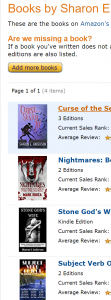
    To do that click on “Books” in the menu options (as seen in the image above). On the next page you will see this:

    screen-shot-2016-12-06-at-3-20-48-pm

    And if you have already added books you will also see a list of your own books. If you have a publisher actively involved in updating the Amazon information for your book, you may want to discuss your using Amazon Central with them first, because changes to sections here may prevent them from making future changes to those particular sections in their own access panel for your book.

    To add a book, click the button and search for it by author or title, if it’s available on Amazon, you will find it quickly (if it’s not available on Amazon then you still need to add it to KDP and/or CreateSpace–and that is another article entirely).

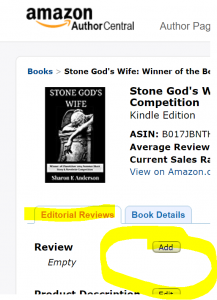
    When your book is listed on the “Books” page of your Author Central you can click the title and access its details. In “Editorial Reviews”  you will find all kinds of goodies to play with!

    You will see something like this:

    screen-shot-2016-12-06-at-3-34-52-pm

    This Review slot is what we are after. You can also add things in the other slots if they are needed, but keep in mind these are the bits that your publisher won’t be able to edit anymore if you change them. (Also you won’t be able to change them over on the KDP side either, so you will always have to come back here to make your changes).

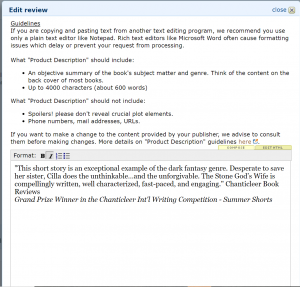
    When you click the “add” button next to Review, a window will pop up to enter the text as well as a detailed set of instructions from Amazon on how format your reviews and their guidelines.

    Choose a good quote from your Chanticleer review, a couple sentences, without too many “…” between snippets (you don’t want it to look pasted together like a ransom letter). Remember less is more. Use words that convey excitement and opinion about your book. Don’t waste your quote on plot description, that’s what your synopsis is for.

    For example: “A riveting adventure…” — Chanticleer Reviews

    Once you’re happy with it, hit preview and save. That’s it. It couldn’t be simpler.

    Quick List of Steps for Adding Your Editorial Review to Amazon

    1. Log in to author central
    2. Go to your Books Page
    3. Click on the title of the book you want to edit
    4. Under Editorial Reviews, click “add” review
    5. Enter an exciting snippet from your review that clearly shows the reviewers opinion about your book and attribute it the Chanticleer Reviews (e.g. – “A riveting adventure…” — Chanticleer Reviews)

    By adding your review you are taking advantage of the authority and reputation that a Chanticleer Review brings with it. You’re showing people that your book was vetted by a respected source within the publishing community. Remember your editorial review is one of the single most valuable tools available to you in persuading readers to take a chance and buy your book. If you don’t use it, you are missing book sales.