
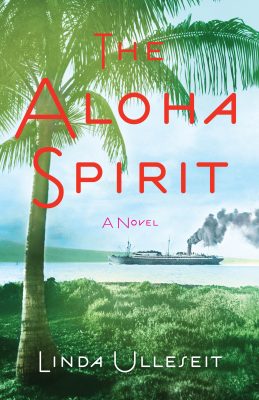
In Linda Ulleseit’s novel The Aloha Spirit, we meet the plucky heroine, Dolores, as her father leaves her.
“Dolores’s father deemed her useless when she was seven. Neither he nor her older brother, Pablo, ever said that, but every detail of their leaving told her so. Papa had tried to explain the Hawaiian custom of hānai to her. All she understood was the giving away, leaving her to live with a family not her own.”
Her story starts in 1922; the place, multiethnic, multilingual Hawaii. Papa, a sugar cane cutter from Spain who worked in Hawaii, decides to take his son Pablo with him to seek his fortune in California. His wife died five years earlier. He leaves 7-year-old Dolores with a large family on Oahu in an arrangement called hānai, an informal adoption. Dolores doesn’t know the family well. She feels abandoned, with no idea when or if her father will send for her or return.
There follow years of drudgery in which she works as an adult, laundering clothes for many people at least six days a week as part of her hānai arrangement. The hard-working couple she lives with struggles to survive. Befriended by Maria, an older hānai girl, Dolores escapes her situation when Maria leaves to marry Peter. Dolores goes to live with them, to help Maria through her pregnancy, and for a while, she gets to share their happy family and have some things of her own.
At age 16, Dolores marries Manolo Medeiros, a boy she met on the beach and barely knows.
She becomes part of his large, extended Portuguese family, which includes Alberto, a nephew four years younger than Dolores. She hopes the Medeiroses will be the family she always wished for. When she met him on the beach, Manolo gave his interpretation of the aloha spirit: “Aloha begins with love.”… “Love yourself first.”… “Love the land.”… “Love the people.”… “Aloha is the joyous sharing of life’s energy.”
Dolores has her first child at age 17. But Manolo’s serious drinking problem, anger, and physical abuse of Dolores estranges him from her and the family, forcing her to take more control of her own life and protect her daughters. As Manolo’s behavior worsens, Alberto steps up to support Dolores, and they fall in love. But as part of a devout Catholic family, Dolores can’t possibly divorce Manolo.
Novelist Ulleseit gives us a vivid picture of the life of a hard-working Hawaiian woman and her community in the early decades of the 20th century.
Anyone interested in the history of Hawaii or in women’s history will enjoy this book. This book centers on abuse, overwork, and alcoholism as major themes, described in a matter-of-fact way. Dolores lives through interesting times, including the bombing of Pearl Harbor and the United States’ entry into the war, rationing, and the removal of Japanese Americans from Hawaii. Dolores goes to California and visits the World’s Fair, so we get to see the fair through her eyes. A glossary at the end of the book provides translations and a pronunciation guide for the many Hawaiian and Spanish words.
Linda Ulleseit was born and raised in Saratoga, California, and taught elementary school in San José. In addition to The Aloha Spirit, she wrote Under the Almond Trees, another historical novel, which takes place in California starting in 1896. She has also written a series of Flying Horse books, young adult fantasy books set in medieval Wales. She has an MFA in writing from Lindenwood University, serves as marketing chair of Women Writing the West, and is a founding member of Paper Lantern Writers.
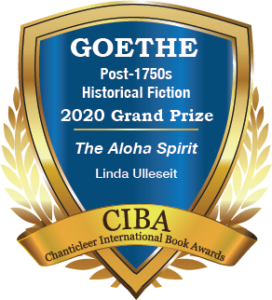
Linda Ulleseit’s The Aloha Spirit won Grand Prize in the 2020 CIBA Goethe Book Awards for post-1750s Historical Novels.