You’re good at deadlines… cutting the right wire under pressure is nothing. You can take down dozens of bad guys with just your wit and some duct tape.
You can certainly make this deadline!
Our new deadline for the 2020 (only) in the CIBA GLOBAL THRILLER Awards is October 31, 2020, at 11:59 p.m.
(*Beware, my friends, for the Global Thriller Awards deadline next year will be one month earlier ~ September 30, 2021! …tick, tick, tick!)
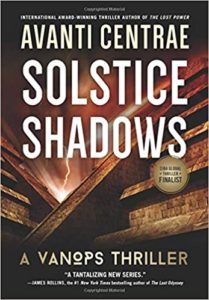
Avanti Centrae pulled the trigger just in time and brought home the CIBA 2019 GRAND PRIZE in GLOBAL THRILLERS Book Awards for SOLSTICE SHADOWS – A VanOps Thriller!
The First in Category Winners for The 2019 Global Thrillers are:
We also had Cybertech Thrillers and Political Thrillers such as John Trudel’sRaven’s Resurrectionand the Raven’s Series.
Here’s your assignment, if you choose to accept it…
Submit your Thrillers in the following categories by October 31, 2020, for a chance to bring home a First in Category WIN the 2020 CIBAs in Global Thrillers – or a Grand Prize – or maybe even the Overall Grand Prize!
In a future Los Angeles, a terrorist group called the Stay Ready Soldiers (SRS) has declared war on seemingly everyone. The city is on the verge of martial law, with political and corporate corruption everywhere in a city all but collapsed. Anti-establishment groups roam L.A. with advanced weaponry virtually matching the powers of the federal government. People in endless numbers, both good guys and bad guys, are blown to bits throughout the novel with the blood and violence found in the most-venal video games. Yet, themes of systemic injustice come to bear in the experiences and emotions of the central cast of characters while facing daunting opposition to their cause.
In a country described by the media in the book as being on the verge of collapse, with issues including unemployment, crime, healthcare, education, immigration, and climate change quickly eroding, viewers are asked to decide whether the SRS is either a force of freedom fighters or domestic terrorists. Which are they? You get a chance to choose as the book opens with a bloody attack on a police unit by two SRS soldiers, Geronimo and Kali, who are as close as a love interest as any two people in the book.
The pair must keep their wits (and guns) about them to cross the dilapidated streets of a neglected stretch of L.A., meeting with allies in the fight for justice and change. They face hired killers and the U.S. government’s agents, as well as crises of faith and the threat of a conspiracy that could overturn their very mission.
A Night in Babylon is full of larger-than-life action scenes in which bullets fly, fires burn, and explosions rock the night. From the beginning of the book, this action sets up the stakes: the Stay Ready Soldiers’ lives hang in the balance of one night, as they hunt and are hunted. The narrative flows in and out, taking the reader smoothly from tense scenes to calm and emotionally intimate ones, and back to the action yet again. There’s time to breathe with this story, but the sense of danger is never far away. The action takes surprising turns within the various firefights, and though sometimes there isn’t enough time spent setting up details that become important later in the scene, the well-paced prose keeps the fights exciting.
The LAPD and U.S. federal agents are the distinct villains, painted as more than just cruel individuals but as part of a massive unjust system that shoves people of color down, especially in cities like Los Angeles. A Night in Babylon shows abuses of power like those that exist in the real world, and even though the action scenes are extravagant, the violence and injustice that drives the SRS are drawn from reality. The story critiques not only how authority reacts to resistance against violence with a heightening of violence, but also how authorities can exploit unstable times and places to expand their power and control over people.
Viewing this novel strictly as violence porn would be a mistake. Woven into it are dystopian themes that are now inescapably part of today’s America taken to extremes. At the same time, it does not shrink from asking questions about the nature of today’s violence. Embedded in the story are questions about the role of corporations in bed with the government. What do we really know, the book asks, about the intertwined interests of politicians and corporations? Questions like these used to be relegated to comic books and/or the Internet’s dark side. With credible news reports on similar issues in today’s headlines in newspapers and on T.V., it is undoubtedly fair games for novels such as this one to take these discussions into literature and let readers decide their relevance.
What is A Night in Babylon ultimately trying to say? Is it entertainment, a political tract, or a warning? The cynicism expressed in this relatively short novel is too blatant to ignore, but it does not seem to cut to the left or the right. In that sense, it is a Rorschach test for readers to determine its point of view. Whichever way readers respond, it’s a book that is hard to ignore.
In this stirring, coming of age saga by J. R. Collins, an old man shares his recollections of a time when the good old life was turning bad in his home region of the Tennessee mountains.
Jebediah, known as Jeb, Collins was born in 1815 in a place known to the local Cherokee Indians as Cho-E-Sto-E, “Land of the Dancing Rabbits.” Owing to their closeness and their many shared needs, the family is, in a sense, adopted by the Cherokees. Jeb’s brother marries a Cherokee girl, and he himself is blessed by a sort of spiritual brotherhood with a Cherokee boy named Wolf who was born the same night as he. The story, a sequel to Collins’ earlier work, The Boy Who Danced with Rabbits, opens in 1827 as Jeb and Wolf, just on the brink of adolescence and able to act in manly ways, go on a hunting expedition. They slaughter a huge wild boar and are enjoying their conquest when renegade Indians enter their camp, demanding to know the whereabouts of a female slave who has run away into the woods. The intrepid lads manage to turn their intruders away and set out on their own to find the woman, after being alerted to her possible location by a panther, known in that part of the world as a “painter” cat. They find her nearly dead. Wolf sets her in a cave known to his people for its healing powers, where a huge bear will remarkably take part in her care before Jeb’s sister Anne can arrive with herbs and other remedies she has learned from her Cherokee relations.
But lurking in the hills at that time are many, even greater dangers, as Jeb and Wolf learn when they encounter two surveyors for the United States Army, even now planning what will someday be called the “Trail of Tears,” driving the indigenous people abruptly, violently, from their spiritual and physical homeland. The reminiscences of Jeb as an old man give hints of that shameful time to come, while he sees his younger self resting rather easily after having helped to save the dying woman who, it evolves, has reason to rejoice at being found by members of Wolf’s tribe.
Collins was raised in the area about which he writes so knowledgeably. He has an ear for the local dialect that runs throughout the narrative, and sensitive awareness of local lore with its powerful undertones of Native American culture and history. His sense of the tight connection between humans – both Irish and Cherokee – and the land they occupy is a dominant theme, along with the deep distrust both have for government men and the miners that have come to strip the area of its store of gold. Many supernatural events also demarcate the story, like the bear’s healing attention on the wounded escapee, and the many etheric visions experienced by Jeb as he realizes he is growing into manhood through his perils and victories.
Those with a love of the old ways – both the real, factual events of America’s early development and the mystical imponderables that infuse the natural world of its native peoples – will savor Collins’ dramatic Choestoe series as thus far conceived, and wait excitedly for the next episode.
Living Where the Rabbits Dance (Choestoe Series, Book 2) won First in Category in the CIBA 2018 LARAMIE Awards for American Literature.
Tornadoes and bomber strikes rival one another in the destruction they leave behind, except that bombers have a predefined target, and tornadoes follow an opportunistic path—one that even experts cannot predict. Len Joy deftly shows what happens when a tornado hits the town of Maple Springs, Missouri, on July 18, 2003.
A vicious whirlwind storm cuts a narrow path of destruction, sometimes turning one side of a street into rubble while leaving the other unscathed. Needless to say, the people of Maple Springs are changed forever in a matter of minutes.
The stage is set with considerable color and evocative language. Joy breathes life into his characters of all walks of life: land developers, car dealers, teachers, police officers, military veterans, a couple of basket weavers, a tattoo artist, and even a former baseball legend turned jukebox restorer. The kind of people you find in small towns. They all know each other and often help each other. But they also hurt one another. They marry, they divorce, or maybe they don’t bother to divorce, and they gossip. Oh yes, they gossip. In Maple Springs, one can certainly see more than a little flavor of “Peyton Place.” That’s life in the ‘small town.’
Dancer Stonemason is trying to manage the jukebox restoration business started by his son Clayton, recently killed in a car accident. Having already lost his wife to cancer, Dancer now lives alone in Clayton’s house. His other son, Jim, owns the successful Stonemason Chevrolet dealership and doesn’t find much time to visit, but does find time enough to sell his brother’s house.
Dancer has to move out—jukeboxes and all, which he is trying to do with the help of a recent Iraq War veteran, Wayne Mesirow, who owns a truck big enough to carry the jukeboxes. No longer living with his wife Anita and their two children, Wayne hopes to join a touring rock group.
Meanwhile, Anita is dating land developer Ted Landis, who bought an 1880s riverboat that is now docked at Landis Landing on the Caledonia River. Having spent a fortune repairing The Spirit of St. Joseph, Landis is throwing a major party, with music by the Confederate Pirates, the group Wayne hopes to join. But as the townspeople head for the river, thunder and lightning erupt, the clouds taking on an eerie yellow cast. The suspense begins to build.
Back in town, the Stonemasons are transforming the Chevy showroom into a ballroom for a reception.
Daughter Kayla is marrying Barry on Monday. With the work almost done, Jim and Paula head home. Minutes later, the wind hits the glass door so hard that Barry can barely close it. He and Kayla head for the parts storeroom, but then hear a banging on the door. People are calling out for help. They return to let a teenage boy and girl in—then go out to help a man and three women reach the showroom.
Barry sees a “swirling white spiral…hovering over the mall like an alien spacecraft…” It “pinballs down Main Street…chewing up the Tastee-Freeze, leaving chunks of concrete, twisted rebar, pickup-stick configurations of aluminum siding…” The huge Stonemason sign is ripped down. Then a car skids into the drainage ditch. Barry and Kayla know they must help the father holding his young son and the mother with an infant in her arms clambering out of the car.
Dancer, at home, is surprised when he calls Russell for dinner, and the dog doesn’t come. He finds Russell perched on a log in the river, which is now a torrent of water. Dancer has to rescue Russell; he’s Clayton’s dog. Held by a rope tied to his belt loops, he slides into the river.
Soon the sun comes out, and the sky is blue once again. The tornado has left town. And this is just the beginning of the book. What happens to the town – and its inhabitants, make this a story you won’t quickly put down. Highly recommended.
Here at Chanticleer, we love Children’s literature! There is just something about a truly well-told story that sparks the imagination of the young – and the young at heart.
So, as we celebrate Children’s Book Week – May 4 – 10, 2020, allow us to bring along a few friends and share with you some really good books.
Did you know that 2020 marks the 96th anniversary of the first edition of the first book The Boxcar Children by Gertrude C. Warner?
It’s true! We titled the Chanticleer International Book Awards (CIBAs) division for middle-grade readers The Gertrude Warner Awards in honor of the author of the well-loved children’s The Boxcar Children Series.
I guess you could say, we’re fans. BIG fans!
We love Gertrude and so many others! Here’s a little list of some of Middle-Grade Children’s authors you probably already know:
Are you interested in seeing how your Middle-Grade book stands up to the competition? Submit them to the Chanticleer International Book Awards and we will choose the best among the entries!
The deadline to submit your book for the Gertrude Warner awards is May 31, 2019. Enter here!
The deadline for 2019 submissions has been extended to June 15, 2019. Grand Prize and First Place Winners for 2019 will be announced on September 5, 2020, at the CIBA Awards Banquet.
Any entries received on or after June 16, 2019, will be entered into the 2020 Gertrude Warner Book Awards.
As our deadline draws near, don’t miss this opportunity to earn the distinction your Middle-Grade Reader deserves! Enter today!
The GERTRUDE WARNER Book Awards is a division of the Chanticleer International Book Awards – the CIBAs.
All Finalists and First Place category winners will be recognized, the first-place winners will be whisked up on stage to receive their custom ribbon and wait to see who among them will take home the Grand Prize. It’s an exciting evening of dinner, networking, and celebrations!
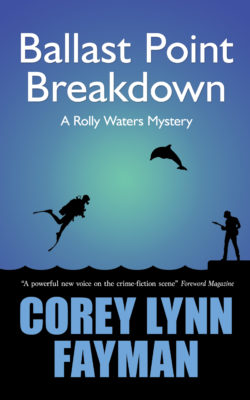
Secrets buried at sea have a grave tendency to resurface in time. The incident happened twenty years ago. A Naval exercise has gone wrong at a rocky point near San Diego. Not just wrong, it was a complete Ballast Point Breakdown. Butch Fleetwood participated in that Naval exercise. He was a rebel. After so many years, Butch Fleetwood is an urgent problem for P.I. Rolly Waters now, even though Butch Fleetwood is dead.
There’s a well-attended party at the San Diego Bay Admirals Club. Guests are enjoying a celebration of the Navy’s top-secret dolphin divers program on the brink of its retirement, and the pending release of the trained dolphins. The sounds of music and conversation fill the air. Then the sound of a motor dominates. A speedboat traveling the Bay approaches fast and crashes the party, right through the frontage windows. Janis Withers crawls out from the explosive blaze, and with her last breath, shouts that Arion has returned.
P.I. Rolly Waters wasn’t at the party, but heard about it from a fellow musician who was playing the gig. Rolly is hired to investigate and soon connects Butch Fleetwood’s dog tags to Janis. He had been one of the first Navy divers working in the secret dolphin program. The local police and the FBI are wary as Rolly uncovers clues about several prominent, and also some shadowy individuals. The Navy is not happy that Rolly is asking questions about Arion. With so much against him, Rolly incurs insults and much worse. He views the abuses as expressions of the other person’s fears. What’s worse are the dire threats he faces. Despite the questions and deterrence from the authorities, this determined musician/P.I. follows the trail to its exciting crescendo.
This is the fourth novel in the Rolly Waters mystery series, and author, Corey Lynn Fayman paints fascinating glimpses into the world of music and into the contrasting world of Navy programs. This book is a refreshing and contemporary remake of the classic P.I. Genre, including a thrilling and diverse group of supporting characters and suspects. The narration is crisp and bold and is part of the driving force that moves the plot forward at a high velocity.
Building suspense into a real page-turner is this author’s forte, and the resolution at the end is nothing short of breathtaking. Rolly Waters reveals that what can be seen on the surface may be a mere reflection of what someone designs. He digs deep to uncover what really happened so long ago. Seeing through the murky water of lies, he finds a wave no one was prepared to ride.
In this imaginative middle-grade reader from Kay Bates, a friendly nomadic beetle gets caught up in a conflict between a city of hospitable mice and the tyranny of rat overlords. Here the amiable insect puts his knowledge and training to good use by joining forces with his murine allies in an all-out effort to bring peace to their domain.
Rug Bug is a blue-bellied, green-shelled hexapod who is injured while trying to get away from the swatting wrath of humans and a feline he’s encountered while flying about The House. To escape, Rug Bug (or, Rug to his friends) slips into a baseboard hole and soon finds himself in the bustling world of Mousetopia. In this miniature anthropomorphized setting, Rug finds help and treatment at the City Health Center, then locates a safe haven at the “Cheeze Wheel,” a local eatery/catering establishment. Here he befriends a motley crew of employees and quickly learns of the long-standing feud between the greater rodent populace led by Fat Rat Bart and his army and how they terrorize Mousetopia and its inhabitants.
With no military forces or means of retaliation, Mousetopians are forced to live under the thumb (or rather a paw) of rat rule. While a monthly acorn & cheese tax holds the city in fear, additional threats from Bart lead the Cheeze Wheel owners and staff to contemplate the liberation of Mousetopia. Using Rug’s past technical training as a member of the fighting Beetle Brigade, plans for a revolution begin. Unfortunately, vermin spies are at large, and Mousetopia experiences a significant defeat. Notorious Bart is not above mouse-napping, which suddenly brings the younger generation into the conflict. Meanwhile, Rug and the adults look for additional reinforcement from outside sources to deal with their plight.
While Bates offers up this engaging rodent utopia by showcasing thematic contrasts of good vs. evil, at its heart, this proves a relatable story with a beautiful medley of furry, long-tailed characters exuding human qualities. Readers experience the likes of a tap-dancing young mouse who marches to his own drum; school bullies who strike within the halls of mouse academia; a pacifist rat soldier who longs for a gentler career; and a down-trodden mouse community choosing to rise above its oppressor.
Using witty footnotes sprinkled throughout the narrative, Bates’ humorous notations readily provide definitions for vocabulary words that may be new to some readers. From a quick-thinking Rug pulling on a cat’s whiskers to release a mouse from its grip to arthropods in training donning fighting-stick helmets that resemble toilet plungers, Bates detailed writing also conjures comical images Middle-Graders will giggle about.
Within this likable story highlighting unexpected friendships, Bates provides a heroic little character who not only finds solace in an unfamiliar kingdom but who also works diligently to bring about peace and harmony in a conflicted world. The lesson behind this rodent revolution reveals charming, authentic, and creative entertainment. An adventure destined to win young readers and those who love them!
The Adventures of Rug Bug: The Revolution won 1st Place in the 2018 CIBAs, in the Gertrude Warner division for Middle-Grade Fiction.
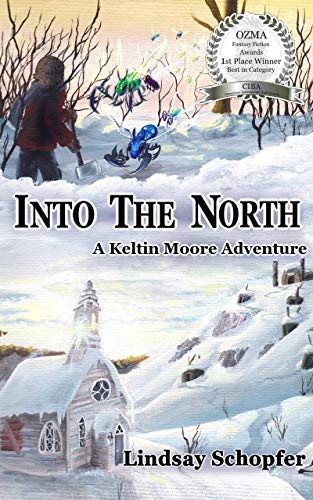
If Jack London had written about hunting fantastic beasts in a fantasy-tinged “Great White North” during a gold rush, instead of real animals in the Klondike, he’d have created a hunter like Keltin Moore and a beast like the Ghost of Lost Tap.
The adventures of Keltin Moore read a lot like London’s best adventure stories, only written as if they were inspired by Larry Correia’s Monster Hunter International series. The combination leads to a chilling story (in more ways than one) about a professional beast hunter and his companions on a quest to make some money and save a town from a beast that no one has survived. Still, everyone has seen the aftermath of its depredations.
They call it the Ghost of Lost Tap because it moves like a ghost. Or something supernatural. And no one has been able to catch it, certainly not the little band of shakedown artists calling themselves the Hunter Guild that has sprung up in the ramshackle boomtown of Lost Tap.
The story focuses on the character of Keltin Moore, the last of a long and storied family of professional beast hunters. Keltin learned his trade at his father’s knee, and like his father, is used to hunting alone. But in his second adventure, he is traveling with an apprentice, young Jaylocke, who needs to learn a trade to earn his place as an adult among his own people.
In Lost Tap, Keltin and Jaylocke band together with old friends that they fought with in the first book of Keltin’s adventures, The Beast Hunter. While they hunt the “Ghost,” Keltin finds himself meditating on the nature of leadership, his need to be alone versus his understanding that he needs others to bring down this unstoppable beast, and his feelings of responsibility to those under his care – and in his heart.
Keltin is a fascinating character. This second installment of the series provides a thought-provoking perspective on his profession, his responsibilities as a leader, and his desire to save people, often from their own mistakes.
At the same time, the world that Keltin inhabits, as much as it will remind readers of London’s tales of the Klondike, is a fantasy world and not London’s historical one. Except for the beasts themselves, with atypical and strangely asymmetric biology, there is little magic in this world or not that is seen in this story.
Beasts are killed with guns, not spells. No matter how unnatural they seem, a bullet to the brain, once Keltin manages to determine where a beast’s brain actually is, kills them just fine. But the places Keltin refers to, and the sentient nonhumans that he meets and befriends, remind the reader that this is a different world with its own history.
While these reminders are not enough to make the reader feel they have missed too much by starting with this second book in the series, they do serve to tease the reader that there are stories yet to be told. We love this adventure/fantasy so much, we happily recommend readers to start with the first book in the series and then move on.
Into the North: A Keltin Moore Adventure by Lindsay Schopfer is such a terrific story on its own that readers will feel compelled to pick up the other stories just to catch up on all the action! Highly recommended.
Into the North: A Keltin Moore Adventure won First Place in the CIBA 2018 OZMA Awards for Fantasy Fiction.
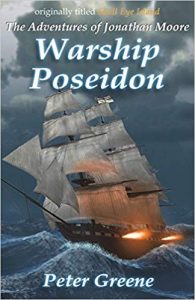
Meet Peter Greene, CIBA Award-Winning author of High-Seas Action Adventure novels that appeals to all ages!
If you’ve ever been to a CAC (Chanticleer Authors Conference), you might recognize author Peter Greene. He’s the one that sits on the outside aisle, quiet and unassuming. Well kids, don’t be fooled! Peter has one of the best imaginations I know of—and there is a reason for his works are award-winning! You’ll just have to read on to discover it yourself!
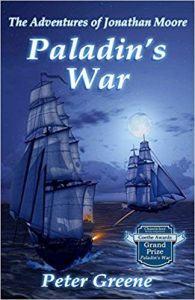
Peter Greene took home the Goethe Book Awards Grand Prize in the 2017 CIBAs for Historical Fiction for Paladin’s War.
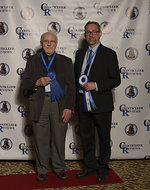
CIBA 2017 Goethe Book Awards Winners Joe Vitovic & Peter Greene
Chanticleer: Tell us a little about yourself: How did you start writing?
Greene: My parents were both prolific storytellers, and they were amazingly descriptive, especially my Father. He would act out the voices and mannerisms of all the people. I learned a lot from trying to outdo them. Then in high school, when I took a creative writing class, my teacher, Mrs. Beem, would just yell out something like “a story with lots of movement” or “use the words ‘freedom’ and ‘cheesecake’ in a short story” and I would just go. The other kids sat and struggled, but I already had a plot, characters, and all that in seconds. She gave me A’s all the way through.
Structure: Pantzer or Plotter?
Chanti: That sounds like a great way to be introduced to storytelling!
So just how structured are you in your writing work?
Greene: Very structured, but only in the process, not in the structure of the piece.
I first list “essentials” – just the essential things I want in the story, in no order, and some may make it in there, some may not. This way I get ideas out of my head before they are lost in the ether!
Then comes some basic research, which is ongoing through the process of course, but I just want to make sure I’m building my fiction on a solid, believable foundation.
I then outline like a madman, very detailed at times, sometimes with partial chapters written out, sometimes with crude drawings! These outlines are dozens of pages long, and I print them and literally wallpaper my office with them! The outline for Paladin’s War covered three walls in my office!
Finally, I start the actual writing, usually in chronological order, but that is a rule I break depending on my mood.
When I’m done, I have my wife read the book out loud to me so I can hear the rough spots-that is critical— I find so much that makes me cringe: from unnatural dialogue to foggy descriptions to just clunky passages. I judge a competition and this is the advice that I tell almost every beginning author who enters the contest.
Then, I send to the editor for evaluation. But all of these steps are ‘writing’ to me. And I love all of it.
Authors Who Have Influenced Your Work
Chanti: That’s a good way to approach your writing! I like the Madman Outliner… sounds like the title of your next book! Name five of your favorite authors and describe how they influence your work.
1) Kurt Vonnegut, mostly his later stuff, like Breakfast of Champions because he became so irreverent after his ‘mainstream’ success. He taught me that style can change, and be ANYTHING as long as it has something valuable to say.
2) Erma Bombeck, again showing that style, if it is true, can let you do anything. I would read her columns, and even though I was about twenty-two years old and a single man in Los Angeles when I discovered her, I identified with her message and I laughed. Her writing seems so effortless! I miss her.
4) David McCullough. This is cliché, but he makes history come alive, and his writing voice (as well as his speaking voice), is so crystal clear. No extra stuff, just the best, most important things are covered in a wonderful manner that intrigues us. He never put his opinion in his works, because he doesn’t have to. History is history, and it is interesting enough.
5) J.R.R. Tolkien because he is the best at everything: plot, character, situation, excitement, humanity, emotion, poetry, prose and adventure. I have read the Silmarillion at least ten times and Lord of Rings each year since I was fourteen. I am always amazed at the scope of his stories, and the languages – truly amazing. I have learned from him that no matter how good I think I can be at times, I am no master. He is the true master. I would never try epic fantasy because the bar has been raised so high.
About Dialogue
Chanti: Great insights – and choices! You’ve given us something to chew on. What areas in your writing are you most confident in? What advice would you give someone who is struggling in that area?
Greene: Dialogue is pretty easy and natural for me, maybe because of my theatre training. As far as advice for others who struggle with dialogue, I’d say this: if you are always looking for a witty, snappy, clever, smart ways for your characters to speak, STOP! It will all come out cliché, and no one talks in clichés. It will read like an episode of some seventies, low-budget television series. J.D. Barker said at the last CAC19 that he sits in a Starbucks, has a cup of coffee and listens to what the people around him say, and he types it into his laptop! That is brilliant. It’s natural. I tried it. It was a blast!
JD Barker presented at CAC19!
Expanding Readership and Promoting Literacy
Chanti: Ah, that’s my favorite thing to do! What do you do in your community to improve/promote literacy?
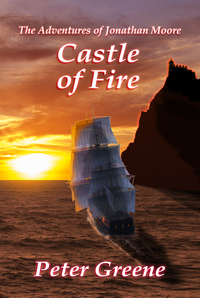
Greene: For the Adventures of Jonathan Moore series, I specifically targeted YA readers. I consciously write each book to graduate the reader from the fourth-fifth grade reading level with Warship Poseidon, to the sixth-seventh grade level with Castle of Fire, then Paladin’s War finishes on the ninth-tenth grade level. If a youngster reads all three, he jumps several reading levels! I also donate books to schools and libraries in the area and have done a few talks to writing classes.
Honestly, my book reviews from Chanticleer after my winning the Goethe award in 2018 and the (Chanticleer) review of Paladin’s War exploded my sales. I increased my sales by over 400%, so that worked for me! – Peter Greene
Marketing and Sales Tips
Chanti: That’s awesome! So, you give away books and present writing classes, what else do you do to market your books? What’s worked to sell more books, gain notoriety, and expand your literary footprint?
Greene: I don’t do enough, but when I learn something, I do it. I enter contests that are legit. Advertising can work, it just depends on finding what works for you. Honestly, my book reviews from Chanticleer after my winning the Goethe award in 2018 and the (Chanticleer) review of Paladin’s War exploded my sales. I increased my sales by over 400%, so that worked for me! You just have to try everything, meet people, and spread the word – without saying “Hey, I wrote this great book, you should read it.” Let others speak for you, and most of all, let your writing speak for you.
Let others speak for you, and most of all, let your writing speak for you. – Peter Greene
How do you separate your books in a crowded marketplace?
Chanti: That is incredible! I love that – especially how Chanticleer Reviews helped to boost your book sales by 400%! I think we need that on a t-shirt…
What is different about your series from other YA books out there?
Greene: Two things: I avoided all magic, superpowers and paranormal material. That’s all fun – but there is too much of it out there already. None of us will ever discover we have wizards or Olympians for parents or have a mystical ability. For this series, I wanted to point out that real heroes do exist, and they have throughout history.
I also decided to take it easy on the terminology and more unsavory aspects of life at sea. I’ve always loved the classic sea stories in Stevenson’s Treasure Island, Forester’s Horatio Hornblower, and O’Brian’sJack Aubrey series, but I couldn’t help thinking that for most of us, unless one had supporting texts and companion guides to get through all the jargon and technicalities, one could easily become lost-and maybe surrender to something easier to read. That would be too bad. And the things you do really need to know, well, wouldn’t it be best to learn that along with the characters? The ones that started out as land-lubbers just like you and your kids?
The Adventures of Jonathan Moore books are about one would-be hero and his friends who try to succeed using only their courage, their wits and industry alone – no magic necessary. And though I will never fill the shoes of Stevenson, Forester or O’Brian, I can attempt to follow in their footsteps.
Chanticleer: That’s great! But you never know…you may be the one to fill their shoes if “Adventures of Jonathan Moore” are any indication!
Now we would really do need to know a little bit more about when did you realize you that you were an author?
Greene: I got my degree in Theatre from Illinois State, and a playwriting professor said I had a “knack for dialogue and physical humor.” That made me continue writing. I wrote screenplays after college, and a studio exec at 20th Century Fox pulled me aside and said “you really can write, keep it up” – then years later, my first novel, Warship Poseidon won the Adventure Writers Competition’s Grandmaster award, and Clive and Dirk Cussler chose the winner. When Clive announced my name, he said “I read your book, you know. Beautifully written.” THAT made me think that maybe I have a little writing ability. So when I write, I always think “maybe Clive and Dirk will read this so it better be my best effort.”
Editor’s Note: Clive Cussler’s books have been published in more than 40 languages in more than 100 countries. They are New York Timesand international bestsellers. He has written 17 books in a row that reached the New York Times’ fiction best selling list. He is of a select group of authors to achieve this status. Cussler has also published more than 50 novels—quite the back list that keeps him on the list of richest authors in the world.
Chanticleer: Holy Moley, man! That’s Clive & Dirk Cussler! I can’t… I just need a moment… Okay then, what led you to write what you write?
Greene: I write a lot of different stuff in different genres, because, why not? The Adventures of Jonathan Moore series is YA historical fiction, and it all happened by accident. One night, as I was putting my children to bed, I realized that I was tired of reading the books available on our bookshelf. Knowing they were crazy about the Pirates of the Caribbean movie, I just said, “Tonight I’m going to tell you a story about twelve-year-old Jonathan Moore who lived in a dark and filthy alley, and how he ended up a hero on a tall sailing ship.” I kept telling a little bit each night, making it up as I went. My wife, who was listening to the stories each night, suggested that I write it as a novel. Ten years later I have three books in the series!
Chanti: And so the magic began… How do you come up with your ideas for a story?
Greene: Good question! Usually, something just clicks that I observe or realize, and off I go. For example, I was thinking about hidden social casts in America and I thought “Wow. People don’t see it, do they?” So BAM! This Sci-Fi idea hits me for a novel, the characters came quickly and then a plot and now the outline is almost finished. I’m starting it now. It’s a strong female character who uses history and propaganda to, well, you will have to read it!
Chanti: A SciFi novel! We can’t wait to read it! Are you going to enter it into the Cynus Book Awards?
Greene: Definitely!
Chanti: Thank you, Peter Greene with an “e,” and we look forward to seeing you at CAC20!
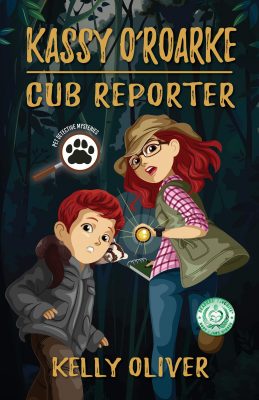
In this first installment from the new Kassy O’Roarke Pet Detective Series, award-winning author Kelly Oliver delivers a fun and engaging kid-friendly literary experience. Here is a story intended for middle-graders, Cub Reporter proves a quality blend of adventure and mystery involving a smart, inquisitive 12-year old with aspirations of becoming a spy.
As a reporter for her school paper, Kassy’s hoping to nab a front-page scoop and win the honorable Thompson Award for Journalism. Unfortunately, help from her pesky, but the well-intentioned younger brother, sets in motion a roller coaster of calamities she never expected. From animal-nappings and a mixed-bag of clues to car chases and rescues from entrapment, ultimately the constant reinforcement from family, friends, and a menagerie of furry companions bring positive lessons to the forefront of this likable tale.
Kassy O’Roarke and her brother Percy, aka “Crispy,” live with their veterinarian mom in the Lemontree Heights Community. Mom runs an animal clinic, along with a petting zoo. The father has moved out and is living 10 minutes away in Nashville with his new family. Since his parents’ separation, Percy has developed a penchant for talking to the animals. The wacky ensemble includes a variety of rescued creatures, including a circus camel named Spitoon, Chewbacca the lab chimp, an anteater dubbed Athena, and Percy’s ever-present sidekick, a flatulent ferret named Freddie who likes to steal keys.
When the 3-month old cougar cub, Apollo, goes missing, Kassy’s determined to find him before he’s captured by the local animal control officer, Pinkerton Killjoy. Mean-spirited “Pinky” seems determined to shut down the family’s petting zoo.
Oliver creates a quirky and endearing character in young Kassy and tells the story from her perspective. With her tendency to overthink everything, the studious bespectacled loner gravitates to books, reads the dictionary to expand her vocabulary, and astutely realizes her strengths when she comments, “No one can take away the stuff in my head. My brain is my secret weapon.” The pre-teen detective wannabe also tends to keep a well-stocked pocketed “spy vest” on hand, complete with various accouterments of the trade.
Within a modern-day framework, Kassy is a sensitive and vulnerable individual who worries about her mom, longs for her dad’s love and approval, and is always willing to take risks (even at the chance of being grounded for a year) to garner the greater good. Kassy is surrounded by a vibrant and colorful cast of characters, including future stepsiblings, classmates, and neighborhood locals that help fuse the story with themes of friendship, loyalty, and honor.
The frantic search for Apollo keeps the action moving at a steady, well-conceived pace. Smart questions and a trail of riddles will draw readers into the investigative mode, while details that hinder Kassy’s probe, (from wild thunderstorms, gushing rivers, and blocked exits, to nosy receptionists, a cacophony of barking dogs, and conflict with Killjoy) all lead to twists and turns and a heightened rush of adrenaline.
While pawprints form a corner framework on chapter title pages, a scattering of black & white illustrations provides a quick artistic reference for happenings throughout the narrative. The drawings are essential, and easily capture the intended humor, whether in the antics of undie-clad animals at a birthday party, or the central heroine dowsing a mustachioed villain with glue. Oliver continues to render this strong sense of middle-grade humor with the lively and conversational dialogue where unlikeable characters are labeled as “deviled eggs,” and expletives of frustration are shouted in G-rated profanities of the “Shrimp and grits!” variety.
Amidst popular classics like Emil and the Detectives and the resurgence of the Nancy Drew mysteries, Oliver has hit the mark with this bright and entertaining series opener. Though geared toward a younger audience, readers of all ages can look forward to more investigative capers on the horizon featuring the creative escapades of Kassy and company. Highly recommended!


 It’s come down to this…




 In this stirring, coming of age saga by J. R. Collins, an old man shares his recollections of a time when the good old life was turning bad in his home region of the Tennessee mountains.










 Secrets buried at sea have a grave tendency to resurface in time. The incident happened twenty years ago. A Naval exercise has gone wrong at a rocky point near San Diego. Not just wrong, it was a complete Ballast Point Breakdown. Butch Fleetwood participated in that Naval exercise. He was a rebel. After so many years, Butch Fleetwood is an urgent problem for P.I. Rolly Waters now, even though Butch Fleetwood is dead.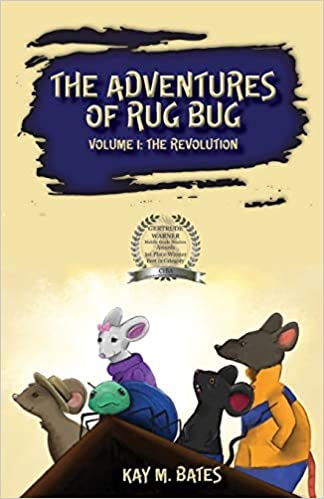
 If Jack London had written about hunting fantastic beasts in a fantasy-tinged “Great White North” during a gold rush, instead of real animals in the Klondike, he’d have created a hunter like Keltin Moore and a beast like the Ghost of Lost Tap.



 In this first installment from the new Kassy O’Roarke Pet Detective Series, award-winning author Kelly Oliver delivers a fun and engaging kid-friendly literary experience. Here is a story intended for middle-graders, Cub Reporter proves a quality blend of adventure and mystery involving a smart, inquisitive 12-year old with aspirations of becoming a spy.