Tag: A.M. Linden

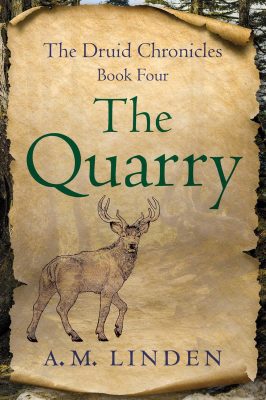
  • THE QUARRY: The Druid Chronicles Book 4 by A.M. Linden – Historical Fiction, Brittania, Druids


    Druids struggle to evade Christian persecution in A.M. Linden’s The Quarry, Book Four in the Druid Chronicles, a fast-paced adventure through medieval Brittania.

    Although dwindling in number and hunted by Christians who fear their pagan rituals, Druids still roam the land. Linden explores these oppressed people and their belief system, one that approaches life and conflict with reason and attempts to find a peaceful resolution—a novel idea during this historical time.

    The High Priestess Feywn’s health is failing. Our hero, Druid priest Caelym, does everything in his power to save her so she can pass on her vital role in their religion.

    The necessary ritual takes time and specific ingredients. As he hunts for those sacred herbs, he is captured by the local sheriff whose second in command, the fanatic Christian Matthew, only wants Caelym’s death.

    Cyri, the young Druid woman who would become the next High Priestess, goes in search of Caelym but finds only his bag, weapon, and clothes. Fearing him kidnapped, Cyri journeys to save him in a hunt or be hunted Dark Age. Each step puts Cyri’s and Caelym’s survival into question.

    Linden peoples this story with characters from across her series whose roles stand clear and meaningful—including the villains.

    Stefan, the Saxon warrior recently appointed sheriff of the Shire of Codswallow, weighs two problems against one another. His wife’s uncle wants to marry her—over Stefan’s dead body. And Stefan has just run into a wanted Druid who might prove useful.

    The different POVs create unpredictable and entertaining twists, as Stefen captures Caelym on his way to an inn where he hopes to receive a hearty lunch and a roll in the hay with Cyri, who he believes to be a barmaid. Little does Stefan know Cyri’s connection to Caelym’s mistress Feywn.

    Stefan first wants Caelym simply for his value as a hostage, but recognizes his talent as a gifted musician and storyteller, and refuses to give in to Matthew’s murderous desire. When an attempt is made on Stefan’s life, his understanding of his place in the world is shaken to its core, and only Caelym can give him the perspective and advice he needs—both to save himself and plot revenge.

    For lovers of historical fiction, Celtic and Druidic literature, and classic fantasy like Tolkien’s Lord of the Rings, the story of Stefan, Caelym, and Cyri in The Quarry will cast an enrapturing spell, making them fall in love with Linden’s characters, both heroic and villainous, and appreciate these ancient pagan ways.

    Linden’s masterful storytelling in The Quarry stands wonderfully on its own and as continuation of the Druid Chronicles, leaving new readers excited to finish the whole series.


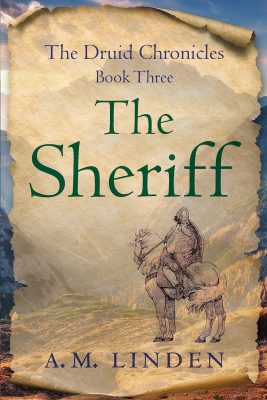
  • THE SHERIFF: Book Three of The Druid Chronicles by A.M. Linden – Historical Fiction, Medieval England, Mystery


    The Sheriff, the third installment of A.M. Linden’s Druid Chronicles series about 9th-century life in Anglo-Saxon England, fully immerses readers in that distant era with all of its joys, conflicts, and hardships.

    Trained from his youngest years in the military, Stefan has learned both battle skills and leadership, with the ability to approach a situation without causing it to get out of hand. He is fiercely loyal, but continually denied a larger role in the kingdom’s army. His latest indignity came with the king assigning him as sheriff of Codswallow, a paltry village. With a retinue of less than 10 people including his slave, he has to collect taxes and keep the peace.

    The novel shows two major episodes. The first follows his Codswallow days, including his relationship with Jonathan, owner of the Three Dragons Inn. Stefan learns that Jonathan is paying protection money to keep bandits away from the inn, and carries out a series of plans to discover who is, what we could call, the crime boss.

    But Stefan stirs up yet more trouble in Codswallow.

    A Druid priestess and her niece, relatives of Jonathan, take refuge in the Three Dragons Inn after their sacred shrine is discovered. The niece may actually be Jonathan’s child by his marriage to the queen’s sister, and things get complicated when Stefan, unhappily married with three children of his own, sets his eyes on her.

    Before he can act on his romantic impulse, Stefan is summoned to track down a princess who went missing on the day she became betrothed to the ruler of a neighboring kingdom, possibly being abducted by that king’s enemies, or even killed. The possibility that she ran away to avoid being wed to the notoriously cruel king, was barely a consideration. It would take a person of Stefan’s many skills to find her and reunite her with her king, whether she wanted to or not.

    Overall, The Sheriff is a well-rounded character study of Stefan himself.

    We see him as a child, and when his warm family is torn apart by a searing dispute between him and his father. He is apprenticed to the military and is trained by Matthew, a devout Christian who sees in the youth the makings of a leader, later becoming his most loyal soldier.

    Stefan shows his disappointment in the king not assigning him to the post that he deserves, but he handles trouble effectively, diffusing potential conflicts and becoming a careful investigator. He doesn’t reflect on himself, instead focusing on the problems of those around him.

    This book takes time to fully establish the world and people of its stories.

    Of the large cast, many characters have detailed backgrounds, some connected to previous books in the series. Thankfully, a detailed character glossary makes it easy to keep up with everyone.

    The Sheriff succeeds most in its feel of authenticity.

    While life in early England cannot be fully known, The Sheriff gives the reader enough granularity to help them imagine what it would be like to live there. It isn’t about the battles that often dominate history, but rather the regular people who could be our family, friends, and neighbors even though they exist in a time so far gone.

    Readers who enjoy being taken away to the distant past, feeling as though they could breathe the air of something different from what they know, will find The Sheriff a fascinating and satisfying read.


    Chanticleer Book Reviews 4 star silver foil book sticker


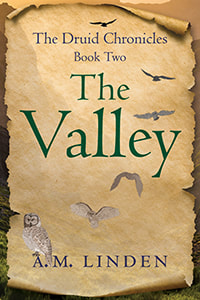
  • The VALLEY (The Druid Chronicles Book Two) by A.M. Linden – Medieval Historical Fiction, Alternate Religions Historical Fiction, Ancient Civilizations Historical Fiction

    Herrwn, Chief Priest of a secret Druid community, has spent his entire, privileged life in Llwddawanden, a secluded valley kept separate from the spread of Christianity from both Saxon and Celt alike, in A.M. Linden’s The Valley (The Druid Chronicles, Book Two).

    Nonbelievers of the Great Mother Goddess threaten inevitable persecution. But Herrwn has maintained the traditional practices passed to him by his own father. As an orator in charge of repeating the legends and beliefs of his people, he knows the importance and the heavy responsibility required by his sacred office. With the decrease in believers outside of the valley, he understands the precarious position of the community and the difficult balance he must maintain.

    Over the course of his long life, he has come to rely on his cousins, Olyrrwd (Chief Healer) and Ossiam (Chief Oracle). Still, as the years pass, his loyalties become torn when what starts as simple gibes between the two priests morphs into unspoken fear of what the other might do to gain favor with the various priestesses chosen as the Goddess Incarnate. Having lost his beloved wife and young child, Herrwn grows closer to Olyrrwd and becomes the peacekeeper between the priests to keep what remaining family he has left.

    When a promising young man, Caelym, the son of a former Goddess Incarnate, becomes the sole priest-in-training, the cousins further divide on the right course of action for the clan. At each turn, dissension and sedition threaten every belief and tradition that holds the people together, and Herrwn will have to make decisions that could change the course of his community forever.

    One notable strength of this prequel lies in Linden’s character development.

    Herrwn becomes real as his life story unfolds. The tragic loss of both Lothwen, his consort, and Lillywen, his young daughter, forge him into a contemplative and thoughtful character. The reader will feel his grief through his shared memories of their time together and the depth of the love that ran deep enough to keep him from ever becoming the consort of any other woman nor the father of any more children.

    The remembrance of his doting and proud father’s advice and the love of a mother long gone will resonate with readers. We witness his strength and forethought as he tries to soothe the growing tensions and tread the choppy waters of change surging through his once-tranquil life. However, Herrwn is only one of many such characters so well developed that they seem to leap from the pages into real life.

    Olyrrwd, the physician combining herbal and ritual healing, is another such character.

    His charm and humor will make him a reader-favorite with his sarcastic, albeit pithy comments. As the novel continues, the two become closer than just their familial bonds of cousins. Each is a sounding board for the other, and their relationship is reminiscent of that one friend every person has–the one who understands without words and knows us better than we know ourselves.

    However, the mixture isn’t complete without a bit of chaos, and that is where their cousin Ossiam takes the stage.

    The reader will love to hate him as much as Olyrrwd does in that classic villain way, second-guessing his every move and questioning his every motive. With his charismatic control over the young Goddess Incarnate and his scheming to gain more than her favor, he is a perfect catalyst to the majority of the boat-rocking that disturbs both cousins’ lives. This collision of values causes Herrwn’s peacemaker qualities to emerge.

    The ongoing battles between Olyrrwd and Ossiam create a palatable tension and serve to drive the force within the plot itself. It also reminds the reader that although millennia separate Herrwn, Ossiam, and Olyrrwd from the modern world, people are essentially the same. Fear, anger, love, hate–the emotions that make us human are the same as those of every human, creating a surprising connection to these pagan Druids.

    A theme within this frame story prequel revolves around change and its impact on human relationships and cultures.

    Right from the start, the Druid clan fights a dramatic shift within the Saxon kingdoms surrounding their valley. Set during the spread of Christianity and the turning away from pagan gods and goddesses, the sacred shrines and villages retreated into an even more secluded region.

    For many years, their isolation kept away the influences brought by Roman occupation; however, as more and more Saxons converted, the worshipers of the Mother Goddess began to follow suit, including members of Herrwn’s own family. Believers begin to defect and lose faith.

    For a Chief Priest set to educate future priests to pass on their very heritage, these changes literally show the end of an ancient religion. He must watch the foundation of his life shift and begin to crumble.

    Every choice and every thought is consumed with rituals that are fast becoming meaningless. Reconciling–much less accepting–these changes will cost Herrwn more than a sleepless night. Not only is the clan facing a loss of faith, but the mature priest must also learn to live with a younger generation that seems to disregard many of the traditions he is fighting so hard to save.

    From a Goddess Incarnate chosen for her beauty rather than wisdom to her blood-thirsty consort challenging better trained and better equipped Saxon enemies, the generation set to lead poses a change to the somber, thoughtful people of Herrwn’s youth.

    With the attention to detail, explanation of ancient rituals, and the mythology within the clan’s legends, this novel builds a community, exploring a people about which little is actually known. It’s an extraordinary portrayal, breathing life into a long-dead civilization. Readers feel Herrwn struggle as he endeavors to keep a secret Druid community alive, fracturing from within, persecuted from without by the spreading Christian church. Highly recommended!



    5 Stars! Best Book Chanticleer Book Reviews