Category: Writing Craft

  • How to Write a Potent Action Scene by Jessica Page Morrell – Writing Craft Series

    How to Write a Potent Action Scene by Jessica Page Morrell – Writing Craft Series

    [fusion_builder_container hundred_percent=”no” equal_height_columns=”no” menu_anchor=”” hide_on_mobile=”small-visibility,medium-visibility,large-visibility” class=”” id=”” background_color=”” background_image=”” background_position=”center center” background_repeat=”no-repeat” fade=”no” background_parallax=”none” parallax_speed=”0.3″ video_mp4=”” video_webm=”” video_ogv=”” video_url=”” video_aspect_ratio=”16:9″ video_loop=”yes” video_mute=”yes” overlay_color=”” video_preview_image=”” border_size=”” border_color=”” border_style=”solid” padding_top=”” padding_bottom=”” padding_left=”” padding_right=””][fusion_builder_row][fusion_builder_column type=”1_1″ layout=”1_1″ background_position=”left top” background_color=”” border_size=”” border_color=”” border_style=”solid” border_position=”all” spacing=”yes” background_image=”” background_repeat=”no-repeat” padding_top=”” padding_right=”” padding_bottom=”” padding_left=”” margin_top=”0px” margin_bottom=”0px” class=”” id=”” animation_type=”” animation_speed=”0.3″ animation_direction=”left” hide_on_mobile=”small-visibility,medium-visibility,large-visibility” center_content=”no” last=”no” min_height=”” hover_type=”none” link=””][fusion_text]

    Action is eloquence. William Shakespeare, Coriolanus

    There are a few techniques it seems like I’m always passing on to my clients: amp up your verbs; use language and details to create more tension, and force scenes to rise. By ‘rise’ I mean writers need to thrust the drama level to a crisis, a confrontation, an explosion. Because in most scenes you’re aiming for the worst outcome.

    Components of an Action Scene

    Characters The main players in the scene with their key traits visible & engaged. Secondary characters need a reason for being.
    Setting The time, place and context in which the scene takes place. The setting is not just a backdrop; stage action scenes for maximum wattage.
    Scene Driver:  The inciting event/change/stimulus/threat.

    The event/stimulus/threat that starts the action rolling in the scene (action can be precipitated before the scene begins)

    Internal response

    External response


    How the main characters react emotionally to actions, threat, choice. How the main characters react physically–dialogue, movement, escape confrontation, fisticuffs. Typically there is a second driver (event or response)that starts the action.
    Goal What the main character decides to do as a reaction to the inciting event or threat.
    Consequence How the main character struggles to accomplish the goal.
    Resolution How the scene goal turns out–win, lose, draw, escape, disaster.
    • Three words to write by—cause and effect.
    • Action scenes are high stakes.
    • The action needs to build to a full boil crisis.
    • Whenever possible structure action scenes with a midpoint which is also a reversal.
    • Use all your tools to create a character’s emotional responses including, subtext, posture, facial expressions, gestures, mannerisms, eye movements, and voice quality. Voice includes pitch, the rate of speech (does the character talk fast when nervous?), and intonation.
    • As you write, imagine you’re holding a camera catching the action blow-by-blow.
    • With intense action, use short sentences to pick up the pace. Action scenes usually have a minimal amount of description unless it contributes to the scene. The scent of blood. The sound of a gun cocking, or the creak of a floorboard. This is not the place for describing the scenery or the characters.
    • Action scenes feature choppy and incomplete sentences. Such as, “What was that noise?” “What the . . .”
    • If the setting is complex and the action intricate, sketch out a map. Place coins or placeholders to mark your players, define the sight lines, scene’s boundaries (how far can a character reach?), and how long it might take to walk, run (or sneak) from point A to point B.
    • If the action is complicated, ask friends or family members to act it out so you can verify the sequence and reactions.
    • Read your dialogue out loud.
    • Use simple past tense verbs such as “kicked” or “punched” rather than those pesky ‘ing’ participles such as “kicking” or “punching.”
    • Your protagonist has skills, strengths, and weaknesses you can exploit and showcase. Foreshadow those traits throughout the story so when the reader reaches the action scene, he is expecting complications and credibility.
    • Scenes are never random events—they all need a logical connection to the storyline and to create ramifications.
    • Pay special attention to endings—they need weight, potency, and to reveal consequences.
    • Pacing is key but should be controlled by the scenes that come before and after. These will typically be slower to set up and react to the fight/conflict.
    • When writing fight scenes or violence, pack these scenes with an emotional punch too.
    • Read screenplays to digest the moment-to-moment breakdowns.
    • When you watch films study the reaction shots.
    • Some emotions in an action scene will be brief or fleeting.
    • When a gunshot is fired nobody has time to think. However, the body’s chemistry shifts to handle lethal threats, allowing the brain to process far more information in a shorter period of time.
    • Keep in mind that action scenes happen at several levels and much of the fight needs to be about internal changes, the inner world of the protagonist.
    • During revisions fine tune character’s emotional reactions so they’re unique, fresh, and individual. This aspect of revision can be difficult, but it is crucial.
    • Make certain you can justify carnage and bloodshed.
    • Don’t bog down the sequence with too much technical description. Show who has the upper hand, rack up the tension to the nines and tap into the motivations of the character readers root for. And if someone gets punched or shot or knocked to the ground, readers should feel it too.
    • Utilize all the senses and never rely solely on the physical description.

    The next article from Jessica Page Morrell will include an example of screenplay action from Air Force One by Andrew Marlowe.

    Jessica Page Morrell is a top-tier developmental editor and a contributor to Writer’s Digest magazine,  and she teaches Master Writing Craft Classes at the Chanticleer Authors Conference that is held annually.

    Jessica Page Morrell
    Jessica Page Morrell

    Jessica understands both sides of the editorial desk–as a highly-sought after content development editor and an author. Her work also appears in multiple anthologies and The Writer and Writer’s Digest magazines.  She is known for explaining the hows and whys of what makes for excellent writing and for sharing very clear examples that examines the technical aspects of writing that emphases layering and subtext. Her books on writing craft are considered “a must have” for any serious writer’s toolkit. For links for her writing craft books, please click on her above. 

    Chanticleer Reviews and OnWord Talks will interview Jessica for more of her writing tips and advice. Stay tuned! ~ Chanticleer

    We are planning a writing craft workshop soon that will be taught by Jessica.[/fusion_text][/fusion_builder_column][/fusion_builder_row][/fusion_builder_container]

  • Synopsis Writing Tools Checklist by Jessica Page Morrell

    Synopsis Writing Tools Checklist by Jessica Page Morrell

    Jessica Page Morrell
    Jessica Page Morrell

    SYNOPSIS Tools Checklist by Jessica Page Morrell  Part 2 of a Two-Part Blog Post

    Jessica is a top-tier developmental editor. Jessica is teaching the Master Writing Classes at the Chanticleer Authors Conference on Sunday, April 22, 2018. 

    Here is the second half of a two-part series on How to Write a Synopsis. The first Synopsispart deals with synopsis development and the second part will discuss the mechanics of a synopsis.

    Here is the link to Part 1:

    Part 1 of Jessica Page Morrell’s Writer’s  Toolkit series on How to Write a Synopsis

    A quick recap of Part One: 

    A Synopsis Is:

    • Part Bare Bones  Story Recap (but not too bare)
    • Part Pitch
    • Part Illustration of Your Writing Style

    Every sentence matters and pushes your story forward. 

    Typically a synopsis completes a sales package that includes your first three chapters and sometimes a letter of introduction. Since at times editors read the synopsis first, it must be comprehensive, comprehensible, and compelling, forcing them to then peruse your chapters. Hopefully, your synopsis will be read not only by an agent and editor but if it passes muster, the marketing and art department will read it too. A synopsis will also be used in the publishing house meetings where decisions are made about what titles will be published in an upcoming season.

    SYNOPSIS CHECKLIST 

    A synopsis is written in the same order as the novel and is written in the style and tone of the manuscript—a witty, fast-paced novel requires a witty, fast-paced synopsis. If the story is literary, your synopsis will be more serious, but keep in mind that your dazzling prose goes into the manuscript, not the synopsis. Don’t leave major questions unanswered such as who killed the victim, as well as how Malcolm solves his internal conflict, and how the subplot was resolved after he lost his job when he was arrested. A synopsis keeps the reader’s interest, but it’s not a tease and is not written with cliffhangers and such devices. It’s particularly important to demonstrate that your ending provides a satisfying conclusion to the plot and ties up loose ends.

    A synopsis demonstrates that your characters are in jeopardy and what is at stake and why this matters. It introduces your main characters and their conflicts and agendas. It is not a list of characters or character sketches, and it usually does not describe physical attributes of characters, although the main characters are given some sort of tag. For example, you might want to refer to a character as the leading citizen in a small Southern town, or a respected doctor or frustrated novelist. Antagonists are always introduced, but secondary characters are mentioned only if they are involved with the protagonist’s inner or outer conflict.  A synopsis is also written with a careful attention to flow—ideas follow each other logically and one paragraph leads to the next. This means that transitions will be important in connecting the dots.

    Is or Does Your Synopsis Questions:

    • Is it reflective of a thoughtful writer at work?
    • Is it reflective of the mood and tone of the manuscript submitted?
    • Does it portray an enthralling story?
    • Does it highlight a gripping main conflict?
    • Does it highlight the intriguing motivations of the main players?
    • Does it lead the reader logically from inciting incident to end with:
      • major plot points along the way?
      • turning points along the way?
    • Does it provide a satisfying conclusion to the plot and ties up loose ends?
    • Does it connect the dots and progress logically?

    Mechanics

    • Write the synopsis in the present tense
    • The first time you introduce a character, type his or her name in ALL CAPS
    • The synopsis should be written in the same order as the novel
    • The synopsis should be written in the same style, tone, and pace of the manuscript

    HEADER  PAGE should be single-line spaced

    • On the first page in the upper-right hand corner write Synopsis
    • The next line should state the type of Genre
    • The next line should state the Word Count
    • The left-hand margin first line should state your name followed by your contact information (digital, voice, and delivery address)
    • Do not number your first page

    TITLE PAGE 

    Don’t number your first page, but scroll down to about one-third of the page and center your title in ALL CAPS. Then leave four lines after the title and begin with your hook. 

    BODY of MANUSCRIPT FORMATTING

    • Use 1-inch margins
    • Do not justify the right margin
    • After the first page use a header (or slug line) on the upper left-hand corner that looks like this: MORRELL/DOOMED FOR DEATH/Synopsis
    • The page number goes on the same line as the header
    • Do not use fancy fonts
    • Remember that you are summarizing, not copying
    • Begin a new paragraph if you are introducing a new scene or plot twist
    • You may want to note one or two short dialogue exchanges to illustrate a point
    • Rule of thumb for spacing: over two-pages, double-spaced is preferred; if it’s one or two pages, single space

    LENGTH 

    Since most agents and editors are notoriously pressed for time and read so much for their jobs, the five-page synopsis is appreciated by most. However, in the past, the wisdom about length went like this: one double-spaced page of synopsis for each 10,000 manuscript words. If you wrote an 80,000-word manuscript you’d write an 8-page synopsis.


    Finally, here’s a checklist that you might want to use to verify that you’ve covered all these points:


    • Have you printed it out and then edited it for spelling, grammar and punctuation mistakes?
    • Does the opening paragraph contain a hook that raises a question and forces the reader to keep reading?
    • Does the synopsis prove that the story is based around a single, dramatic question?
    • Have you shown the protagonist taking charge of events, making choices and decisions, but also stumbling and dealing with internal conflict?
    • Have you introduced your main characters and defined their conflicts, desires, and motivations? Are the protagonist’s dominant traits demonstrated?
    • Have you covered the major scenes and plot points?
    • Are reversals, twists, and surprises depicted?
    • Is the setting and timeframe of the story clear?
    • Does the synopsis include the places in the story where the protagonist changes? If your characters are changing, are you briefly explaining why?
    • Have you shown the protagonist’s darkest moment that comes near the end of the story? Does he or she hit bottom or is there a moment of truth? Are emotional or internal changes evident during this dark moment?
    • Is the ending revealed and does it clarify how the main conflicts are resolved? Have you briefly explain what the protagonist has won or lost?

    Resources:   Jack and Glenda Neff and Don Prues, authors of Formatting & Submitting Your Manuscript, suggest double spacing. 

    LINKS and other INFO

    Instructional and Insightful Books by Jessica Page Morrell to add to your Writer’s Toolkit. Click here. 

    Click here if you would like more information about Jessica Morrell’s Master Writing Classes that will be held on Sunday, April 22, 2018, Bellingham, Wash.

    Click here for information about the 2018 Chanticleer Authors Conference. 

    Click here for Jessica Page Morrell’s website.

  • Synopsis Writing Tools – a Two Part blog post by Jessica Page Morrell

    Synopsis Writing Tools – a Two Part blog post by Jessica Page Morrell

    Jessica Page Morrell
    Jessica Page Morrell

    SYNOPSIS Development by Jessica Page Morrell

    Jessica is a top-tier developmental editor. Jessica is teaching the Master Writing Classes at the Chanticleer Authors Conference on Sunday, April 22, 2018. 

    Here is the first half of a two-part series on How to Write a Synopsis. The first part deals with synopsis development and the second part will discuss the mechanics of a synopsis.
     

    Part 1 of Jessica Page Morrell’s Writer’s  Toolkit series on How to Write a Synopsis

    I’ve got a book in progress now, but I’m planning to write several nonfiction projects, so I’ll be crafting proposals to sell these projects. Now, I’d rather yank out my fingernails one by one or undergo a series of root canals than write a proposal—there’s just something about them that fills me with dread and the worst case of procrastination this side of the Rockies. I know proposals are a top-drawer tool in my toolbox of writing skills, but I still loathe writing them. And I’ve heard this same sort of dread about writing a synopsis from fiction writers, so if you’re fortunate enough to be finishing a novel, here are some ideas for this next crucial step.

    First, if you’re not fond of writing a synopsis, this doesn’t strike me as abnormal. After all, you’re summarizing about 400 pages into the briefest possible form while introducing the major players and situation and somehow leaving no questions unanswered, while not disclosing everything that happens in the story. A synopsis is part bare bones of your story (however, not too bare), part pitch, and part illustration of your writing style. And every sentence matters and must push the story forward.

    Typically a synopsis completes a sales package that includes your first three chapters and sometimes a letter of introduction. Since at times editors read the synopsis first, it must be comprehensive, comprehensible, and compelling, forcing them to then peruse your chapters. Hopefully, your synopsis will be read not only by an agent and editor but if it passes muster, the marketing and art department will read it too. A synopsis will also be used in the publishing house meetings where decisions are made about what titles will be published in an upcoming season. In your synopsis, these professionals want to see a thoughtful writer at work—one who has crafted an enthralling story, with a gripping main conflict and intriguing motivations in the main players. They also want to understand how the story moves logically from the inciting incident in the opening chapters to the end, with major plot points and turning points along the way.

    These days there seems to me no grand consensus on the ideal length of a synopsis. If you’ve written a saga, chances are you might weigh in at 10 pages or more and if you’ve written a fairly simple tale, you might get away with a one-page shortie. Since most agents and editors are notoriously pressed for time and read so much for their jobs, the five-page synopsis is appreciated by most. However, in the past, the wisdom about length went like this: one double-spaced page of synopsis for each 10,000 manuscript words. If you wrote an 80,000-word manuscript you’d write an 8-page synopsis.

    Synopsis

    If you’re new to the task of synopsis writing you might want to read the back cover copy of your favorite paperback novels and the inside jacket of hardcover novels. Notice how enticing the copy is and how the story question is revealed. Notice also the verbs and the level of specific detail. Then make a list of all the major characters and events that you need to include in your synopsis.

    Start your synopsis with a hook—such as in:

    When JAMES MALCOLM, an insurance adjustor, awoke in a strange basement wearing women’s clothing, he knows it won’t be an ordinary day, but could scarcely have imagined that the clothes he wore belonged to MELINDA DAVIS who had been recently murdered. Wrongly suspected of her murder, Malcolm is forced to discover who murdered Davis and why and why he was fingered for the crime.

    Write in the present tense and the first time you introduce a character, type his or her name in all caps. A synopsis is written in the same order as the novel and is written in the style and tone of the manuscript—a witty, fast-paced novel requires a witty, fast-paced synopsis. If the story is literary, your synopsis will be more serious, but keep in mind that your dazzling prose goes into the manuscript, not the synopsis.

    Don’t leave major questions unanswered such as who killed the victim, as well as how Malcolm solves his internal conflict, and how the subplot was resolved after he lost his job when he was arrested. A synopsis keeps the reader’s interest, but it’s not a tease and is not written with cliffhangers and such devices. It’s particularly important to demonstrate that your ending provides a satisfying conclusion to the plot and ties up loose ends.

    A synopsis demonstrates that your characters are in jeopardy and what is at stake and why this matters. It introduces your main characters and their conflicts and agendas. It is not a list of characters or character sketches, and it usually does not describe physical attributes of characters, although the main characters are given some sort of tag. For example, you might want to refer to a character as the leading citizen in a small Southern town, or a respected doctor or frustrated novelist. Antagonists are always introduced, but secondary characters are mentioned only if they are involved with the protagonist’s inner or outer conflict. A synopsis is also written with a careful attention to flow—ideas follow each other logically and one paragraph leads to the next. This means that transitions will be important in connecting the dots.

    The Part 2 will discuss the mechanics and formatting of a synopsis and her handy checklist (by Jessica Page Morrell).

    LINKS

    Instructional and Insightful Books by Jessica Page Morrell to add to your Writer’s Toolkit. Click here. 

    Click here if you would like more information about Jessica Morrell’s Master Writing Classes that will be held on Sunday, April 22, 2018, Bellingham, Wash.

    Click here for information about the 2018 Chanticleer Authors Conference. 

    Click here for Jessica Page Morrell’s website.


  • USING SOUND and SIGHT to REVISE YOUR WORK by Craig Anderson – Writing Instruction, Editing, Author Toolkit

    When it comes to selecting an approach to review and revise their work writers have plenty of options. They can read it forwards; backward; silently; out loud to themselves, a friend, or even the family pet.


    Regardless of the choice, a writer can end up reading it so many times their eyes cross, blur, or melt.

    I found reading my work aloud was beneficial, but because I sometimes missed simple mistakes, I wasted valuable time going back over the material time and again. It took repeated face plants against the keyboard to uncover my problems.

    Will anyone see my cry for HELP?

    Reading too fast: My brain would fill in a missing word or skip over an unnecessary word: What was supposed to be written versus what I’d actually written.

    Fast eyes; slow mouth: I found my eyes would be five to ten words ahead of my mouth.

    Boring:  Finally, and a most painful realization, I soon became bored at hearing my own voice read something aloud I knew inside and out. Thus, my attention wavered. I remembered my parents complained about my attention— hey, look at the puppy.

    Several years back, I found a cure after listening to a book on my old 3G reader and its Text-to-Speech option. The author overused different iterations of the word grimace throughout the book, which the computerized voice pronounced as ‘gri-moss.’ I reread some of the text and grimace was not as noticeable as hearing it. I knew it was a time for a change.

    Text to Speech (TTS) is a computerized program that turns text (words) into speech and is available on most Windows-based and Mac systems. (FYI: I use a Windows system, which translates into I’m Mac-challenged.) There are commercial TTS programs, free or fee-based, that you can load onto your system.

    I personally prefer the TTS, Windows-based, free program Balabolka for all of my editing and revision. There are different ways to use the program, but I run it on one screen and listen to the words while I follow along with the manuscript on another screen.

    Whenever I find an issue or, more importantly, discover a sentence, paragraph, or scene that is grammatically correct but doesn’t sound quite right or could be sharpened, I’d stop the voice and make the correction.

    The effect is both amazing and humbling.

    I like Balabolka because it’s easy to use; you can adjust volume, pitch, and rate of speech; insert pauses; adjust the pronunciation of words, so you avoid gri-moss and it remembers the change; and, what I think is the best feature, is you can create an MP3 file (similar to a music file) of your work—a sentence, paragraph, or an entire manuscript. Now you can take your work with you and listen to it on a phone, music player, in your car, or send it to a friend for a critique. It’s like an instant audiobook of your own work. Here’s a word of caution. You may not want to listen to your work while on a treadmill because if you hear a mistake and stutter step, you’ll ricochet yourself against another machine and hit the wall. It’ll leave a mark.

    For those who may be skittish about the electronic voice of a TTS program, I urge you to stick with it. For me, I no longer hear it. You can purchase professional programs (for Windows and Mac systems) that offer different languages with regional accents or dialects in adult male, female, and children voices such as: American English—Southern, English—Irish or Scottish, Russian, German, French, Japanese, etc., which can cost between twenty-five and forty bucks. Some companies run periodic sales.

    Some authors I know use the professional voice options to hear their genre-specific manuscripts. For example, a kid or teenager’s voice for Children/Young Adult; southern drawl for a Civil War-era piece; Texan for Western, and so on.

    TTS is a permanent part of my writing toolkit, which means I no longer get bored listening to myself talk.

    Priceless.

    Here are some links to tutorials that you may want to consider:

    Balabolka: An Introduction and Overview

    Balabolka: Text to Speech and Saving Text to MP3

    Balabolka: Importing the Dictionary and Word Pronunciation

    How to use Balabolka for Accessible Textbooks


    A note from the Editor: Craig’s Bio:

    Craig Anderson served for twenty-six years in the US Air Force, completed an MFA in Creative Writing for Fiction, and a Graduate Certificate in the Teaching of Writing. He is a professional book reviewer, manuscript evaluator, mentor, and book editor for nonfiction and multiple fiction genres with Chanticleer Reviews and Editorial Services.  An avid writer, he’s authored the forthcoming thriller Grabbed and Gone. He, his wife, and five large dogs dwell in Eastern Washington State.

    Craig after a cup of coffee...

      Craig Anderson before a cup of coffee…

     

  • What Acquisition Editors and Agents Notice When Evaluating a Manuscript – A Handy Checklist by Jessica Page Morrell

    Jessica Page Morrell
    Jessica Page Morrell, Developmental Editor for Books and Screenplays

    Jessica Page Morrell is a top-tier developmental editor for books and screenplays. Her articles have appeared in Writer’s Digest and The Writer magazines. She is known for explaining the hows and whys of what makes for excellent writing and for sharing very clear examples that examine the technical aspects of writing that emphases layering and subtext. Her books on writing craft are considered “a must have” for any serious writer’s toolkit.

    Jessica will teach the Master Craft Writing Classes at the Chanticleer Authors Conference on Sunday, April 21st, and will present sessions during the conference.

    She is sharing her handy Writing Craft Checklist with us because we all can use reminders. We advise that you make sure that your manuscripts do not have any of the following issues prior to submitting them to agents and acquisition editors.  If you are too close to a work to evaluate it, you may want to consider having an objective and unbiased manuscript overview to catch these issues.

    Editors and agents are word people, most were English majors in college and have a great love and respect for the written word. They will notice your level of craft within the first sentences, so your efforts must be polished, vivid and exceptional.


    Jessica Page Morrell’s Handy Writing Craft Reminders Checklist


    • Your manuscript lives or dies on your opening sentences and each word must be perfect, precise, and weighted with meaning.
    • Editors notice and are turned off by passive voice and wimpy verbs.
    • Editors notice when the viewpoint jumps or shifts within a scene.
    • Editors notice too much telling (reporting or summary) and not enough showing in all types of writing including essays and memoir.
    • Editors notice when emotions are announced instead of dramatized.
    • Editors notice frequent use of names in dialogue. Generally, leave out names.
    • An editor notices sloppy punctuation such as the excess use of exclamation points, quote marks around inner thoughts, improper use of semicolons and ellipsis.
    • Editors notice protagonists who are not proactive, heroic in some way, and bigger than life.
    • Editors notice characters with a limited emotional range and expression.
    • Editors notice large and small inaccuracies and inconsistencies—when the character has blue eyes on page 23 and green eyes on page 57; when a character drives an old, beat-up, pick-up truck that is inexplicably equipped with airbags; when an animal, plant, or species of any sort is misnamed or shows up in the wrong region of the country.
    • Editors notice when technical details don’t ring true—such as in a mystery when police don’t follow standard arrest procedure; when a yacht sinks from a single bullet hole; or explosive materials are used haphazardly.
    • Editors notice vague descriptions (plant instead of ivy, tree instead of oak) and generalities instead of details that bring the reader into a specific time and place.
    • Editors notice when writers don’t write for all the senses, especially leaving out smells.
    • Editors notice small confusions such as misusing it’s and its, that and which, affect and effect, compliment and complement, lay and lie.
    • Editors notice overly long paragraphs and a general lack of white space. Generally, paragraphs are five or six sentences long and as taught in grade school introduce a topic, develop a topic, then conclude or lead on to the next paragraph.
    • Editors notice a lack of transitions—the words and phrases that announce a change in mood or emotion, time, and place so the reader can easily follow. They also know excess transitions as when you follow your characters across every room and along every sidewalk.
    • Editors notice excess modifiers, purple prose, and too much description. The best writing is lean and economical and every word in every sentence has a job to do.
    • Editors notice a voice that is flat, inappropriate, or boring. Voice, whether it is the writer’s voice in an essay or the viewpoint character or narrator in fiction, must breathe life into the piece and hint at the person behind the words.

    CAC18 Writing Craft Sessions and Workshops presented by Jessica Page Morrell to take your writing craft to the next level. #SeriousAuthors

    Click here to read more in-depth descriptions of the sessions.

    • Learning from the Greats – Sunday Master Morning Writing Craft  Class – Intermediate to Advanced Levels
    • The Anchor Scenes of Fiction – Sunday Afternoon Master Writing Class – Fiction, Film
    • How High Concept Really Works – Regular Session – Friday Regular Session – Fiction, Film
    • Subtext: The Quiet River Beneath the Story – 1.5 hours Regular Session on Saturday – Writing Craft
    • KaffeeKlatch Session – What’s in a Title? – Book Promotion Tools & Tips
  • Rhythm and Cadence and Beats, Oh Yes! by Margie Lawson – Taking Your Writing to the Next Level

    Rhythm and Cadence and Beats, Oh Yes! by Margie Lawson – Taking Your Writing to the Next Level

    Rhythm Cadence and Beats
    Note from Kiffer Brown:  Margie Lawson is a psychologist-turned-editor. She uses her psychological expertise to analyze more passages and chapters than most people read in ten lifetimes. She developed deep editing techniques that help writers add power to each paragraph.

    Reading a book with flat-lined cadence is like watching a movie on mute. – Margie Lawson


    Most writers know about the power of rhythm and cadence and beats. But most don’t use that power in every sentence.

    A compelling cadence is more than varying sentence lengths. More than using ­­­­­standalone words.

    A compelling cadence carries power on the page. It propels readers through paragraphs and passages and pages.

    Read your work out loud, with feeling, and you’ll hear what beats work well, and what beats are missing.

    Many rhetorical devices are cadence-driven. Knowing which rhetorical devices boost cadence, pick up pace, make the read imperative, and 947 more cool things, loads your writing toolbox with super-powered tools.

    Check out these cadence-driven examples.

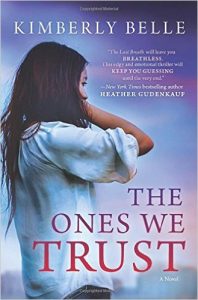
    The Ones We Trust, Kimberly Belle, Award-Winning MIRA Author, Multi-Margie-Grad

    1. Gabe’s good looks are real and rugged and raw, and now that I’ve seen both brothers up close, I’d choose Gabe over Zach any day.

    RD Combo: Polysyndeton (multiple conjunctions, no punctuation) and Alliteration

    2. The silence that spins out lasts forever. It’s the kind of silence that wraps around you like a shroud, the kind that turns the air thick and solid, the kind that makes you want to hear the answer as much as you dread it.

    Kimberly Belle could have written: The room went silent.

    I’m glad she decided to empower that emotionally-loaded scene dynamic.

    Rhetorical Devices: Amplification (silence) and anaphora (the kind, the kind, the kind)

    3. My heart races and my skin tingles and my blood pressure explodes like a grenade.

    Rhetorical Devices: Three visceral responses are powered with polysyndeton (multiple conjunctions, no punctuation) and a simile.

    The Blessing of No, Megan Menard, Multi-Margie-Grad

    1. Luke had a machine-gun laugh that fired about every third word.
    1. I picked up a French fry. It was a slender blonde, tall and weepy. I named the fry Tanya and chomped off its head.

    Those examples carry interest and power and are perfectly cadenced. The second example uses a metaphor and structural parallelism. It reveals a truth in a humor hit that could make us laugh or cry.

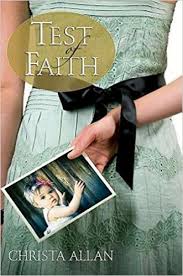
    Test of Faith, Christa Allan, Award-Winning Author, Multi-Margie-Grad 

    1. “If. Faith. Can. Come. Live. With Me?” I heaved every word out of my brain and into my mouth. I felt like someone regaining consciousness in an unfamiliar room or house or life.

    Christa Allan stylized that dialogue by using a Period. Infused. Sentence. That’s what I named it. Her dialogue cue is amplified, amplified, amplified stellar.
    She used an RD combo in the last sentence: polysyndeton and zeugma.

    What’s zeugma?

    I’ll SHOW not TELL. I know you’ll get it.

    My teaching-zeugma sentence:

    Margie grabbed her purse, her keys, and her steely resolve.

    You got it!

    This 2-point version is an example of zeugma too:

    Margie grabbed her purse and her steely resolve.

    Now you know the rhetorical device zeugma.

    1. This dinner was the Indy 500 version of returning to the track after a pit stop, except that the finish line was Logan, and there was only one first place.

    Ah… Metaphors and power words and hope all themed, propelled by a compelling cadence.

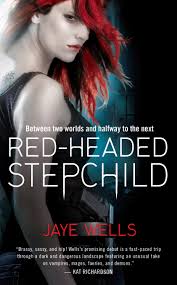
    Red-Headed Stepchild, Jaye Wells, USA Today Bestseller

    Jaye Wells wrote this paragraph when she was in a full day workshop I taught for Dallas Area Romance Authors in 2007. I asked all the participants to write an example of anaphora.
    Anaphora — Repeating a word or phrase at the beginning of three or more successive phrases or clauses or sentences. The first three must be in a row.

    The paragraph she wrote in class became the first paragraph in the first chapter of Red-Headed Stepchild, her debut Urban Fantasy.

    Digging graves is hell on a manicure, but I was taught good vampires clean up after every meal. So I ignored the chipped onyx polish. I ignored the dirt caked under my nails. I ignored my palms, rubbed raw and blistering. And when a snapping twig announced David’s arrival, I ignored him too.

    Deep Edit Analysis:

    Anaphora: I ignored, I ignored, I ignored, I ignored

    Three Humor Hits:

      • Digging graves is hell on a manicure
      • good vampires clean up after every meal
      • I ignored him too

    Power Words — Words that carry psychological power: graves, hell, vampires, clean up, ignored, ignored, dirt, ignored, raw, blistering, arrival, ignored him

    What does the reader learn in those 53 words?

    1. She’s digging a grave. We can infer she killed someone.
    2. She’s a vampire.
    3. She gets manicures.
    4. She’s Goth.
    5. She’s been digging that grave for a while.

    She’s not concerned about David catching her digging a grave.

    In that one short, opening paragraph, Jaye Wells deepened characterization, shared a strong and fun voice, and made the reader want to read more. That’s smart writing. The kind that impresses agents and editors and readers and reviewers.

    Every example in this blog carries a compelling cadence. That pleasing cadence speaks to the reader’s subconscious. Cadence has the same impact on the reader that a movie sound track has on a viewer.

    Read the first sentence of this blog OUT LOUD:

                Reading a book with flat-lined cadence is like watching a movie on mute.

    Do you hear those perfect beats?

    I could have written:

                It is critical to pay attention to cadence.

    No cadence-driven power.

    Deep Editing Caveat:  Most of the examples I shared in this blog were amplified. I’m not suggesting that every sentence should be powered up, or made special in some way. That would be gag-ifying

    Not a word. But it carries the punch I wanted to share.

    We need plain writing. Writing that does it’s job without any amplification.

    We need fun, quirky, deep, stylistic, and tug-your-heart writing too.

    I teach writers how to add psychological power to their writing in hundreds of ways. No hype. No hyperbole. I’m just sharing what I do.

    I teach writers how to empower emotions.

    • How to avoid clichés and clichéd phrasing.
    • How to write fresh faces and voices and visceral responses.
    • How to use advanced stimulus-response patterns.
    • How to use my Four Levels of Powering Up Emotion. How to have the right emotional intensity in the right place.
    • How to create emotional authenticity on the page. How a character can act in an out-of-character way, and get the reader to buy it.
    • How to use six rhetorical devices to finesse backstory. Succinct, un-skimmable, beautifully cadenced backstory.
    • How to use my 20 Point Checklist for Openings, my 15 Point Checklist for Endings, my 12 Visceral Rules for Fiction Writers, my 10 Gems for Not Writing Your Mama’s Character Descriptions, and more.
    • How to deep edit analyze your scenes. I developed The EDITS System so writers can see what’s working, what’s not working, and what’s missing.

    I used to teach college. Graduate level psychology courses. I back up every teaching point with plenty of examples from a variety of genres.

    I shared a few of the twenty rhetorical devices I teach fiction writers here. I’ll cover all twenty in about 75 minutes in my full day master class. Some, like polysyndeton (…photographed and bagged and carried away…, The Last Breath, Kimberly Belle) may be new to you, but they’re easy to learn, and use. Handouts help.

    I’m looking forward to having fun in my Master Class on March 30. Join me, and you’ll leave with deep editing tips and techniques that will add power to your WIP.

    FIND OUT HOW TO ENTER Margie Lawson’s Contest to WIN a LECTURE PACKET by clicking here!

  • “The Strange World of Editing and the Beasts Who Inhabit It”

    “The Strange World of Editing and the Beasts Who Inhabit It”

    [fusion_builder_container hundred_percent=”yes” overflow=”visible”][fusion_builder_row][fusion_builder_column type=”1_1″ background_position=”left top” background_color=”” border_size=”” border_color=”” border_style=”solid” spacing=”yes” background_image=”” background_repeat=”no-repeat” padding=”” margin_top=”0px” margin_bottom=”0px” class=”” id=”” animation_type=”” animation_speed=”0.3″ animation_direction=”left” hide_on_mobile=”no” center_content=”no” min_height=”none”]

    Tools of the Editing Trade
    Tools of the Editing Trade

    What Authors Should Know about Editing and Editors:

    Editing—you know your book requires it. But, where to start?

    An introduction to the Strange World of Editing and the Beasts Who Inhabit It.”

    Did you know that there are several types of editing? One size does not fit all.

    Developmental Editing

    Developmental editors are the top level of the editor beasts. This is because of the abstract and creative thinking required at the concept level of writing a work. Developmental editing is considered to be the most expensive type of editing.

    Developmental editing consists of:

    • Taking a rough idea or proposal and developing it to a final manuscript that will move to the substantive editing level.
    • Taking a manuscript that is chaotic, but has a potential idea within it, and applying order to the chaos.
    • Coaching. Developmental editors are considered to be coaches for writers. The writer has an idea. The developmental editor coaxes the writer to develop it and make it compelling.
    • Almost as acting as a literary agent. Publishing houses will assign developmental editors to non-writers who they believe have market potential (such as celebrities, the latest diet creator, etc). Some developmental editors will invest time into writers who are “diamonds in the rough” via business partnerships.
    • Always keeping the Reader/Audience in mind (visit our link about finding audience). Developmental editors hone everything in the manuscript to that particular reader audience: voice, word choice, pacing, point of view, dialogue, setting, and so forth.
    • Finding literary agents, publishers, distribution and warehousing systems for the work-in-progress.

    However, most fiction works should start with a manuscript overview or a manuscript evaluation. 

    Substantive Editing – Manuscript Overview

    Substantive editing looks at the big overall picture of the manuscript. This type of editing is generally what is needed when the authors say, “It just needs a quick look.” However, that is rarely the case. If you find that your requested manuscript keeps getting rejected, you may find that it requires substantive editing to take it to the next level and to overcome slush reader obstacles.

    Substantive editing aka Manuscript Overview consists of:

    • Reading the work in its entirety before any editorial changes are suggested.
    • Checking for consistency in voice, characterization, plot holes, shifts in point-of-view, pacing, sub-plots, story arc (or lack thereof), and other items that may cause readers to stumble.
    • Moving chapters or sections to improve the flow of the story-line.
    • Ensuring that the author’s “world construct” holds.
    • Taking a completed manuscript to the next level of storytelling.
    • Changing characters to make them more like-able, or more despicable or just more interesting to readers.
    • Click here for more detailed information about Chanticleer’s manuscript overviews and evaluations.

    Line Editing

    Content Editing is “apple polishing” the entire manuscript line by line. Sections are no longer being moved about, plot-holes have been filled, characterizations are formed, and setting details worked out.

    Line Editing consists of:

    • Line-by-line editing for tone, tightening of phrases to “leave the boring bits out,” looking for dead sentence construction, passive voice, removal of unnecessary modifiers, and point-of-view lapses.
    • Re-organization of the work at the paragraph, section, and chapter levels if needed.
    • Maintaining the author’s voice while improving the sentence structure that will move the story forward.
    • Ensuring the continuity of the story line. Removing any obstacles that would make the Reader stumble.
    • Moving the story and its readers along from one chapter to the next.
    • Most authors think that their works are ready for the Content/Copy Editing phase when their works could be made more competitive with substantive editing.

    Style Sheets and Continuity Notebooks or Story Bibles

    Each work of fiction deserves a Style Sheet. This is the tool that a Copy Editor will need to edit a work. The Style Sheet tracks the spelling of names, Physical attributes, whether to use British Standard English or American Standard English, metric measurements or US Standard System of measuring, magical constructs, character backgrounds, locations, timing,—all the little details that allow your reader to become fully immersed into your story.

    Continuity Notebooks or Story Bibles include everything from the attributes of the characters to the placement of buildings in the world. It covers the timeline and storylines from book to book, along with the rules of the world. Like building a house, an author needs to include the correct nuts and bolts as needed to plan the best possible design of the world she is creating. And, yes, even pantzers need to do this at some point before typing The End.

    If you want to pitch your book for a TV series or film or gaming, you will need to create a story bible. Screenwriters depend on it and so should serious authors. The story bible holds all of the tiny pieces of information such as cultural phrases, potential plotting ideas, dialogue, emotions, memories, does the character like dry wines or takes her bourbon neat, coffee black or macchiatos only, and a myriad of other ideas or details. And then there or the locations, timelines, character details, … The entire film and gaming industry runs on Story Bibles.

    And, yes, there are editors for Story Bibles. The most successful authors have them and swear by them. Story Bible Editors allow authors more time for creativity and for writing.

    Click here to learn more about Style Sheets and Story Bibles and Chanticleer’s service.

    Copy Editing

    Copy editing is what most writers think of when they hear the word “edit.” It is a very mechanical process that ensures that the publishing standards that readers have come to expect and appreciate are met.

    Copy Editing consists of:

    • Fact checking –especially with historical fiction.
    • Imposing the rules of the style guide that is required for the type of work (Chicago Manual of Style, AP Style Guide, etc.) and whether British Standard English or American Standard English is used for the galley.
    • Checking against the Style Sheet or Story Bible/Continuity Notebook
    • Correcting faulty spelling, grammar and punctuation.
    • Standardization of linguistics (i.e.: Elf language, French slang, or Klingon) throughout the work.
    • Correcting misused words.
    • Using the correct spelling, hyphenation, numerals, and capitalization.
    • Parallel structuring of headings, chapter titles, and sequencing.
    • Checking for triteness, unnecessary uses of jargon, and clichés while keeping the author’s voice.

    Proof-Reading

    Proof-reading is best conducted by a “cold read.” This means that the proof-reader has not seen the work. A cold read makes it harder for the proof-reader to “fill in” any gaps or “auto-correct” the text. Writers should never perform the final proof on their own works. Fresh eyes are advised. It is practically impossible to proof your own work.

    Proof-reading consists of:

    • Marking the typeset (whether digital or press) word for word against the final approved and edited manuscript.
    • Checking one more time for correct usage of dialogue quotation marks and punctuation.
    • Checking one more time for typos, double words such as: he he, or wrong word usage such as: sew, so.
    • Proofing the galley on different types of digital press software platform to ensure that it “translates” correctly and glitches are dealt with for each e-pub platform.
    • Checking for word spacing, paragraphing, “orphans and widows” (words and/or a sentence that appear by themselves on a page all alone), hyphenation and incorrect word breaks.
    • Re-checking for mislabeling, miss-numbering of pages (this happens all the time), and sequencing of chapters, prologues, epilogues, and glossaries.

    Advanced Reader Copies (ARCs) 

    After the first proof-reading is typically when Advanced Reader Copies are printed (or PDF files created). These are typically given out for reviews – peer, editorial, and for the trade, Beta Readers (who are great at catching whatever slips through the first proofing), used for pre-orders, and for book shows.

    Final Proofing (using feedback from ARCs)

    FORMATTING

    Formatting for print and for e-pubs are two different animals. Formatting for print is a different process than formatting for e-pubs. Trust me, it is.

    PUBLISHING

    After proofing the formatting for digital books and for printing, then the work is ready to be PUBLISHED!

    BUT BEFORE PUBLISHING – make sure that you have the work’s alphabet soup ready to go —

    • ISBN’s  (different for print, digital, audio, etc.)
    • BISAC codes
    • SEO
    • Keywords
    • Tagging
    • Works that you would like your work to be shelved with (for association – digitally)

    The Final Word

    Each type of editing has its specialists. Each level of editing becomes more focused on the details until the absolute final proof-reading for publication.

    Editing professor Carolyn Dale explains the different types of editing services like this:

    If you were remodeling your house you would not expect a sheet rocker to install plumbing, or an architect to hang sheet rock, or an electrician to create cabinetry, or the painter to create working plans.  However, you would expect them to be able to communicate with each other, schedule the work that needs to be done, and, ultimately, deliver a finished product with which you will be satisfied.  It is the same with editorial services.

    Editing–every work needs it.

    Our next post will be about how to determine the type of editorial services that your work requires and how to select an editor or editorial services company.

    [/fusion_builder_column][/fusion_builder_row][/fusion_builder_container]