No matter your writing level, your story needs a kickass main character. Now, I don’t mean you need a brawler, a bully, or beast to headline your story–instead, you need someone who readers have never met before. An unforgettable someone who fascinates and captivates. Someone who readers can care about, empathize with.
A story person who can carry the weight of your storyline.
Examples: Katniss of Hunger Games, Kirsten of Station Eleven, Jay Gatsby in the Great Gatsby, Celie in the Color Purple, Poirot in the Hercule Poirot series, Arsene Lupin of the Lupin, Gentleman-Burglar series by Maurice Leblanc, Harry Potter of the Harry Potter series.
You will notice that most of these protagonists can carry the weight of a series. Readers want to spend time with them.
Hercule Poirot of Agatha Christie’s series
Create a worthy protagonist:
A fictional person who is about to face some of themost interesting events and hardest challenges of his or her life. Elizabeth Bennet ofPride and Prejudice is a good example.
A protagonist who hasskin in the game. Elizabeth’s situation–living with her family because she has no means of support–means she is in aninescapable position.
A character you can pile on troubles and miseries and he or shewon’t topple. Well, maybe topple, but then is capable of rising again to face the challenges of the story events. This means your protagonist can stand up to his or her opposition, enemies, and travails, however difficult.
Think about the character Kirsten Raymonde in Station Eleven by Emily St. John Mandel. Kirsten is strong, observant, and skilled in protecting herself. She struggles with the violence of the new world and the fact that she has killed other people to survive. She believes in the power of art to make her new brutal life worth living and longs to better understand the world left behind.
The protagonist, Kirsten Raymonde, of Station Eleven by Emily St. John Mandel
A character withrealistic and possibly relatable flaws. InPride and PrejudiceLizzie Bennet possesses a sharp tongue that matches her quick wit, but she’s also prone to jump to conclusions {prejudice} and might be prouder than might be good for her.
A character who is complicated and complex, which in turn leads to inner conflict.This means protagonist battles his/her circumstances hindered by his or her personality, nature, and circumstances.
Use characters with significant histories{backstory}that cast a shadow onto the present. Typically this means past traumas or troubles that somehow mess with his/her ability to face the story conflict and hardships. InPride and PrejudiceElizabeth Bennet’s family is dysfunctional, in that the father is uninvolved and distant, their mother is an ambitious busybody, and her younger sisters will chase any man in a uniform. Which is going to lead to a scandal that the family might not recover from.
Lizzie’s older sister Jane is typical of a woman of her times–Regency England–who seems to accept society’s norms and has a sweet disposition. Oh, and low expectations. Lizzie, on the other hand, is different from her sisters–a reader, a dreamer and yet a realistic type because she’s aware of her family’s flaws and disapproves of her father. But importantly, she’s a woman who will not marry unless her beloved is a perfect match.
Smiling in spite of being subject to England’s Inheritance Laws during the Regency Era.- which means they will not inherit land or the family home. Husbands will be required.
But the ultimate backdrop for this story comes from England’s inheritance laws. The family’s five daughters unable to inherit their family estate because they’re female, which creates a threat that hangs over the story. This is an excellent example of the Regency English era.
All stories need anoverarching threat. Think worst-case scenario.
Fiction typically, but not always, is told from the protagonist’s viewpoint.The pov character is the reader’s entrée into the story world, the lens we view the story through.The prideful Lizzie provides access into society’s norms and expectations for females. Thus, she serves as a reflection of the story’s themes and premise. {It is a truth universally acknowledged, that a single man in possession of good fortune, must also be in want of a wife.}
If Pride and Prejudice was told from elder sister Jane’s or Lydia’s viewpoint it would be a far different tale.
Less complex and involving, since Jane isn’t exactly a firecracker and 15-year-old Lydia’s agenda is all about romance with a dashing soldier, Mr. Wickham. No matter that his agenda is ungentlemanly at best. Then there’s the matriarch, Mrs. Bennet, who is well aware of the unfairness of inheritance laws and is determined her daughters will be married because that’s all the security they can hope for. While Mrs. Bennet is realistic, it’s doubtful she’d provide an honest perspective.
Early on in your story development, consider thinking about or perhaps outlining what the narrative would look like from your other character’s perspectives. You may gain an interesting slant to your story line. Kiffer
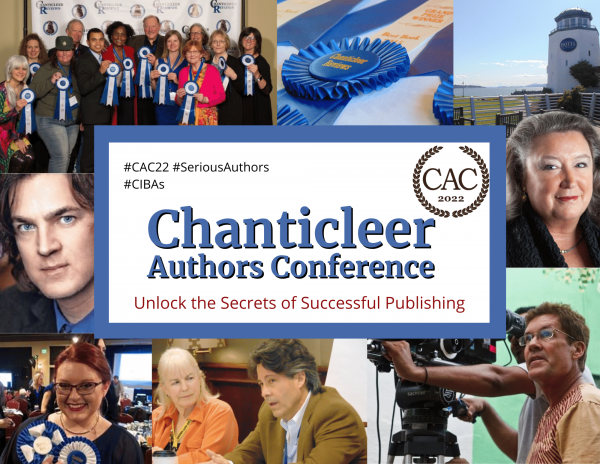
Seating is Limited. The esteemed WRITER Magazine (founded in 1887) has repeatedly recognized the Chanticleer Authors Conference as one of the best conferences to attend and participate in for North America.
Videos will be available for replay for six months on The Narrative Project’s website,
so you can watch when you have time!
Don’t worry about starting on the fourth or the fifth or even on the seventh! Just get started!
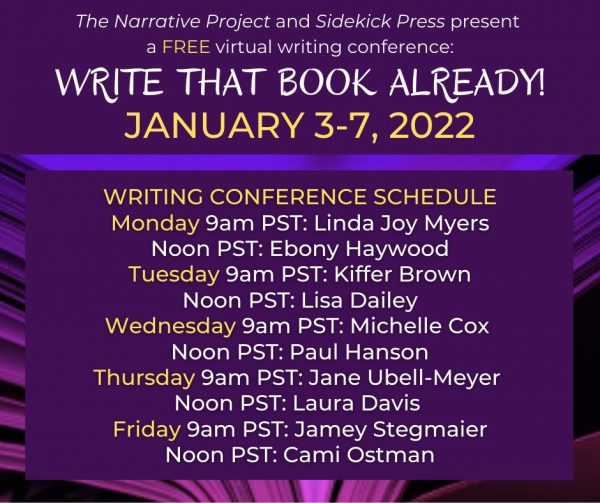
WRITE THAT BOOK ALREADY in 2022!
You’ll get two videos a day delivered straight to your inbox. THEN, we’ll be playing the videos during LIVE watch parties in a private Facebook group so the coaches at THE NARRATIVE PROJECTcan be with you to answer your questions and cheer you on in your commitment to…Write That Book Already!
If you’ve ever thought about writing a book or keep starting to write a book, this conference will coach you to succeed in writing that book that you have always wanted to!
Why haven’t you written that book already?
If you’re like most of the would-be authors, it’s because you need some answers to some of the following questions:
How do I get myself to sit and write?
What do I do with my manuscript once I’ve got it written?
Why does MY particular story matter so much that I should write it NOW?
What are the best strategies for getting past my writing blocks?
Is it selfish to spend the time to write a book? AND how can I write this book with kids underfoot or the pressures of my job keeping me so busy?
How can I tap into MY best creative process?
How can I know if my book is relevant?
How can contests and reviews help me get my book into the hands of my ideal readers?
How can I get in the right mindset to push past my inner critic?
How can I get the support and accountability I need to keep going even on the hard days?
How can my writing be a light in the world right now?
Why should I think about my author’s platform and marketing even while I’m writing and how can building that platform encourage me to get your book done.
Write That Book Already presenters are among the most encouraging and knowledgeable BOOK PEOPLE in the world.
Kiffer Brown, Michelle Cox, Laura Davis, Betsy Graziani Fasbinder, Paul Hanson, Ebony Haywood, Linda Joy Myers, Jamey Stegmaier, and others!
If you have a book in you, you don’t want to miss this!
You’ll walk away inspired, motivated, and COMMITTED to Write That Book Already!
When you sign up for the conference using this link, you will have access to the VIDEOS and Replay of VIDEOS on the Write That Book Already Virtual Conference!
Just click this link to be taken to The Narrative Project’s website to sign up for FREE! Just scroll down to the sign-up link.
And don’t forget to SAVE the DATES for the Chanticleer Authors Conference – April 7 – 10, 2022 at the Hotel Bellwether, Bellingham, Wash!
“If you’re going to have a character appear in a story long enough to sell a newspaper, he’d better be real enough that you can smell his breath.” ~ Ford Madox Ford
She might has well been talking to three empty chairs…
You see, it’s impossible to write fiction without understanding its underpinnings such as conflict, scene structure, and character development. Without this understanding , you might write two or three or four hundred pages, but you won’t end up with a story; instead you’ll produce a lot of words on a lot of pages or a haphazard pile of scenes loosely clustered around characters who never quite come to life.
The best fiction touches the deep layers in us. A writer achieves this effect by embedding dozens of techniques into his or her story.
Do your characters sound like this?
We hope that you have found these encore posts to be useful reminders and prompts for your work-in-progress!
And in cased you missed it, here is the link to our New Year’s Eve post with the first five articles. Click here.
NOW for Kiffer’s Number One Tip for Writers in 2022!
RULE # 1
WRITE FAST! EDIT SLOW!
Don’t edit your first draft as you write it!
Writing your first draft should be a mad dash to get your story out of your brain. Don’t hinder it by worrying about each little detail. There will be time for that later.
Try to unspool the “mind-film” in your brain before reworking every sentence. Get your story out. Let the characters introduce themselves to you. Create the Atmosphere.
There will be plenty of time to craft and hone sentences later. Meanwhile, fall in love with your story. Experience the rush and the thrill of creativity!
We wish you joy and peace in the New Year from all of us at Chanticleer!
We hope to see you at the 2022 Chanticleer Authors Conference and the 2021 CIBA Banquet and Ceremony
Our 10th Anniversary Chanticleer Authors Conference (CAC22) will be April 7-10, 2022, where our 2021 CIBA winners will be announced. Space is limited and seats are already filling up, so sign up today! CAC22 and the CIBA Ceremonies will be hosted at the Hotel Bellwether in Beautiful Bellingham, Wash. Sign up and see the latest updates here!
Secondary Characters. They can drive their co-stars crazy and they can also drive the plot. They can star in their own subplots and often support the protagonist’s goals. Or thwart the protagonist’s goals.
Benny, the unforgettable secondary character in “The Queen’s Gambit” by Walter Tevis
Using characters’ eyes to reveal emotion and meaning. If you’re serious about writing, you must notice subtext and how to convey it. And that often begins with the eyes.
Beth Harmon knows she will win several moves out in this scene of Queen’s Gambit
A look at more advanced ways of considering writing from some of the best craft books to come out in the last decade. Consider the narrator in your story, structure, proportion, and, most importantly, the heart of your work.
How-To tips and examples for adding fuel your characters’ fires. Your character should always have a lot to prove and master, so he or she can get off on the wrong foot and things can go downhill from there. Naturally.
Hitchhiker’s Guide to the Galaxy protagonist, the last known Earthling – Arthur Dent
Learn how to edit ruthlessly with these top tips with handy links! Make sure you get the most out of your next round of editing for your work-in-progress.
The Editor – going over the ms with an MOV.
We hope that you have found these encore posts to be useful reminders and prompts for your work-in-progress!
We wish you joy and peace in the New Year from all of us at Chanticleer!
January 1st, 2022, we will post five more of the The Top Ten Writing Posts for 2021 along with Kiffer’s Number One Tip for Writers in 2022!
When you’re ready,did you know that Chanticleer offers editorial services?We do and have been doing so since 2011.
Our professional editors are top-notch and are experts in the Chicago Manual of Style. They have and are working for the top publishing houses (TOR, McMillian, Thomas Mercer, Penguin Random House, Simon Schuster, etc.).
If you would like more information, we invite you to email Kiffer or Sharon at KBrown@ChantiReviews.com or SAnderson@ChantiReviews.com for more information, testimonials, and fees.
We work with a small number of exclusive clients who want to collaborate with our team of top editors on an on-going basis.Contact us today!
Chanticleer Editorial Services also offers writing craft sessions and masterclasses. Sign up to find out where, when, and how sessions being held.
A great way to get started is with our manuscript evaluation service, with more information availablehere.
And we do editorial consultations for $75. Learn morehere.
If you’re confident in your book, consider submitting it for a Editorial Book Reviewhereor to one of our Chanticleer International Awardshere.
Our 10th Anniversary Chanticleer Authors Conference (CAC22) will be June 23-26, 2022, where our 2021 CIBA winners will be announced. Space is limited and seats are already filling up, so sign up today! CAC22 and the CIBA Ceremonies will be hosted at the Hotel Bellwether in Beautiful Bellingham, Wash. Sign up and see the latest updates here!
Sometimes knowing what not to do is helpful in writing your work-in-progress.
Jessica Morrell, top-tiered developmental editor, and Kiffer Brown share with us on what to keep in mind as you create your work with this handy list.
Not knowing your ending as you write.
This lack of direction not only makes the process more difficult, but results in missed opportunities to insert foreshadowing and clues.
Hooks: The opening hook does not raise a compelling question and relate to the whole.
Do the individual chapters contain their own hooks to compel the reader to turn the page?
Inciting Incident. Not having a catalyst for your story. What is yours?
Your readers waiting for the inciting incident.
Flat Characters. Not understanding your main character, especially how he or she is shaped by the past, and using these factors from the past along with motivations as the basis for the plot. Causality.
Not giving your main character tangible goals and motivations.
Are your characters introduce
Lack of Tension. Not making the stakes high enough.
Without high stakes, the reader won’t care.
Smooth Sailing—does not make for great storytelling. Not creating obstacles for the character to struggle against.
Without obstacles, the story will not have enough tension or suspense—even it is a light-hearted romance or a humorous piece.
Whatever. Not involving your readers emotionally.
It’s important that the reader take on the character’s goals while entertaining them with the events of the story.
Use flashbacks only if they add drama and reveal information that cannot be told through present action.
Are the first 40 pages for your benefit and not the reader’s?
Dialogue: Do your characters all sound alike?
Dialogue is generally too long, mundane or stilted. Do your characters tend to give speeches? Don’t let this happen.
Remember, most dialogue exchanges should contain conflict. As Robert Dugoni states: “Dialogue is Action. Action is Dialogue.”
Development: Not understanding that fiction requires introducing change throughout the story.
Insert enough complications, surprises, reversals, and new elements to create tension, suspense, and to force the reader to discover how these complications turn out.
Saggy Middle? Not inserting a major complication or reversal in the middle of the story to push the plot into a fresh direction and increase the reader’s interest. Just when you your reader thinks she knows what happens next, the unthinkable happens.
White Room Syndrome. Not writing enough setting details to create a vivid, real world.
Lack of Atmosphere. Not realizing that setting can interact with plot and character and affect the mood and tone.
Dearth of Causality. (Yes, again) Do not forget that causality is a prime factor in plotting.
A plot is not a series of random scenes, but connected through a chain of causal, interrelated events.
Unsatisfactory ending. Does your conclusion fail to offer a big pay off.
As the plot concludes, tensions are unbearable, and a point of no return is reached. The conflicting forces should meet in a face-to-face contest that resolves the issues, reveals a winner, or at least changes how things look. The ending does not have to be happy, but it does need to be satisfying—even if there is more story to come and more plot questions to answer.
The best fiction touches the deep layers in us. A writer achieves this effect by embedding dozens of techniques into his or her story. An intimate story takes us to a specific place and coaxes us to remain there. An intimate story is lifelike and feels as real and complicated as the world the reader inhabits. When he finishes the final pages, and leaves the story world, he should feel the satisfaction of the ending, but also a huge sense of loss. Like a friend has moved to another town just when the friendship had reached a level of closeness and trust. — Jessica P. Morrell
Jessica Page Morrell
Keep writing, keep dreaming, have heart. Jessica
Jessica Morrell is a top-tier developmental editor and a contributor to Chanticleer Reviews Media and to the Writer’s Digest magazine. She teaches Master Writing Craft Classes at the Chanticleer Authors Conference that is held annually along with teaching at Chanticleer writing workshops that are held throughout the year.
Kiffer Brown
Keep creating magic! Kiffer
Kathryn (Kiffer) Brown is CEO and co-founder of Chanticleer Reviews and Chanticleer Int’l Book Awards (The CIBAs) thatDiscover Today’s Best Books. She founded Chanticleer Reviews in 2010 to help authors to unlock the secrets of successful publishing and to enhance book discoverability. She is also a scout for select literary agencies, publishing houses, and entertainment producers.
When you’re ready, did you know that Chanticleer offers editorial services? We do and have been doing so since 2011.
Our professional editors are top-notch and are experts in the Chicago Manual of Style. They have and are working for the top publishing houses (TOR, McMillian, Thomas Mercer, Penguin Random House, Simon Schuster, etc.).
If you would like more information, we invite you to email Kiffer or Sharon at KBrown@ChantiReviews.com or SAnderson@ChantiReviews.com for more information, testimonials, and fees.
We work with a small number of exclusive clients who want to collaborate with our team of top editors on an on-going basis. Contact us today!
Chanticleer Editorial Services also offers writing craft sessions and masterclasses. Sign up to find out where, when, and how sessions being held.
A great way to get started is with our manuscript evaluation service, with more information available here.
And we do editorial consultations for $75. Learn more here.
If you’re confident in your book, consider submitting it for a Editorial Book Review here or to one of our Chanticleer International Awards here.
Our 10th Anniversary Chanticleer Authors Conference (CAC22) will be April 7-10, 2022, where our 2021 CIBA winners will be announced. Space is limited and seats are already filling up, so sign up today! CAC22 and the CIBA Ceremonies will be hosted at the Hotel Bellwether in Beautiful Bellingham, Wash. Sign up and see the latest updates here!
Robert Dugoni is one of our most popular speakers
Writer’s Toolbox
Thank you for reading this Chanticleer Writer’s Toolbox article.
The First in a Series of Articles on Writing a Book Series
Writing a series of books and writing a novel are similar processes, though of course the series, as you may expect, is on a much grander scale.
A series is an excellent choice for a writer because you keep your readers! It’s always easier to maintain a connection with people who have already decided to read, not only your book, but a book in the same world!
Let’s begin by talking about different types of Book Series
Two Variations for Book Series
There are essentially two types of book series out there. One is the Finite Series, and the other is the Infinite Series.
Finite Series
These Series have a story arc that expands beyond one book, and each one relates directly to the one before or after it. Examples of this are N.K. Jemisin’s The Broken Earth Series or Jim Butcher’s The Dresden Files. Series can be as short as two books or as many as twenty-three, but the main thing is that the order they come in is highly recommended to best understand the plot.
This is a group of books set in a universe, but where each book can stand alone and be read in any order. Examples are Anne McCaffery’s Dragonriders of Pern or Terry Pratchett’s Discworld series. For the most part, these books will follow the same rules of the universe between volumes, just as a finite series would.
These also are called an anthologized series as I learned in a discussion about writing craft with Chanticleer Editorial Assistant Scott Taylor during our Roost book group meeting discussing Save the Cat! Writes a Novel. They happen often if someone just decides they enjoy continuing to write in an established world with established characters –David
Honorable Mention
Terry Brooks’ Shannara series is both finite and infinite! He has finite quartets and trilogies that all take place in an infinite series universe. You can read each finite mini-series in the universal infinite series in whatever order you want, and they all offer hints about the other books.
Did you know? Series don’t need to be italicized while writing them! Only book titles require it.
The Overlap
Obviously the key here is that both of these are series. A series will always have central themes that overlap across books, and what happens in one book will affect the world at large, even if the books can be read as stand alones. Even in an infinite series, characters will have cameos, such as the character of Death in Pratchett’s Discworld universe.
It’s recommended that in an infinite series each story has a strong, independent story to help it stand apart from the other books set in that universe, but even in a finite series, it’s important that each book avoids being too repetitive. The concern about repetition is important to keep in mind, though many successful series often rely heavily on repetition to help the reader orient themselves to a familiar landscape. For example, in The Dresden Files, almost every book follows this pattern:
Harry hears of a strange mystery that’s way beyond his ability to comprehend
Then he finds a simpler mystery, one he can manage, or so he thinks.
His team assembles slowly over the course of the book, Thomas the vampire, Murphy the cop, Michael the knight, and John the mobster.
The simple mystery turns out to be much bigger. Harry is defeated and ready to give up.
Suddenly Harry understands the bigger mystery by solving a key point in the smaller mystery.
Day is saved.
Hint about how the day wasn’t totally saved.
Paul Blackthorne as Harry Dresden holding Bob the Skull
Likewise, Terry Brooks often follows the character pattern of making sure there’s someone with the fabled Shannara bloodline, that person receives help from someone who is a bit of a nomad, a druid is introduced, and then we have a couple more magical characters who help out the heroes.
When you’re ready,did you know that Chanticleer offers editorial services?We do and have been doing so since 2011.
Our professional editors are top-notch and are experts in the Chicago Manual of Style. They have and are working for the top publishing houses (TOR, McMillian, Thomas Mercer, Penguin Random House, Simon Schuster, etc.).
If you would like more information, we invite you to email Kiffer or Sharon at KBrown@ChantiReviews.com or SAnderson@ChantiReviews.com for more information, testimonials, and fees.
We work with a small number of exclusive clients who want to collaborate with our team of top-editors on an on-going basis.Contact us today!
Chanticleer Editorial Services also offers writing craft sessions and masterclasses. Sign up to find out where, when, and how sessions being held.
A great way to get started is with our manuscript evaluation service, with more information availablehere.
And we do editorial consultations for $75. Learn morehere.
If you’re confident in your book, consider submitting it for a Editorial Book Reviewhereor to one of our Chanticleer International Awardshere.
Our 10th Anniversary Chanticleer Authors Conference (CAC22) will be June 23-26, 2022, where our 2021 CIBA winners will be announced. Space is limited and seats are already filling up, so sign up today! CAC22 and the CIBA Ceremonies will be hosted at the Hotel Bellwether in Beautiful Bellingham, Wash. Sign up and see the latest updates here!
Writer’s Toolbox
Thank you for reading this Chanticleer Writer’s Toolbox article.
IF you are participating in NaNoWriMo, you are getting close to the FINISH LINE! Stay the Course as you try to achieve the 50,000 words goal.
If you are NOT participating in NaNoWriMo, then we hope that this post will spur you on as write your work-in-progress (w-i-p) or your next work.
RULE # 1
WRITE FAST! EDIT SLOW!
Don’t edit your first draft as you write it!
Writing your first draft should be a mad dash to get your story out of your brain. Don’t hinder it by worrying about each little detail. There will be time for that later. NaNoWriMo or not.
Not taking our word for that piece of advice?
Chelsea Cain, a bestselling thriller author (with a TV series to her credit), gives this piece of advice:
Write the bare-bones version of the scene first using mostly dialogue, and then move on and in the second draft flesh out the scenes with description and action.
“Action is dialogue. Dialogue is action.” –Robert Dugoni, Amazon Bestselling Author
What is YOUR STORY?
Story is essentially a problem that needs solving for the protagonist. –Jessica Morrell
What is yourprotagonist’sproblem that must be solved—or else?
What is the worst thing that can happennextto your protagonist?
Remember that it is not your problem. It is your protagonist’s problem, obstacle, impossible dream.
Start at least one subplot. This subplot(s) should also complicate the protagonist’s goals.
No matter when the problem begins (it’s always in Act One) the problem is weighty and vexing, perhaps insurmountable. If the problem is not immediately personal, it should become so that it will create a bond (connection) between the protagonist and antagonist. Classic examples are the connection between Sherlock Holmes and Jim Moriarty and Harry Potter and Voldemort.
What is the inciting event or threat?
The inciting incident might lead to the problem. This event will disrupt the status quo, demand response, and set actions in motion. It’s a threat that unbalances the story world and creates dilemmas that must be dealt with.
To name a few:
The tornado incident in the Wizard of OZ
Katniss’s little sister selected for the Hunger Games
Luke Skywalker ‘seeing’ and hearing Princess Leia calling for help in Star Wars
These are great tips to get your creativity groove on!
Remember you want to send your protagonist into new emotional territory with new challenges and pressures.
And at the same time, she will need to deal with new physical territories such as a new school (Footloose) or a different culture (Dances with Wolves) or a different legal society with different norms (Handmaid’s Tale)or a new environment (Deadwood) or a different time (Outlander)or galaxy (Farscape).
Don’t be afraid to stage danger in benign or lovely settings or conversely gentle scenes in dangerous and gruesome settings.
Kiffer’s Note: I just saw this bucolic scene while watching The Wheel of Time first episode. All white coats and white tents. And then, bam! We learn that the guys in white are not the “good guys” —at all—even if their name is Children of the Light.
Bucolic looking camp scene in Wheel of Time inhabited by these characters all in white.
Atmosphere
Allow the overall atmosphere and mood to imbue your writing from the get-go.
The atmosphere lends itself to the overall tone and mood of a work. Allow it to permeate your work as you write.
The atmosphere in Shadow and Bone series by Leigh Bardugo
Or Sex in the City by Carrie Bradshaw
Why use atmosphere in your first draft? (or during NaNoWriMo)?
Because it will affect your mood and approach to your story.
It will make you focus on creating unease–a necessary ingredient not always considered in early drafts.
Unease contributes to writing a page-turner.
Atmosphere underlines themes–even if you don’t have your themes nailed down yet.
Here is the link to our Writer’s Toolbox article onAtmosphere
Emotional Baggage
Know your protagonist’s main emotional wound, sometimes called baggage in real life. How is it going to affect his or her ability to solve the story problem? (See the questions below to jumpstart creativity.)
Remember that Writers (that is you) should carry a notebook everywhere you go. You never know when a brilliant solution is going to appear.Jessica Morrell
If I could offer a single piece of advice about creating characters it would be this (Jessica Morrell):
Take risks with your main characters.
Make them stand out from the myriads of fiction published each year.
And don’t be afraid to allow eccentricities, quirks, and oddball ways of seeing reality.
More questions for your protagonist from Jessica Morrell—these are guaranteed to get your creative wheels turning:
First, ask yourself these questions and then “ask” your protagonist. Have your protagonist go into depth. Find out what your protagonist’s iceberg under the waterline is all about.
Photo taken in Greenland’s waters.
Kiffer suggests that you take a walk when you are considering these questions. Be sure to either take notes or record your thoughts on your smartphone while you explore your protagonist’s emotional baggage.Walk a mile in your protagonist’s shoes.
What’s the most embarrassing thing that has ever happened to you?
What is your biggest regret?
What is your superpower?
Who do you cherish most in the world?
If you could change one thing about your world, what would it be?
What is your average day or schedule?
What 5-6 words sum up your values?
What do you do after a really bad day?
How do you celebrate?
The secret you’d never tell your significant other? Your mother? Your sibling?
What reminds you of home?
What item must you always take along when traveling?
Favorite drink?
Secret vice?
Pizza or tacos? Cookies or tequila?
Favorite climate?
Reading or television to unwind?
Breakfast or coffee only?
We hope that we helping you, Dear Writer, to arm and prep yourself to get down to the writing of your next work—the reckoning.
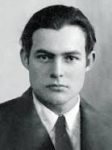
Ernest Hemingway: There is nothing to writing. All you do is sit down at a typewriter andbleed.
Stay tuned for more NaNoWriMo Tips // Jump Start Your Novel Tips
Chanticleer Editorial Services – when you are ready
Did you know that Chanticleer offers editorial services?We do and have been doing so since 2011.
Tools of the Editing Trade
Our professional editors are top-notch and are experts in the Chicago Manual of Style. They have and are working for the top publishing houses (TOR, McMillian, Thomas Mercer, Penguin Random House, Simon Schuster, etc.).
If you would like more information, we invite you to email Kiffer or Sharon at KBrown@ChantiReviews.com or SAnderson@ChantiReviews.com for more information, testimonials, and fees.
We work with a small number of exclusive clients who want to collaborate with our team of top-editors on an on-going basis.Contact us today!
Chanticleer Editorial Services also offers writing craft sessions and masterclasses. Sign up to find out where, when, and how sessions being held.
Jessica Morrell is a top-tier developmental editor and a contributor to Chanticleer Reviews Media and to the Writer’s Digest magazine. She teaches Master Writing Craft Classes at the Chanticleer Authors Conference that is held annually along with teaching at Chanticleer writing workshops that are held throughout the year.
Keep creating magic! Kiffer
Kathryn (Kiffer) Brown is CEO and co-founder of Chanticleer Reviews and Chanticleer Int’l Book Awards (The CIBAs) thatDiscover Today’s Best Books. She founded Chanticleer Reviews in 2010 to help authors to unlock the secrets of successful publishing and to enhance book discoverability. She is also a scout for select literary agencies, publishing houses, and entertainment producers.
If you are partaking in NaNoWriMo, then you are over a third of the way done! Congratulations!
We hope that this article will provide prompting to spur you on to the finish line.
If you are on your time schedule, we hope this article will help keep you focused and spur you on!
The best fiction touches the deep layers in us. A writer achieves this effect by embedding dozens of techniques into his or her story. — Jessica P. Morrell
Dramatic Question
Compelling fiction is based on a single, powerful question that must be answered by the story climax. This question will be dramatized chiefly via action in a series of events or scenes.
This scene from Miss Fisher’s Mysteries could be powered by several Dramatic Questions
For example, if you are writing a romance, the question always involves whether the couple will resolve their differences and declare their love. Then in a mystery the dramatic question might be will Detective Smith find the serial killer in time to prevent another senseless death? In The Old Man and Sea, the dramatic question is will Santiago catch the big fish and thus restore his pride and reputation?
Consider the following:
What is the dramatic question in Harry Potter and the Sorcerer’s Stone?
What is the dramatic question in Stephanie Myers’ Twilight Saga?
Understanding the dramatic question in other writer’s work can better help you approach your novel. To make it the best we can, let’s turn to world building.
An Intimate, Simmering World
An intimate world isn’t created by merely piling on details. It means your story world has the resonance of childhood memories, the vividness of a dream, and the power of a movie. An intimate, simmering world is filled in with shadows and corners and dogs and ice cubes and the sounds and smells of a dryer humming on wash day and a car blaring past, with pop music shaking the windows. These details lend it authority, potency, and a palpable physical existence.
Diana Gabaldon’s The Outlander Series simmering details make this time-travel, fantasy, horror, science fiction extremely believable and immersive fiction.
Outlander – Diana Gabaldon’s details make for immersive fiction
An intimate story takes us to a specific place and coaxes us to remain there. An intimate story is lifelike and feels as real and complicated as the world the reader inhabits. When he finishes the final pages, and leaves the story world, he should feel the satisfaction of the ending, but also a huge sense of loss. Like a friend has moved to another town just when the friendship had reached a level of closeness and trust. — Jessica P. Morrell
Characters Built from Dominant Traits
Create main characters with dominant and unforgettable traits as a foundation of personality. These traits will be showcased in the story events, will help him achieve or fail at goals, and will make the story person consistent. For example, Sherlock Holmes’ dominant traits are that he is analytical, Bohemian, opinionated and intelligent. These traits are showcased in every story he appears in along with secondary and contrasting traits. When the character first appears in the first scene, he arrives in the story with his dominant traits intact.
Henry Cavill as the Witcher from Andrzej Sapkowski’s series of the same title
Who can forget Henry Cavil’s portrayal of Geralt of Rivia? He enters the scene as a hardened warrior with an iron code of honor. As the series progresses, he becomes softer and allows a few friends to become closer to him, taking responsibility for individuals’ happiness, not just their safety. Even as he grows, his core character elements remain unchanged. The interiority of a character is often one of those elements.
Emotional Need & Significance
The protagonists and main characters are people with baggage and emotional needs stemming from their pasts. These needs, coupled with motivation cause characters to act as they do.
For example, in Silence of the Lambs Clarisse Starling is propelled by childhood traumas to both succeed and heal the wounds caused by the death of her father. Likewise, Robert Dugoni’s Tracy Crosswhite is searching for her sister’s murderer, and Craig Johnson’s Sheriff Walt Longmire is trying to find out who killed his wife. That’s a lot of character baggage.
Motivation Entwined with Backstory
Motivation, the why? of fiction, is at the heart of every scene, fueling your character’s desires and driving him to accomplish goals. This provides a solid foundation for the often complicated reasons for your character’s behaviors choices, actions, and blunders. Motivating factors provide trajectories for character development, as a character’s past inevitably intersects with his present. Your character’s motivations must be in sync with their core personality traits and realistically linked to goals so that readers can take on these goals as their own.
Desire to drive your NaNoWriMo project
Desire is the lifeblood of fictional characters. Not only do your characters want something, but they also must want something badly. You can bestow on your character flaming red hair, an endearing, crooked grin and a penchant for chocolate and noir movies, but if she doesn’t want something badly, she’s merely a prop in your story, not a driving force. But if she wants to win the Miss Florida contest, take over her boss’ job, or become the first female shortstop for the Atlanta Braves, then you’ve got a character who will make things happen and a story that will be propelled by desire.
The Ring from Lord of the Rings is a perfect example of a symbol of desire on so many different levels.
Frodo and The Ring – LOTR by J.R.R. Tolkein
Threat
Fiction is based on a series of threatening changes inflicted on the protagonist. In many stories, these threats force him or her to change or act in ways he or she needs to change or act. Often too, what the protagonist fears most is what is showcased in a novel or short story. It can be fear of losing his family, job, or health with a dreaded outcome. Fear of losing to a threat or threats provide interest, action, and conflict.
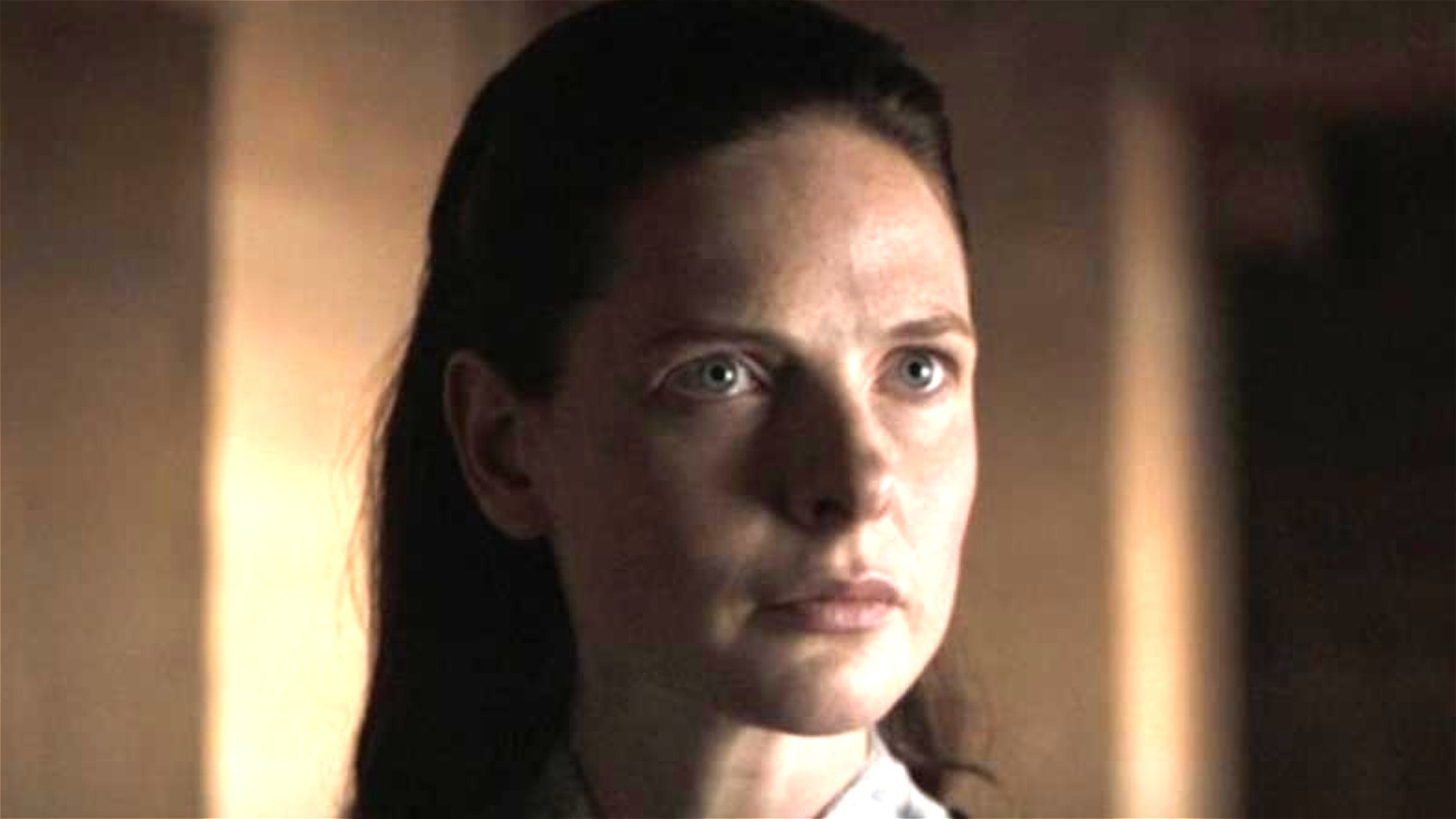
“Fear is the Mind Killer” – Rachel Ferguson as The Lady Jessica in the 2021 Dune often repeats this litany against fear
Inner Conflict
A fictional character doesn’t arrive at easy decisions or choices. Instead, they are burdened by difficult or impossible choices, particularly moral choices, that often make them doubt and question their actions. Inner conflict works in tandem with outer conflict – a physical obstacle, villain or antagonist–to make the story more involving, dramatic, and events more meaningful.
Causality
Events in fiction are never random or unconnected. They are always linked by causality with one event causing more events later in the story, which in turn causes complications, which cause more events, which cause bad decisions, etc. Visit our blog post on The Inciting Incident to learn more!
The inciting incident of the Wizard of Oz
Complications
A story builds and deepens by adding complications, twists, reversals, and surprises that add tension and forward motion. Plots don’t follow a straight path. Instead, there are zigzags, dead ends, and sidetracks. Complications create obstacles and conflict, cause decisions to be made, paths to be chosen.
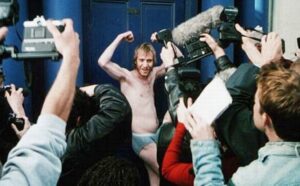
My favorite complication is one from Notting Hill when Spike is standing outside in his underwear strutting around with the paparazzi going wild for a peek at Anna Scott. How could Anna and William ever expect that complication? — Kiffer Brown
A complication from Notting Hill
Midpoint Reversal | A NaNoWriMo Must
The middle of a novel comprises more than half its length. At about the midpoint of most novels, a dramatic reversal occurs. The hunter becomes the hunted; a second murder occurs proving the detective has been wrong in his suspicions; a former lover arrives in town to complicate a budding romance. In Jessica Brody’s Save the Cat! Writes a Novel, she describes the midpoint as either the false victory or the false defeat. No matter what happens, the hero is in for a surprise! This reversal keeps the middle from bogging down and becoming predictable and also breathes new life and often a new direction into the story.
Every story needs an ending that satisfies the reader while concluding the plot. A satisfying ending does not have to be “happy” or victorious or riding off into the sunset. The final scenes, when the tensions are red hot and the character has reached a point of no return, must deliver drama, emotion, yet a logical conclusion. This is not to suggest that every plot ends with a shoot-out or physical confrontation. Some endings are quieter, more thoughtful. Some endings are ambivalent, some a dramatic or a violent clash of wills. However, there is always a sense that all the forces that have been operating in your story world have finally come to a head and the protagonist’s world is forever changed.
We are cheering you on to the NaNoWriMo Finish Line! You can do it!
Jessica Page Morrell
Keep writing, keep dreaming, have heart. Jessica
Jessica Morrell is a top-tier developmental editor and a contributor to Chanticleer Reviews Media and to the Writer’s Digest magazine. She teaches Master Writing Craft Classes at the Chanticleer Authors Conference that is held annually along with teaching at Chanticleer writing workshops that are held throughout the year.
Kiffer Brown
Keep creating magic! Kiffer
Kathryn (Kiffer) Brown is CEO and co-founder of Chanticleer Reviews and Chanticleer Int’l Book Awards (The CIBAs) thatDiscover Today’s Best Books. She founded Chanticleer Reviews in 2010 to help authors to unlock the secrets of successful publishing and to enhance book discoverability. She is also a scout for select literary agencies, publishing houses, and entertainment producers.
When you’re ready, did you know that Chanticleer offers editorial services? We do and have been doing so since 2011.
Our professional editors are top-notch and are experts in the Chicago Manual of Style. They have and are working for the top publishing houses (TOR, McMillian, Thomas Mercer, Penguin Random House, Simon Schuster, etc.).
If you would like more information, we invite you to email Kiffer or Sharon at KBrown@ChantiReviews.com or SAnderson@ChantiReviews.com for more information, testimonials, and fees.
We work with a small number of exclusive clients who want to collaborate with our team of top editors on an on-going basis. Contact us today!
Chanticleer Editorial Services also offers writing craft sessions and masterclasses. Sign up to find out where, when, and how sessions being held.
A great way to get started is with our manuscript evaluation service, with more information available here.
And we do editorial consultations for $75. Learn more here.
If you’re confident in your book, consider submitting it for a Editorial Book Review here or to one of our Chanticleer International Awards here.
Our 10th Anniversary Chanticleer Authors Conference (CAC22) will be April 7-10, 2022, where our 2021 CIBA winners will be announced. Space is limited and seats are already filling up, so sign up today! CAC22 and the CIBA Ceremonies will be hosted at the Hotel Bellwether in Beautiful Bellingham, Wash. Sign up and see the latest updates here!
Writer’s Toolbox
Thank you for reading this Chanticleer Writer’s Toolbox article.
You’re handing your precious book over to a beta reader to see if it’s worthwhile, ready, perhaps, for a Chanticleer Book Review or to be entered into the Chanticleer Int’l Book Awards. They look at you over the cover that you worked so many long hours on with your designer and say with all the authority of fate: “I just don’t think your main character is very likeable,” they say. “Can’t you make them more likeable? All characters should be likeable.”
Are your grumpy readers right?
Writer, they are wrong
You can of course have an unlikeable main character! If they were only willing to read for ten minutes though, you may have a more difficult problem on your hands than whether or not your character is someone they want to be friends with. Some of the most compelling characters in literature aren’t someone I’d want to share a hotel room with anytime soon.
We can sleep in separate bedrooms. Really, it’s okay.
The key isn’t to worry about whether or not your protagonist is “likeable” (which is a tricky word to define), but about whether or not they are interesting.
Are the actions they take moving the plot forward while engaging the reader at the same time? Those two things must be true of anything that happens in your story.
Manuscript Overviews and Editing
Now, if the majority of your readers are coming back to you and letting you know these early drafts aren’t working, we highly recommend a Manuscript Overview.A manuscript overview (MOV) is a broad overview of your manuscript – what’s working and what isn’t from all aspects of your story: structure, plot, pacing, character development, dialogue, etc. We are here to offer our guidance on what you need next. Save time and money by honing your work before you begin the editorial process.
Here, we’ll go through a few basic checks to make sure that your character is compelling.
On Writing Compelling Characters
There are a few questions you’ll want to ask to see if your complex character is someone who will grab your reader’s attention.
What is the Status Quo your character inhabits?
What is your character’s Desire?
How does the Conflict impede the character’s Desire?
Speaking of Secondary Characters, Severus Snape, Professor of Potions from the Harry Potter series is a prime example of uncompelling compelling character.
Severus Snape
Status Quo
This is the classic way you engage readers with your story. The story is introduced, and something happens to break the status quo. One story where this jumps to mind is Neal Stephenson’s Seveneves. With cannibalism and the end of the world, there’s no lack of unlikeable characters in this book, but all the characters rivet your attention.
Seveneves begins with the moon blowing up. Well, more accurately, with it being split into four pieces. Up until the catalyst (the breaking of the status quo), the four chunks of the moon are a point of fascination, friendly enough to have one chunk named “The Bean.” Then the status quo changes when one of the moon chunks hits another and they start to fragment even more. This gives all the characters a goal to work for: Save the Human Race. Having a strong focus for your characters will help readers empathize with them and want to know what’s happening.
Our favorite editor Jessica Morrell has an excellent article detailing even more ways to stir up trouble for your characters here.
Character Desire
Similar to the breaking of the status quo, your characters will all want something different out of the world you’ve written them in. Of course, like the breaking of the status quo, this problem won’t be easy for them to solve.
Tom Ellis as Lucifer from Netflix
There are two common methods of frustrating your character’s ability to achieve their desire. The first is simply to make it difficult to do. Anything that takes a lot of work and will make them struggle. The other excellent choice is to have them try to solve the wrong thing. So often characters misunderstand what will make them happy or they struggle to find the correct solution to their problem. By having them do the wrong thing, the reader will be able to enjoy a much more interesting story than an unlikeable person succeeding at everything they do and never growing or developing.
Cats
Who doesn’t love cats? We love cats at Chanticleer, that’s for sure!
The newest additions to the Chanticleer family: Tiefen and Biscuit at 15-weeks-old
Now the connection between cats and what to do with your unlikeable character might not be immediately clear, and it might sometimes be a metaphor rather than an actual cat. The tried and true advice is you have a character who might be a little rough around the edges save a cat early on in the story. This shows that, despite their flaws, they do care about the world around them, and they will help a creature in need. Of course, this doesn’t have to be a literal cat, but it’s something sweet the character chooses to do without being pressured.
For those of you in The Roost, Chanticleer’s online community, you know that we have been reading SAVE THE CAT, WRITES a NOVEL by Jessica Brody (based on the screenwriting books by Blake Snyder) in our Writing Craft Book Group. There is even a reading guide by Chanticleer’s David Beaumier uploaded to the activity feed.
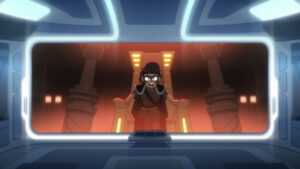
The opposite can happen too! In Lower Decks, the irreverent Star Trek cartoon that’s currently playing on Paramount+, Beckett Mariner kills a holographic character to establish herself as the villain in a fantasy program she designed.
Beckett Mariner as Vindicta in “Crisis Point” from Star Trek Lower Decks
It’s fairly easy to flip through the first pages of your book to see if there’s a cat who your narrator can save in the early pages of your work, and then see if you can find a few beta readers to poll on their feelings.
To consider more of the timing and development of plot in relation to your characters, review this article here.
“There’s no such thing as writer’s block or plotter’s block. There’s only perfectionist’s block.” Jessica Brody
Go forth and write!
When you’re ready,did you know that Chanticleer offers editorial services?We do and have been doing so since 2011.
Our professional editors are top-notch and are experts in the Chicago Manual of Style. They have and are working for the top publishing houses (TOR, McMillian, Thomas Mercer, Penguin Random House, Simon Schuster, etc.).
If you would like more information, we invite you to email Kiffer or Sharon at KBrown@ChantiReviews.com or SAnderson@ChantiReviews.com for more information, testimonials, and fees.
We work with a small number of exclusive clients who want to collaborate with our team of top-editors on an on-going basis.Contact us today!
Chanticleer Editorial Services also offers writing craft sessions and masterclasses. Sign up to find out where, when, and how sessions being held.
A great way to get started is with our manuscript evaluation service, with more information availablehere.
And we do editorial consultations for $75. Learn morehere.
If you’re confident in your book, consider submitting it for a Editorial Book Reviewhereor to one of our Chanticleer International Awardshere.
Also remember! Our 10th Anniversary Chanticleer Authors Conference (CAC22) will be April 7-10, 2022, where our 2021 CIBA winners will be announced. Space is limited and seats are already filling up, so sign up today! CAC22 and the CIBA Ceremonies will be hosted at the Hotel Bellwether in Beautiful Bellingham, Wash. Sign up and see the latest updates here!
Writer’s Toolbox
Thank you for reading this Chanticleer Writer’s Toolbox article.
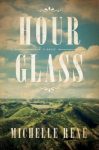
I wrote the first draft of my award-winning historical novel,Hour Glass, in sixteen days.You read that correctly—sixteen days. My experimental novella,Tattoo, was written in about three weeks. Both have been released in 2018.
Though I am intensely proud of this accomplishment, I’m not telling you this to brag. I’m telling you that you can do this, too.
“Sit down every day to write. Even if you don’t want to. A little every day.” –Michelle Rene
Sounds like a line you’ve heard before, right? Yeah, me too. It’s not that this is bad advice. Far from it. Many people find this the best way for them to consistently write draft after draft. But if you really want to knock that rough draft out of the park, I’m going to ask you to kick that notion to the curb.
I’m not magical; I’m a binge writer, and none of the ideas in this article are uniquely mine. Most of them are exercises I’ve stolen from other writers. I used to be just like you because I was led to believe novels should take years to write. I would write a chapter, go back and edit it, and then proceed to the next one. A first draft took me over a year to complete.
It wasn’t until I decided I really needed to finish my novel, I Once Knew Vincent, that I decided to shove my face in the cold, scary, deep end of the writing ocean. I went away to a writer’s retreat and forced myself to write as much as I could every day. I wrote the lion’s share of that book in six days, and those chapters were by far the best in the book.
Why is that?
Isn’t it counterintuitive that the chapters written in a whirlwind of typing be the best? I’m glad you asked, nebulous reader voice in my head. Let’s delve into that.
Why Write This Fast?
Nothing kills a book faster than never finishing that initial draft. A malaise sets in, often slowing a writer down to a crawl while they chip away over a long time and often give up entirely.
“Will I ever finish this book?” the writer asks, (fists raised to the sky for dramatic effect).
Maybe. Maybe not. That first draft is possible if you pick yourself up by your metaphorical bootstraps and do the work every day, but a large percentage of writers never cross the finish line. What a shame that is!
Strangely, there is a raw emotion that comes from writing something so fast you don’t have time to noodle it to death.
How excited are you when you first start fleshing out a story? How amazing does it feel to start naming your characters and setting up their scenes in your mind? Fan-freaking-tastic!
This is because you are in the beginning of abook affair.
Writing a book is like having a relationship. In the beginning, it’s like a honeymoon! You feel all the emotions. Love and pain and excitement and lust. Well, okay. Maybe not lust. Paper cuts hurt, so let’s not go there.
“Writing a book is like starting a new relationship.” Michelle Rene
The point is the first draft should be all elation and honeymoon. Leave the nitty-gritty for your fifteenth edited draft. You don’t want to be sitting in a rocking chair with your first draft complaining about how much he snores before you even get to edit. Taking years to write that first draft can land you in complacency town before you cross the finish line. Pour your heart and soul into the rough draft with reckless abandon.
“Pour your heart and soul into the rough draft with reckless abandon.”– Michelle Rene
“But nothing good can come from my sloppy first draft if I write it in a few weeks,” says the nebulous reader voice in my head that’s starting to sound whiny.
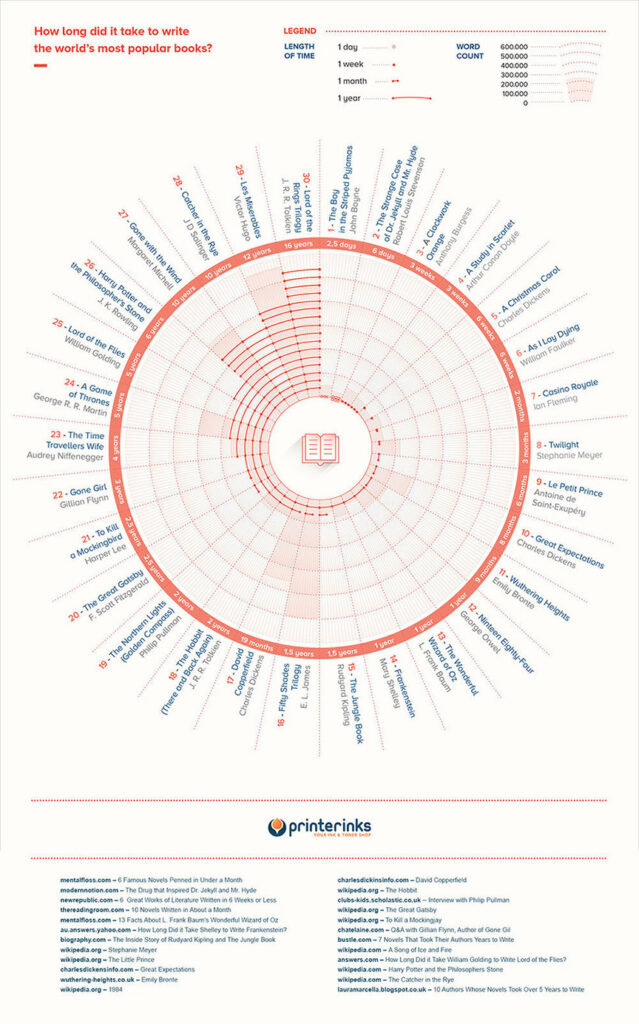
Please refer to the infographic below. It lists some of the most popular books and how long it took the writer to finish them. WhileLord of The Ringstook a whopping sixteen years to complete (no shocker there), I’d like to direct your attention to roughly a quarter of the chart that indicates books written under three months. If theBoy in the Striped Pajamaswas written in two and a half days, you can write something of quality in four weeks. Write Fast. Edit Slow.
Hugh Howey wrote the sensational bestselling science fiction story WOOL in four weeks during NaNoWriMo 2011.
Water for Elephants was drafted by Sara Gruen in four weeks.
Jack Kerouac’s semi-autobiographical tale, On the Road, took three weeks to write the first draft.
How Do I Start?
Let’s begin with talking about the snarky, three-hundred-pound elephant in the back of your mind. Your inner editor. We are going to bind and gag that jerk, and it may take fifty shades worth of rope because it’s three-hundred pounds and takes up a lot of headspace.
Write Fast! Edit Slow!
Sara Bale, an extremely prolific romance writer, has similar advice for your would-be-elephant editor.
“I think the biggest mistake an author makes when writing a rough draft is stopping and rereading/editing their work. The key is to keep moving forward and get the whole story out. Know the beginning and the ending. If you have those elements, the rest is easy.”
Sara Bale
“The key is to keep moving forward and get the whole story out.” Sara Bale
The passionate ideas come when the critic in our mind is silenced.
Your visceral idea is key, and I will not accept the old “I don’t know what to write about” excuse. You are here to pour your heart and soul into a story. If you are having a hard time with inspiration, here’s a handy dandy exercise to help that I stole from a writer’s workshop I attended.
Sit down with a piece of paper and a pen. Yes, a real piece of paper and pen. No cheating with keyboards. I know, I know. Your handwriting is horrible because all you do is type now. My handwriting looks like a serial killer’s ransom note, so I totally understand, but stick with me.
Next, set a timer for ninety seconds.
Hit start, write the first thing that comes to your mind and don’t stop until that timer goes off. No contemplating it. No editing your idea and wondering if Stephen King has already done it. He probably has. Just write, no excuses, for the whole ninety seconds.
Go ahead… I’ll wait…
You back? Okay. I’m not a betting woman, but I would put money on what you wrote was pretty damn good.
Whether or not that is the idea you run with doesn’t matter. It’s an exercise to get the creative juices flowing. Use that. Build your characters. Plot the story fast and loose. Fall in love with your story. Get down and dirty in that honeymoon phase…but not literally because remember the paper cuts. We talked about that.
And finally, outline! For the love of all that is holy, outline your story! Do not do this flying by the seat of your pants. That is a sure-fire way to crash and burn. It doesn’t need to be an in-depth outline. On the contrary, keep that pretty loosey-goosey, too.
My outlines are often little more than a few sentences for each chapter.
Time Management
Okay, you have your outline, your idea, and your story. Let’s do this. The clock begins when you type “Chapter One” or “Prologue” if you want to be fancy. Let’s use NaNoWriMo (National Write a Novel in a Month) rules as I find these to be the best guidelines: 50,000 words in four weeks.
So four weeks. That’s your mission.
Write Fast. Edit Slow.
Select a four-week span of time in your life that you can devote to writing. Don’t sabotage yourself by doing this during a family vacation or when it’s the busy season at work. Choose a month that will allow you some time to devote to this endeavor because it is important.
For that month, give up on being the best mom, husband, wife, etc. Let your family know that this is going to be what you are doing for this month, and they can have you back after it’s over. The laundry can wait. Order in food. Maybe shower because, well, hygiene.
Editor’s Note: I totally agree with Michelle. November can be an impossible time for many because of increased work demands, family demands for the approaching holidays, the doldrums due to shorter and shorter days. The main thing is to pick a time that works for you. It can be NaFebWriMo if you have to put in overtime starting in November for the holiday season, or NaJulyWriMo – if you are a teacher. Find a time period that works for you and stick with it! Put it on your calendar. Alert your friends and family.
I highly, highly, highly recommend you track your progress. Doing a rough draft during NaNoWriMo is a great idea. This happens in November, and the organization sets you up for a win. You have a word tracker, writer friends to cheer you on, and helpful articles when you get stuck. If November is not a good month for you, try a program like WriteTrack. It will help you keep up with your progress.
Insider secret: Don’t shoot for the minimum goal. If your tracker says you need to write 2,000 words that day, shoot for 3,000 or 4,000. It’s easy to fall behind only doing the bare minimum; but if you’re always ahead, you have a little breathing room.
The Black Hole of the Internet
Can someone say distractions? Turn those notifications off! Set your phone to do not disturb except for emergencies. Hang a banner on your doorknob with a picture of Gandalf saying, “Thou shall not pass!” Get away from the addicting vacuum of social media. It will be there when you get back.
“That’s all well and good if you are writing something you just made up, but what about people who need to research their content?” asks nebulous reader voice again.
WithHour Glass, I wrote a historical fiction novel about Calamity Jane. There was definitely some research involved there. I did as much as I could before the writing began, mainly broad stroke things: dates, places, and a few good details relevant to the story. Nothing more.
Research is the most unassuming trap in writing. You’re on a good writing jag, everything is flowing, and then you hit a spot where you need the name of a city or a date or a vocabulary word. You have to have that accurate information, right? So you switch to the internet and start researching. Well, that first page on a website leads you to another, which leads you to Facebook; and then before you know it, it’s been three hours, and you lost your momentum.
Broad stroke your research before you start; but while you’re writing, don’t research. If you need the name of a city, don’t go looking. Just write something like, “He rode into the sunset hoping his horse knew the way to {insert city name}.” Get the story down, and go back in later to fill in those brackets.
Write your story from the heart and with passion. Research and accuracy can be added later.
Write Fast! Edit Slow!
The Middle Stick
It’s right around the 30,000-word mark that this happens. The Middle Stick is what I call the point where your initial enthusiasm begins to wane, and your progress gets sluggish. What began as “yay, I’m writing a book” turns into “I don’t know if I can do this.” It happens to everyone.
This is where participating in programs like NaNoWriMo can be helpful. Having other writers in the same place can be encouraging, and they can hold you accountable. If you aren’t doing NaNoWriMo, I suggest getting a group of like-minded author friends to do this together. This is also where writing ahead of your minimum word count helps because The Middle Stick will almost certainly slow you down.
Here are some other helpful tips.
Try that writing something in ninety seconds exercise I mentioned earlier to get inspiration.
Go out of your comfort zone and experience something related to your book. For example, if you are writing a western, go see a rodeo. Get away from your computer.
Multi-award winning author, Janet Shawgo, has this to say about immersing yourself in your research outside the page when she was researching her book,Look For Me, set in the Civil War. “What helped me was putting feet on the ground at Gettysburg to get a feel of the area, what my characters saw, what they heard. To try on costumes true to that era. I walked some of the roads soldiers did in Virginia. If at all possible, put yourself there.”
Janet Shawgo Won the Chatelaine Grand Prize
Switch up your chapters. This is where outlining really helps you. If you are hitting a wall writing chapter thirteen, jump forward and write chapter twenty. Sure, you’ll have to go back to that chapter eventually, but this helps you jump over that block and continue to get your word count in.
I wroteTattooentirely this way. It’s made of seven parts of a story told chronologically backward. I didn’t write any of those parts in order. Not one. Yet, I still managed to piece them together in the end.
Just keep moving. The momentum will pick back up. You can do this.
Hurray! You Did It!
Out of breath and exhausted, you crossed that finish line. You did it! Rejoice! I told you you could do it!
Go celebrate. Treat yourself to a fancy dinner. Toast your deed with some friends. Eat a whole chocolate cake. I don’t care. Party it up because you managed to do what the vast majority of humans on this planet cannot do. Most people never dream about writing a book. Fewer attempt it. Only a small fraction actually finish a draft.
You are spectacular.
Now, put the book aside for at least a month (more like two). You will eventually go back and edit. You will fill in those empty brackets. You will allow that annoying three-hundred-pound editor elephant back into your life. But not right now. That’s for another day.
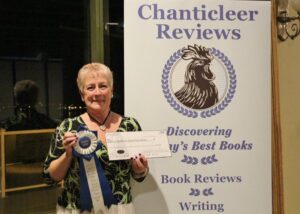
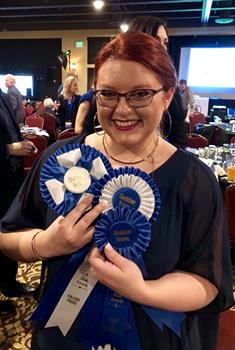
Michelle Rene and her Chanticleer Grand Prize Ribbons
Michelle Rene, the author of this blog post, is a creative advocate and the author of a number of published works of science fiction, historical fiction, humor, and everything in-between.
She has won indie awards for her historical fiction novel,I Once Knew Vincent. Her latest historical novel,Hour Glass, won the Chanticleer International Book Awards Grand Prize for Best Book. It was released on February 20th to rave reviews from Chanticleer, Kirkus and Publishers Weekly. Her experimental novella,Tattoo, was released on March 7th.
When not writing, she is a professional artist and self-described an all-around odd person. She lives as the only female, writing in her little closet, with her husband, son, and ungrateful cat in Dallas, Texas.
A special thanks go out to the authorsSara BaleandJanet Shawgofor contributing their writing expertise to help others.
Chanticleer Editorial Services – when you are ready
Did you know that Chanticleer offers editorial services?We do and have been doing so since 2011.
Tools of the Editing Trade
Our professional editors are top-notch and are experts in the Chicago Manual of Style. They have and are working for the top publishing houses (TOR, McMillian, Thomas Mercer, Penguin Random House, Simon Schuster, etc.).
If you would like more information, we invite you to email Kiffer or Sharon at KBrown@ChantiReviews.com or SAnderson@ChantiReviews.com for more information, testimonials, and fees.
We work with a small number of exclusive clients who want to collaborate with our team of top-editors on an on-going basis.Contact us today!
Chanticleer Editorial Services also offers writing craft sessions and masterclasses. Sign up to find out where, when, and how sessions being held.