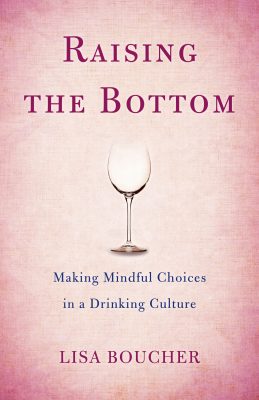
A mother’s wish for her daughter brought this guidebook into being; in it, author Lisa Boucher recounts her struggles and conquest of alcoholism, with specific advice for women trapped in the clutches of the disease.
Boucher provides ample autobiographical proof of her addiction. When growing up, her mother was “drowning in booze” and many childhood memories center on her mother wrecking the car, burning the supper, or just being nonfunctional. Her father reacted by acting the tyrant, using fear tactics in hopes that he could control his wife’s drinking. By the time she was twelve, Boucher was smoking, using pot, and drinking. Her first early marriage ended in divorce.
Most alcoholics begin slowly, perhaps drinking only on weekends, using booze as a reward, imagining the warm glow that the drink can provide and gradually spreading weekends out to include the entire week. It took Boucher years, and a dedicated, disciplined adherence to the 12 Step program, to realize that she was better off without drinking.
Ultimately, she says, alcoholics have a thinking problem – distortion, delusion, and denial constantly crowd in, and drinking suppresses those negative feelings. Her book focuses on women with alcohol addiction, and the first story in her collection of sobriety is perhaps the most poignant: her mother’s account of her years of alcoholism and road to recovery. After a rewarding phase of sobriety and dedication to helping others, her mother began to urge Boucher to chronicle her own experiences on the path up from the bottom.
Boucher’s work provides direct advice delivered in an accessible manner by someone who has walked the walk to recovery and is well qualified to talk the talk. She understands, for example, that some people can control their drinking, but she offers many clues as to how that perception can also be a deception. She urges a realistic approach: to quit drinking; you have to prepare yourself for the possibility of “losing friends, maybe losing your marriage, maybe losing everything.” Thus far, she has enjoyed nearly 30 years of sobriety spent in a professional and personal quest to assist other women who are carrying the burden of alcoholism. Her journey has led her to present ten stories from other women like herself, whose lives are peppered with violence, arrests, loss of jobs, partners and self-esteem, who now can proudly announce a “sobriety date” and a recovered existence.
Boucher examines the particular problems of women in the struggle against alcoholism, though her book would have realistic outreach for men also. She writes from hard experience that will be recognizable to anyone who has flirted with or entirely fallen for the false promise of the bottle. Her book can and should be read by women in the throes of the disease as well as those who seek to counsel and assist their sisters in need.
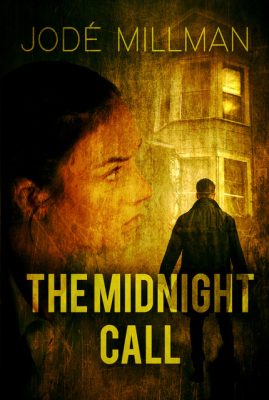
In this fast-paced legal thriller, young attorney Jessie Martin faces multiple crises in both her personal and professional lives when her former high school teacher and beloved mentor calls in the middle of the night to confess a crime. He has just committed murder.
Jessie feels compelled to help Terrance Butterfield, after all the many times he has come to her aid, so she rushes to his side over the protests of her fiancé, and in spite of her third-trimester pregnancy.
When she arrives, she finds herself plunged into the depths of a nightmare that has only just begun. The ending will either make or break Jessie and everything she holds dear. As well as the lives and careers of everyone caught up in the bloody mess.
Although this story begins with Jessie receiving the titular midnight call, the pace of the story is driven by the investigation into the crime, the defendant, and eventually into Jessie herself.
The maneuvering of both legal teams sets a frenetic pace, as the District Attorney is driven to prosecute what turns out to be a high-profile case in the press as well as the courtroom. While the defense attorney sees the case as a way to solve his financial problems, feed his adrenaline addiction, and put himself back on top as the maverick defender with a nose for finding the weak spots in any case.
The punch and counterpunch between the rival legal teams push the story forward at a high-speed, as they maneuver both in and out of the courtroom. The revelation of new information, about both the crime and the people involved in it, is nothing short of fascinating.
As the case builds, Jessie’s life falls apart, and all her long-held secrets are laid bare. During these instances, the pacing slows a bit, in juxtaposition to the back-and-forth battles between the legal teams. The legal strategy and the courtroom battles create an intense page-turner of a book.
The ending of the case does an excellent job of making the reader – and the defense team – question every single thing that came before.
The Midnight Call won First Place in the 2014 CIBAs in the CLUE Awards.
Lucy Spencer has everything, a successful career in advertising, good friends, and a quiet life. For fourteen years, she’s pushed aside her feelings for a childhood friend, Callum Hawthorne, and become a strong, independent woman, burying her hurt over his betrayal and creating her own life free of the drama of Cal’s womanizing ways–that is until he saunters back into her life.
Callum Hawthorne only wants one thing, to reconnect with his former best friend, Lucy. Cal has done everything he can think of to worm his way back into his Lucy’s life even enlisting the help of one of their mutual friends, but he can’t get Lucy to agree to meet him. With no idea what he did to create the rift between them, Cal doesn’t know how to make amends, but he does know one thing for sure: His life will never be complete without Lucy.
When his father’s first acquisition, a failing resort on the Gold Coast, is threatened, Cal hires Insight Marketing to help him save the crippled business. Lucy has no idea who the new, ultra-rich client is until she sees Callum. With no choice but to do the job she was hired to do, Lucy must find a way to put aside her old hurt and work with Cal, who hopes his high school crush can evolve into a grown-up relationship.
Friendship is an endearing theme in this well-written, fast-paced novel. It exists in every form, long-time friends, new friends, the kind of friends who will help drown your sorrows in wine, and the kind who will literally and figuratively rescue you from yourself. Lucy’s friends often ride to her defense. From Madison’s refusal to divulge Lucy’s whereabouts to Mia and Steph showing up at her door, pizza and booze in hand. Lucy’s female friends make a strong nexus, but the entire premise is based upon the friendship of Lucy and Cal, a lasting friendship that holds both love and hate.
Cal is the typical hot, rich protagonist (yes this is a familiar trope), but his friendship with Lucy sets him apart from the norm. He realizes quickly that he must win her back through that friendship. In order to win her, he must set aside the fiery passion he feels every time they are together and re-establish their friendship. He vows to gain her friendship, then her love, a love for which he’s pined most of his life. In fact, his surface philandering began as his way to preserve their friendship, fearing that admitting his feelings in high school would push her away.
Lucy quickly realizes she can’t just give up on Cal’s friendship again. He was once her closest confidant and letting that go proved to be a huge mistake. Nearly every happy memory she has includes the delectable Cal, and her traitorous heart refuses to release him without trying to be what they once were (and maybe more). They both have to take a headlong plunge into something that could prove heart wrenching and disastrous, but isn’t that the duality of this crazy emotion called love? The ability to heal and kill all in one.
With only one month to save their childhood memories and to resurrect a dead friendship, Cal and Lucy will take the reader on a face-paced, romantic adventure.
Persuading Lucy won 1st Place in the 2018 CIBA in the Chatelaine Awards for Contemporary Romance.
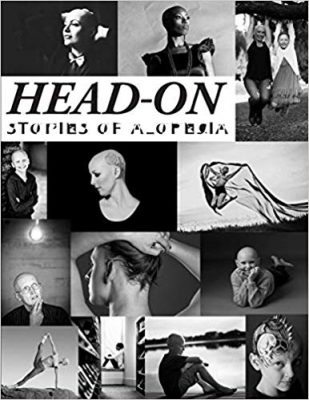
More than 10 years ago, when Deeann Callis Graham went through a second bout of alopecia areata (AA), the first was when she was seven years old, she wondered where she could find pictures and read stories of people who were also losing their hair. She wanted to embrace positive messages amid a society that equates baldness with cancer and sickness. Yearning to relate to people who looked like her, she started writing her own story and soon she had connected with others with alopecia wanting to tell their stories.
Head-On: Stories of Alopecia, featuring 75 narratives from people of all ages and walks of life with alopecia. Graham’s purpose is to educate and shed light on the illness that affects 6.8 million people in the US, according to the National Alopecia Areata Foundation (NAAF), and help change the world’s attitudes toward hair, beauty, and self-worth.
In the book, Graham makes it clear that alopecia areata is not cancer, and that hair loss is not any easier for men and boys than it is for girls and women. Alopecia areata is an autoimmune condition where the body gets confused and attacks the hair follicles, which causes hair to fall out. A more severe form is alopecia totalis, where all of the hair on the head falls out. Alopecia universalis, which is less common, is hair loss on the entire body including the head, eyelashes, eyebrows, legs, toes, etc.
To produce the 216-page book, which features black-and-white portraits and short narratives from each participant, Graham talked to more than 500 people to compile the stories and conduct research. At the end, she includes interviews with Jeff Woytovich, founder of the nonprofit Children’s Alopecia Project (CAP), and Andy Turpen, who started Mondo Baldo to highlight positive messages around baldness.
Most impressive are the narratives of hope, rebirth and renewed confidence after years of stares, pranks, and bullying in school and misinformed comments, rudeness, and more stares as adults. Being a child with alopecia can be particularly devastating, as the many contributors wrote, being called “freak” or “hairless cat” on the schoolyard. Sophia said she missed going to her junior prom; and Tanya recalls that as a youngster, she felt “ugly and vulnerable.”
Most of the contributors talk about the countless hours they spent in front of the mirror creatively trying to hide their bald patches with their existing hair. Making the decision to wear a wig in public was a major turning point and a show of independence yet it also came with its own potential failures. Sarah, from California, had a pivotal moment during middle school when a classmate pulled her wig off her head. Sarah was “completely shocked,” but after that incident, she decided to tattoo her eyebrows and leave the wig at home when she entered high school. “I’m just so tired of hiding,” she writes.
While some of the stories are heartbreaking, they are also uplifting, showing how each person rose from the ashes to use their alopecia for good either for their own self exploration or to help the world understand the illness.
Steph, a high school swimmer, says when the team gathers for pictures at meets, she proudly displays her bald head. “It’s as if I’m announcing, ‘Here I am. Bald, beautiful, and not sick!’”
Joyce, who has had alopecia for more than 50 years, had hair loss from age 12 to 24. Her hair fully returned and remained for almost 30 years. “I believed I was cured,” Joyce writes, however there is no known cure at this time although there are treatments. Later, when her son’s hair started falling out, hers did again too and she said she felt relieved she was done with the cycle.
Not only is Head-On a lovely display for the coffee table, it serves as a resource for parents of children with alopecia and anyone who would like to learn more. Graham has included Alopecia 101 with facts and, at the end, a Resources page listing organizations based in the US, the UK, Australia, and Canada.
Head On: Stories of Alopecia won First Place in the CIBA 2017 Instruction & Insight Awards for Non-Fiction.
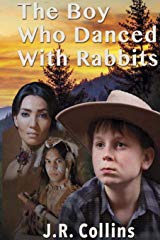
J.R. Collins has given a voice to an ancestor, Jeb Collins, who was almost killed at birth – twice. His survival is significant for that, but also for the fact that in another part of the Georgia mountains, a Cherokee boy, Wolf, is born on the same night. The families of the two boys will meet and mix in the early days of American settlement when everyone had to struggle for survival, and such friendships were still possible.
Jeb learns smatterings of Cherokee language, and Wolf and his kin pick up English with a sharp mountain twang from their settler neighbors. Together Jeb and Wolf explore the mystical, mountainous part of Appalachia named Cho-E-Sto-E for the prevalence of rabbits there.
Both of the boys’ fathers remember and despise the British who killed the American rebels and betrayed the Indians who agreed to help them; and both hate all evil-doers, like the ones who kidnapped Jeb’s sister or the sneak-thieves who stole from Jeb’s family. But most of all, they will stand united against a nearby tribe that wants Wolf’s sister as a bride for their leader.
The author grew up in the region he describes so vividly in this, his first novel, and has a sequel, the award-winning, Living Where the Rabbits Dance. The story, focusing on the boy’s view of a sometimes-dangerous world, is told in a satisfyingly recognizable dialect, using many endearing folk expressions – one of our favorites being, My heart melted like butter on a hot biscuit.
This multilayered saga presages the time that will come when the Cherokees will be marched away on the Trail of Tears, and family connections like those depicted here will be destroyed in the name of Manifest Destiny. It is heartening to read about the few years enjoyed by such friends as Jeb and Wolf when they could roam the land together with the approval of their elders. There is a finely-honed homage paid to two religions, the Christianity of the Collins clan and the animist visionary beliefs of the Cherokees, each playing a role in Jeb’s perceptions of the world around him.
From learning to fish to making bead bracelets from local gemstones, to seeing visions invoked by Cherokee spirits, here is a tale of a boy coming of age in a significant time and place. Collins’ book records that history, that atmosphere, with equal measures of zeal and reverence.
The Boy Who Danced with Rabbits by J. R. Collins won First Place in the 2017 CIBAs for the Goethe Awards, Western Fiction.
While mothers are as varied and diverse as the many varieties of flowers in the world, none of us would be here without them! When I think of the word “mother,” there is no possible way I can disassociate the word from my mother. She is strong-willed, strong-minded, and strong-opinioned. And her love rivals the strength of the greatest army the world has ever known. She is my mother. She is the one person who loves me enough to tell me when I am wrong and, yet, loves me anyway.
How and When was “Mother’s Day” Started
As all things of Western Civilisation seem to have started in ancient Greece it seems (reference: My Big Fat Greek Wedding), so did Mother’s Day. Well, sort of, honoring the goddess, Cybele/Rhea (depending on time and region). The early Christian Church co-opted the day, calling it “Mothering Sunday,” a festival day in which the faithful would return to the church of their birth.
When is Mother’s Day Celebrated Around the World?
Mother’s Day is celebrated on thesecond Sunday in May, in the USA, Canada, most European countries, Australia, New Zealand, India, China, Japan, the Philippines, and South Africa.
The UK and Ireland celebrate Mother’s Day on the fourth Sunday in Lent.
Most Arab countries celebrate Mother’s Day on March 21st (vernal equinox).
Most East European countries celebrate Mother’s Day on March 8th. For a complete overview of the dates of Mother’s Day around the world see Mother’s Day on Wikipedia.
The Rise of Mother’s Day in America
Before the Civil War, Ann Jarvis and her friend, Julia Ward Howe decided to set up regional clubs, “Mothers Day Work Clubs” designed to teach young mothers how to care for their infants. Their involvement and the clubs continued throughout the Civil War and once the war ended, they held a Mothers’ Friendship Day and invited both Union and Confederate soldiers and their mothers to attend. Big strides toward reconciliation were made through the efforts of these women.
The women who inspired Mother’s Day were social activists, abolitionists, suffragettes, and educators who wanted to make their world – and their children’s world a much better place. And that is something to celebrate!
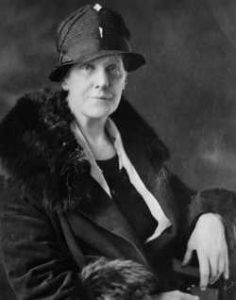
It was all made a legal holiday when Anna Jarvis, inspired by her social activist mother, Ann Maria Reeves Jarvis, decided to memorialize a day in which to celebrate her mother. In 1907, three years after her mother’s death, she did just that. She chose a white carnation to inspire people to remember their mothers and what they sacrificed for them.
“Its whiteness is to symbolize the truth, purity and broad-charity of mother love; its fragrance, her memory, and her prayers. The carnation does not drop its petals, but hugs them to its heart as it dies, and so, too, mothers hug their children to their hearts, their mother love never dying. When I selected this flower, I was remembering my mother’s bed of white pinks (flowers)…” – Anna Jarvis (quote)
It wasn’t until 1914 that Woodrow Wilson signed a decree that designated the second Sunday in May as the United States official day to celebrate Mother’s Day. Of course, Mother’s Day is celebrated all over the world (in at least 49 countries) on different days.
It should be noted that Anna Jarvis wasn’t very happy with the commercialization of Mother’s Day and she fought long and hard to try and get it withdrawn as a national holiday, but we all know how that ended. And if you don’t, well, let’s just say it is a most intriguing mystery…
Suggested Reads
Because mothers are incredibly diverse in their habits and reading lists, we invite you to dive into our reviews and choose what’s you think your mother would like to read most and to perhaps enjoy the books yourself.
Chanticleer Mother’s Day Reading List!
Jaimie Ford‘s Love and Other Consolation Prizes is powerful storytelling from a master storyteller! Jaimie Ford breathes to life a little-known piece of Seattle history spanning the early to the mid 21st century. And a truly unique story of the many ways a mother’s love can manifest itself.
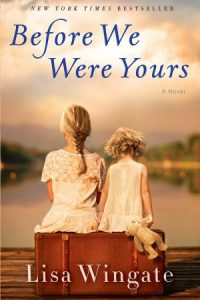
Before We Were Yours by Lisa Wingate is a disturbing look into what those who should know better, choose to do to society’s most vulnerable during the 30-years between 1920 and 1950 at the Tennessee Children’s Home Society.
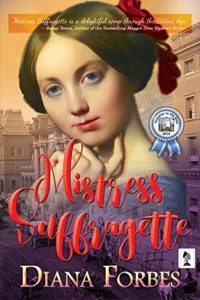
Diana Forbes‘ Mistress Suffragetteexamines the facts of life, the challenges of social restrictions, and the woes of youthful love through the eyes of a sharp-minded, sharp-shooting young woman. Mistress Suffragette is now available on Audible!
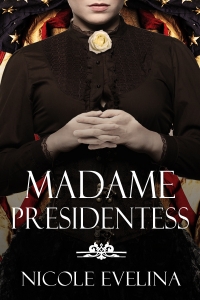
Nicole Evelina‘s Madame Presidentessis a fascinating story of a woman’s meteoric rise from rags to riches, from subservience to achievement – based on a true story that was instrumental in propelling the Suffragette Movement.
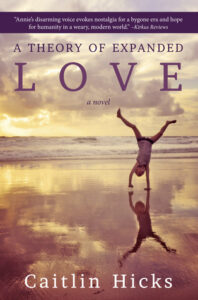
A Theory of Expanded Love by Caitlin Hicks is a bold, authentic, & captivating –a young teen in the 1960s confronts doctrine when it threatens to outweigh compassion.
Caregiving Our Loved Ones by Nanette Davis, Ph.D.Dr. Davis passes on her knowledge to caregivers for dealing with the ongoing emotional, financial and health toll of taking care of someone who will never get better.
Nick Adams‘ Away at War: A Civil War Story of the Family Left Behind is a rich and fascinating account of day-to-day life in rural America in the mid-19th century set against the backdrop of the Civil War. Taken from primary sources, this narrative brings to life all that was loved and all that was lost.
This is just the beginning of our list! To find more amazing reads in every genre, please click here to discover our favorites!
We would like to wish all mothers, mothers-to-be, stand-in mothers, and those who possess the mothering instinct, a very Happy Mother’s Day!
In 1902, the year of the Boxer Rebellion in China, five-year-old Yung Kun-ai watches as his mother buries his newborn sister in a tiny grave that she has dug with her fingers. The starving mother hadn’t been able to feed her. She kisses her son and gives him her only possession, a filigreed hairpin, then tells him he must remain in the cemetery until his “uncle” comes to take him to America, to a new life in a new world. “This is my gift to you,” she says as she shuffles away.
These words, and the poignant story that follows, bring to mind two words from the title of author Jamie Ford’s New York Times bestseller first novel—‘bitter’ and ‘sweet’. This is his third…worthy of equal praise.
Yung spends that chilly night shivering, in fear of the nearby fighting between rebels and soldiers, and in doubt of his future. But his mother’s gift does indeed come to pass. A voyage of many weeks in the hold of a freighter takes him to Seattle. His early years there are not easy, however. Fathered by a white missionary, he is a half-breed and the brunt of taunting and worse by both his peers and his elders. Nonetheless, he ably gains an education, takes the name of Ernest Young, and begins to earn a living as the twelve-year-old houseboy and driver at a high-class brothel called The Tenderloin in Seattle’s Garment District. The other occupants—servants as well as the ‘working girls’—become the family he has yearned for. Some years later, he has his own family with Gracie, a Japanese immigrant known as Fahn when he met her (for the second time) at The Tenderloin.
The story hops back and forth between the first and seventh decades of the century, centering on Seattle’s Alaska-Yukon-Pacific (AYP) Expo in 1909 and the city’s World Fair in 1962. A raffle at the former is what brings Ernest to The Tenderloin. During the latter, Ernest and Gracie’s daughter Juju, a journalist, has been asked by her editor to write a then-and-now story of the two fairs, based on interviews with old-timers who have been to both. Her primary interviewee is to be her father, she thinks, but he stalls her, offering only tidbits—nothing that would put her story on the front page. Why is he so reluctant? Is there a tale he doesn’t want to share, not only with the newspaper’s readers but even with his daughter?
This historical novel is brought to a literary level not only by the author’s expertise with language but also by the extent of his research into the facts around which the story is woven. In an Author’s Note, Ford explains that his inspiration for writing is a “never-ending appetite for lost history—the need to constantly turn over rocks and look at the squishy things underneath.”
For this novel, one of those rocks was the 1909 Alaska-Yukon-Pacific Exposition. From yellowing newspaper articles relating to the Expo, he learned that both the suffrage movement and “social evils” such as brothels (not only the moral evil but the spread of syphilis) were at their height in Seattle at that time. One article told of a child (named Ernest), who was donated by the Washington Children’s Home Society as a raffle prize at the AYP. Another described a climb up Mount Rainier by Washington suffragettes. Much was written about the plight of East Asian immigrants, economically forced into servitude and prostitution. Jamie Ford drew on these articles and other historical documentation to create this touching story and to bring to life its colorful and accurately drawn characters.
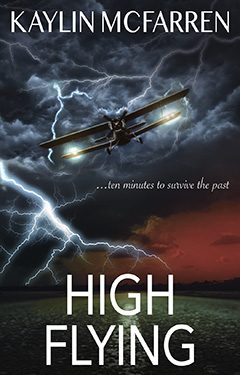
Stunt-pilot, 21-year-old Skylar Haines, honed by a childhood of adversity and trauma, is ambivalent about flying eight new maneuvers for which she’s had little preparation and no in-air practice. A lot could go wrong.
Her father, a pilot, was killed in a plane crash before she was born, triggering her mother’s downward spiral into a life of booze, drugs, and prostitution. When Skylar was seven, her mother died. As an orphan, Skylar fell into the system until her grandfather stepped in — no bed of roses there. Although she emerged an independent, savvy, and street-smart survivor who’d learned to fly along the way, those painful memories of her youth are always fresh in her mind.
Why had she agreed to fly in tandem with her mentor, Jake Brennen, for this performance? She might have said it was a lifelong dream. Or, that she did it out of love. Both would be true, but, of course, there is more…
Before she realizes it, she’s flown into the bowels of a storm, loses radio contact with Jake, and struggles to keep her plane aloft. After a near miss with another aircraft, she regains radio contact. A stranger talks her down into a world before her time.
Skylar uses everything she knows, and everything she’s learned to survive. Dylan Haines, who’s not yet her father, saves her, and she becomes entangled in his life in ways that stretch the imagination. He is caught in a web of danger and deceit destined to kill him. Skylar is tempted to intervene, but she knows his fate is set. Her father has to die, in order for her to live.
Like a modern-day H.G. Wells, Kaylin McFarren’s High Flying, ventures boldly into the fourth dimension, where history is reimagined, and epiphanies come in three-dimensional, real time. This gritty, emotionally penetrating story, set in Nevada, that not only touches upon social concerns with roots in the past but reaches into the future. The characters have depth, and the dialogue is sparkling authenticity. Here’s a story where everyone has an agenda, there are more crooks than cops, and bullets fly with abandon. In other words, a deliciously twisted sci-fi mystery with plenty of danger and romance!
A lonely child’s fantasy life intersects with reality in this Korean War-era tale of separation and reunion.
At almost nine, Jake often escapes into his imagination, blotting out a couple of situations developing around him. He and his mother are hoping against hope that his father might someday return from the Korean War, and Jake cannot read. Words just seem to jumble up before his eyes, the other kids make fun of him, and worse – bullying has become routine. These days, Jake tries every ruse to skip school until he is referred to a reading counselor who figures it out. Jake is dyslexic, as is the counselor, and this may mean he is, in fact, more intelligent than average, as well as unusually intuitive.
Intuition begins to seep into Jake’s life as he spends time in the attic arranging the Christmas ornaments, wishing it could be “Christmas forever” for himself, and for everyone. One of the decorations is a porcelain figure of an old bearded man, Ebenezer, who holds a mysterious, unreadable scroll. Deciphering the scroll’s message will lead Jake into a world of psychic visions, ultimately leading to his conviction that his father is alive. Jake’s mother, who has built a sentiment-laden shrine to her lost love, holds on to the last shreds of hope even as her soldier husband is officially presumed dead. Together, she and Jake will learn the surprising truth.
Author Clausen (Prairie Son) has an excellent grasp of the emotive power of the past to awaken the reader to timeless influences. In this story, the Ebenezer ornament said to be 100 years old, links old customs with a child’s search for peace and reassurance in the present. As the boy travels through time with the ancient sage, he becomes stronger, better able to face his current struggles.
Clausen writes with authority about these two subjects, dyslexia and its effects on the mind, and “The Forgotten War” in Korea, where thousands of American soldiers remain unaccounted for to this day. He also links the earnest, childlike wishes of Jake to find solace and create solutions to the pervasive sadness of a mother mourning her husband while doing her best to support and encourage their only child.
The novel begins and ends in a present-day framework in which we learn that Jake has incorporated his childhood adventures into an adult striving to expand the “forever Christmas” concept to a broader spectrum.
Plausible fantasy with a clear connection to our national past composed by a practiced wordsmith, My Christmas Attic can be appreciated as a classic seasonal saga with a cinematic quality that speaks of broader possibilities.
If you ask the district attorney of this affluent Louisiana community where a man has shot and killed another man, and the murder captured live on TV, there is no justification.
Jack Carney sees it differently. An affluent middle-aged civil attorney, he considers the killing to be the result of a man pushed beyond his limits by another who seemingly destroyed his marriage, kidnapped his son, and might have been planning a horrible fate for the boy he stole.
There are real-world consequences to Jack’s taking the case. The shooter, a childhood friend, has no money, so Jack volunteers to take the case free of charge. Jack’s law firm is dismayed, his wife is unhappy with his decision, but Jack’s conscience, his religious convictions, and his military honor will not let him ignore his troubled friend.
There is no question about whether Connor Padget committed the crime. The real suspense is whether Jack can still lessen the charge of murder to manslaughter when the DA is determined to show no mercy to the defendant; when Connor’s wife and Connor himself put obstruction after obstruction in front of Jack in his determination to have the law do right by his friend.
While the crime story is suspenseful, it is nearly matched by other nuances that lift this novella well beyond the usual legal procedural.
Rarely does a book about the law take you this close into the mindset of an attorney. Carney isn’t a criminal attorney but his ability to think “legal” demonstrates how a well-trained mind can work even in a foreign territory like criminal law. His familiarity becomes our familiarity. This is not a blockbuster case; no mob bosses will fall; no bombastic courtroom duels await. What is showcased here, however, is good lawyering, legal competence, and a writer’s commitment to sharing his love of the law with his readers.
Familiarity also extends to the book’s Louisiana setting. With small but well-crafted touches, you are introduced to the writer’s south, not so much of a bus tour as a first-person sharing of the places where the characters live. You know he knows and loves his south and brings you along for a first-person ride.
Two marriages—the client’s and the lawyer’s – are central to understanding the fates of both Connor and Jack. Neither is happy nor conventional. Jack’s marriage is particularly at odds: his wealthy wife plans to build a home in an affluent neighborhood and live there whether Jack joins her or not. Their sexuality flourishes, but will the marriage survive? As for Connor’s marriage, the fact that the murdered man played a part in the dissolution of his marriage is clear, but what part remains an open question. Unlike the portrayals of the law and the south in this novel, the path ahead for both marriages remains mysterious throughout.
This reader can only hope the author rescues Jack Carney from the obscurity he seems determined to want and bring him back for another round or two of tussling with the law and his conscience.







 More than 10 years ago, when Deeann Callis Graham went through a second bout of alopecia areata (AA), the first was when she was seven years old, she wondered where she could find pictures and read stories of people who were also losing their hair. She wanted to embrace positive messages amid a society that equates baldness with cancer and sickness. Yearning to relate to people who looked like her, she started writing her own story and soon she had connected with others with alopecia wanting to tell their stories.