Category: Reviews

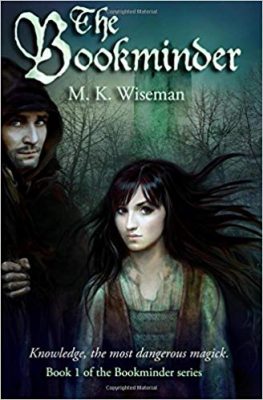
  • The BOOKMINDER by M.K. Wiseman – Fantasy, Coming of Age, Magic

    The BOOKMINDER by M.K. Wiseman – Fantasy, Coming of Age, Magic

    More than anything, Liara just wants to belong. As an orphan “fey” child in the seventeenth century, Liara has been a ward of the Church for ten of her sixteen years. Grateful to be taken in and cared for by Father Phenlick, she knows most of the villagers want her gone.

    The product of a rape by a magical creature, Liara is imbued with magic and in many ways is magic itself. The powerful wizard who created the creatures responsible for the attack during the attack on the valley, knows nothing of her existence. Father Phenlick enlisted the help of Nagareth, the wizard of the woods, to shield Liara and the village from further assaults all while outlawing the very power he is secretly trusting.

    At St. Sophia, Liara is safe until she steals from the village busybody. When Liara’s extensive hidden stash is discovered in a “magicked” hollow tree, the Venetian soldiers who protect the valley force Father Phenlick to ostracize Liara. Abandoned by even her friends, Liara is taken in by Nagareth, who promises Phenlick that he will not teacher Liara his craft. Liara begs Nagareth for magical instruction, but he only allows her to care for his extensive magical library. Gradually, Nagareth sees great potential in his new ward, but when everyone in Dvigard is killed by a mysterious plague, he begins to fear that he can’t protect her from her powerful creator who will want her powers for his own if she is discovered.

    Liara cannot see the danger around her, and as her own magical knowledge grows through her maintenance of Nagareth’s books, her only goal is to exact revenge against her father. As her abilities grow so does her anger and confusion at the only person standing between her and her destruction.

    Liara is a complex, dynamic character. Her history gives her more than normal teenage problems. Liara’s mother was driven crazy by the rape and was never able to truly care for or love Liara, leaving Liara to the cruelty of the villagers. Without Father Phenlick, Liara would never have survived, and though he tries to give her a home, he isn’t able to fill the emptiness deep within her. Liara desperately needs something and somewhere of her own, which is why she steals–to fill her life with things that are her own. In creating her hollow-tree hiding place, she creates that place where she isn’t afraid to be herself. Though she is unaware of her own magic, it is as much a part of her as her history.

    In the beginning, all Liara wants is to grow that power. She desires the very thing others accuse her of having to give her what she has never had, but it’s a double-edged sword. She is hated for her supposed abilities even before she shows evidence of magic, but when she finds the magic she wants so badly, it will define her. She wants others to see she has feelings and dreams, but in the very thing she wants most, this undeniable power, people will see only that. She limits herself to this magical creature, and that drive quickly becomes an obsession. Only too late does she see Nagarath’s minimal use of magic isn’t a waste. She almost allows her prejudiced idea that magic should be grandiose to cloud the important lesson she learns about living simply, living for love and not power. As she grows through her relationship with Nagareth, she learns what magic should truly be.

    The evolving bond between Liara and Nagareth is a beautiful story. Only nine years Liara’s senior, Nagareth sees Liara as a child in the beginning, but over the novel’s development, he begins to see Liara as a true companion. The joy she brings to his life, the peace she makes him feel, even though she annoyingly begs him to teach her magic, becomes invaluable to the lonely wizard.

    He wants to make sure she has a life of stability, not fear. As he opens himself up more and more, he becomes her friend. He realizes she has given him more than he has returned and relents in his promise not to teach her. Nagareth grows as much as his precious ward.

    The Bookminder won 1st Place in the CIBA 2017 OZMA Awards for Fantasy Fiction.
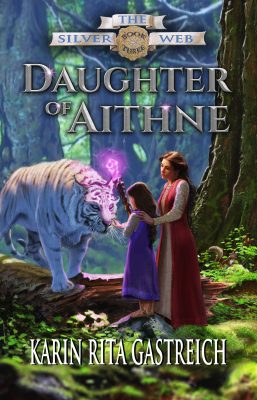


  • Daughter of Aithne: The Silver Web Series, Book 3 by Karin Rita Gastreich – Romance Fantasy, Sword & Sorcery, Magic Realism

    Daughter of Aithne: The Silver Web Series, Book 3 by Karin Rita Gastreich – Romance Fantasy, Sword & Sorcery, Magic Realism

    Writer and ecologist Karin Rita Gastreich draws inspiration from her trips to the magical forests of Costa Rica to bring life to the Silver Web series. An unforgettable journey, Daughter of Aithne, is the finale to the epic story of Queen Eolyn the High Maga, set in a world of seemingly never-ending war where female practitioners of magic (maga) are feared.

    Set ten years after the conclusion of Gastreich’s second installment in the series Sword of ShadowsDaughter of Aithne begins during an era of abundant peace. That peace quickly turns to turmoil when a group of Eolyn’s magical progeny commits an act of grave betrayal by kidnapping Princess Elisara, daughter of the former Queen Taesara.

    The Mage King Akmael immediately orders all maga to lay down their arms and have their magic bound. For years magas have been prosecuted for having magic and were all but annihilated by the crown. Except for a small amount that managed to escape hoping to one day be able to live their lives of magic according to their beloved culture. Fear of women’s magic is still alive in the kingdom, and the King, wishing only to protect his queen and her daughters, attempts to avoid an outbreak of war by banning all magas use of their craft.

    Gastreich uses vivid language to transport readers into the story. An overarching theme of distrust and vying for loyalties in and among kingdoms presented in this third installment of the Silver Web series is reminiscent of other high fantasy series such as George R. R. Martin’s A Song of Ice and Fire. Gastreich masterfully executes an effective use of narrative misdirection throughout the story.

    Karin Rita Gastreich has an apparent love for the magic of nature and breathes that into the heart of her books, but she also successfully sets real-world issues at the forefront. She follows a common trope within the Young Adult genre by taking an issue from today and melding it into her narrative. Here, the main element in the Silver Web trilogy is the stark contrast of beliefs and opinions centering around magic and especially female magic welders. Many fear their magic and believe magas are dangerous, but then have little or no issue with male mages.

    A triumphant story of adversity, Daughter of Aithne is the exciting conclusion to the Silver Web series. Readers of all ages may hope this is not the last time Gastreich will return to her fantastical world of magic.

    Daughter of Aithne won 1st Place in the CIBA 2017 OZMA Awards for Fantasy novels.


  • WHAT GOES AROUND COMES AROUND – A Guide to How Life REALLY Works by Rob Davis – Philanthropy & Charity, Motivational Management & Leadership, Business Motivation & Self-Improvement

    WHAT GOES AROUND COMES AROUND – A Guide to How Life REALLY Works by Rob Davis – Philanthropy & Charity, Motivational Management & Leadership, Business Motivation & Self-Improvement

    Combining personal vignettes with sage advice, Rob Davis demonstrates how the saying, What Goes Around Comes Around, connects to other sources of wisdom, indeed to our everyday lives. As an adult involved in business, family, and sports, he came to recognize how true the saying is.

    As a child, he often heard the expression, “As you sow, so shall you reap.” As an adult, he saw in numerous situations, including the experiences of friends, business partners, and in his own life, how the results we reap do come from the actions we sow.

    It was some time until he realized that “sow” referred to the planting of seeds and had nothing to do with needles and thread. Also, that “reap” referred to how successful or disappointing the resulting harvest would be.

    One example referred to the Ponzi scheme run by Bernie Madoff, the notorious financier who had built what appeared to be a thriving business until being exposed as a fraud who stole $millions, even from widows, orphans, and charities. Madoff is now in prison, most likely for the rest of his life.

    Suppose Davis suggests, that early on, Madoff had called together those involved, and “fessed up?” While the consequences would have been painful, they would not likely have been anything as disastrous as the total ruin he and his family ended up experiencing.

    The lesson here is that the longer one lets the deception continue, the more bottomless the pit they dig for themselves when the light finally catches up to them.

    Much of the book’s theme rests on the significance of choice. When it appears that we have no other option in a given situation, the right choice probably seems like the most challenging thing to do. Here Davis cautions us to set our sights on the high road to avoid losing the chance for the most positive possible outcome.

    Of course, not all choices are wrong, and not all comebacks are bad. A friend and running buddy described by Davis wrecked his car after having had a few too many drinks at a party. His driver’s license was suspended for three months, along with the requirement to attend weekly classes. Despite the problematic consequences, his friend turned this self-created slip into an example for his children, by accepting the full measure of his punishment and making the best of it.

    Some of Davis’ stories are his own, such as the time he was kicking himself for not living up to his commitment to helping a friend who had organized a charitable fund-raising event. The result led to his creation of a new organization supported by alternative, investment industry people for the prevention and treatment of child abuse.

    His book concludes with positive “Thoughts to Live By,” such as – I Choose HappinessI Cooperate for the Greatest GoodI Take the High Road, and I Expect to Be Happy.

    His philosophy, as expressed here, makes effective use of humor, humility, and a hefty helping of logic! Drawing insight from personal parables, Davis has constructed a manual of straightforward and sensible life skills designed for those who genuinely want “what goes around” to yield the best outcomes!


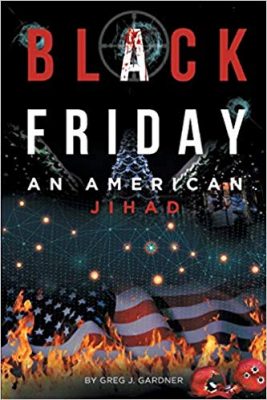
  • BLACK FRIDAY: An American Jihad by Greg J. Gardner – Thriller, Military Thriller, War

    BLACK FRIDAY: An American Jihad by Greg J. Gardner – Thriller, Military Thriller, War

    Art imitates life and life imitates art. When Greg J. Gardner was writing his highly suspenseful novel, Black Friday, An American Jihad, the mass shooting at the Walmart in El Paso had not yet occurred. Taking place on Labor Day weekend, the shooter knew the store would be filled with people taking advantage of sales on school supplies as students prepare for the first day of class. Customers and their children became targets as the store was turned into a carnage-filled scene.

    Why is this relevant? In Gardner’s book, scenes of mass violence take place in many Walmart stores in the United States on the busiest shopping day of the year, Black Friday. The killers, in this case, however, aren’t American; they’re 50 jihadists who have been training for years for a series of precisely timed and sequenced attacks that will result in the deaths of thousands and derail American life in a manner never seen before. Just when people think the attacks have stopped, they’ll begin again at other retail locations.

    This is a story with nuance. The author considers the critical questions of why and how this jihad was undertaken. He avoids fairytale extremes of good and evil and delves into the harrowing events that produced an assassin, a mastermind able to motivate a team of men to turn Black Friday into “Bloody Friday.”

    The media barely has time to digest the latest attack before the next shooting rampage occurs. Stores become war zones, but the United States has no defense in place because only the terrorists know when and where the next attack will take place. The hours roll forward, and Americans continue to be perfunctorily slaughtered. An assembly line of meticulous mass scale murder is underway.

    Chaos begets chaos. In this era of immediate reporting on social media, Facebook declares, “We cannot allow these images to propagate through our platform.” Twitter and Snapchat agree while Instagram crashes, and YouTube shuts down its servers. Walmart stores across the nation close. Vigilantes attack mosques, American gangs attack each other, and looters are on the prowl. ATM machines run out of money, and thousands of businesses close.

    The National Guard is deployed, and the President eventually declares Marshall Law. With their liberties curtailed and life essentially shut down, the only thing left for Americans to do is watch CNN, a reporter now one of the most important people in their lives. America is no longer the country its citizens recognize, and it all happened so quickly.

    This is a fast-paced, heart-pounding narrative in which we meet many characters, most only briefly. There are poignant moments of would-be heroism cut all too short but also a few genuinely bright spots in a reign of terror.

    Gardner notes in the epilogue that he, of course, hopes his book will never be a reality. Nonetheless, this is a novel that will stay with you, that you’ll think of as you’re shopping, as you’re noticing a security guard in a parking lot, and certainly as you’re watching the evening news. Once you’ve been taken to the brink and given a glimpse of what could be, the concept of safety itself is in question.


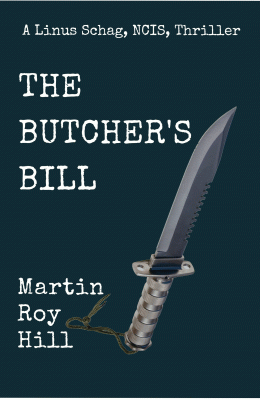
  • The BUTCHER’S BILL (The Linus Schag, NCIS Thrillers Book 2) by Martin Roy Hill – Int’l Mystery & Crime, Military Thriller, Suspense

    The BUTCHER’S BILL (The Linus Schag, NCIS Thrillers Book 2) by Martin Roy Hill – Int’l Mystery & Crime, Military Thriller, Suspense


    Bill Butcher can’t take it anymore. He’s played by the rules and lost. Now he’s making up his own rules. He’s determined to assert his own justice upon the people he identified as secretly betraying him and the troops who serve the country.
    In this novel, part of the conspiracy against Bill Butcher is the publishing of a fraudulent list of demands supposedly written by him. The media nicknames the list The Butcher’s Bill. How can he fight? Follow the money trail, is all he can do – and what he hopes Linus Schag will do. It’s clear by now that Bill Butcher is a tormented man; terminated from NCIS (Naval Criminal Investigative Service) after his deployment in Iraq under accusations he’s unstable.

    In every sense, this is a page-turner that readers won’t want to miss as Bill Butcher conducts his own subversive investigation to exact revenge. Is he out of his mind? Or, are his instincts right? This second book in the Linus Schag series by author Martin Roy Hill will keep you up nights.

    Agent Schag has a reputation for impatience with authority, hidden secret guilt from his previous assignment, and boredom with his current exile in San Diego. He is the best in the business, and he is the only person Bill Butcher trusts to do the right thing. But when Butcher commits a crime so outrageously brutal, that Agent Schag is called in to bring him to justice. The question is, what kind of justice should be administered, and to whom?

    Despite all obstacles before him, Bill Butcher relentlessly pursues the man he suspects is the source of the corruption. He will put an end to this man or die trying.

    Linus Schag analyzes the evidence while keeping a vigilant watch against treachery. As he reviews the case, his concern grows. It is at this point, Lt. Commander Kendra Clarke of the Medical Corps steps in and diagnoses Butcher’s behavior as severe psychosis from a drug administered by naval officials. This new information may explain the gruesome messaging Butcher leaves behind at the crime scenes.

    This is a smart thriller that will keep you guessing until the very last page. Martin Roy Hill builds the suspense skillfully, placing you just where he wants you: on the edge of your seat.

    Martin Roy Hill is well-versed in the culture and commitment of those who serve in the military, especially the Navy. Even the term, “The Butcher’s Bill” is an old naval slang for the list of killed and wounded after a battle and takes on an additional meaning as it also represents the number of dead left behind as the book’s plot advances. Hill relates a compelling picture of service. These are professionals against a smart setting.

    Be ready to puzzle through the trail of evidence as it is uncovered and analyze the potential motives of characters who are not always as they appear. This thriller engages the reader to solve the ultimate twisted solution.  A thrilling work of fiction inspired by historical fact will leave readers wondering how closely art imitates life. Highly recommended.

    The Butcher’s Bill won 1st Place in the 2017 CIBAs CLUE Awards for Suspense/Thriller novels.


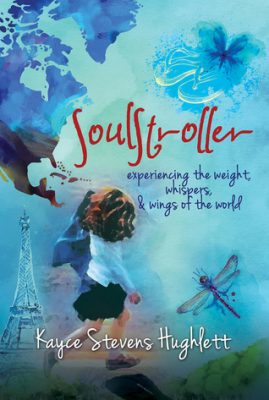
  • SOULSTROLLER: Experiencing the weight, whispers, & wings of the world by Kayce Stevens Hughlett – Women’s Biographies, Personal Transformations, Self-Help

    SOULSTROLLER: Experiencing the weight, whispers, & wings of the world by Kayce Stevens Hughlett – Women’s Biographies, Personal Transformations, Self-Help

    In a creative blend of existential memoir and artful travel journal, Kayce Stevens Hughlett’s SoulStroller takes readers along on an adventurous journey of self-discovery. Reminiscent of Elizabeth Gilbert’s popular Eat, Pray, Love, Hughlett focuses on family issues, ancestral memories, and dreams explored within the context of personal travels, focusing on the importance of moving beyond our comfort zones.
    Here we come to learn that a SoulStroller is a term used for an individual who ventures into the fullest version of their true selves. Guided by intuition and spiritual essence, they stroll through life with a feeling of curiosity, compassion, contentment, and gratitude. Like a pilgrim on a quest, they follow their heart, rather than move ahead with a tourist mentality of set goals and to-do lists.

    Raised with the traditional expectations of the “good girl,” Hughlett lived the first 30 years of her life within 150 miles of Oklahoma City, an area of white, middle-class, conservatives. The blinders came off when she moved to Seattle. Divorced, and remarried with two children, Hughlett indicates that when everything is FINE, sometimes that refers to the acronym for “fucked up, insecure, neurotic, and exhausted.”

    It is during a trip to Mexico in search of a therapeutic boarding school for her troubled son that she finds a sense of peace and a firm idea of place as she falls in love with the desert landscape. With the outstretched arms of the saguaro cactus offering a sense of peace, it is in this moment that everything changes.

    Hughlett’s journeys go far beyond visits to the likes of the Eiffel Tower and Louvre. Whether enjoying the delicacy of an eggplant and cheese sandwich on the banks of the Seine or meeting a charmingly eccentric and her poodle, Hughlett learns to distinguish the essential rhythms of her own life.

    Hughlett writes with a comfortable conversational voice that invites readers into her world view; one that she approaches with both exuberance and trepidation. The overall narrative unfolds in a generally chronological sequence, though journal entries and recollections can at times reflect past memories or events.

    Insightful words from several authors, poets, scholars, and artists are used to grace the opening of each chapter, including contributions as varied as those of Roald Dahl, Thich Nhat Hanh, Gloria Steinem, and Henry Miller. Mark Twain’s quote seems to epitomize the central “SoulStroller” sentiment in “Sail away from the safe harbor. Catch the trade winds in your sails. Explore. Dream. Discover.”

    Each section of the book concludes with a simple practicum highlighting suggestions for readers to venture into their own SoulStrolling mindset. Exercises range from quiet meditation and writing prompts, to practicing self-kindness and ideas for travels off the beaten path.

    While Hughlett considers that her story may be too personal or esoteric for some readers, her work speaks to her positive growth, as her travels and experiences have allowed her to trust her own voice and value the lessons of her own journey. This is a book that strings together individual pearls of wisdom that have universal appeal.

    SoulStroller by Kayce Stevens Hughlett won 1st Place in the CIBA 2018 Journey Awards for Narrative Non-Fiction.


  • A TALL TALE ABOUT DACHSHUNDS in COSTUMES: How MORE Dogs Came to Be by Kizzie Jones – Children’s Books, Children’s Dog Books, Children’s Fantasy & Magic Books

    A TALL TALE ABOUT DACHSHUNDS in COSTUMES: How MORE Dogs Came to Be by Kizzie Jones – Children’s Books, Children’s Dog Books, Children’s Fantasy & Magic Books

    A unique fairytale by author Kizzie Jones, A Tall Tale About Dachshunds in Costumes: How MORE Dogs Came to Be adds the third book her series that began with How Dachshunds Came to Be: A Tall Tale about a Short Long Dog, followed by the award-winning title, A Tall Tale about a Dachshund and a Pelican: How a Friendship Came to Be.

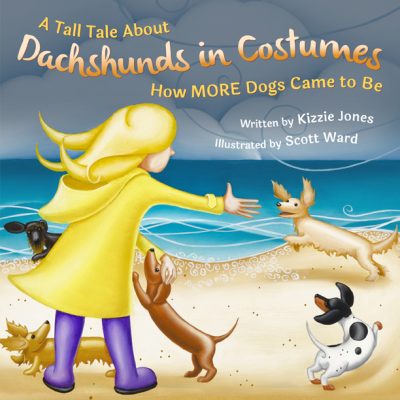
    This tall tale begins on the beach one autumn day where a big storm is fast approaching a girl and her dogs, stopping their play and forcing them to retreat indoors. The next day the girl and the dogs decide to go clean up the debris left by the storm, and it is not long before they see what sort of costumes they can create with the various kinds of debris scattered along the beach.

    The dressed-up dogs ask the girl if she would be upset if they stayed dressed up.  The girl wonders if the dogs would change on the inside as well. they reply,

     “We’d be changed and transformed—we’d be diff’rent outside. Yet, inside, our hearts are still caring and kind.”

    That night the girl sends her wish to the ocean for the dogs to become the dogs they costumed themselves to be and goes to sleep hoping her wish will be granted.

    It is easy to see that author Kizzie Jones has a deep love for her dachshunds and nature, but it is also clear that she loves to teach through her books. With assistance from USDA Forest Service, Jones fills her story with accurate plant life as well as lots of terms for different dog colorings and patterns, all of which she includes in a glossary at the end of the book.

    Dachshunds in Costumes is a creative story that gives a lighthearted explanation for how the different breeds of dogs came to be, and as Jones’s previous books, we see the gift of self-acceptance. Also present is a meter that has a lilting and soothing quality. The meter pairs well with the wonderful illustration work from Scott Ward that has a unique and uniform shading style that readers of all ages will admire.

    Kizzie Jones’ newest addition is perfect for the curious and inquisitive child who will surely spend hours curled up studying all that A Tall Tale About Dachshunds in Costumes: How MORE Dogs Came to Be has to offer.

    This title will be released on November 3, 2019, in English and in Spanish! If you would like more information, please sign up on Kizzie’s blog here.


  • KASSY O’ROARKE: CUB REPORTER – PET DETECTIVE, Book 1 by Kelly Oliver – Middle Grade Mystery, Caper, Action/Adventure

    KASSY O’ROARKE: CUB REPORTER – PET DETECTIVE, Book 1 by Kelly Oliver – Middle Grade Mystery, Caper, Action/Adventure

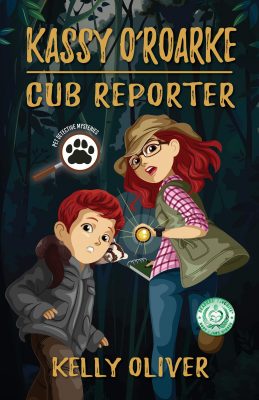
    A blue and gold badge for the 2020 Grand Prize Winner for Gertrude Warner Middle Grade Readers Kassy O’Roarke, Cub Reporter by Kelly OliverIn this first installment from the new Kassy O’Roarke Pet Detective Series, award-winning author Kelly Oliver delivers a fun and engaging kid-friendly literary experience. Here is a story intended for middle-graders, Cub Reporter proves a quality blend of adventure and mystery involving a smart, inquisitive 12-year old with aspirations of becoming a spy.
    As a reporter for her school paper, Kassy’s hoping to nab a front-page scoop and win the honorable Thompson Award for Journalism. Unfortunately, help from her pesky, but the well-intentioned younger brother, sets in motion a roller coaster of calamities she never expected. From animal-nappings and a mixed-bag of clues to car chases and rescues from entrapment, ultimately the constant reinforcement from family, friends, and a menagerie of furry companions bring positive lessons to the forefront of this likable tale.

    Kassy O’Roarke and her brother Percy, aka “Crispy,” live with their veterinarian mom in the Lemontree Heights Community. Mom runs an animal clinic, along with a petting zoo. The father has moved out and is living 10 minutes away in Nashville with his new family. Since his parents’ separation, Percy has developed a penchant for talking to the animals. The wacky ensemble includes a variety of rescued creatures, including a circus camel named Spitoon, Chewbacca the lab chimp, an anteater dubbed Athena, and Percy’s ever-present sidekick, a flatulent ferret named Freddie who likes to steal keys.

    When the 3-month old cougar cub, Apollo, goes missing, Kassy’s determined to find him before he’s captured by the local animal control officer, Pinkerton Killjoy. Mean-spirited “Pinky” seems determined to shut down the family’s petting zoo.

    Oliver creates a quirky and endearing character in young Kassy and tells the story from her perspective. With her tendency to overthink everything, the studious bespectacled loner gravitates to books, reads the dictionary to expand her vocabulary, and astutely realizes her strengths when she comments, “No one can take away the stuff in my head. My brain is my secret weapon.” The pre-teen detective wannabe also tends to keep a well-stocked pocketed “spy vest” on hand, complete with various accouterments of the trade.

    Within a modern-day framework, Kassy is a sensitive and vulnerable individual who worries about her mom, longs for her dad’s love and approval, and is always willing to take risks (even at the chance of being grounded for a year) to garner the greater good. Kassy is surrounded by a vibrant and colorful cast of characters, including future stepsiblings, classmates, and neighborhood locals that help fuse the story with themes of friendship, loyalty, and honor.

    The frantic search for Apollo keeps the action moving at a steady, well-conceived pace. Smart questions and a trail of riddles will draw readers into the investigative mode, while details that hinder Kassy’s probe, (from wild thunderstorms, gushing rivers, and blocked exits, to nosy receptionists, a cacophony of barking dogs, and conflict with Killjoy) all lead to twists and turns and a heightened rush of adrenaline.

    While pawprints form a corner framework on chapter title pages, a scattering of black & white illustrations provides a quick artistic reference for happenings throughout the narrative. The drawings are essential, and easily capture the intended humor, whether in the antics of undie-clad animals at a birthday party, or the central heroine dowsing a mustachioed villain with glue. Oliver continues to render this strong sense of middle-grade humor with the lively and conversational dialogue where unlikeable characters are labeled as “deviled eggs,” and expletives of frustration are shouted in G-rated profanities of the “Shrimp and grits!” variety.

    Amidst popular classics like Emil and the Detectives and the resurgence of the Nancy Drew mysteries, Oliver has hit the mark with this bright and entertaining series opener. Though geared toward a younger audience, readers of all ages can look forward to more investigative capers on the horizon featuring the creative escapades of Kassy and company. Highly recommended!


  • CALL to JUNO (A Tale of Ancient Rome, Book 3) by Elisabeth Storrs – Historical Fiction/Ancient World, Historical Fiction Romance, Mythology

    CALL to JUNO (A Tale of Ancient Rome, Book 3) by Elisabeth Storrs – Historical Fiction/Ancient World, Historical Fiction Romance, Mythology

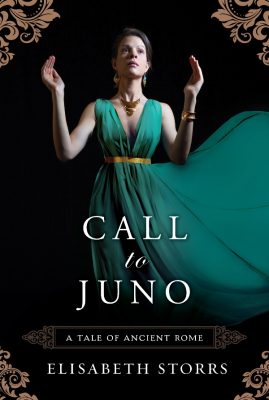
    Elisabeth Storr delivers an extraordinary tale of “Peasant and patrician; concubine and master” where man seeking woman, man seeking man (mostly unrequited) and man seeking boy, erupts into a generous narrative of the quest for power between a reluctant Etruscan king, Vel Mastarna (situated in Veii—mere miles from his oppressor) and Marcus Furius Camillus—he who would be Rome’s dictator in her stunning Historical Fiction novel, Call to Juno: A Tale of Ancient Rome.

    Veii has been under a 10-year siege; Rome biding its time at the unsurmountable gates, waiting to starve its conquest into submission (and thereby looting the bounty and putting Rome’s finances back into the black).

    But there is danger afoot: almost entirely fueled by relationships strong or soured. Along with the “human” battlements, the gods must also be looked after—not a few of them “serving” both sides of the battle.

    At the center of it all is Artile Mastarna an Etruscan soothsayer who would rather corrupt boys than provide life-advancing advice. His brother, Vel (albeit reluctantly) is readily betrayed by his all-knowing sibling who prefers to work with the Romans and topple his own countrymen. A further link to Rome comes in the beguiling and astute shape of Caecilia. Years ago, her Roman relatives used her as the glue for peace in a forced marriage between the warring countries. Their eldest, adopted son, Tarchon, also prefers the company of men and makes no bones about showing his inclination. Four other children have blessed this political union which, nonetheless, has become a truly loving relationship.

    In Rome, the action centers around the highly ambitious Marcus Furius Camillus, unashamed patrician and consular general. His love interest is a former prostitute (kept a secret from her lover, but others within the circle are aware), who faithfully serves her master in the role of concubine. The gay blade on this side of the divide is Marcus Aemilius Mamercus, whose unrequited love for Appius Claudius Drusus is further complicated Drusus’ infatuation with Caecilia—all the better to kill the Etruscan king!

    Watching, of course, are the gods. How curious that both sides worship the same deities, albeit with different names (e.g., Uni/Juno, Tina/Jupiter, Aplu/Apollo, Fufluns/Dionysus). When simultaneously beseeched for assistance from the disparate factions, what’s a god to do? Beware the thunderbolt!

    As with all good historical fiction, Storrs takes us on a long-ago journey that has much relevance for the present day, proving once again the old adage that there is nothing new under the sun (and in this case, son). Savor the past, then fill in your own cast of 21st-century characters and see them through the lens of time.

    Call to Juno won 1st Place in the 2017 Chaucer Awards for Early Historical Fiction.


  • BLIND TRUST by John W. Feist – Political Thriller, Suspense/Thriller, High-Stakes Int’l Thriller

    BLIND TRUST by John W. Feist – Political Thriller, Suspense/Thriller, High-Stakes Int’l Thriller

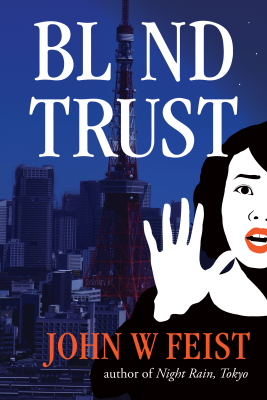
    Brad Oaks and his wife Amaya have no idea what is in store when they answer a call for help from the newly appointed Japanese prime minister in John W. Feist’s second novel, Blind Trust.

    The year is 2022, and a mysterious explosion compromises Japan’s electric grid infrastructure (LNG regasification, to be precise). Yuko Kagano’s election as the next prime minister comes with the hope that she will commit to her campaign promise of restoring Japan’s energy structure. However, she must first deal with the criminal activity associated with the previous leader. She needs help. She calls on Brad Oaks and Amaya Mori, his wife, for advice on pipeline and steel strategies. Amaya especially, as the two women have known one another since college, and both are heirs to familial steel companies, the American Elgar Steel and the Japanese Kanawa, respectively.

    Brad Oaks gave up his lawyer career a few years back after he rescued Amaya when she was abducted due to her connections with her father’s company. The two fell in love, married, and moved to California. Now, Brad is the executive vice president of Elgar Steel (Please refer to John W. Feist’s first novel in the series, Night Rain, Tokyo). Three years later, they receive a call from Eisuke Tanaka, the commissioner of the Tokyo Metropolitan Police, who delivers the message that Yuko requests a meeting with them in Tokyo. The call couldn’t have come in a more inconvenient time. Brad and Amaya are critically assessing a possible new season in their marriage: adoption. Placing their plans on hold, they fly to Tokyo unaware that they will be walking into deadly covert schemes to undermine the prime minister.

    John Feist blazes a path in his approach to geopolitical suspense. Having ventured into Japanese culture via his past professional connections, Feist understands, firsthand, the underlying and ongoing cultural tension that exists between the Japanese and foreigners in the business sector. That said, Feist’s method of storytelling is not Americanized, which usually follows an often dizzying and fast-paced route. Instead, tension builds through innuendo-rich dialogue scenes between characters as he undergirds his plot with realistic aspects of Japanese culture that is rooted in “nativism” (the revival or perpetuation of an indigenous culture especially in opposition to acculturation, Merriam-Webster).

    Feist does an excellent job surrounding Brad and Amaya, his principal characters, with a diverse cast of characters that range from subdued to surly. Each chapter alternates character POVs packed with a handful of red herrings and a plethora of unexpected twists and turns amid political history and the sights, sounds, and smells of a beautiful Asian country.

    Blind Trust is a unique and satisfying Political Thriller that closes on a promising note of a sequel.