

 Slow is smooth. Smooth is fast. This is the code that John Bishop, one of America’s most decorated military heroes, teaches his men to follow whether they’re on a mission in the heat of the Middle East or in the jungle that is New York’s Lower East Side in Rafael Amadeus Hines’ novel, Bishop’s Law.
To say his life is complicated is putting it mildly. In this second volume of the John Bishop series, several high-level assassins are hell-bent on killing him for his actions as a soldier. At the same time, he’s deep in his crime family’s military-style battles against various opponents’ groups. All these forces are closing in on him simultaneously, even as the United States government had hired him and his family to protect the country from bad guys using whatever means necessary.
Complicated? You bet. But if you crave non-stop action, ultra-violence, and high body counts in your novel-reading this fall, this is a great place to start.
Part Panamanian, part Jamaican with amber eyes, his face forever scarred in an assassin’s attack that killed his parents when he was nine, Bishop is related by blood to the powerful Valdez crime family. He learned from them—the ability to act, lead, protect his men at all costs—served him well as a Special Forces soldier who fought in the Middle East against a host of bad actors. By the time the story begins, Bishop has returned from overseas, living with Maria, his childhood sweetheart, and about to become a father. He dreams of leaving his military life behind but instead finds himself helping the Valdez family in a significant military-style action against Russians on New York’s Lower East Side.
The complications are only starting.
While setting up the military engagement with the Russians, he also finds out that his previous actions in the Middle East have earned him the wrath of some of the world’s most dedicated killers from Russia, Pakistan, ISIS, and even a corrupt U.S. billionaire. Not great if you want to stay alive.
While this book is clearly an action thriller, with deep roots in military-style combat, detailed weaponry descriptions, and sustained action scenes, the human story comes front and center even as the mayhem continues. Bishop is no superhero. His emotions are of a man who experiences sizeable loss and yet must keep his feelings bottled up as the beloved leader of his band of brothers. While he is wounded several times throughout the book, we feel his determination to continue doing his duty under the circumstances, few of us could sustain.
In other hands, a story of this complexity could have been cartoonish, a video game. But the book maintains a careful balance between the go-go action and the humanity of its characters.
Bishop’s Law is the second in a series on John Bishop. A third book is in development as of this writing. Readers may want to consider reading the first volume, Bishop’s War, before reading Bishop’s Law. While the book stands on its own, a richer reading experience might be had by reading the two books in sequence.


 The first book in the Plane series,




 After being charged with burglary and attempted arson, fifteen-year-old African American boxer, Curtis Jefferson, has been sent to Fort Grant, a juvenile detention area in Arizona in Vince Bailey’s Path of the Half Moon.

 In a rundown Minneapolis neighborhood, a woman and her three children are shot to death by someone using an automatic weapon. The city is shocked. The police department goes on full alert.

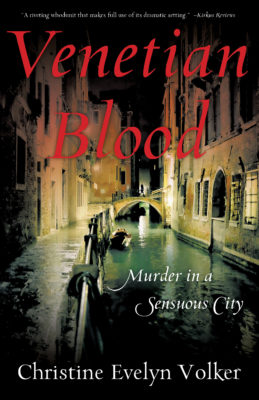
 Venice has a long and intricate history and is best known as “The Floating City.” Tourists from across the world come to marvel at its beautiful architecture and walk over its countless bridges. Getting lost in time among the splendors of Venice can be seductive. Visitors will recognize the undercurrent of romance and mystery to the city, and make no mistake, Christine Evelyn Volker captures it in her novel, Venetian Blood: Murder in a Sensuous City.
 Twenty-two-year-old museum intern and unknown artist, Anne Gautier, has undertaken a significant project, restoring an elegant house on one of the most beautiful streets in New Orleans. The grand old Creole home has been in her family for many generations, and, when her grandfather died, he left her the house on Esplanade Avenue, where all the best French Creole families once lived.