Category: Reviews

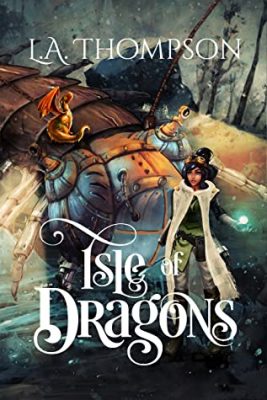
  • ISLE of DRAGONS by L. A. Thompson – Steampunk Sci-fi, Y/A Sword and Sorcery Fantasy, Fantasy Anthologies and Short Stories

    ISLE of DRAGONS by L. A. Thompson – Steampunk Sci-fi, Y/A Sword and Sorcery Fantasy, Fantasy Anthologies and Short Stories

    Jade of House Sol has the chance to save her father from the Isle of Dragons, but land, sea, and the guards of her homeland stand between them. Will, her new friends, prove loyal and capable enough to see her journey through, and what will they find on the elusive island?

    Carison Sol, betrayed by his fellow nobles, disappears across the sea in the dark of night. Meanwhile, Jade flees the guards chasing her, the leader whom is Kaylen, a former friend. Just as her pursuers close in, a young witch named Miria saves her and offers shelter, but Jade can’t stay still long. Though she doesn’t know much about the Isle of Dragons, Miria and her brother Dan must find their parents, and they offer to join Jade in her quest. Together, the three of them find a dragon who can take them to the magical island. Their journey is full of friends and enemies – and situations that test their mettle and their connection to one another.

    Isle of Dragons starts off running, with a tense scene of Jade evading the guards who want to drag her back to the capital. From there, scenes after scenes flow quickly into one another, leading the characters to new and exciting challenges. As they run and struggle, Jade and her companions gradually uncover a dangerous conspiracy that’s shifting the very forces of their world out of balance. They rarely have a chance to rest, constantly on the chase, which relaxes only long enough to prepare the next rising tension point.

    Author L. A. Thompson develops her coming-of-age young adult novel with characters that will resonate with today’s audience.

    Her characters showcase their personalities and the dynamics they’ll share with those around them, which makes the cast unique and compelling. The journey develops and expands with charming, friendly people who bring Isle of Dragons’ world to life, alongside the callous villains. Kaylen, the hunt’s leader, makes for a villain both relentless, and in her uncertainties, sympathetic. She becomes a strong foil for Jade as the story continues, drawing on their shared past.

    Jade’s heart is bare in the prose, showing the strength of her desire to save Carison, as well as her fear of being a burden on her friends, of putting them in danger with her very presence. The relationships and conflicts between Jade, Miria, and Dan remain at the heart of the story, even as Jade and Miria’s determination borders on obsession and threatens to destroy them.

    Thompson sets scenes with efficiency and care, with landscapes of fully realized Steampunk, full of color, heat, cold, and history.

    The sense of mystery and adventure is vital as the heroes find something new to learn about every place they visit. Their travels begin with fantastic descriptions of fighting, riding, and befriending dragons. They master impressive feats of magic and the mechanical vehicles which roam the land, driven by Jade, Dan, and their pursuing guards. Their flight through these extraordinary settings becomes grander and more complex with every close escape, action scenes growing more intense to match the stakes they hold.

    To finish her journey, Jade must learn the importance of not facing the world alone but embracing the community and kindness to save the lost and frightened. She finds that good people are struggling under their corrupt, power-hungry leaders and that the only way to go on is to accept help and offer it to those she meets. Kaylen’s villainy is thrown into stark reality by the unjust law she serves and the cruelty that those above her inflict. Betrayal offers intoxicating power; will Jade resist it and keep her loyalty to those who care for her, or will her old world of scheming nobles drag her back into their fold?

    Isle of Dragons is an excellent fit for fans of fantasy and adventure, and those who love to see creative Steampunk mechanical devices, magical fights, and well-developed characters whose story is worthy of reading the next book in the series.


  • CECILIA (The Cecilia Series Book 1) by Sandra L. Rostirolla – Teen & Young Adult Myths and Legends, Teen & YA Dystopian, Teen & YA Dark Fantasy

    CECILIA (The Cecilia Series Book 1) by Sandra L. Rostirolla – Teen & Young Adult Myths and Legends, Teen & YA Dystopian, Teen & YA Dark Fantasy

    Content and happy in a village nestled deep within the forest, eighteen-year-old Cecilia never realized a bigger world existed in Cecilia (The Cecilia Series Book 1) by Sandra L. Rostirolla.

    After the Great War, Cecilia’s great ancestor led a small group of followers far away from the destruction left behind. For many years, they lived underground away from the poisonous air until it was safe to begin life above ground again. Now, generations later, Cecilia lives an idyllic life with her mother and two older brothers. One day, a group of dark riders decimates her village, killing every female and old person and taking prisoner all of the males old enough to join their ranks or serve as slaves for Vitus, a city Cecilia never knew existed.

    After narrowly escaping the riders, Cecilia is visited by Siersha, the Goddess of Light. Cecilia now has a deep drive to save her brothers though she knows nothing of the world beyond her forest. Not long into her journey, Cecilia is attacked by Amalardh, a professional killer sent to find the lone survivor of the village massacre. When Cecilia saves Amalardh from a horrible accident, he can’t bring himself to kill the beautiful, innocent girl. He agrees to take her to Vitus to find her brothers. However, as the two become closer, it is clear Siersha has a purpose for them both unfolding from an ancient prophecy that must be fulfilled by the Flower Princess and the Wolf.

    As the Dark Shadow named Eifa moves across the land, Cecilia and Amalardh know they must defeat the darkness before it annihilates the tiny shred of human goodness left in the world. But with an army of dark riders and the sadistic rulers of Vitus, the two will face a greater evil than they know.

    A central theme of the novel is resilience.

    Cecilia is an untested, completely innocent girl with no knowledge of evil. In fact, her greatest “sin” is her refusal to kiss Leighton, a boy with a hard crush on his former friend. Because Cecilia loves and respects the connection between all living things – and loves to tell stories of the myths and legends of her people, the village girls gather to listen to her stories about the Flower Princess and the Wolf while she braids their hair.

    To Cecilia, the stories of the brave warrior princess are just beloved fairy tales until her initial visit from Siersha. At first, she resists Siersha’s urging to take the challenge of returning light to the world of men. However, when she sees the villagers’ bodies and that of her mother’s, she knows she cannot hide. That is when her resilience truly begins.

    After burying the dead, Cecilia begins a journey she couldn’t have fathomed before the killings. She often questions her ability to accomplish such an enormous task, but she digs deep within herself to find the strength to go on each time. Even when confronted by Amalardh, the Dark Shadow of the Senators of Vitus, Cecilia refuses to give in to the darkness. When she begins to see the connection between herself, Amalardh, and the fairy tale she loves, she believes in her purpose. Through her resilience, Cecilia convinces Amalardh as well. Each group Cecilia meets questions her belief, but she never gives up and eventually convinces strangers to believe in her purpose as well. Cecilia rises to become the warrior princess, who, without her resilience, her incredible journey, both literal and metaphorical, could never have happened.

    The love story between Amalardh and Cecilia is another beautiful facet of this novel.

    Cecilia decided long ago never to love a man. but Amalardh’s story goes much deeper. Raised by the Senators for the sole purpose of killing, he has none of the softer emotions connected with love. After his father’s death, Amalardh was imprisoned and beaten for years, then trained as an assassin by the head of the army of Vitus. He has never known kindness from another human. When Cecilia, his next intended victim, saves his life, he cannot process his emotions. The evolution of his feelings in this savage world serves as an interesting juxtaposition with Cecilia.

    Seeing the familiar world in this post-apocalyptic landscape will bewitch both lovers of fantasy and dystopian. Cecilia is a dark dystopian fantasy for young adults that promises more adventure to come. Sandra L. Rostirolla won First in Category for Cecilia in the CIBA 2017 Dante Rossetti Awards for Young Adult Fiction novels.

    5 Star Best Book Chanticleer Reviews round silver sticker


  • LITTLE TEA by Claire Fullerton – Southern Fiction, Friendship Fiction, Cultural Heritage Fiction

    LITTLE TEA by Claire Fullerton – Southern Fiction, Friendship Fiction, Cultural Heritage Fiction

    Somerset Literary & Satire 1st Place Best in Category CIBA badgeAuthor Claire Fullerton’s skillfully crafted fourth novel, Little Tea, weaves bits and pieces of the human condition into a timely story.  

    Prepare to visit Fullerton’s Deep South, where, like the tropical storms from the Gulf, the southern mystique engulfs the land and its people. Beneath the genteel manners and tradition are whirlpools of passion, unrelenting memories, and behaviors that ebb and flow to and from the edges of conscious thought, leaving behind a sense of anxious anticipation.  

    From when Celia Wakefield agrees to meet her high-school friends, Renny Thornton and Ava Cameron, to spend a long weekend at Renny’s lake cabin in Arkansas, she’s been uneasy. She hasn’t gone “home” for more than ten years—it’s too painful. She first met Renny and Ava before her life inexorably changed. They were thirteen years old – newly-minted adolescents eager to spread their wings and take on the world. Besties ever since, Renny and Ava are a part of Celia’s present and unthinkable history. Celia needs their friendship, but the past floats just below the surface, like a ‘gator waiting for prey.

    But now she must go.  

    Ava, the fey sprite, the dream spinner, needs her help. She’s having a mid-life crisis and has reached out to her and Renny for support. 

    Celia agrees to fly to Memphis, meet Ava at the terminal, travel to Renny’s ranch in Olive Branch, Mississippi. From there, they will proceed to Renny’s lake house over the border in Arkansas for a long weekend of intervention and renewal. It’s all about Ava’s issues—not hers. It’s what good friends do. 

    That weekend, while Ava grapples with her discontent, alcoholism, and re-connects with her first love, Celia finds herself revisiting her own agonies. Her painful past, sublimated for so long, surfaces and demands resolution.   

    Little Tea resonates on many levels. 

    This modern-day drama juxtaposes the traumas of contemporary issues with unresolved traumas from history, where, for so many, the safe, secure, and predictable world of childhood innocence was ripped away, replaced by the unthinkable.

    For the reader who not only enjoys an engaging story but values skilled writing, Little Tea fits the bill. Fullerton’s use of lyrical language, imagery, and authentic dialogue capture the feel of the south. Her characters are believable—everyone knows an “Ava.” Fullerton uses setting as a nuanced character, always nearby, influencing without being intrusive and, her pacing and word choices are exemplary.        

    Like many modern, provocative novels, Little Tea ends not by tidying up anything. Fullerton leaves her readers with an open door, so to speak, that allows readers to venture out onto the porch, sit down on the old wicker rocker, and ponder what the characters might do next. In this trusting the reader, Fullerton gifts us with latitude for interpretation.      

    If you’ve never spent time in the south or wish to revisit, Little Tea will take you there. All in all, Fullerton has given readers a story that engages both the mind and the heart. Little Tea won First in Category in the 2019 Somerset Awards for literary fiction.

    5 Star Best Book Chanticleer Reviews round silver sticker


  • FORTUNE’S CHILD: A Novel of Empress Theodora by James Conroyd Martin – Ancient History Fiction, Middle Eastern Literature, Biographical Fiction

    FORTUNE’S CHILD: A Novel of Empress Theodora by James Conroyd Martin – Ancient History Fiction, Middle Eastern Literature, Biographical Fiction

    2019 Best Book Grand Prize Blue and Gold BadgeJames Conroyd Martin brings to life one woman we should all know better in his multi-award-winning, epic novel, Fortune’s Child: A Novel of Empress Theodora. 

    Like Cleopatra, Empress Theodora was a legend in her own time. And also, like Queen Cleopatra before her, Empress Theodora’s life and accomplishments were distorted and maligned by the male historians of her own time. Even after death, men who couldn’t bear or couldn’t believe that a woman, particularly a woman of the lower classes as Theodora was, could possibly have accomplished the things she did or wield the power she had.

    Fortune’s Child, the first book of a projected duology, Theodora, near death, determines to leave behind an accurate chronicle of her life and work. She’s desperate to get a step ahead of the official biography already being written by a man who hates her, everything she came from, and everything she stands for.

    What’s an empress to do? 

    As Claudius does in Robert Graves’ landmark I, Claudius, Theodora intends to tell her own story before it is too late. A terrible cancer that will eventually claim her life significantly weakens Theodora. She lacks the strength to write the biography herself. So she commissions an old friend, the scribe, historian, and palace eunuch Stephen, to write it for her. 

    After all, he was there for a great deal of it. So much of it, in fact, that Theodora placed him into prison to keep him quiet about it all and has now released him to have him set the record straight.

    An empress in the making.

    As Theodora tells Stephen details of her past, both before they met and after, the reader experiences her hardscrabble childhood. One comes to understand that before all else, Theodora was a survivor. 

    Everything she did, every decision made, every hard path she took, points to a woman who wanted to survive. In the truest form of survival, Theodora wanted to make a better life for herself, and if possible, for the women who came after her.

    James Conroyd Martin masterfully brings the 6th century Eastern Empire to life. From Africa to the Levant to the glittering gem of Constantinople, the reader sees the sprawling successor to the Roman Empire through the eyes of a woman whose story began at the bottom as an actress and a prostitute. Despite the humble background, the Empress determines to rise to the top by any – and every – means available to her.

    Empress Theodora’s story will resonate with modern readers.

    The determination to make a far better life for herself, based on her own gifts and on her own, Theodora’s proto-feminism makes her an easy character for contemporary readers to identify with as she rises to dizzying heights and unprecedented power. As she discovers loyal friends and makes desperate enemies on all sides.

    The facts and figures of Martin’s masterpiece are not hidden. They are for all to uncover. Theodora’s life and accomplishments are not nearly well enough known. The adventure, the danger, the drama, and the glitter swallow readers whole into this recreation of a world that is long gone and an empress who should be better remembered.

    Fortune’s Child is a brilliant historical biography rendered in full color, vibrantly animated by its author, James Conroyd Martin. Theodora’s life story is so significant, in fact, that it will take more than one volume to tell all there is to tell. And that is simply glorious. 

    James Conroyd Martin won the Overall Grand Prize in the 2019 CIBA Awards, the Best Book of the Year, for Fortune’s Child: A Novel of Empress Theodora.  


    5 Star Best Book Chanticleer Reviews round silver sticker

  • The JOY of SEARCHING, BUYING and SELLING ANTIQUES and HOME DECOR from FRANCE and ENGLAND by Dennis J. Kotchmar – Traveler and Explorer Biographies, Europe Travel Guide, Antiques and Collectibles

    The JOY of SEARCHING, BUYING and SELLING ANTIQUES and HOME DECOR from FRANCE and ENGLAND by Dennis J. Kotchmar – Traveler and Explorer Biographies, Europe Travel Guide, Antiques and Collectibles

    If ever a love letter could be written in the context of a solid how-to guide in the antique business, Dennis Kotchmar has done a marvelous job in The Joy of Searching, Buying and Selling Antiques and Home Décor from France and England.

    Dennis recalls his beloved wife Laura and the remarkable life they shared as they traveled the world locating, buying, selling, and displaying household treasures from candles to couches to credenzas.

    Dennis met Laura (now passed away) in 1971 when he was in the military, and she was an assistant elementary school principal in the Virginia Beach school system in Virginia. They shared a love for sporty cars and soon, for each other. Laura had already begun to demonstrate a zeal for collecting and selling interesting objects. With Dennis at her side, she grew this interest into a full-scale business, Chelsea Antiques. It began close to home, going to local auction sales seeking items of unusual interest. With no business experience, they took advantage of the development of Brightleaf Square, a former tobacco warehouse district converted into a charming marketplace in downtown Durham. The Kotchmars secured a space there and began building inventory.

    Laura had an eye for décor and arrangement, and before long became a display artist with a fine instinct for desirable products that seemed to come naturally to her.

    Her enthusiasm soon led the couple farther afield; noting that antiques and art objects from the English countryside were enjoying popularity, they made reliable contacts there and traveled to and from London where they resided at the time several times a year. From there, they began to buy and sell, remotely at first and then by on-site visits, in France. The work was a continually growing success and, as Kotchmar notes, a continual surprise. Travel could be a joy – or a problem. Laura was once stuck on a plane whose engines were attacked by a flock of birds; there were unavoidable delays for such things as airline strikes; and perhaps most memorable, ten days spent trapped in France and England, just after 9-11.

    Kotchmar’s vivid color photos grace the narrative, with a stand-out being views of Monet’s garden including the famous lily pond; he and Laura were touched and amazed that ordinary folk can still visit such storied sites. His book also contains nitty-gritty details of the business, including the contacts made and lost, back roads explored, and the truly spectacular range of items to be discovered, marketed, and enhanced.

    Kotchmar composed this memoir as a paean to Laura.

    In doing so, he has come to appreciate her intelligence and intuition all the more. He concludes that Laura did what she loved, and working together, they created an aura of romance and adventure that few couples can even dream of. His book will be of interest to fans of antiques and the antique business, as well as to North Carolinians, who will admire the ambition and artistry of Laura Kotchmar, one of their own.


    5 Star Best Book Chanticleer Reviews round silver sticker

  • DOUBT and DEBT by John Feist – Political Thriller, Suspense/Thriller, High-Stakes Global Thriller

    DOUBT and DEBT by John Feist – Political Thriller, Suspense/Thriller, High-Stakes Global Thriller

    Pipelines—large industrial pipelines through which pour oil, gas, and other natural elements—are not the usual stuff that writers tackle for intelligent, sophisticated international high-stakes spy novels. But then again, most writers aren’t John Feist, whose lawyering background in, yes, global pipelines and related industries such as steel, coal, and shipping companies make him the perfect choice to turn these typically pedestrian subjects into absorbing books. His work introduces us to complex issues involving international trade at the highest level, greed, murder, and above all, the intricacies and rewards of multinational, prominent, and sometimes multiracial families.

    In Doubt and Debt, lawyer Brad Oaks is now the president and CEO of California-based Elgar Steel.

    He and his wife Amaya have adopted an 11-year-old Canadian girl, Kozue, whose parents died in a mass shooting in Toronto. She is a perfect fit for the Oakes, both in their mid-40s, both in business and personal relations in Japan. Amaya is the half-sister of the two sisters who own the steel company which manufactures high-grade steel pipes through which the mineral wealth of nations pours. She is half-Japanese, grew up with the racial issues of her home country, and is also best friends with Japan’s current woman premier.

    In the first two books, the family-owned business was vital in developing the Wishbone Pipeline that brings water and oil from Canada to the U.S. (Any similarity to the now real-world defunct Keystone XL pipeline is purely coincidental.) That project, and the international consortium necessary to build it, involved players including Oaks, the chief architect of the complex trade pact, Japan’s prime minister, her steel-manufacturing brother, secret agents from China, a red-headed femme fatale who is also an engineering brainiac, etc.

    Brad Oaks is once again the target of a murder attempt.

    In this third volume, the same players face a new challenge: a proposed pipeline that would send Iranian oil money to North Korea, both blacklisted players on the international scene, and violate sanctions imposed by the United States and Japan. Brad’s life is threatened—he thinks by someone involved in the new pipeline negotiations. In other words, if he’s out of the way, then a potential block to the illicit deal disappears.

    As the investigation commences, one of the Elgar sisters, June, becomes involved with a scheming, unscrupulous businessman, Bob Hager. He charms her into a business decision that puts her in debt, positioning her to potentially delivering her significant portion of the company to Hager and his greedy associates and thus wresting control of the family-owned business into the hands of absolutely the wrong people. Can there be a solution that will keep the Elgar business in the family and not subject to the business predators that want to tear it apart?

    Feist pays attention to the importance of multi-cultural understanding in business.

    Underlying it all, Feist delivers a multi-part dialog that runs through all three books about family, commitment, cultural differences, and ethics. Virtually every central character in the series finds him or herself conscious of the morality of their decisions, whether it be Brad’s wife’s constant tug between her new life in America and her old life in Japan, Japanese Prime Minister Yuko  Kagono relationship with her steel-magnate brother Iseo, Iseo’s secret relationship with red-headed American Cynthia and his clinging to the glory of old Japan, and June’s flakiness and twin sister Sarah-Jane’s steadfastness.

    The business negotiations between the various parties are of a high order, both complex and yet intriguing. They offer insights into how the Great Game between multinational companies and governments plays out, written clearly from the position of someone who has been there as a player. The multiple discussions between the characters, whether American to Japanese or American to American or Japanese to Japanese, have the ring of truth.

    In parallel to all this are the intricate relations between the various characters on a personal and business basis. These are people whose lives require thinking on multiple levels, as their decisions about how they live affect them personally, socially, and globally. They live a three-dimensional chess-world life and must live up to the standards of the game.

    Do yourself a favor and pick up the first two books in the series, Night Rain, Tokyo, and Blind Trust before you dive into Doubt and Debt, and find out for yourself why John Feist writes novels we love.

    5 Star Best Book Chanticleer Reviews round silver sticker


  • The SATISFIED WORKBOOK: A Spiritual Guide to Recovery and Food Freedom by Dr. Rhona Epstein, PsyD, CAC – Food Addiction Recovery, 12 Step Recovery, Weight Management and Weight Loss

    The SATISFIED WORKBOOK: A Spiritual Guide to Recovery and Food Freedom by Dr. Rhona Epstein, PsyD, CAC – Food Addiction Recovery, 12 Step Recovery, Weight Management and Weight Loss

    Dr. Rhona Epstein, PsyD, CAC is the leading expert on Food Addiction Recovery.

    She is a therapist who has recovered from the problems she now focuses on, seeking to help those who suffer from food addiction to recognize their problem and solve it with spiritual guidance.

    Epstein has based this manual around the 12 Steps, a program originally geared to alcoholism and based on Christian principles, but gradually secularized to facilitate outreach to a broader group. The 12 Steps take the addict, of whatever sort, through a series of deepening inner questions and resolutions. Initially, the addict must admit he or she has an addiction – in this case, to food and overeating, resulting in bingeing and other disorders such as bulimia. From that point, there will be a diligent search for relief, aided by faith in God’s care, and concluding with the possibility of helping others with the same problems.

    Epstein has organized her book extremely carefully, each chapter considering one of the steps.

    The chapters contain an initial Overview followed by Real Talk by Dr. Rhona, who speaks with two voices. As a psychologist, she recounts case studies concerning people whose problems illustrate the need for the steps. As a former food addict, she recalls her ways of dealing with, or dodging, the issues. It took her several years to conquer her overeating and related compulsions, and, as she reminds her readers, the need for diligence, or what she calls “daily housekeeping,” is a constant. For each step, she offers Recovery Questions, makes challenges, and sometimes presents multiple pages of Scriptural Meditations since her work and wisdom are heavily steeped in a Christian viewpoint. Throughout the book, she will urge her readers to give their burdens to God while also suggesting some secular solutions such as meditation and music, attendance in group therapy, and individual counseling, both professional and friend-and-family based.

    The author, who has a doctorate in clinical psychology and many years of experience counseling in the field of food-related addiction, references food as both a physical poison that can lead to and perpetuate addiction and as a symbolic spiritual satisfaction when it comes, as healing, from the grace of God.

    As a recovered addict, Dr. Rhona is frank about the work it may take at times to acknowledge and overcome food obsessions fully. It is precisely this perspective that gives her strategies credibility. Anyone experiencing food or other addiction problem may benefit from reading Epstein’s highly relevant work. The questions and exercises contained within the book would make an excellent tool for therapeutic workshops.


    5 Star Best Book Chanticleer Reviews round silver sticker

  • OVERCOMING The IMPOSTOR: Silence Your Inner Critic and Lead with Confidence by Kris Kelso – Motivational Business Management, Business Motivation and Self Improvement, Business Leadership

    OVERCOMING The IMPOSTOR: Silence Your Inner Critic and Lead with Confidence by Kris Kelso – Motivational Business Management, Business Motivation and Self Improvement, Business Leadership

    Author and entrepreneur Kris Kelso made a discovery about himself that he shares with others in his book, Overcoming The Impostor: Silence Your Inner Critique and Lead with Confidence.

    The author was surprised in a first meeting at a new job to be referred to as an “expert.” It raised doubts in his mind about whether he had earned such a title, but it also forced him to do things he’d never done before and succeed in the process. But the voices in his head persisted, even as he went from accomplishment to accomplishment. His shadow, The Impostor, told him he didn’t know how to do a certain thing; moreover, he was making it up. The Impostor relentlessly mocked him, saying that just been lucky, he wasn’t a “real” businessman at all. When he learned about “Impostor Syndrome” – “a psychological pattern in which people doubt their accomplishments” – he realized that we all have an “Inner Impostor” that needs to be recognized, dealt with, and banished.

    Kelso often faced “figure-it-out moments” for problems he’d never encountered before. That’s when The Impostor would creep in. But gradually, Kelso began to see that in those critical moments, hidden abilities came to light. Analyzing his past business history, he soon realized that those moments where The Impostor spoke the loudest were the most pivotal, positive steps in his career.

    Soon, it became clear, challenges are often the pathways to growth.

    At a meeting with new work colleagues, Kelso introduced himself and then gave a brief picture of the syndrome, and others quickly chimed in, expressing their own experience of it. He studied other people’s approaches to their Impostors, learning that even high achievers may be quite susceptible to The Impostor’s negative voice. Entrepreneurs are often beset by The Impostor’s negative messages. Instead of feeling proud of their unique abilities that lead to their successes, they often categorized their accomplishments as an anomaly.

    In addition to numerous examples of the syndrome from his cohort of businesspeople, Kelso offers a ten-step process for dealing with and silencing The Impostor. First, Identify its presence; Remember that failure is part of success; Recognize that learning on the job is a strength; Avoid the trap of comparing yourself to others; Trust those who believe in you. Then act: Accept compliments, Say “I don’t know,” when appropriate, Find mentors, Be open and vulnerable, and, Share your own story. He advises focusing on one step at a time until your success becomes a habit.

    Kelso’s dynamic, well-thought-out methods to revise and revitalize one’s inner self-confidence will undoubtedly be a wellspring of hope and encouragement, not just in the business world but to anyone seeking a fresh, creative approach to new projects and lifelong aspirations. Recommended!

    5 Star Best Book Chanticleer Reviews round silver sticker


  • THIRTIES: The Album in Portrait and Prose by Jill Andrews – Actor and Entertainer Biographies Actor and Entertainer Biographies, Photo Essays, Composer & Musician Biographies

    THIRTIES: The Album in Portrait and Prose by Jill Andrews – Actor and Entertainer Biographies Actor and Entertainer Biographies, Photo Essays, Composer & Musician Biographies

    Thirties: The Album in Portrait and Prose is a companion book to the album “Thirties” by Indie-folk singer Jill Andrews and both are very personal and poignant.

    Thirties: The Album in Portrait and Prose features lush photography that illustrates the prose as any good coffee table book should. But it is more than a book of pictures and writing to add to your décor.    The album was written during Jill’s transformative third decade of challenge and change, of love and loss. The book came from the feeling that there was more to tell that would “go deeper than a three-minute song” could take the singer/song writer and the listener and so the book idea was born to share the journey. There are times it feels like we are reading a personal journal as Jill struggles to come to terms with the ideals and dreams of her younger years, that in her “thirties” she would have all those things one imagines should be in place as an adult, a family, career, and a loving relationship.

    The cover of both the book and the album hint at what is to come, a picture of Jill dancing, her arms around no one, but her shadow silhouette dancing with a partner.

    The book starts after the birth of a new baby girl with a second partner, and the growing dark clouds of alcoholism and absence that are threatening to end this relationship. “He sleeps when it’s bright and beautiful outside, long after the baby’s first morning cry for milk.” As Jill navigates her journey through this crumbling relationship and all of the pressures of, once again, being a single mom, her joy and sadness are tangible.

    Each chapter corresponds with a song on the album and lyrics are sprinkled throughout. The photographs are both glossy color and brilliant black and white, each choice enhancing the chapters they illustrate. Some of the photos harken back to a bygone era, with Jill in Vintage Riding clothes astride a beautiful horse (My Own Way) or in a 40’s style polka-dot two-piece in the river with dazzling red lipstick (River Swimming) to a haunting “evolution” photo of infant girl to Jill now (The Way to Go). Although the book is about separation and loss, readers (and listeners) will also find a deep longing and hope for the future, hope that there is still a chance for love.

    Fans of Jill Andrews will find this book to be a perfect companion to the album and find the same hopefulness in the book as in her lyrics and those who pick up this book to read it may find themselves going to the “book extras” on the web page to listen to samples of the album and find a richer experience for it.

    5 Star Best Book Chanticleer Reviews round silver sticker

  • ABIGAIL’s WINDOW by Susan Lynn Solomon – Romantic Fantasy, Paranormal & Urban Fantasy, Paranormal Romance

    ABIGAIL’s WINDOW by Susan Lynn Solomon – Romantic Fantasy, Paranormal & Urban Fantasy, Paranormal Romance

    Katy Novacs is haunted, both by her past and the laughing specter that reminds her of it. When her friends bring her to Niagara-on-the-Lake in the hopes of lifting her spirits, she finds that their inn has a ghost of its own who has a tale that might save her.

    Katy comes to the Niagara Inn in a mire of sorrow, fear, and trauma. Though her friends try to help her move forward with her life, to fall in love and open herself up to other people again, Katy’s stay at the inn only seems to drain her further. Both she and her friends question her sanity as she becomes certain that she’s sharing a room with the spirit of a dead woman, but when Abigail eventually reveals herself, it is to tell Katy a story that she needs to hear—that of Abigail’s life.

    One hundred and fifty years ago, Abigail Kirby finds her own love in Will Bender. They cross the lines of class to be together, but Abigail’s story doesn’t end when she wins Will’s heart; there are far greater struggles, sorrows, and the dark shadows of the past waiting to fall upon her. What strings have fate wrapped around Abigail, and will Katy be able to find the message that she so desperately needs?

    Abigail’s Window is threaded through with evocative descriptions. The cold and snow of Niagara-on-the-Lake surrounds the Niagara Inn, which is built up with foreboding and emotional energy that suffuses parts of the old house. Abigail’s story is even more expansive in its description, building the whole town as it was long in the past; this old picture gives the reader a strong sense of Abigail and the world that she lived in, from the small social circles of Niagara-on-the-Lake to an exploration of the far-reaching American Civil War.

    Susan Lynn Solomon creates animated, complex characters whose personalities show through in everything they do and say. Katy’s emotional exhaustion is palpable on the page, shading the entire beginning of the story; her narration is intimately understandable even at its most troubled. Her experiences show a deep alienation from the people around her and draw the reader into her world which is, at least early on, truly private. Among that fear and isolation from Katy’s struggles, the story introduces a slow, powerful development of the friendship and emotional connection that Abigail and Katy share as they tell each other what they’ve both been through; their life stories carry parallels that help them understand one another while remaining distinct characters with their own voices and ways of seeing the world.

    The reader learns the mysteries of Katy and Abigail at the same time the two women learn them, their stories interwoven. The pacing of Abigail’s Window is excellent. The story takes its time revealing Abigail, giving space for Katy to settle into the house and teach the reader about herself. Katy’s fear of the ghost doesn’t change to comfort all at once, but over time as Abigail becomes more and more present. Once they begin sharing, both of their stories are given the space they need to be told, to explore the feelings within them and show the reader who these characters were before they came to share a bedroom in the Niagara Inn. Those stories come together as Abigail’s Window picks up the pace for a tense and affecting climax.

    Common themes connect Abigail and Katy. Abigail’s story is marked by fate, how what happened to her before could only have led to what came after, and how she tried to fight against it. Katy struggles to accept the love that’s waiting for her because of her own past. Abigail’s Window doesn’t shy away from the deep emotional pain of its characters, but the story is strung together with the idea that a true connection with someone else has the power to heal the soul, and the trust that love will survive, no matter what else.

    Abigail’s Window is a touching, fascinating story of two wonderful characters, and the connection they form across a century and a half. This novel by Susan Lynn Solomon won Grand Prize in the CIBA 2019 Paranormal Awards for supernatural fiction.