Category: Reviews

  • SEVEN APRILS (American Civil War Brides Book 1) by Eileen Charbonneau – U.S. Military Romance, American Civil War Brides, Historical Romance

    SEVEN APRILS (American Civil War Brides Book 1) by Eileen Charbonneau – U.S. Military Romance, American Civil War Brides, Historical Romance


    Laramie Western Fiction 2019 Grand Prize Winner Seven Aprils blue and gold badgeDisguised gender identities, warfare, and thwarted romance all play a role in this many-layered novel, Seven Aprils, by award-winning fiction author Eileen Charbonneau.

    When Tess Barton, a hardscrabble farm girl, saves the life of a man attacked by a panther, she and he little realize how fated this encounter will prove. Ryder Cole, the man she saved, moves on, pursuing a medical career just as the United States seems destined for war. Intrepid Tess will move on, too, when she learns that her widower father sells her in matrimony to an old, brutish shopkeeper. A wise crone cuts Tess’s hair and garbs her in men’s attire. Reborn as Tom Boyde, who will soon, strangely, meet up with Ryder and become one of his “men,” conscripted into Lincoln’s armies. Tess/Tom shows promise as a medical assistant with some undeniable cooking skills, and together with two other conscripts, they make the team in the Union’s army hospital units.

    Things change again for Tess when she and the others visit a brothel in Washington, DC.

    The madam spies a young woman in Tess/Tom right away. She dresses and perfumes Tess and sends her to Ryder.  As for Ryder, he’s not stopped fantasizing about the huntress “Diana,” who saved him from the panther. As this strange link develops, Tom helps Ryder write to his “sister” Tess since Ryder has feelings – for Tom – that can only be assuaged by the hope of meeting the young man’s female twin someday. Meanwhile, their sexual affair blooms. Diana/Tess will meet Ryder only in darkness, though, and Tom/Tess serves mysteriously as their go-between. When the war ends, Ryder, assuming Tom to have been killed, feels compelled to seek out Tess, who has meanwhile met the Underground Railroad founder, Harriet Tubman, and has more than one surprise for her former lover and comrade-in-arms.

    Seven Aprils feels a lot like the mistaken identities and disguises found in a romping romantic Shakespeare comedy.

    The plot, undeniably complicated, appears in seven phases – beginning in 1860 with Tess and Ryder’s first encounter and concluding in 1866. When done with subterfuge, the two can finally see each other in complete honesty. The novel abounds with what is clearly the author’s deep commitment to historical fact. Many women disguised their physic to serve in the war.  The scenes of army medical care, savage as it had to be under the harrowing circumstances, are founded on real accounts. And the background of noted battles and locations is drawn from the annals of recorded history.

    If the tale seems a bit too fanciful, how could Ryder not see that Tom was a female at some point in their mixing?  Held together by the reader’s own wish to have it so, readers have a chance to sit back and enjoy the show. So long as Tess/Tom can sustain her/his deception, there will be a gripping war chronicle and a sensual love story on the boil. And in the end, Charbonneau deftly ties up all the threads, leaving an opening (this being Book 1) for more such dramas to play out in the future. Seven Aprils took home the CIBA Laramie Grand Prize for the Best Western Romance novel in 2019.

    5 Star Best Book Chanticleer Reviews round silver sticker

    Gold Foil Laramie Grand Prize Book Sticker


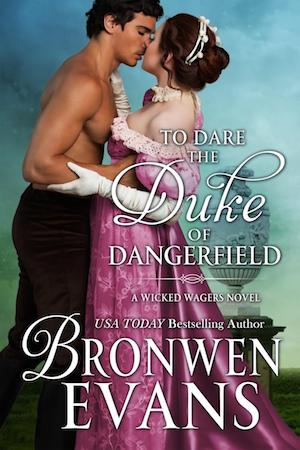
  • To DARE the DUKE of DANGERFIELD: Wicked Wagers Triology Book 1 by Bronwen Evans – Regency Romance, Historical Romance, Victorian Romance

    To DARE the DUKE of DANGERFIELD: Wicked Wagers Triology Book 1 by Bronwen Evans – Regency Romance, Historical Romance, Victorian Romance

    Chatelaine 1st Place Best in Category Blue and Gold Badge

    Lady Caitlin Southall wants to save her home in Bronwen Evan’s first novella in the Wicked Wager Trilogy, To Dare the Duke of Dangerfield.

    According to her deceased mother’s will, Caitlin inherits the estate upon her marriage or her twenty-fifth birthday, whichever occurs first. Since she’s twenty-three with no suitors on the horizon, Caitlin’s estate falls under the care of her father, the Earl of Bridgenorth. When her father loses Mansfield Manor in a faro game to the Duke of Dangerfield, Caitlin’s hopes of independence seem lost.

    Harlow Telford, a rakish devil, determined to see Caitlin’s father ruined, rejoices when he finally succeeds in divesting the Earl of Bridgenorth of his family home.

    Harlow vowed revenge fourteen years earlier when Bridgenorth seduced his recently widowed mother and left her pregnant. His half-brother Jeremy had been paying the price of that betrayal his whole life. Harlow swore he would give Jeremy what should have been his birthright, Mansfield Manor.

    But when the beautiful Caitlin marches into his home, demanding its return, Harlow’s captivated by her spirit. Caitlin’s undaunted in determination, and the two agree to a best of three challenges. If Caitlin wins, she gets her house back. If Harlow wins, he’ll get Caitlin in his bed. As the two face off against each other, they soon find much more at stake than they initially realized.

    Harlow Telford may seem like the typical, lust-worthy hero, but there’s much more.

    After suffering a broken heart at the hands of a cheating fiancé, Harlow swore off love. He spent his adulthood bedding women and gambling, but readers may suspect that Harlow possesses a conscience. Even while making the scandalous bargain with Caitlin, Harlow vows to propose marriage before Caitlin’s reputation falls into ruin. Though he should hate her for the sins of her father, he cannot ignore the lessons learned through watching his mother’s suffering at the hands of a rigid Victorian society.

    Harlow sees the injustice of Caitlin not inheriting her mother’s estate and makes numerous plans to rectify the mistake without compromising the promise he made to his half-brother. Harlow cannot take advantage of anyone hurt by the very man who hurt his mother. He finds himself wanting her respect, something he never expected to need from a woman.

    Lady Caitlin Southall, on the other hand, possesses an iron will and a salty disposition.

    Growing up motherless with a derelict father forced Caitlin into a keen awareness of her financial situation. Her bravery and fire make her a fantastic character, especially when she slaps the arrogant, albeit perfect, face of Harlow.

    Caitlan doesn’t hesitate to take matters into her own hands, even though that could mean destroying her reputation. Despite giving in to Harlow’s lecherous designs, she remains determined to find a husband who sees her as a true partner, not an heir-bearer. Her home means more than a place to live. For Caitlin, the manor embodies her security, a chance at financial independence from her father and husband. Retaining Mansfield Manor would prevent her from being sold off to the man who can fill her father’s empty purse.

    A simple theme for the novel revolves around the idea of what makes a house a home.

    Caitlin’s overwhelming desire to retain Mansfield Manor nearly becomes her undoing when she risks not just her reputation but also her life. Harlow’s love for his brother causes him to take revenge upon the man responsible for the unfortunate situation. His actions almost cost him the woman he loves. Both must learn that people make a house a home – not the stones with which it’s built.

    To Dare the Duke of Dangerfield won First in Category in the CHATELAINE Book Awards, a division of the CIBAs, for Romance novels.


    Chanticleer Book Reviews 5 Star Best Book silver foil stickerChatelaine 1st in Category gold foil book sticker image

  • SHAPING PUBLIC OPINION: How Real Advocacy Journalism™ Should be Practiced by Janice Ellis, Ph.D. – Media and Internet Politics, Political Advocacy, Human Rights

    SHAPING PUBLIC OPINION: How Real Advocacy Journalism™ Should be Practiced by Janice Ellis, Ph.D. – Media and Internet Politics, Political Advocacy, Human Rights


    Shaping Public Opinion Grand Prize Nellie Bly Blue and Gold Badge

    Janice S. Ellis, Ph.D., introduces the journalistic theories of Walter Lippmann in her new non-fiction work, Shaping Public Opinion: How Real Advocacy Journalism™ Should be Practiced.

    Walter Lippmann, considered one of the foremost journalists in the field over the last 100 years, was a mentor in absentia of Dr. Ellis in the art of advocacy journalism. During Lippmann’s 40+ year career, his columns were syndicated in over 250 newspapers nationwide and over 25 other international news and information outlets. Lippman focused on the ethical dissemination of information, especially about communities, society, and the world. A theory, which Dr. Ellis calls Real Advocacy Journalism.

    Real Advocacy Journalism theory pertains to foundational behavior and ethical standing for those who report on, translate, and share information with the masses. This theory identifies the tension between individualism and collectivism, the private sector and public sector, the ruling elite, and the dormant masses.

    Real Advocacy Journalism™ eschews demagoguery and tribalism for a belief that reason, logic, facts, truth, and clear graphic language are the most effective instrument of public persuasion.

    Remarkably well researched, Dr. Ellis shows throughout the book how Lippmann identified challenges to factual sharing of information and how he spoke to the importance of choosing words wisely.

    Three tasks every journalist must consider in the pursuit of Real Advocacy Journalism, 1—separate words and their meanings in order to disentangle complex ideas, 2.-be effective at creating a visual picture to explain the words and concepts used, and, 3.-have a good understanding of the traits and characteristics of the target audience.

    Lippmann knew the impossible task of considering everything that the typical listener may utilize in their life as a filter of information. As the audience grows, the number of common words and references diminishes. The information becomes more abstract, lacking a distinct character of its own. This phenomenon leaves the general audience to interpret the message as they see fit, not necessarily equal to the original information. Age, race, gender, social standing, mood, and “his place on the board in any game of life he is playing” inform how information is understood.  The journalist must set the highest goal to clarify, evaluate and draw conclusions for readers and listeners too preoccupied or too removed from the actual events to judge clearly for themselves.

    The problem occurs when the constant feed of partial information is based on opinion and not wholly on facts.

    Information in its most proper form may be perceived as dull and uninteresting. To gain viewers, “opinion news” sources have become increasingly personal and deliberately dramatic to stop the viewer from tuning out or turning the channel. Not having the time, energy, or understanding to draw their conclusions, the listener accepts this partial information as truth.

    Ellis cites Robert O. Anthony as saying, “The secret to Lippman’s ability to reach such a wide audience lay in his expert understanding of the information, his reasonableness of temper, his complete honest and profound attachment to the principles of liberty.”

    Lippman’s “survivors,” Kennedy, Schlesinger, and others claim Lippman taught them how to think.

    He perfected a rare ability to impose verbal order on chaos. Even when wrong, corrected, or later expanded on, the goal was not to be the only voice but to be like “the village light post.” Ellis’ book exposes the dangers of “opinion news” and how very counterproductive “celebrity journalism” truly is, as it puts profits and popularity (ratings) over actual truth.

    Ellis encourages readers to research and discover the meaning of the words being used to grasp the whole picture of what any news source presents. Shaping Public Opinion: How Real Advocacy Journalism™ Should Be Practiced won Grand Prize in the 2019 CIBAs, Nellie Bly Awards for Longform Journalism.


    Chanticleer Book Reviews 5 Star Best Book silver foil sticker


  • JOEL EMMANUEL by J.P. Kenna – Mystery, Coming of Age, Pacific Northwest Literary Fiction

    JOEL EMMANUEL by J.P. Kenna – Mystery, Coming of Age, Pacific Northwest Literary Fiction

      Blue and Gold Somerset First Place Winner Badge for Best in CategoryBlue and Gold Clue Suspense/Thriller 1st Place Best in Category Badge

      Set in the Pacific Northwest in the 1970s, Joel Emmanuel by JP Kenna rewards its readers with the story of a boy coming of age and how he understands the changes around him. Kenna’s style echoes the English novels of the 19th century.

      Young Joel Emmanuel Webber, named for a Wobbly executed long ago in 1915, lives with his mother, Nance Raindance, in a cabin on the Skagit River near Seattle before it was a technopolis. Their world is antiquated even for the 1970s and defined by farming, fishing, and basics like a woodburning cookstove, kerosene lamps, and candles. Joel calls his mother by her given name, doesn’t know his father, and lives an open life free of school and, even occasionally, clothing. He is sensitive and easily succumbs to tears. 

      His small world includes a nearby septuagenarian farmer who is the cabin’s landlord; an Indian from “the Rez” named Billy Sampson and his daughter; and Bruce, a suitor of his mother’s who has become the town’s hustling (and overextended) entrepreneur. This unique upbringing affects how Joel sees the world, as he comes face-to-face with adult matters, while other children his age are happy and oblivious to the difficulties of adulthood.

      As the world away from rural Washington slides from President Carter to President Reagan, young Joel’s life changes when his actual father, George, shows up unexpectedly at his ninth birthday dinner.

      Of course, George has past transgressions, as we all do. Still, the boy bonds with his father, assisting in his coal business while his mother’s relationship with Bruce becomes complicated. The family takes an apartment in town as Nance moves from selling vegetables at a roadside stand to helping run Bruce’s real estate office. Joel is content with his time on boats and bicycles and at ease with hard work such as splitting wood. However, the interactions between the men in his mother’s life warp his understanding of the world.

      Bruce’s precarious financial position – or perhaps his non-Native capitalistic thinking – leads him to repossess his old fishing boat from Billy’s cousin Gerald. The repercussions of this one decision pit Native Americans against townies, and forces Joel to choose sides in the subsequent murder trial.

      Kenna weaves his literary suspense like a true master, making farms and equipment come alive, all while using them to represent the flow of change and time. Each place, each scene, each vehicle, and each tool is imbued with meaning. Kenna’s characters have strong relationships with their place in the world, which makes it easy for the reader to internalize. In fact, Kenna captures a way of life that seems impossible today, focusing on the human story and systems of the time, and makes them universal and accessible to contemporary readers.

      J.P. Kenna’s story of changing and butting cultures beats at the heart of Joel Emmanuel, and readers will surely enjoy it. Joel Emmanuel won 1st in Category in the Somerset Awards for Literary Fiction and the Clue Awards for Suspense Fiction. 


      Somerset Literary and Contemporary Chanticleer International Book Awards 1st Place Winner oval Gold Foil stickerClue Suspense and Thriller Chanticleer International Book Awards 1st Place Winner oval gold foil stickerReviewed by Chanticleer Book Reviews 4 Stars! round silver foil sticker

    • The DEVIL PULLS the STRINGS by J. W. Zarek –  Young Adult Epic Fantasy Adventure, Young Adult Fantasy Action Adventure, Young Adult Urban Fantasy

      The DEVIL PULLS the STRINGS by J. W. Zarek – Young Adult Epic Fantasy Adventure, Young Adult Fantasy Action Adventure, Young Adult Urban Fantasy


      Overall Best Book of 2021 Grand Prize Badge for J.W. Zarek's The Devil Pulls the StringsThe protagonist and all-around decent guy, Boone Daniels, is in a heap of hurt in JW Zarek’s new Young Adult novel, The Devil Pulls the Strings.

      One would think being plagued by an evil spirit wendigo since age six would be enough inconvenience to last a lifetime, but when Boone jousts with his best bud at a Ren Faire and accidentally deals a mortal blow, the hurt he experiences suddenly lands on a sliding scale of 1 to 1 million. And Boone Daniels becomes a millionaire, so to speak.

      No ordinary guy, Boone makes a living as a handyman and swashbuckling knight at Renaissance Faires around Missouri. He’s also uniquely gifted with a form of eidetic memory coupled with synesthesia. What’s that? Simply put, synesthesia allows people to see colors and taste things when they hear music – and an eidetic memory allows folks to memorize whatever they’ve seen or heard one time. But that’s not all. Boone can time-travel, make friends with almost any feline or shapeshifter, and convince a certain immortal he’s worth more as an ally than a snack. No kidding, Baba Yaya loves human meat.

      After wounding his best friend, Boone promises to fill in for him as lead vocalist in the band, The Village Idiots, for a major gig in New York City.

      The gig caps off the Dragons and Nymphs Annual Charity Ball – a blood drive. (The irony of this will make readers chuckle.) After the band plays, a mysterious score of music by Niccolò Paganini will be played by the best violinist of the time, who also happens to be Boone’s fast-friend-confidant-maybe-girlfriend-we’ll-have-to-see, Sapphire Anjou. Sapphire, the French Ambassador’s daughter, has connections that tie her deeply to the Lavender and Rose Society. There’s more to these societies. The Dragons and Nymphs want nothing but destruction and chaos, while the Lavender and Rose Society maintain order and work to keep people alive. And both societies seek the magical score. You see, no one actually has the Paganini sheet music. It’s a mystery and plenty of people die and get maimed in the pursuit of the piece, but finally, just in the nick of time, Boone and Sapphire obtain it.

      What’s so special about this piece of music?

      It’s magic, of course! Whoever plays the Paganini score can summon anyone they want. The Dragons and Nymphs want it to summon Ambrogio, their Vampire All-Father, who now resides in Hell. One immortal wants it to free her sister, who’s been caught in a pocket universe (you’ll have to read the book to figure out what that means). And then there’s the nefarious all-around baddie, Ambrozij Sinti, humiliated as a young boy, who now seeks his revenge by using the Paganini piece to summon the Devil himself and destroy the world. The stakes are high, and there’s no time to lose.

      Told in first-person by hero Boone Daniels, J. W. Zarek spins an epic fantasy with tons of action, adventure, and folklore.

      His writing peppers readers with alliteration in trios, that serve to tighten phrasing to speed up action scenes, evoking visceral responses. Readers feel the panic Boone feels as the world closes in around him. Does it work? Like a charm. Almost perfect, readers will surely love this first in series, epic fantasy world and fall in love with Zarek’s leading man because of it.

      Somewhere between The Librarians meets The Magicians – mixed with the flawed hero archetypes of Jim Butcher’s Harry Dresden and Harold Hearne’s Atticus O’Sullivan, Zarek’s hero brings fans of the genre something new to dig their teeth into – and that’s an excellent thing. Fans will be thrilled to learn that the novel will release in Graphic Novel format soon!

      The Devil Pulls the Strings won a whopping four Ribbons at the 2021 CIBA Ceremonies, a First Place Ribbon in both Ozma and Cygnus, as well as the Grand Prize in Paranormal, and the Overall Best Book of 2021 for the Chanticleer Int’l Book Awards!

      Chanticleer Book Reviews 5 Star Best Book silver foil sticker


    • A SWORD OF VENGEANCE: A Novel (Call of Vengeance Book 2) by John Stafford – Dark Fantasy / Horror, Men’s Adventure Books, Thriller / Suspense

      A SWORD OF VENGEANCE: A Novel (Call of Vengeance Book 2) by John Stafford – Dark Fantasy / Horror, Men’s Adventure Books, Thriller / Suspense


      In the second volume of the Call of Vengeance series, author John Stafford takes the fight overseas in A Sword of Vengeance.

      Brady, the young American hero of the first volume, A Prayer of Vengeance (see our review), continues his crusade to decimate The Beast, the Evil One, the darkness, whatever your favorite term, wherever it exists. Along with his three brothers, his girlfriend, and an ever-expanding crew of like-minded supporters, they take on Beelzebub in Israel’s Temple Mount and France.

      This time, in 1980, the book leaps into revisionist history as Pope John Paul supports an attack by Brady and his companions on the evil spirit that has taken over the Islamic Imam of the Temple Mount. By freeing the most sacred building of the world’s three major religions of its evil, in coordination with the Vatican, Brady makes it possible for the Pope to convene a most secret meeting of the Council of Cardinals, telling them that he is casting out the Devil from the Vatican along with those who waver from the faith with an Act of Consecretion to the Sacred Heart.

      Simultaneously, the Dome of the Rock, housed within the Temple Mount and supposedly the place where Mohammed ascended into Heaven, will be consecrated with holy water containing the blood of Jesus, casting out The Angel of the Fallen from the sacred spot.

      While these acts will mean much more to Catholic readers, the planning surrounding these events reads more like a combination of graphic thriller and supernatural thriller in one. Brady and his three brothers, his girlfriend Michelle, and some additional crew members find themselves on a luxury yacht at the beginning of the book, bonding with the Mighty Men of King David,  an Israeli military group of 40 men led by a general and his daughter. They enjoy a great food-filled celebration with each other, capped by seeing Brady, infused by the light, elevating into the air so they can see for themselves the miracle of who he is: the man who talks to the angels.

      But before the storm, there is a coupling to celebrate.

      A joyous union among the team comes as a surprise to all involved. Nevertheless, family and friends have managed to remain hidden on the yacht before the nuptials. The wedding procession preceding the landing in Israel and the possibility of death all make the bonding aboard the yacht so special.

      Backed by the Israelis, Brady and company make their way into the Temple Mount in a military-style operation and perform their miracle, but not without tragedy. But Brady uses his unique talents given him by the Mother of God to save a life, taking unto himself the wounds suffered by another.

      Brady roots out evil in the church, as well.

      Brady must face one more assignment overseas: to release dozens of children captured by an evil sect of the Church. Corrupt priests and nuns capture children and allow unspeakable evil to be done to them in an annual bacchanal at a chateau outside Paris. With the same religious fervor, Brady takes on the task. The house’s defense by Iranian shooters hidden in the bushes causes considerable damage to the would-be rescuers, including people near and dear to Brady and his people. In the world of this series, Iranians do the Devil’s work.

      As in the first book, the evil fought here may repulse some people. The descriptions, in some instances, are uncomfortably vivid. Yet, the writer believes that the need to portray the good properly must be accompanied by a strong showing of the evil that must be cast out forcibly and by any/every means necessary from the world. Readers will find these books well-written and intriguing additions to the supernatural thriller genre – but quite graphic.


    • RESCUED, JT Thomas Adventures Book 1 by E. Alan Fleischauer – Action/Adventure, Romantic Action/Adventure, Mystery Action/Adventure

      RESCUED, JT Thomas Adventures Book 1 by E. Alan Fleischauer – Action/Adventure, Romantic Action/Adventure, Mystery Action/Adventure

      Laramie Western Fiction 1st Place Best in Category CIBA Blue and Gold BadgeAlan Fleischauer ushers in his new Action/Adventure Western series with Rescued – and gives us a protagonist worthy of the title “hero.

      John Thurgood (JT) Thomas just found the most unusual cave, housing a strange treasure trove of high-end furniture, extraordinary inventions, and a custom gun. While he’s enjoying his mountain view and wondering what should happen with the goods, he spies another unusual site. Three women follow a wagon of dangerous-looking desperados. JT can’t help but step in, little knowing that action will alter his entire life. As a former lieutenant colonel in the Civil War and U.S. Marshal, JT rescues the three women and finds a fourth sitting in the wagon. He immediately abandons his cave camp and takes the women to nearby Point Stevens Pass, Colorado, where he stays until their safety is secured.

      One of the women, however, leads the gang and is responsible for kidnapping the others. Jean Cantrell, a bloodthirsty bank robber, and murderer flees town before the women spill the beans – but not before leaving behind a dead banker.

      Hellbent on capturing Cantrell, JT pursues the villain, but another woman, Annabelle Hewitt, insists on accompanying him. JT and Annabelle soon realize their feelings may run more profound than those of “victim and rescuer” when they take shelter in the very cave JT had earlier abandoned. Inside, they soon discover a secret. However, Cantrell isn’t about to give up her need for revenge and her greed, and soon, the new couple will face off with the kidnapper again, and their lives will take an incredible turn once again.

      So many characters in this novel are unbelievable survivors, especially the female characters.

      Annabelle is the most obvious example of these fierce women. Annabelle is married to a violent, dangerous man, Marcus. They lived in New York, where Annabelle trained as a nurse under the tutelage of Marcus’s father; however, when Marcus turns to alcohol and womanizing, Annabelle makes up her mind to leave with their daughter. Marcus isn’t about to let her go, though, and chases her down, takes their daughter from her, and leaves her penniless and abandoned. Annabelle refuses to return with him and works as a housekeeper in an inn until she saves money to keep traveling. While traversing the vast plains, a group of Cheyenne takes her prisoner. She earns the respect of the tribe as a healer, but her adventure doesn’t stop there. Annabelle creates her own business as a midwife and returns from a visit when the Cantrell gang takes her. Meeting JT makes her even more resolved, especially when the two embark on a trip back to New York to take back her daughter and get her freedom legally through a divorce.

      Annabelle isn’t the only female survivor.

      Though unbelievably evil in a “super-villain” way, Jean Cantrell is also a survivor. While Annabelle gains strength and independence by helping others, Jean chooses the opposite route; nevertheless, her story is one of survival in the brutal world of the Old West. Jean takes on one of the oldest occupations open to women and becomes a whore until she stumbles into a bank robbery where she quickly, remorselessly kills the would-be robber and takes the money. Once Jean realizes how much easier her life can be, the transition from prostitute to outlaw is quick, and no one gets in her way. Though her path is bloody and ruthless, she knows what she must do to survive. She is respected, albeit through fear, and no one, but JT, is willing to challenge her. Evil or not, Jean is a survivor.

      Another great theme in the novel is the kindness of strangers, best seen in the actions of JT Thomas.

      JT is the consummate good guy. Lovers of old westerns will recognize his gallantry in that comfortable, protector of weak way. He cannot stop himself from helping everyone he meets. He not only saves these women, but he also insists on paying their way, buying them clothes, and finding other people to safeguard them when he leaves to chase Jean Cantrell. When the plot transitions to the big city of New York, JT proves to be the hero again and again. He becomes fast friends with Mrs. C, the owner of a failing hotel, and finds a way to refurbish and restore her hotel. When he meets Annabelle’s daughter, he makes sure she is cared for in all forms, including hiring her boyfriend to manage the hotel. With a few loose ends left at the novel’s end, JT’s heroic actions seem likely to be continued in subsequent adventures.

      From the rugged mountains of Colorado to the grit and glitz of New York City, this novel is a fast-paced, twisting adventure that lovers of westerns will devour. Rescued (JT Thomas Adventures Book 1) took home 1st in Category in the 2019 CIBAs for LARAMIE, Western Fiction.


      Laramie Western Fiction Chanticleer Int'l Book Awards 1st Place Winner gold foil oval book sticker imageReviewed by Chanticleer Book Reviews 4 Stars! round silver foil sticker

    • RESISTANCE, REVOLUTION and OTHER LOVE STORIES by K. – Short Story Collection, Love Stories, Literary

      RESISTANCE, REVOLUTION and OTHER LOVE STORIES by K. – Short Story Collection, Love Stories, Literary


      The Ancient Greeks believed that there were eight different types of love. To the poet Emily Dickinson, “… Love is all there is, Is all we know of Love.” But in the words and stories in this collection, Resistance, Revolution and Other Love Stories by K., love sometimes requires desperate action, whether embraced, resisted, or a combination of the two.

      The twelve stories here range from the mythic past to a far-flung future as the author goes back to retell the classic myth of “Orpheus and Eurydice.” In “Automatonomatopoeia,” we reach forward into a future that resembles the harsh authoritarian worldview of Orwell’s classic 1984 until its protagonist learns the truth behind the strict conformism that kept him isolated and alone.

      Several of the most poignant stories present as contemporary reflections on the forms of love and the ways that society twists love around.

      In “Calamity Jane,” the friendship of two teenaged boys crashes into the rocks of their mutual love for the same beautiful and calamitous girl. A girl who seems to like getting between the two friends more than she loves either one of them – or herself.

      Meanwhile, in “Vikings” we meet a protagonist caught between several different types of love. He’s in a situation where the best thing he can do may very well destroy him. What could it be? The only certainty, the only way forward – the only way to preserve what he loves is to leave everything he cherishes behind. Can he do it?

      The would-be lovers in “Head Down” face a dilemma made all the more heartbreaking because it feels so very real.

      This sad tale speaks of the conflict between love and duty, wrapped around a romance that can never be fulfilled because the lovers have met too late. Both parties have commitments that they cannot or will not break. So, they must break each other’s hearts instead.

      As with any collection of short stories, whether by multiple authors or by a singular author, not every story will appeal to every reader. That being said, Resistance, Revolution and Other Love Stories, with its wide range of genres, not only showcases the author’s talent, but is certain to please a vast readership.  From myth to historical to romantic to speculative, and its exploration of all the different kinds of love from the altruistic to the romantic to the obsessive, those looking to have their hearts touched and their minds blown in the space of a single, beautifully curated collection need look no further.

      In other words, Resistance, Revolution and Other Love Stories by K. tops our list for what to read this summer.


      5 Star Best Book Chanticleer Reviews round silver sticker

    • A YEAR of LIVING KINDLY: Choices that will Change Your Life and the World Around You by Donna Cameron – Spiritual Growth Self-Help, Happiness Self-Help, Communication and Social Skills

      A YEAR of LIVING KINDLY: Choices that will Change Your Life and the World Around You by Donna Cameron – Spiritual Growth Self-Help, Happiness Self-Help, Communication and Social Skills

      I & I Instruction & Insight Non Fiction 1st Place Best in Category for A YEAR of LIVING KINDLY

      Donna Cameron’s guide, A Year of Living Kindly: Choices That Will Change Your Life and the World Around You, invites readers to live more richly, thoroughly, and fruitfully.

      Perhaps the best way to enjoy Cameron’s guide to kindness is to drink it in slowly, for a year, as its structure suggests. Savoring one of its 52 meditations – thoughtful, introspective, resonate, and wide-ranging discussions – each week. She turns to a new topic grouping with the advent of each new month, traversing the four parts, the “seasons,” as the year progresses.

      Of course, as Cameron will tell you, living a year of kindness is not, in the end, enough; it’s a journey suited to a lifetime. But the habit of it, the joy of it, can take root throughout a year.

      Based on the experiences of its author, the book’s foundation lies in the work of a lifetime of nurturing nonprofits and championing causes from the varied perspectives of executive, consultant, trainer, and volunteer. The guide incorporates observation and situates itself also in research. In and among her insights, Cameron weaves the thoughts, studies, and findings of cultural anthropologists, philosophers, physicians, psychologists, investigative journalists, mindfulness experts, and other teachers. The source notes at the back are modest enough to be accessible to those outside academia, yet extensive enough to show sinew.

      So that readers might more easily incorporate these habits of thought into their own lives, each meditation ends with a Kindness in Action exercise. Together, these exercises are the passageways to reshaping ourselves.

      The four seasons – Discovery, Understanding, Choosing, and Becoming – mirror the natural contours of such a journey.

      In Discovery, we learn about kindness: what it is and what it isn’t, the health benefits that being kind grants, how we might begin to be truly warm and caring. In Understanding, we learn the barriers to kindness – from within and without and delve more deeply into opening ourselves to this way of encountering the world. In Choosing, we explore the courage that kindness can take, the roles of vulnerability and curiosity – yes, curiosity – play, and what it means to extend compassion to all, including standing up to bullies, online and off. In Becoming, we settle in to look soberly at the challenges, at what we might do to create a kinder world, and at what it means to live in kindness every day.

      This structure makes for a powerful presentation and easy entry into the eddies and currents of these gently meditative discussions. But it is not, as Cameron herself notes, necessary to follow a linear path. A reader could just as quickly open the book and flip to any point within it to encounter something rich and thought-provoking to ponder that day, that week, that month.

      In this journey to kindness, we might each of us follow whichever path calls to us.

      Giving our whole selves to kindness helps us to become whole.

      A Year of Living Kindly is a generous book brimming with open good-heartedness and calm practicality, with guidance firm yet gentle. Wise, yet itself kind. Cameron undertakes her journey from a position many would recognize – not so much unkind as hurried, distracted, disengaged. Perhaps in the habit of being, when the situation calls for it, “nice.” Civil, not especially warm. Cautious, not connected.

      Cameron invites us instead to be open to the world. To be generous with our time and our talent, in word, deed, and spirit. To be aware of and awake to others. To be fully present. To be, fully.

      She invites us to embrace kindness as a way of embracing life. Adopting the “mantle of kindness,” she says, will enable each of us to enjoy more entirely in the abundance of our own lives and in the richness the world has to offer. Such a journey connects us more deeply with ourselves and others, enabling us to live our best lives. And such kindness spreads. When we give so wholly of ourselves, others tend to take that gift and pass it along.

      The case she makes is compelling. The message, timely. It’s an invitation that’s difficult to resist, particularly in the company of such a guide. In the world it seems we’ve all been hurtling toward in the past five years or so, Donna Cameron’s steady voice and clear-eyed vision is a balm for the soul.

      Perhaps, just perhaps, with enough kindness, we might indeed remake neighborhoods, remake communities, and transform the national temper.  A Year of Living Kindly placed 1st in Category in the CIBA 2019 Instruction and Insight Awards for Non-Fiction How-To manuals.


      5 Star Best Book Chanticleer Reviews round silver sticker

      Non-Fiction Instructional & Insightful Chanticleer Int'l Book Awards 1st Place Winner

    • SOMETIMES WHEN I’M MAD by Deborah Serani, Psy.D. – Children’s Self-Help Books, Children’s Books About Anger, Children’s Books with Reader Guide

      SOMETIMES WHEN I’M MAD by Deborah Serani, Psy.D. – Children’s Self-Help Books, Children’s Books About Anger, Children’s Books with Reader Guide


      Sometimes When I’m Mad, “… it’s because everything goes wrong,” is the enticing opening phrase of psychologist Deborah Serani’s informative children’s book. It explores the emotion of anger and helps youngsters identify and cope with this often uncomfortable feeling.

      Here we meet a dark-haired girl with spiky pigtails who is easily frustrated by the day’s happenings. Whether a spilled glass of milk, a frantic search for a toy, or discontent when a friend doesn’t come over to play, sharp images of a furrowed brow, snarling face, or pouting lips tell the story. Concerned parents, grandparents, and a teacher soon help this youngster realize that simple actions can help remedy and manage her anger. Ultimately a talk or fun activity, a nap or hug, or sometimes even an apology can calm the inner turmoil and make an individual feel better.

      Kyra Teis’s artful illustrations beautifully complement the straightforward narrative.

      The opening background of a lined and spattered wall seems intentionally reflective of the tumultuous subject matter. Details like a crossed arm stance, ears covered to avoid listening, or the rising blush in cheeks when attempting to put on a pair of socks all prove indicative of the child’s building frustration. The color palette is natural yet toned down. For appropriate contrast, the central character’s bright red shirt and shorts and an orange sweatshirt draw the reader’s attention and accentuate the young girl’s intense upset. A final smiling image, where she dons cool-green attire and pets her ever-present, inquisitive feline, helps bring an element of soothing comfort to the storyline.

      The book’s final pages guide concerned adults looking to help a child deal with their emotions of anger. Learning to understand it can prove a transformative, healing, and empowering force. Serani smartly explains how the negativity of anger may appear as many physical symptoms like headaches, stomachaches, appetite, and sleeping problems. Anger unmanaged can also contribute to academic difficulties, as well as social and emotional concerns. Ideally, learning to express anger in adaptive ways will help build confidence and allow children to experience greater physical and emotional well-being.

      Serani also points out that anger can manifest itself differently within each child, but there are specific patterns to look for within the developmental stages of specific age groups.

      Treating children with respect, helping a child understand that anger is natural, encouraging open and honest communication, and providing age-appropriate consequences for aggressive behavior are also noted as methods to help promote healthy emotional expression. Special needs challenges such as ADHD, Autism, or learning disabilities may also influence a child’s anger. Likewise, if a child’s anger becomes more frequent and intense, consultation with a mental health professional or specialist may be in order. Also included is a list of various organizations offering information and support.

      An easy read intended for the 4-8 age group, Sometimes When I’m Mad proves an intelligent choice that delivers positive reinforcement and direct ways to handle complicated feelings that can stir within us at any age. Highly recommended.

      5 Star Best Book Chanticleer Reviews round silver sticker