Category: Reviews

  • THE MERCHANT From SEPHARAD by James Hutson-Wiley – Historical Fiction, Medieval, Jewish History

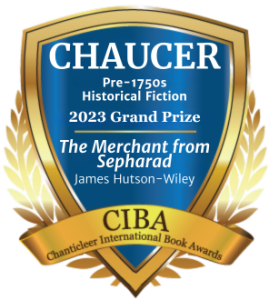
    blue and gold badge recognizing The Merchant from Sepharad by James Hutson-Wiley for winning the 2023 Chaucer Grand PrizeJoshua Ibn Elazar, the eager son of a Jewish merchant, travels to al-Andalus (the Iberian Peninsula under Muslim rule) to prove himself in his father’s business. But he finds an unwelcoming, degrading society waiting for him, and begins a journey of misfortune and anger in James Hutson-Wiley’s historical fiction novel, The Merchant from Sepharad.
    Shortly after arriving in the city of Lishbunah, al-Andalus, Joshua is tricked out of the gold for his living expenses. Worse yet, he learns that Jews in Lishbunah suffer under oppressive laws, holding far less status than Muslim citizens. He can only find help in Lishbuna’s Jewish community, meeting Rabbi Hiyya al-Daudi and his son Yaish, who house and feed him.

    They tell him that his father’s colleague, Essua, who was to help Joshua manage a shipment of flax and sugar, has been arrested. Though Essua is eventually released, Joshua fails to secure storage for his goods, as the makhzan (warehouse) he rented is given to a Muslim merchant instead. In his fury at the city’s prejudice, he sets fire to the makhzan, and is forced to flee.

    Thankfully, Rabbi al-Daudi has secret connections to Alfonso Henriques, the Christian King of Portugal.

    Joshua travels with Blazh, a Slav who was enslaved as a boy when his village was raided. They deliver a message of Lishbunah’s weaknesses to Alfonso, who plans to march on Lishbunah with the help of the Crucesignati (crusaders). Al-Daudi hopes that Alfonso’s conquering of the city would be better for the Jews in Lishbunah than the encroaching threat of the Almohad, a Muslim power that demands either conversion or death.

    Joshua travels on to the city of Qurtuba and becomes a student of Rabbi Maimon ben Joseph. However, Joshua’s troubles have only begun. He becomes involved with Karaites, Jews who reject Rabbinical authority, and shares in their far-off dream of retaking Yerushalayim (Jerusalem). Together they leave Qurtuba, only to suffer at the hands of a band of Christian soldiers. Joshua’s fury at the world of Muslims and Christians grows with each misstep in his journey, as he watches friends be killed, loses his father’s respect, and is told over and over again to accept these pains as God’s plan.

    He travels through al-Andalus, across the Mediterranean to Sicilia (Sicily) and Al-Misr (Egypt), and down the Red Sea as he tries to redeem himself in his father’s eyes. He can’t forget the cruelties he suffers, and they weigh on his shoulders. But so too does each kind act keep his spirit alive. As he sees more and more of the world, he measures his desire for retribution against the ideals of his faith.

    The Merchant from Sepharad offers an in-depth, fascinating look into twelfth-century Iberia, the Mediterranean, and the Red Sea.

    From Lishbuna to Qurtuba to al-Yaman, Joshua encounters the subtleties of social life amongst peoples with vastly different histories. Rather than taking a broad view of the dynamics between different cultures in al-Andalus and al-Misr, author James Hutson-Wiley fills this book with specific struggles and clashes. A helpful glossary at the end of the book explains the terms and language of this time and place.

    This dedication to detail makes each new city feel unique, as they were in real life. The people speak and treat each other differently, the pains and joys are weighed out in different amounts, and the ever-turning wheels of history threaten to crush one people while enriching another. As a Jew, Joshua remains an outsider along much of his journey, giving him a fascinating view of the conflicts in his world. Readers will learn much about the power struggles of the twelfth century as they follow him from region to region.

    Joshua becomes an engrossing protagonist through his struggle to succeed as a merchant – and often just to survive.

    His anger drives him to make rash, but understandable, choices. Despite all of the social forces arrayed against him, he hopes to make some kind of change in the world. But when his very life is threatened, more than once, how can he hold on to his ideals and his rage at the same time?

    Friends and teachers on Joshua’s journey show a more hopeful side of humanity. The kind Blazh, patient Maimon, passionate Simon, stalwart Wallo, and others help to shape Joshua’s emotional path. He comes to understand that oppression is shared amongst many people, and one of the few strengths they have is solidarity with one another. Without the generosity of others, Joshua would never have survived. But, of course, the cruelty of the world stings worst when it takes good people from him.

    At the heart of the story lay Joshua’s faith, and sometimes lack thereof.

    He learns from Rabbis, explores the Karaite philosophy, and tries to take solace in his beliefs. Much of his life is shaped by being a Jew, how could it not be in a place like al-Andalus? But while teachers like Maimon urge him to be patient and understanding of God’s plan, others like Simon insist that God demands them to act against their oppressors. He struggled to believe that God could want him to accept all of the pain and death he’s seen. Should he not take up his sling against the forces of Amalek?

    As he learns of new people and their struggles, he considers what unity there is in faith. While his hope of taking Yerushalayim remains far out of reach, perhaps there are still some ways that he can help those who share his hardships?

    The Merchant from Sepharad not only provides lessons on history, but an exploration of Jewish philosophy and scripture. Fans of historical fiction and religious history will adore this story, the third installment in the Sugar Merchant series.


    5 Stars! Best Book Chanticleer Book Reviews

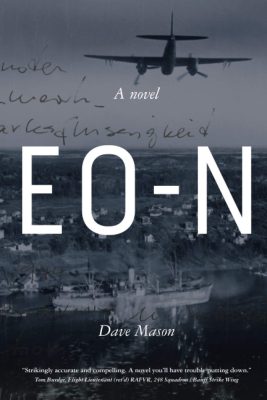
  • EO-N by Dave Mason – Historical Fiction, WWII Fiction, Historical Mystery


    A young boy in Norway makes a discovery while playing with his dog, opening the mystery of EO-N by Dave Mason, a detective story spanning multiple decades and both sides of the Atlantic, a deep dive into the horrors of Nazi Germany, and a heartfelt love story.

    A small metal fragment leads to the discovery of a downed WWII twin-engine Mosquito fighter-bomber hidden in snow and glacial ice for nearly 75 years. The crash site yields an initial set of clues, one of which finds its way across the world to Alison Wiley, a biotech CEO in Seattle. Having recently lost her mother, and, a few years earlier, her brother in Afghanistan, she finds her days full of despair, but the discovery makes a distant connection to her long-lost grandfather, and she flies to Norway. There, she meets Scott Wilcox, a Canadian researcher assigned to investigate the discovery after his government learned that the crashed aircraft belonged to the Royal Canadian Air Force. Their attraction is both intellectual and emotional, but the quest to uncover the plane’s mysteries and the fate of Alison’s grandfather place any romance to the side.

    At first, the crash doesn’t appear exceptional, until certain contradictory and confusing clues emerge that make it clear that the circumstances that led to the plane’s fate were anything but simple.

    EO-N’s story is complex, leading the reader from clue to revelation with a sure hand. And it takes a dark secret from the past and develops it into something that might make the world a better place.

    The details are key to the novel’s success. Readers will wonder whether the facts outlined in the book are based on actual history, and while the specifics of the heinous Nazi activities at the center of the story may differ somewhat from reality, the spirit of the revelations rings true.

    This novel is impeccably researched, and the characters are believable, warm, and heartbreaking. Readers won’t be able to put it down until its perfect conclusion.

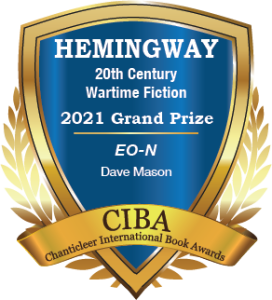
    EO-N by Dave Mason won the Grand Prize in the 2021 CIBA Hemingway Awards for 20th Century Wartime Fiction.


    5 Star Best Book Chanticleer Reviews round silver sticker

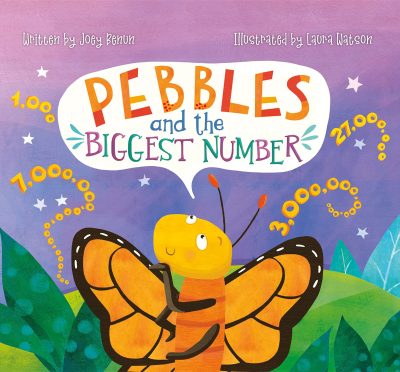
  • PEBBLES And The BIGGEST NUMBER by Joey Benun, illustrated by Laura Watson – Picture Books, Children’s Science Books, Science & Nature

    Pebbles the butterfly loves to count as much as he can in his garden. But soon enough he gets curious, and in Pebbles and the Biggest Number by Joey Benun, he embarks on a science-filled quest to find the world’s truly gigantic numbers.

    While the numbers start small, they quickly grow bigger and bigger, as do the wild events that Pebbles must face. Our butterfly guide wanders from forests to deserts, and encounters earthquakes, tsunamis, and even an avalanche. Each landscape and natural disaster pushes Pebbles onward to meet new friends and find even bigger numbers.

    How big can the numbers get?

    You’ll find no made-up numbers in Pebbles and the Biggest Number. Everything from a quintillion to a googolplex actually exists, though it isn’t long before the numbers become nearly impossible to imagine. However, there is a handy sand chart in the back to put some numbers into immense perspective. This is the kind of book that kids will sit with for long hours and astound you with the facts they’ve learned.

    The friendly creatures and beautifully rendered landscapes of Pebbles’s journey will engage young and curious minds. Complete with extra notes and definitions in the back, this book will continue to teach even after the story ends.

    Pebbles and the Biggest Number is hopefully the start of a great new series explaining the world to young readers. With its wonderful descriptions and knowledge, this book comes highly recommended!


    5 Stars! Best Book Chanticleer Book Reviews

  • A PLACE Of REFUGE: Book Four of First Light by Linda Cardillo – Romance, Historical Fiction, Women’s Literature


    Izzy Monroe has lost herself. Three months after an accident that damaged a portion of her brain, she isolates herself in her parent’s home on Chappaquiddick Island, on the eastern end of Martha’s Vineyard.

    She has spent her life in the world of academia, working on a doctorate in literature at Harvard, but now with her short-term memory gone, she has to give up her dreams. Her emptiness and doubt have left her rudderless and deeply depressed.

    When her former college roommate, Maria, suggests she intern at Portarello, Maria’s grandfather’s self-sustaining farm in the Italian countryside, Izzy isn’t immediately convinced she can make the journey alone much less work at the successful inn and thriving farm. However, Izzy remembers the peace she felt there on the one visit she and Maria made years ago, and she knows this is her only chance to regain any sense of normalcy.

    Daniel Richetelli, a Jesuit priest and Maria’s cousin, is facing a crisis himself. After ten years of self-sacrifice, he has lost his faith and is desperate to find a new path.

    He knows his grandfather can help him find his way, so he leaves the Church and goes to Portarello. A chance encounter with Izzy leaves him reeling. In her, he feels he has found that for which he is searching, but the guilt of his physical attraction to her and the criticism of his sister, Linda, make him once again question who he really is. Meanwhile, Izzy hasn’t felt so much like her old self since the accident. The farm and Daniel are bringing her back to life, but she fears his past will forever stand in the way of their happiness.

    The search for self is the central theme of the novel.

    Izzy remembers the strength she had prior to the accident. She was adventurous and outgoing, a lifelong learner. Not even a disability left over from her bout with childhood polio could keep Izzy down. Half-Wampanoag, half-Irish, Izzy was a warrior from the beginning. She was fearless. Now, she knows she is hiding from this new Izzy, a woman who doubts herself and cannot see past her brain damage to the new life she must build. She is scared to risk the possibility of failure and pain, but Maria convinces her she cannot rediscover herself without taking the risk.

    When she does finally gather the courage to leave her hovering, protective family, she thinks she must keep her inability to remember a secret from the other interns and Maria’s family. She hopes to reinvent herself among strangers and the physical labor of farm life. That journey to self-discovery feels like stepping off the edge of the world, and finding to courage to take that step is a part of reclaiming her life.

    Though she cannot truly interact with the other interns or inn guests because of her memory, she plays the part in yet another step toward normalcy.

    Izzy is amazed by the power she finds in physical labor. Working in the vegetable gardens and tending to the pigs form a sense of connection as her brain begins to heal and form new pathways. This also leads to a deeper appreciation for her Native American heritage, a deeper contemplation of the natural world – a world so foreign to her after years spent in study and academics.

    Her immediate attraction to Daniel and the physical relationship they share also give her purpose.

    United in their vulnerability, the two draw on and strengthen each other. Daniel’s path to the farm began with a forced leave of absence from the Church. He struggles with Jesuit ideology to find God in everything. In fact, he can find his maker in nothing recently. He is not looking forward to the mental grilling his grandfather will give him, but he knows it is the only way to truly rediscover himself. He lacks Izzy’s courage, though, and doesn’t immediately face his indecision.

    Daniel recognizes a mystical power within Izzy, likely from her brush with death, and he is inexplicably drawn to that power. The guilt he feels over his fascination with her and his lack of courage nearly push him to self-destruction, and it is only her love that pulls him back from the brink. She gives him the freedom to be himself, and he gives her the freedom to face her new limitations.

    Just like the archaeological dig occurring on the farm, the two must uncover the treasures buried beneath layers of doubt and uncertainty, and just as those artifacts show a connection to the past, Daniel and Izzy must use their pasts to create a new future.


    5 Stars! Best Book Chanticleer Book Reviews

  • ISOLATED DOMAIN by Tyler Drinkard – Sci-fi, Dystopian, Action & Adventure


    Harry Hardacre, better known as Hare to his few friends, hunts for a score big enough to lift him out of poverty, in Isolated Domain by Tyler Drinkard.

    Hare hopes to leave his disreputable business contacts and desperate neighbors behind in the decaying slum known as the Conurb. He yearns for the bright lights of the Central City, where the streets are paved with the possibility of high-paying jobs, and more importantly, highly skilled doctors who can replace his broken-down prosthetic leg and free him from its pain.

    But every resident of the Conurb shares his hope, always just one great scheme away from exactly the same dream – and they’re always disappointed when they wake up to grind away another day in the dark and grime.

    Hare’s score turns into his worst nightmare, as his partner disappears with the seed for their new “business” while setting the local law on Hare’s trail.

    Fleeing from the relatively safe, if downtrodden, Conurb, Hare struggles through a hellish dystopia with no end of novel threats. From endless deserts to carnivorous plant life and cannibal bikers, Hare’s trail ends in a terrible truth that is determined to use him for its own ends – even if it ends him.

    Isolated Domain begins as a pulse-pounding wild ride of a caper story, as Hare and his best friend Chunk hunt for that one big score. But their dream takes them to the brink of dissolution and destruction. The story doesn’t relent, each dark turn leading to one darker yet – over and over, in myriad visions of a dystopian future.

    Hare will compel readers to follow his journey and empathize with him throughout his tribulations.

    His world may be vastly different from the reader’s, but his goals and his dreams still feel familiar. He wants a better life but fears it will only get worse. His descent into pain and struggle lands with a heavy emotional impact. Hare’s quest for that big score toys with his hope and refuses to fulfill it. Anyone searching for a light at the end of the tunnel for Hare and his world may close the book feeling a bit depressed.

    Readers looking for an odyssey of misfortune will find Hare an engaging and (mostly) good man as he tries to navigate the layers of chaos and despair. His story finishes with a twist that will leave those readers in a state of dark astonishment.

  • FUTURE’S DARK PAST: Time Forward Trilogy, Book 1 by J.L. Yarrow – Sci-Fi, Time Travel, Action & Adventure


    A time travel epic, Future’s Dark Past is the creative endeavor of J.L Yarrow, husband and wife duo of John and Leanne Yarrow. The time-hopping action begins in the year 2355, in a world virtually uninhabitable outside a few city pods where food is scarce and violence a certainty.

    Caught sneaking into a city pod with nowhere else to go, Kristen Winters agrees to join the Time Forward Project, a group from which no volunteers have ever returned. Kristin’s new superiors send her to fight a deadly battle for the fate of humanity. In 2025, Hunter Coburn becomes an important piece of the puzzle after he gets accidentally connected to Kristen’s time jumps. Initially on opposite sides, they must figure out how to work together as the plan to save the future becomes increasingly unstable.

    John and Leanne do an excellent job of creating an immersive world from the beginning, with many characters who develop and grow with the story as it unfolds.

    This book’s brief chapters make for easy binge-reading as the feeling of “just one more chapter” hits after each ending hook. This fictional world starts off strong, with well-established details, and the central characters join the story with compelling introductions. The Future’s Dark Past delivers a complex and winding time-travel plot, although sometimes the story loses focus on its main characters in that complexity, and sudden plot developments leave some other characters underdeveloped. Despite its chaotic sense of direction, Future’s Dark Past has a lot to love, and the following books in this series have many questions left to answer, and intriguing characters to pursue them.

    Future’s Dark Past offers exciting action as its characters struggle to change the past, and in doing, change their future.

    Kirsten and Hunter travel back in time both to prevent events set in history and to put plans in motion to help save the future. Their mission to stop the JFK assassination in 1963 will in particular will have readers swimming in suspense. As timelines branch and change, the characters try to parse which parts of their memory are even true anymore, creating fascinating dynamics between them.

    The concluding arc of Future’s Dark Past will surprise readers, with an unexpected antagonist. This intense ending leaves the characters with a complex and dangerous job ahead of them. Humanity’s survival depends on it.

    Future’s Dark Past by J.L. Yarrow won Grand Prize in the 2017 CIBA Cygnus Book Awards for Science Fiction. Available now!

    5 Stars! Best Book Chanticleer Book Reviews


  • EUDORA SPACE KID: Do the Robot! (Book 3) by David Horn – Science Fiction, Children’s Action & Adventure, Illustrated Books


    In Eudora Space Kid: Do the Robot (Book 3), David Horn’s latest middle-grade sci-fi novel, Eudora Jenkins embarks on a rollicking, action-packed story that shows the reader just how much mischief one girl can get into out in deep space.

    Eudora lives on the Planetary Republic’s flagship Astro liner Athena. A smart and sassy third-grader, Eudora can’t stop finding trouble on the ship’s journey to protect the Republic from aliens and perform science experiments and exploration in deep space.

    The story begins with a school play, where Eudora plays a tree. How embarrassing. Her best friend, Arnold, joins her as a shrub. To make matters worse, Eudora’s eighth-grade sister, Molly, snatches Eudora’s role as the leading lady in Snow White. Molly eagerly anticipates a first kiss from her crush, Buck Fraser, playing the leading man.

    Eudora plans a little payback for her sister stealing the lead role. She reprograms Walter, whom Eudora calls ‘lootenant,’ the only robot officer on the ship.

    As everyone in the Planetary Republic knows, these robots are expensive. Walter is cast as “Grumpy the Dwarf,” and Eudora’s plot goes off perfectly. During the big scene, Walter pushes Buck aside and kisses Molly, to the delight of the audience. But after the performance, Walter breaks, and Eudora must think fast. She and her best friend work furiously to fix him, but soon the whole bridge realizes that something is wrong with him.

    How can Eudora avoid destroying her shot of attending the Space Academy, and save her dream of becoming a Chief Engineer?

    Horn’s masterful storytelling brings the sci-fi world of outer space alive, a realm filled with aliens both good and evil. Readers will Join Eudora in this romp through The Athena, as it struggles to operate without its robot extraordinaire.

    Eudora is wonderfully imaginative, and she captures our sympathies. Readers will in love with her as she tries to solve the problem of reprogramming the complicated circuitry of a one-of-a-kind robot.

    Each scene of Do the Robot! is filled with suspense, excitement, science, and space exploration. The surprising ending will satisfy readers young and old alike.


    5 Stars! Best Book Chanticleer Book Reviews

  • EVERYTHING THAT WAS by Conon Parks, Chris Sempek, Mike MacNeil, Larry Knight – Terrorism Thriller, Satire, Political Fiction


    The Grand Prize Somerset Badge for Everything That Was by Conon ParksEverything That Was
    echoes myriad broken emotions born of the world in turmoil after 9/11, intricate and politically bold, and as disturbing in its brutal humanity as it is satisfying with witty jests.

    The 9/11 terrorist attack has shattered the psyche of the American people. A volcanic eruption of questions demands the whys and hows of the attack. From this anger, a massive war on terror begins. This historical fiction reflects the chaos of 9/11 and its ensuing global chaos – resulting in a series of violent endeavors and events. Throughout Everything That Was, one can find a swarm of fragmented ideologies, mini memoirs of war veterans, and witness accounts – all screeching reasons for the attack, the ensuing war, and its consequences: political, ideological, and theological.

    The book’s very structure expresses the central ideas of its content, making for an affecting read.

    The prose presents fragments of thoughts from the characters, broken grammar cutting sentences together and leaving emotions unexplained. Using a similar framework, Larry Knight’s introspective poetry gives an alternative form of expression to this story’s deep thoughts. In both forms, this structure points towards the lack of clarity in human conscience and the unsettling nature of a world riddled with war and havoc.

    The characters appear to be in a trance, and several of their comments end in interrogative or rhetorical questions. Andre joins the National Guard, furious at the loss of innocent lives. But when he arrives at the camp, he has no idea what he signed up for or what the day is. There is no finality or closure to these pluralities of thought; each moment only flows until another idea or rhetorical question replaces it.

    Everything That Was faces readers with the automation of war and its devastating impact on individuals.

    In a variety of concepts, the book suggests that the fears of being taken over, perceived as powerless, or overrun by women regulate human societal behavior regardless of character. Instinctive and unconscious support for the war grows, as does widespread confusion and skepticism. Andre muses on the battle at hand, questioning whether it is “WWII? Korea? The Viet Cong? Sandinista? Drug War? A War on Drugs?”

    Everything That Was represents both the separation and simultaneity of consciousness prevalent in the world. No single meaning can claim to be the ultimate answer in a plethora of conflicting notions. Many internal and external battles result from the interplay between religion and politics, and the diverse interpretations of those aspects by different characters.

    As the book unfolds, its discourses allude to several historical events. In its desire to reach emancipation through infinite perspectives, this story proves its attention to the details of history. As a classic example of gonzo journalism, a literary form used by Hunter S. Thompson, the text is a frazzled amalgamation of first-person experiences that rouse incredulity at the brutality and defamiliarization of war and its chessmen in the religious and political spheres. All of these complex internal reactions to external horrors come wrapped in biting irony, peppered with tragicomedy.

  • THE CHAMELEON: A Jake Palmer Novel by Ron McManus – Global Thriller, Nuclear Weapons, Action & Adventure


    Global Thriller Badge for Ron McManus's book The Chameleon, the 2021 Grand Prize WinnerThe Chameleon: A Jake Palmer Novel by Ron McManus takes on one of the most terrifying issues in the modern world: nuclear weapons in the hands of terrorists.

    Amidst the ongoing conflict between India and Pakistan, the world’s superpowers recognize that both nations possess large nuclear arsenals, which intelligent, well-armed fanatics threaten to steal for their own nefarious purposes. If these weapons went off, they could easily lead to World War III. To prevent this, the U.S. eagerly takes on the role of supervising the security of these weapons in both countries.

    In this terrorism thriller, India and Pakistan clash over the disputed Kashmir region. Pakistan’s leaders decide to secretly deploy a variety of nuclear weapons to the front, sending them along backroads in unmarked trucks. But in a carefully planned attack, terrorists kidnap one of these vehicles containing three nuclear weapons, before substituting a precise duplicate truck to take its place. The theft is not discovered until the decoy truck reaches its destination.

    Jake Palmer, a decorated former SEAL, attorney, and investigative consultant, returns again in this fourth installment of the Jake Palmer series.

    U.S. military Command assigns Palmer to oversee the security of Pakistan’s nuclear weapons during the conflict. He arrives in Islamabad, Pakistan, just as the terrorists pull off the truck switch. A chance satellite photo captures a mysterious road incident involving the truck, giving Palmer and U.S. Intelligence a hint that something has gone wrong.

    It’s now up to Palmer and his team to follow up on this report and sift through myriad unconnected details to discover the theft, and more importantly, where and how the terrorists plan to use the weapons.

    McManus offers a grounded, complicated thriller full of intrigue and intense danger.

    The Chameleon tells its story with remarkable attention to detail and a clear depth of research, giving readers a full understanding of historical, armament, military, and political situations. This well-constructed narrative shows the reader a variety of perspectives and a realistic view of the world’s potential conflicts.

    Palmer is a professional. He’s not given to glib conversation, patriotic speeches, or sentiment. Even a possible romance doesn’t take his laser-like focus away from identifying the crime and stopping its horrific potential. This story stands both as part of a series and on its own. Unfamiliar readers can jump right into this volume and not miss a thing, but instead find a new series to explore.

    The best thrillers shine with authenticity, and The Chameleon is no exception.

    You walk through the crowded streets of Pakistan, join meetings in command centers in Washington and London, and ride the cramped trucks where terrorists do their dirty work. Readers will understand the jargon, the agony that comes with making the right decision at the right time, and the sweat of fear when something goes horribly wrong.

    This mystery holds some of its secrets even to the end. We never meet The Chameleon, nor see what happens from their point of view. The brilliant, evil puppet master who planned these events remains an enigma, but perhaps a subsequent volume will tell their story.

    For readers who enjoy an intelligent thriller that draws much from the real world, The Chameleon is a must-read.

    The Chameleon by Ron McManus won Grand Prize in the 2021 CIBA Global Thriller Awards for High Stakes Suspense.


    5 Star Best Book Chanticleer Reviews round silver sticker

  • THE RIVER By STARLIGHT by Ellen Notbohm – Historical Fiction, Family Fiction, Homestead Era


    Set in the early twentieth century, The River by Starlight by Ellen Notbohm follows Annie (Analiese) Rushton, a woman struggling against her lot in life.

    After a messy divorce leaves her separated from her only child, Annie returns home to her emotionally unavailable and dying mother. A betrayal of Annie’s own mind destroyed her marriage and took away any hope of seeing her daughter again. When she finds a letter from her oldest brother hidden in a drawer by her mother, she decides to join him on his homestead in Montana. Once settled into her new life, she soon forms a whirlwind romance with local business owner Adam Fielding.

    After they marry, Annie wants nothing more than another child, despite the certain risk of her postpartum psychosis returning.

    A string of losses and sickness keeps the passionate couple from their dream of a family until the stress drives them apart. After a jarring separation, Annie gives birth to and loses custody of a little girl she names Nora. Once Annie becomes a member of society again, she works hard to get Nora back from the orphanage and builds a life where they can be together.

    The River by Starlight is historical fiction at its finest. Parenthood and mental health frame this contrast of love and loss.  Throughout the story, Annie is asked how she can just forget the past and move on so easily. The reality is that she does not forget, she must move on to survive. The pain of the past is a character of its own in the story. Its presence and weight are held between Annie, those she loves, and those who love her. Annie struggles to swim her way through troubled waters in a world that believes it would be better off if she drowned. She embodies strength against all odds and the power of love that never dies.

    The River by Starlight by Ellen Notbohm won First Place in the 2018 CIBA Goethe Awards for Post-1750s Historical Fiction.


    5 Stars! Best Book Chanticleer Book Reviews