Category: Reviews

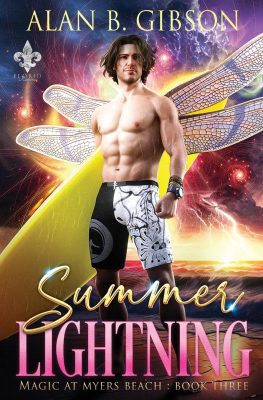
  • SUMMER LIGHTNING: Magic at Myers Beach Book 3 by Alan B. Gibson – Romance, Urban Fantasy, Mystery


    In Summer Lightning, the third book in Alan B. Gibson’s Magic at Myers Beach series, fairy prince Alias shoulders the weight of his people’s prejudice, but also their very lives.

    Someone has poisoned the natural reserves of fairy dust ingredients, lacing it with deadly iron. With many of his people already dead, and others terribly ill, King Theos relies on his younger brother Alias to devise the lost recipe with ingredients found at Myers Beach, a small human town. Alias helps house the sick in Myers Beach, and dedicates himself to his research, he loses much of his own comfort.

    Alias lives with his boyfriend, Christophe, a hero of the Third Kingdom– one of his own kingdom’s allies. He and Christophe can walk together freely in the human world, still Alias must worry about how his people see their prince. And now, with so many fairy eyes in his little town, he can’t even hold Christophe’s hand in public without the danger of being found out.

    As Alias worries about fairy eyes on him, humans catch sight of the mystical beings in their midst.

    Though Alias has created a functional fairy dust with only some of the ingredients, it leaves his peoples’ magical disguises unreliable. When famed actress and Alias’s childhood teacher, Dame Gabor, is found in her true form by a little girl, a media frenzy unleashes on the small town.

    Summer Lightning shines a satirical light on the fads of modern mass-media, with an online group, Friends of the Fairies, arriving in town to find evidence for their various blogs and podcasts. The story morphs from one of a fairy, to a small bird, to a seven-foot monster, all with opportunistic tour guides and business owners looking to cash in on the town’s tourists.

    More pressing than even keeping the true fairies hidden, however, is figuring out who poisoned the original dust.

    Calling back to earlier books in the series, Summer Lightning menaces the protagonists with hints of their old villain, a powerful and vengeful witch. But, more personally, Alias has to face the traumatic memories of his old tutor–from the days he spent growing up in the Third Kingdom. Though he’s certain he’s seen the last of the man, Györfi, who tried to molest him as a teenager and outed his forbidden relationship with the young Third King, Alias begins to discover possible connections between Györfi and the current trouble.


    Alias’s emotional journey will pull readers in, with his struggle between responsibility, personal connections, and the shadows of the past.

    His relationship with Christophe takes center stage as they deal with homophobia from both human and fairy society. Christophe tries to bridge the gap between them, but Alias doesn’t dare make his relationship public, especially with so much attention already on him as the only hope for his people’s survival. In this story, the word ‘fairy’ pulls double-duty, both as the name for Alias’s people, and one of the slurs thrown at him by bigots.

    Summer Lightning doesn’t shy away from darker subject matter, and as the story continues, readers will delve deeper into Alias’s memories of the cruelty he’s suffered–all while his old traumas resurface in new and dangerous forms.

    But he and Christophe aren’t alone, with characters like Dame Gabor standing as a staunch ally both to their relationship and Alias’s work. And though the fights between Alias and Christophe can feel a bit rushed, their connection remains heartwarming and empowering in the face of adversity.

    With a well-balanced mixture of comedy, intrigue, drama, and satire, Summer Lightning brings these magical characters to major crossroads as they try to keep up with the sinister forces ensnaring their homelands.


    Chanticleer Book Reviews 4 star silver foil book sticker

  • THE GARDEN PLOT DIARIES by Endy Wright – Short Story Collections, Small Town Fiction, Humor


    Endy Wright’s The Garden Plot Diaries is a delightful collection of four short stories about life, relationships, and consequences.

    Wright captures the gossip and rivalries between factious groups of town folk, all between sixty and ninety-something, who have known each other since childhood and carry the grudges to prove it. Our delightful narrator professes, “I am a rambling old man with a tale to tell and in no hurry to tell it.” So, settle in.

    Hailing himself from New Hampshire, Wright has set these stories in Monadnock, a New England town/region which he peoples with a menagerie of colorful octogenarians who drink, dance, and feud. In the voice of his narrator again, “[these are stories] of chaos creeping into God’s Garden.” Wright’s stories certainly do deliver a wonderful kind of chaos and pandemonium usually expected in a kindergarten class.

    We meet Old Lady Sourton, known after her introduction as the OLS. We meet Ivendricus Poudry, or Iven as his friends call him, the sidekick to our narrator, and of course our humorous and witty prankster narrator whose name we never learn, even as we grow to love him.

    These delightful characters, and so many more, leap off the page as they garden or go to the Oval in the town center to visit, shop, or pick up the morning paper. A tall tale lurks behind every pair of garden sheers and pot of tomato plants.

    No place is safe, even while fishing on the ice. Iven and our narrator head out with Ned Jalbert and Chester Turcotte with some of Iven’s famous Lion’s Tooth wine. Our narrator brings along his fresh homemade cheese he calls Cutting Cheese. They travel to Lake Massabeesacomapesit and commence the tradition of setting up their picnic in the ice fishing house or “bob.” Soon, the wine and cheese are flowing, and the stories turn surprisingly real for our fishermen.

    Wright spins his yarn and lures us into these hilarious fishing stories. Within the hour, the characters are reliving their WWII battle memories and becoming a force that even Eris Heavystep’s twelve-year-old twins can’t compete with– and when I say they can’t compete, these boys didn’t know what hit ‘em that day on the ice.

    After our heroes wake from their post-fishing naps, they find that the OLS has won their special cheese at the town’s Christmas auction.

    They waste no time in getting to the OLS’s house only to find they are too late. Her Zulu war outfit is missing from the mannequin in her museum-like home. Music is blaring and they can’t find the OLS. When they do, Wright describes a scene that will have readers rolling on the floor.

    The grand finale is a ghost story to end all ghost stories, as only Farmer Horthfarger Ghunt can tell.

    He sets a group of youngsters down in his pumpkin storage shed and spins a yarn for Halloween that would make Freddie Krueger run and hide. It’s a perfect way to end this wonderful and hysterical romp through Monadnock.

    These four stories capture the quaint side of small-town living in New Hampshire. Wright draws a picture of a small town then colors outside the lines. Readers will fall in love with this motley crew of mischievous elders planting their gardens and sowing the seeds of prankery and high jinks. Five stars all the way!


    5 Star Best Book Chanticleer Reviews round silver sticker

  • EARTHLY VESSELS by David T. Isaak – Metaphysical Fiction, Coming of Age, Mystical Fiction

    In Earthy Vessels by David T. Isaak, Crystal Keeling encounters a mystical power that sends her on a journey of true chaos.

    Crystal wasn’t necessarily seeking spiritual enlightenment on the streets of Manhattan, but there were certainly plenty of fools and charlatans peddling it back in 1969 – as well as both legal and illegal means of achieving ‘higher consciousness’ one way or another.

    Fortunately – and unfortunately – for Crystal, the man who found her, cult leader Anton Reginald LaMarr, and his Children of Pan were the real deal, whether they knew it or not. They had discovered a ritual that could draw down the soul of a Hero, and planned to implant that Hero’s soul into Crystal – using the usual orgiastic methods.

    Crystal was fine with the ritual sex but had not signed up for imprisonment and pregnancy. She ran far and fast and never looked back.

    When she discovered that she really was pregnant despite the birth control regimen she religiously maintained, she took it in stride – as did all the other members of whichever commune or co-op she happened to be living in at the time.

    The child, however, a boy she named Rainbow Bounty, rebelled against her counterculture lifestyle every bit as much as Crystal had rebelled against her conservative upbringing before him.

    Thus, readers follow Rainbow Bounty, who calls himself by his initials RB, pronounced ‘Arby’, because having people in the early 2000s think you’re named for a brand of fast food is much better than advertising that your mother was and still is a ‘flower child’. Arby makes his way from a job in the oil fields of Bahrain to Portland, Oregon because his mother hinted that there is a life-threatening event on the horizon.

    But she’s not the one whose life is about to be threatened and thrown off its course.

    The ritual that gave Arby life is about to come crashing down on his head – one way or another – and the fate of the world rests on him reconnecting with the abilities of his past lifetimes.

    Whether those abilities will help or hinder is a crapshoot of the highest order, because Arby isn’t the avatar of some long-dead Hero or God. That would be much too easy. Arby is, as he has so often been in his life, the avatar of chaos, the embodiment of Murphy’s Law.

    Arby is destiny’s Fool, and his purpose is to cast all plans into disarray. Even his own.

    Earthly Vessels, beginning as it does in the counterculture movement of the 1960s, reads with a sense of nostalgia for that brief era, and Crystal’s acceptance of and equally brief involvement with the Children of Pan fits right in with books of the time, from the Harrad Experiment to Stranger in a Strange Land.

    As the story moves from Crystal to Arby, a different perspective emerges, as the reader learns Arby’s place in the post-9/11 world right along with him. Arby discovers his expected role at a compelling pace, as there are forces beyond his understanding searching for him – on both sides of the cosmic balance that human shorthand calls ‘good’ and ‘evil’.

    The scope of Arby’s story, diving deeply into that longest of long-running battles, with avatars fighting on both sides of the divide, will remind readers of both Good Omens and American Gods.

    Earthly Vessels is both a deep exploration of the philosophy of the cosmos and a compelling thriller in one breathless story.

    Arby is a protagonist readers can easily empathize with, an Everyman who rises to an occasion he never dreamed was possible, doing his damnedest along a path he doesn’t fully understand.

    This story will keep readers turning pages as fast as they can, from the first until the surprising, fitting, and delightful last.

  • TOMORROWVILLE by David Isaak – Dystopian, Sci-Fi, Satire


    As Tomorrowville by David Isaak opens, it is in fact yesterday. 2008 to be specific. Toby Simmons, a Gen X programmer/engineer/hacker, is in the midst of something professionally fascinating but personally stupid.

    Toby uses a state-of-the-art virtual reality system to surreptitiously peek into the apartment of the woman across the street. But he’s three stories up, and loses track of where his real feet are walking as he’s too busy following his virtual eyeballs, leading him to one of Wile E. Coyote’s famous maneuvers. He discovers that there’s nothing underneath him but air and a three-story drop to the pavement.

    But just like that cartoon coyote, Toby comes back from the dead. It only takes a silly prank, a forgotten gin and tonic, and 80 years, as medical science makes great strides in bringing cryogenically frozen bodies back from formerly life-ending spinal destruction. Along with a whopping bill from the U.S. government– nearly five million dollars for all the many, many costs of Toby’s revival.

    It’s 2088, and Toby Simmons has unwittingly become Rip Van Winkle. The world has changed while he’s been sleeping– although not, perhaps, nearly as much as it should have.

    This compelling story follows along with Toby’s learning curve/adaptation to a not-nearly-so-brave new world. The government relies on asset reclamation for funding, and issues mandatory, automatically-dispensed mood enhancements to keep its population from noticing that fewer and fewer people manage to stay out of the prison industrial complex.

    The late 21st century that surrounds Toby has idealized the era from which he came to the point that, as much as they want to hear the account of the person who lived it, they are only interested in that account if it reinforces their mythology. At the same time, this new society’s faults are clear to both Toby and the reader– but concerns about safety and security eclipse all other concerns from the powers-that-be, leaving the U.S. a totalitarian regime that has lost ground to the rest of the world and has medicated itself into not caring about all that much.

    The world in which Toby has found himself is a dystopia without having ever experienced an apocalypse, made all the more fascinating because they did it to themselves, using tools that they claim the late 20th and early 21st century gave them.

    It’s a future that is all too easy to see from here. Toby begins to feel himself superior to those around him, and as he’s not drugged up to his eyeballs, it’s easy for readers to slide into his perspective on this world.

    In the end, Toby wants out of 2088, and the story leaves readers with the hope that he might manage to avoid the destination his journey is leading to– prison– by doing something professionally interesting but quite possibly, and quite personally, stupid, once again.


    Chanticleer Book Reviews 4 star silver foil book sticker

  • STAY With The WAGONS: Ghosts Along the Oregon Trail Book 3 by David Fitz-Gerald – Historical Fiction, Oregon Trail, Mystery Edit | Live


    Blue and Gold Badge recognizing Ghosts Along the Oregon Trail by David Fitz-Gerald for winning the 2023 Series Grand PrizeThe wheels roll relentlessly westward. In Stay with the Wagons, book 3 of David Fitz-Gerald’s Ghosts Along the Oregon Trail series, the families upon those wheels must face not only the consequences of the trail behind them but also new dangers that lie ahead.

    Dorcas, the resilient mother, widow, and adventurer will need to summon forth all her remaining strength– physical and emotional– to survive these new challenges. Especially with her children to protect. Their community of waggoneers have supported each other through great hardship, but cracks are growing between them.

    Amongst its incredible beauty, the country they travel through contains great danger, wild animals, and a hidden evil energized by greed and violence. There is a promise, a hope of happiness on the trail west if you Stay With The Wagons, but nothing is guaranteed.

    There’s no turning back now for Dorcas and her children, as they near the halfway point to Oregon.

    She can’t give up on this dream, facing down their long way to go into the unknown. Dorcas yearns to truly become a strong and independent Athena-style woman, yet doubts linger.

    It’s the first day of summer, so the weather conditions are improving, but even this helpful development brings forth new challenges. So far the graves left behind them due to illness have been isolated cases. Dorcas buried her husband, but now she faces her own possible demise as she falls deathly sick.

    While she fights desperately for life, her children must step up to responsibilities beyond their years. Their friends in the wagon train do what they can to help, but can this family carry on and can their mother summon the vitality to recover? Like a mustang out on the plain, will the family’s wild spirit prevail?

    Along the trail there are many spirited encounters. Some are animalistic, some are devilish, some are affairs of the heart– none are predictable.

    Grizzlies, snakes, even scorpions seem to conspire against the invaders of their lands. But true evil lurks in human form, and paranormal forces hovers over the wagons.

    The complications of love are woven within the community, and even beyond. It’s not only romance that provokes trembles, but also the love for family, and wishing only the best of dreams for those who are cherished. When they reach a fork in the trail, life choices must be made with dire stakes.

    Don’t fall behind now. This series continues west to the promised future.

    Author David Fitz-Gerald propels readers through the 1850 American West, alongside the people of that era in the journey of their lifetime. We all know the destination, but no one knows whether– or how– this wagon train will arrive. Fitz-Gerald wields an amazing talent for suspense and surprise twists.

    Readers will feel as if they’re walking the trail step by step with Dorcas and her family, sharing the emotional heights of rocky precipices as well as the depths of valleys in all their vivid beauty and daring, as they continue onward to Stay With The Wagons.


  • WOKELYND by George Denny – Dystopian, Political Fiction, Contemporary Social Issues

    Wokelynd by George Denny transports readers to a futuristic New California, where the government’s benevolent rhetoric of equity and inclusion disguise instead an insidious quest for power and dominance.

    A panoramic view of New California as an independent nation in 2066 sets the scene. The authoritarian JSS (Justice of Social Soldiers) wields absolute control over the population of this nation, where despotic policies stifle human autonomy. The ‘intersectionality score’ of an individual governs their position in the social hierarchy; the higher the score– the higher the chances one has experienced historical oppression– the higher their privileges. The result is chaos: an ideological rift has taken over the nation as the Liberati challenge the status quo with a stance of ‘Anti-Anti-Racist ideology’.

    Distrust and division pervade New California. The story opens on a fierce military operation between the JSS and Nevada at Lake Tahoe over ideological disputes. The ambiguity and perplexity of soldiers are embodied through Quinceton, a teenage sniper with the identity of a straight cisgender boy of African descent. A soldier under the JSS government, Quinceton straddles his commitment to JSS and his dilemma due to a growing awareness of the complexities in the despotic system. Wokelynd ushers Quinceton along a journey of self-discovery and resistance, along with companions Sarah and Bones, as they navigate the treacherous paths of identity politics and societal change.

    The climax throws Quinceton into the throes of uncertainty as he grapples with the JSS’s professed motive of universal equity versus their thirst for power.

    The horrors of warfare with Nevada further disillusion Quinceton, leading him to question his duty and the greater good of all. As Quinton and his companions navigate through the apocalyptic landscape of post-war New California, they encounter the elderly Tinh, living off the grid with his family. Tinh reveals his involvement in the secret network ‘Rooftop Railroad’, aiding refugees out of JSS’s grasp, as well as opening clandestine chapters in the history New California, which were otherwise written only from the regime’s viewpoint.

    The encounter foreshadows a critical juncture for the three soldiers, especially Quinceton, as they turn to the precarious roles of revolt and defiance. The peril of Anti-Anti-Anti Racist (AAA), the muscle of JSS, awaits them. To AAA patrolpersons, dissenters are terrorists who end up in the ‘DIE’ camp– offers either indoctrination or death. With AAA’s manipulation and severe disciplinary measures in place, the trio is headed for a future where equality reigns supreme.

    George Denny makes an intriguing correlation between language and power dynamics.

    The JSS government exercises control by shaping the discourse of citizens. Phrases such as “Anti-Racist” and “Anti-Anti-Anti-Racist” (AAA) reinforce the ideas that the New Californian Society stigmatizes. Likewise, the title “Knowers”, for the top members of society with the highest influence over people and policymaking, reflects the government’s implied justification for their every decision. But this use of language to maintain authority is echoed in the linguistic tactics of the opposing Liberati to mobilize resistance.

    Social and political allegory of frail government policies and the erosion of freedom manifest through Tinh’s family. Tinh disregards the JSS’s programs aimed at promoting equality and welfare. He stresses autonomy and self-reliance, recognizing the inherent limitations of government projects that perpetuate exclusion and dependency despite their professed objective of encouraging fairness.

    “The most potent weapon in the hands of the oppressor is the mind of the oppressed.” This quote by Steve Biko reverberates in the pages of Wokelynd. This piece lays bare an insatiable desire for power and control contrasted with the indomitable spirit of human agency.


  • COMING OUT Of The METAPHYSICAL CLOSET by Lisa Rhyne – Spirituality, Metaphysics, Memoir


    Lisa Rhyne offers a view into her beliefs, education, and personal experiences with the mystical and otherworldly in Coming Out of the Metaphysical Closet.

    In this autobiographical compendium of supernatural phenomenon, Coming Out of the Metaphysical Closet is a combination of multiple original manuscripts, beginning with a hefty overview of the foundational science and concepts to help frame Rhyne’s experiences, the metaphysical world, and those who claim to work in it. Rhyne explains her perspective on walking between and having to function in both the ‘normal’ and ‘mystical’ worlds and, like many visionaries, describes this reality as illusory and subjective, created by the collective consciousness of living beings through morphogenic fields and a universal repository of knowledge.

    Within this metaphysical framework, humans reincarnate from an ‘Oversoul’ that seeks to learn through each lived experience—the good, bad and everything in between. As such, Rhyne relates that shamans such as she can step between past and present lives, and even across different planes of existence. Throughout the book, Rhyne expands on the powers, dangers, as well as unique transformative opportunities that these spiritual journeys can lead to.

    Her own path within the metaphysical community takes center stage as she shares impactful moments in her life. From a complex and abusive relationship with her mother, to a dangerous stalker, to joyous life-changing personal revelations, she insists that metaphysical forces have watched over her since before she was born.

    Rhyne maintains a strong sense of yearning and hope throughout these stories, with moments of evocative description that paint both the mundane world and her enchanting mystical visions. Emotional scenes frame otherworldly ideas with experiences that readers can easily connect to—the pain of supporting a loved one through illness, the simple love between a girl and her cat, the joy and satisfaction of feeling that you’ve helped another person.

    As she learned more about mystical practices and her relationship to them, Rhyne continuously connects with many fascinating people. Her continued studies include a wide variety of scholars, healers, and thought leaders, Hopi and other indigenous elders, fellow Metas (her term for those who share her beliefs, abilities and practices), and renowned authors such as Michael Talbot, Phillip K. Dick and shamanic practitioner Dr. Hank Wesselman, PhD. Coming Out of the Metaphysical Closet contains numerous references and links, so curious readers will find many more valuable threads of knowledge to pursue.

    Rhyne shares examples of her metaphysical experiences and powers such as manifesting desired outcomes into her life, healing herself and others by moving between dimensions, and being guided by higher beings to pursue or avoid certain relationships. The full nature of these higher beings remains elusive, with references and stories that paint them in angelic, ancestral, and even extraterrestrial light.

    Coming Out of the Metaphysical Closet seeks to inspire readers—encouraging those who not only believe in but know the mystical to utilize their powers and share their abilities and perspectives with the world to foster understanding and acceptance of all things metaphysical.

    Some readers might find some ideas difficult to grasp, as this book is oriented more towards those who already have some education and connection to various metaphysical theory and beliefs, but Rhyne grounds the more esoteric ideas with figurative language, scientific foundations, and recurring explanations. Additionally, as some ideas are often drawn from various mythologies across the world, they show interesting connections between belief systems that at first glance appear disparate but share foundational concepts.

    Coming Out of the Metaphysical Closet has over 300 images including pictures and video stills of sometimes unexplainable supernatural phenomena, and significant moments for Rhyne, with an online gallery that further expands on them, including transcripts and videos.

    Rhyne’s online gallery includes images in the book and provides readers a chance to view the photos on their computers to be able to see the details better. More significantly, she includes security camera videos of drifting motes of light. The true nature of these videos is interesting to consider, whether one believes them to be small spiritual manifestations, or physical things catching the camera’s attention. Similarly, the photos and videos, and recording of the Mysterious & Unexplained show, include significant technical issues and comments by others experiencing the phenomena, giving tangible examples of Rhyne’s claims that her energy disrupts electrical systems.

    Rhyne also provides supplemental documents like the full Dragon dictation messages (from Chapter 8) in this gallery. These messages contain some ominous and even poetic lines, though similarly to Rhyne herself, readers will find it difficult to parse meaning from this text. Much could be read into it, however, and the lack of clarity prompts one to wonder how an otherworldly entity might struggle to communicate with someone in our reality utilizing electronics.

    All these examples might encourage others with metaphysical beliefs to openly share their experiences, their own documented phenomena, and could certainly spark fascinating discussions which is one of the goals of this book—to start authentic dialogue without any fear of negative repercussions or discrimination.

    This book will resonate with those who experience—as well as seek to experience—seemingly unexplainable mystical things, and ultimately advocates for a world of understanding, love and authentic personal empowerment.

    At the core of Coming Out of the Metaphysical Closet is the idea of inclusion and universal connection—through past lives, Aka cords, soul groups, or even just the small moments of kindness that turn strangers into friends. Whether or not readers share every belief with this book, Rhyne reminds them to search for people who enrich their lives and live the ideals of empathy and equality.

    For readers on a journey of metaphysical spirituality, or for those who are merely ‘psi-curious’ (to borrow one of Rhyne’s terms), this book will spark curiosity and a sense of community. Rhyne understands there will be those who doubt and no matter how much evidence is presented by her or anyone else, some will never accept. And that’s perfectly fine with Rhyne. This book is a beacon of light for those who wish to be the masters of their lives and dreams. There are two questions that sum it up nicely. “What if she’s wrong?” and “What if she’s right?”


  • MISTRESS Of LEGEND: Guinevere’s Tale Book 3 by Nicole Evelina – Arthurian Legend, Historical Fantasy, Myths & Legends


    In Mistress of Legend, the enticing finale of Nicole Evelina’s Guinevere’s Tale trilogy, matters are life-and-death by the second sentence, pulling readers deep into Guinevere’s fate in this retelling of Arthurian legend.

    We come upon heroine Guinevere in the midst of an ill-fated romance with Lancelot. It’s far from her first troubled entanglement, but the stakes rise as she’s severely injured and faces even more threats, pursued by possible enemies. The novel’s beginning is woven with backstory, which adds suspense to the drama unfolding in Guinevere’s present. This summarizing might be slow for readers familiar with the series, but makes the story accessible for those who haven’t picked up the first two books.

    Many more characters appear, waving the web of intrigue Guinevere finds herself caught in.

    Evelina builds this setting through well-researched cultural details, like the holidays and rites of Guinevere’s pagan world, and the symbolism and ideology of the Christianity that threatens to blot her world out.

    Though it’s a work of fantasy, Mistress of Legend has the feel of magical realism. Paranormal abilities like Guinevere’s “sight” fit subtly within Evelina’s carefully constructed foundation. Details down to ritualistic makeup and intoxicants are based on fascinating historical truths, many of which are explained in the author’s notes at the end.

    Evelina avoids foreshadowing to ensure her characters’ futures long remain inscrutable. Unpredictable shifts in individuals and relationships seem to arrive at every turn, making for a thrilling, if at times mystifying, read. Guinevere’s relationship with Morgan, Arthur’s second wife, feels uncertain until the end, as the two vacillate from enemies to friends and back again. Meanwhile, Mordred, son of Morgan and Arthur, undergoes surprising development that makes perfect sense only in retrospect.

    The use of “the sight” by characters like Guinevere and Morgan provides windows into other places, even the future, as the women experience highly realistic visions.

    This allows Evelina to show two places at once without using multiple points of view (though some characters are so fascinating that readers may wish they could see things through their eyes). Instead, only Guinevere’s perspective is given, and readers feel her claustrophobic sense of being trapped in the mechanisms of fate.

    Along with the characters involved in it, this tale of political intrigue only grows more complex with time.

    The story begins to feel like a tapestry whose threads disappear and reappear in the weave. Some characters – even main ones – vanish and are nearly forgotten, only to return when they’re least expected. Guinevere’s life-threatening injuries, so crucial to the first pages, are soon eclipsed by even more pressing problems. Yet they return to the narrative from time to time, the marks left behind to remind the aging Guinevere of how much she’s lived – and how much is still in store.

    Mistress of Legend fits well within the literary tradition of retelling classics from a strong woman’s point of view.

    It’s a great pick for readers of magical realism, historical fiction, and new twists on old classics. It takes things a refreshing step further, too, with a strong female character who remains formidable, agile, and the subject of much male attention as she ages past 40. Youth is no threat to Guinevere. The foolish grabs for power that surround her are.

    The pace of the novel shifts wildly: speeding through seasons, only to suddenly slow and zoom in on the intense details of a moment. At times, it feels a bit like whiplash – but surely that’s how Guinevere felt, as the life she built crumbled time and time again. Readers remain close within her viewpoint, feeling everything she feels, in a world whose only constant is change. Ambitious though she is, her true quest is simply for peace.

    Mistress of Legend by Nicole Evelina won First Place in the 2018 CIBA Chaucer Book Awards for Pre-1750s Historical Fiction.

    The Guinevere’s Tale series by Nicole Evelina won Grand Prize in the 2021 CIBA Book Series Awards for Fiction Series.


    5 Star Best Book Chanticleer Reviews round silver sticker


  • GOD, The MAFIA, MY DAD, and ME: A True Story of Secrets and Survival by Lori Lee Peters – Memoirs, Family Relationships, Organized Crime


    God, the Mafia, My Dad, and Me by Lori Lee Peters begins in the voice of a child, compelling not just for its narrative honestly, but for the fact that it might not be reliable. As the book opens, we learn that this narrator firmly believes she will be killed.

    Readers can easily see through the childlike hyperbole, but that doesn’t detract from the intrigue. How did a kid come to such an extreme conclusion? Is there any seed of truth to it? These questions will hook readers from the start.

    Author Peters set out to write a book about her dad. God, the Mafia, My Dad, and Me tells the true story of her father, and his fascinating work helping the FBI tackle Mafia activity in Lodi, California. Yet in the end, this is a memoir in which the compelling lead character – young Lori – overshadows her father in many ways.

    We only see Lori’s father through Lori’s eyes, so he seems larger-than-life. Lori herself becomes the truly fascinating figure, especially as her life grows more complex with age. At first, the book holds little suspense, as young Lori unpacks the seemingly-straightforward details of her and her father’s life. Yet what seems to be an idyllic childhood starts to break down as the narrator reveals her complicated family dynamics and very real fears. Lori’s fear of God takes on a literal meaning, far beyond religion. In fact, it starts to tear apart her life.

    Author Peters provides every detail with remarkable calmness, giving a window into the adult writing the story.

    Yet the book maintains the voice of a child until near the end, which may leave readers wishing for more reflection from present-day Lori. Instead, we walk closely with young Lori through the twists and turns of a childhood plagued by fear. Her father’s challenges dealing with the Mafia undercover become more tangible, and in some ways, easier to face. They seem to pale in comparison to Lori’s nebulous personal troubles, especially since she’s so afraid to speak them out loud.

    Peters includes moments from her father’s perspective, recreated from later research. These recreations feel less lively than other scenes, but ultimately, the book is more memoir than biography. Scenes increasingly focus on Lori’s life as time progresses, and readers will feel drawn in by the truthful way she relates her struggles.

    God, the Mafia, My Dad, and Me avoids traditional chapter headings, and initially jumps back and forth through time, which can create some confusion. However, later sections settle into a steady rhythm as Lori enters adulthood, plagued by growing anxiety and secret issues with grasping reality itself.

    Watching her slowly confront, then overcome, these inner problems is the heart of the book, and provides an ending even more satisfying than her father’s win over the Mafia.

    As a narrator, Lori offers compelling moments of honesty and understanding, such as when she goes through a messy divorce with vast compassion for her soon-to-be ex. When she grows up, the adult Lori emerges as a stronger and more reliable narrator, giving readers reflection and depth that ties the book together. This warm and thoughtful voice that will keep readers invested throughout the story.

    God, the Mafia, My Dad, and Me by Lori Lee Peters won Grand Prize in the 2022 CIBA Shorts Awards for Novellas, Collections, and Anthologies.


    Shorts GP gold sticker

    5 Stars! Best Book Chanticleer Book Reviews

  • A MAP Of The EDGE by David T. Isaak – 1960s, Coming of Age, Psychological Fiction

    To say that fifteen-year-old Rick Leibnitz has had a difficult childhood would be an understatement. Abandoned by his mother when he was eleven and left with a physically and mentally abusive father, Rick’s teenage anger is justified in A Map of the Edge by David T. Isaak.

    After a violent episode with his father, Rick is caught holding drugs for a girl he hopes to impress and is sent to a juvenile detention center. There, he refuses to capitulate to the demands of his jailers until his probation officer offers him not only a possible reprieve but also, for the first time in his life, listens to Rick’s problems.

    When he is handed back to his father’s custody, his nightmare life continues until Rick is befriended by Lincoln Ellard. Linc finds Rick a place to stay after a vicious beating from his father, and the two quickly become inseparable, with Linc eventually bringing Rick in on his drug dealing business. In his adolescent mind, Rick has it made–drugs, girls, popularity, but the good times end abruptly when a rival drug dealer attacks Rick and Linc, leaving their relationship perpetually plagued. When a close friend nearly overdoses, Rick again finds himself in over his head.

    The novel’s title perfectly sums up Rick’s predicament. He is on the edge of everything.

    Rick hovers on the edge of adulthood in many ways. At fifteen, he is too young to get a job or to be on his own, stuck living with his cruel, angry father who takes out his own wasted choices on everyone else. Rick can remember the beatings his mother suffered, and he feels that her leaving him is justice for his lack of action to protect her. But now, he has become the target of his father’s wrath and can’t legally escape it. Eventually, he refuses to even try to get along with his father and chooses defiance, which leads to even worse treatment.

    Not physically big enough to stand up to his father, he seeks an escape in alcohol and drugs, a decision which leads to his first sexual encounter with the girl whose punishment he took on himself. Both the juvenile detention and that encounter push him again closer to the edge of adulthood. He romanticizes his imprisonment as a chivalrous gesture that is sure to lead to a grateful and lovesick Stacy. When she refuses him after his release, he’s pushed beyond his emotional capacity and turns to self-harm in multiple ways.

    After meeting Linc, Rick thinks his life is finally turning around.

    Linc convinced Rick that the drugs they sell and use aren’t really hurting anyone but instead are expanding their thinking. The two of them skirt the edge of reality and LSD-induced illumination. For a time, Rick lives on this edge of 1960s teenage idealism. He parties, with others and alone, has sex with lots of girls, and makes excessive amounts of money with little effort. He listens to Linc’s pontificating, believing him to be enlightened and knowledgeable.

    When the boys are attacked by rival drug dealers, Rick reaches the edge where the fun stops and danger becomes real. His entire perception changes, and he cleans himself up as he and Linc drift apart. When Lisby, one of Linc’s many girlfriends, tries to commit suicide, Rick finally takes the advice of his probation officer, Leo, seriously. As his only true champion, Leo has attempted to keep Rick on the straight and narrow throughout the novel, but it isn’t until this last near-tragedy that Rick seems to understand. While the edge is exciting, its precariousness leads to destruction.


    Chanticleer Book Reviews 4 star silver foil book sticker