Category: Reviews

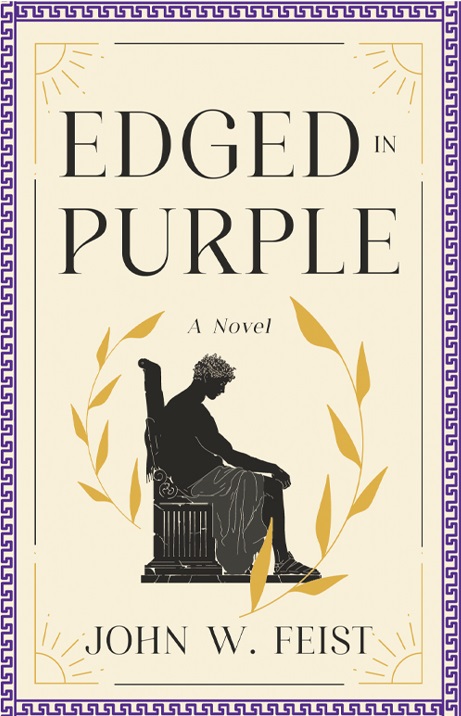
  • EDGED In PURPLE by John W. Feist – Myths & Legends, Historical Fiction, Romance

    EDGED In PURPLE by John W. Feist – Myths & Legends, Historical Fiction, Romance


    Chatelaine 1st Place Best in Category Blue and Gold BadgeEdged in Purple by John W. Feist welcomes readers to a place outside of time and space, a liminal space where characters of myth wait to return to their fated stories.

    The Fold is a beautiful land, a near-utopia shepherded– literally– by Thetis and Peleus of Greek mythology. They raise the heroine of Shakespeare’s The Winter’s Tale, Perdita, after her father had accused her mother of betraying him with another, the whole sad story a product of his own paranoia.

    Perdita’s story is proceeding as it was written. She has already met Florizel, the man who should be the hero of her romance– when her story is intersected by another. Just as The Winter’s Tale features royal courts, doomed relationships, mistaken identities, and family murder, so too does an ancient Greek drama: the Oresteia of Aeschylus, the story of Agamemnon after the Trojan War.

    Orestes, the hero of that ancient tale, joins Perdita in the fold, pulling both of them from the paved road of fate.

    They fall in love. Florizel goes mad with jealousy and proves that she’s MUCH better off with Orestes– as he pursues the lovers out of The Fold and into a reality that none of them are quite prepared for.

    The reality they wake up in is that of the late 19th century, among the ruling class of the teetering Austro-Hungarian Empire of the Habsburgs, not far from Archduke Franz Ferdinand’s date with destiny.

    Edged in Purple begins as a whimsical combination of fantasy and mythology.

    Characters such as Orestes and Perdita’s adopted mother Thetis mingle with characters from the classics of literature– not just Perdita herself but nearly all of the personae from The Winter’s Tale. Peleus implies that characters from countless other stories have passed through The Fold on their way to their own endings, whether happy or not.

    This setting offers a wealth of possibilities for stories to mingle and morph, which Edged in Purple explores to excellent effect.

    It turns two familiar stories into one brand new adventure, transforming The Winter’s Tale into the kind of love vs. power romantic triangle that defines such stories as The Princess Bride, with Orestes, Perdita, and Florizel taking the roles of Wesley, Buttercup and Prince Humperdinck, respectively.

    However, the curtain of fantasy is pulled back and the characters must inhabit the bodies of very real historical figures. And yet still, they seek to control their own fates.

    After all, they managed it once, back in The Fold.

    But as fantasy transforms into historical fiction, their lives become fixed to moments in time. And as Orestes– now Franz Ferdinand– learns, the wheels of history can’t be steered as easily as a story.

    The two very disparate parts of Edged in Purple are equally compelling, and while that switch from fantasy fairy tale utopia to oncoming historical tragedy could send some readers for a spin, those interested in the blending of genres will be enthralled by this mirrored tale.

    For readers who do make the leap, Franz Ferdinand and Sophia’s impossible happy ever after is both compelling and heartbreaking. Recommended for readers who enjoy portal fantasy, historical fiction, and tragic romance.


  • TSARINA’S CROWN: The Nightingale and Sparrow Chronicles by Jerena Tobiasen – WWI, Historical Fiction, Romance, Espionage, Russian Revolution

    TSARINA’S CROWN: The Nightingale and Sparrow Chronicles by Jerena Tobiasen – WWI, Historical Fiction, Romance, Espionage, Russian Revolution


    Jerena Tobiasen delivers a sharp, first-rate novel in Tsarina’s Crown, first installment in The Nightingale and Sparrow Chronicles, capturing a precise panorama of Russian politics and British espionage during a delicate period in time.

    The year is 1915 and Simon Temple, a young naval officer aboard the RMS Guardian— a British Royal Navy Ship— patrols the North Sea for questionable communications and marine activity. Months later, he is entrusted by the British crown to serve as a liaison on a covert mission in Petrograd, Russia. Simon is careful not to blow his cover as a young aristocrat while he is thrust into the world of international politics, the ruthless Russian Revolution, and becomes caught right in the middle of two powerful royal families.

    The mission turns out to be longer than Simon anticipated, and his life quickly becomes threatened as he tries to navigate a dangerous political labyrinth, all the while hoping to unearth the spy information that his King requires of him. But as the precarious wheel of mayhem and chaos churns in Russia, Simon’s only way to survive is to escape, realizing that his wit and intelligence might not save him from the tense political atmosphere. Things become even more complicated when he is joined by two other people who hope to flee.

    Told with verve and heart, the plot offers a raw and intimate portrait of events and activities bookended by the First World War.

    The tension and suspense are palpable in every chapter as Simon wrestles his way out of one dangerous situation after another.

    Tobiasen’s lucid writing and adept storytelling capture the culture and intricate details during one of the biggest social and political upheavals of the twentieth century. She takes us behind palace walls of both Britain and Russia, offering readers a globetrotting experience as we glimpse into the intrigues of the aristocracy amid controversy and fiery protests.

    The author does a remarkable job balancing vocabulary and syntax appropriate for this period while using modern language to make her text easily graspable. The meticulous research done before writing this novel is salient in her story and keeps the chronology accurate, a worthy indication of an author in command of her genre.

    Love becomes a central theme in the story, giving weight to the characters’ emotions and connections.

    An element of romance sparks between Simon and Mary, allowing characters to maneuver not just external conflicts but inner ones as well, pushing them to grow as people. Simon Temple is a character to cheer on, with admirable boldness and determination. The supporting characters are memorable and well-wrought too, adeptly playing their role in moving the story forward.

    Tsarina’s Crown: The Nightingale and Sparrow Chronicles is a striking start to a promising series, and one of the best espionage stories in modern historical fiction.

    Tsarina’s Crown by Jerena Tobiasen won First Place in the 2023 CIBA Hemingway Awards for 20th Century Wartime Fiction.


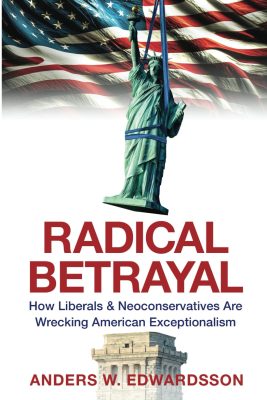
  • RADICAL BETRAYAL: How Liberals and Neoconservatives Are Wrecking American Exceptionalism by Anders W. Edwardsson – American Politics, Political History, Political Analysis

    RADICAL BETRAYAL: How Liberals and Neoconservatives Are Wrecking American Exceptionalism by Anders W. Edwardsson – American Politics, Political History, Political Analysis


    Radical Betrayal by Anders W. Edwardsson explores American Exceptionalism and its echoes in today’s US politics and society. It offers a perspective on the nuances of the ideology and calls for its reworking towards a more united nation.

    Donald Trump’s unexpected win shocked a major segment of the USA populace in 2016, raising a big question about a complete neophyte’s victory. For some, he was a messiah to renew America’s standing. For others, he was a candidate with an unconventional campaign of blunt, rabble-rousing talk, who surprisingly took over the electoral term.

    What emerged as more remarkable is that, despite not winning the popular vote, the electoral college votes secured the 2016 US president his win. It added to the debate surrounding the election and highlighted the existing political divides in the states. Radical Betrayal examines why the 2016 election played out as it did, opening with its discussion of American Exceptionalism.

    American Exceptionalism is the belief in the unique global leadership of the USA. This book follows the evolution of this ideology, starting from the blend of the nation’s founding ideals of Enlightenment and Religion. It covers various historical periods and traces the idea’s development over several presidencies. This discourse presents the basis for the thesis, paving the way to answer the controversial win of the 2016 election.

    Radical Betrayal covers a labyrinth of movements like isolationism and interventionism in the 19th and 20th centuries, as well as the rhetoric of political leaders from George Washington and Theodore Roosevelt to Ronald Reagan and Donald Trump.

    What becomes clear is years-long tactic of harnessing American Exceptionalism to gain public support and justify policies. Not only this, the history highlights differences in how this strategy was approached, and its continued influence on shaping political takes and public views today.

    The work creates an inclusive argument for why Trump’s slogan “Make America Great Again” resonated with many people. To establish its position, Radical Betrayal works through the many political and cultural changes in American history that have created the appeal of this slogan. Different visions of Exceptionalism across history—inclusive and exclusive, active and passive—contribute to the debate on polarizing politics. They showcase a bridge between those conforming to two forms of this ideology—the more conservative form, and the broader, less focused version.

    This book invites readers to help shape the future discourse around American Exceptionalism and its influence on the US.

    Pointing to Trump’s presidency and the clear divisions in American identity during the era, Radical Betrayal suggests reassessing the power of Exceptionalism in shaping these national identities. It stresses the need to bridge historical ideals and modern realities toward a unified America. This journey to understand American Exceptionalism illuminates a potential for inclusivity in the nation’s rich tapestry of communities, races, and heritages.

    An analytical approach with an encouraging and didactic tone shapes the pages of this book. Idealistic and inspiring, it opens the opportunity for further enrichment with discussions on potential obstacles in the journey to political refinement and growth.

    The piece propels one toward reinterpretation and rejuvenation of American ideals, unity, and progress—the essence of American Exceptionalism itself.


    Reviewed by Chanticleer Book Reviews 4 Stars! round silver foil sticker

  • SUMMER THUNDER: Magic at Myers Beach Book 1 by Alan B. Gibson – Small Town Romance, Urban Fantasy, Fairy Romance

    SUMMER THUNDER: Magic at Myers Beach Book 1 by Alan B. Gibson – Small Town Romance, Urban Fantasy, Fairy Romance


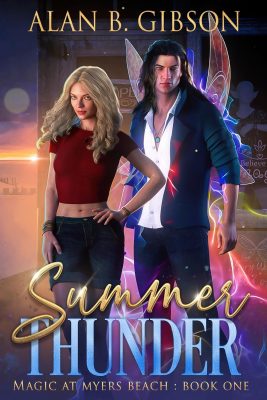
    Lily struggles to keep her business, her son, and her home. But in Summer Thunder, first book of the Magic at Myers Beach series by Alan B. Gibson, Lily’s luck begins to turn as she connects with the enigmatic beach king Theos.

    With the help of her friend and fellow business owner Greta “the Witch,” Lily tries to revitalize her fairy-themed decoration and figurine store. Her divorce from her abusive ex-husband Kelly is pending, and she must present a calm and reliable home to ensure full custody of her son Jamie. But when her kindly landlord, Ms. Coffey, passes away, she’s confronted with two options: lose her prime business location and upstairs apartment, or somehow make enough money to buy the building herself.

    Enter Theos, a kitesurfing champion with adoring fans. He shows true appreciation for Lily’s fairy figurines, bringing her many more sales. But more importantly, Theos becomes deeply interested in Lily herself. Their romance begins on rocky footing, as Theos has a strange air about him and seems to vanish whenever a storm comes into town. But when he begins modelling for a new fairy figurine– aptly named Theos, the King– the two are drawn inevitably closer.

    Though she succeeds at turns, Lily confronts ever-growing problems, testing her determination.

    She must keep Kelly from influencing her son and jeopardizing Lily’s chance at a happy family. And as Theos becomes a more serious figure in her life, Lily will have to decide how much of a leap of faith she’s willing to take–who she’ll end up becoming.

    Meanwhile, the town of Myers Beach is facing change of its own.

    This story keeps a tongue-in-cheek attitude as it tackles real-world issues. Powerful national banks sweep up local institutions, bullies wield the term ‘fairy’ against boys like Jamie who don’t follow their standards of masculinity, and the lives of people like Lily risk being seriously upended for the sake of someone else’s real-estate investments. While Summer Thunder keeps a lighter tone, it doesn’t shy away from serious topics.

    The two perspectives, Lily and Theos, create an engaging balance of information for the reader.

    While Lily tries to shape her own life, Theos shoulders an even more dire burden–the lives of his people. As crown prince of a true fairy kingdom, Theos deals with the aftermath of their most vital resource­–fairy dust–being poisoned. He must find a new source of its core components, but thankfully, he’s already noticed a few in Myers Beach.

    He works to set up a home for sick fairies around the town, while courting Lily and debating when–and how–to reveal his true nature. Often, readers will see the disconnect in Theos and Lily’s understanding of the world. Neither fully knows the other, especially as Theos presents such a larger-than-life persona, giving space for conflict to grow between them. Will they be able to overcome their differences, and truly connect as themselves?

    This story shines with a charming setting and lively cast of characters.

    Gibson’s descriptions place readers in the cool spray of kitesurfing and the quaint boardwalk of Myers Beach. Lily lives in a town of friendships and rivalries, with vibrant and unique characters to flesh out the story around her. While the prose sometimes explains more than it should, and dramatic threads don’t always have enough time spent building tension, the characters are driven and will pull readers easily into their schemes.

    For those interested in urban fantasy, beach-side romance, and the adventures of plucky local fairies, Summer Thunder will be a strong opening to the Magic at Myers Beach series.


    Chanticleer Book Reviews 4 star silver foil book sticker

  • PARALLEL SECRETS by ML Barrs – Murder Mystery, Small Town Mystery, Amateur Sleuths

    PARALLEL SECRETS by ML Barrs – Murder Mystery, Small Town Mystery, Amateur Sleuths


    In the small Missouri town of Walkers Corner, it seems everyone has a dark secret. In Parallel Secrets by ML Barrs, a TV journalist comes to town to do a magazine piece on a missing girl and begins uncovering many of those hidden stories.

    Motivated by feelings of guilt for not following up on a previous unsolved case, Vicky Robeson’s joins the search for the missing child. She’s tenacious in her investigation. As a TV station journalist currently between jobs, she has well-honed investigative skills, specifically in her ability to wheedle stories from even the most reluctant people. She’s familiar with Walkers Corner; and  as a reporter for a St. Louis TV station, she covered the case of a never-identified mystery girl. She believes the two cases are connected. The similarities that link these cases to her own experiences as a child make her unable to let this new story go.

    Safe to say, her investigating is not welcomed by most of the locals in this close-knit town.

    But one by one, Vicky finds ways to pull details about both cases from virtually everyone, using her eye for detail to wedge people out of silence. Vicky’s quest is not without personal danger, however, as she finds long-buried secrets, crimes that some are willing to kill to keep buried.

    In the midst of her reporting, Vicky finds her relationship with Pete, her new love interest who has traveled with her in his RV, to be both a blessing and another challenge.

    Pete keeps wanting a deeper relationship, while Vicky is reluctant. In addition, she’s considering taking a TV job in Texas that would put an additional strain on the couple. Even though Pete is perfect for her now, she’s not sure he’s perfect when it comes to her future.

    Parallel Secrets is a literary jigsaw puzzle, the kind that remains unclear until the final piece is put in place. This is an enthralling read for anyone who enjoys a good-to-the-last-drop mystery.


  • ONE Of FOUR: World War One Through the Eyes of an Unknown Soldier by Travis Davis – Historical Fiction, WWI, Family Relationships

    ONE Of FOUR: World War One Through the Eyes of an Unknown Soldier by Travis Davis – Historical Fiction, WWI, Family Relationships


    One of Four: World War One Through the Eyes of an Unknown Soldier by Travis Davis is a compassionate and intimate portrait of the tenuous and unforgiving First World War, as shown through the eyes of an American soldier on France’s front lines.

    Based on real people and events in 1918 France, One of Four begins with a young French girl, Camille, who stumbles upon a diary lying next to an unknown American soldier. He was killed among his comrades in a German ambush near the banks of the Aire River, as he tried to protect his fellow soldiers. When Camille comes of age, she leaves her hometown to seek a better life in Paris. There, she is killed after joining a German resistance group. But before her death, she tucked the soldier’s diary in her Bible and hid it in a local bookstore.

    Decades later, a man by the name of Walter travels to France with his son, Alex, to whom he’d become estranged after the painful divorce from Alex’s mother. He hopes this will be a journey of healing and exploration and that their time together will revive their shaky relationship. While there, Alex purchases the Bible left by Camille many years ago. By reading the hidden diary entries of the soldier together, Alex and Walter’s relationships takes an unexpected turn.

    One of Four deftly alternates between Walter and Alex’s story—detailing their growth, reflections, musings, and dialogues—and the soldier’s diary records of his experiences in France.

    The unknown soldier is among the first American to leave the United States to fight in Europe, and his diary entries recounts the excitement and joy that he and his comrades felt upon boarding the ship for France—even as an air of uncertainty casts a long shadow over their lives.

    His narrations relay the enthusiastic reception the US military received in France, but the entries take on a more somber tone as he details the vivid brutality of the war amidst harsh weather conditions. Hiding in desolate muddy trenches, the soldier is worn down by the constant sound of cannons, rigorous combat training and drills, and the sorrowful deaths of his friends from disease and shell fire alike. The author presents these experiences to readers in a succinct and often fervent manner. His wish was to return home, and although his wish was not granted, his thoughts and feelings live on in the diary, even as his remains are laid to rest in the Tomb of The Unknown Soldier back in his home country.

    Davis asserts, “Kindness can be found even in the worst conditions known to man; you don’t have to look far. The compassion that lies in a man’s heart is, at times, overwhelming, and those same hearts are trained to kill their fellow man.”

    The text demonstrates this idea impeccably, with readers retracing the steps of the unknown soldier in the period between 1917-1918, through the bloodshed for which the war was infamous. Yet, his narrations provide an unwaveringly honest panorama of his dedication and loyalty to his fellow soldiers in the face of tremendous challenge.

    This powerfully told tribute to a brave American soldier is not only emotionally resonant but also a worthy demonstration of the resilience of the human spirit in the face of insurmountable tragedy. Here, literary fiction and historical threads are woven together expertly, as the writer whisks us back to a bleak era, one that implores us to reflect and learn as we draw strength from those who came before us. Ultimately, One of Four by Travis Davis is a page-turner whose payoff upon its conclusion is well worth a read.


  • THE SILVER WATERFALL: A Novel of the Battle of Midway by Kevin Miller – WWII Historical Fiction, Battle of Midway, Military History

    THE SILVER WATERFALL: A Novel of the Battle of Midway by Kevin Miller – WWII Historical Fiction, Battle of Midway, Military History


    In The Silver Waterfall, author retired U.S. Navy Captain Kevin Miller reveals the intricate and deadly turns of the Battle of Midway, a combat shaped by transforming warfare, and one that would in turn shape the rest of WWII’s Pacific Theater.

    After their surprise attack on Pearl Harbor, the Japanese Navy seeks to draw American aircraft carriers into an ambush, to secure Japanese power over the Pacific. In a time of great upheaval for warfare technology, aircraft carriers dominated both sea and sky. So, to destroy the USS Enterprise, Yorktown, and Hornet, Chūichi Nagumo— commander of the Japanese First Air Fleet— brings to bear his own four carriers, HIJMS Akagi, Hiryū, Kaga, and Soryu.

    But the Americans had cracked the Japanese communication codes, so as the First Air Fleet launches their provoking attack against the Midway Islands, the American carriers are already steaming into position. From June 4th to June 6th of 1942, planes filled the skies above the remote Pacific waters, both American and Japanese pilots dashing back and forth, knowing that either they sink the enemy’s carriers, or they’ll have none of their own to return to.

    Author Miller, author of the highly-rated Raven One trilogy of contemporary carrier aviation, draws on his experience as a former carrier-based fighter pilot to place the readers into the shoes of commanders, strategists, pilots, and gunners alike.

    Readers get a glimpse into the intricate planning and communication involved with this sort of naval warfare, as each character struggles to glean the information vital to their own success— and survival. This is a warfare of radio, fuel tank ranges, hand-drawn plotting boards, and cloud cover. Characters clash over the right move, knowing that any mistake could cost their lives and more.

    Amidst all this detailed information, however, The Silver Waterfall takes time to shown the humanity of its characters. Though specific moments and personal dynamics are fictional, each character was a real person in the Battle of Midway. Their little conflicts with each other, their moments of bonding, and the lives that they hope against the odds to return to, become palpable. And every bit of personal charm lives under the shadow of their next flight.

    From the bunks of the aircraft carriers to the cockpit of a Devastator torpedo plane, neither characters nor readers can escape an imposing sense of danger, the ever-present possibility that someone’s unique, full life will be snuffed out in a cloud of black smoke.

    The Silver Waterfall takes on a massive amount of information, given the complex nature of real naval warfare.

    Readers will have to pay close attention to understand the events of the battle, as planes take flight time and time again. Thankfully, Miller provides a list of commanders and naval jargon/acronyms, so those unfamiliar with this specific setting will be able to grasp the details. As well, a few helpful diagrams throughout the book keep locations clear— a luxury not afforded to those in the battle itself.

    Though each side pores over their plans, information is precious and incomplete. The Japanese strategist Genda argues with his superiors as they wait for confirmation on the presence of enemy carriers, just as John Waldron— Commanding Officer of Torpedo Eight— pleads for a fighter escort, knowing that death awaits his pilots without one. But even solid plans have fractures and crack apart amidst tracer rounds and enemy pursuit.

    The dynamics between different groups of pilots stand out amongst the chaos, with torpedo planes (“torpeckers”) and bombing squadrons relying on scouts and fighters to bring them into— and more importantly out of— enemy fire. Tensions rise with every miscommunication and bad decision, as everyone must grapple with the fact that they hold someone else’s life in their hands.

    The Battle of Midway is filled with personal weight. Characters on both sides become easy to empathize with.

    The Japanese pilots are much like the American ones— sent to kill and die for the sake of their country. They share the fear of death, the thirst for vengeance as their comrades fall out of the sky or into the flames of a dying carrier, and heartbreaking moments of grief— all the more horrible for the fact that they can’t take but a moment away from the fight.

    Knowing these characters at a personal level makes each flight gripping. Will Taisuke Maruyama somehow escape the storm of anti-aircraft fire from the American ships? Is Bill Evans really going to follow his CO Waldron to his death? Will Lloyd Childers ever get to pay Darce the money he owes him? Or, will these young men be lost? Readers will feel the importance of each answer they receive.

    More than anything, The Silver Waterfall confronts the horrific impact this battle has on the people who wage it.

    Grief turns to rage, the flames fanned by racism, national supremacy, and the unrelenting, unpredictable chance of death. Miller shows that for every kill made in the name of a fallen warrior, a soldier on the other side etches another name into their memory. But to speak of rage and revenge alone wouldn’t do these pilots and gunners justice.

    It takes monumental feats of bravery for these soldiers to get in their planes and fly into danger. Readers sit with them in those terrible seconds of watching a compatriot go down, and the true comradery of the pilots looking out for one another. They yearn for the glory of a hit on an enemy carrier. They act for their cause despite death all around them. And in an ocean of violence and terror, their humanity, their compassion reminds the reader that these are not just soldiers— they’re boys, some no older than nineteen.

    But this story saves its deepest sorrows until the quiet after the battle, as the characters themselves must do the same.

    With pathos and intricate detail, The Silver Waterfall makes for a fulfilling read.

    Fans of historical fiction will appreciate the clear amount of research that went into this novel, which illuminates the back and forth aircraft carrier warfare in one of its earliest and most impactful forms. Readers of all sorts will end the book with a greater understanding of one of WWII’s most pivotal battles— an understanding both factual and emotional.

    The Silver Waterfall by Kevin Miller won Grand Prize in the 2023 CIBA Hemingway Awards for 20th Century Wartime Fiction.


  • APOCALYPSE In OUR TIME: The Accountant’s Apprentice Book 3 by Dennis M. Clausen – Paranormal, Metaphysical Fiction, Contemporary Social Issues

    APOCALYPSE In OUR TIME: The Accountant’s Apprentice Book 3 by Dennis M. Clausen – Paranormal, Metaphysical Fiction, Contemporary Social Issues


    In The Accountant’s Apprentice III: Apocalypse In Our Time by Dennis M. Clausen, the director of a homeless shelter sees subtle changes in the community around him, changes that are both worrisome and bizarre—portending a change to the world beyond human understanding.

    The story of Justin Moore, director of a homeless shelter in San Diego, continues. In the previous books in the series, he has met individuals who seem to be not quite of this world. A.C., a mysterious man in a wheelchair who played an important role earlier in the trilogy, is gone as of the third book, but his wheelchair is now being used by another man— seemingly catatonic and with no name. This man is known only as “Levi” by the staff at the bus depot where he was found, but Justin finds there is something more to him beneath the surface. Levi seems to have certain things in common with A.C., but with unique abilities. Justin is warned by a woman that the man he knows as Levi may be dangerous, but is he? And who is she, anyway?

    So many questions are raised, and Justin has few if any answers. In the previous book, he saw a demonic army gathering on the horizon. Was that real? A.C. had given Justin a limited ability to see the future, and a horrifying promise of things to come:

    “No one else saw what I saw that day. They only saw the huge, monstrous tsunami wave approaching from the west and engulfing the Mission Beach Pier. They did not see the demonic army forming on the horizon and threatening every living thing on the shore.

    “… A. C. did what he said he would do. He used me as his camera to see present events—but also future possibilities. What I saw on the pier was not only a vision of the tidal wave that was approaching from the west. It was a vision of the future and the demonic forces of pure evil that were aligned against all life on the planet Earth.”

    Apocalypse in Our Time gives us a peek into the future— or perhaps a peek into our own minds. A story of the world coming of age, so to speak, with menace on the horizon and possible salvation, if such a thing can exist.

    As this story continues, the narrative becomes deeply intriguing. The beginning reintroduces readers to the setting and characters, and once this final part of the series begins in earnest it gives us a sense of wonder and mystery, while at the same time the alarming scenario escalates around Justin. The intensifying plot echoes through well-fleshed-out characters like Angelina, a young girl living in the homeless shelter, fascinated by Shakespeare and his works, who explores her own unique abilities—and connection with Levi.

    End of the world, or something more? That is left to the reader to decide. Certainly, after the events that the characters see and experience, the world—and they—will never be the same. Dennis Clausen’s third work in his trilogy is both ephemeral and thoughtful, making the reader wonder about the end of the world well after the end of the book.


  • R&R: A Feast of Words by Maria Giuseppa – Contemporary Fiction, Friendships & Relationships, Covid-19 Fiction

    R&R: A Feast of Words by Maria Giuseppa – Contemporary Fiction, Friendships & Relationships, Covid-19 Fiction


    In R&R: A Feast of Words by Maria Giuseppa, two life-long friends, Rachele and Raffaele, connect through letters and emails during the early stages of COVID quarantine.

    Their conversations–fusing with each other and evolving rapidly through life stages–culminate in a long-overdue reunion and a trip to Portugal and Italy. Through the loss of a spouse, divorce, parenting struggles, and the apocalyptic reality of COVID-19, two real-as-life characters–oft-neglected in their daily lives–share their thoughts with one another across an intimate distance.

    Simple and elegant, Giuseppa’s heartrending storytelling will inspire readers to live with intention and purpose–and perhaps, to cook more delicious food and write more meaningful letters.

    R&R is a small, close story. With only two active characters, readers come to inhabit their daily monotony and to crave adventure and companionship alongside them. Despite each letter’s lack of timestamps, the current of time is constantly pressing forward in the background. Holidays come and go, tragedies break and are healed, even as some days feel never-ending.

    At first, Rachele’s and Raffi’s confined spaces are palpably claustrophobic. “I think the world as we knew it no longer exists,” Rachele admits. But as time moves on and they realize there is more to their friendship than meets the eye, the world opens for them in both exciting and dangerous ways. Despite how long they’ve known each other and the correspondence that connects them, they realize that there is no end to the newness they uncover in one another.

    In the end, their submission to vulnerability leaves them raw and at the mercy of their instincts, freeing them to live unabashed in their tenderness for one another.

    While an undercurrent of romance keeps Rachele and Raffi drifting ever closer, this novella transcends any superficial sort of tale.

    This is a story of two people who belong with each other no matter what form their belonging takes. Although hints of “long lost love” appear, the reader feels that no romance is necessary for a satisfying ending. As Raffaele admits to Rachele, “For the first time in my life, I am longing for something other than a lover. I want a true friend. You are the one.” This insistence on friendship continues throughout the novella, despite the romance that threatens their close connection.

    They support each other through hardship, coach each other through difficult decisions, and love ceaseless despite mistakes and wrongs. With their letters, the characters create space for vulnerability and cultivate a communal understanding of selfhood despite the physical and social barriers that inhibit their ability to share their lives together.

    R&R will linger in readers’ hearts for a lifetime, urging them to intentionally reflect on their own intimate details, including relationships, adventures, faith, regrets, secrets, loss, politics, trauma, travel, parenthood, and so much more.

    The form of letters allows the characters, as well as readers, to “strip away boundaries and…share” the most vulnerable parts of their lives. Giuseppa weaves together the intricacies of the characters seamlessly into a world all their own. When readers reach the final page and leave Rachele and Raffi behind to finish their glorious adventure, they’ll be moved to feast on their own blessings as well, moving toward openness and belonging.


  • THE SOWER Of BLACK FIELD by Katherine Koch – Historical Fiction, WWII, Religion & Community

    THE SOWER Of BLACK FIELD by Katherine Koch – Historical Fiction, WWII, Religion & Community


    In The Sower of Black Field, Katherine Koch’s historical fiction novel, Father Viktor Koch— a 67-year-old Catholic priest— presides over a monastery in a small German village, as the Nazi regime sweeps through the country.

    The time is April, 1941. Fr. Viktor’s order, the U.S.-based Passionists, built the monastery eight years prior, providing employment for most of the villagers and remaining a symbol of their faith.

    Fr. Viktor has lived in Europe for over 20 years, but balances his love of Germany, its land, its mysticism, with his American roots. He will need all his personal and religious resources over the next four years as the Nazis take hold in the village and, later, the Americans come to “de-Nazify” the town and hold its people responsible for the horrors of the Holocaust.

    The village is far more Catholic than Nazi, even as the regime does its best to turn its citizens away from their faith.

    They take over the monastery despite Fr. Viktor’s strenuous efforts to hold onto it. Their next major push is to remove crosses from the schools. That measure is met with a petition from the villagers, a move that threatens to land them in prison.

    We get to meet several villagers who personify the conflict between their way of life and Nazi fanaticism.

    Norbert and his wife and family run the local bakery, a central food supply to the villagers. His anti-Nazi stance threatens his life as well as destroying this important community resource. Helene, a woman who lost her husband who served in Hitler’s army, will do anything to protect her two sons from their forced enrollment in the Nazi youth corps.

    Klaus, her oldest son, endures his militarist, cult-like corps training. Hans, the youngest, remains true to his Catholic faith. This look into the indoctrination of Germany’s children remains one of the most powerful aspects of this novel.

    Among the Nazis, the party official Seiz becomes the lens through which we see even the most dedicated member recoil when he finds out first-hand the horror of the Holocaust— as it reaches deep into the village in a horrifying, unexpected way.

    Faith in God, and the testing of that faith, is interwoven throughout the novel.

    As Nazi horrors close in on the village, the heavily religious community finds itself questioning how a just and merciful God can allow these acts to happen. Even Fr. Viktor must dig deeply into his faith to answer the unknowable “framework” of God’s plan.

    When the war nears its end, the town becomes flooded with refugees from other parts of Germany. Stories of Russian atrocities and rumors of American “gangsters” flood the small, outlying town. When liberty finally comes, the conquerors impose their own set of rigors on the people, further testing the faith of adults and children alike. Fr. Viktor is stressed to his limit as he becomes the village’s voice.

    The Sower of Black Field shows us everyday Germans as peace-loving people of faith trying to survive during WWII, a side of that terrible conflict not often shown.

    A picture emerges from this novel of people caught up in a conflict not of their making, resisting as they can from its evils, and finding strength in the courageous example of their pastor.